The Paradigm Shift in Broadcast Production Environments
The digital media landscape has undergone a profound structural transformation over the past decade, fundamentally altering the infrastructure requirements and operational philosophies of content creation. What was historically recognized as an "audio-first" medium-traditional podcasting and radio broadcasting-has aggressively pivoted towards a "video-first" or "video-hybrid" format. This evolution has set a rigorous new baseline for production values, driven largely by shifting consumption habits. Recent industry projections indicate that video is no longer an optional ancillary feature but a strategic imperative, with platforms such as YouTube emerging as the dominant arena for podcast consumption, effectively surpassing traditional audio aggregators.

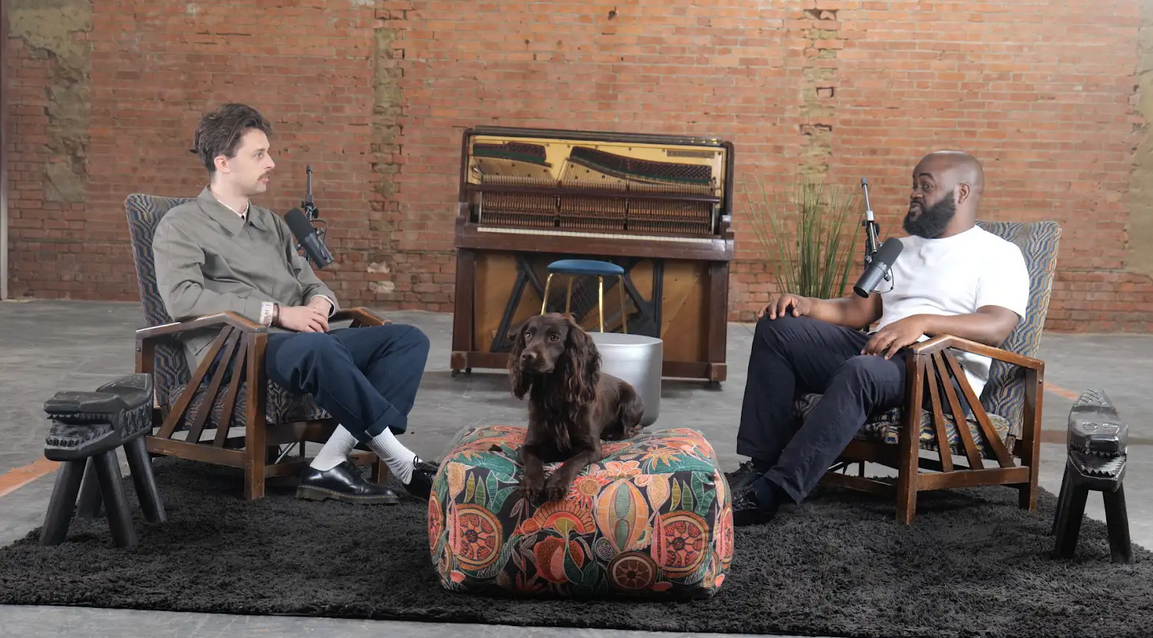
See the 'BBC Children in Need' podcast setup used by Dr Julie from BBC at Finchley Studio (Lounge setup). Book this setup for your podcast
In highly competitive metropolitan media hubs, the demand for a professional Podcast studio london facility capable of delivering broadcast-quality audio alongside cinematic 4K visuals is unprecedented. This widespread "YouTube-fication" of digital media dictates that the low-resolution grain, inadequate lighting, and static webcams characteristic of early remote recordings are no longer commercially viable. Today, an elite Video studio london space must seamlessly integrate multi-camera 4K ecosystems, professional lighting grids, and intentional, aesthetically pleasing set design, all without compromising the rigorous acoustic integrity that defines top-tier audio production, as observed by Finchley Studios.
Within this high-stakes, visually unforgiving environment, the management of guest talent emerges as a critical operational variable. A pristine Recording studio london setup, regardless of its capital investment, is ultimately only as effective as the human performance it manages to capture. The necessity of headphone monitoring for guests is frequently misunderstood by laypersons, who often view the equipment merely as a stylistic cliché, a prop utilized to project a veneer of professionalism, or an unnecessary encumbrance, according to Wantek. In reality, the deployment of high-fidelity monitoring equipment is profoundly utilitarian. It serves as a silent, vigilant partner in the intricate dance of audio creation, acting as the primary mechanism for real-time quality control per Wantek.
The industry-wide decision to standardize guest monitoring utilizing Beyerdynamic closed-back headphones is not a product of arbitrary preference. Rather, it is rooted in a complex confluence of acoustic physics, behavioral psychoacoustics, ergonomic endurance, and a century of historical reliability in broadcast engineering. As any premium London podcast studio scales its operations to accommodate high-profile guests, the deployed hardware must facilitate a seamless, distraction-free environment. This hardware must actively enhance vocal performance while strictly mitigating catastrophic technical liabilities, including audio bleed, phase cancellation, and acoustic feedback loops, as outlined by Wantek.

Finchley Studio (Dialogue set): book this setup for your podcast
The Psychoacoustics and Physiology of Guest Monitoring
The human voice is continuously regulated by internal and external auditory feedback loops. When individuals speak, they hear their own voice through a combination of air conduction (sound waves traveling from the mouth to the ear) and bone conduction (vibrations traveling through the skull). In a treated recording environment, introducing a microphone disrupts this natural equilibrium. When guests cannot clearly hear how their voice is being electronically translated and captured, natural physiological responses dictate an unpredictable alteration in speaking volume, pitch, and cadence, a phenomenon explained by Podlad. This phenomenon elucidates precisely why headphone monitoring is a non-negotiable protocol in any professional production facility.
Vocal Regulation, Plosives, and the Proximity Effect
Without the benefit of real-time auditory feedback, untrained guests frequently exhibit exceptionally poor microphone technique as noted by SportsEpreneur. This poor technique typically manifests in two extremes: either the guest leans too far back from the capsule, resulting in a thin, distant, and hollow vocal capture plagued by a poor signal-to-noise ratio, or they crowd the capsule excessively, per SportsEpreneur. Crowding the microphone exacerbates a phenomenon known as the proximity effect and introduces severe low-frequency distortion and plosive strikes, according to Podlad.
The proximity effect is particularly prominent in directional cardioid and hyper-cardioid microphones, which are typically utilized in a recording studio to reject off-axis room noise, as detailed by Jason Sanderson. As a sound source moves closer to a directional diaphragm, the low-frequency bass response is artificially and exponentially boosted, per Jason Sanderson. Furthermore, close proximity increases the vulnerability of the microphone to plosives-the explosive bursts of air pressure generated by hard consonant sounds such as 'p' and 'b', as explained by Jason Sanderson. Acoustic diagnosticians often demonstrate this physical force by having individuals place a hand in front of their mouth while repeating phrases like "peanut butter"; the sheer velocity of the expelled air is sufficient to overload a microphone capsule if not properly managed, according to Jason Sanderson.
When guests are equipped with high-resolution closed-back headphones, they are instantly integrated into a real-time, zero-latency feedback loop. This auditory mirror allows them to hear exactly how their physical spatial relationship with the microphone translates into the electronic audio mix, as observed by Wantek. Consequently, a profound psychological shift occurs: guests unconsciously self-regulate, a fact supported by Rachel Corbett. If they lean too close and hear the overwhelming, muddy bass emphasis of the proximity effect, or the jarring, disruptive burst of a plosive strike, their auditory cortex signals an immediate physical correction, prompting them to naturally adjust their distance or speaking angle, as detailed by SportsEpreneur. This autonomic self-regulation prevents digital clipping and distortion at the source, preserving the dynamic range of the recording and drastically reducing the need for aggressive, destructive equalization or dynamic compression during post-production workflows.

Finchley Studio (Lounge set): book this setup for your podcast
Cognitive Isolation and the "In the Zone" Effect
The psychological impact of wearing headphones extends far beyond mere volume control and physical positioning. Audiences globally spend an average of four hours per day consuming audio media through headphones, and rigorous psychological research indicates that this medium exerts a significantly more powerful impact on listener perception, judgment, and behavioral immersion compared to external loudspeakers, according to UC San Diego. In a production setting, providing a guest with a dedicated, isolated monitoring feed leverages this exact psychological phenomenon to enhance performance.
By isolating the audio directly into the guest's ears, ambient room noise is suppressed, and the cognitive load required to focus on the conversation is substantially reduced. This acoustic isolation induces a powerful "in the zone" effect, anchoring the guest's attention entirely on the dialogue and the subject matter at hand. Furthermore, in multi-speaker panel setups or dynamic co-hosted shows, the headphone mix acts as an intimate conduit for a secret language of non-verbal auditory cues. The heightened clarity provided by studio-grade transducers allows participants to detect the most subtle inhalations, changes in breath, or preparatory mouth sounds, signaling that another speaker is preparing to interject. This acoustic intimacy fosters a natural, overlapping, and highly dynamic conversational flow that is nearly impossible to replicate when participants are forced to rely solely on the unpredictable acoustics of an open room, as noted by Wantek.
Mitigating Latency and Managing Remote Feedback Loops
The modern Video studio ecosystem frequently incorporates complex hybrid workflows, bridging in-person hosts with remote guests via digital communication platforms such as Riverside, Zoom, or Zencastr, as observed by SportsEpreneur. In these scenarios, audio latency is an unavoidable physical reality dictated by network routing, server processing, and geographic distance, per Wantek.
If a local guest in a london Video studio is not wearing headphones, the delayed audio of the remote participant playing through external studio monitors will inevitably bleed into the local highly sensitive microphones. This routing error creates a devastating audio feedback loop or a highly distracting, delayed echo. Because the local microphone captures both the local host's voice and the delayed remote audio simultaneously, the resulting track is fundamentally compromised; it is physically impossible to isolate and remove the echo in post-production without severely degrading the primary vocal track of the host, according to Reddit Users.

Finchley Studio (CEO Set): book this setup for your podcast
The deployment of closed-back headphones completely eliminates this vector for technical failure. By sequestering the incoming remote audio entirely within the sealed ear cups of the local participants, the studio microphones are left to capture only the pure, isolated local dialogue. Furthermore, hearing the remote guest with absolute clarity and zero room interference allows local hosts to adapt immediately to minor network delays, consciously pacing their responses to prevent the awkward over-talking, accidental interruptions, and dead-air silences that persistently plague amateur hybrid recordings.
Acoustic Imperatives: The Physics of Bleed and Isolation
The primary acoustic mandate of any professional London recording studio facility is the rigorous optimization of the signal-to-noise ratio. Every single microphone active in a recording space acts as a potential liability, capable of capturing unwanted acoustic reflections, room reverberation, or sound originating from external, unintended sources, as explained by YouTube Creators. Therefore, controlling the acoustic environment requires not only specialized wall treatments but specialized personal monitoring hardware.
Finchley Studio (The Brick Studio): book this setup for your podcast
The Necessity of Closed-Back Architecture
Within the realm of professional audio, headphones are broadly categorized into three distinct architectural designs: open-back, semi-open, and closed-back, per Beyerdynamic. While open-back headphones are universally revered by mastering engineers for their natural, uncompressed, and expansive soundstage-making them ideal for evaluating and refining final mixes-they are fundamentally incompatible with live vocal tracking, according to YouTube Creators.
Open-back designs feature perforated or entirely exposed ear cup housings that allow air and sound waves to pass freely through the driver unit, as outlined by Beyerdynamic. If a guest or vocalist wears open-back headphones, the audio they are monitoring-whether it is a backing track, a remote caller's voice, or a rhythmic click track-will inevitably project outward and bleed directly into the highly sensitive condenser or dynamic microphones positioned mere inches from their face, according to YouTube Creators. This bleed creates severe phase cancellation issues and compromises the integrity of individual multitrack recordings, rendering them incredibly difficult to edit or process independently, as noted by Wantek.
Consequently, closed-back headphones are a strict, non-negotiable requirement for guest monitoring in any live recording environment, a standard detailed by Abbey Road. The Beyerdynamic DT 770 Pro features a robust, acoustically sealed closed-back design that provides exceptional passive noise isolation, per Beyerdynamic North America. The housings of the ear cups are completely closed, utilizing dense polymers and internal acoustic baffling to severely attenuate both incoming ambient noise and outgoing monitor mixes, according to Beyerdynamic North America. This impenetrable acoustic barrier ensures that even when the monitoring volume is pushed to exceptionally high levels-which is often necessary for hosts and producers to hear subtle audio imperfections or low-level background hums-the sound does not leak into the microphone capsule, as observed by Wantek.
Translating the Abbey Road Standard to the Podcast Studio
The stringent requirement for closed-back monitoring is a universal standard across the global audio engineering discipline, scaling seamlessly from the smallest independent podcast studio to the most prestigious, historically significant facilities in the world. At Abbey Road Studios in London, closed-back tracking headphones are standard issue for all live recording and vocal overdubbing sessions. Legacy models such as the Beyerdynamic DT 100, the DT 150, and the Sony MDR7506 are routinely utilized precisely because they provide the necessary acoustic seal required to protect the integrity of the studio's world-class microphone collection, according to Abbey Road.

The philosophy of spatial monitoring has evolved so significantly over the past decade that advanced psychoacoustic modeling technologies have been developed to bridge the gap between headphone monitoring and physical room acoustics. For example, the Waves Nx Abbey Road Studio 3 plugin was engineered in close collaboration with Abbey Road to simulate the precise acoustic environment of their flagship Studio 3 control room entirely within a pair of headphones, as reported by Waves Audio. Utilizing state-of-the-art psychoacoustic modeling of human hearing and Nx HeadTracker technology, the software creates a natural, immersive, three-dimensional sound field that responds dynamically to the user's head movements, per the Waves Audio PDF.
This technology underscores the critical role that a neutral, predictable headphone response plays in modern audio production. When guests are provided with high-end closed-back headphones like the Beyerdynamic DT 770 Pro, they are essentially being given an acoustically treated micro-environment, as detailed in the Waves Audio PDF. This controlled environment shields their monitoring experience from the unpredictable variables of the physical room, ensuring that what they hear is an accurate, uncolored representation of the digital audio signal, according to the Waves Audio PDF.
A Century of Electroacoustic Legacy: The Beyerdynamic Lineage
The overwhelming dominance of Beyerdynamic in professional audio circles is not an aggressive modern marketing triumph, nor is it a temporary trend driven by influencer endorsements. Rather, it is a legacy built upon a full century of rigorous, uncompromising German electroacoustic engineering. Understanding why these specific headphones populate the desks of almost every premium recording studio london facility requires a deep examination of their historical integration into global broadcast infrastructure.
The Origins of Dynamic Transducers (1924-1960)
The foundation of modern headphone technology can be traced back to 1924, when Eugen Beyer founded the "Elektrotechnische Fabrik Eugen Beyer" in Berlin. Initially fascinated by the emerging medium of cinema, Beyer dedicated his early career to the development and production of cinema loudspeakers, seeking to bring moving images to life with unprecedented acoustic fidelity.
However, the rapid expansion of the public broadcasting and radio revolution in the 1930s prompted a pivot that would change audio history. In 1937, Beyerdynamic introduced the DT 48, recognized as the world's first dynamic headphone. The "DT" nomenclature, standing for "Dynamic Telephone," became a foundational standard in early radio communications, as noted by Vintage King. The engineering of the DT 48 was so fundamentally sound and ahead of its time that the model remained in continuous production for an astounding 75 years-surviving a temporary halt during World War II when the company's factory and machinery were destroyed-making it arguably the longest-running headphone model in human history, finally ceasing production in 2012, as reported by Polar UK.
As the company rebuilt and relocated its headquarters to Heilbronn in 1960, its product portfolio expanded to meet the demands of a rapidly globalizing music and broadcast industry. Beyerdynamic microphones became the tools of choice for the world's most iconic artists; the E 1000 was chosen as the exclusive microphone for The Beatles' 1966 German "Blitztournee" tour, while the newly developed M 88 directional microphone became a favorite of Queen and was the exclusive microphone utilized for Queen Elizabeth II's royal visit to Australia in 1963, according to Polar UK.
The Reign of the DT 100 in Broadcast (1965-1985)
As the television and film broadcasting industries matured, the logistical need for indestructible, reliable field and studio monitoring led to the creation of the Beyerdynamic DT 100 in 1965. The DT 100 rapidly became the undisputed workhorse of the British Broadcasting Corporation (BBC) and broader UK television and film production throughout the late 20th century, a legacy explored on YouTube.
Recognized instantly by its blocky, highly utilitarian, and unabashedly industrial aesthetic, the DT 100 was valued for three distinct attributes: superb vocal isolation, high impedance suitability for massive broadcast consoles, and unparalleled mechanical durability. The closed-back design provided the isolation necessary for camera operators standing next to roaring crowds or loud film sets, as noted on YouTube. Crucially, every single component of the DT 100 was modular and user-replaceable, per YouTube. This design philosophy allowed studio technicians to quickly repair broken units rather than replacing entire headsets-a financial and operational philosophy that endeared the brand to facility managers who prioritized cost-efficiency, sustainability, and maximum uptime, according to YouTube.
The Evolution to the DT 770 Pro
Building upon the rugged DNA and modular reparability of the DT 100, Beyerdynamic sought to refine the acoustic signature for the burgeoning high-fidelity studio market. In 1985, they introduced the DT 770 PRO (closed-back) and DT 990 PRO (open-back) studio headphones.
The DT 770 Pro introduced a highly refined acoustic signature characterized by a diffuse-field equalized frequency response, setting the studio standard for the next forty years. It retained the tank-like build quality of its predecessors while delivering an analytical sound profile that engineers could trust blindly, according to Major HiFi. Today, the Beyerdynamic DT 770 Pro is globally recognized as one of the best-selling and most ubiquitous studio headphones in existence, routinely taking the number one spot in comparative analyses of professional tracking headphones, as seen on YouTube.
For a modern london Video studio, adopting the Beyerdynamic DT 770 Pro is not a matter of following a contemporary trend; it is a deliberate continuation of this historical legacy. It signals a commitment to broadcast-grade reliability, leveraging a century of German electroacoustic engineering that has been brutally stress-tested in the most demanding live recording environments on earth.
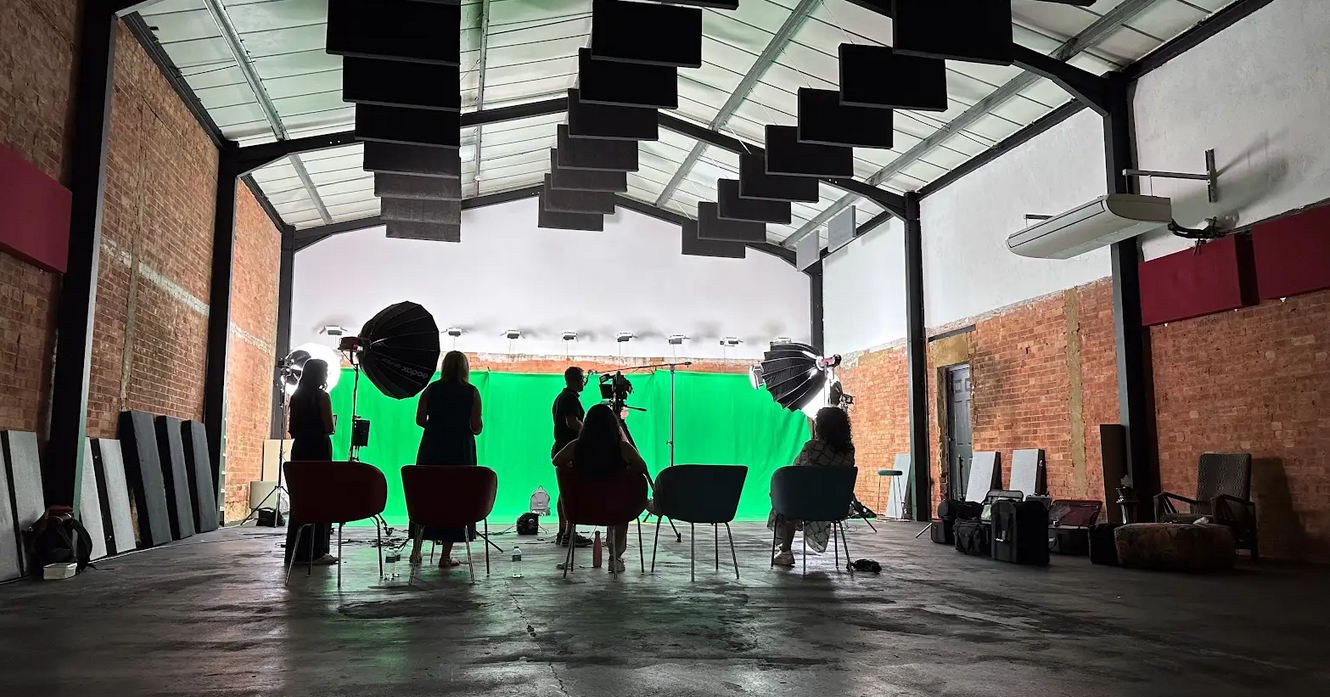
Finchley Studio (Giant Green Screen): book this setup for your podcast
Anatomical and Acoustic Breakdown: The DT 770 Pro
The selection of the Beyerdynamic DT 770 Pro as the primary guest monitoring tool in high-end facilities is justified by a rigorous, scientific examination of its anatomical design and acoustic performance. A professional studio requires hardware that perfectly balances analytical sound reproduction with extreme ergonomic comfort capable of withstanding marathon recording sessions.
Acoustic Signature and the V-Shaped Frequency Response
The DT 770 Pro is engineered specifically for critical music and sound monitoring, delivering a neutral listening environment characterized by a notoriously analytical and rapid impulse response, per Beyerdynamic North America. Unlike mass-market consumer headphones that arbitrarily boost mid-bass frequencies to create a muddy, artificial "warmth," the DT 770 Pro is clinically precise. The acoustic signature exhibits a slight "V-shaped" frequency response curve, according to Audio46. Ultra-low sub-bass sounds are defined, extended, and reproduced crisply without bleeding into the lower mid-range, while the high frequencies are translated into an analytical, highly differentiated sound profile, as described by Beyerdynamic North America. This specific tuning-characterized by powerful bass and highly detailed treble reproduction-is immensely advantageous for live vocal monitoring, according to Beyerdynamic North America.
The detailed treble response allows guests and audio engineers to clearly identify sibilance (the harsh, piercing 's' and 'sh' sounds) and subtle mouth clicks in real-time, per Podlad. When a guest hears this sibilance accurately reproduced, they are prompted to adjust their delivery or slightly alter their angle of address relative to the microphone capsule, according to Podlad. Simultaneously, the defined, distortion-free low-end allows the host to accurately monitor the proximity effect, ensuring their voice maintains authority without dissolving into muddy distortion, as noted by Jason Sanderson. Furthermore, despite its closed-back architecture, the DT 770 Pro achieves an excellent sense of spatiality and high transparency, preventing the claustrophobic, "in-the-head" auditory sensation that plagues cheaper monitoring solutions, according to Beyerdynamic North America.
Ergonomics, Thermal Dynamics, and Clamping Force
The industry shift toward long-form, unscripted conversational content-where podcast episodes routinely run for two to three hours per session-places an immense premium on the physical comfort of the talent. If a guest experiences excessive clamping fatigue on their temporomandibular joint, or thermal discomfort from their ear pads, their cognitive focus degrades, immediately negatively impacting the flow and quality of the conversation, as observed by Wantek.

Finchley Studio (CEO Set): book this setup for your podcast
The Beyerdynamic DT 770 Pro addresses these ergonomic challenges through a meticulously engineered chassis. The headphones feature large, circumaural ear cups that completely enclose the ear, distributing the necessary clamping force evenly across the skull rather than resting painfully on the sensitive cartilage of the pinna, per Beyerdynamic North America. The flexible spring steel temple construction ensures a secure acoustic seal without applying excessive lateral pressure, making the headset suitable for a vast variance in human head sizes, according to Beyerdynamic North America.
Crucially, the ear pads on the standard studio models are constructed from a breathable, plush silver-grey velour, rather than non-porous synthetic leather or cheap pleather, detailed by Beyerdynamic North America. Velour is vastly superior for thermal dissipation. In a Video studio london setting, talent is frequently seated under hot, high-intensity LED film lights for hours. Velour prevents the uncomfortable accumulation of sweat and heat around the ears, maintaining a comfortable micro-climate that allows the guest to forget they are wearing hardware at all, according to Audio46.
The Impedance Triangle: Matching Hardware to Infrastructure
A critical technical consideration when deploying the DT 770 Pro across a studio network is impedance matching. Impedance, measured in ohms ( $\Omega$ ), denotes the electrical resistance the headphone's voice coils present to the audio amplifier, as noted by Beyerdynamic North America. Beyerdynamic strategically manufactures the DT 770 Pro in three distinct impedance variants to suit drastically different amplification environments: 32 ohms, 80 ohms, and 250 ohms, according to Beyerdynamic North America.
If a studio manager incorrectly specifies the 250-ohm variant for a standard podcast setup utilizing bus-powered USB interfaces, the headphones will be severely underpowered, as warned on Reddit. An underpowered 250-ohm driver will not only lack adequate volume for the guest to hear themselves over their own bone conduction, but more importantly, it will fail to deliver the correct rated frequency response, resulting in anemic bass and brittle highs, according to Reddit.
Conversely, the 80-ohm variant represents the perfect acoustic and electrical compromise for the modern London podcast studio, as suggested on Reddit. An 80-ohm driver can be effortlessly driven to authoritative volume levels by the integrated headphone preamps found in popular devices like the RØDECaster Pro or the Audient iD14 mk ii without introducing distortion, per Reddit. Additionally, the 3.0-meter straight cable of the 80-ohm model is highly practical in a video podcast setting; it allows the cable to be neatly routed under a desk, minimizing visual clutter and keeping it safely out of the 4K camera frame, as noted by Beyerdynamic North America. In contrast, the heavy, tension-inducing coiled cable of the 250-ohm version can pull on the guest's head and create unsightly, tangled visual artifacts on camera, according to Beyerdynamic North America.

Finchley Studio (Lounge set): book this setup for your podcast
Next-Generation Transducer Technology: The PRO X Series
While the DT 770 Pro remains the ubiquitous, unassailable standard, the relentless pursuit of audio perfection in the premium studio market has paved the way for the next generation of monitoring hardware. Recognizing the evolving needs of modern creators working across diverse, highly mobile, and visually scrutinized studio environments, Beyerdynamic recently expanded its portfolio with the PRO X series, as detailed by Vintage King.
The STELLAR.45 Driver Architecture
The introduction of the DT 700 Pro X (closed-back) and the centennial anniversary DT 770 Pro X Limited Edition represents a significant, highly technical leap in electroacoustic transducer technology, according to Major HiFi. The beating heart of this evolution is the proprietary, newly developed STELLAR.45 driver, meticulously manufactured and automated at the Heilbronn facility to ensure exceptionally high quality and unit-to-unit consistency, per the Beyerdynamic Blog.
The STELLAR.45 transducer achieves its remarkable efficiency through the utilization of a top-class N52 neodymium-iron-boron (NdFeB) magnet, according to the Beyerdynamic Blog. Thanks to the microscopic precision of the magnetic gap size and the extraordinary quality of the NdFeB material, a magnetic field strength greater than one Tesla is generated entirely within the gap, per the Beyerdynamic Blog. The voice coil, constructed from lightweight copper-clad aluminum wire, is precisely positioned in the exact center of this intense magnetic field, enabling lightning-fast, highly uniform oscillation of the membrane, as observed by users on Reddit.
Furthermore, the diaphragm itself has been revolutionized. Departing from the traditional PET plastics used in legacy headphone transducers, the STELLAR.45 utilizes a PEEK (Polyetheretherketone) polymer foil, per Reddit. PEEK is an advanced, high-performance engineering thermoplastic that is significantly stiffer, lighter, and more structurally robust than PET, according to Reddit. This stiffness, combined with an integrated damping structure and specialized ribbing, completely prevents the uncontrolled compression and physical buckling of the membrane at high deflections, as noted on Reddit. The result is a resonance-free, incredibly precise high-frequency reproduction and a distortion-free bass response, even when the drivers are subjected to extreme volume levels, according to Reddit.
Acoustic and Spatial Comparisons for Vocal Analysis
When audio engineers conduct $A/B$ testing between the legacy DT 770 Pro, the new DT 770 Pro X Limited Edition, and the DT 700 Pro X, subtle but highly impactful differences emerge that influence studio deployment strategies, as reported by Major HiFi.
The new STELLAR.45 driver operates at a highly versatile impedance of 48 ohms, according to Beyerdynamic North America. This optimized impedance ensures that the headphones are highly sensitive; they are capable of playing loudly and cleanly directly out of a laptop or consumer audio interface, yet they retain the microscopic transient detail required for critical mastering analysis out of high-end consoles, per Beyerdynamic North America.
Tonally, the DT 770 Pro X exhibits a slightly more pronounced V-shaped tuning compared to the flatter, highly neutral baseline of the original DT 770 Pro, as evaluated by Audio46. The sub-bass extension on the Pro X is incredibly defined and visceral, providing an intense depth that allows engineers to instantly catch problematic low-frequency rumble, such as HVAC noise, distant traffic, or a guest thumping the recording desk, according to Audio46.
However, for close-up vocal work and precise dialogue analysis, the DT 700 Pro X offers a distinct, measurable advantage in spatial imaging and isolation. The DT 700 Pro X features a completely modernized, sleeker chassis with a denser ear cup construction, providing superior passive noise isolation compared to its predecessors, as observed by Major HiFi. This dense construction yields a slightly more intimate soundstage with laser-focused spatial precision, according to Major HiFi. This pinpoint localization of sound makes the DT 700 Pro X an exceptional diagnostic tool for a producer monitoring a complex, multi-guest podcast. If a stray noise occurs in the room, the intimate soundstage allows the producer to rapidly and accurately identify exactly which microphone is picking up the anomaly, facilitating immediate correction, as detailed by Major HiFi.
Comparative Analysis: Beyerdynamic vs. the Competitive Landscape
The professional studio headphone market is highly competitive, with several manufacturers vying for dominance in the tracking and monitoring space. To fully understand the strategic preference for Beyerdynamic in London studios, it is necessary to contextualize its performance against its primary competitors, as reviewed by Resonate Recordings.
While the Audio-Technica ATH-M50x remains immensely popular for electronic music production, its heavily boosted bass response and tight, compressed soundstage make it less ideal for the nuanced analysis of spoken dialogue, according to Resonate Recordings. Furthermore, its high clamping force and synthetic leather pads quickly induce thermal and physical fatigue during long recording sessions, per Resonate Recordings. The Sony MDR-7506 is a legendary workhorse championed by engineers on tight budgets, but its bright, occasionally fatiguing high-end and thin ear pads cannot match the luxurious comfort of the DT series for guests, as discussed on Reddit.
The Rode NTH-100 represents a formidable modern alternative, offering innovative cooling gel ear pads and a very flat, neutral response, evaluated on YouTube. However, the Beyerdynamic DT 770 Pro's wider soundstage, proven decades-long track record of physical durability, and the analytical clarity provided by its treble response ensure it remains the incumbent standard for critical vocal monitoring, as affirmed by Beyerdynamic North America.
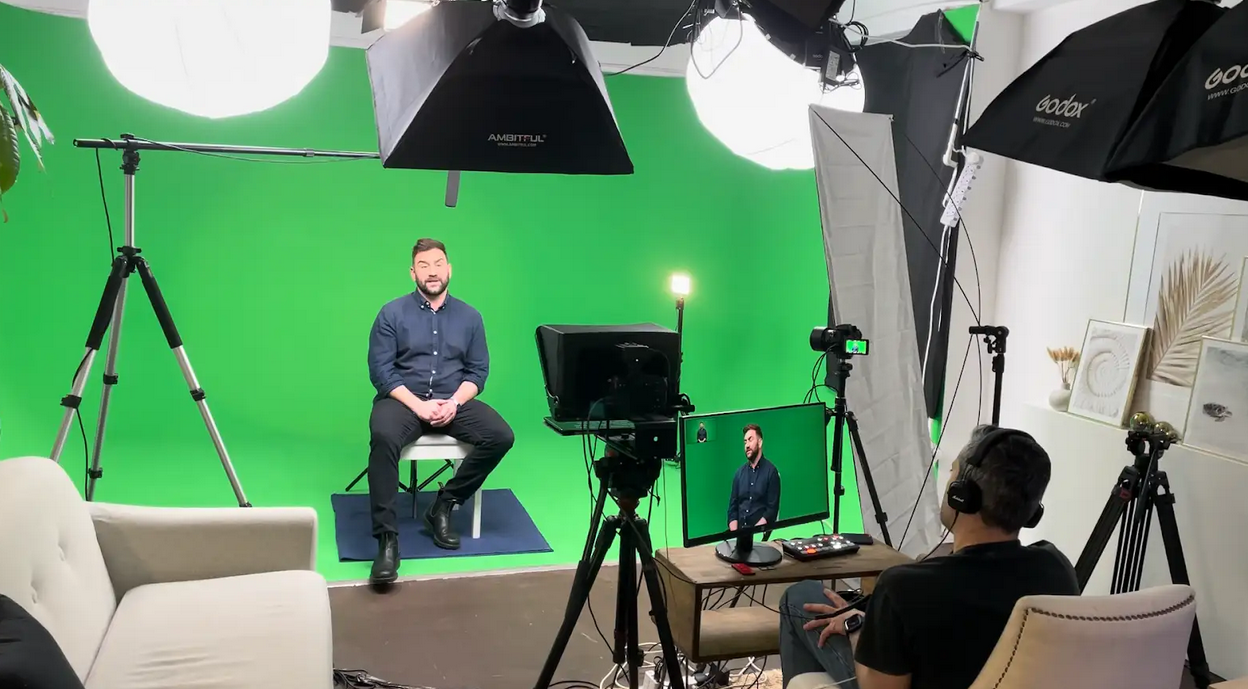
Finchley Studio (Green Screen Cove): book this setup for your podcast
The Visual Ecosystem: Integrating Audio Gear in a 4K Video Studio
The transition from purely auditory consumption to highly visual, algorithm-driven platforms like YouTube and TikTok has dictated that every single piece of equipment in a studio is now, essentially, a set prop. A modern London podcast studio is no longer evaluated solely on its acoustic treatment and audio fidelity; it is judged ruthlessly on its visual aesthetic, lighting design, and the on-camera appearance of its hardware.
Broadcast Compliance and Visual Aesthetics
Top-tier production facilities across the capital-such as Finchley Studios, TYX Studios, Premiere Podcast Studios, and Outset Studio-are equipped with uncompromising cinema-grade 4K camera ecosystems. These studios utilize professional camera bodies like the Sony A7IV, Blackmagic Design 4K Cinema Cameras, and Panasonic GH5 Ils, paired with sophisticated, high-CRI LED lighting grids and dynamic set designs. Under the unforgiving scrutiny of these high-resolution lenses, consumer-grade gaming headsets, excessively branded equipment, or brightly colored, plasticky headphones immediately shatter the illusion of prestige and severely detract from the professional authority of the broadcast.
Beyerdynamic headphones, particularly the classic DT 770 Pro and the sleek, modernized DT 700 Pro X, boast a subdued, matte black, highly utilitarian aesthetic that translates flawlessly to camera, according to Major HiFi. The brushed metal yokes, the textured acoustic housings, and the silver-grey velour pads project an immediate image of serious, broadcast-compliant audio engineering, as seen on Beyerdynamic North America. They do not feature distracting, pulsing RGB lighting, aggressive geometrical designs, or obtrusive corporate logos, per Major HiFi. This intentional visual restraint ensures that the viewer's focus remains squarely where it belongs: on the talent, the facial expressions, and the substance of the conversation.
Equipment Synergy in Premium London Studios
A comprehensive analysis of the competitive landscape among premium London recording studio locations reveals a distinct, highly intentional synergy in equipment standardization. The selection of primary vocal microphones directly dictates the required caliber of the monitoring infrastructure.
In these elite environments, premium dynamic broadcast microphones like the Shure SM7B or the Rode Procaster are heavily favored for their excellent off-axis rejection, which helps eliminate room reverb and cross-talk between guests. However, dynamic microphones are notoriously gain-hungry and require meticulous, consistent mic technique from the talent to yield optimal results, as explained by RØDE.
The presence of high-fidelity Beyerdynamic headphones empowers the host and the audio producer to monitor the signal path with microscopic clarity. If a high-profile guest at TYX Studios drifts slightly off-axis from their highly sensitive Neumann microphone, or if a speaker at Finchley Studios unconsciously taps the desk and introduces low-frequency handling noise to the boom arm, the producer-monitoring through a neutral, closed-back headset like the DT 700 Pro X-can detect the anomaly immediately. This real-time detection allows the producer to halt the recording, correct the guest's posture or technique, and restart the take before invaluable, unrepeatable dialogue is permanently ruined by technical artifacts.
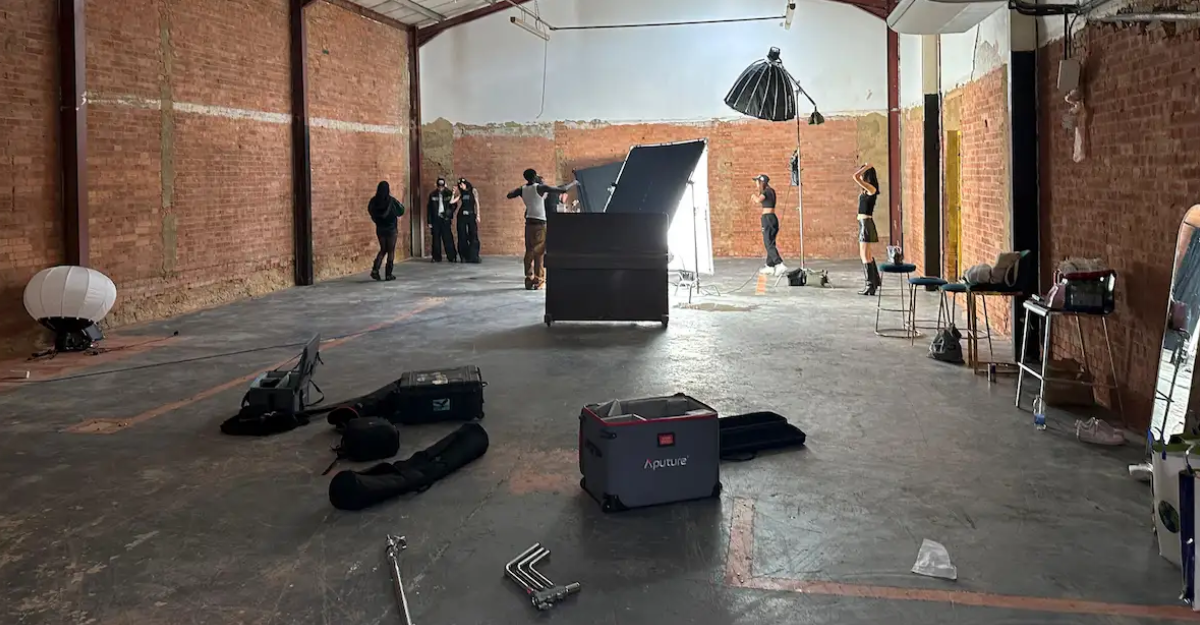
Finchley Studio (The Brick Studio): book this setup for your podcast
Operational Reliability: The Economics of Modularity
A commercial Recording studio london operates under intense, relentless utilization rates. Studio hardware is subjected to daily, extreme physical stress: cables are inadvertently rolled over by heavy studio chairs, headbands are stretched to their absolute mechanical limits to accommodate diverse guest profiles, and delicate ear pads are constantly exposed to sweat, makeup, hair products, and skin oils. Mass-market consumer headphones are explicitly designed with planned obsolescence in mind, relying on glued chassis components and fragile internal wiring that render the entire unit disposable upon the failure of a single part.
Modularity as a Capital Asset
Beyerdynamic radically subverts this wasteful paradigm. Drawing directly from the indestructible architectural legacy of the 1960s DT 100, the modern DT 770 Pro line is fundamentally and aggressively modular, as seen on YouTube. Almost every single structural and acoustic component-the velour ear pads, the internal acoustic foam baffles, the synthetic leather headband wrap, the plastic slider clips, and even the STELLAR.45 transducers themselves-can be purchased individually as spare parts and replaced with minimal technical expertise, per Beyerdynamic North America.
This extreme modularity fundamentally alters the economics of studio management, transforming the headphones from a rapidly depreciating, disposable consumable into a long-term, highly sustainable capital asset. When the plush velour ear pads inevitably become physically compressed, acoustically compromised, or unhygienic after months of daily guest use, a studio manager can easily snap on a fresh replacement pair for a fraction of the cost of a new headset, according to Beyerdynamic North America. This simple maintenance instantly restores both the critical acoustic seal required for isolation and the pristine, professional aesthetic required for the video studio cameras, as noted by Beyerdynamic North America. Furthermore, the vibrant, global modding and repair culture surrounding Beyerdynamic hardware ensures an abundance of third-party support, custom components, and schematic knowledge, allowing technicians to continually upgrade and salvage equipment, a community highlighted on Reddit.
The introduction of the PRO X series further refines this operational economics by addressing the single most common point of hardware failure in a studio environment: the cable, a point raised on Reddit. The PRO X models feature a fully user-detachable cable system utilizing a robust, locking 3-pin mini-XLR connector, per Beyerdynamic North America. This innovation effectively eliminates the need for specialized maintenance, such as soldering a broken internal wire. In a high-turnover Video studio london setting, the ability to instantly swap a damaged or crackling lead in a matter of seconds during a live session guarantees zero downtime, protecting the studio's schedule and the client's investment, according to Audio46.

Finchley Studio (Giant Green Screen): book this setup for your podcast
Synthesis: The Art of the Unnoticed
The highest compliment that can possibly be paid to professional studio equipment is that it remains entirely unnoticed by the talent utilizing it. The ultimate objective of any elite podcast studio is to capture the purest, most uninhibited expression of human dialogue and emotion. Technical friction-whether it manifests as the screech of acoustic feedback, the distracting echo of latency, uncomfortable clamping pressure on the jaw, thermal discomfort, or visually distracting, unprofessional hardware-pulls the guest out of the conversational flow and severely degrades the quality of the final broadcast product.
Beyerdynamic headphones, achieved through a unique synthesis of deep historical refinement, uncompromising acoustic engineering, and rugged physical modularity, systematically eliminate this technical friction. They provide an acoustically isolated, neutral, and highly detailed auditory mirror that instinctively, subconsciously guides guests toward better microphone technique while fiercely safeguarding the recording session against bleed, echo, and phase cancellation issues, as detailed by Jason Sanderson.
In the highly competitive, technically demanding, and visually scrutinized landscape of the modern London Video studio, the integration of precision monitoring tools like the DT 770 Pro and the next-generation PRO X series transcends mere subjective preference. It is a fundamental operational necessity. By ensuring that the auditory feedback loop is pristine, studios guarantee that when the 4K cameras roll and the broadcast microphones go live, the only thing the audience experiences is the uncompromised brilliance of the conversation.