Executive Summary: The Sonic Architecture of Authority
In the rapidly maturing landscape of digital media, where the barrier to entry for content creation has lowered but the bar for audience retention has skyrocketed, audio fidelity has emerged as the definitive marker of professional authority. While the visual component of the "video podcast" has captured the algorithmic attention of platforms like YouTube and TikTok, the fundamental connection between host and audience remains auditory. This connection is fragile; it is sustained by clarity, intimacy, and the absence of distraction. For production facilities and creators operating within the dense, cacophonous urban fabric of London, the challenge of achieving this broadcast-standard audio is not merely technical—it is architectural, strategic, and economic.
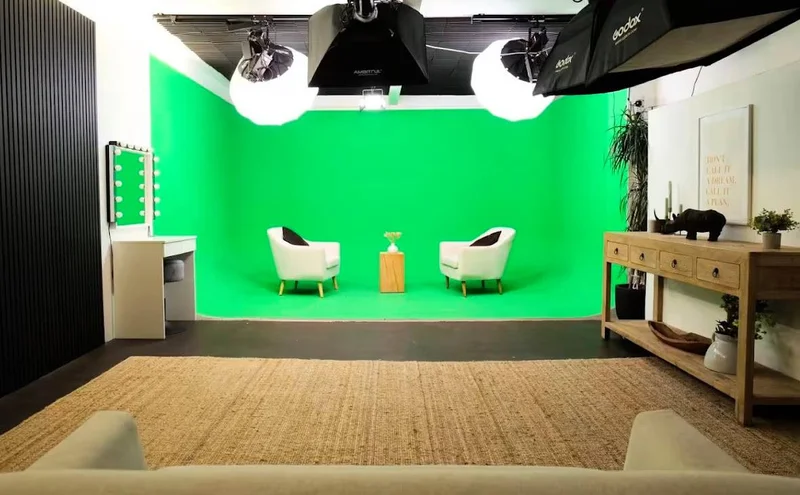
Finchley Studio (Dialogue set): book this setup for your podcast
This report, titled "Podcast Recording Strategic Analysis: Acoustic Treatment," serves as an exhaustive guide for brand managers, content creators, and business leaders seeking to navigate the complex acoustic terrain of London podcast production. It posits that acoustic treatment is not a commodity or a decorative after-thought but a critical infrastructure investment that directly correlates with listener trust and brand equity. When a listener puts on headphones, they are inviting the host into their inner monologue. If that invitation is met with the harsh fatigue of digital artifacts, room echo, or the subterranean rumble of the Northern Line, the relationship is severed.
We will explore the physics of sound in the context of the London soundscape, dissect the difference between isolation and treatment, and analyze the economic friction between constructing a high-end home studio versus the strategic utilization of a professional recording studio for studio hire London. By examining the convergence of aesthetics and acoustics in the era of the video podcast, we aim to demonstrate why the "invisible set"—the sound of the room itself—is the most valuable asset in modern media production.
1. The London Acoustic Landscape: A Strategic Adversary
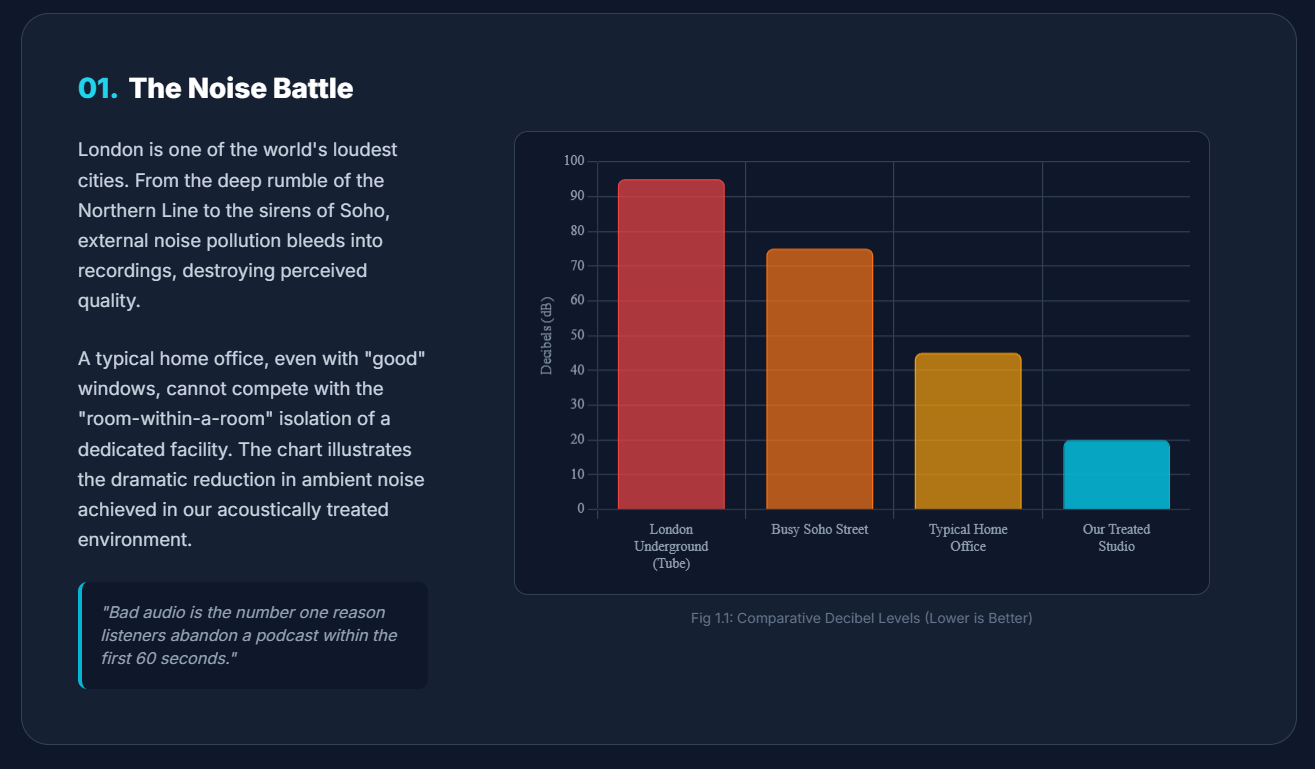
To understand the necessity of advanced acoustic treatment, one must first quantify the adversary. Audio production in London does not exist in a vacuum; it exists in a constant, defensive battle against one of the most aggressive noise environments in the world. The city’s acoustic fingerprint is a chaotic overlay of centuries-old infrastructure, heavy subterranean transport, and unrelenting surface density.
1.1 The Physics of the "London Rumble"
The term "London Rumble" is not merely colloquial; it describes a specific spectral phenomenon common to the London basin. It is characterized by high-amplitude, low-frequency energy, typically situated between 30 Hz and 100 Hz. This energy is particularly insidious because of its mechanism of transmission: structure-borne vibration.
Unlike high-frequency sounds (like a whistle), which travel through the air and can be blocked by a double-glazed window, low-frequency energy travels through the ground. The London Underground network, particularly the deep-level tube lines (Northern, Central, Piccadilly), acts as a massive subterranean subwoofer. As trains push through the tunnels, they generate vibrational energy that couples with the surrounding clay and soil. This energy travels upwards through the pilings and foundations of buildings, exciting the structural frame.
For a podcast studio situated on the third floor of a building in Soho or Shoreditch, this manifests not as a hearable "train noise" but as a constant, low-level thrum. This vibration travels up the walls, across the floor, and up the microphone stand, where it is mechanically coupled to the capsule of the microphone. The result is a muddying of the vocal frequencies, eating up the "headroom" of the recording and forcing the engineer to use aggressive high-pass filters that rob the voice of its natural gravitas.
1.2 The Surface Noise Assault
Above ground, the challenges are equally formidable. London’s streetscape is defined by the "canyon effect," where tall buildings line narrow streets, trapping and amplifying traffic noise.
Heavy Goods Vehicles (HGVs) & Buses: The diesel engines of London’s bus fleet and delivery networks generate significant acoustic energy in the 60 Hz – 150 Hz range. This is the "chest" frequency of the human voice. When this noise bleeds into a recording, it cannot be removed without also removing the body and warmth of the speaker's voice.
Emergency Sirens: London's emergency services utilize sirens designed specifically to pierce through background noise. These operate in the 500 Hz to 3 kHz range—the exact frequencies responsible for speech intelligibility. A siren passing a recording studio during a take is often catastrophic, requiring a complete re-recording of the segment.
The Density Factor: In boroughs like Hackney or Westminster, party walls are shared. The "quiet" of a home studio is entirely dependent on the lifestyle of the neighbors. A washing machine on a spin cycle three floors away can transmit vibration through shared joists that is picked up by a sensitive condenser microphone as a rhythmic thumping.
1.3 Regulatory Context: The Noise Floor Targets
In professional acoustic engineering, spaces are graded using Noise Criteria (NC) curves. These standardized curves define the maximum allowable sound pressure level across the frequency spectrum for a given application.
Standard Office Environment: NC-40 to NC-50. Speech is audible, but background hum from computers and HVAC is omnipresent.
Typical Residential Room (London): NC-35 to NC-45. Variable based on traffic flow and time of day.
Broadcast Standard Studio: NC-15 to NC-20.
Achieving NC-20 in Central London is an engineering triumph. It requires reducing the ambient noise level to the threshold of human hearing. This "black canvas" of silence is essential for modern London podcast production. With the rise of compression standards for platforms like Spotify and Apple Podcasts, audio is mastered "loud." This mastering process involves raising the volume of the quietest parts of the signal. If the noise floor is high (e.g., NC-30), the mastering process will pull that background rumble up until it is audible, creating a subconscious strain on the listener.
2. Structural Defense: The Science of Isolation
A critical distinction must be made in this strategic analysis: Soundproofing (Isolation) is not Acoustic Treatment. This is the most common and costly error made by businesses attempting to build in-house studios.
Isolation prevents sound from entering or leaving the room. It is heavy, structural, and expensive.
Treatment controls how sound behaves inside the room. It is light, absorptive, and aesthetic.
For a professional video studio or podcast studio, isolation is the prerequisite. You cannot treat a room until you have isolated it from the London environment.
2.1 The Mass Law and the Limits of "Heavy"
The fundamental principle of isolation is the Mass Law. It dictates that to reduce sound transmission, one must increase the mass of the barrier. A brick wall stops more sound than a drywall partition. However, the Mass Law has diminishing returns. To double the sound reduction, you must effectively quadruple the mass. In a London office or apartment, structural loading limits prevent simply building 1-meter thick concrete bunkers.
Furthermore, mass alone fails to stop the structure-borne vibration of the "London Rumble." A heavy concrete wall will still vibrate if it is rigidly connected to a vibrating foundation. The vibration passes through the solid material like electricity through a wire.
2.2 The "Room-Within-a-Room" Methodology
To overcome the limits of mass, professional studio hire London facilities utilize a "Room-within-a-Room" (decoupled) construction methodology. This is the gold standard of acoustic isolation and involves building a completely independent inner structure that "floats" inside the host building.
The Floating Floor
The most complex and critical element is the floor. To stop the 30 Hz rumble of the Tube, the studio floor cannot touch the subfloor.
Resilient Mounts: The floor is constructed on top of acoustic isolation pucks or springs (such as those made by companies like Mason Industries or Farrat). These mounts are tuned to a specific resonant frequency, usually around 7-10 Hz.
The Air Gap: These mounts create a physical air gap between the building's slab and the studio floor.
Mass Layer: On top of the mounts, a heavy layered floor is built, often using high-density particle board, cement board, or even a poured concrete slab (if structural loading allows).
The Result: When the building vibrates from a passing train, the energy hits the isolation mounts. The mounts compress and expand, dissipating the energy as minute amounts of heat, rather than transmitting it to the studio floor. The studio effectively "hovers" above the vibration.
Independent Walls and Ceilings
The walls of the studio are built upon this floating floor. They are framed independently and do not touch the structural walls of the building.
De-coupling Clips: Where connection to the main structure is unavoidable (for stability), resilient channels or isolation clips (like RSIC-1 clips) are used. These clips use rubber grommets to break the path of vibration.
Damping Compounds: Between layers of high-density acoustic plasterboard (Soundbloc), damping compounds like Green Glue are applied. Green Glue is a viscoelastic polymer. When sound waves hit the wall, they cause the layers of plasterboard to shear (slide) against each other. The Green Glue resists this shearing movement, converting the mechanical energy of the sound wave into heat. This dramatically improves the low-frequency isolation performance of the wall without adding excessive weight.
2.3 The HVAC Paradox: Breathing in Silence
The hermetic sealing of a "box-in-box" studio creates a physiological hazard. A recording space must be airtight to be soundproof, but it must be ventilated to support human life and equipment function. Humans expel CO2 and heat; high-end video production PCs and LED lighting rigs generate significant thermal loads.
The strategic challenge is to introduce large volumes of fresh air (and remove stale, hot air) without letting sound travel through the ductwork. A standard office air conditioning system is catastrophic for a studio; the high-velocity air creates turbulence (hiss) at the vent, and the metal ducts act as speaking tubes, carrying noise from the rooftop plant directly into the microphone.
The HVLV Solution
Professional recording studio facilities employ High Volume, Low Velocity (HVLV) systems.
Velocity Limits: To prevent air turbulence noise, the air speed at the supply grille must be kept below 300 feet per minute (FPM), and ideally closer to 150 FPM for broadcast critical work.
Oversized Ductwork: To move enough air to cool a room full of equipment at such low speeds, the ducts must be massive—often 2 to 3 times the cross-sectional area of standard ducts. This consumes valuable ceiling height and real estate.
Acoustic Silencers (Attenuators): The air is routed through "baffle boxes" or "dead vents." These are large, serpentine chambers lined with acoustic absorption material. As the sound travels through the curves of the box, it is forced to reflect against the soft lining, which absorbs the acoustic energy. By the time the air reaches the studio, the noise of the fan motor has been extinguished, leaving only a silent, gentle breeze.
This complex integration of structural engineering and fluid dynamics illustrates why London podcast production at a professional level carries a premium. The client is not paying for the room; they are paying for the invisible engineering that makes the room disappear.
3. Internal Acoustic Control: The Art of the Signal
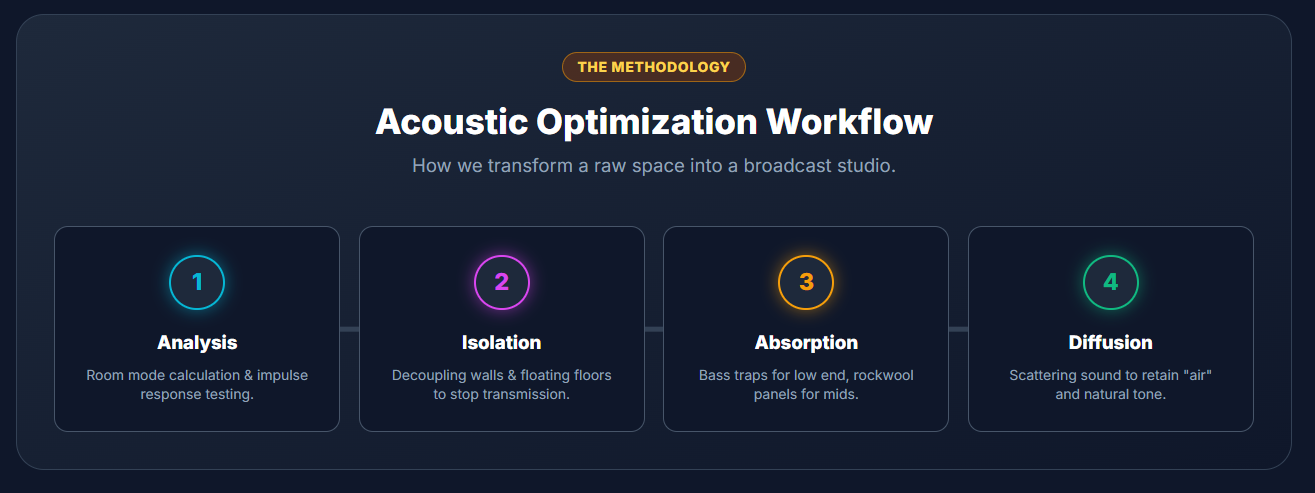
Once the fortress of isolation is built, the strategic focus shifts to the interior. An isolated concrete box is acoustically disastrous; it is a reverberant chamber where sound bounces endlessly, creating a wash of noise that destroys speech intelligibility. Acoustic treatment is the science of controlling these reflections to create a sound that is authoritative, clear, and pleasing.
3.1 Reverberation Time (RT60) and Intelligibility
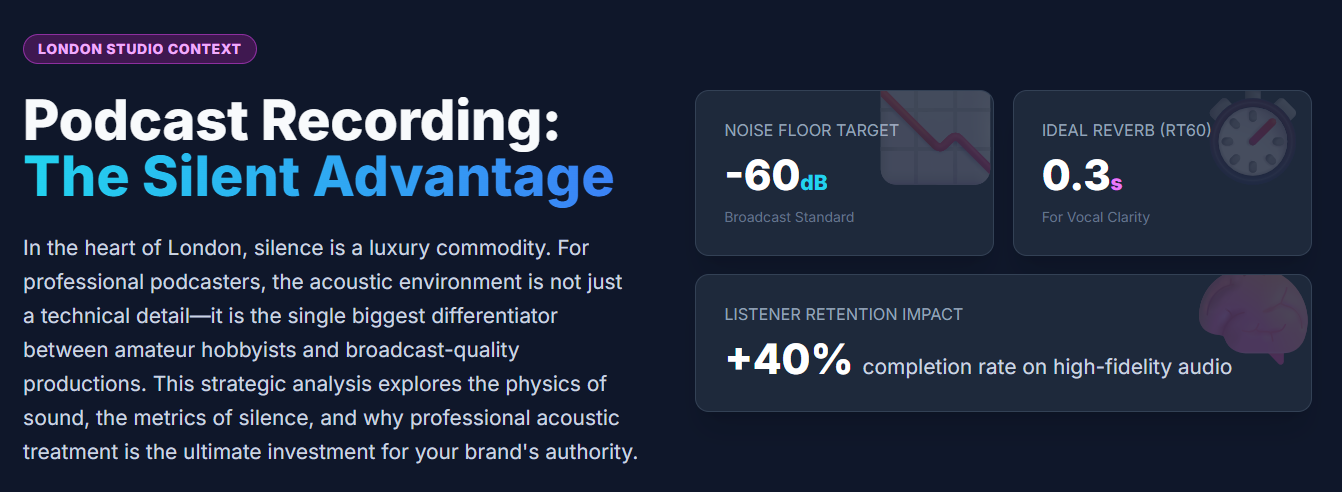
The primary metric for internal acoustics is Reverberation Time (RT60). This is defined as the time required for a sound impulse to decay by 60 decibels after the source has stopped.
The Cathedral Effect: A large stone church might have an RT60 of 4 to 8 seconds. This is majestic for a choir but unintelligible for speech. The syllables run into each other; "strategic analysis" becomes a blur of sibilance and vowels.
The Bathroom Effect: A tiled bathroom typically has an RT60 of 0.8 to 1.5 seconds, but with harsh, high-frequency reflections. This is the "amateur" sound often heard in Zoom calls or kitchen recordings.
The Podcast Target: For spoken word audio, the target RT60 is typically between 0.2 and 0.4 seconds.
The Speech Frequencies
Strategic analysis of speech intelligibility reveals that the most critical information is contained in the consonant sounds (k, p, t, s, f). These sounds are transient (short) and high-frequency (typically 2 kHz to 8 kHz). If the room has a long reverberation time in these frequencies, the "tail" of the previous vowel will wash over the delicate consonant of the next word. This phenomenon, known as spectral smearing, forces the listener's brain to work harder to decode the speech.
The Fatigue Factor: When the brain has to actively filter noise and reconstruct smeared speech, cognitive load increases. This leads to "listener fatigue." In a podcast context, listener fatigue manifests as a drop-off in retention rates. The listener may not consciously know why they are annoyed or tired, but they will stop listening.
Strategic Insight: Acoustic treatment is a retention strategy. By lowering the noise floor and tightening the RT60, you reduce the cognitive load on the audience, allowing them to engage with the content for longer durations.
3.2 The Three Pillars of Treatment
To achieve the desired RT60 and a balanced frequency response, a professional podcast studio employs three distinct types of acoustic tools.
A. Broadband Absorption (The Sponge)
Absorbers are porous materials that allow air particles to enter but restrict their movement. As the sound wave tries to push air through the fibers of the material, the friction converts the acoustic energy into minute amounts of heat.
Materials: The industry standard is high-density mineral wool (such as Rockwool RW3 or Owens Corning 703) or rigid fiberglass. These are vastly superior to the ubiquitous "acoustic foam" sold on Amazon. Foam is often too light and porous to absorb lower-mid frequencies, leading to a room that sounds "thin" or "boxy" (absorbing the highs but leaving the mud).
Placement: Absorbers are placed at "First Reflection Points." These are the specific spots on the walls and ceiling where sound travels directly from the speaker's mouth to the wall and then to the listener's ear or microphone. Treating these points removes the immediate, distracting "slap echo."
B. Bass Trapping (The Foundation)
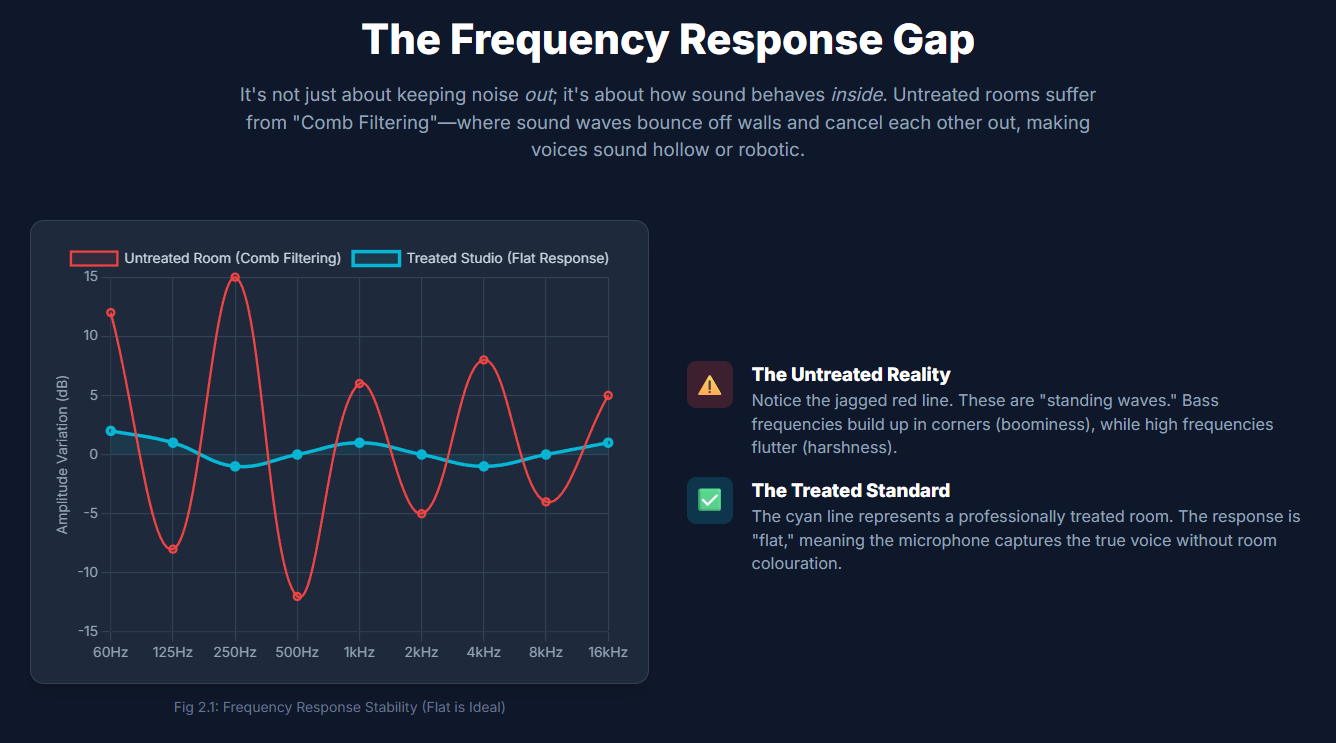
Low frequencies are the hardest to control. Because of their long wavelengths (a 50 Hz wave is nearly 7 meters long), they pass right through thin absorption panels. In a small room (like a typical podcast booth), these low waves bounce back and forth between parallel walls, creating Standing Waves or Room Modes.
The Impact: Standing waves cause the bass to be uneven. At one spot in the room, the voice sounds booming and overwhelming; six inches away, the bass disappears entirely.
The Solution: Bass Traps are thick, dense absorbers placed in the corners of the room, where bass energy naturally accumulates. A proper bass trap might be solid mineral wool 12 to 24 inches deep.
Strategic Value: For male voices in particular, bass trapping is non-negotiable. It clears the "mud" from the lower-mids (200-300 Hz), allowing the deep chest resonance to be heard clearly without overwhelming the mix. This is the secret to the "radio voice" authority.
C. Diffusion (The Polish)
If a room is covered 100% in absorption, it becomes an "anechoic" space. While technically perfect, this sounds unnatural and oppressive to the human ear. We are used to hearing some room reflection; it helps us orient ourselves in space. A completely dead room sucks the life out of a performance, making the host feel like they are speaking into a vacuum.
The Diffuser: Instead of absorbing sound, a diffuser creates a complex, irregular surface that scatters sound waves in thousands of different directions and time alignments.
Strategic Value: Diffusion keeps the room sounding "alive" and "airy" but removes the harsh, distinct echoes. It makes a small room sound larger and more expensive. In high-end studio hire London facilities, you will often see beautiful wooden geometric diffusers on the back wall. These contribute to a polished, shimmering high-end that implies high production value.
Table 1: Comparative Efficacy of Treatment Materials
Data extrapolated from standard acoustic laboratory measurements for illustrative comparison.
4. The Video Studio Paradigm: The Eyes Hear Too
The transition from "audio podcast" to "video podcast" (Vodcast) has fundamentally altered the strategic requirements of studio design. In the past, a studio could be an ugly, windowless box lined with grey mattresses. Today, the studio is a set. It must look as good as it sounds. This has birthed a new discipline: Aesthetic Acoustics.
4.1 The Conflict of Optics and Acoustics
Traditional acoustic treatments are visually intrusive. Thick bass traps and fabric panels can look clinical or industrial. However, hard surfaces (glass, brick, polished concrete) which look "cool" and "industrial chic" on camera are acoustically disastrous.
The Glass Wall Problem: Many modern London offices feature glass partitions. Glass is a perfect acoustic reflector, creating hard, brittle slapback echoes.
The Minimalist Problem: The "Apple Store" aesthetic of clean white walls and hard floors is the enemy of good audio.
4.2 The Solution: Stealth Acoustics
In 2026, the strategic trend is to integrate acoustic treatment into the set design so seamlessly that the viewer does not recognize it as treatment.
Acoustic Slat Wood Panels: This has become the defining look of the modern video podcast. These panels consist of vertical wood veneer slats mounted on a backing of black acoustic PET felt.
Acoustic Function: The gaps between the slats allow sound to pass through to the felt (absorption), while the wood face reflects some high frequencies (diffusion), keeping the speech intelligible but not dead.
Visual Function: The vertical lines create depth and texture that looks stunning under studio lighting, providing a rich, warm backdrop that signals "high budget."
The "Lounge" Aesthetic: High-end London podcast production has moved away from the news-desk look toward the "intimate conversation" vibe. This strategic shift allows for the use of "stealth" absorbers:
Heavy Curtains: Thick, pleated velvet curtains (min 500gsm) act as excellent mid-frequency absorbers.
Rug & Sofa: A thick pile rug and a plush fabric sofa act as massive bass and mid-range traps, helping to deaden the room naturally while looking inviting.
Custom Print: Acoustic fabric can now be dye-sublimated with high-resolution images. A "brick wall" background in a studio might actually be a 4-inch deep acoustic absorber printed with a brick texture.
4.3 Lighting and the Noise Floor
Video requires light. In the past, high-output studio lights (Tungsten) generated immense heat, requiring loud air conditioning and creating thermal expansion noises (creaking) in the rig.
The LED Revolution: Modern LED fixtures (such as those from Aputure, Godox, or Nanlite) are cool-running and energy-efficient.
The Fan Noise Danger: However, high-output COB (Chip on Board) LEDs require cooling fans. A cheap LED light might have a noisy fan that whines at a frequency of 400 Hz. In a silent recording studio, five of these lights running simultaneously can raise the noise floor by 10-15 dB.
Strategic Selection: Professional studios invest in fan-less lights or lights with "silent mode" capabilities to ensure that the visual upgrade does not degrade the audio product.
5. Equipment Synergy: The Signal Chain
Acoustic treatment is the first, and most important, link in the signal chain. No microphone, no matter how expensive, can "un-hear" a bad room. However, the choice of equipment must be strategically paired with the acoustic environment.

5.1 The Microphone: Dynamic vs. Condenser
The single most common question in podcast tech is "Which mic should I buy?" The answer depends entirely on the room.
The Dynamic Microphone (e.g., Shure SM7B, Electro-Voice RE20)
These are the undisputed kings of the podcast world.
Mechanism: They use a moving coil and magnet. The diaphragm is relatively heavy and requires significant acoustic energy to move.
Strategic Advantage: Because of their low sensitivity, they pick up less of the room sound and less of the distant "London Rumble." They have excellent "off-axis rejection," meaning they largely ignore sound coming from the sides or rear.
The Room Relationship: A dynamic mic is forgiving. It can produce a broadcast-quality result in a room with only moderate treatment (Tier 2). This makes it the ideal choice for studio hire London spaces that are not purpose-built bunkers.
The Condenser Microphone (e.g., Neumann U87, Rode NT1)
These are the standard for voice-over and music recording.
Mechanism: They use a lightweight, electrically charged diaphragm that is incredibly sensitive to transient details.
Strategic Disadvantage: A condenser mic hears everything. It will hear the lip smacks of the host, the fan of the laptop, the creak of the chair, and the reverb of the room.
The Room Relationship: A condenser mic is unforgiving. It demands a Tier 1, fully isolated and treated room. Using a U87 in an untreated office will sound worse than using a £50 USB mic, because the U87 will capture the "badness" of the room with perfect fidelity.
5.2 The Preamp and Clean Gain
Dynamic microphones like the Shure SM7B are notoriously "gain hungry." They require 50-60 dB of amplification to reach a usable level.
The Noise Floor Risor: Cheap audio interfaces have preamps that introduce a "hiss" (self-noise) when turned up past 80%. If you are fighting a quiet voice and a low-output mic, you have to crank the preamp, introducing hiss.
Strategic Solution: Professional studios use dedicated "clean gain" preamps (like those from Neve, API, or Focusrite ISA) or inline activators (Cloudlifter). These provide transparent amplification without raising the noise floor, preserving the "black canvas" of silence achieved by the acoustic treatment.
6. Economic Analysis: Build vs. Hire in London
For a London-based business or creator, the decision between building a private studio and utilizing studio hire London services is a complex economic equation. It involves analyzing Capital Expenditure (CapEx), Operational Expenditure (OpEx), Real Estate costs, and Opportunity Cost.

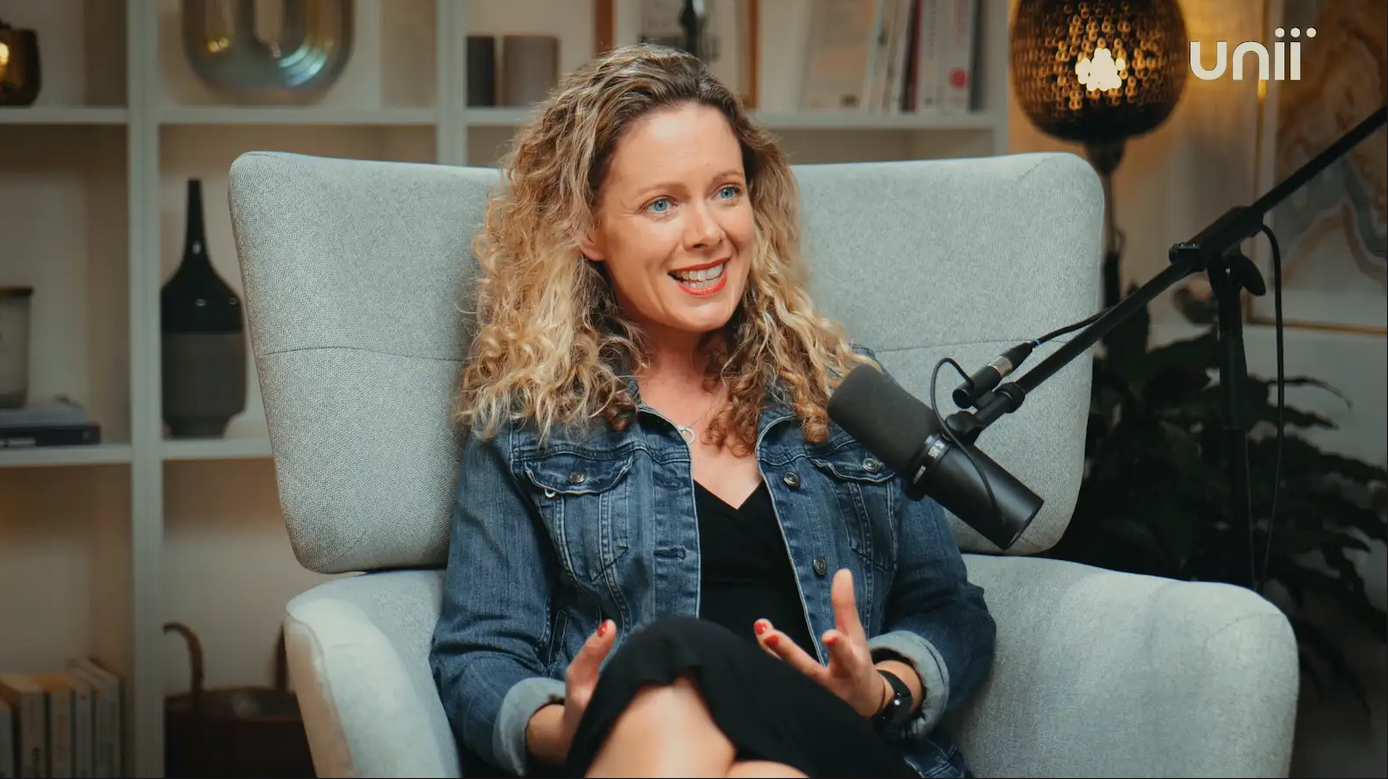
See the 'No ordinary tech podcast ' from Lloyds Banking Group by Rohit D (AI Leader for Lloyds Banking Group) and DR. shini somara (Pro-Chancellor of Brunel University) . at Finchley Studio (Lounge setup). Book this setup for your podcast.
6.1 The Cost of Construction (CapEx)
Building a truly soundproof, broadcast-quality studio in a London residential or commercial property is exorbitantly expensive due to the city's labor rates and logistical challenges.
The Shell (Isolation): To build a "Room-within-a-Room" (4m x 4m) involving floating floors, independent stud walls, acoustic plasterboard, and Green Glue:
Materials: £6,000 - £8,000.
Specialist Labor: £5,000 - £8,000. (Standard builders often fail at soundproofing; specialist acoustic contractors command a premium).
HVAC: £3,000 - £5,000 for a silent, baffled air exchange system.
Subtotal Isolation: £14,000 - £21,000.
The Interior (Treatment & Aesthetics):
Acoustic Panels/Bass Traps: £2,000 - £4,000.
Set Design/Furniture/Lighting: £3,000 - £6,000.
Subtotal Interior: £5,000 - £10,000.
The Gear (Video & Audio):
Cameras (3x 4K Sony FX3/FX30 + Lenses): £10,000 - £14,000.
Audio (Mics, Interface, Recorder): £3,000.
Switcher/PC: £2,000.
Subtotal Gear: £15,000 - £19,000.
Total Estimated CapEx for Home Build: £34,000 - £50,000.
6.2 The Cost of Operation (OpEx) & Hidden Friction
Beyond the build cost, there are operational realities:
Real Estate Value: A 4m x 4m room in London represents roughly 160 sq ft. With London commercial rents averaging £60-£100 per sq ft, the "cost" of dedicating that room to a studio is £10,000 - £16,000 per year in lost utility or rent.
Maintenance: Gear breaks. Software updates break compatibility. Bulbs burn out. In a DIY scenario, the host is also the IT technician.
The "Engineer" Cost: Recording yourself is cognitively draining. You have to monitor audio levels, check focus, switch cameras, and interview the guest simultaneously. This divided attention lowers the quality of the performance.
6.3 The Studio Hire Value Proposition
Comparing this to the studio hire London market reveals the strategic efficiency of renting.
Premium Video Podcast Studio Rate: £150 per hour (approx).
Break-Even Analysis: To justify a £40,000 build, one would need to record roughly 266 hours of content. For a weekly podcast (1 hour), that is 5 years of recording.
The "Engineer" Bonus: Most premium hire rates include a professional engineer. This removes the cognitive load from the host, allowing them to focus entirely on the content. The engineer manages the levels, the lighting, and the files.
Flexibility: Renting allows for scaling. You can book a 2-person room today and a 6-person panel room next week. You are not locked into a fixed physical asset.
Table 2: The Strategic Matrix (Build vs. Hire)
7. The Human Element: Psychology and Performance
Acoustic treatment and studio design are not just about physics; they are about psychology. The environment dictates the performance.

See the 'Murder They Wrote' podcast setup used by Laura Whitmore and Iain Stirling from BBC at Finchley Studio (Gathering setup). Watch Murder They Wrote at BBc sound , Spotify , Apple podcasts , Youtube , Instagram , Amazon music
7.1 The Authority of Silence
When a guest enters a professionally treated room, the acoustic change is palpable. The "deadness" of the room signals that this is a place of focus. The lack of distracting noise elevates the conversation. The guest subconsciously understands that their words are being captured with fidelity, which often encourages them to speak more thoughtfully and intimately. This is the "confessional booth" effect.
7.2 The Comfort Factor
The "London Rumble" is fatiguing. A brain constantly filtering out background noise tires quickly. In a silent, treated room, the conversation can flow effortlessly for hours. This is why the best "deep dive" podcasts often take place in high-end studios; the environment supports the endurance required for long-form discussion.
7.3 Parasocial Intimacy
Podcasting relies on the parasocial relationship—the one-sided bond where the listener feels they "know" the host. This bond is forged in the intimacy of the earbuds. High-quality audio, free from the distancing effect of room echo, removes the barrier between the host and the listener. It feels like the host is inside the listener's head. Bad acoustics (echo) place the host "in a room," creating a psychological distance. Strategic acoustic treatment is effectively intimacy engineering.
8. Future Horizons: The Studio of 2026
As we look toward the future of London podcast production, several trends are reshaping the strategic landscape.

Finchley Studio (Dialogue set): book this setup for your podcast
8.1 AI Audio vs. Acoustic Reality
Tools like Adobe Podcast (Enhance) and Descript use AI to clean up bad audio.
The Myth: "We don't need a studio; AI will fix it."
The Reality: AI is a restorative tool, not a generative one. Heavily processed AI audio sounds robotic, gated, and unnatural. It strips the emotional nuance (breath, cadence) from the voice. In a premium market, "organic" high-fidelity audio will become a luxury signifier, distinguishing human-centric brands from AI-generated churn. The studio's value increases as AI becomes common, because true silence is something AI cannot fake perfectly.
8.2 Spatial Audio (Dolby Atmos)
Platforms like Audible and Apple Podcasts are pushing Spatial Audio. This requires recording in even "deader" rooms, as any natural room reverb will conflict with the artificial 3D reverb added in post-production. This raises the technical bar for recording studio acoustics even higher, pushing the DIY market further behind.
8.3 The Vertical Studio
With the dominance of TikTok and Shorts, studios are being designed "vertical-first." This means acoustic treatment must extend to the floor and ceiling (often visible in vertical crops) and set designs must be tighter and taller. The "wide shot" is less important than the "9:16 crop."
9. Frequently Asked Questions (FAQ)
Q1: I rent a flat in London. Can I soundproof a room without construction?
Short Answer: No.
Detailed Answer: Soundproofing (isolation) requires mass and structural decoupling. You cannot achieve this with temporary measures. Hanging blankets or sticking foam to the wall is acoustic treatment (it reduces echo), but it will not stop the neighbor's TV or the traffic noise from entering. To stop noise, you need airtight seals and heavy mass, which usually contravenes tenancy agreements regarding structural alteration. For renters, the only viable strategic option for professional results is Studio Hire.
Q2: Why is "egg crate" foam bad?
Egg crate foam is too light and porous. It effectively absorbs high frequencies (treble) but lets mid and low frequencies bounce around. This results in a room that sounds "boomy" and "muddy" because the brightness is gone but the rumble remains. It creates an unbalanced, unnatural sound signature that screams "amateur." Professional treatment uses dense fiber (Rockwool) to absorb a balanced spectrum of sound.
Q3: What is the "London Rumble" you mention?
The London Rumble is a specific low-frequency noise pollution (30-60 Hz) prevalent in the London basin, caused by the interaction of the deep-level Tube network, heavy surface traffic, and the density of mechanical infrastructure. It travels through the ground and building foundations, bypassing standard windows. It is the primary enemy of clean audio in the capital.
Q4: Do I really need an engineer? Can't I just press record?
You can, but you pay with your attention. "Cognitive switching costs" are real. Every time you check a level or look at a waveform, you break eye contact and emotional connection with your guest. An engineer allows you to be a host rather than a technician. In high-stakes interviews, this focus is the difference between a good episode and a great one.
Q5: How much does a professional podcast studio cost to hire in London?
Rates vary by tier:
Audio Only: £60 - £100 per hour.
Video + Audio (Self Service): £90 - £150 per hour.
Full Production (Engineer + 4K Video): £150 - £250+ per hour.
While seemingly high, this includes thousands of pounds of gear, acoustically perfect space, and professional staffing.
10. Conclusion and Strategic Call to Action
The marketplace for attention is ruthless. In the auditory medium, quality is the gatekeeper. While content is King, audio is the Castle—without a strong fortification, the King is vulnerable.
The analysis is clear: for London-based creators and brands, the "London Rumble" and the physical constraints of the city make building a professional-grade home studio a venture fraught with high costs, legal risks, and uncertain results. The physics of sound do not yield to enthusiasm; they yield only to mass, decoupling, and engineering precision.
For those who view their podcast not as a hobby but as a strategic asset—a vehicle for brand authority, lead generation, and thought leadership—the solution lies in professional Studio Hire.
Why fight the physics of London when you can simply step out of them?
At our high-end multimedia production facility in London, we have already fought this battle. We have poured the concrete, floated the floors, and tuned the rooms. We have baffled the air and silenced the lights. When you step into our studio, London stops. The rumble fades. The sirens vanish. All that remains is you, your guest, and the pristine silence that gives your voice the authority it deserves.
Don't let London interrupt your conversation. Book your session today and be heard.