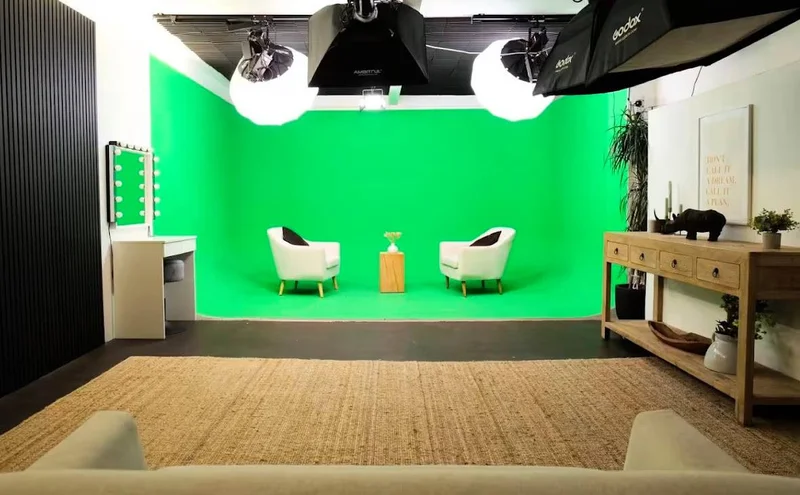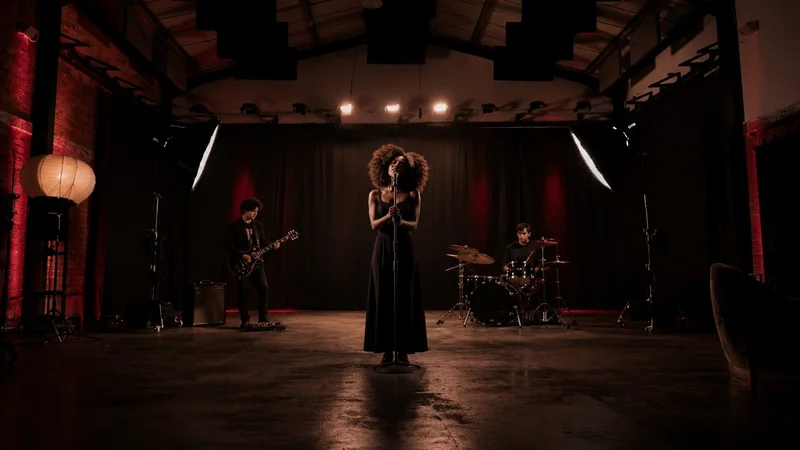
1. Introduction: The Invisible Crisis in Modern Media Production
In the burgeoning landscape of digital media, the "podcast studio" has evolved from a niche requirement into a critical infrastructure component for brands, broadcasters, and independent creators alike. The global explosion of long-form audio content, coupled with the rapid ascendancy of "vodcasting" (video podcasting), has fundamentally altered the technical requirements for recording environments. No longer is a quiet room with a microphone sufficient; today's "London podcast production" standards demand a convergence of broadcast-grade acoustics, cinematic visual fidelity, and sustained occupant comfort. However, a profound engineering paradox lies at the heart of this evolution—a conflict between the physics of sound and the biological necessities of human performance. This is the HVAC Challenge.

For any "recording studio" located in the dense urban fabric of London, the management of air—specifically, the control of airflow and the mitigation of associated noise—represents the single most complex technical hurdle. The challenge is twofold: first, to hermetically seal a space against the aggressive noise pollution of the metropolis, from the subterranean rumble of the Tube to the piercing sirens of emergency vehicles; and second, to introduce voluminous quantities of fresh, temperature-controlled air into that sealed box without introducing a single decibel of mechanical noise. This delicate balance distinguishes a professional "studio hire London" facility from the multitude of prosumer home setups.
The stakes are high. As production values rise, the tolerance for technical imperfections plummets. Listeners consuming content via high-fidelity noise-cancelling headphones can detect the slightest hum of a computer fan or the distant thrum of an air conditioner.1 Simultaneously, the introduction of 4K video lighting has exponentially increased the thermal load within these enclosed spaces, turning unventilated booths into stifling saunas that degrade talent performance and compromise makeup.
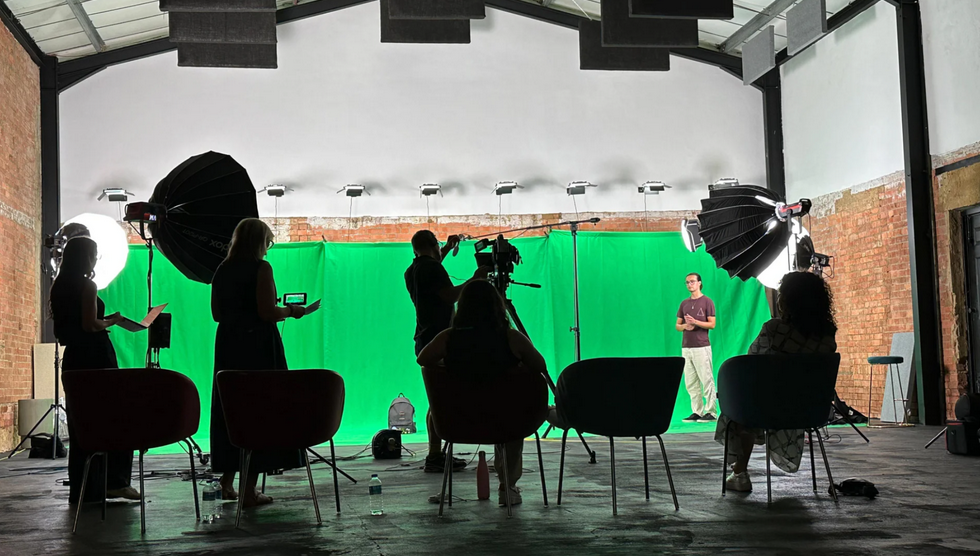
Finchley Studio (Giant Green Screen): book this setup for your podcast
This report provides an exhaustive, expert-level analysis of the HVAC challenge within the context of the London studio market. It explores the acoustical physics of "silent air," the physiological impacts of ventilation on cognitive function, and the structural engineering required to isolate a "video studio" from the chaotic soundscape of the capital. By synthesizing data from acoustical engineering standards, medical research on indoor air quality, and technical specifications of industry-standard equipment, this document serves as a definitive guide for creators and stakeholders prioritizing professional audio excellence.
2. The Physics of Sound in the London Soundscape
To appreciate the magnitude of the engineering required for a premier "podcast studio," one must first quantify the acoustic environment. "Silence" is not merely the absence of sound; in professional audio, it is a measurable, engineered state defined by rigorous criteria.
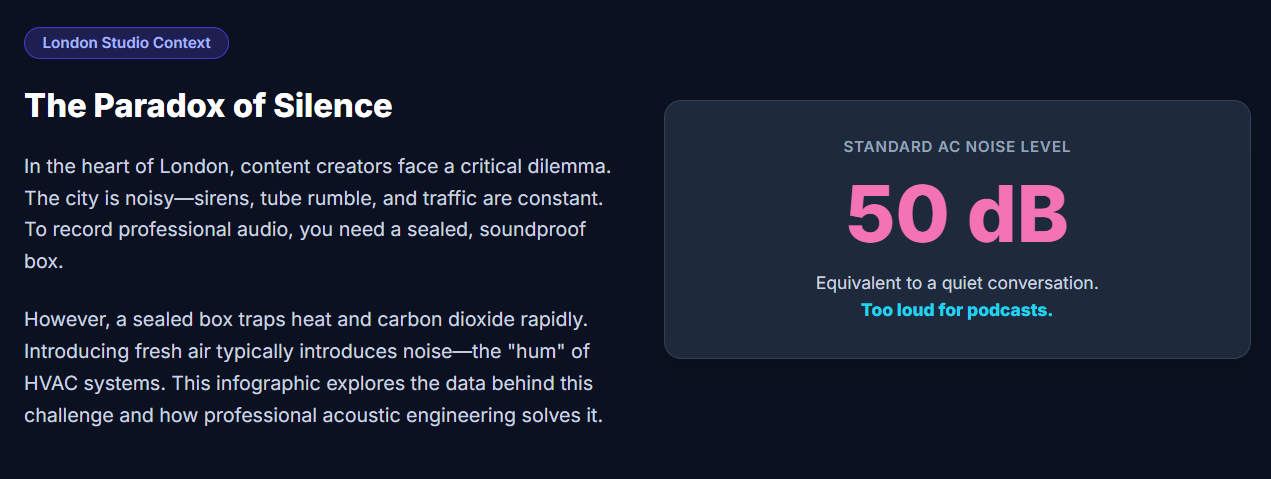
2.1 Defining the Noise Floor: Noise Criteria (NC) Curves
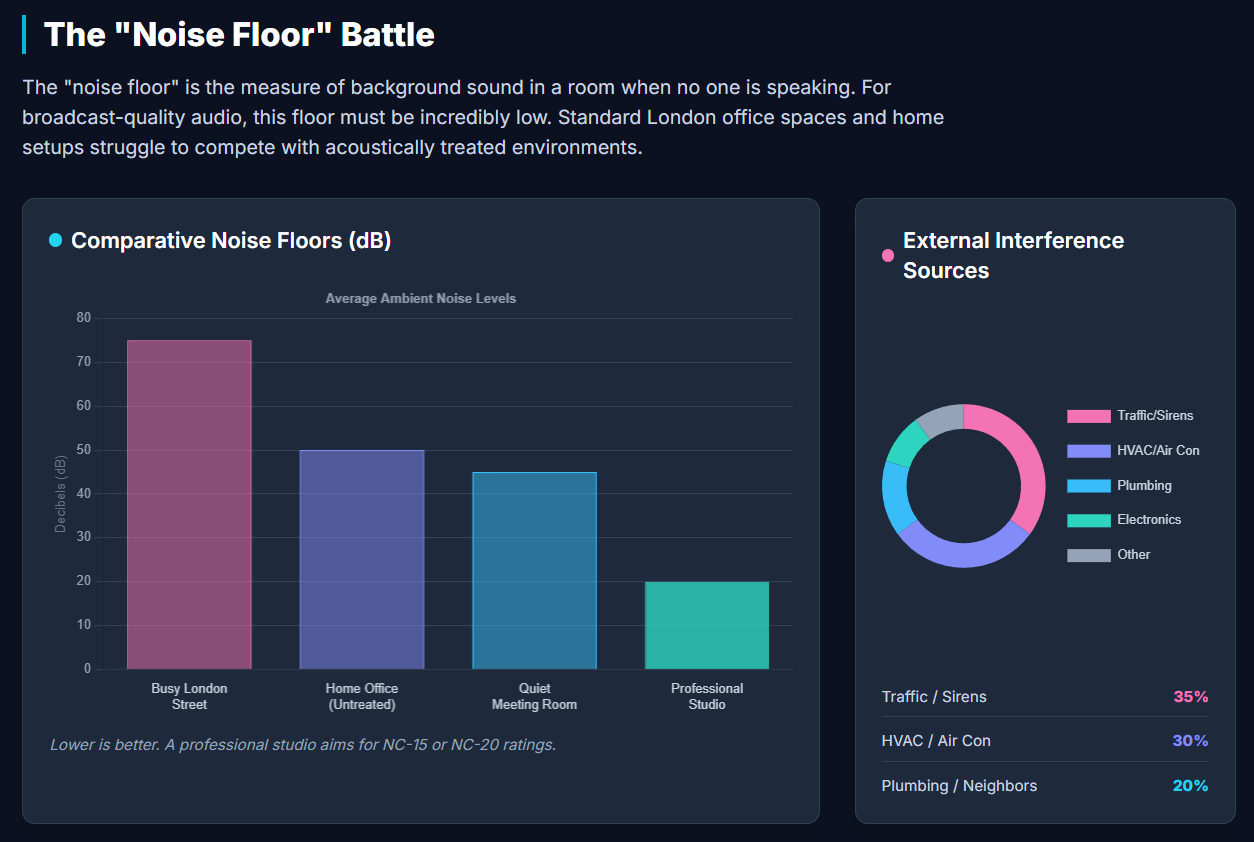
In the realm of architectural acoustics, background noise is rarely measured in a simple A-weighted decibel (dBA) figure, as this fails to account for the frequency spectrum of the noise. Instead, the industry relies on Noise Criteria (NC) curves—a system of contours developed to evaluate indoor background noise across octave bands ranging from 63 Hz to 8000 Hz.5
For a professional "recording studio," the target is not simply "quiet" (typically NC-30 or NC-35, found in libraries or private offices); it is "virtual silence." The gold standard for critical listening environments and broadcast studios is NC 15–20.5 Achieving this rating implies that the background noise level at low frequencies (rumble) must be aggressively suppressed, while high-frequency hiss must be non-existent.
The following table illustrates the comparative acoustic standards required for various environments, highlighting the stringent demands placed on a professional studio compared to other "quiet" spaces:
Table 1: Comparative Noise Criteria (NC) ratings and their implications for audio production.6
The challenge for a London-based business is that the ambient noise level of the city far exceeds these targets. A standard window in Central London might only reduce external noise to NC-40 or NC-50, leaving the recording space vulnerable to the city's sonic intrusion.
2.2 The Spectral Character of Noise: RC Curves and the "London Rumble"
While NC curves are the standard, they often fail to adequately characterize the quality of the background noise, particularly the low-frequency energy that plagues London. To address this, acousticians employ Room Criteria (RC) curves, which diagnose spectral imbalances such as "Rumble" (excessive bass) or "Hiss" (excessive treble).

See the 'No ordinary tech podcast ' from Lloyds Banking Group by Rohit D (AI Leader for Lloyds Banking Group) and DR. shini somara (Pro-Chancellor of Brunel University) . at Finchley Studio (Lounge setup). Book this setup for your podcast.
In London, "Rumble" is the predominant adversary. The city's infrastructure generates massive amounts of structure-borne noise:
Subterranean Rail: The London Underground network creates vibration frequencies between 30 Hz and 60 Hz.10 This energy travels through the earth, up the building's foundations, and excites the walls and floors of the studio.
Heavy Traffic: Buses and HGVs on London's roads generate similar low-frequency energy that penetrates standard building facades.11
Mechanical Systems: The proliferation of rooftop HVAC units and chillers in dense commercial districts adds to the structural vibration load.11
If a studio's HVAC system is not meticulously designed, it can exacerbate this issue. A poorly isolated compressor or a fan running at the wrong speed can generate a specific tone or beat frequency that aligns with these external sources, creating a "droning" noise floor that is impossible to remove in post-production without degrading the richness of the human voice.9
Therefore, a "Podcast studio" in London must be engineered not just to keep air moving, but to decouple the entire recording environment from the vibrating city in which it sits.
3. The Physiological Necessity of Air: CO2 and Cognitive Performance
The solution to noise—sealing the room—creates an immediate biological crisis. A soundproof studio is, by definition, an airtight box. Without active mechanical ventilation, the environment within a vocal booth rapidly degrades, with profound consequences for the quality of the content being produced.
3.1 The CO2 Trap: The Hidden Killer of Content Quality
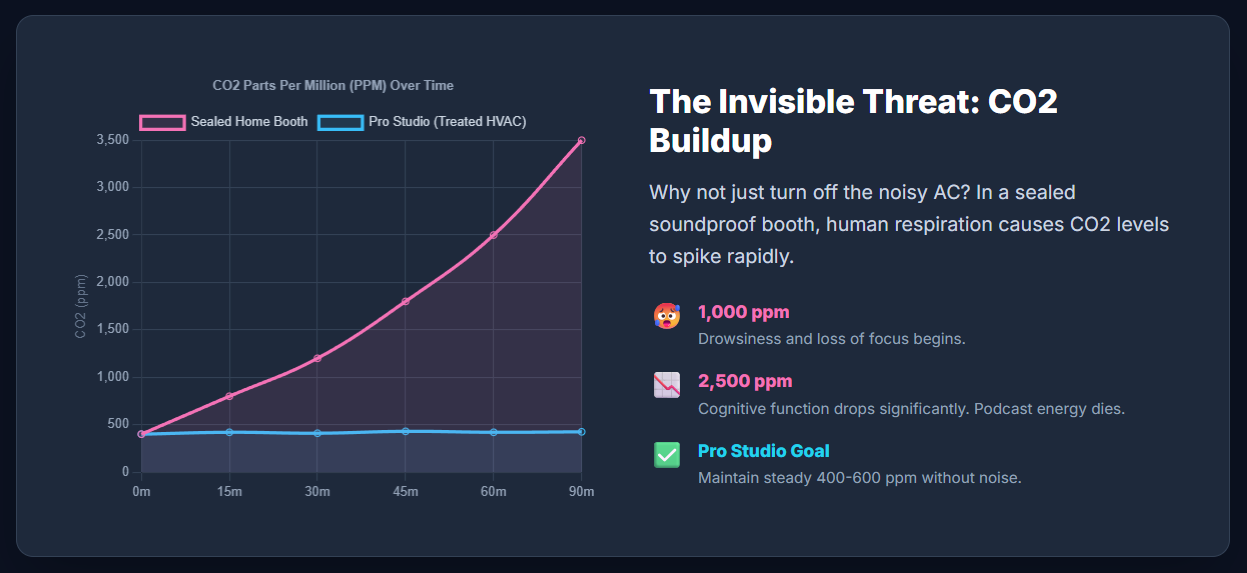
When humans speak, they exhale carbon dioxide (CO2). In the confined volume of a podcast booth (often 10–20 square metres), CO2 levels rise with alarming speed. Ambient outdoor air contains approximately 400 ppm (parts per million) of CO2. In a sealed room with two hosts engaged in spirited debate, levels can exceed 1,000 ppm within 20 minutes and 2,500 ppm within an hour if no fresh air is introduced.13
The physiological impact of elevated CO2 on "talent" is direct and detrimental to the production:
1,000 ppm: Occupants begin to experience drowsiness and a subtle reduction in concentration.15
1,500 – 2,500 ppm: Significant cognitive decline occurs. Symptoms include "mental slowness," inability to focus, and reduced decision-making capability.14 In a podcast context, this manifests as more "umms" and "ahhs," lost trains of thought, and a lack of energy in the delivery.
> 2,500 ppm: Headaches, fatigue, and distinct physical discomfort set in (Sick Building Syndrome), potentially leading to irritability and a desire to end the session early.13
For a high-end "London podcast production," where studio time is billed at a premium and celebrity guests may have limited availability, these physiological effects are unacceptable. The "standard" solution of opening the door between takes breaks the creative flow and destroys the atmosphere. Thus, a continuous supply of fresh, oxygenated air is not a luxury—it is a production necessity.

See the 'The Tooney & Russo Show' from BBC and Lionesses Ella Toone and Alessia Russoat from England national football team at Finchley Studio (Lounge setup). Book this setup for your podcast. Watch 'The Tooney & Russo Show' at BBc sound , Spotify , Youtube, Amazon music.
3.2 The Thermal Load: The "Video Studio" Factor
The transition from audio-only podcasts to "vodcasts" (video podcasts) has fundamentally altered the thermal equation of studio design. A "Video studio" introduces significant heat sources that must be neutralized:
Lighting Systems: While modern LED lights are more efficient than tungsten predecessors, a professional 3-point lighting setup for a multi-camera shoot still generates substantial heat.4
Computing Power: High-end production typically involves gaming-grade PCs for live streaming or 4K capture, which vent hot air directly into the room.3
Human Metabolic Rate: An adult at rest generates ~100 Watts of heat. During an energetic performance or debate, this metabolic output increases.
In a sealed, acoustically treated room (where foam and insulation also act as thermal insulators), this heat has nowhere to go. Without active cooling, temperatures can rise to uncomfortable levels within 15 minutes, leading to sweating (ruining makeup) and visible distress on camera.17 The HVAC system, therefore, must provide powerful cooling (removing kilowatts of heat) while maintaining the NC-15 silence required for audio.
4. Engineering Silent Air: The Technical Solution
Solving the HVAC challenge—providing high-volume ventilation and cooling without noise—requires a departure from standard building services engineering. It demands a specialized approach focused on High Volume, Low Velocity (HVLV) airflow.
4.1 The Velocity Constraint: Slowing the Flow
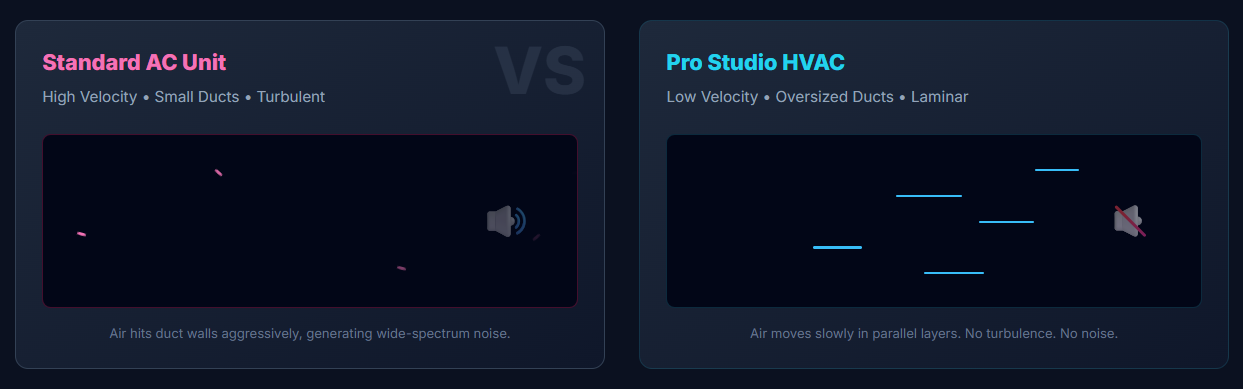
The primary source of noise in an air conditioning system is turbulence. The sound power level generated by airflow is proportional to the 6th power of the air velocity. This means that a small reduction in air speed yields a massive reduction in noise.
Standard Office HVAC: Operates at 500–800 Feet Per Minute (FPM) at the diffuser. This creates a "whoosh" that is acceptable in an office but catastrophic for a microphone.19
Broadcast Standard: To achieve NC-15, air velocity at the supply grille must be restricted to < 300 FPM, and ideally between 100–300 FPM.19
Achieving this requires massively oversized ductwork. To move the same volume of air (CFM) at a lower speed (FPM), the cross-sectional area of the duct must increase. A "studio hire London" facility retrofitting a historic building often faces severe spatial constraints, making the routing of these large ducts a complex architectural puzzle.8
4.2 The Path of Silence: Duct Design and Baffles
Even with slow air, noise from the fan unit itself (break-in noise) can travel down the ductwork and emerge into the studio. To prevent this, the air path must be acoustically treated:
Baffle Boxes (Dead Vents): These are the heart of a silent system. A baffle box is a large, lined chamber containing a serpentine path. As air navigates the S-bends, sound waves (which travel in straight lines) impact the absorbent lining and are dissipated as heat.12
Duct Liners: Rigid metal ducts are lined with acoustic foam or fiberglass board to absorb internal reflections. This prevents the duct from acting as a speaking tube or resonance chamber.20
Flexible Decoupling: The final connection between the rigid duct and the room vent is often made with a short length of acoustic flexible ducting. This acts as a shock absorber, ensuring that any mechanical vibration from the ductwork is not transmitted to the studio ceiling or walls.22
4.3 The "Mini-Split" Paradox
Many smaller London studios utilize "Ductless Mini-Split" systems. These separate the noisy compressor (placed outside) from the quiet evaporator (inside).
Pros: They are quieter than window units and require less ductwork.23
Cons: They only recirculate and cool existing air; they do not provide fresh air exchange.
The Professional Solution: A hybrid approach is required. The mini-split handles the heavy thermal load (cooling), while a separate, silent ducted system (often an Energy Recovery Ventilator, ERV) provides the necessary fresh air exchange to control CO2.3
5. Structural Defense: Isolating the London Studio
While the HVAC system manages the internal environment, the physical structure of the studio must defend against the external chaos of London. This defense relies on the principle of decoupling.
5.1 The "Box-in-Box" Construction
The only way to achieve professional isolation in a noisy city is to build a room within a room—a "Box-in-Box" structure. This inner room does not touch the outer building; it floats.
Floating Floors: This is critical for mitigating the "London Rumble" (Tube/Traffic). The studio floor is constructed on top of resilient rubber isolators or springs, creating an air gap between it and the building's concrete slab.25 This breaks the path of structure-borne vibration.
Independent Walls: The walls of the studio are built on this floating floor and do not touch the structural walls of the building.
Suspended Ceilings: The ceiling is hung from the structural slab using acoustic isolation hangers (e.g., RSIC clips), preventing impact noise from footsteps on the floor above from reaching the microphones.27
5.2 Mass and Damping
Mass blocks sound. Professional studios utilize multiple layers of high-density plasterboard (drywall) separated by damping compounds (like Green Glue) or constrained layer damping materials.
Mass Loaded Vinyl (MLV): This dense, heavy material is often limp-mass loaded into wall cavities or wrapped around ductwork to stop sound from breaking out.11
The Result: A structure that acts as a fortress of silence, allowing the creator to record a whisper-quiet podcast even while a siren wails on the street outside.
6. Equipment Synergy: The Final 5%
Even with world-class engineering, a perfect "NC-0" environment is theoretical. The final step in the noise-control chain is selecting equipment that complements the acoustic environment rather than fighting it.
6.1 Microphone Selection: Dynamic vs. Condenser
For a "London podcast production," the choice of microphone is strategic.
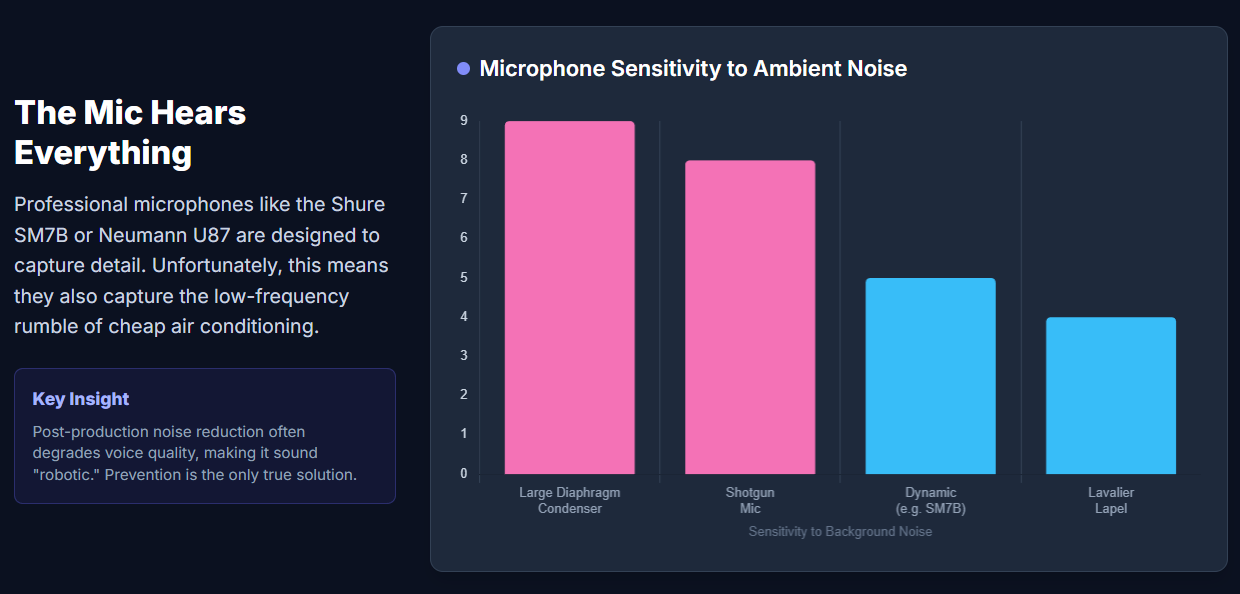
Dynamic Microphones (e.g., Shure SM7B): This is the industry workhorse for a reason. Dynamic mics have low sensitivity and excellent off-axis rejection. They "hear" what is directly in front of them (the voice) and naturally reject distant sounds (like residual HVAC hum or room reverb).28 The SM7B also features a bass roll-off switch specifically designed to attenuate low-frequency rumble, further insulating the recording from London's traffic noise.31
Condenser Microphones: While offering greater detail and high-frequency "air," condensers are extremely sensitive. In a city environment, they often capture too much "room tone" and external bleed, requiring aggressive and potentially destructive post-production noise reduction.32
6.2 Lighting and Heat Management
Transitioning to LED technology is mandatory for the "Video studio."
Thermal Efficiency: LEDs convert the vast majority of energy into light, whereas traditional Tungsten fixtures waste 90% of energy as heat.4 Using Tungsten lights in a small booth would necessitate a massive increase in air conditioning power (and thus noise) to keep the talent alive.
Fanless Operation: For video, selecting high-end LED panels that are passively cooled (no internal fans) eliminates a common source of on-set noise.4
7. Market Analysis: The "Studio Hire London" Landscape
Navigating the London market reveals a distinct stratification of facilities, defined largely by their approach to the HVAC challenge.
7.1 The "Air Con Trap" (Budget Studios)
Many budget-friendly options listed under "studio hire London" boast air conditioning, but user reviews often reveal a critical flaw: the AC is a standard residential unit.
The Operational Flaw: Because the unit is loud (NC-40+), it must be turned off during recording.
The "Shoot-Edit-Shoot" Cycle: Creators record for 20 minutes, become uncomfortably hot, pause production to blast the AC for 10 minutes, and then resume.19 This disrupts the natural flow of conversation, extends the booking time, and ruins the "vibe."
Client Experience: The result is sweat-shined faces on video and a fragmented, frustrating session.
7.2 The Professional Differentiator (High-End Studios)
Premier facilities (such as Qube, dedicated broadcast hubs, and purpose-built podcast suites) differentiate themselves through "Climate Controlled" or "Fresh Air Exchange" systems.34
The Promise: Continuous recording capability. The air systems run silently during the take, maintaining a constant 21°C and <800 ppm CO2.
The Value: This allows for uninterrupted 3-hour "deep dive" interviews (ala Rogan or Diary of a CEO) where the guests remain energized, comfortable, and focused throughout. For professional brands, this reliability justifies a higher hourly rate.
8. Operational Excellence: The Unseen Maintenance
For the studio owner, the work does not end at installation. Maintaining an NC-15 environment requires rigorous operational protocols.
Filter Hygiene: As HVAC filters clog with dust, static pressure increases, forcing fans to work harder and louder. Regular replacement is acoustic maintenance.
CO2 Monitoring: Installing visible air quality monitors in the booth provides reassurance to clients and an objective metric for when to boost fresh air exchange.13
Scheduled Silence: In mixed-use buildings, even the best isolation has limits. Coordinating with neighbours to avoid heavy drilling during key recording blocks remains a necessary soft skill in London's crowded creative hubs.
9. Frequently Asked Questions (FAQ)
Q: Why do I get a headache or feel tired after recording in a soundproof booth?
A: This is a classic symptom of high carbon dioxide (CO2) levels. Soundproof booths are airtight; if the studio lacks a dedicated fresh air exchange system (distinct from just a cooling unit), you are re-breathing exhaled CO2. This leads to drowsiness, cognitive fatigue, and headaches (hypercapnia). Professional studios monitor air quality to keep CO2 below 1,000 ppm to ensure you stay sharp.
Q: Can't I just use software (like a noise gate) to remove the air conditioner hum?
A: You can, but it compromises quality. A noise gate silences the background between words, but the hum remains audible underneath your voice while you speak. This creates a distracted "pumping" effect. Furthermore, heavy noise reduction (de-noising) can make voices sound robotic or "underwater." "Silent air" capture is always superior to "fixed in post" audio.
Q: What is the difference between "Soundproofing" and "Acoustic Treatment"?
A: Soundproofing (Isolation) stops noise from entering or leaving the room (e.g., blocking London traffic noise using mass-loaded vinyl and floating floors). Acoustic Treatment manages how sound behaves inside the room (e.g., using foam panels to stop echo and reverb). A professional studio needs both: isolation to keep the world out, and treatment to make your voice sound broadcast-ready.
Q: Is a "Floating Floor" really necessary for a studio in London?
A: In many parts of London, yes. The city suffers from significant "structure-borne" noise—vibrations from the Underground (Tube), trains, and heavy bus traffic that travel through the ground and up the building's frame. A floating floor decouples the studio from the building, preventing these vibrations from shaking your microphone stand and creating a low-frequency rumble on your recording.
Q: Why does "Climate Controlled" studio hire cost more?
A: Achieving silent air conditioning is a feat of expensive engineering. It requires oversized ductwork, specialized baffle boxes, and often commercial-grade mechanical systems located far from the recording room. You are paying for the ability to record continuously in comfort without sacrificing audio quality—a feature that budget studios simply cannot offer.
Q: Which microphone is best if the studio has some background noise?
A: The Shure SM7B is the industry standard for this scenario. It is a "dynamic" microphone with low sensitivity and a cardioid pattern, meaning it primarily picks up sound directly in front of it and rejects off-axis noise (like HVAC hum). It also features a "bass roll-off" switch that can further reduce the low-frequency rumble common in urban environments.
10. Conclusion & Call to Action
In the high-stakes arena of London's media production industry, the "HVAC Challenge" serves as the definitive litmus test for studio quality. It is the intersection where mechanical engineering meets acoustic art, and where the comfort of the creator directly dictates the quality of the content.
A truly professional Podcast studio or Video studio offers more than just high-end equipment; it provides a controlled environment where the chaotic variables of the city are strictly managed.
Acoustic Integrity: Through NC-15 compliant airflow and structural decoupling, we ensure your audio is pristine, capturing the nuance of the conversation rather than the noise of the commute.
Physiological Support: By actively managing CO2 and thermal loads, we protect the energy and focus of your talent, enabling long-form content that remains engaging from minute one to minute one hundred.
Creative Freedom: The elimination of the "shoot-edit-shoot" cooling cycle means your creativity is never interrupted by the need for fresh air.
Experience the Sound of Silence.
Don't let the roar of London or the stifle of a sealed room compromise your production. At our central London facility, we have mastered the physics of silent air to provide the ultimate canvas for your voice.
Breathe Easy: Hospital-grade filtration and silent fresh air exchange.
Record Clean: NC-15 rated studios for broadcast-ready audio.
Stay Cool: Precision climate control for 4K video lighting loads.
**** – Step inside, close the door, and hear the difference that professional engineering makes. Your audience is listening.
Works cited
Maintaining Optimal Sound Quality in Podcast Recordings - Zencastr, accessed January 8, 2026, https://zencastr.com/en-us/blog/maintaining-optimal-sound-quality-in-podcast-recordings
The Importance of Sound Quality in Podcasting - Wavve.co, accessed January 8, 2026, https://wavve.co/the-importance-of-sound-quality-in-podcasting/
BOXYGEN: silent ventilation system for audio studios, accessed January 8, 2026, https://www.boxysystem.com/blog/boxygen-the-silent-ventilation-system-for-perfect-acoustic-environments/
LED vs. Tungsten vs. HMI: Choosing the Right Film Light for Your Project - GVM Official Site, accessed January 8, 2026, https://gvmled.com/film-light-guide-led-vs-tungsten-hmi/
Noise Criteria (NC) and Room Criteria (RC) Curves - Larson Davis, accessed January 8, 2026, https://www.larsondavis.com/learn/building-acoustics/nc-rc-curves
NC Rating 101: Understanding Noise Criterion Sound Levels - Commercial Acoustics, accessed January 8, 2026, https://commercial-acoustics.com/guides/noise-criterion-nc-rating-101/
What Are Noise Criteria Levels? - Soundproof Your Studio, accessed January 8, 2026, https://www.soundproofyourstudio.com/blog/what-are-noise-criteria-levels
HVAC for broadcast facilities | TV Tech - TVTechnology, accessed January 8, 2026, https://www.tvtechnology.com/miscellaneous/hvac-for-broadcast-facilities
Ambient Noise Evaluation: NC, RC, and NR Curves - SVANTEK, accessed January 8, 2026, https://svantek.com/academy/noise-criteria-and-rating/
Soundproofing News - London - Mute Group, accessed January 8, 2026, https://www.mutesoundproofing.com/category/news-soundproofing/
Why Soundproofing Is Important? - Mammoth Film Studios, accessed January 8, 2026, https://www.mammoth.london/post/why-soundproofing-is-important
HVAC Systems - Acoustic Sciences Corporation, accessed January 8, 2026, https://www.acousticsciences.com/hvac-systems/
Why CO₂ Levels Matter in Acoustic Pods — AgileAcoustics, accessed January 8, 2026, https://www.agileacoustics.co.uk/why-co-levels-matter-in-acoustic-pods
CARBON DIOXIDE EXPOSURE EFFECTS – FACT SHEET, accessed January 8, 2026, https://ethanolrfa.org/file/348/Module-2-Handout-CO2-Adverse-Health-Effects-Fact-Sheet.pdf
Sick Building Syndrome and CO2 in the Office - Omni Sensors & Transmitters, accessed January 8, 2026, https://sensorsandtransmitters.com/sick-building-syndrome-co2-workplace/
Hypercapnia (Hypercarbia): Causes, Symptoms & Treatment - Cleveland Clinic, accessed January 8, 2026, https://my.clevelandclinic.org/health/diseases/24808-hypercapnia
Indoor Temperature, Productivity, and Fatigue in Office Tasks - ResearchGate, accessed January 8, 2026, https://www.researchgate.net/publication/233338619_Indoor_Temperature_Productivity_and_Fatigue_in_Office_Tasks
Essential Role of Makeup Artists: Elevating Production Quality on Set, accessed January 8, 2026, https://www.skillmanvideogroup.com/do-i-need-a-makeup-artist-on-set/
Recording Studio HVAC Design - Air Speed, accessed January 8, 2026, https://www.soundproofyourstudio.com/blog/recording-studio-hvac-design-air-speed
How To Soundproof An HVAC System, accessed January 8, 2026, https://www.soundproofyourstudio.com/blog/how-to-soundproof-an-hvac-system
HVAC Noise Reduction | Soundproofing Ductwork and Vents, accessed January 8, 2026, https://www.soundproofcow.com/soundproofing-101/how-to-soundproof-a-home-2/how-to-soundproof-hvac-systems/
Sound treatment of air ducts : r/audioengineering - Reddit, accessed January 8, 2026, https://www.reddit.com/r/audioengineering/comments/11ec8ex/sound_treatment_of_air_ducts/
Tips for Having an HVAC System in Your Home Music Studio - Pioneer Mini Split, accessed January 8, 2026, https://www.pioneerminisplit.com/blogs/news/tips-for-having-an-hvac-system-in-your-home-music-studio
Ventilation in the recording studio - how to provide fresh air without noise? - I-Klimat, accessed January 8, 2026, https://iklimat.pl/en/ventilation-in-the-recording-studio-how-to-ensure-fresh-air-without-noise/
Floating floor: what it is, advantages and porcelain stoneware solutions - Marazzi, accessed January 8, 2026, https://www.marazzigroup.com/blog/marazzi-stonewares-for-raised-floors/
Intro to Concrete & Lightweight Acoustic Floating Floors - Mason UK, accessed January 8, 2026, http://masonukcouk.yourwebhosting.com/floatingfloorsintro.asp
Soundproofing a Home Recording Studio: DIY Guide for Musicians & Creators, accessed January 8, 2026, https://acousticgeometry.com/diy-soundproofing-home-recording-studio/
SM7B User Guide - Shure, accessed January 8, 2026, https://www.shure.com/en-US/docs/guide/SM7B
SM7B - Vocal Microphone - Shure USA, accessed January 8, 2026, https://www.shure.com/en-US/products/microphones/sm7b
Dynamic vs. Condenser Mics: How to Choose the Right Microphone for Podcasting, accessed January 8, 2026, https://www.adorama.com/alc/dynamic-vs-condenser-mics-how-to-choose-the-right-microphone-for-podcasting/
sm7b-spec-sheet.pdf - Shure, accessed January 8, 2026, https://content-files.shure.com/publications/specSheet/en/sm7b-spec-sheet.pdf
Dynamic vs. Condenser Mics: Which Is Best for Your Podcast?, accessed January 8, 2026, https://thepodcastconsultant.com/blog/dynamic-vs-condenser-mics
LED vs HMI and TUNGSTEN ? : r/cinematography - Reddit, accessed January 8, 2026, https://www.reddit.com/r/cinematography/comments/1ald344/led_vs_hmi_and_tungsten/
London - Studio Hire - Cue Podcasts, accessed January 8, 2026, https://www.cuepodcasts.com/studio-hire/london
Podcast Studios In Central London - Podshop, accessed January 8, 2026, https://www.podshoponline.co.uk/services/podcast-studio
Best Podcasting Studios in London | Our Picks for 2025 - TYX Studios, accessed January 8, 2026, https://tyxstudios.com/blog/best-podcast-studios-in-london