The Paradigm Shift in Digital Audio Consumption
The landscape of digital audio has fundamentally transformed from a fragmented medium of disparate RSS feeds into a consolidated, highly sophisticated ecosystem. Podcasting is no longer merely a broadcast mechanism utilized for brand awareness; it is the foundational layer of a multi-channel digital strategy designed to capture attention, cultivate loyalty, and drive sustained monetization through sophisticated retention mechanisms. The current paradigm shift reflects an industry moving decisively away from the relentless pursuit of raw download numbers and toward the development of interconnected community hubs, newsletter engines, and first-party data repositories.
The scale of the medium has reached unprecedented levels of penetration. Recent authoritative surveys from Edison Research indicate that 167 million Americans consume a podcast monthly, representing 58% of the population over the age of twelve, while 130 million tune in on a weekly basis1. Furthermore, the age 55-and-older demographic has seen a dramatic surge in online audio listening, leaping from 52% to 70% in just two years, signaling that the medium has transcended its early-adopter demographics1. Globally, the podcast listener base is projected to reach 619 million in 2026, representing a nearly 7% year-over-year increase1. On-demand audio has officially overtaken linear formats, such as traditional radio, in total listening time2.
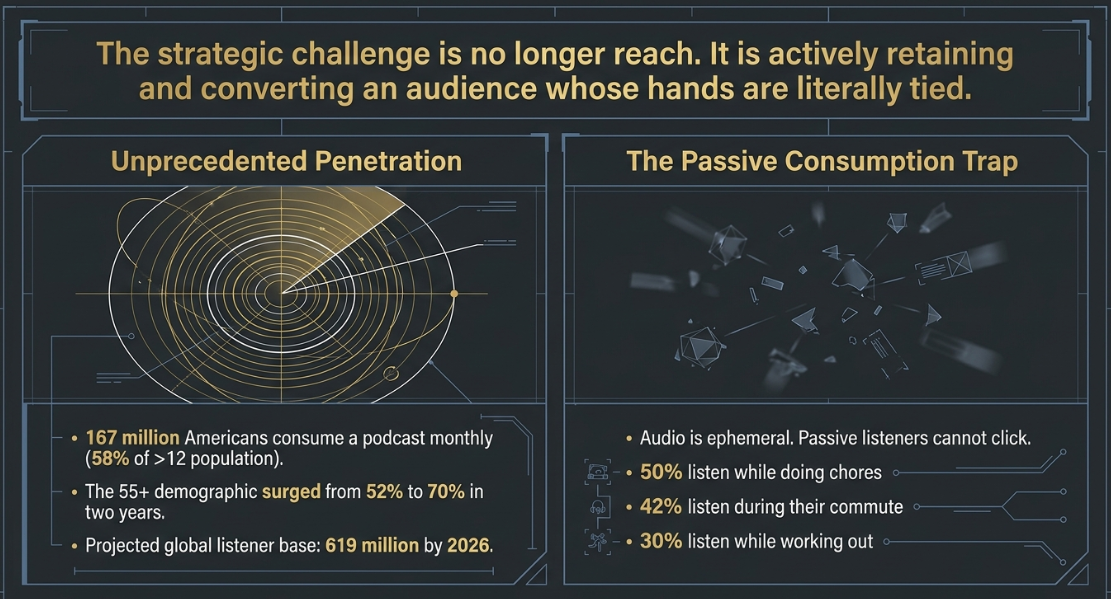
Yet, the core strategic challenge for modern publishers, enterprise brands, and independent creators is not merely reaching this vast audience, but actively retaining and converting them. Audio, by its nature, is a passive and ephemeral medium. Listeners predominantly consume content while driving, exercising, or performing household chores, making direct-response actions inherently difficult to track and optimize2. Nearly 50% of people listen while doing chores, 42% during their commute, and 30% while working out2.
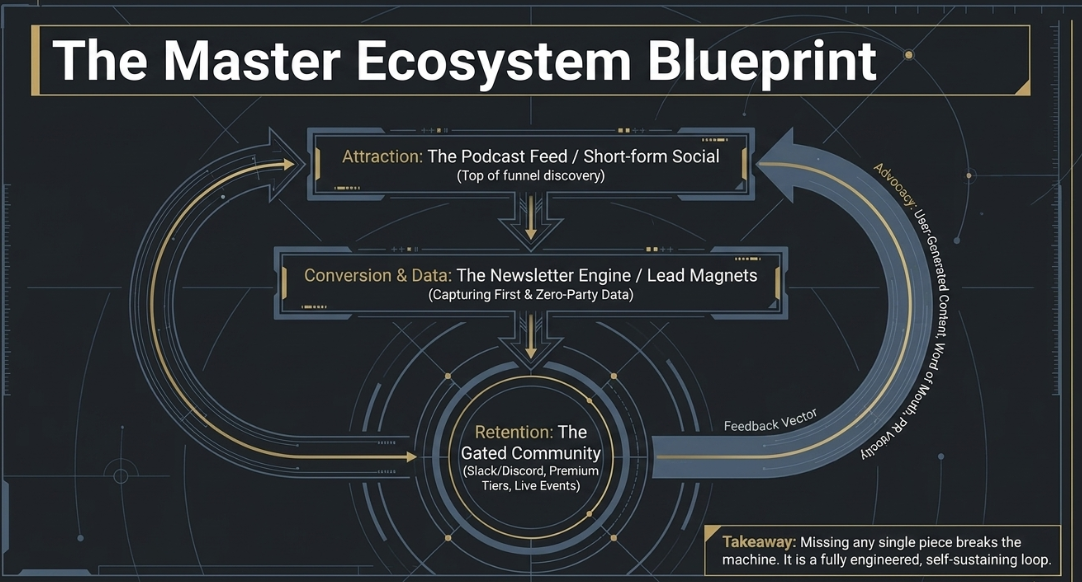
To overcome the inherent limitations of the audio format, successful audio brands are constructing robust ecosystems that capture the listener's attention across multiple touchpoints. By employing "hub and spoke" frameworks, creators channel passive audio listeners into active community members and dedicated newsletter subscribers3. This comprehensive strategic report explores the theoretical mechanics of the podcast marketing flywheel, the architectural design of audio-first communities, the conversion strategies powering the newsletter engine, the critical importance of first-party data collection, and the evolving metrics governing podcast monetization and advertising effectiveness in a cookieless future.
The Podcast Marketing Flywheel Framework
The concept of the "flywheel," originally derived from the mechanics of the Watt steam engine—which stores rotational energy to sustain momentum with decreasing effort—perfectly encapsulates the modern podcast growth trajectory5. In business strategy, popularized by Jim Collins in his analysis of Amazon, the flywheel represents a virtuous cycle where an initial investment of massive energy eventually leads to self-sustaining acceleration6. In the context of strategic podcast marketing, the flywheel dismantles the traditional linear approach of content creation, replacing it with a cyclical mechanism where audience engagement fuels content quality, which in turn drives organic advocacy and new listener acquisition.
Overcoming the Content Treadmill
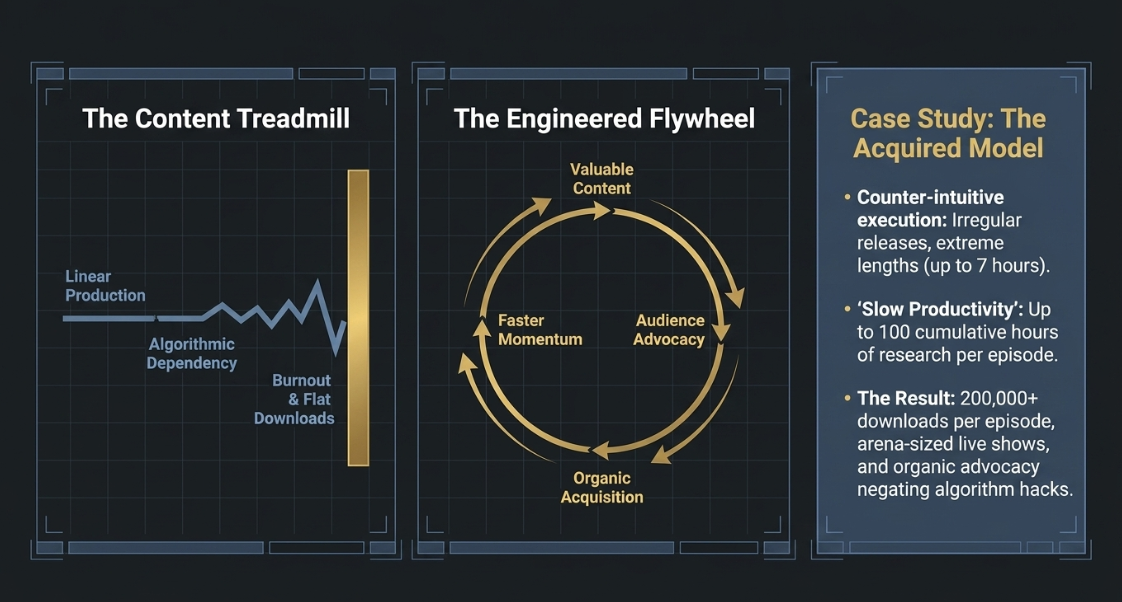
Most early-stage audio creators and B2B marketers fall into the trap of the "content treadmill." They operate under the assumption that producing a higher volume of episodes, launching continuous social media campaigns, or chasing algorithmic virality is the sole path to audience growth3. This approach frequently leads to creator burnout and flatlining download metrics, primarily because the audio content was never structurally designed to convert passive listeners into engaged community members or buyers3.
The flywheel framework provides an alternative architecture. Instead of linear production, the podcast flywheel operates on interconnected vectors. A customized podcast flywheel begins with the production of highly valuable, deeply researched, long-form content6. This content is then atomized into short, shareable clips to attract first-time listeners6. As the audience samples the content, the creator implements feedback loops to learn about audience preferences, refining the product further5. The improved product converts casual listeners into loyal subscribers, and eventually into active advocates5. These advocates subsequently drive word-of-mouth marketing—the most potent growth engine in the audio space—which attracts new guests and new listeners, thereby spinning the wheel faster with each rotation6.
"Slow Productivity" and the Acquired Case Study
The most compelling real-world execution of the podcast flywheel operating counter to conventional industry wisdom is the Acquired podcast, a venture so successful it became the subject of a comprehensive Harvard Business School case study authored by Shane Greenstein, Susan Pinckney, and Kerry Herman11. Acquired, hosted by David Rosenthal and Ben Gilbert, dissects the histories, strategic pivots, and business models of major technology and enterprise companies, evaluating high-tech startups and their digital business models12.
Rather than adhering to standard podcasting advice—which typically dictates releasing short, highly edited 40-minute episodes on a strict weekly schedule—Acquired releases episodic deep dives irregularly, often waiting over a month between publications13. Their episodes frequently extend past traditional constraints, with a two-part treatment of Nintendo clocking in at nearly seven hours13.
The success of Acquired—which routinely serves over 200,000 downloads per episode, generates substantial advertising revenue, and commands arena-sized live audiences—is rooted in the psychological concept of "slow productivity"13. By obsessing over quality and investing up to 100 cumulative hours of research into a single episode, the hosts trigger an immense flywheel effect13. The exceptional quality and depth of the content naturally compel the audience to advocate for the show, negating the need for a relentless social media strategy. The energy is input directly into the core product, which spins the wheel of organic recommendation far faster than algorithmic growth hacks5. The HBS case study specifically highlights how this operating model allowed the hosts to experiment and create a matching platform for advertisers and customers that entirely broke from conventional media wisdom11.
Architecting the Audio-First Community Ecosystem
While the podcast serves as the top-of-funnel discovery engine, the private online community is the mechanism for deep retention and behavioral insight. Online communities act as the gravitational center of the audio ecosystem, transforming isolated, passive listeners into a cohesive, interactive audience that generates its own momentum.
The Psychology of Community Engagement
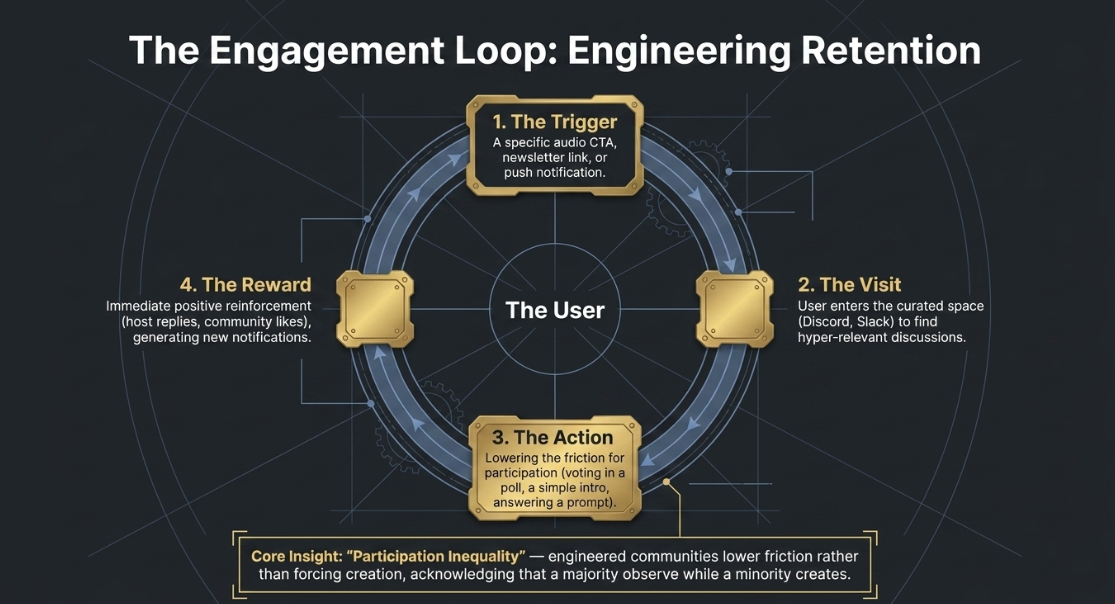
Developing a thriving podcast community requires an intrinsic understanding of "participation inequality," a well-documented sociological principle stating that in nearly any online community, a small minority creates the majority of content, a slightly larger group interacts with it, and the vast majority act as passive observers10. Effective community management does not attempt to force all members to become content creators; rather, it designs systems that lower the friction for participation and reward engagement.
The community engagement loop follows a specific, repeatable architecture:
The Trigger: A notification, an email newsletter, or a direct call-to-action within the podcast episode prompts the listener to visit the community platform10.
The Visit: The user enters the community space (e.g., Discord, Slack) and encounters highly relevant, curated content10.
The Action: The user engages by voting in a poll, leaving a comment, answering a prompt, or introducing themselves to the group10.
The Reward: The user receives immediate positive reinforcement via likes, direct replies from the host, or community recognition, which restarts the cycle by generating notifications for others10.
Designing for Specific Demographics: Goalhanger Podcasts
The implementation of community ecosystems varies widely depending on the audience demographic and the creator's underlying monetization strategy. Goalhanger Podcasts, the UK's leading independent podcast production company founded by Gary Lineker, Jack Davenport, and Tony Pastor, provides a masterclass in utilizing community to drive a premium subscription business16.
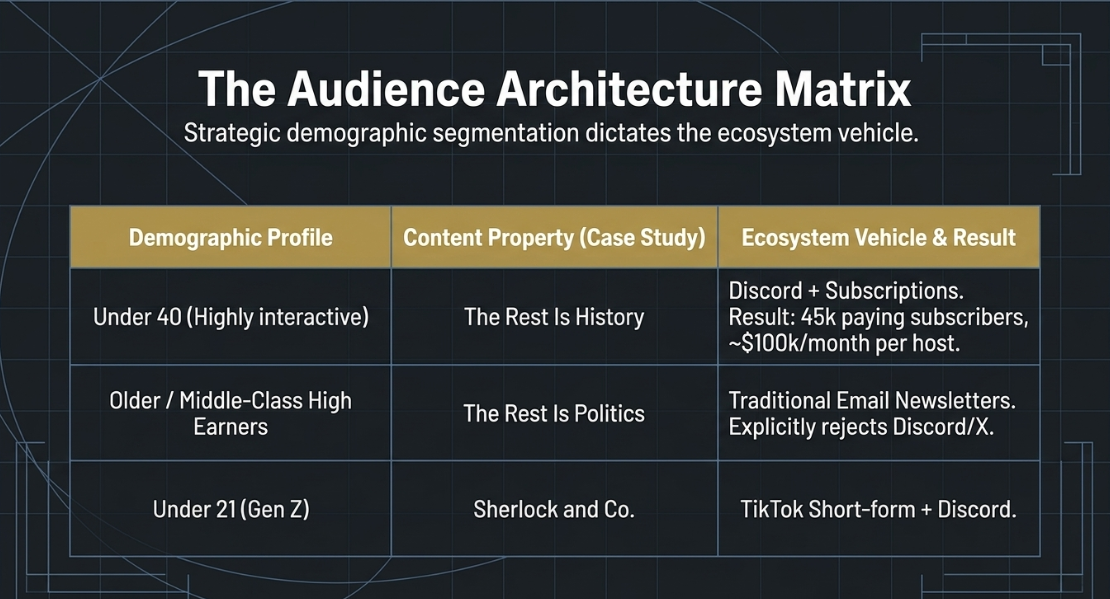
Goalhanger's flagship historical podcast, The Rest Is History, hosted by historians Tom Holland and Dominic Sandbrook, has achieved extraordinary scale. As of October 2024, the program generates 11 million monthly downloads and 1.2 million monthly YouTube views18. More critically, the hosts successfully converted this audience into over 45,000 paying subscribers for "The Rest Is History Club," generating estimated monthly earnings of nearly $100,000 for each host18. The success of this conversion relies heavily on community features. Members gain access to a highly active, private Discord chatroom, alongside ad-free listening, exclusive miniseries, and priority access to live festival tickets19. Notably, 70% of this specific audience is under the age of 40, a demographic highly receptive to Discord-based interaction18.
Conversely, Goalhanger actively tailors its community platforms to different listener profiles. For The Rest Is Politics, hosted by Alastair Campbell and Rory Stewart, the audience skews toward older, middle-class high earners16. This demographic explicitly rejects platforms like Discord or X (formerly Twitter)17. Consequently, Goalhanger prioritizes standard email newsletters as the primary community touchpoint for this group. For their fictional drama podcast, Sherlock and Co., where nearly half the members are under 21, the community management pivots entirely away from email and toward interactive, short-form spaces like TikTok and Discord17. This strategic demographic segmentation ensures that the community architecture matches the behavioral habits of the listener base.
Value Extraction: Lenny's Podcast and Flywheel DeFi
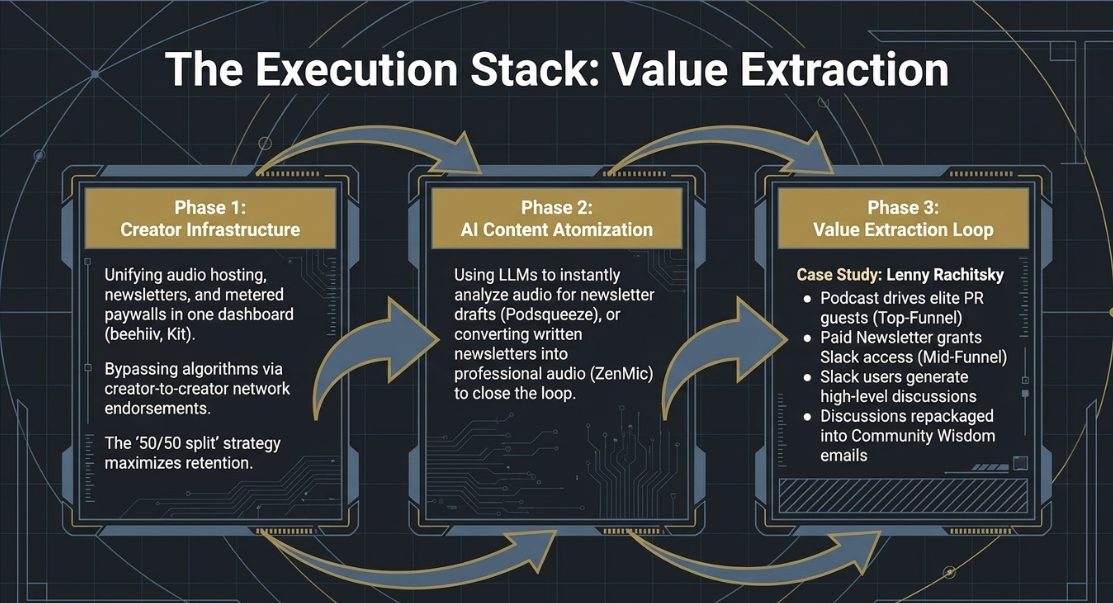
Community ecosystems also serve as powerful content generation engines. Lenny Rachitsky has built a highly influential media empire encompassing a Substack newsletter with 1.2 million subscribers, a top-tier business podcast boasting 500,000 YouTube subscribers, and a highly curated private Slack community21. In this ecosystem, the podcast acts primarily as the top-of-funnel marketing vehicle, maintaining a positive, PR-friendly environment that guarantees a steady stream of elite tech industry guests22. The true monetization and community depth occur in the mid-funnel: the paid newsletter subscription, which grants access to the Slack community21. The members of this Slack community provide immense utility by generating their own high-level discussions on product management and AI integration. Rachitsky subsequently repackages the best of these discussions into weekly "Community Wisdom" emails, creating a self-sustaining content loop that further spins the flywheel21.
In the cryptocurrency sector, Flywheel DeFi operates a grassroots media platform focused on Frax Finance. Their ecosystem extends the concept of community beyond digital borders by organizing in-real-life (IRL) meetups at major blockchain conferences in cities like Amsterdam, Paris, and Tokyo24. By supplementing their weekly authoritative podcast interviews with educational hackathons (FraxBuild) and physical merchandise, they cultivate a deeply dedicated group of "Fraximalists" who actively advocate for the protocol's adoption across the broader decentralized finance landscape24.
The Newsletter Engine: Bridging Audio and the Inbox
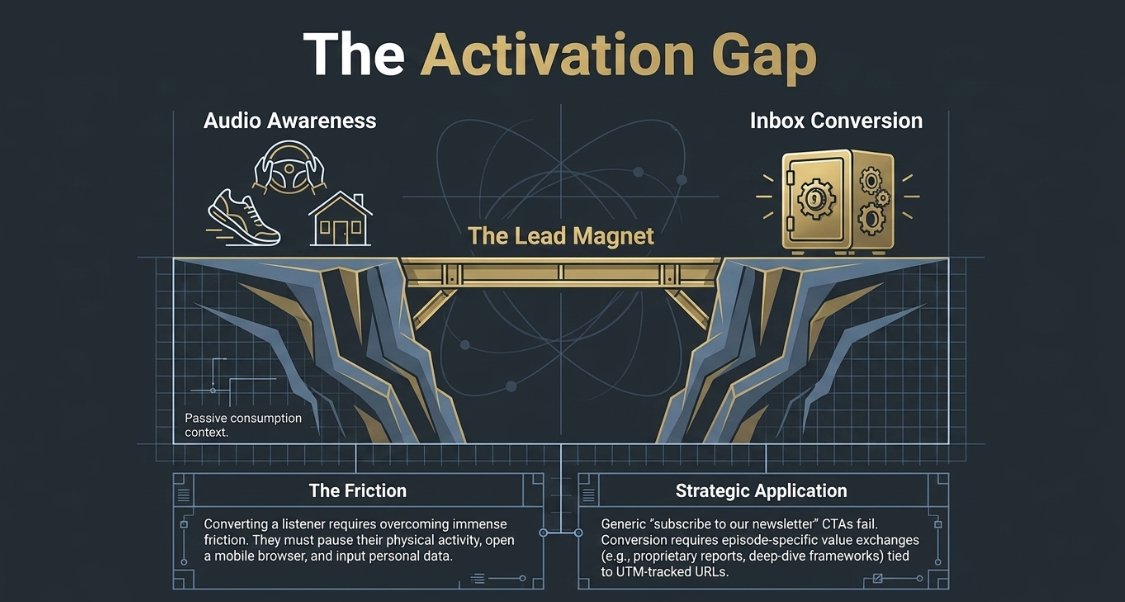
If the private podcast community serves as the town square, the email newsletter operates as the direct, unfiltered line to the listener's home. Email marketing is the ultimate bridge between passive audio awareness and active, measurable conversion. Because podcast listeners cannot easily click a hyperlink or fill out a form while driving or running, the primary strategic goal of the audio broadcast must be to drive the listener to an owned asset, specifically the email inbox.
Conversion Mechanics, Friction, and Benchmarks
Converting an audio listener to an email subscriber requires overcoming significant friction. The listener must actively pause their current activity, open a mobile browser, navigate to a specific landing page, and input their personal data. Consequently, achieving high conversion rates requires compelling value exchanges, commonly referred to as "lead magnets," such as proprietary industry reports, exclusive bonus audio, or deep-dive analytical frameworks25.
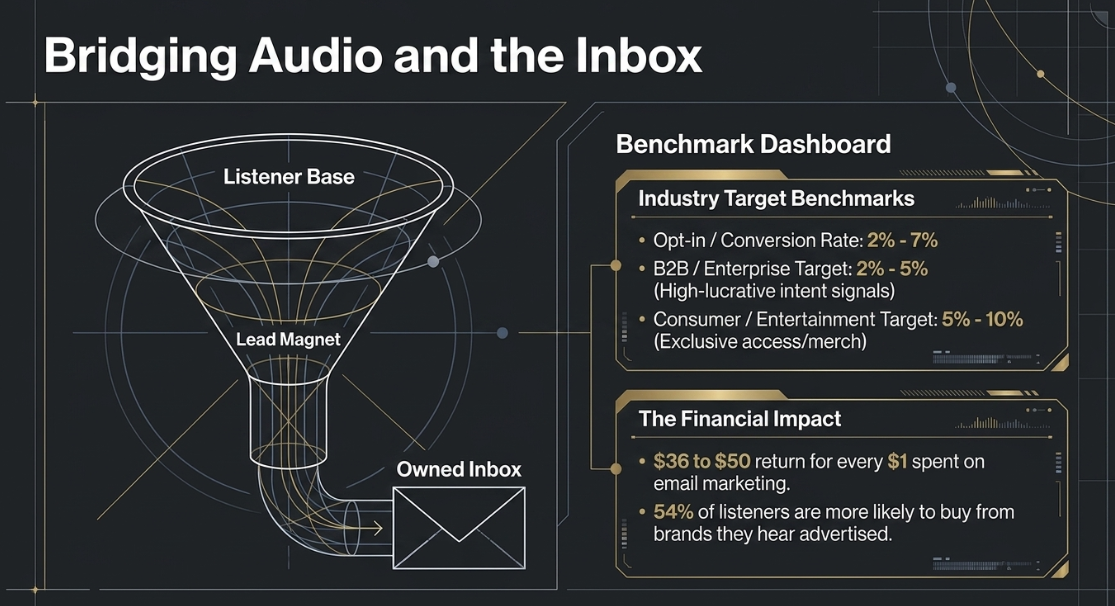
Industry data indicates that a healthy listener-to-newsletter conversion rate generally falls between 2% and 7%27. The specific benchmarks differ based on the podcast's genre and the nature of the offer:
B2B and Enterprise Podcasts: Average conversion rates sit between 2% and 5%27. These audiences require high-value, career-oriented resources. A conversion in this space is highly lucrative, as business-to-business intent signals can directly accelerate active sales pipelines25.
Consumer and Entertainment Podcasts: Average conversion rates are slightly higher, ranging from 5% to 10%27. These higher rates are often driven by the promise of exclusive merchandise discounts, early access to live show tickets, or premium bonus entertainment content27.
To maximize these conversion rates, podcast marketers utilize highly targeted Calls to Action (CTAs). Instead of a generic plea to "subscribe to our newsletter," sophisticated campaigns use episode-specific lead magnets tied to tracking URLs with UTM parameters25. This allows marketers to measure precise opt-in rates and attribute downstream conversions directly to specific podcast episodes25. The return on investment for this effort is substantial; research from Litmus indicates that marketing leaders attribute $36 to $50 in return for every $1 spent on email marketing25. Furthermore, Edison Research data reveals that 54% of podcast listeners are more likely to consider buying from brands they hear advertised, making the email follow-up a highly primed conversion mechanism25.
The Rise of Creator-Centric Platforms: beehiiv and Kit
The technological infrastructure supporting podcast newsletters has evolved significantly, shifting away from generic email service providers toward specialized, creator-centric platforms.
The publishing platform beehiiv has aggressively expanded its feature set to capture the entire creator ecosystem. Originally a newsletter tool, beehiiv recently introduced native podcast hosting, RSS distribution, and advanced creator tools including live webinars and metered paywalls28. This unified architecture allows publishers to manage their audio feeds, written content, premium subscription tiers, and digital product sales from a single dashboard, keeping 100% of their subscription revenue28. To aid creators in monetizing free listeners, beehiiv implemented metered paywalls—allowing creators to set limits (e.g., three free posts per month) before a hard paywall triggers—and paid trials requiring an upfront credit card, significantly increasing long-term retention30. Data analysis of thousands of top beehiiv publications reveals that the most successful creators utilize a "50/50 split," locking exactly half of their content behind premium tiers, and optimize their written newsletters for a four-minute reading sweet spot32. Furthermore, by integrating open-source AI analytics into podcasting, beehiiv allows creators to query their data directly through Large Language Models (LLMs), asking plain-language questions about download geography, app usage, and transcript generation30.
Similarly, platforms like Kit (formerly ConvertKit) emphasize creator autonomy and collaboration. Kit provides robust tools for podcasters to build free, brand-aligned landing pages that embed audio players alongside sophisticated email capture forms33. Through Kit's Creator Network, podcasters can recommend each other's newsletters directly within the subscription flow33. This utilizes trusted, creator-to-creator endorsements to bypass unpredictable algorithmic discovery, allowing shows to grow their lists exponentially faster through audience sharing33. Financial podcaster Nick True highlights this transition, noting that moving from platform-owned audiences to owned email lists secures the relationship and creates reliable, algorithm-proof revenue streams33.
AI Integration and Content Atomization
The operational burden of maintaining both a high-quality podcast and a compelling, regular newsletter has traditionally led to creator burnout. However, the integration of Artificial Intelligence into the podcasting workflow has streamlined this process dramatically. Platforms like Podsqueeze utilize AI to instantly analyze podcast audio files, pinpoint main themes, and generate optimized newsletter drafts35. These drafts include essential elements such as subject lines, bulleted summaries, timestamps, and calls to action, reducing hours of manual writing to mere minutes35.
Conversely, tools like ZenMic reverse this process entirely. They allow creators to input text-based newsletters, which the AI then rewrites into natural-sounding dialogue and renders into professional audio36. By keeping intros under 30 seconds and adding verbal calls to action that mirror the newsletter's primary links, creators can effortlessly turn email subscribers into podcast listeners, completely closing the content loop36.
Operationalizing Retention and Feedback Loops
While acquiring email addresses and community members is the first step, active operational management is required to prevent churn and foster long-term loyalty. Audience retention is arguably a more vital metric than total initial downloads, as it directly reflects content quality and sustained audience satisfaction.
Mastering the Feedback Loop: SpeakPipe and Voice Interactions
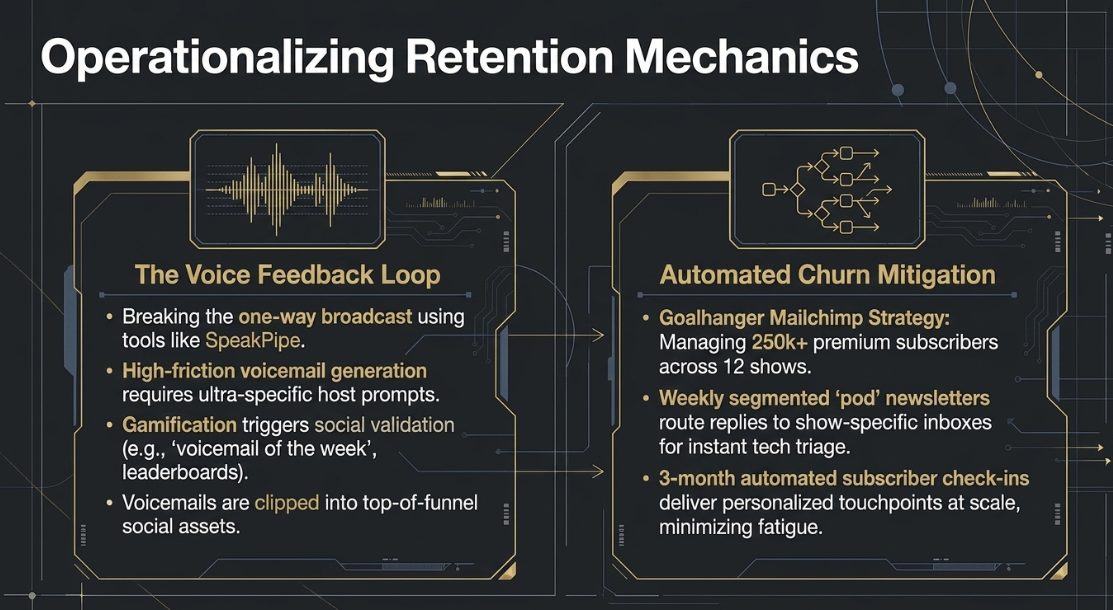
Interactive podcasting transforms the medium from a one-way broadcast into a multi-directional conversation. Integrating listener voices directly into the audio product is a highly effective psychological retention strategy. Tools like SpeakPipe allow listeners to record voice messages directly from a podcaster's website or dedicated voicemail page, which hosts can then seamlessly integrate into subsequent episodes8.
Creating a successful voicemail segment requires a deep understanding of audience psychology. The friction required for a listener to record a voice message is extremely high. To mitigate this, hosts must avoid generic requests and instead provide highly specific, structured prompts39. When a listener hears their own voice, or the voice of a peer, broadcasted on their favorite show, it cements their loyalty and signals to the wider audience that the community is actively listening and participating8. To accelerate this behavior, sophisticated creators utilize gamification—such as implementing a "voicemail of the week" segment or an anonymous leaderboard—which builds a repeatable loop that social media algorithms readily promote39. Every compelling voicemail can be cut into a standalone social clip with a cold open and captions, turning community engagement directly into top-of-funnel marketing assets39.
Operationalizing Churn Mitigation: Goalhanger's Mailchimp Strategy
A definitive example of operationalizing the newsletter engine for retention is demonstrated by Goalhanger's strategic use of Mailchimp to manage its vast portfolio of premium shows17. To prevent subscription churn across its TRIP+ and Rest Is History Club memberships, Goalhanger implements several highly sophisticated email workflows:
Direct Feedback Triage: Goalhanger sends weekly newsletters specifically segmented for each show's membership "pod." These newsletters explicitly ask for listener replies17. When highly engaged listeners reply directly to these Mailchimp-sent newsletters, the responses land in show-specific inboxes which are triaged every morning. This allows the community management team to resolve technical issues instantly, effectively minimizing the technical frustration that leads to immediate churn17.
Automated Customer Journeys: Recognizing that personalized communication scales poorly across 250,000 subscribers, Goalhanger utilizes Mailchimp's Customer Journey Builder to automate relationships17. For example, exactly three months after a user subscribes, they automatically receive an appreciative email checking in on their experience17. While automated, this strategy incorporates a personal touch that prompts high reply rates, making the subscriber feel valued17.
Streamlined Campaign Management: Managing 12 different shows requires immense operational efficiency. Goalhanger utilizes Mailchimp's Campaign Manager and replicate tools to ensure consistent branding and layout across all communications, visualizing the entire schedule to ensure no subscriber cohort is over-messaged, which leads to audience fatigue17.
Measuring Community Health: Advanced KPIs
To ensure these retention strategies and feedback loops are functioning correctly, audio brands must monitor advanced Key Performance Indicators (KPIs) that extend far beyond standard RSS download metrics.
Daily and Monthly Active Users (DAU/MAU): Tracks the ratio of users who engage with the community platform daily versus monthly. Consistently high active user metrics indicate a vibrant, healthy community environment10.
Activation Rate: Measures the percentage of new community members or product users who reach a specific engagement milestone (their first "aha!" moment) within a specific timeframe42. High activation rates correlate strongly with long-term retention; data from Twilio Segment indicates that even a 1% increase in activation can scale to $1.5 million in annual recurring revenue over five years42.
Average Listening Time and Completion Rates: Monitoring how long listeners stay engaged with an episode. Current data shows 35% of listeners drop off within the first five minutes; achieving a 90% listen-through rate indicates exceptional narrative pacing and audience alignment7.
Net Promoter Score (NPS): Gathered via email surveys, NPS measures the likelihood that a listener will recommend the podcast or premium subscription to a friend on a scale of 0 to 10, providing a quantifiable metric for word-of-mouth growth potential41.
First-Party Data: The Ultimate Audio Asset
The strategic pivot toward newsletters and private communities is not merely about engagement; it is fundamentally a pursuit of first-party data. In the context of digital marketing, first-party data refers to information collected directly from an audience via interactions on owned channels, such as email subscriptions, website behavior, e-commerce transactions, and direct survey responses43.

Navigating the Cookieless Future
As global privacy regulations tighten and major tech platforms phase out third-party tracking cookies, digital marketers are losing the ability to reliably track users across the open web46. Podcasting has historically suffered from a severe lack of granular data; standard RSS feeds provide basic delivery metrics, device types, and broad geographic regions, but they completely fail to capture demographic details, purchase intent, or cross-platform browsing behavior.
By incentivizing listeners to join an email list or a gated community, podcast hosts effectively bridge this critical data gap. A newsletter subscription transitions an "unknown" anonymous listener into a "known" deterministic entity45. With an email address acting as a unique identifier, publishers can collect zero-party data—information a customer intentionally and proactively shares regarding their preferences, budget, or job title—through welcome surveys, preference centers, and conversational forms26.
To effectively harness this, modern media organizations execute rigorous "data censuses"45. This step-by-step methodology requires forming a cross-functional team, mapping all current data sources, categorizing the data by type (zero, first, second, or third-party), establishing a recency "shelf life" for the data, and conducting a gap analysis to ensure the collected information actually aligns with organizational monetization goals45.
The Impact on Advertising Efficacy
The acquisition of high-quality first-party data dramatically increases the commercial value of a podcast audience. Advertisers, particularly in the B2B and direct-to-consumer sectors, are willing to pay significant premiums for verified, deterministic data over assumed demographic targeting.
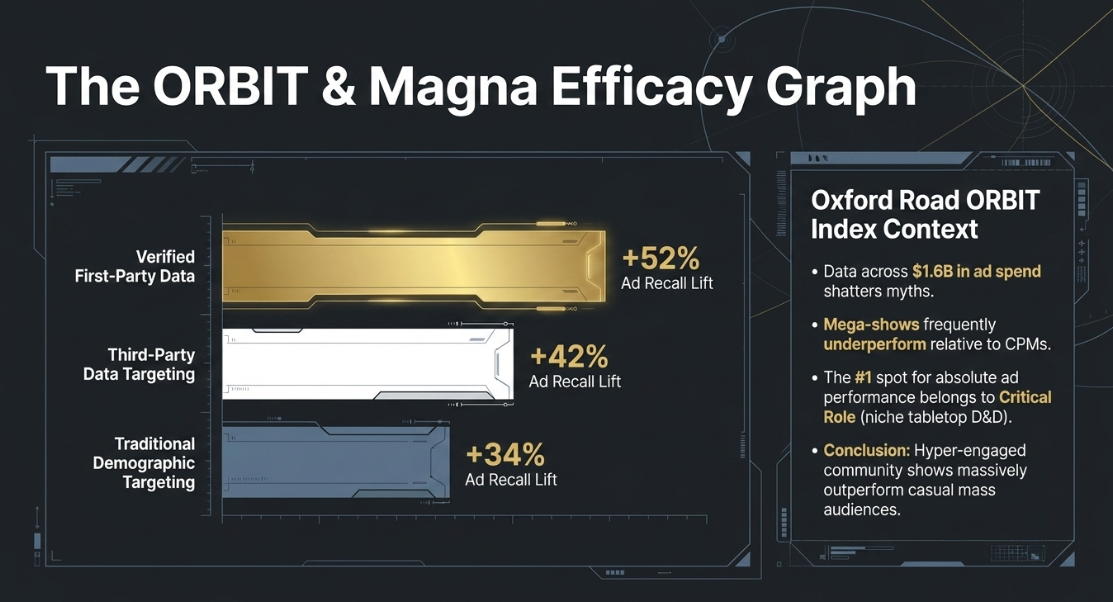
A landmark study conducted by Magna Media Trials and SiriusXM demonstrated the profound impact of data quality on audio advertising effectiveness. Campaigns utilizing first-party data delivered a staggering 52% increase in aided ad recall47. In contrast, campaigns relying on third-party data saw only a 42% increase, and traditional demographic targeting yielded a mere 34% increase47. Consequently, the newsletter engine is not simply a tool for content distribution; it is the vital mechanism for capturing the first-party data necessary to secure premium advertising rates in an increasingly competitive media landscape.
Monetization, Measurement, and the New Advertising Reality
The culmination of a thriving content flywheel, a highly engaged community, a robust newsletter engine, and rich first-party data is a highly lucrative monetization engine. The podcast advertising industry is experiencing explosive growth, projected to exceed $5 billion globally by 2026, with the US market accounting for nearly $2.9 billion1. However, the distribution of this revenue is shifting rapidly as advertisers demand greater accountability, verified performance tracking, and cross-format execution.
The Unparalleled Power of the Host-Read Endorsement
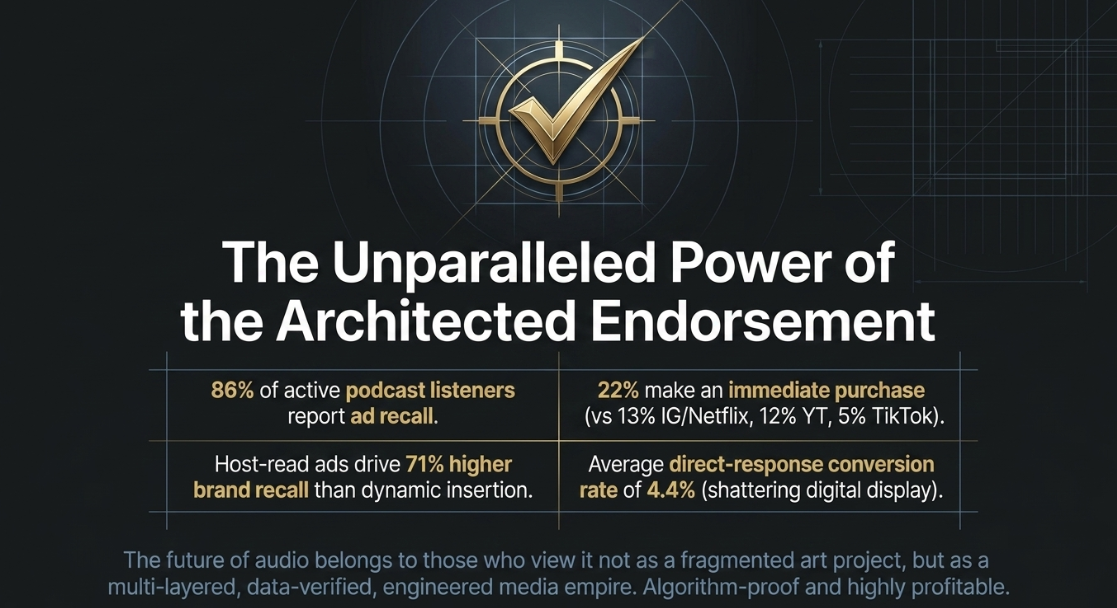
Despite advancements in programmatic digital audio advertising and dynamic ad insertion (DAI), the host-read ad remains the gold standard of podcast monetization48. Because the listener has developed a deep parasocial relationship with the host—a relationship continuously reinforced by newsletters, Discord interactions, and IRL events—the host's personal endorsement carries immense psychological weight.
Authoritative data confirms the unparalleled efficacy of this format. An astonishing 86% of active podcast listeners report ad recall, and 47% have purchased a product based specifically on a podcast recommendation1. Most notably, 22% of monthly podcast listeners make an immediate purchase after hearing a podcast ad, compared to just 13% for Netflix/Instagram, 12% for YouTube, and a mere 5% for TikTok viewers1. Furthermore, host-read ads drive a 71% higher brand recall rate than pre-produced, dynamically inserted spots1. This high-trust environment allows premium podcasts to convert direct-response campaigns at remarkable rates, often averaging a 4.4% conversion rate, significantly outperforming traditional digital display channels27.
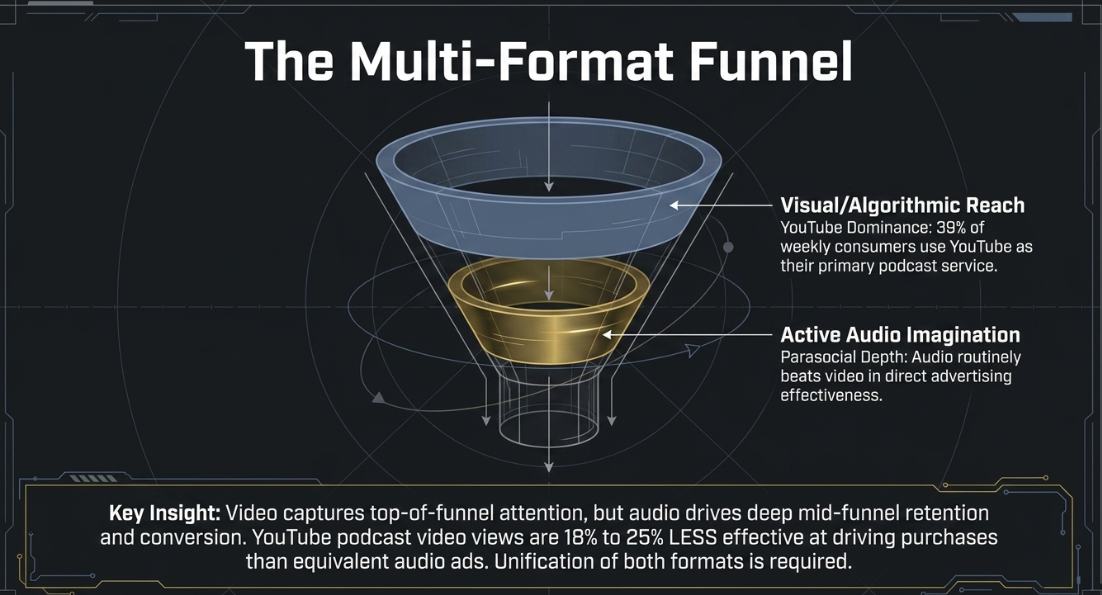
When comparing media channels, Adelaide AU attentiveness scores reveal that podcasts possess 94% of the attentiveness of linear television, far exceeding streaming audio (86%) and AM/FM radio (85%)49. This intentional, active listening environment is precisely why audio formats routinely beat video formats in advertising effectiveness; a recent Oxford Road and Podscribe study revealed that YouTube podcast video views are 18% to 25% less effective at driving purchases than the equivalent audio podcast ads, largely because audio requires active imagination while video allows for passive consumption49.
ORBIT and the Bumper Score: The Push for Verification
As major brand advertisers allocate larger portions of their marketing budgets to audio, the industry is experiencing a necessary reckoning regarding measurement, viewability, and transparency. For years, the industry relied on flawed server-side download metrics, which often failed to reflect actual human listenership, ad delivery, or completion rates50. Analysts estimate that implementing better data and verification methods could unlock an additional $1 billion in untapped ad spend for the industry50.
To solve this trust gap, prominent analytics firms and agencies are introducing rigorous verification standards. Oxford Road, the world's largest podcast advertising agency, launched the ORBIT (Oxford Road Benchmark Intelligence Tool) index to track actual customer acquisition costs, return on ad spend, and sales results across $1.6 billion in campaign data52. The ORBIT data shattered conventional industry wisdom. Their rankings revealed that massive, mainstream mega-shows (like The Joe Rogan Experience) often underperform relative to their high CPMs (Cost Per Mille) and were largely absent from the top 15 performers53. Instead, highly niche, deeply engaged community shows took the lead. Critical Role, a podcast focused entirely on professional voice actors playing tabletop Dungeons & Dragons, took the #1 spot for absolute ad performance, proving that passionate, niche audiences massively outperform casual mass audiences53. Furthermore, despite widespread brand safety anxieties among advertisers, ORBIT data indicated that comedy and political podcasts dominated the top 15 list (including The David Pakman Show at #2 and Strict Scrutiny at #10), proving that controversial, highly opinionated content drives superior consumer action53.
Simultaneously, the introduction of the Bumper Score provides the podcasting industry with a standardized metric for audience verification. Designed by Jonas Woost and Dan Misener, the Bumper Score acts as a definitive "viewability" standard for audio50. It aggregates podcast delivery data from hosting providers, verified audience data from major podcast apps, and episode-level retention data to generate a score between 0 and 200, with 100 representing the industry average50. By creating an independent signal derived entirely from first-party data, the Bumper Score gives publishers the cryptographic proof required to command premium ad rates, and gives media buyers the confidence to scale their investments by mitigating the risk of fraudulent or unengaged downloads50.
The Future is Multi-Format
Any modern audio ecosystem must account for the rapid convergence of audio and video. Edison Research data confirms that YouTube has now surpassed Spotify and Apple as the single most-used podcast destination, with 39% of weekly podcast consumers utilizing the platform as their primary service1. This behavioral shift necessitates that podcast advertising is increasingly evaluated as a combined video-and-audio opportunity. Shows that successfully integrate host-read video sponsorships alongside their audio feeds are capturing a disproportionate share of brand budgets1.
To navigate and maximize the yield from this multi-format reality, platforms like Sounds Profitable—an industry trade association with over 10,000 newsletter subscribers—continuously provide deep-dive research into brand fans, streaming behaviors, and dynamic ad insertion technologies28. Their partnerships with creator-first platforms like beehiiv emphasize that the future belongs to creators who do not treat audio as a standalone add-on, but rather unify their text, video, and audio assets into a seamless, highly integrated media stack28.
By combining the intimate trust of the host-read audio ad with the targeted precision of email marketing, the retentive power of online communities, and the cryptographic proof of verified data measurement, modern podcast strategists can build resilient, highly profitable media empires that remain immune to the whims of unpredictable algorithms.
Works cited
Audio Advertising in 2026: Stats, Trends and Opportunities - AudioGo, https://www.audiogo.com/blog/audio-advertising-in-2026
Castovers: Podcast Directory, https://www.castovers.com/
Podcast Marketing, Evergreen Sales Funnel & Lead Generation for Coaches & Consultants - Buzzsprout, https://feeds.buzzsprout.com/1265354.rss
Podcast Marketing Services for B2B Companies Guide - Rise 25, https://rise25.com/lead-generation/podcast-marketing-services-b2b/
Podcast Growth Flywheels: How to Grow Faster with Less Effort, https://podcastmarketingacademy.com/podcast-flywheels/
How To Create A Successful Podcast Using 'The Flywheel' - Rick Kettner, https://rickkettner.com/how-to-create-a-successful-podcast/
Track Podcast Engagement Trends Over Time - Podgagement, https://podgagement.com/track-podcast-engagement-trends-over-time/
Engaging Your Podcast's Audience with Listener Feedback, https://listeningdogmedia.com/engaging-your-podcast-audience/
Flywheel Leadership - Apple Podcasts, https://podcasts.apple.com/us/podcast/flywheel-leadership/id1760600369
Community Engagement Playbook: Proven Strategies to Grow and Retain Members, https://buddyboss.com/blog/community-engagement-playbook-proven-strategies-to-grow-and-retain-members/
The Acquired Podcast: Scaling the Mic - Case - Faculty & Research, https://www.hbs.edu/faculty/Pages/item.aspx?num=68094
The Acquired Podcast: Scaling the Mic | Harvard Business Impact Education, https://hbsp.harvard.edu/product/626031-PDF-ENG
How the Acquired Podcast Became a Sensation - Cal Newport, https://calnewport.com/how-the-acquired-podcast-became-a-sensation/
The making of 'Acquired,' the No. 1 tech podcast sensation - Fast Company, https://www.fastcompany.com/90927453/acquired-number-1-tech-podcast-sensation
Is Podcasting Still Growing in 2026? - Transistor, https://transistor.fm/podcast-listeners/
The Rest Is Politics - Wikipedia, https://en.wikipedia.org/wiki/The_Rest_Is_Politics
Goalhanger Embraces 2‑Way Communication to Drive Retention - Mailchimp, https://mailchimp.com/case-studies/goalhanger-customer-retention/
The Rest Is History (podcast) - Wikipedia, https://en.wikipedia.org/wiki/The_Rest_Is_History_(podcast)
Join The Rest Is History Club | Exclusive Content & Events | The Rest Is History, https://therestishistory.com/
The Rest Is Politics - Apple Podcasts, https://podcasts.apple.com/us/podcast/the-rest-is-politics/id1611374685
Reluctantly Influential: Inside Lenny Rachitsky's Demandingly Chill Life, https://review.firstround.com/reluctantly-influential-inside-lenny-rachitskys-demandingly-chill-life/
Lenny's podcast + newsletter review : r/ProductManagement - Reddit, https://www.reddit.com/r/ProductManagement/comments/1mizhwz/lennys_podcast_newsletter_review/
Community wisdom | Lenny's Newsletter | Substack, https://www.lennysnewsletter.com/s/community-wisdom
Flywheel DeFi - Projects & Protocols | IQ.wiki, https://iq.wiki/wiki/flywheel-defi
Podcast Email Marketing: Convert Listeners Into B2B Leads | Content Allies, https://contentallies.com/learn/podcast-email-marketing
How to become the obvious choice over AI - gaining trust with psychological heuristics, CreatingReorganized Show, https://postdoctransformation.ac-page.com/creatingreorganized_show0014
How To Measure Listener Conversion Rates - Podgagement, https://podgagement.com/how-to-measure-listener-conversion-rates/
Sounds Profitable Welcomes beehiiv to its Partner Network, https://soundsprofitable.com/press-release/sounds-profitable-welcomes-beehiiv-to-its-partner-network/
Creating a podcast on beehiiv, https://www.beehiiv.com/support/article/39459323549591-creating-a-podcast-on-beehiiv
Webinars - Product Updates by beehiiv, https://product.beehiiv.com/p/webinars
Beehiiv adds even more features to go up against competitors and win over creators, https://digiday.com/media/beehiiv-adds-even-more-features-to-go-up-against-competitors-and-win-over-creators/
I analyzed 1000 top Beehiiv posts (Paywalls, Reading Times, & Authors) using a new exporter tool I built - Reddit, https://www.reddit.com/r/beehiiv/comments/1rxb4h1/i_analyzed_1000_top_beehiiv_posts_paywalls/
Email Marketing for Podcasters | Grow Your Listeners - Kit, https://kit.com/use-cases/podcasters
Flodesk vs Kit (ConvertKit) - Why We Switched to the Better Platform - Arner Adventures, https://arneradventures.com/flodesk-vs-convertkit/
Podcast Newsletter Generator - Podsqueeze, https://podsqueeze.com/podcast-newsletter-generator/
Convert Newsletter to Podcast with ZenMic, https://zenmic.com/convert/newsletter-to-podcast/
The How To Podcast Series - Podcast Co-Hosts, Practical Podcast Tips, and Podcast Community - Podcast - Apple Podcast - Apple Podcasts, https://podcasts.apple.com/us/podcast/the-how-to-podcast-series-podcast-co-hosts-practical/id1610039000?l=zh-Hant-TW
Olvy vs. SpeakPipe Comparison - SourceForge, https://sourceforge.net/software/compare/Olvy-vs-SpeakPipe/
How do you drum up interest for a brand-new podcast (especially a voicemail/hotline format)? - Reddit, https://www.reddit.com/r/podcasting/comments/1q4rka1/how_do_you_drum_up_interest_for_a_brandnew/
How To Measure Community Engagement: Key Metrics And Tools | Kajabi Blog, https://www.kajabi.com/blog/how-to-measure-community-engagement
Community Engagement Strategy: Outline, and Best Practices - Watchers.io, https://watchers.io/post/community-engagement-strategy
9 Metrics & KPIs for Customer Engagement - Twilio, https://www.twilio.com/en-us/resource-center/customer-engagement-measure
What is first-party data? Definition, examples, and how to use it - StackAdapt, https://www.stackadapt.com/resources/blog/1st-party-data
First-Party Data: How to Collect and Leverage 1PD - Mailchimp, https://mailchimp.com/resources/first-party-data/
Understanding First-Party Data: A Guide for Newsrooms - News Product Alliance, https://newsproduct.org/blog/understanding-first-party-data-a-guide-for-newsrooms
7 Ways to Get First-Party Data for Targeting & Personalization | Informa TechTarget, https://www.informatechtarget.com/blog/a-cookieless-world-7-ways-to-get-first-party-data-for-targeting-personalization/
Audience Data: Optimizing Your Buy to Reach The Right Listeners - Podbean Blog, https://blog.podbean.com/audience-data-optimizing-you-audience/
17 Statistics That Demonstrate the Effectiveness of Podcast Advertising and Host-Read Ads, https://www.podmuse.com/post/17-stats-that-reveal-the-power-of-podcast-advertising-and-host-read-ads
Don't Be Shocked By The Podscribe/Oxford Road Podcast Sales Effect Study That Reveals Audio Ads Beat YouTube Video Ads In Effectiveness | Westwood One, https://www.westwoodone.com/blog/2026/01/05/dont-be-shocked-by-the-podscribe-oxford-road-podcast-sales-effect-study-that-reveals-audio-ads-beat-youtube-video-ads-in-effectiveness/
Bumper Bridges Gap in Untapped $1 Billion Podcast Advertising Potential with New 'Bumper Score' - Podnews, https://podnews.net/press-release/bumper-score
The next $1 billion in podcasting starts with better data, https://wearebumper.com/blog/the-next-1-billion-in-podcasting-starts-with-better-data
Oxford Road Debunks Persistent Ad Performance Myths Plaguing Entertainment & Media Podcasts - Roastbrief US, https://roastbrief.us/oxford-road-debunks-persistent-ad-performance-myths-plaguing-entertainment-media-podcasts/
Oxford Road Reveals Which Podcasts Actually Sell Products - Podnews, https://podnews.net/press-release/oxford-road-orbit-oct25
Simplecast Unifies Video and Audio for Growth and Discovery - AdsWizz, https://www.adswizz.com/simplecast-unifies-video-and-audio-for-growth-and-discovery/
About Us - Sounds Profitable, https://soundsprofitable.com/about-us/
Sounds Profitable: Home, https://soundsprofitable.com/
Research - Sounds Profitable, https://soundsprofitable.com/research/