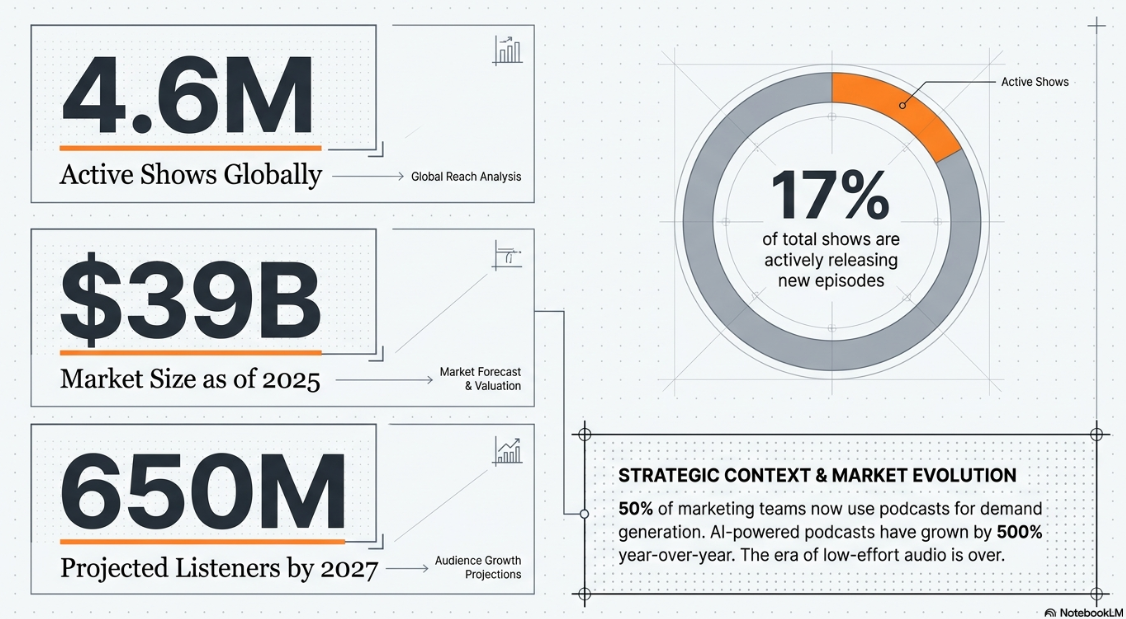
The global podcasting landscape has transitioned from a specialized niche into a highly mature, saturated, and technologically sophisticated medium. As of 2026, the global podcast ecosystem features over 4.2 to 4.6 million active shows, representing a market size that surpassed $39 billion in 20251. Global listenership is projected to scale to approximately 650 million consumers by 20271.
This rapid growth has altered traditional audience discovery patterns3. The historical methodology of optimizing audio files for a single keyword on an isolated directory platform is obsolete3. Discoverability in the current era is defined by a fragmented, multi-surface, and semantic search reality3.
To achieve scalable audience growth and business returns, digital media strategies must treat podcasts not merely as raw audio files, but as structured, multi-format informational networks3. This requires integrating semantic search engine optimization, platform-specific algorithmic alignment, robust RSS metadata management, and an advanced post-production layer powered by artificial intelligence and multimodal machine learning.
The Macro Landscape of Podcast Distribution and Algorithmic Discovery
According to market research, approximately 42% of Americans consume podcasts monthly, with active listeners consuming an average of eight episodes per week5. Listener engagement remains exceptionally high, with 80% of users completing all or most of each episode they initiate5.
In terms of daily audio consumption in the United States, podcasts represent 11% of total listening time2. Demographically, consumption patterns show a slight decline in the 12–34 age range, stability in the 35–54 cohort, and marked growth among listeners aged 55 and older2.
For demographics aged 13 to 64, podcasts have surpassed traditional AM/FM radio in popularity, capturing 41% of daily consumption compared to radio's 39%2. However, for demographics older than 65, traditional radio remains the dominant medium, commanding 66% of consumption compared to podcasting's 13%2.
The Saturation of the Directory Ecosystem
This audience expansion has driven significant publisher saturation1. While millions of podcasts have been created, the percentage of truly active podcasts—defined as shows continuously releasing new episodes—has remained steady at approximately 17% since 20232.
To cut through this competitive field, more than 50% of marketing teams now utilize podcasting as a primary brand promotion and demand generation channel1. Additionally, AI-powered podcasts have grown by 500% year-over-year, intensifying the competition for organic search visibility2.
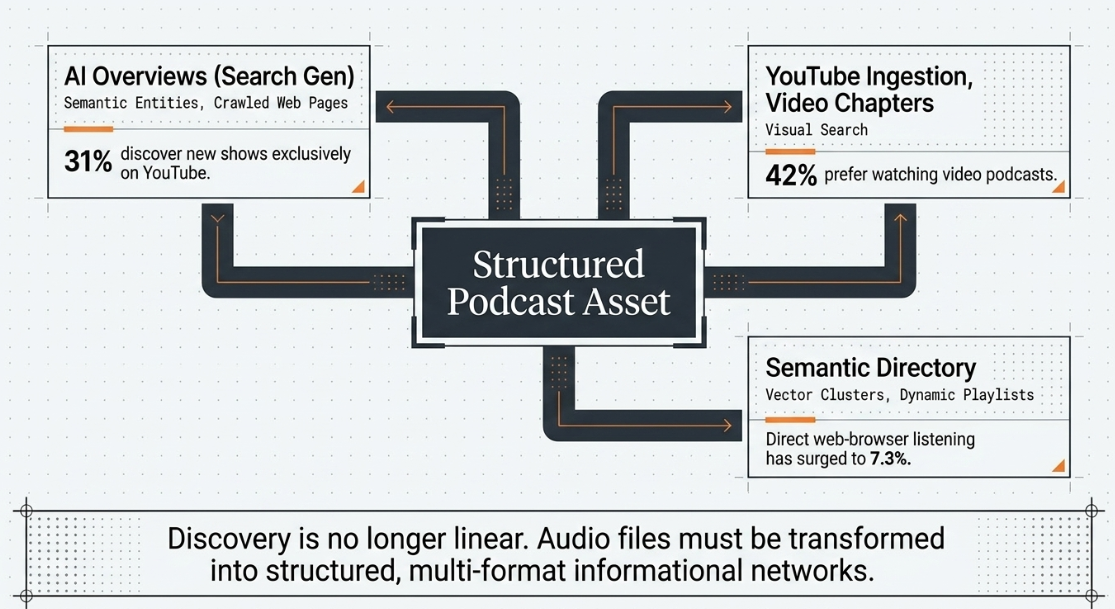
+----------------------------------------+
| Search Generation 2026 |
+-------------------+--------------------+
|
+-----------------------+-----------------------+
| | |
v v v
+-----------------------+ +-----------------------+ +-----------------------+
| AI Overviews (SGE) | | Visual Search (YT) | | Semantic Directory |
| * Semantic Entities | | * Ingested Feeds | | * Vector Clusters |
| * Crawled Web Pages | | * Video Chapters | | * Dynamic Playlists |
+-----------------------+ +-----------------------+ +-----------------------+
The Shift to Multi-Surface Discovery
Traditional podcast directories like Apple Podcasts and Spotify have adapted their search interfaces to behave more like search engines, while general web search engines have integrated audio transcripts into their core crawlers6. Listener discovery habits have shifted accordingly: direct web-browser-based listening rose to 7.3% of total podcast consumption, up from 5.4% in previous tracking periods4.
Furthermore, video-first ingestion has become an essential growth engine4. Approximately 31% of podcast consumers discover new shows on YouTube, and the platform commands a 39% share of monthly podcast consumption in the United States, positioning it ahead of both Spotify and Apple Podcasts4. This shift is reinforced by the finding that 42% of weekly podcast listeners prefer watching video podcasts, compared to only 30% in 20224.
Consequently, modern strategic marketing requires distributing episodes across a diverse range of surfaces—ranging from traditional RSS directories to YouTube playlists, AI-driven search engine overviews, and on-page website indexes3.
Semantic SEO and Entity-Based Audio Indexing
The transition of web search engines (such as Google’s Search Generative Experience, Gemini, and SearchGPT) toward semantic retrieval has changed how audio content is discovered3. Historically, search engines relied on literal string matching7. In 2026, search algorithms leverage natural language processing and dense vector databases to execute semantic search for audio, transitioning from a keyword-centric index to an entity-centric understanding3.
The Mechanics of "Strings to Things"
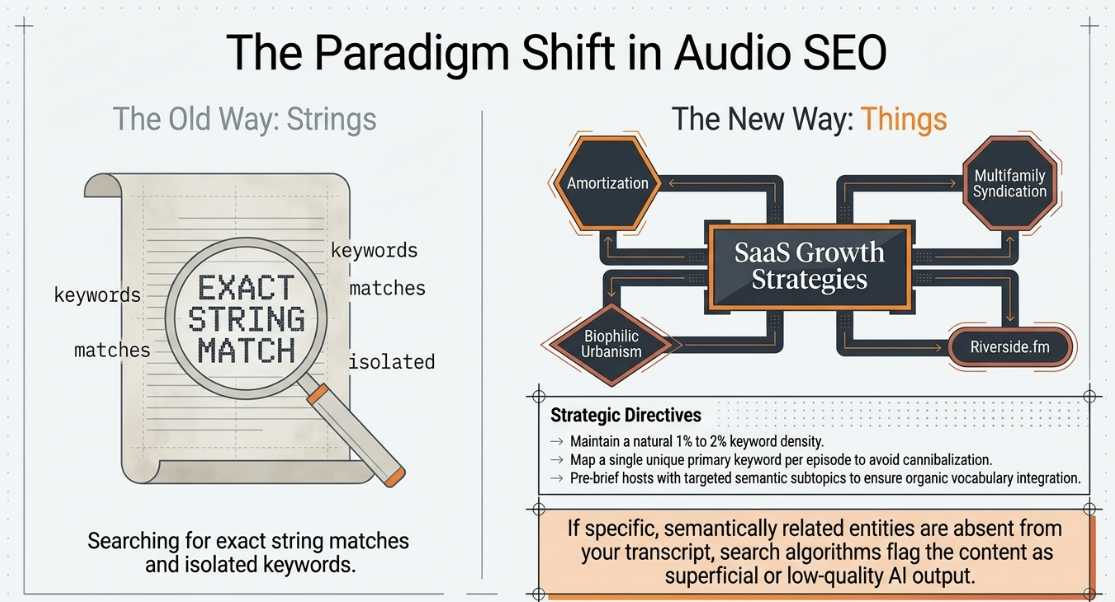
Under the "Strings to Things" paradigm, search engines evaluate whether an episode has true topic authority by analyzing the presence of related entities, conceptual relationships, and content depth3. For example, if an episode's metadata targets "SaaS Growth Strategies," the search crawler expects to find highly specific, semantically related vocabulary within the transcript and descriptions—such as amortization, multifamily syndication, Synthetically Augmented Creative Workflows, Neuro-Inclusive Workplace Design, or biophilic urbanism3.
If these contextual concepts are absent, the algorithm assumes the content is superficial or low-quality AI-generated output, resulting in depressed search rankings3.
To establish true topic authority, content managers must implement structured clustering3:
Thematic Content Clusters: Rather than treating episodes as standalone assets, shows should group multiple episodes around specific industry problems, systematically cross-linking show notes and transcripts to build natural internal link equity1.
Protecting Keyword Ownership: To prevent internal keyword cannibalization, marketing teams should map a single, unique primary keyword to each episode1. According to search methodology, content should aim for a natural 1% to 2% keyword density within titles and descriptions1.
Entity-Rich Mapping: Summaries must explicitly list recognized tools, locations, and personal brands (e.g., Riverside.fm, Capsho, or Adobe Podcast) to feed semantic parsers with recognizable entities3.
Host Pre-Briefing Integration: Hosts should be briefed prior to recording with the targeted search queries, semantic subtopics, and common buyer objections to ensure these key terms are naturally spoken and captured in the audio transcript1.
Post-Interview Title Finalization: Show titles should be written after the interview is completed to align with the actual questions answered during the conversation1.
Descriptive Timestamps as Sitelinks
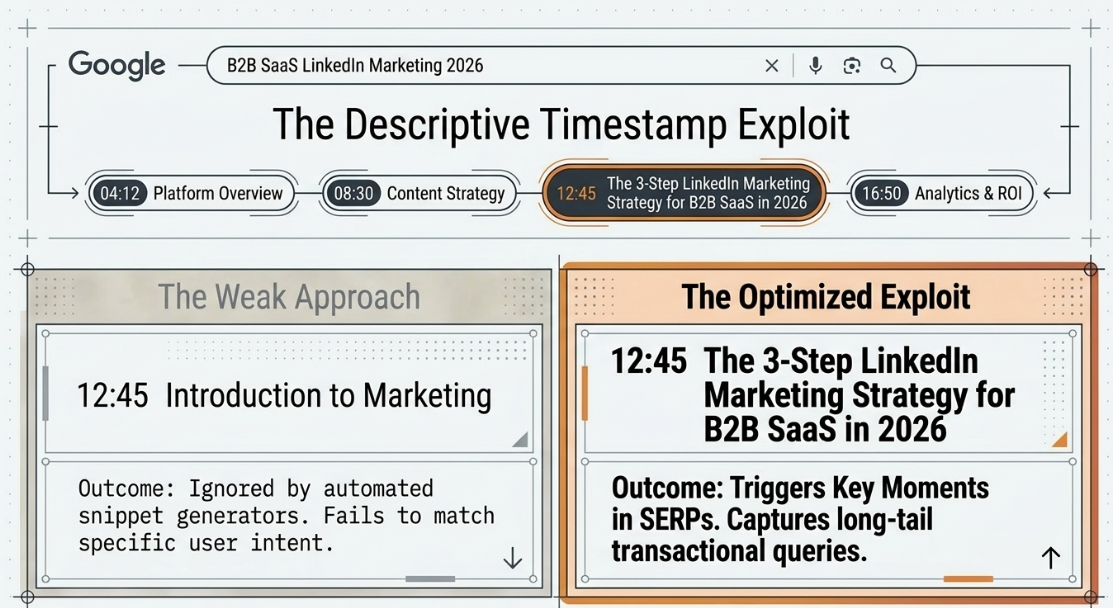
One of the most powerful tools for ranking podcast content on Google search results pages is the descriptive timestamp3. In 2026, Google often displays "Key Moments" directly in search results, converting podcast timestamps into clickable site links that allow users to jump to the exact minute an interview answers their query3.
Creators must avoid vague timeline markers, replacing them with keyword-rich, descriptive labels that target highly specific search intents3:
Technical RSS Feed Optimization and XML Directory Standards
The podcast RSS feed remains the technical foundation of global distribution7. Ingestion errors, unescaped HTML tags, or formatting non-compliance can instantly drop a show from major directory indexes7.
Required and Recommended XML Tags
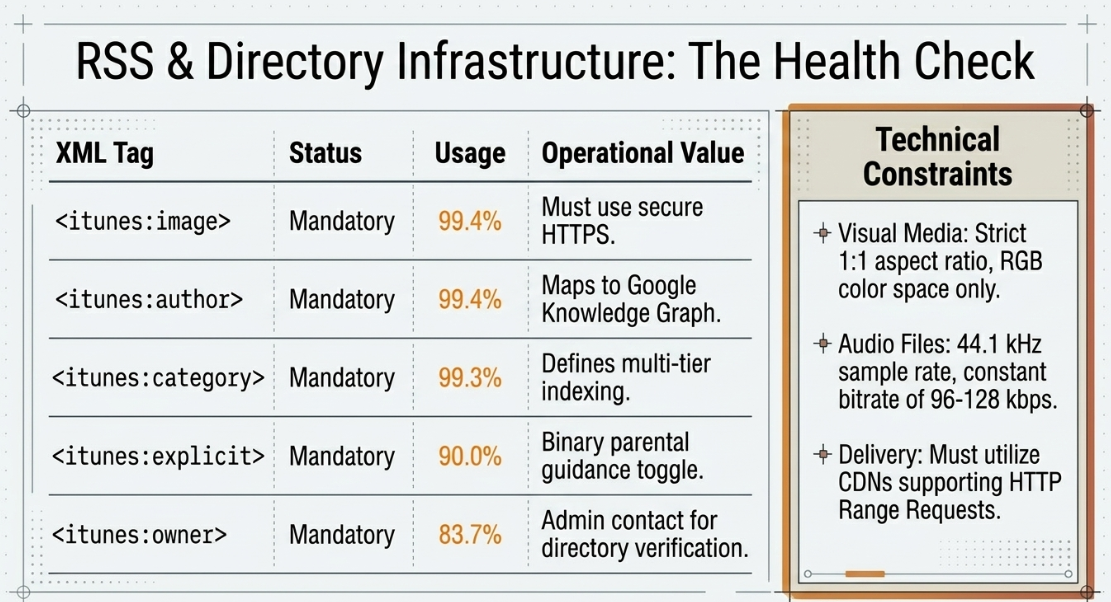
Modern directory crawlers read specific tags within the channel and item layers of the RSS feed10. Based on a metadata analysis of over 250,000 active podcasts, the distribution and utilization of these tags must be carefully managed to prevent truncation or indexing issues10:
Ingestion Requirements and Content Delivery Networks
To maintain high-speed feed delivery and complete compliance with Apple Podcasts Connect and Spotify for Creators standards, the following technical requirements must be enforced:
Visual Media Formatting: Cover art must be square (1:1 aspect ratio), measuring exactly between 1400×1400 pixels and 3000×3000 pixels12. It must be compressed using the RGB color space (CMYK is strictly rejected) in JPEG or PNG format under 512KB12.
Audio File Constraints: Spoken audio should be exported as MP3 files at a constant bitrate of 96–128 kbps to strike a balance between audio fidelity and fast mobile load times, or up to 320 kbps for high-end stereo productions12. The sample rate must be set to 44.1 kHz12.
Server Delivery Speed: Feeds should be routed through Content Delivery Networks (such as Cloudflare or BunnyCDN) to maximize download speeds15. Static assets must support HTTP Range Requests, allowing external directory players to scrub through timestamps without downloading the entire media file12. Caching plugins (such as WP Rocket) should be active on the hosting domain to handle heavy search traffic15.
Technical SEO of Transcripts, Schema Integration, and Web Engine Ranking
While directories process metadata fields inside the RSS feed, general search engines rank podcasts based on the crawlable text of their web pages4. Converting spoken audio into highly structured HTML transcripts is essential for web indexing4.
Search Engine Indexing and Web Traffic
Adding manual, high-fidelity transcripts to episode pages yields measurable indexing improvements16. According to search engine research, websites that systematically implement transcripts experience a 15% increase in organic traffic and a 50% lift in keyword rankings16.
This is particularly important because major directory ecosystems, like Spotify, restrict transcripts to their proprietary, closed mobile apps17. These in-app transcripts cannot be copied, exported, or indexed by external search crawlers17.
To bypass this platform block, publishers use third-party transcription services (such as BrassTranscripts, which handles speaker identification in minutes for $2.50 to $6.00 per file) to generate open-web, crawlable text assets17.
To avoid duplicate content flags across different episode pages, transcripts should exclude standard boilerplate elements like intro and outro music disclaimers16.
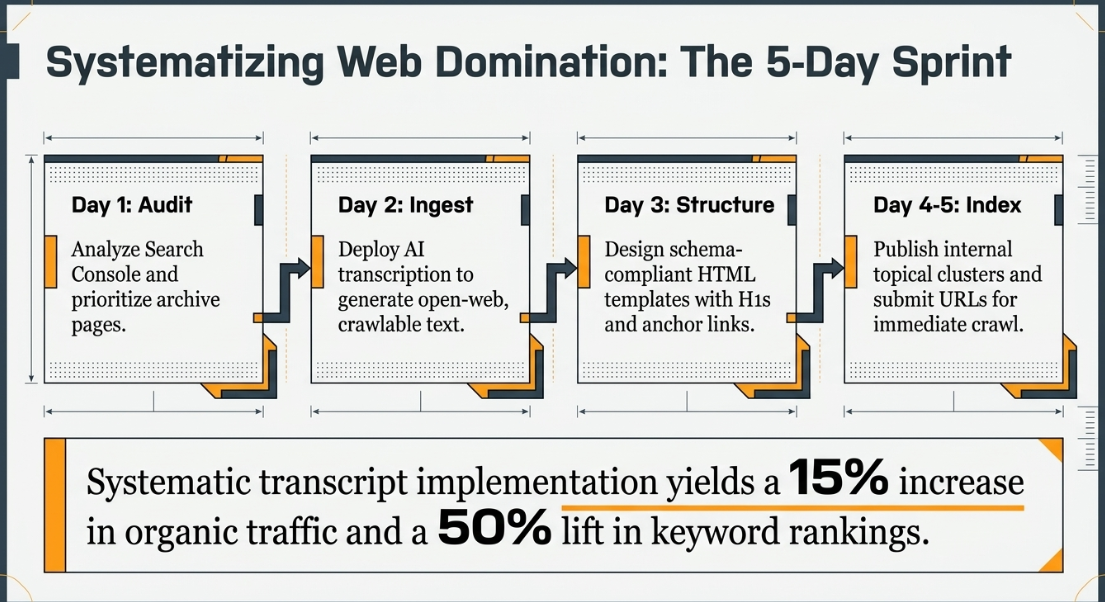
Systematizing Web Domination: The Actionable Implementation Checklist
To turn a website into a high-ranking podcast hub, content teams should execute a structured five-day optimization process:
The Post-Production AI Layer: Audio Restoration, Automated Editing, and Mastering
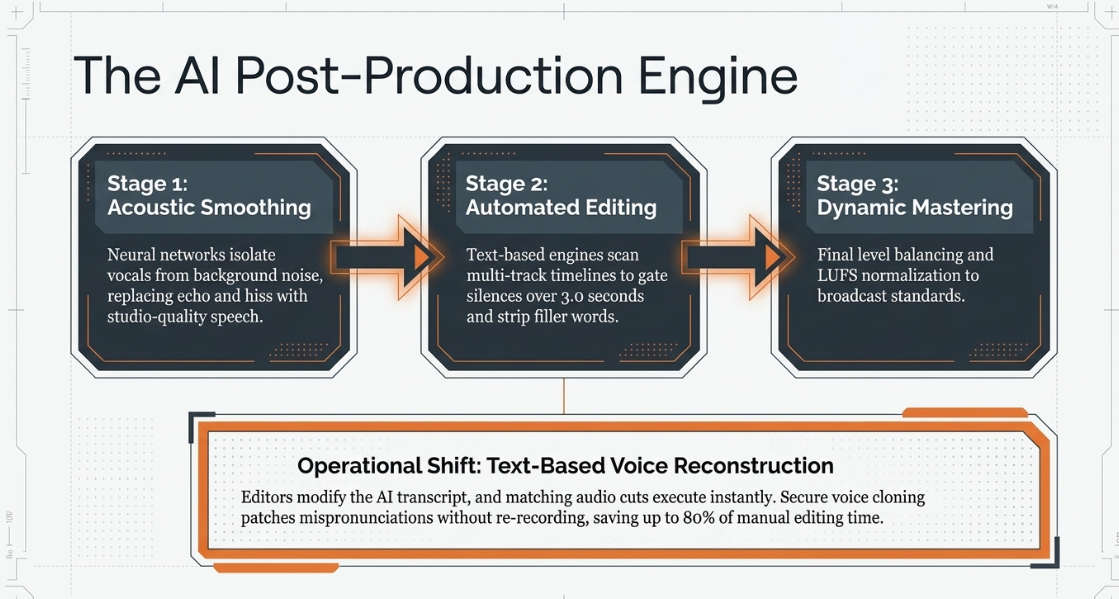
Artificial intelligence has streamlined the technical side of podcast post-production18. Rather than spending hours on manual timeline edits, creators deploy specialized algorithms to run high-quality post-production pipelines18.
Research indicates that 63.4% of content creators use AI tools primarily in post-production, 46.7% in scriptwriting and research, 43.7% in automated marketing, and 40.7% in topic development21. ChatGPT remains the most common entry point for conversational scripting (69.1%), followed closely by specialized audio platforms21.
+----------------------------------------+
| Raw Multi-Track Audio |
+-------------------+--------------------+
|
+-------------------------+-------------------------+
| | |
v v v
+--------------------+ +--------------------+ +--------------------+
| Acoustic Smoothing | | Automated Editing | | Dynamic Mastering |
| * Noise Isolation | | * Filler Removal | | * Level Balancing |
| * Echo Mitigation | | * Silence Gating | | * LUFS Normalization|
+--------------------+ +--------------------+ +--------------------+
Advanced Algorithmic Audio Restoration
Modern sound-restoration suites use targeted neural networks to salvage compromised audio tracks20:
Voice Isolation and Spectral De-Noising: Deep-learning engines, such as Adobe Podcast’s Enhance Speech or ElevenLabs Voice Isolator, analyze input waveforms to separate vocals from background noise20. The algorithm replaces room echoes, microphone hiss, and ambient noise with clean, studio-quality speech20.
Acoustic Waveform Diagnostics: Adobe’s Visual Mic Check analyzes microphone distance and gain levels in real time, advising remote guests on physical adjustments before recording begins20.
Local Multi-Track Capture: Riverside.fm records uncompressed 16-bit 48k WAV files directly to each participant's hard drive20. This prevents internet-induced audio dropouts and provides clean, separate stems for post-production20.
Semantic Editing and Voice Reconstruction
Text-based audio editing has changed the standard production workflow20. Rather than physically cutting waveform regions, editors can modify the automatically generated transcript, and the matching audio cuts are executed instantly20.
Filler Word and Silence Gating: Algorithms like Resound or Descript scan multi-track timelines to locate filler sounds (ums, ahs, errs) and awkward silences longer than 3.0 seconds19. These can be removed across the entire show with a single click, saving up to 80% of manual editing time19.
Speech Synthesis and Correction: Platforms like ElevenLabs Studio 3.0 or Riverside’s Revoice use secure voice cloning to edit recorded speech20. If a speaker mispronounces a word or leaves out a key point, the editor can simply adjust the text script; the engine generates the corrected phrase in the speaker’s exact tone, patching the timeline without a re-recording session20.
Mastering Standards and Dynamic Normalization
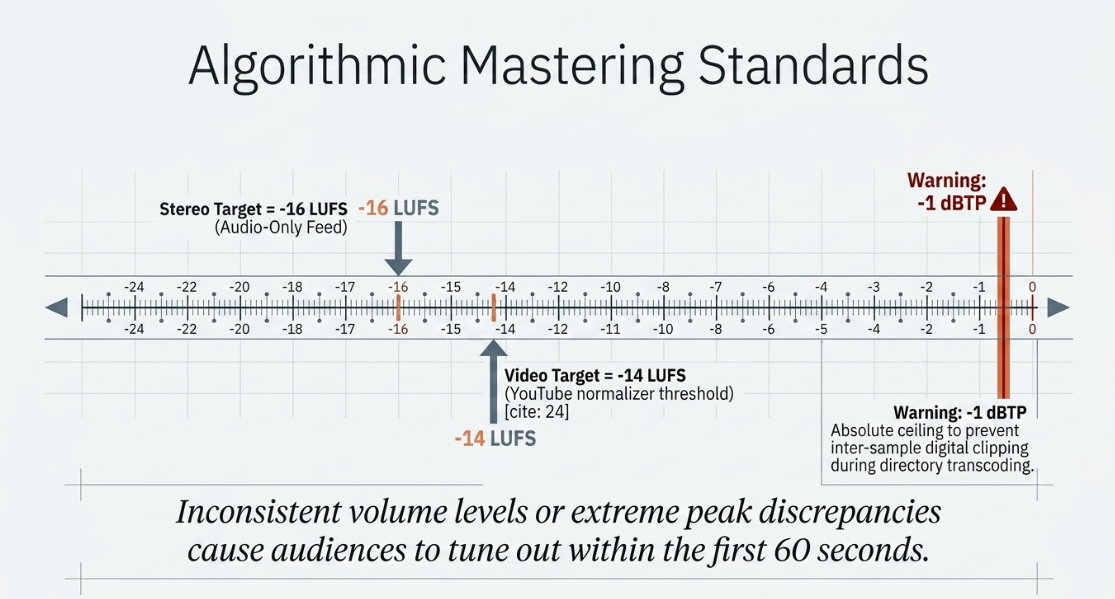
To prevent listener fatigue, the final master file must adhere to strict international loudness standards20. If an audio track has inconsistent volume levels or extreme peak discrepancies, audiences will often tune out within the first sixty seconds20.
Mastering engines (such as Auphonic) automate loudness normalization using perceived human hearing metrics (Loudness Units relative to Full Scale, or LUFS) rather than simple peak volume20:


To prevent inter-sample digital clipping during directory transcoding, the absolute ceiling should be set to 
Multimodal Video Splicing and Viral Hook Detection Frameworks
With the growing popularity of video podcasts, short-form visual promotion has become essential for organic audience growth4. Splicing long-form files into highly shareable, vertical vertical video clips is now automated by multimodal AI pipelines18.
The Multimodal Sentiment and Facial Tracking Pipeline
Advanced vertical clipping platforms (such as CapCut Pro, Memories.ai, Klap, or Brieflee.co) run parallel neural networks to analyze three sensory streams at once25:
Computer Audition (Acoustic Parsing): Encoders like w2v-BERT 2.0 or openSMILE map the audio to track acoustic changes29. Sudden shifts in pitch, rate of speech, and spectral intensity are flagged as emotional peaks26.
Computer Vision (Spatial Tracking): BlazeFace maps approximate 3D facial meshes to capture expressions of humor, intensity, or surprise29. These visual cues are paired with pose estimators (BlazePose) to monitor body language and speaker changes29. The system then applies smart reframing to center the speaker in a vertical 9:16 aspect ratio25.
Natural Language Processing (Textual Analysis): Transformer models analyze the transcript for linguistic cues25. The NLP engine maps semantic transitions to identify when the speaker pivots from casual talk to a dense, high-value point25.
Multi-Layer Splicing, Review, and Export Processes
The clipping pipeline organizes workflow into three clear stages:
[Import Long-Form Video] -> [Multimodal Fusion Scoring] -> [Refine & Customize] -> [Export 9:16 Vertical Video]
Import and Transcription: Content is ingested via direct file uploads or YouTube URLs25. The system transcribes the audio, generates speaker labels, and aligns text tokens with specific video frames25.
Reviewing AI Recommendations: The engine uses multimodal fusion to score each segment for engagement potential26. The user can then review these suggestions, tweak timestamps, and select clips that stand alone as complete, self-contained ideas under 60 seconds25.
Polish and Export: In the final stage, captions are generated with up to 96% accuracy33. Custom branding, styling, and animations are applied, and the clip is exported in a 9:16 aspect ratio25.
To help creators prioritize their marketing assets, these tools evaluate and rank clips using a structured scoring system25:
Operational Economics, B2B Strategic Integration, and Multi-Channel ROI Systems
Integrating an AI post-production layer is more than a technical upgrade; it changes the operational economics and pricing models of modern creative teams1.
Operational Realities and Time Investments
The 2025 Independent Podcaster Survey of 558 creators shows that manual production is highly time-intensive: 27% of DIY podcasters spend 1–3 hours per episode, 28% spend 4–5 hours, 20% spend 6–8 hours, and 21% invest 9 or more hours per episode38.
Furthermore, audio-only creators invest more time than video creators, with 45% spending over six hours per episode compared to 36% for video podcasters38.
MANUAL DIY PRODUCTION:
[Plan: 2-4h] -> [Edit: 3-6h] -> [Design: 1-2h] -> [SEO: 1-2h] = 7-14 Hours per Episode
AI-AUTOMATED WORKFLOW:
[Brief/Record: 1h] -> [AI Splicing/Editing/SEO Summary: 30m] = 1.5 Hours per Episode [cite: 37, 39]
These manual workflows often lead to burnout, especially when guest booking consumes an additional 100 to 200 hours monthly38. The transition to an AI-assisted workflow reduces this operational burden:
Lower Production Friction: Automating editing, transcription, and metadata creation cuts the time investment per episode from up to 14 hours down to under 30 minutes5.
Higher Production Throughput: Creative agencies can scale their output from managing 8 active client podcasts to 40 without needing to expand their staff37.
Shift to Strategic Pricing: Instead of billing hourly for manual audio editing, agencies can price their services based on high-level content strategy and client relationships, letting AI handle the mechanical execution37.
Strategic Relationship Engineering
In B2B marketing, podcasting is often used as a direct channel for relationship-building and account acquisition38.
The "Dream 200" Account Acquisition Model: Rather than trying to build a massive consumer audience, B2B podcasts target key accounts, strategic partners, and high-value decision-makers38. Inviting these prospects to be guests on the show establishes a low-friction touchpoint that can convert into business pipeline down the road38.
Higher Conversion Rates: Trust established through in-depth audio content translates into stronger business outcomes5. While standard blog readers show a 3% trial conversion rate, podcast listeners convert at a rate of 12%5.
Multi-Channel Distribution: Repurposing a single interview into blog posts, newsletters, and vertical social clips allows B2B marketing teams to expand their total content reach by 35% without increasing content creation times5.
Strategic Toolkit Analysis
To help marketing teams select the right software for their workflow, the following comparison maps the top AI podcast platforms to their primary use cases, features, and pricing models:
By integrating these specialized AI tools, marketing departments can build a unified, automated post-production pipeline39. This workflow takes a single raw recording, cleans the audio to professional standards, generates optimized metadata, and produces a complete suite of text and video assets18.
This technical framework allows creative teams to spend less time on manual post-production tasks and focus their energy on creating engaging conversations, building audience relationships, and driving business growth38.
Works cited
Unlock Listeners: Essential SEO for Podcast Strategies - Podmuse, https://www.podmuse.com/post/seo-for-podcast
80+ Podcasting Statistics You Must Know in 2026 (Complete Roundup) - WPBeginner, https://www.wpbeginner.com/research/podcasting-statistics-you-must-know-complete-roundup/
Mastering Zero-Click Podcast SEO: How to Rank on Google, YouTube, and Spotify Simultaneously, https://blog.podcast.co/reach/rank-with-podcast-seo
SEO for Podcasts: 2026 Ultimate Guide - SpearPoint Marketing, https://www.thespearpoint.com/blog/seo-for-podcasts
AI Podcasts for Marketing: The Ultimate Content Repurposing Strategy | SparkPod, https://sparkpod.ai/blog/ai-podcasts-for-marketing-content-repurposing
Best Podcast SEO Tools for Better Discovery in 2026, https://deliberatedirections.com/podcast-seo-tools-for-discoverability/
Podcast SEO: How to Get Found in Search and Directories, https://podcastingauthority.com/podcast-seo-strategies/
35 Top Podcast Content Distribution Sites: 2026 Guide, Uses + Strategy - Talks.co, https://talks.co/p/podcast-content-distribution/
An Airflow-Orchestrated AI Pipeline for Podcast Transcription, Topic Modeling, and Recommendation System - MDPI, https://www.mdpi.com/3042-6308/2/1/1
Apple Podcasts Tags - Podcast de facto Standard, https://podcast-standard.org/itunes_tags/
Columbia on iTunes U Formatting RSS and XML for use in iTunes U, https://ccnmtl.columbia.edu/itunesu/contribute/formatting_rss_and_xml.html
Podcast RSS Feed Guide 2026 - Apple Podcasts & Spotify Compatible | RSS Validator, https://rssvalidator.app/podcast-rss-guide
Podcast SEO: The Ultimate Guide to Making Audio Content Discoverable Across Search Engines & Apps | Hashmeta, https://hashmeta.com/blog/podcast-seo-the-ultimate-guide-to-making-audio-content-discoverable-across-search-engines-apps/
Podcast RSS Feeds… What the Heck Are They?!?, https://blog.podcast.co/create/podcast-rss-feeds
The Ultimate Podcast SEO Guide To Rank Higher In 2025 - Fame.so, https://www.fame.so/post/podcast-seo
Podcast SEO: How AI-Generated Transcripts Boost Your Search Rankings | SparkPod, https://sparkpod.ai/blog/podcast-seo-ai-transcripts
Spotify Podcast Transcription: Complete Guide, https://brasstranscripts.com/blog/spotify-podcast-transcription-complete-guide
Podcast Production Software - Podsqueeze, https://podsqueeze.com/podcast-production-software/
Resound: The AI Podcast Editor for Creators, https://www.resound.fm/
5 Best AI Podcast Editing Tools for Creators - Fueler, https://fueler.io/blog/best-ai-podcast-editing-tools-for-creators
The Best Podcast AI Tools: How to Create a Podcast with AI - Podigee, https://www.podigee.com/en/blog/podcast-ai-tools/
Adobe Podcast | AI audio recording and editing, all on the web, https://podcast.adobe.com/en
Studio 3.0 - AI audio and video editor for creators - ElevenLabs, https://elevenlabs.io/studio
Is Focusing on Target LUFS a Mistake? - YouTube, https://www.youtube.com/watch?v=WTjAG9R3W_I
Your Guide to the Best AI Video Splicing Tool - Klap, https://klap.app/blog/ai-video-splicing-tool
How to Build an AI Video Clipping Platform Like OpusClip, https://ideausher.com/blog/build-ai-video-clipping-platform-opusclip/
The 50 Best Podcasting Tools You'll Ever Need In 2026 (Free & Paid) - Podsqueeze, https://podsqueeze.com/blog/the-best-podcasting-tools/
How to Analyze TikTok Videos with AI: The Complete Guide for 2026 | Memories.ai Blog, https://memories.ai/blogs/How-to-Analyze-TikTok-Videos-with-AI-2026
DISCOVER: a Data-driven Interactive System for Comprehensive Observation, Visualization, and ExploRation of human behavior - PMC, https://pmc.ncbi.nlm.nih.gov/articles/PMC12492635/
How is multimodal AI used in sentiment analysis of video content? - Milvus, https://milvus.io/ai-quick-reference/how-is-multimodal-ai-used-in-sentiment-analysis-of-video-content
How to use AI in your video projects – Top AI tools for video creators - Envato, https://elements.envato.com/learn/top-ai-tools-for-video-creators
AI Podcast Show Notes, https://www.swellai.com/ai-podcast-show-notes
25 Best AI Tools for TikTok in 2026 (Tested & Ranked), https://posteverywhere.ai/blog/25-best-ai-tools-for-tiktok
How to Use AI to Find Viral Moments in Your Videos - StreamYard, https://streamyard.com/blog/find-viral-moments-in-video-ai
Free Video Breakdown Tool - Analyze TikTok, Instagram & YouTube Shorts | Brieflee, https://www.brieflee.co/free-tool-video-breakdown
(PDF) EmoCo: Visual Analysis of Emotion Coherence in Presentation Videos, https://www.researchgate.net/publication/335355152_EmoCo_Visual_Analysis_of_Emotion_Coherence_in_Presentation_Videos
How AI Podcast Generation Is Transforming Content Marketing Workflows in 2026, https://www.brainpercent.app/articles/how-ai-podcast-generation-is-transforming-content-marketing-workflows-in-2026-1776157887301
Podcast Production Pricing: B2B Packages, Costs & ROI | Rise25, https://rise25.com/lead-generation/podcast-production-pricing/
The Ultimate AI Podcast Production Workflow for 2026, https://thepodcasthaven.com/ai-podcast-production-workflow/
10 Best AI Podcast Repurposing Tools in 2026 (Castmagic, Descript, Riverside & More Ranked) - BLACKBOX.AI, https://app.blackbox.ai/share/61a7d576-5f2b-4506-817e-61dc9e9ed745
Castmagic - 10x Audio Content With AI, https://www.castmagic.io/
Swell AI | Repurpose Audio or Video Content for Every Marketing Channel, https://www.swellai.com/
Podsqueeze, https://podsqueeze.com/