The podcast industry has irrevocably transitioned from a decentralized network of independent, hobbyist audio feeds into a highly sophisticated, multi-billion-dollar omnichannel media ecosystem. As the medium matures and attracts enterprise-level advertising budgets, the intersection of creative content and empirical data has become the defining battleground for publishers, advertisers, and technology vendors. The contemporary audio landscape is characterized by the rapid convergence of audio and video, the paradigm shift from static advertising to programmatic dynamic ad insertion, and the relentless pursuit of standardized, cross-platform measurement.
To navigate this environment, modern media organizations must treat podcasting not merely as a content distribution channel, but as a complex ecosystem requiring rigorous business intelligence, advanced technical infrastructure, and highly calibrated lifecycle marketing. This comprehensive report provides an architectural analysis of the modern podcast industry. It explores the foundational mechanics of podcast analytics, the regulatory and technological shifts impacting data privacy, the intricacies of programmatic ad-decisioning and verification, the technological stratification of hosting platforms, and the strategic frameworks necessary to build, sustain, and aggressively scale a successful podcast network.
The Anatomy of Podcast Analytics: Tiers of Measurement
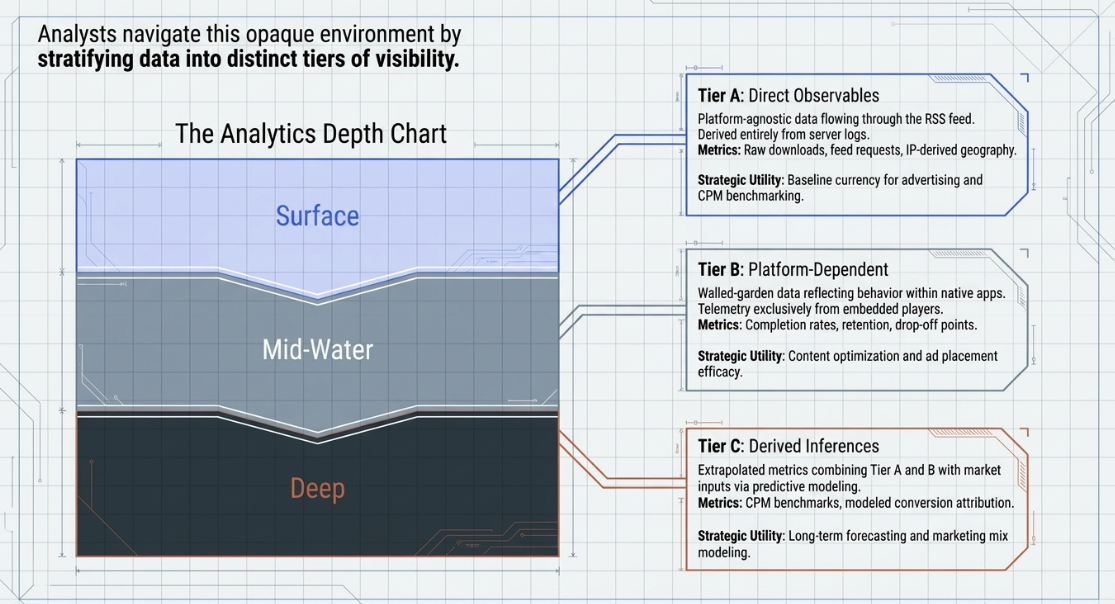
The foundational challenge of the podcast industry has historically been measurement fragmentation. Unlike closed-ecosystem digital video or web publishing, podcast distribution relies heavily on open Really Simple Syndication (RSS) feeds1. The connection between the hosting server that stores the audio file and the end listener's device is inherently disconnected. An audio file is downloaded to a podcast application, but the host server typically receives no direct telemetry on whether the file was subsequently played, paused, skipped, or completed1.
To navigate this opaque environment, industry analysts divide podcast analytics into distinct tiers of data visibility. These tiers reflect the spectrum of certainty and interpretive inference inherent in audio measurement1.
Because podcast audio files are downloaded instead of streamed via unique session tokens in open RSS environments, "listener" counts are often an estimate rather than a direct measurement, relying on IP clustering and device fingerprinting1. Consequently, raw, validated downloads remain the most defensible metric for open-market advertising transactions.
The Evolution of IAB Measurement Standards
To prevent the artificial inflation of download metrics and establish a trusted currency for media buyers, the Interactive Advertising Bureau (IAB) Tech Lab introduced the Podcast Measurement Technical Guidelines2. Without standardization, routine application behaviors—such as the automated pre-fetching of the first 60 seconds of audio data by a smartphone to buffer playback—could register as multiple false downloads1.
The Core Mechanics of IAB Validation
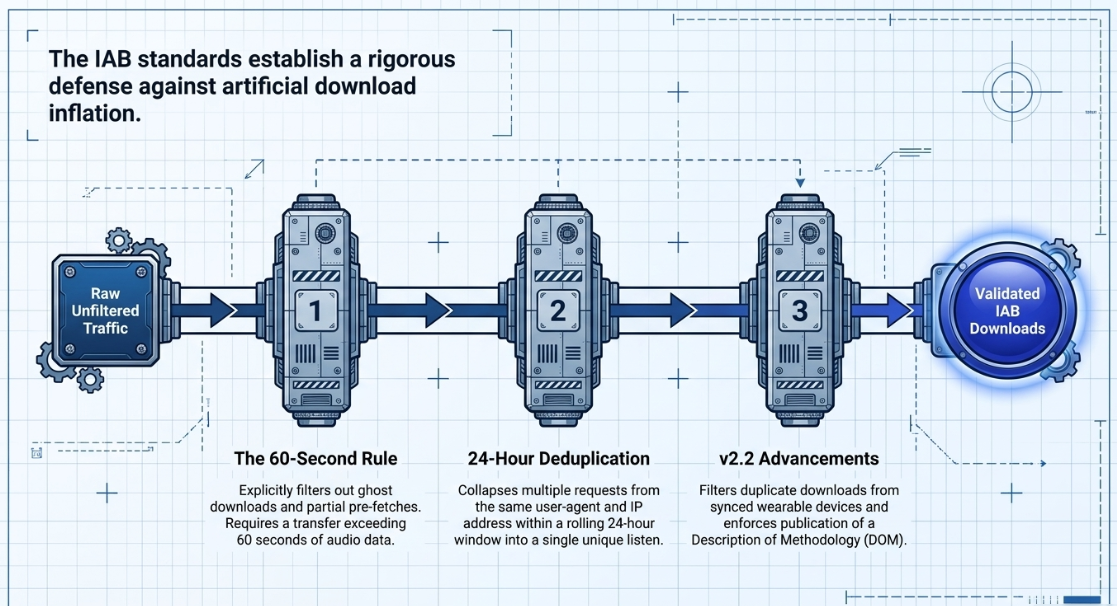
The IAB v2.1 guidelines, released in 2021, established the fundamental rules of download validation. To register as a valid download, a compliant hosting platform must detect a file transfer that exceeds a strict minimum threshold of 60 seconds of transferred audio data (or the full file if the episode duration is shorter)1. This rule explicitly filters out ghost downloads, auto-plays, and partial pre-fetch requests.
Furthermore, the guidelines mandate a strict 24-hour window for deduplication. If a single user-agent (the software requesting the file, such as Apple Podcasts on iOS) and IP address combination requests the same episode multiple times within a rolling 24-hour period—perhaps because a listener paused playback and resumed it hours later—the platform must collapse these requests into a single, unique listen1. This dual-filter system ensures that bot traffic, server re-tries, and repeated HTTP requests are systematically scrubbed from the analytics dashboard3.
The Advancements in IAB v2.2
As the industry adapted to technological advancements, the IAB released version 2.2 of the guidelines in May 2024, introducing refined measures to enhance trust and transparency5.
The most significant structural addition in v2.2 is the requirement for certified platforms to publish a Description of Methodology (DOM)4. This document forces platforms to explicitly disclose exactly how listener data is collected, processed, filtered, and secured, moving the industry away from proprietary black-box calculations4.
Additionally, v2.2 provides explicit guidance on filtering out duplicate downloads originating from wearable devices, such as the Apple Watch2. Prior to this update, a listener downloading an episode to their iPhone and syncing it to their Apple Watch on the same IP network could erroneously trigger multiple validated downloads. The updated guidelines also introduced stricter protocols for handling anomalous spikes from single IPv6 addresses and clarified the handling of third-party tracking prefixes2. Compliance requires annual re-certification, ensuring that hosting providers continuously adapt to evolving fraud vectors7.
The Measurement Dilemma and The AMP Accords
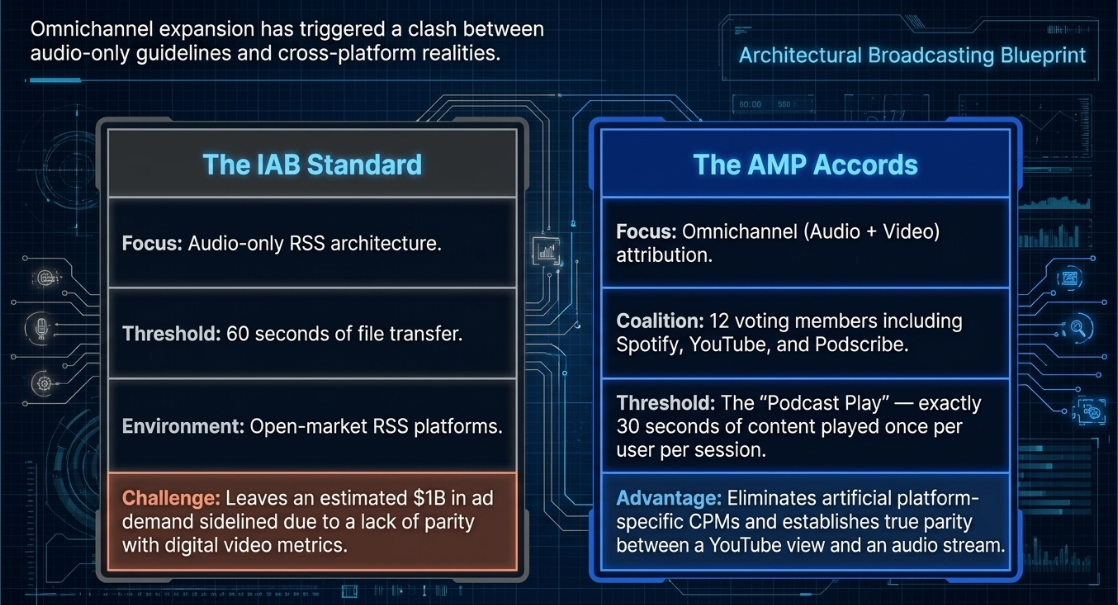
While the IAB guidelines secured the integrity of RSS audio downloads, the explosive rise of video podcasting introduced a severe new crisis. Advertisers attempting to buy omnichannel campaigns found themselves navigating totally disparate, incompatible metrics: Apple Podcasts measured standard audio downloads, Spotify measured audio and video streams, and YouTube measured visual views8.
This lack of standardized cross-platform metrics, combined with fundamental disagreements over the classification of where a "podcast" ends and a "social video" begins, resulted in a severe loss of brand advertiser confidence9. Industry analysts reported that this measurement confusion caused an estimated $1 billion in advertising demand to remain sidelined, as buyers refused to transact on an "honor system" lacking verifiable parity9.
The Formation of the Alliance for Measurement in Podcasting (AMP)
In response to this existential threat, Oxford Road—the world's largest podcast advertising agency—convened the Alliance for Measurement in Podcasting (AMP) in July 20259. AMP operates as an independent industry coalition, comprising 12 voting member parties that include platforms (Spotify, SiriusXM Media, YouTube), major advertisers (DraftKings, BetterHelp), publishers, talent agencies (United Talent Agency), and measurement providers (Podscribe)9.
The AMP Accords target three primary objectives to future-proof the industry:
Defining the Medium: Establishing a universal classification of a "podcast" to inform industry sizing and buying processes9.
Standardizing Impression Metrics: Creating unified units that all major platforms can map to, eliminating the need to trade on artificial, platform-specific CPMs9.
Cross-Platform Attribution: Developing a consistent attribution method acceptable to both open RSS and closed video platforms9.
The 30-Second "Podcast Play" Standard
To bridge the audio-video divide, AMP unanimously ratified a new exposure definition known as the "Podcast Play," explicitly defined as 30 seconds of audio or video content played once per user per session8.
This represents a massive strategic pivot. The 30-second threshold diverges from the IAB's 60-second download transfer rule. Instead, it is designed for modern streaming environments supported by HTTP Live Streaming (HLS) protocols, where playback telemetry is actively tracked8. The 30-second mark was chosen based on behavioral data indicating it is a reliable threshold for intentional consumption, effectively filtering out accidental clicks and immediate bounces while establishing parity between a YouTube view and an audio stream13.
In June 2026, Spotify formally adopted this 30-second minimum for podcast play counts within its Spotify for Creators platform14. By conflating audio and video consumption under a single metric, Spotify provides creators with a unified engagement dashboard17. However, from a data engineering perspective, this adjustment fundamentally alters the baseline for historical data analysis. Lowering the threshold from 60 seconds to 30 seconds can superficially inflate play counts, complicating cross-platform aggregation for analysts who must reconcile Spotify's 30-second streams with legacy RSS platforms still adhering to 60-second download rules17. Broadcasters in traditional radio have also noted this shift, questioning whether their own stringent measurement thresholds (such as Nielsen's three-minute quarter-hour credit qualifier) place them at a disadvantage against podcasting's newly established 30-second baseline13.
Data Privacy, IP Tracking, and the Regulatory Landscape
As the podcast industry seeks more granular attribution and programmatic targeting, it collides directly with stringent global privacy regulations and platform-level privacy restrictions. Because the RSS podcast architecture does not natively support cookies, the industry has historically relied entirely on IP addresses and user-agent strings for audience measurement, geographic targeting, and post-listen attribution18.
The "Privacy Problem" Paradox
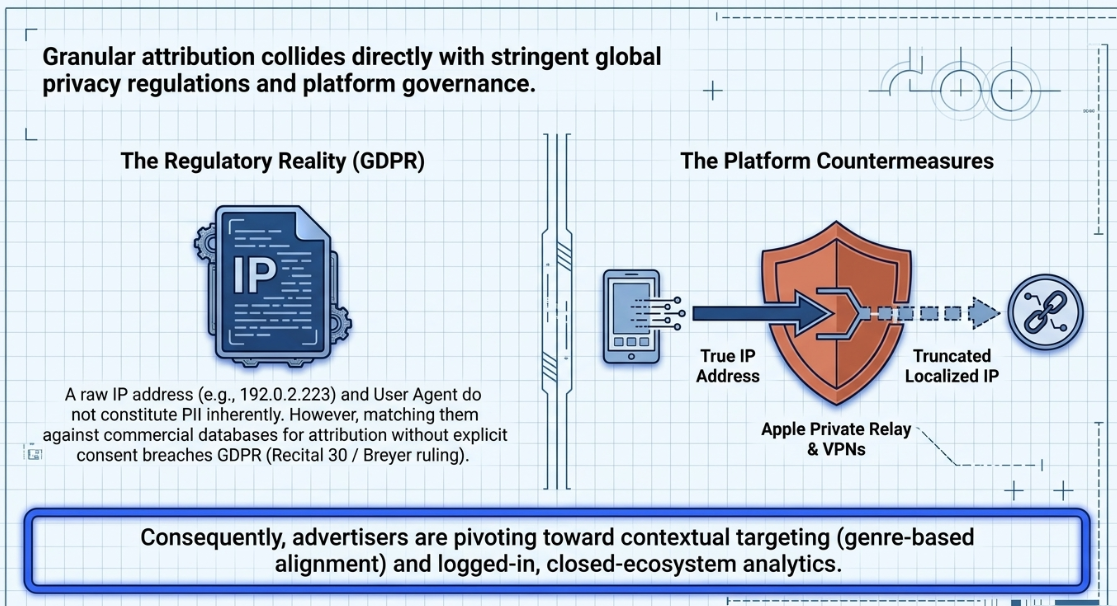
A prominent debate exists within the media sector regarding whether podcasting inherently suffers from a privacy problem. From a structural, technological standpoint, the raw data collected by a podcast hosting server—an IP address (e.g., 192.0.2.223) and a user agent (e.g., Podcasts/2.0 Dalvik)—does not contain personally identifiable information (PII) such as a name, gender, or exact residential address18.
Under the European Union's General Data Protection Regulation (GDPR), specifically Recital 30, online identifiers like IP addresses only cross the threshold into PII when they are actively combined with other datasets capable of identifying a natural person18. European legal precedent, including the German Breyer ruling, affirms that a dynamic IP address alone is insufficient to directly identify a user without additional identifying logs from an internet service provider or website login18.
The privacy violation, therefore, does not occur during the download phase; it occurs during the ad-targeting and attribution phases. When third-party ad-tech vendors cross-reference a podcast listener's IP address with massive commercial databases (e.g., consumer purchase history, household demographics from Experian or Nielsen) without explicit user opt-in, it constitutes a clear breach of GDPR and emerging state-level privacy frameworks18.
Technological Countermeasures and Platform Governance
In response to consumer privacy demands, platform gatekeepers are actively degrading the efficacy of deterministic IP tracking. Apple's Private Relay (introduced for iCloud+ users) and the widespread consumer adoption of Virtual Private Networks (VPNs) serve to mask the listener's true IP address from the hosting server18.
When a user downloads a podcast via Apple Private Relay or the Apple Podcasts web player, the hosting platform receives a generic, truncated, and localized IP address18. For the web player specifically, if a user is not signed into an Apple account, activity is associated with a random unique identifier that resets every 24 hours to prevent long-term tracking20. This intentional disruption breaks the fundamental mechanism used for both programmatic geographic targeting and subsequent ad attribution, as the ad server can no longer definitively match the IP address of the podcast listener with the IP address of the user who later purchases a product on an advertiser's website18.
The Interactive Advertising Bureau (IAB) has expressed significant concern over these developments, noting that privacy restrictions heavily impact content creation and advertising business models. Data is necessary not only for monetization but also for complying with regional frequency-capping laws and fighting ad fraud18. Consequently, the industry is experiencing a strategic pivot. Advertisers are increasingly relying on contextual targeting—aligning brands with specific podcast content genres rather than individual listener profiles—and closed-ecosystem analytics where deterministic user data is governed by logged-in user consent21.
Enterprise Hosting Platforms and Distribution Architecture
To execute a multi-platform, highly monetized audio strategy, publishers rely on sophisticated enterprise hosting platforms. These platforms act as the central Content Management System (CMS), handling RSS feed generation, global distribution, ad-decisioning, and analytics collection.
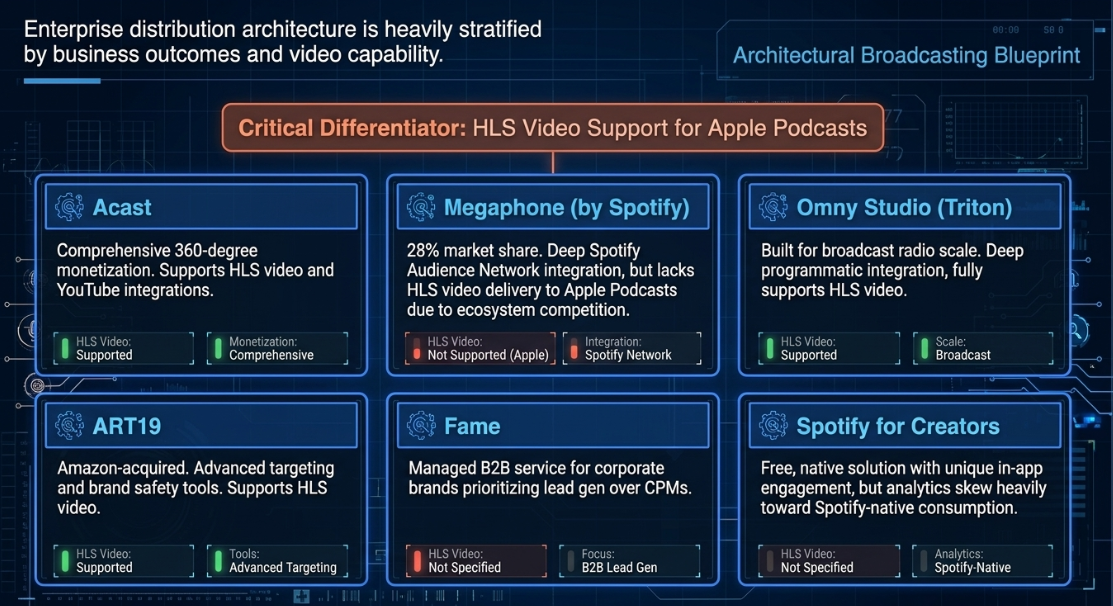
The market is heavily stratified, with solutions tailored to different business outcomes. When selecting a platform, media networks must prioritize IAB v2.2 compliance, Dynamic Ad Insertion (DAI) capabilities, and the ability to distribute HLS video1.
The ability to deliver HTTP Live Streaming (HLS) video to Apple Podcasts has become a key differentiator. Platforms like Acast, Omny Studio, ART19, Transistor, and Captivate actively support this feature, allowing publishers to monetize visual content on Apple's ecosystem. Conversely, legacy platforms like Libsyn and Spotify-owned Megaphone have lagged in this specific technical integration, forcing some publishers to reconsider their hosting infrastructure as video becomes paramount22.
Advanced Analytics and Attribution Technology
As brand advertisers demand proof of ROI that matches the precision of digital search and social media, the podcast industry has developed a secondary layer of advanced analytics and attribution tools. These platforms sit atop the hosting infrastructure, providing the critical link between an audio exposure and a business outcome.
The Landscape of Analytics Tools
For audience growth and search engine optimization (SEO), publishers utilize specialized tracking software30:
Podstatus: An all-in-one solution tracking chart rankings across Apple Podcasts, Spotify, and iVoox in 175 countries. It monitors reviews, tracks keyword positions, analyzes SEO, and integrates with OP3 for download data, positioning itself as a cost-effective daily operational tool30.
Podkite: Known for its SmartLinks (routing listeners to their preferred app automatically) and deep historical data dating back to 2018, serving as a strong foundational tool for chart tracking30.
Podgagement: Focuses aggressively on listener interaction, offering unique features like voicemail collection, NFC Podcast Beacons, and social proof image generators to drive audience loyalty30.
Enterprise Verification and Pixel-Based Attribution
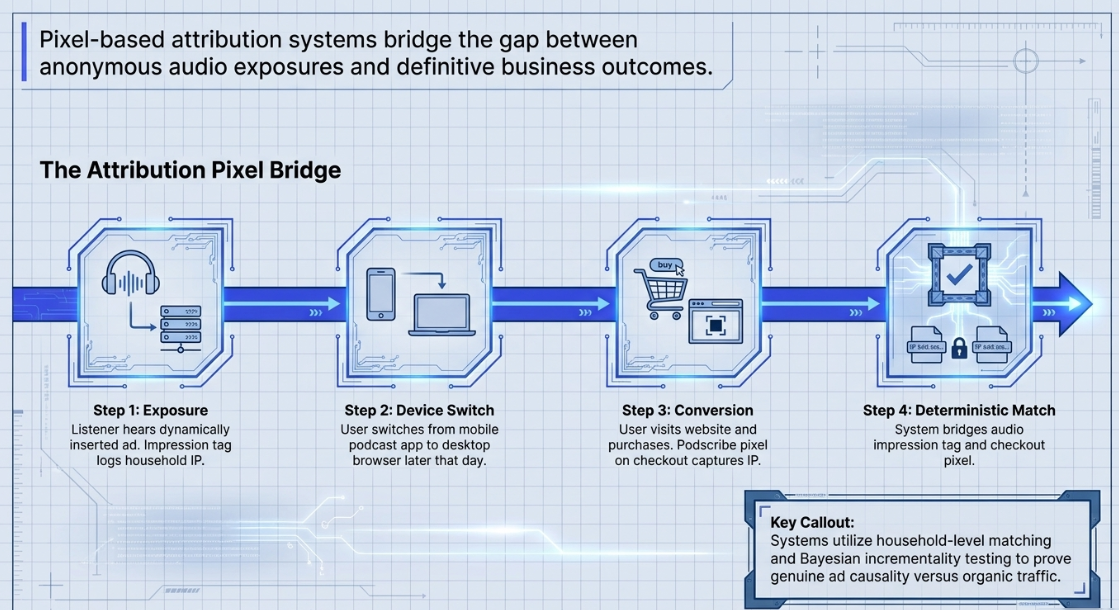
To solve the attribution gap, the industry relies on pixel-based tracking. Prior to its acquisition by Spotify, Podsights led this space. The methodology involves placing an attribution pixel on the advertiser's website and appending an impression tag to the podcast ad served via Dynamic Ad Insertion (DAI)28. When a listener is exposed to the ad, the system logs the IP address; when that same IP address visits the advertiser's website to make a purchase, the conversion is deterministically attributed to the podcast campaign, moving beyond the archaic reliance on promo codes28.
Following Spotify's acquisition of Podsights and Chartable (which brought SmartPromos and SmartLinks into the Megaphone ecosystem), independent verification became a critical market need28. Podscribe emerged to fill this void, positioning itself as the premier independent, IAB-certified measurement platform31.
Podscribe’s architecture solves two fundamental problems: verification and attribution.
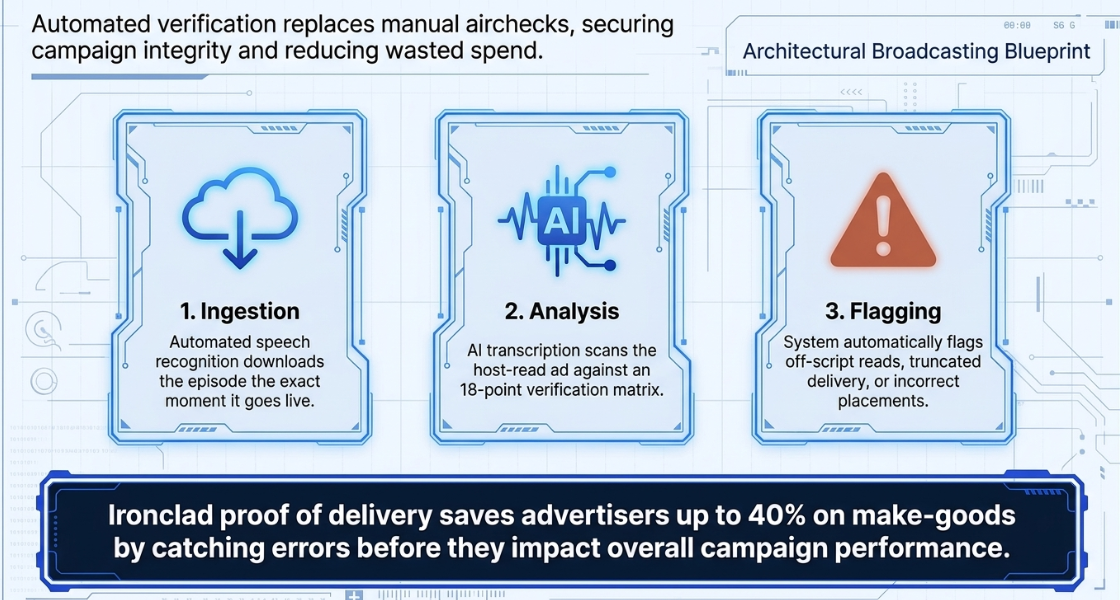
AI-Driven Airchecks (Verification): Historically, verifying that a host read an ad correctly required manual listening. Podscribe utilizes automated speech recognition and AI transcription to download and analyze episodes in real-time. It checks ads against an 18-point verification matrix, flagging issues such as incorrect placements, off-script reads, poor audio quality, or truncated delivery31. This automated QA process provides ironclad proof of delivery, saving advertisers up to 40% on make-goods by catching errors before they impact overall campaign performance31.
Full-Funnel Attribution: Podscribe tracks exposure to conversion at the household level, utilizing pixels, IP-based matching, and first-party purchase data to attribute website visits, app downloads, and purchases back to podcast ads—even when listeners switch devices. By layering in incrementality testing (Bayesian analysis), Podscribe proves which conversions were genuinely caused by the ad versus those that would have occurred organically31. Podscribe has also extended this digital-style measurement to terrestrial and satellite radio, allowing omnichannel audio buyers to compare podcasting and radio performance in a single dashboard36.
While platforms like Podtrac focus on standardized monthly reach rankings and prefix-based measurement for publishers, Podscribe focuses aggressively on verification-first ROI measurement for advertisers, ensuring that ad spend translates directly to quantifiable business outcomes37.
Programmatic Advertising Architecture: DAI and Real-Time Auctions
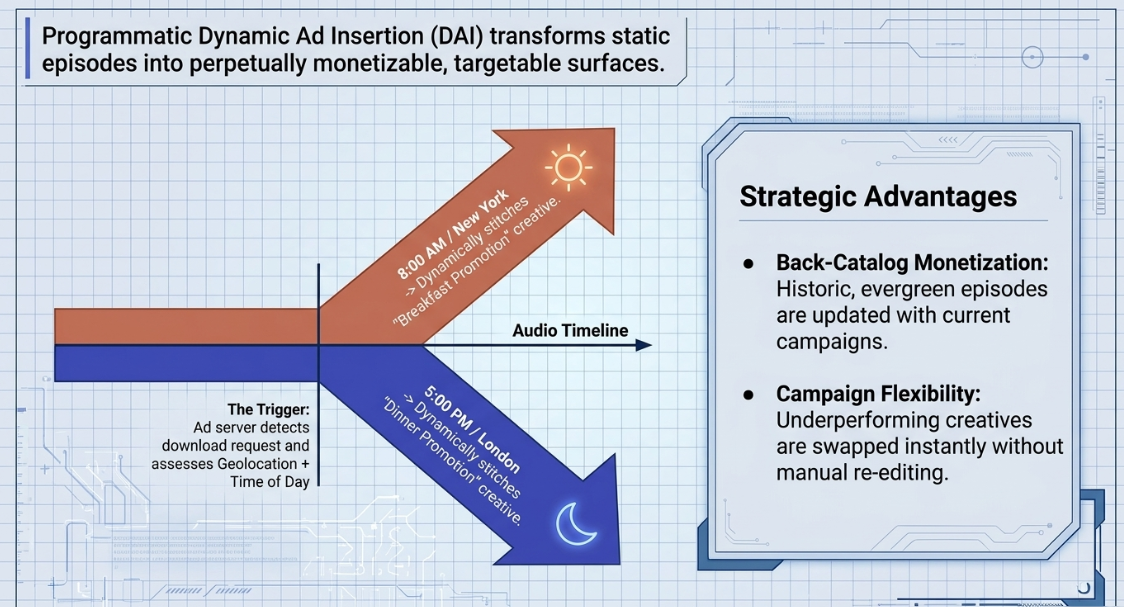
The transition from permanently "baked-in" host-read advertisements to Programmatic Dynamic Ad Insertion (DAI) represents the most significant commercial evolution in the medium's history. DAI transforms static podcast episodes into flexible, targetable, and perpetually monetizable ad surfaces23.
The Mechanics of Dynamic Ad Insertion
DAI technology inserts pre-produced audio or video advertisements into an episode at the exact moment a listener initiates a stream or download request23.
This architecture provides immense strategic advantages:
Back-Catalog Monetization: Advertisers can purchase inventory across a show's entire historical archive. Because evergreen podcast content continues to generate downloads long after publication, DAI ensures that older episodes are monetized with current, geographically relevant campaigns38.
Campaign Flexibility and Creative Control: Ads can be swapped, updated, or paused in real-time. If a creative message is underperforming, it can be altered instantly without requiring the publisher to un-publish and manually edit the underlying audio file39.
Targeting Precision and Dynamic Creatives: Podcasters define precise pre-roll, mid-roll, and post-roll ad markers within their CMS38. When a download is requested, the ad server assesses the user's geolocation, device type, and time of day, dynamically serving the most relevant advertisement. Advanced executions utilize "dynamic creatives"—generating multiple versions of an ad and delivering the most relevant one (e.g., serving a breakfast promotion at 8:00 AM in New York, and a dinner promotion at 5:00 PM in London)41.
The Programmatic Audio Ecosystem
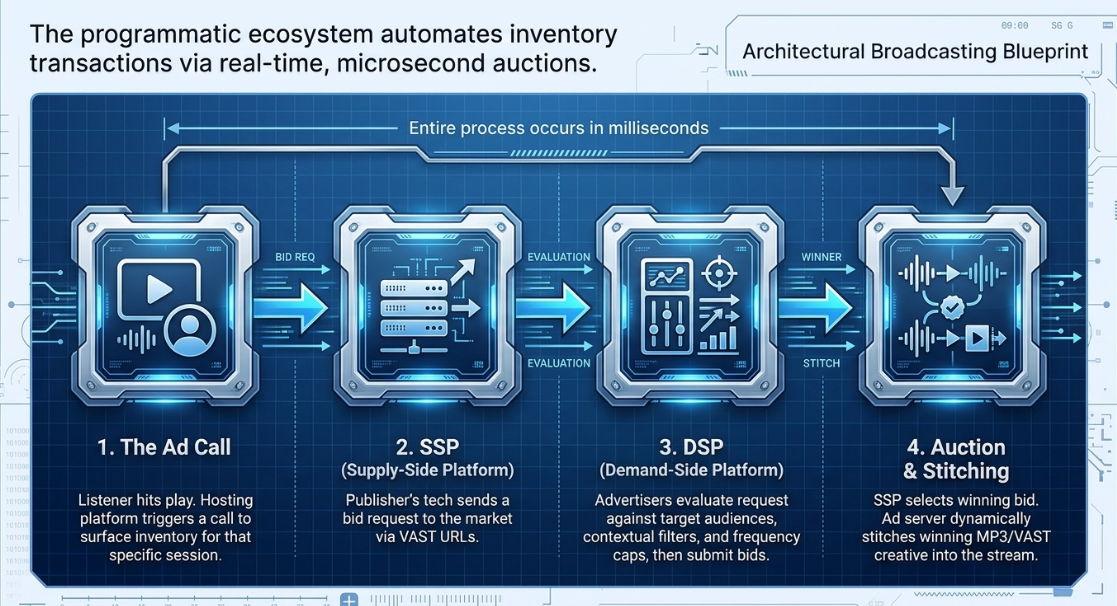
Programmatic podcast advertising applies the rigor of modern display and video ad tech to the audio medium. It automates the buying and selling of inventory through real-time, microsecond auctions23.
The workflow operates seamlessly in the background of the listener experience:
The Ad Call: When a listener hits play, the hosting platform triggers an ad call to surface available inventory for that specific session23.
The Supply-Side Platform (SSP): The publisher's technology (the SSP) sends a bid request to eligible demand-side platforms. For example, Megaphone inventory can be routed via VAST URLs to the Triton Audio Marketplace29.
The Demand-Side Platform (DSP): Advertisers utilize DSPs (e.g., The Trade Desk, DV360) to define target audiences, contextual filters, budgets, and frequency caps. The DSP evaluates the incoming bid request against its parameters and submits a bid23.
The Auction and Stitching: The SSP selects the highest-value, most relevant bid. The publisher's ad server then stitches the winning MP3 or VAST audio creative directly into the audio stream. Measurement tags fire, and VAST events capture delivery and quartile completions to track playback23.
Strategic activation of programmatic audio requires distinct objective setting. For upper-funnel reach and frequency shaping, marketers utilize in-stream music and digital radio. For mid-funnel consideration, programmatic podcasting via DAI is deployed, filtered by specific genres and episode-level context42. Buyers can utilize open-exchange auctions for scale, or Private Marketplaces (PMPs) and Programmatic Guaranteed deals to secure premium, brand-safe inventory on highly sought-after shows21.
Lifecycle Marketing Strategies for Audience Acquisition
Building a successful audio ecosystem requires a bifurcated marketing approach: the deployment of owned audio (branded shows, executive interview series) to build long-term brand equity and category authority, and the execution of paid audio (host-read sponsorships, programmatic placements) to drive immediate demand generation and customer acquisition44.
Designing the Listener Brief
A high-performing podcast marketing strategy must be anchored in a highly specific listener profile. Strategic planning requires defining the listener's exact role, seniority, and contextual consumption habits (e.g., listening while commuting versus doing focused work). Crucially, in B2B podcasting, the strategy must assess the listener's buying relevance—whether they hold the authority to purchase, influence a shortlist, or champion a product internally44. If the audience problem, the promised outcome, and the proof point are not explicitly defined in a creative brief, both the ad campaign and the show's narrative will inevitably drift, resulting in wasted ad spend44.
The Four Phases of Podcast Growth
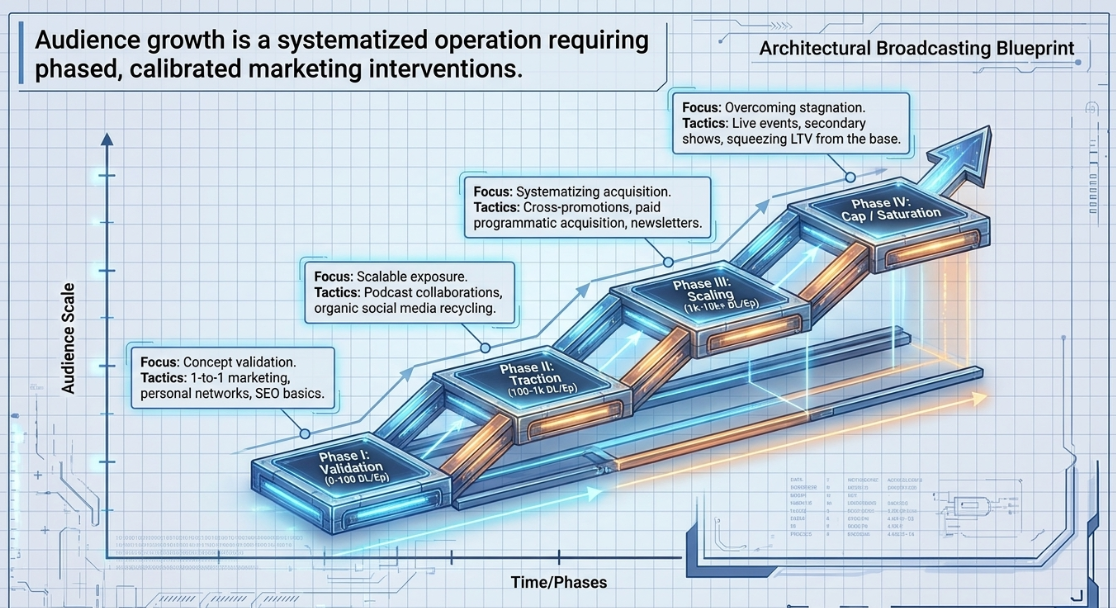
Achieving scale in podcasting is notoriously difficult due to the decentralized nature of RSS feeds and the lack of native algorithmic discovery in legacy apps. Audience growth must be systematically managed through distinct phases45:
The Mechanics of Podcast Swaps and Cross-Promotion
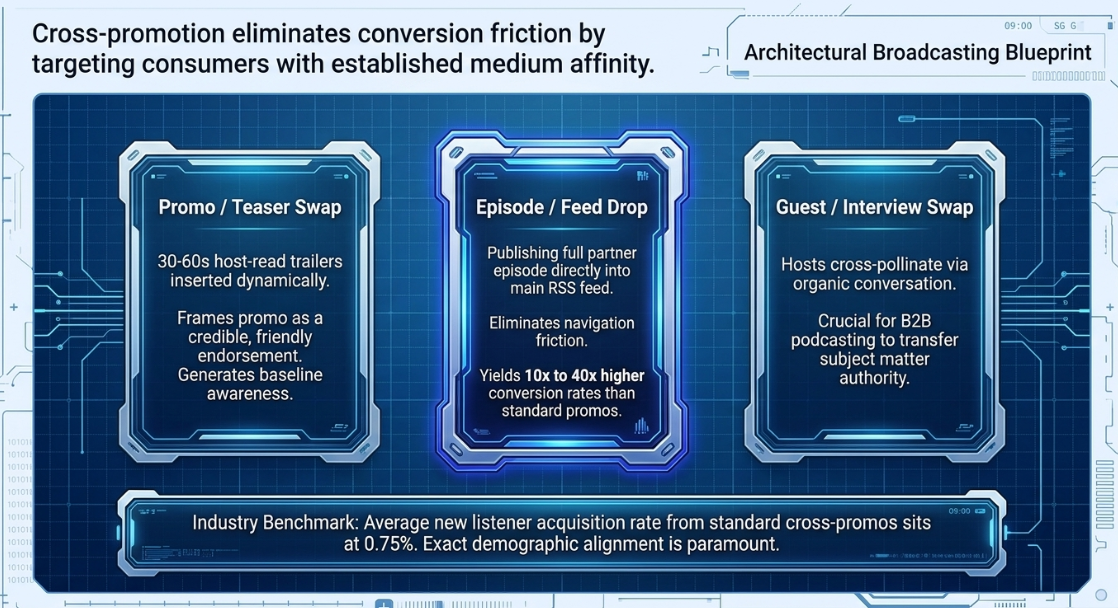
Cross-promotion and "podcast swaps" represent the most efficient and cost-effective mechanisms for listener acquisition in Phases II and III. Because they target consumers who already exhibit a high affinity for the medium, they eliminate the friction of converting a non-listener into a podcast consumer45.
Swaps take several forms:
Promo / Teaser Swap: 30- to 60-second host-read promotional trailers inserted dynamically into a partner's ad breaks. These generate baseline awareness and are most effective when the host provides personal context, framing the promo as a credible, friendly endorsement46.
Episode / Feed Drop: Publishing a full, high-performing episode of a partner's podcast directly into the host's main RSS feed, prefaced by a brief introduction. This strategy yields the highest conversion rates—reportedly 10x to 40x higher than standard promos—as it allows the audience to sample the product immediately without navigating away from their player47.
Guest / Interview Swap: Hosts appear on each other's shows to cross-pollinate audiences through organic conversation. This is highly effective for B2B podcasting, where the transfer of subject matter authority is the primary value driver45.
Data from Chartable indicates that the average new listener acquisition rate from standard cross-promos sits at approximately 0.75%47. When executing these collaborations, demographic alignment is paramount. Shows must possess complementary audiences of similar sizes to ensure an equitable exchange of value, avoiding lopsided deals that yield negligible returns46.
The Omnichannel Audio-Video Ecosystem: The Goalhanger Case Study
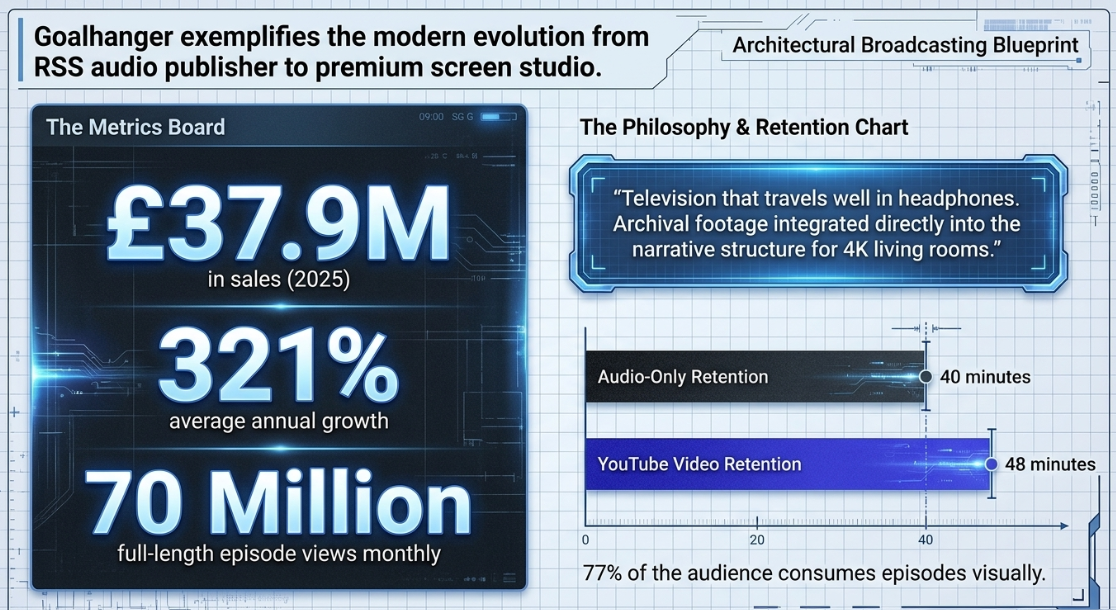
The theoretical principles of multi-platform strategy, visual integration, and advanced audience monetization are flawlessly illustrated by Goalhanger, named the UK's fastest-growing private company in 202648. Co-founded by former footballer Gary Lineker, alongside Tony Pastor and Jack Davenport, Goalhanger achieved an astonishing 321% average annual growth rate over three years, generating £37.9 million in sales in 202548.
Goalhanger’s unprecedented success stems from a calculated departure from traditional, RSS-only podcasting. It has architected a comprehensive media ecosystem that blends premium audio, high-retention video, and a highly lucrative direct-to-consumer subscription model.
The Transition to Screen-First Podcasting
Goalhanger recognized early that the ceiling for audio-only reach was finite. Driven by shifting consumer habits and the reality that video advertising commands higher CPMs, the company re-engineered its production methodology to become a true "screen studio"51.
The company now produces "television that travels well in headphones"52. Rather than merely filming individuals talking into microphones, Goalhanger integrates rich visual elements directly into the narrative structure. In The Rest is Football, hosts analyze archival Premier League footage that viewers can watch in real-time, elevating the show from a passive audio experience to a primary screen event designed for 4K living room televisions52. Even their audio drama, Sherlock & Co, underwent animated pilot testing to explore visual formats52.
This video-first philosophy has yielded staggering engagement metrics. The flagship The Rest is History commands approximately 500,000 viewers per episode on YouTube, with an average watch time of 48 minutes—exceeding its audio-only retention rate of 40 minutes51. In total, approximately 77% of Goalhanger's audience consumes episodes visually in some format, resulting in roughly 70 million full-length episode views monthly and over 750 million full-length streams across 202551.
The "Shop Window" Strategy and Incremental Impact
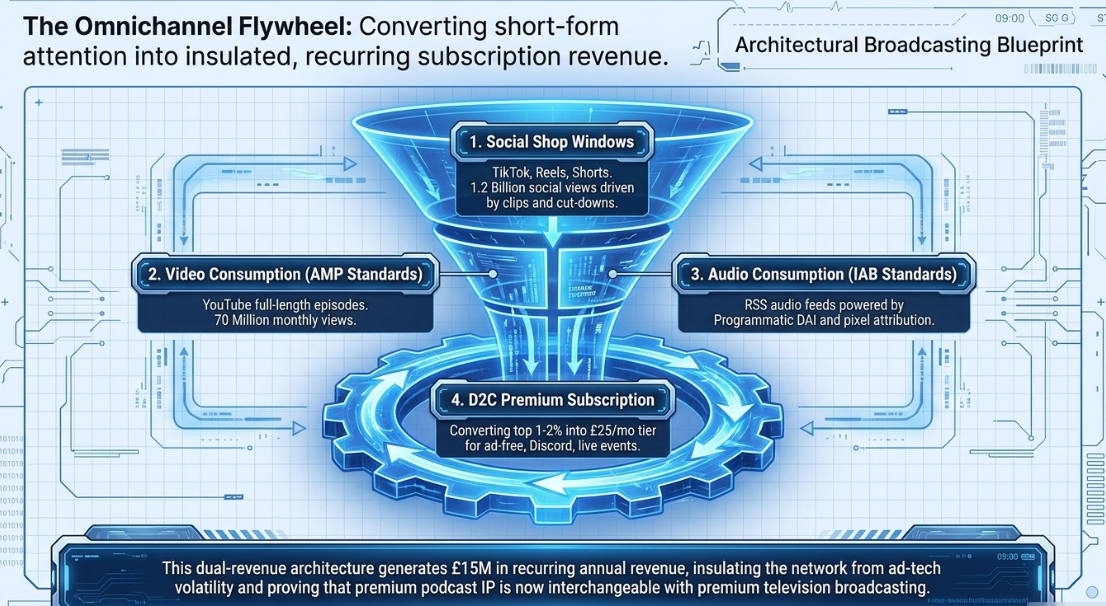
To drive this immense long-form consumption, Goalhanger masters top-of-funnel acquisition utilizing short-form social media. Platforms like TikTok, Instagram, Facebook, and YouTube Shorts serve as digital "shop windows"52.
In 2025, out of 1.8 billion total network views, a massive 1.2 billion were driven entirely by social clips, cut-downs, and feed-native moments52. By strategically seeding highly engaging micro-moments into algorithmic feeds, Goalhanger captures vast demographics. A percentage of those viewers are subsequently funneled toward full-length YouTube episodes and RSS audio feeds52.
This omnichannel methodology is highly attractive to enterprise advertisers. Nielsen and Acast research substantiates the power of this approach in the UK market. The Podcasts' Incremental Impact UK report concluded that adding podcast video to a media mix ranks first in driving attention across key visual channels, outperforming both Broadcast Video on Demand (BVOD) and Subscription Video on Demand (SVOD)26. Furthermore, integrating Acast-distributed podcasts into traditional campaigns increases overall campaign reach by 25% over AM/FM radio, 21% over BVOD, and 15% over live TV26. The active choice required to engage with a creator fosters deeper consumer trust, with 55% of respondents indicating that podcast campaigns add more credibility than live TV, and 48% reporting increased brand consideration26.
Subscription Economics and Broadcaster Evolution
While programmatic and host-read advertising remain lucrative, the volatility of ad-tech markets necessitates diversified cash flows. Goalhanger successfully pioneered a massive premium subscription tier, exceeding 250,000 paying members across its network of shows48.
Utilizing platforms like Supporting Cast and Patreon, Goalhanger offers tiered memberships averaging £60 annually54. The premium "Athelstan" tier for The Rest is History commands £25 per month, offering members exclusive perks such as ad-free listening, early access, bonus content, private Discord communities, and access to live events and zoom quizzes54.
This direct-to-consumer model generates an estimated £15 million in recurring annual revenue48. Crucially, only 1-2% of the overall listener base converts to a paid tier, demonstrating that immense subscription revenue can be achieved without placing the core growth engine behind a restrictive paywall55. This dual-revenue stream insulates the company from programmatic market shocks while providing deep, first-party listener data that simultaneously strengthens its proposition to premium advertisers54.
Goalhanger is now rapidly evolving into a modern broadcaster. It has hired editorial directors to expand its written newsletter offerings and has launched a venture capital arm to invest in creator-led media businesses48. The validation of this model is evident in its corporate partnerships: The Chernin Group recently acquired a minority stake, and Netflix secured a global broadcasting deal to carry The Rest is Football daily during the 2026 FIFA World Cup48. These moves signal that premium podcast intellectual property is now entirely interchangeable with premium television broadcasting.
Conclusion
The strategic foundation of podcast marketing has shifted irreversibly. The era of treating audio as a secondary, unmeasurable experimental channel has concluded. Today, building and sustaining a successful audio ecosystem demands a rigorous application of business intelligence, merging the traditional intimacy of the spoken word with the ruthless precision of programmatic ad tech, pixel-based attribution, and AI-driven verification.
The standardization of metrics—driven by the IAB's v2.2 methodology disclosures and the cross-platform parity established by the AMP Accords' 30-second play definition—provides the unified currency necessary to unlock billions in enterprise marketing budgets. As consumer privacy regulations and platform-level restrictions like Apple Private Relay continue to obscure deterministic IP tracking, the industry will lean further into dynamic ad insertion, incrementality testing, and the creation of walled, logged-in subscription communities.
The most successful media entities will no longer view themselves merely as podcast producers. Instead, they must operate as multi-format broadcasters. By leveraging short-form algorithmic discovery as a shop window, anchoring their narratives in high-retention video, and converting top-tier fans into recurring subscription revenue, these organizations will build resilient, highly profitable ecosystems capable of dominating the modern attention economy.
Works cited
Podcast Analytics and Metrics: What to Track and Why | Podcasting Authority, https://podcastingauthority.com/podcast-analytics-and-metrics/
IAB Tech Lab Releases Podcast Measurement Technical Guidelines 2.1 for Public Comment, https://iabtechlab.com/press-releases/tech-lab-releases-podcast-measurement-technical-guidelines-2-1-for-public-comment/
IAB Tech Lab 2.1 : All you need to know - Ausha, https://www.ausha.co/blog/productlove-iab-tech-lab-2-1-standards/
Ausha's analytics now officially comply with IAB 2.2 Standards, https://www.ausha.co/blog/iab-tech-lab-2-2/
Podcast Measurement Technical Guidelines Version 2.1 - Podnews, https://podnews.net/uploads/iab-v2.1-and-v2.2.pdf
Podcast Measurement ec n ca u de nes Version 2.2 - IAB Tech Lab, https://iabtechlab.com/wp-content/uploads/2024/02/PodcastMeasurement_v2.2_final.pdf
IAB Releases Updated Podcast Measurement Guidelines - Radio Ink, https://radioink.com/2024/05/06/iab-releases-updated-podcast-measurement-guidelines/
AMP proposes new podcast impression standard across platforms - PodcastingToday, https://podcastingtoday.co.uk/amp-proposes-new-podcast-impression-standard-across-platforms/
AMP Task Force Emerges to Confront Podcasting's Measurement Dilemma - Podnews, https://podnews.net/press-release/alliance-for-measurement-in-podcasting
Alliance for Measurement in Podcasting - Podnews, https://podnews.net/directory/company/alliance-for-measurement-in-podc
A new AMP member, https://podnews.net/update/amp-member
Should New Podcast Credit Rules Lead To Questions About Radio's Three Minute Qualifier? - Barrett Media, https://barrettmedia.com/2026/06/15/podcast-credit-radio-three-minute-qualifier/
Introducing a New Standard for Podcast Plays and Upgraded Creator Analytics Experience, https://newsroom.spotify.com/2026-06-11/spotify-for-creators-tools-plays-analytics-updates/
Bringing deeper insight to know and grow your audience - Spotify for Creators, https://creators.spotify.com/resources/news/plays-analytics-updates
Spotify Adopts 30-Second Minimum for Podcast Play Counts, Updates Creator Analytics, https://interspacemusic.com/blog/spotify-adopts-30-second-minimum-for-podcast-play-counts-updates-creator-analytics/
Spotify for Creators New Analytics! : r/podcasting - Reddit, https://www.reddit.com/r/podcasting/comments/1u3d3ft/spotify_for_creators_new_analytics/
Podcasting's “Privacy Problem” | James Cridland - radio futurologist, https://james.cridland.net/blog/2022/podcasting-s--privacy-problem/
Understanding the Impact of Platform Privacy Restrictions in the Podcast Marketplace, https://iabtechlab.com/understanding-the-impact-of-platform-privacy-restrictions-in-the-podcast-marketplace/
Apple Podcasts web player & Privacy - Legal, https://www.apple.com/legal/privacy/data/en/apple-podcasts-web/
Guide to Programmatic Advertising on Podcasts - Triton Digital - Blog, https://blog.tritondigital.com/guide-to-programmatic-advertising-on-podcasts
New partners announced for Apple Podcasts video | News | Triton Digital, https://tritondigital.com/news-item/March-16-2026/new-partners-announced-for-apple-podcasts-video
How Programmatic Podcast Advertising Really Works: From Play Button to Ad Delivery - Intentsify, https://intentsify.io/blog/how-programmatic-podcast-advertising-works/
Acast: The Best Podcast Monetization Platform, https://acast.com/
Podcast Hosting Platforms - Beamly, https://beamly.com/podcast-hosting-platforms/
Podcasting outperforms other media to deliver campaign reach and attention boost, says Acast survey, https://uk.themedialeader.com/podcasting-outperforms-other-media-to-deliver-campaign-reach-and-attention-boost-says-acast-survey/
The 14 Best Podcast Distribution Platforms For B2B Growth In 2026 - Fame.so, https://www.fame.so/post/best-podcast-distribution-platforms
Spotify's latest acquisitions expand its podcast analytics and attribution capabilities—here's how the tech works - Marketing Brew, https://www.marketingbrew.com/stories/2022/04/14/spotify-s-latest-acquisitions-expand-its-podcast-analytics-and-attribution-capabilities-here-s-how-the-tech-works
Trafficking a Triton Advertising VAST URL in Megaphone, https://help.tritondigital.com/docs/trafficking-a-triton-advertising-vast-url-in-megaphone
7 Best Podcast Analytics Tools in 2026 - Compared | Podstatus Blog, https://podstatus.com/blog/best-podcast-analytics-tools
Podscribe | IAB-Certified Podcast & Audio Ad Measurement, https://podscribe.com/
Spotify Acquires Podsights and Chartable To Advance Podcast Measurement for Advertisers and Insights for Publishers, https://newsroom.spotify.com/2022-02-16/spotify-acquires-podsights-and-chartable-to-advance-podcast-measurement-for-advertisers-and-insights-for-publishers/
About Podscribe — Podscribe, https://podscribe.com/about-us
How Podscribe Verifies Placement (Airchecks) & Delivery, https://help.podscribe.com/verification/2ZBnvGeWNKuGLwWEtqp5i3/how-podscribe-verifies-placement-airchecks--delivery/7mYbD7BSjd7hekJBckF9mi
Podcast Ad Verification | Stop Wasted Spend with Podscribe, https://podscribe.com/solutions/ad-verification/podcast-ad-verification
Radio Measurement for Ads: Airchecks, Attribution & Smart Columns | Podscribe, https://podscribe.com/blog/radio-measurement-smart-cols
Podscribe vs. Podtrac: Podcast Analytics & Measurement Comparison (2026), https://podscribe.com/blog/podtrac-vs-podscribe
Dynamic Ad Insertion on Podcasts: What It Is & How It Works | Ad Results Media, https://www.adresultsmedia.com/news-insights/dynamic-ad-insertion-for-podcasts/
The Benefits of Dynamic Ad Insertion in Podcast Advertising - Acast, https://advertise.acast.com/news-and-insights/the-benefits-of-dynamic-ad-insertion-in-podcast-advertising
Dynamic Ad Insertion - Blubrry Podcasting, https://blubrry.com/services/dynamic-podcast-advertising-insertion/
How to Scale Your Podcast Ads With Programmatic Advertising - AdsWizz, https://www.adswizz.com/how-to-scale-your-podcast-ads-with-programmatic-advertising/
What Is Programmatic Audio Advertising in 2026 - AI Digital, https://www.aidigital.com/blog/programmatic-audio-advertising
Programmatic Advertising Part 2: SSP Trends, CTV Growth, and What Q1 Data Shows, https://podcasts.apple.com/us/podcast/programmatic-advertising-part-2-ssp-trends-ctv-growth/id1863383874?i=1000763057625&l=fr-FR
Podcast Marketing Strategy: A 2026 Guide - Podmuse, https://www.podmuse.com/post/podcast-marketing-strategy
The Four Phases of Podcast Growth, https://podcastmarketingacademy.com/phases-of-podcast-growth/
How to grow your podcast using podcast swaps - Content is Queen, https://contentisqueen.org/free_resources/how-to-grow-your-podcast-using-podcast-swaps/
Podcast Swaps: The New Strategy for Cross-Promotion and Listener Growth, https://www.premierepodcastpros.com/uncategorized/podcast-swaps-the-new-strategy-for-cross-promotion-and-listener-growth/
Gary Lineker's Goalhanger named UK's fastest-growing business | Media | The Guardian, https://www.theguardian.com/media/2026/jun/05/gary-lineker-goalhanger-fastest-growing-business-podcasts
Gary Lineker's podcast firm tops fastest-growing list as risk pays off - Yahoo Finance UK, https://uk.finance.yahoo.com/news/gary-lineker-punt-podcasts-pays-060000376.html
Goalhanger becomes Britain's fastest-growing company - Podnews, https://podnews.net/update/fastest-growing-goalhanger
Inside Goalhanger's shift from podcast producer to screen studio - Digiday, https://digiday.com/media/inside-goalhangers-shift-from-podcast-producer-to-screen-studio/
https://www.digiday.com/media/inside-goalhangers-shift-from-podcast-producer-to-screen-studio/
About Goalhanger | Podcast Network, Shows & Hosts, https://goalhanger.com/
Goalhanger exceeds 250000 paying subscribers - Press Gazette, https://pressgazette.co.uk/paywalls/goalhanger-subscribers/
Goalhanger Launches The Accelerator Fund, New Fox Creator Studios Head, & More, https://soundsprofitable.com/the-download/goalhanger-launches-fund/
“We need to rethink what news is” – Our panel on building and keeping audience relationships, https://reutersinstitute.politics.ox.ac.uk/news/we-need-rethink-what-news-our-panel-building-and-keeping-audience-relationships
Goalhanger - Wikipedia, https://en.wikipedia.org/wiki/Goalhanger