Technical Production Standards and Acoustic Engineering
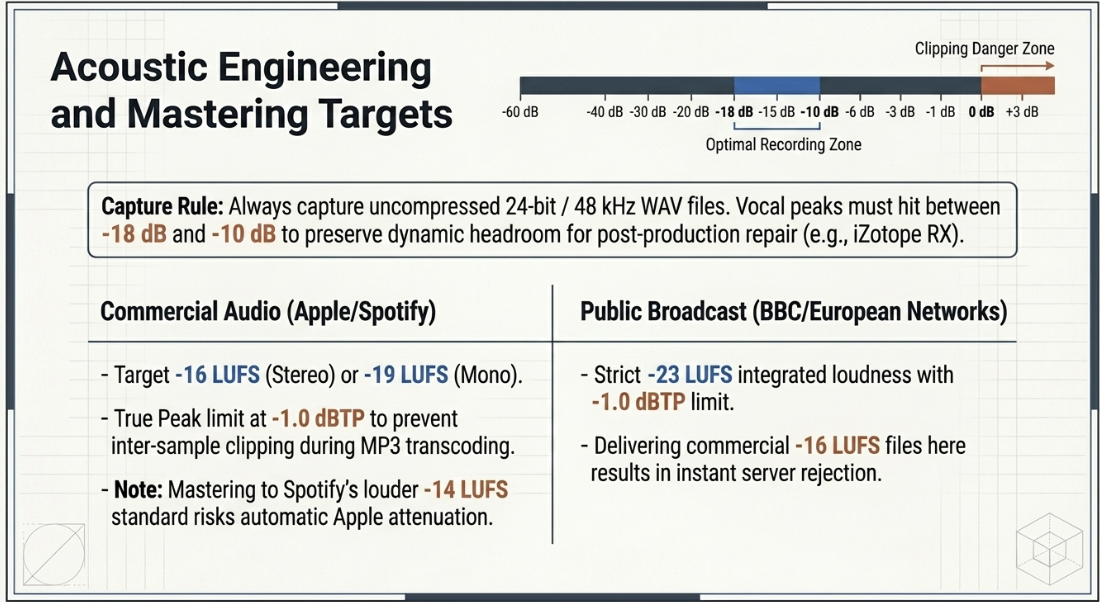
The production pipeline of high-performing digital audio assets is governed by strict technical specifications that directly dictate distribution platform compatibility and consumer retention1. The modern podcast ecosystem operates under a dual-standard model where the destination directory defines the mastering parameters1. Commercial platforms, led by Apple Podcasts and Spotify, rely on Loudness Unit Full Scale (LUFS) targets to regulate perceived audio volume across their platforms1.
For standard stereo files, the commercial consensus target is 


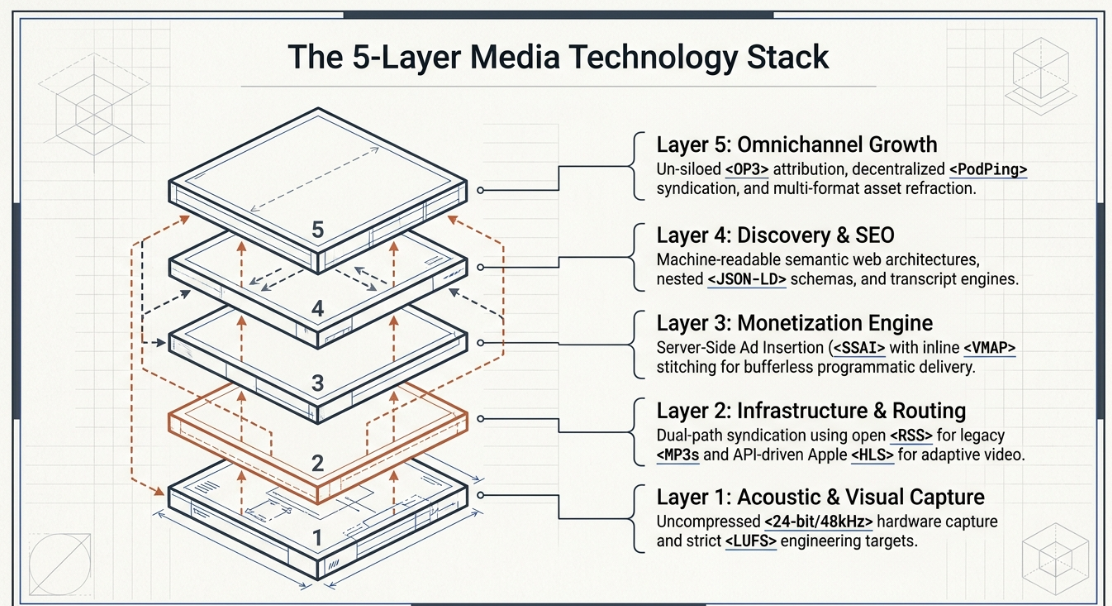
Public service broadcasters, such as the British Broadcasting Corporation (BBC) or European regional networks, enforce a separate, stricter standard derived from television and radio transmission regulations1. This workflow requires an integrated loudness target of 


Maintaining a clean signal path during the capture phase is essential to ensure audio assets are resilient to post-production processing1. During recording, the voice signal should peak consistently between 


To maximize post-production flexibility, professional workflows mandate recording at a minimum of 48 kHz sample rate and 24-bit depth2. While consumer distribution files are down-converted to smaller, highly compressed file formats, capturing uncompressed WAV files at 24-bit depth preserves a wider dynamic range, enabling clean frequency modifications, background noise subtraction, and multi-track level leveling without introducing digital processing artifacts2.
The selection of a recording environment and hardware toolchain depends on the format of the show and the available budget1. Audio-only productions, such as narrative journalism, can achieve professional standards by using high-end "travel kits" consisting of dynamic microphones like the Shure SM7B or Rode NT1-A paired with in-line preamplifiers like the Cloudlifter to boost signal strength without raising the noise floor1. Alternatively, creators can use membership-based creative spaces like The Qube for clean, acoustically treated tracking1.
Budget-conscious independent workflows often use regional facilities like Pirate Studios, leveraging their integrated hardware setups (such as the RØDECaster Pro II) while bringing physical MicroSD cards to maintain direct data custody of the raw multi-track files1.
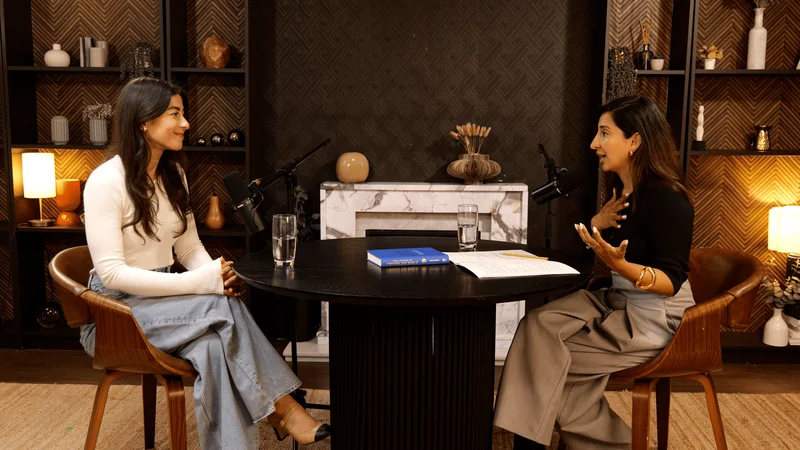
For visual productions, the complexity of lighting, multi-camera depth, and live engineering support makes renting professional facilities (like Podcast House or Spiritland) more cost-effective than building custom in-house studios1. High production value in visual formats is a key discovery driver on video-first directories, whereas basic bedroom backdrops can signal amateur production to modern audiences1.
The physical audio captures are processed through a digital software pipeline to remove noise, level voices, and master the final mix1:
Acoustic Restoration: Raw files are processed through audio repair suites like iZotope RX to eliminate hardware self-noise, room echoes, mouth clicks, and plosive distortions1.
Creative Editing: Editors compile and sequence the dry tracks using Digital Audio Workstations (DAWs) like Hindenburg Pro or Zrythm to organize multi-guest setups, music beds, and transition sound effects3.
Leveling and Mastering: The final export is processed through automated systems like Auphonic to balance different vocal tracks and ensure the master meets target loudness and True Peak standards1.
Hosting Infrastructure and the Architecture of Modern Syndication
The mechanics of podcast distribution rely on the Really Simple Syndication (RSS) 2.0 XML specification6. This format acts as a structured, chronological index that directories (such as Apple Podcasts, Spotify, and Amazon Music) query to identify, display, and deliver audio-on-demand files6. Unlike social media distribution channels that prioritize content based on engagement-driven algorithms, RSS feeds remain neutral, serving updates directly to subscribing clients in chronological order8.
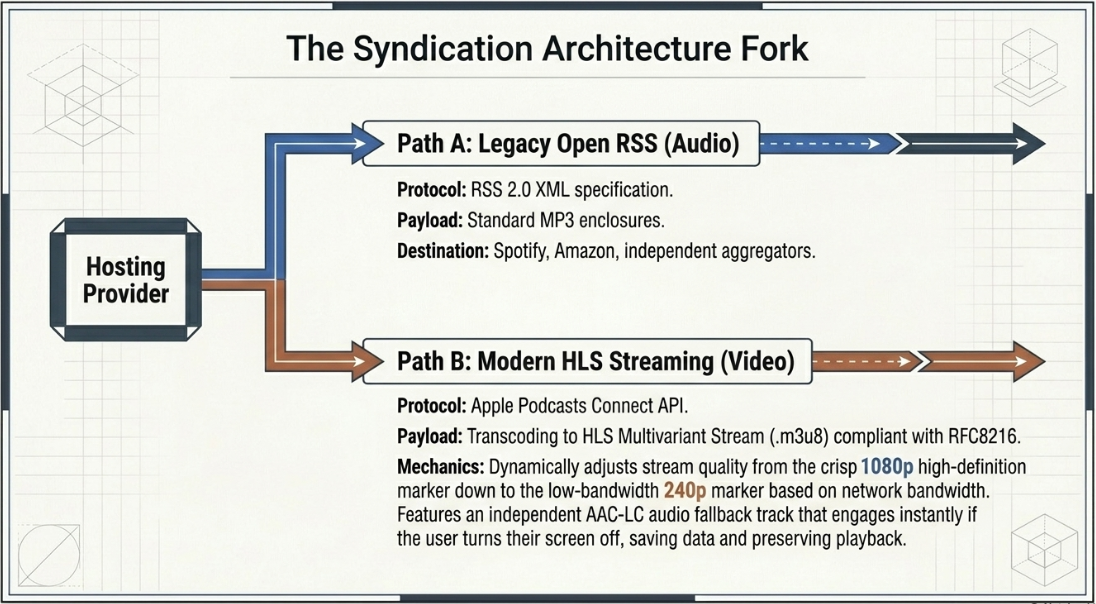
An RSS feed contains structured metadata tags that define both show-level attributes (title, overall description, categorization, and show artwork) and episode-level items (individual titles, summaries, publication dates, and specific enclosure tags containing the source audio file URLs)7. To optimize syndication, these XML nodes must comply with strict namespace extensions, most notably those defined by Apple Podcasts, which historically structured digital audio distribution across the web6.
The introduction of high-definition video into traditional audio workflows has created a division in syndication infrastructure9. Historically, video podcasting relied on standard RSS video downloads (using MP4 enclosures), but large file sizes and manual download models made it unscalable for mobile networks and consumer-grade media systems9.
The industry currently uses two separate video syndication systems9. Platforms like YouTube act as centralized, platform-native ecosystems where video is uploaded, hosted, and indexed within their own search engines, bypassing traditional RSS mechanisms8. Under this model, publishers lose granular analytics, custom attribution prefix URLs, and Interactive Advertising Bureau (IAB) certified download tracking10.
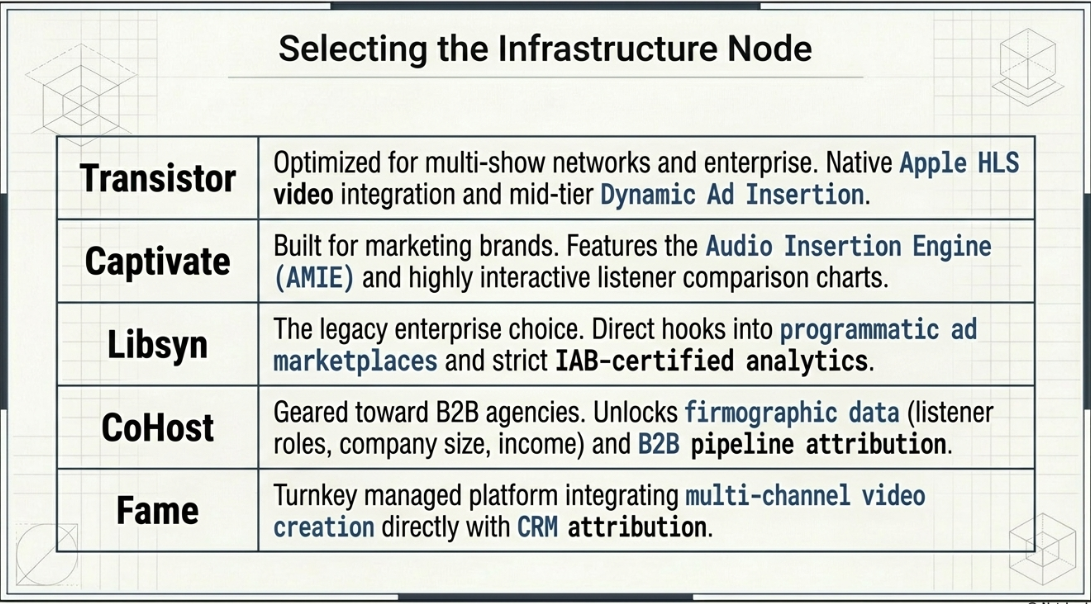
Apple Podcasts addresses this issue using native HTTP Live Streaming (HLS) video delivery9. Instead of relying on open RSS tags to distribute large MP4 files, Apple uses an API-centric syndication model9. Publishers must provide an API key generated from their Apple Podcasts Connect account to an approved, participating hosting platform (such as Transistor, Captivate, Podbean, Acast, or Art19)12. When a video file is uploaded, the hosting server transcodes it into a multivariant HLS stream compliant with RFC821611. This specification splits the video into small media segments (typically using H.264 video encoding paired with AAC-LC audio) and generates a .m3u8 index file11.
The HLS multivariant playlist defines different resolutions and bitrates, enabling the playback client to dynamically adjust stream quality based on current network bandwidth15. This architecture includes a separate audio-only rendition track11. If a listener switches off their screen or hits the "Turn Video Off" button, the client stops downloading the video segments and seamlessly switches to the independent audio track without losing the playback position11. This architecture prevents the device from downloading unnecessary video data while ensuring a continuous listening experience11.
The HLS stream is only processed by devices running compatible operating systems (such as iOS/iPadOS 26.4, visionOS 26.4, or modern web interfaces), while legacy devices and audio-only aggregators fall back to traditional MP3 downloads generated from the same RSS feed11.
The hosting infrastructure market contains several providers tailored to specific business needs17. Standard services vary across storage limits, analytics depth, visual rendering, and pricing models17.
This infrastructure has significant monetization implications9. While Apple Podcasts does not charge hosting providers or creators to distribute HLS streams, it charges participating ad networks an impression-based fee for delivering dynamic video ads within HLS video content9. This acts as a platform-controlled gate within what has historically been an open RSS distribution model9.
Technical Ad Operations: VAST, VMAP, and Server-Side Dynamic Ad Insertion (SSAI)
Modern podcast monetization relies on Dynamic Ad Insertion (DAI), which replaces the traditional model of baking static commercials directly into the audio file25. This technology swaps ad creatives on the fly at the exact moment a listener requests a download or initiates a stream, targeting the ad spot based on geographical IP data, client device, timestamp, and audience demographics26.
DAI can be executed using either Client-Side Ad Insertion (CSAI) or Server-Side Ad Insertion (SSAI)25. In CSAI, the listener's playback app parses an ad tag, sends a separate network request to an ad server, downloads the ad creative, and attempts to pause the content to play the ad28. This approach is common in web video but highly vulnerable to ad blockers, often introduces buffering latencies at ad transition points, and depends heavily on player-side SDK support25.
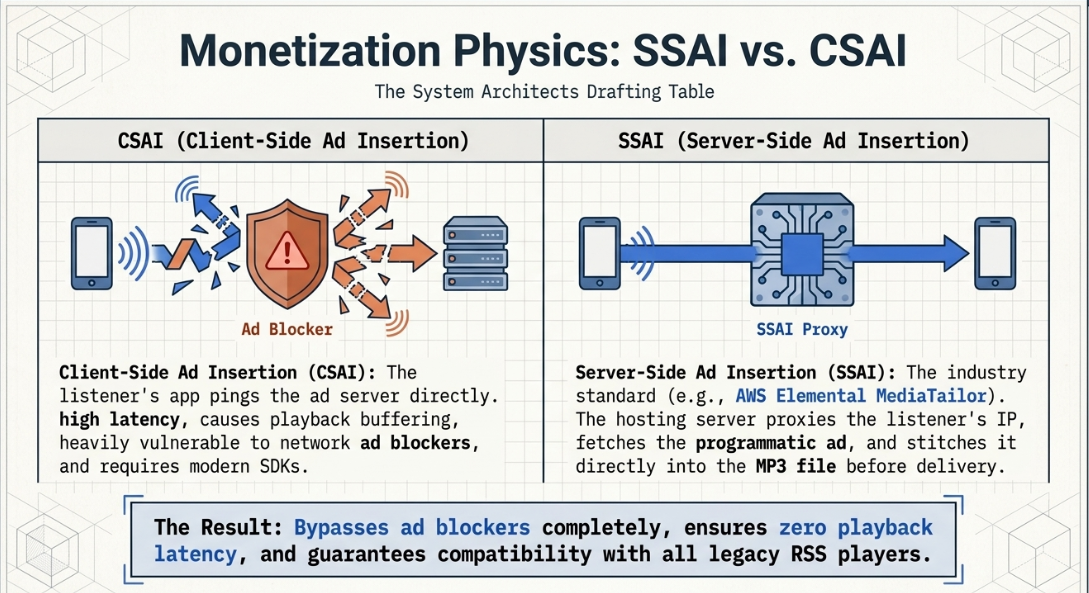
In podcasting, SSAI (also known as server-side stitching) is the industry standard27. The publisher’s hosting platform or ad-decisioning server acts as an intermediary29. When a client requests an MP3 download, the server parses the request headers (including client IP and User-Agent) and makes a backend ad request to an ad decisioning server using standard ad tech protocols26. The server then dynamically stitches the selected audio ad creative directly into the podcast's MP3 file at pre-defined edit points27. The client device receives a single, unified file, which bypasses ad blockers, eliminates playback buffering, and works across all legacy RSS players27.
Client Device Hosting/SSAI Server Ad Decision Server (ADS)
| | |
|--- 1. HTTP Request (Get MP3) --->| |
| |--- 2. Ad Request (VAST/VMAP) ------->|
| | |
| |<-- 3. XML Response (Ad MP3 URLs) ----|
| | |
| |--[Stitch Ad & Episode MP3s] |
|<-- 4. Unified MP3 Stream --------| |
| | |
|--- 5. Trigger Tracking Beacons ---------------------------------------->|
The underlying technical syntax relies on three XML-based schemas: the Video Ad Serving Template (VAST), the Video Multiple Ad Playlist (VMAP), and the Video Player Ad Interface Definition (VPAID), all defined by the IAB Tech Lab26:
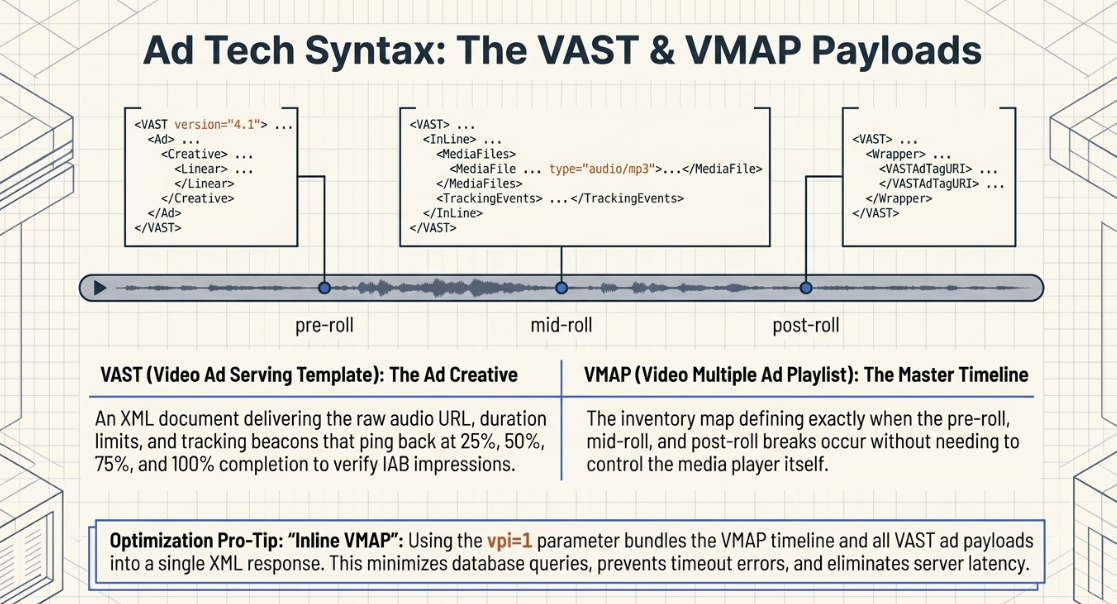
VAST (Video Ad Serving Template): Structures the metadata for individual ad creatives30. An ad-decisioning server responds to an ad request with a VAST XML document that specifies the URL of the audio file, the creative type, the duration, and tracking URLs (tracking beacons) that the playing client must ping at specific milestones (such as start, 25%, 50%, 75%, and completion) to verify impressions29.
VMAP (Video Multiple Ad Playlist): Manages the timing structure for multiple ad spots across long-form content30. It allows publishers to define ad breaks (pre-roll, mid-roll, and post-roll points) without controlling the media player itself31. VMAP acts as an inventory map, defining exactly when ad breaks occur in the media timeline, while VAST payloads fill those positions31.
VPAID (Video Player Ad Interface Definition): Sits on top of VAST to support interactive ads (such as clickable companion banners or custom call-to-actions)30. However, VPAID’s high error rates (often exceeding 30% due to script loading failures) and security vulnerabilities have accelerated its deprecation in modern programmatic pipelines30.
For enterprise-level cloud distribution, publishers use dedicated server-side ad stitching tools like AWS Elemental MediaTailor32. MediaTailor integrates directly with Ad Decision Servers (ADS) to fetch and ingest VAST and VMAP payloads32. The platform supports up to VAST 4.3 and VMAP 1.0 specifications, resolving up to seven levels of nested XML redirection wrappers to locate the raw ad media assets32.
To preserve tracking accuracy, MediaTailor proxies the user-agent and IP headers (x-forwarded-for) from the listener's playback device during the server-side ad call, ensuring downstream attribution networks can accurately track geographic and demographic delivery metrics32.
To manage high request volumes, publishers use inline VMAP formatting33. Rather than forcing a client to make multiple backend ad calls for each pre-roll, mid-roll, and post-roll slot—which can cause timeout errors and latency—the ad manager uses a single inline VMAP request (using the vpi=1 parameter in Google Ad Manager)33. This returns the complete structural playlist and all associated VAST ad payloads in a single XML payload33.
This optimization minimizes round-trip database queries and decreases overall latency, helping ensure that files are delivered efficiently and without playback lag33.
XML
<VMAP xmlns:vmap="http://www.iab.net/vmap-1.0" version="1.0">
<vmap:AdBreak timeOffset="start" breakType="linear" breakId="preroll_1">
<vmap:AdSource id="preroll_source" allowMultipleAds="true" followRedirects="true">
<vmap:AdTagURI templateType="vast3">
<![CDATA[https://pubads.g.doubleclick.net/gampad/ads?sz=1x1&iu=/1234/podcast_preroll&vpi=1&output=xml_vmap1_vast3]]>
</vmap:AdTagURI>
</vmap:AdSource>
</vmap:AdBreak>
<vmap:AdBreak timeOffset="00:15:30" breakType="linear" breakId="midroll_1">
<vmap:AdSource id="midroll_source" allowMultipleAds="true" followRedirects="true">
<vmap:AdTagURI templateType="vast3">
<![CDATA[https://pubads.g.doubleclick.net/gampad/ads?sz=1x1&iu=/1234/podcast_midroll&vpi=1&output=xml_vmap1_vast3]]>
</vmap:AdTagURI>
</vmap:AdSource>
</vmap:AdBreak>
</VMAP>
Publishers using monetization platforms like Xandr configure ad break rules through specific parameters on the ad placement34. The system can be configured to support standard or optimized ad pods33. This requires setting the maximum_number_ads parameter greater than one and defining a max_duration_secs limit34.
For mid-roll spots, setting a start_delay_secs parameter greater than zero defines the exact injection point in the episode timeline, while targeting the /ssvmap endpoint initiates server-side ad rendering to deliver structured programmatic spots34.
Programmatic buying leverages demand-side platforms (DSPs) to bid on ad inventory in real time26. The IAB Tech Lab Podcast Measurement Guidelines v2.2 require that 100% of the ad file bytes be downloaded before a dynamic ad is counted as an impressions26.
Publishers can use dynamic creative optimization (DCO) to swap specific ad elements—such as voiceover tracks, offers, and sound effects—in real time based on audience metrics26. On mobile devices, publishers can also use interactive formats like AdsWizz ShakeMe26. This technology enables listeners to take immediate, direct actions (such as shaking or tapping their phone screen during a commercial to open a web map, download an app, or initiate a call)26. This bridges the gap between traditional audio-only brand messaging and direct-response performance marketing26.
Technical Podcast Search Engine Optimization and Schema Architecture
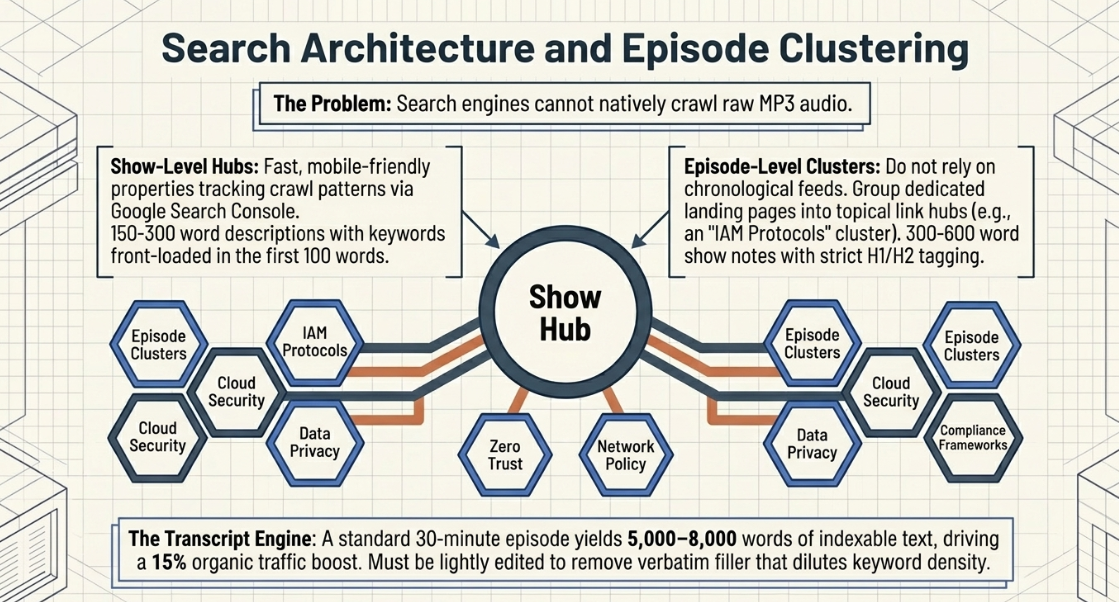
Because search engines cannot natively crawl raw audio, search visibility relies on textual metadata and structured web content36. For search engine optimization (SEO), a podcast must be treated as a web asset, transforming audio content into machine-readable text that search engine crawlers can index37.
An optimized search footprint requires separating show-level from episode-level search signals37. At the show level, publishers should configure a dedicated, fast, mobile-friendly website with an SSL certificate39. This site should be connected to Google Search Console to track crawl patterns and indexation37. Show titles must prioritize clarity over cleverness41. Incorporating primary industry keywords into the show’s name establishes topical relevance, while the author field must match the personal brand or corporate entity to capture relevant search queries41. Show descriptions should span 150 to 300 words, clearly outlining the value proposition, publishing frequency, and targeting primary keywords within the first 100 words to ensure prompt indexing37.
[Chronological Episode Release]
|
+-----------------------+-----------------------+
| |
v v
[Topic Hub A: Cyber Security] [Topic Hub B: Data Engineering]
| - Episode 104 (Firewalls) | - Episode 108 (Vector DBs)
| - Episode 112 (Zero Trust) | - Episode 115 (Data Lakes)
| - Episode 121 (IAM Protocols) | - Episode 124 (ETL Pipelines)
At the episode level, every installment needs a dedicated landing page38. Rather than presenting episodes chronologically in a single feed, organizing pages into topical clusters and internal link hubs establishes stronger topical authority on search engines38. The URL slug must be clean and keyword-focused, and the page title should remain under 60 characters36.
The title should front-load key topics and eliminate episode numbers from the front to prioritize keyword prominence36. Show notes must use explicit heading tags (H1, H2), incorporating keyword-focused summaries (300 to 600 words) with a natural keyword density (incorporating the primary keyword 3 to 5 times), timestamped navigational chapters, and contextual outbound links to resources mentioned during the recording36.
Transcripts are a highly effective tactical SEO asset38. A standard 30-to-60-minute episode can yield 5,000 to 8,000 words of indexable text, capturing long-tail keyword variations that are rarely accounted for in short descriptions37. Moz research indicates that adding transcripts to podcast landing pages can drive a 15% increase in organic search traffic and a 50% boost in keyword rankings42.
Raw, unedited transcript blocks, however, can introduce SEO issues36. Verbatim audio records contain filler words ("um," "like," "you know") and disjointed phrasing that can dilute keyword density and compromise user experience36.
Transcripts should be lightly edited to improve readability while maintaining the speaker's voice36. They should also use descriptive H2 subheadings and bold speaker labels to structure the text for search engine crawlers36. To prevent duplicate content penalties from search engines, generic intro and outro scripts should be excluded from the indexed transcript files40.
For B2B brands launching a new series, a 90-day SEO implementation framework can structure the optimization process37:
Month 1 (Audit & Cleanup): Analyze the 10 most-listened back-catalog episodes37. Edit and optimize old titles, write structured descriptions, and configure transcription generation systems37.
Month 2 (System Setup): Establish standardized, reusable templates for show notes37. Set up and test valid JSON-LD schema markup on every episode landing page37.
Month 3 (Search Console Analysis): Parse data within Google Search Console to identify page-two rankings and long-tail query patterns37. Optimize copy and internal links to boost these high-potential pages to page one37.
From a technical web development perspective, publishers can use specific tools and configurations to support search crawlers40:
Astro Native Components: Use Astro's <Image> components to optimize cover art and set clean canonical URL headers44.
Site Search Indexing: Implement Pagefind to generate static search indexes directly in client builds44.
Structured Meta Controls: Add <link rel="canonical"> and viewport meta tags within page header configurations40.
Dynamic Schema Injection: Use Next.js dynamic routing with custom generator functions to inject valid JSON-LD schemas via the dangerouslySetInnerHTML React attribute43.
AI Search Engine Targeting: Configure custom llms.txt and build-time llms-full.txt files to make site content legible for generative AI search crawlers44.
Crawler Instruction Files: Include optimized XML sitemaps and configure robots.txt files to grant access to standard search engines while blocking or permitting specific AI crawler agents39.
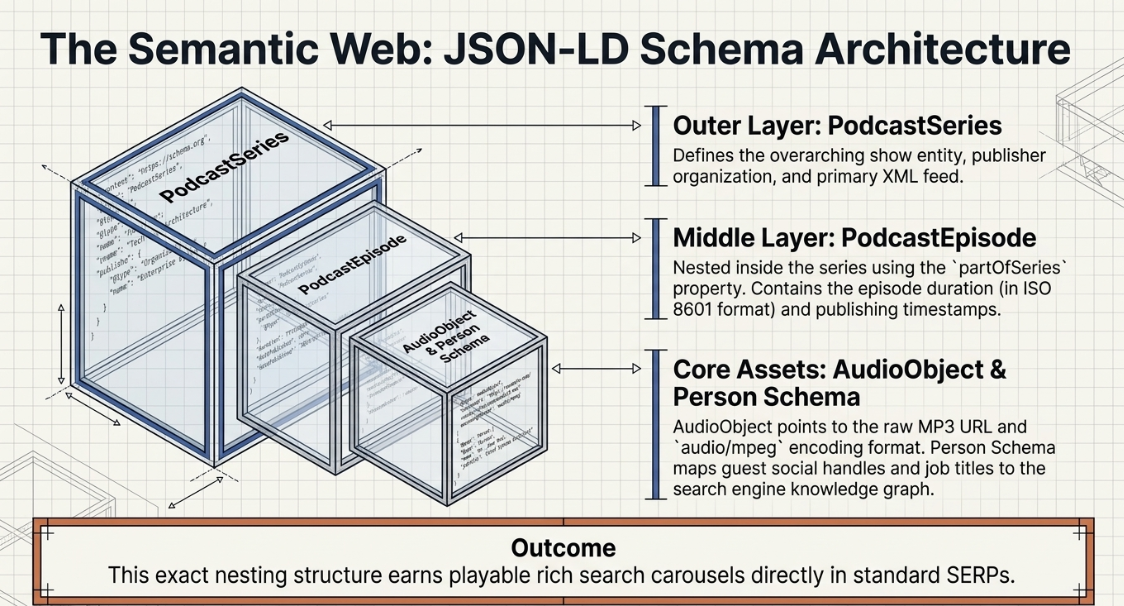
To make these landing pages fully machine-readable, publishers must use JSON-LD structured data43. Schema markup allows search engines to identify the page as an audio program, which can earn the site rich results, including playable episode carousels directly in search engine results pages (SERPs)42.
A standard schema architecture combines PodcastSeries on the show's homepage with PodcastEpisode nested on individual landing pages52. The PodcastEpisode schema must reference the parent PodcastSeries using the partOfSeries property to maintain topical grouping54. It should also include a nested AudioObject that contains the URL of the audio file, the encoding format (audio/mpeg), the duration in ISO 8601 format, and the transcript URL to help crawlers fully index the audio asset53.
Publishers can expand these JSON-LD structures to support richer visual and voice search capabilities44:
Person Schema: Nest Person schema arrays within guest or host fields to map social handles, official bios, and job titles, linking episode entities with search engine knowledge graphs52.
BreadcrumbList Schema: Define the page nesting structure, helping search engine crawlers navigate from specific episodes back to the parent series homepage44.
HowTo Schema: Add step-by-step metadata for tutorials or instructional episodes to improve visibility within specialized educational search carousels44.
Speakable Schema: Use the Speakable specification to identify specific parts of the transcript or show notes that are optimized for voice assistant platforms (such as Google Assistant or Siri)39.
JSON
{
"@context": "https://schema.org",
"@graph": [
{
"@type": "PodcastSeries",
"@id": "https://example.com/podcast/#series",
"name": "The Enterprise Architecture Review",
"description": "A highly granular analysis of modern software infrastructure paradigms.",
"url": "https://example.com/podcast",
"image": "https://example.com/artwork.jpg",
"webFeed": "https://example.com/podcast/feed.xml",
"inLanguage": "en-US",
"publisher": {
"@type": "Organization",
"name": "Global Technology Council",
"logo": "https://example.com/logo.png"
}
},
{
"@type": "PodcastEpisode",
"@id": "https://example.com/podcast/kubernetes-orch-104/#episode",
"partOfSeries": {
"@id": "https://example.com/podcast/#series"
},
"name": "Episode 104: Orchestrating Microservices with Kubernetes",
"description": "An in-depth analysis of containers, ingress controllers, and service meshes.",
"episodeNumber": "104",
"datePublished": "2024-10-15T08:00:00Z",
"duration": "PT45M30S",
"url": "https://example.com/podcast/kubernetes-orch-104",
"transcript": "https://example.com/podcast/kubernetes-orch-104/transcript",
"actor": [
{
"@type": "Person",
"name": "Dr. Sarah Lin",
"jobTitle": "Chief Systems Architect"
}
],
"associatedMedia": {
"@type": "AudioObject",
"contentUrl": "https://media.example.com/ep104.mp3",
"encodingFormat": "audio/mpeg",
"duration": "PT45M30S"
}
}
]
}
The Decentralized Movement: Podcasting 2.0 Namespace and Value-for-Value Mechanics
The podcast industry faces a growing tension between open distribution models and closed, platform-controlled ecosystems4. As platform giants introduce proprietary APIs, dynamic ad-insertion systems, and exclusive content walls, independent creators risk losing access to direct, unmediated listener relationships5. This challenge has driven the development of Podcasting 2.0, a movement spearheaded by the Podcast Index to maintain open-source audio syndication across the web4.
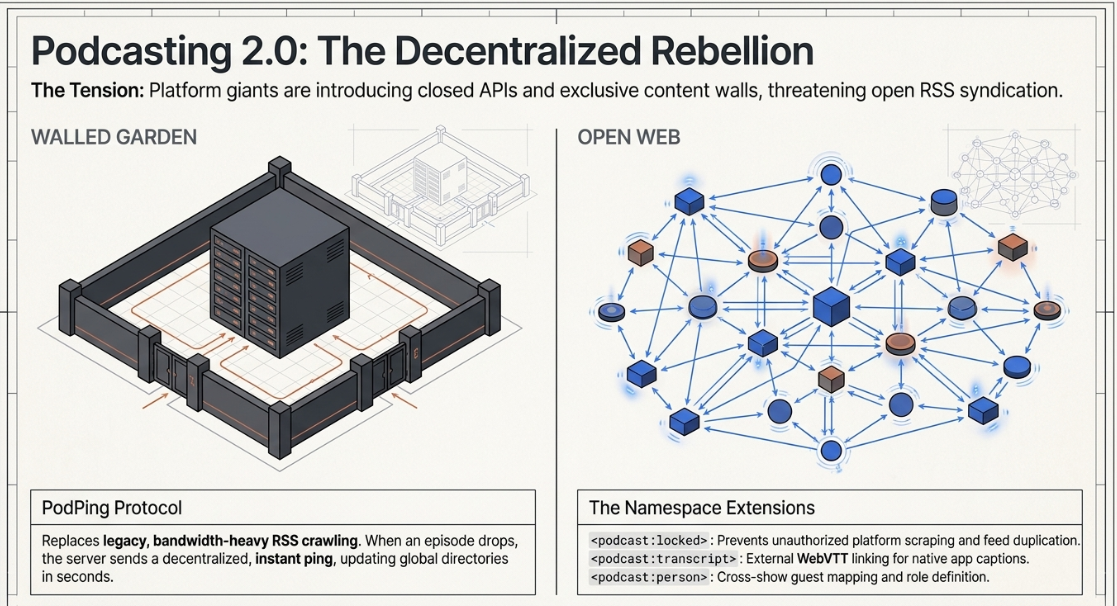
At the core of the Podcasting 2.0 framework is the extension of the standard RSS 2.0 XML specification through a new, open namespace6. This namespace introduces tags designed to improve metadata representation, player features, and independent monetization57:
<podcast:locked>: Prevents platform-controlled imports by signaling whether the publisher’s RSS feed can be cloned or migrated by unauthorized hosting platforms57.
<podcast:transcript>: Links directly to an external WebVTT, JSON, or TXT transcript file57. This enables participating players to display synchronized captions in real time without forcing creators to rely on platform-generated transcripts11.
<podcast:chapters>: Links to an external JSON chapters file57. This allows standard players to display chapter titles, custom artwork, and timestamps without requiring the creator to bake images directly into the MP3 ID3 tags57.
<podcast:person>: Explicitly defines the roles of hosts, guests, and production crew, allowing players to index and display cross-show host and guest appearances57.
<podcast:funding>: Establishes a uniform link pointing directly to creator-defined donation systems (such as Patreon or PayPal), bypassing platform-controlled subscription networks57.
XML
<podcast:locked>yes</podcast:locked>
<podcast:transcript url="https://example.com/ep104.vtt" type="text/vtt" />
<podcast:chapters url="https://example.com/ep104_chapters.json" type="application/json" />
<podcast:person role="host" href="https://example.com/hosts/sarah">Dr. Sarah Lin</podcast:person>
<podcast:funding url="https://patreon.com/enterprisearch">Support our independent research</podcast:funding>
These tags have received mixed reactions from platform developers59. Overcast's developer, for example, supports utility tags (such as transcript, funding, chapters, and person metadata) as valuable enhancements for user experience, but rejects integrations with cryptocurrency elements59.
The developer notes that managing digital financial transactions is complex, falls outside their core focus, and has low user adoption59. This represents a broader challenge in the space: while creators value decentralized metadata control, platform developers prioritize stable, low-complexity features4.
XML
<podcast:value type="lightning" method="keysend" suggested="0.00000005000">
<podcast:valueRecipient
name="Lead Host Node"
type="node"
address="030a66b5b5..."
split="80" />
<podcast:valueRecipient
name="Producer Node"
type="node"
address="024c98a21d..."
split="20" />
</podcast:value>
To optimize feed performance, Podcasting 2.0 introduces the PodPing protocol57. Traditionally, podcast players had to query every RSS feed URL repeatedly to check for new episodes, which wasted bandwidth and introduced lag between publication and directory visibility57. PodPing operates on a decentralized, real-time messaging model57. When a publisher uploads a new episode, the hosting provider sends a simple, instant ping to the PodPing system, notifying all listening directories of the update in seconds57. This minimizes platform crawl traffic and ensures real-time syndication updates57.
The most technically complex component of the Podcasting 2.0 ecosystem is the Value-for-Value (V4V) model57. V4V establishes a decentralized, direct monetization path using cryptocurrency networks like Bitcoin's Lightning Network57. Instead of relying on programmatic ad networks or platform-controlled subscriptions, creators can embed their digital node wallet keys directly in their RSS feed57.
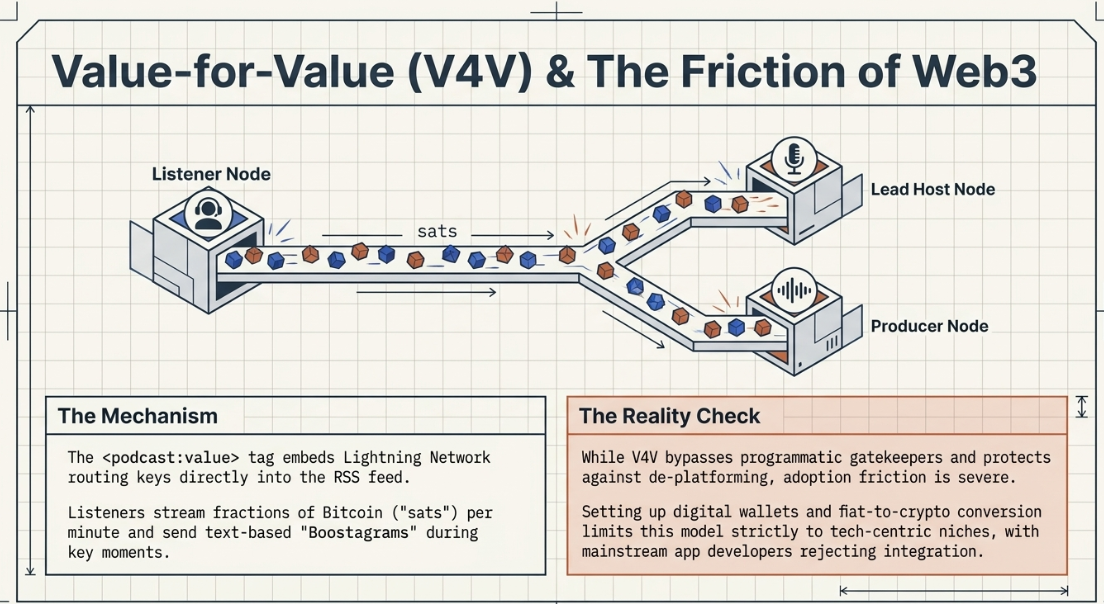
Using compatible players, listeners can stream micropayments (measured in "sats," or fractions of a Bitcoin) for every minute they spend listening57. They can also send one-off digital tips paired with text messages (known as "boostagrams") during key moments of an episode57.
While V4V protects free speech and prevents platform deplatforming, adoption has been slow4. Setting up a digital wallet and converting fiat currency into Bitcoin creates a high barrier to entry for mainstream listeners58. Consequently, V4V remains highly popular within tech-centric niches but faces challenges scale-wise among broader consumer audiences4.
Promotional Dynamics, Discovery Physics, and Growth Engineering
Launching high-quality audio files into the digital landscape is not enough to build an audience36. To grow a show, publishers must implement systematic, multichannel promotional strategies that leverage both platform-native features and organic distribution networks35.
Consumer listening metrics should guide scheduling and episode formatting63. Data indicates that the average user listen duration is 22 minutes per session, and industry trends suggest an optimal episode length of 22 to 34 minutes63. Publishers can structure long-form content into focused segments, using transitions, theme music, or jingles to maintain pacing and keep listeners engaged63.
Publishing on a consistent, predictable schedule (such as every Tuesday at 8:00 AM) helps build listener habits far more effectively than releasing episodes in irregular bursts41.
[Raw Multi-Track Session (WAV)]
|
v
[Post-Production Edit]
|
+-------------------+-------------------+
| (Video Pipeline) | (Audio Pipeline)
v v
[1080p Master File] [24-bit / 48kHz Master]
| |
+--> [Magic Clips (Vertical 9:16)] +--> [Mastering: -16 LUFS]
| - YouTube Shorts |
| - Instagram Reels +--> [SSAI Engine / Ad Markers]
| - TikTok |
| +--> [Open RSS 2.0 Syndication]
+--> [YouTube Longform / HLS Video] - Apple Podcasts
- Spotify
- Amazon Music
Because social media platforms prioritize native, highly visual content, static promotional elements like audiograms generally deliver low conversion rates64. Social audiences scroll past static waveforms in favor of dynamic video featuring visible human faces64.
To maximize engagement, video-enabled productions should capture multi-camera footage during recording to export clips in multiple aspect ratios35:
16:9 Landscape: Tailored for long-form video platforms like YouTube and website embeds62.
1:1 Square: Optimized for standard social feeds and embedded media player preview tiles65.
9:16 Vertical: Cut from key highlights and formatted specifically for YouTube Shorts, Instagram Reels, and TikTok35.
Organic podcast promotion often relies on cross-promotional formats, such as promo swaps and guest exchanges41. In a promo swap, two podcasters with overlapping audiences agree to air a 30-to-60-second host-read commercial promoting each other's show, either as a standard dynamic ad campaign or baked directly into the audio file41. In a guest swap, creators appear as guests on each other's programs, bringing high-value expertise directly to an established, highly engaged audience of active podcast listeners41.
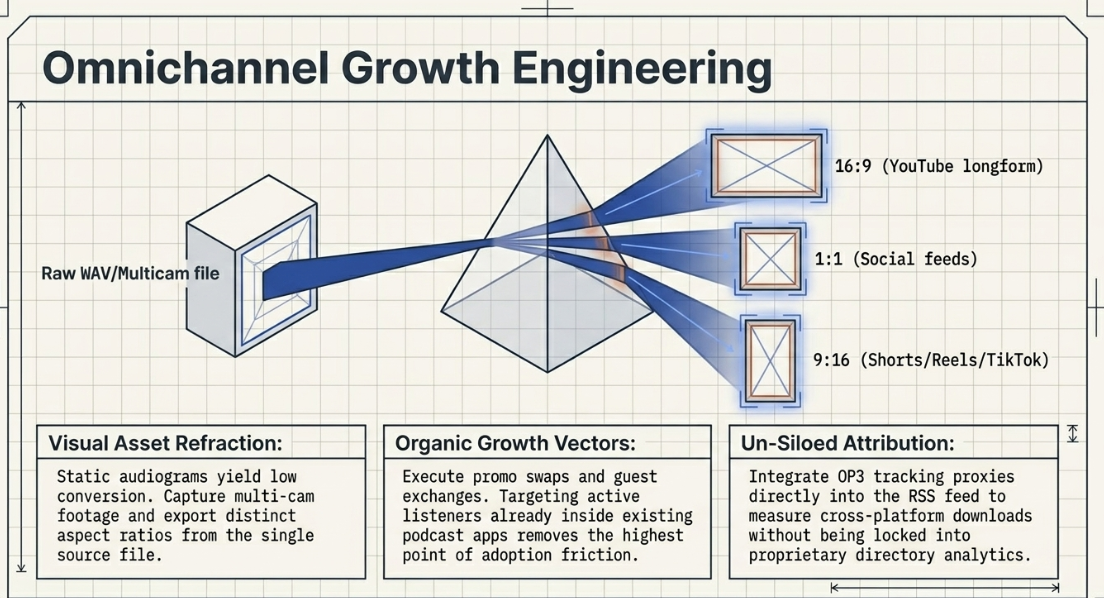
Because these listeners are already using podcast apps, the friction of getting them to try a new show is exceptionally low41. This approach is an effective way to grow an audience organically without high advertising spend66.
Publishers can also use paid channel placement to accelerate growth41. Paid options include running targeted social media ads to boost high-performing organic video clips, or placing programmatic audio ads inside adjacent shows26. Another high-conversion tactic is placing banner or native display ads directly within podcast directories (such as Overcast or Pocket Casts)41. Because these ads target users who are already inside a player app, they convert exceptionally well, helping publishers grow their subscriber base directly at the point of consumption41.
For un-siloed listener analysis, publishers can integrate open-source tracking tools like OP3 directly into their RSS feeds3. OP3 acts as an independent proxy, measuring and tracking downloads across all consumption directories without locking publishers into proprietary platform metrics3.
This un-siloed data helps B2B brands measure exact audience attribution and optimize their distribution strategy3.
Strategic Conclusions and Synthesis Roadmap
Building a resilient, discoverable, and highly monetizable podcast asset in the modern media landscape requires a systematic, technical approach27. Publishers must align their production standards, syndication pathways, and promotional strategies to build a cohesive, scalable system35.
[Technical Ingestion] -> [HLS Adaptive Encoding] -> [Inline SSAI Stitching] -> [JSON-LD Web SEO Clusters] -> [Omnichannel Promotion]
To establish a highly optimized, professional media workflow, publishers should implement the following technical and operational roadmap:
Adhere to Rigid Technical Audio Standards: Record all dry vocal tracks at a minimum sample rate of 48 kHz and 24-bit depth, maintaining vocal peaks between


Implement a Dual-Path HLS Video Strategy: Deploy standard RSS 2.0 feeds to distribute audio-only assets to major directories8. For video delivery, connect Apple Podcasts Connect API keys to automatically transcode files into adaptive bitrate HLS streams13, split across multi-resolution outputs (


Optimize Server-Side Ad Operations: Build a dynamic ad pipeline using Server-Side Ad Insertion (SSAI) to bypass consumer ad blockers and eliminate playback buffering27. Use inline VMAP configurations with the vpi=1 parameter to bundle all programmatic VAST creatives into a single server response33, reducing latency and protecting tracking analytics33. Configure ad placements with precise start-delay metrics to insert mid-rolls smoothly34.
Develop a Machine-Readable Web Presence: Treat every episode page as a key web asset37. Organize episodes into topical clusters and write comprehensive, 300-to-600-word show notes with a natural keyword density (incorporating the primary keyword 3 to 5 times)36. Nest valid JSON-LD schemas featuring PodcastSeries, PodcastEpisode, and AudioObject blocks within the head tags of landing pages to earn playable search carousels and improve organic discoverability52.
Leverage the Open Namespace: Configure the latest namespace tags (such as <podcast:locked>, <podcast:transcript>, and <podcast:person>) to support native player captioning and protect feed integrity57. Monitor real-time syndication updates using the decentralized PodPing protocol to minimize platform crawl traffic and keep catalog listings updated in real time57.
Execute Video-First Promotional Campaigns: Capture high-resolution video during recording to export native vertical (9:16) clips for Shorts, Reels, and TikTok, replacing static, low-conversion audiograms35. Run targeted, in-app display campaigns within player platforms like Overcast or Pocket Casts to acquire subscribers directly at the point of consumption, and use independent tracking proxies like OP3 to verify download statistics and marketing performance3.
Works cited
Acoustic Standards and Infrastructure in the UK Podcast Ecosystem: A Technical Analysis of Chart-Topping Productions and London Studio Facilities, https://www.finchley.co.uk/finchley-learning/visual-podcast/acoustic-standards-and-infrastructure-in-the-uk-podcast-ecosystem-a-technical-analysis-of-chart-topping-productions-and-london-studio-facilities
Why Your Podcast Sounds Amateur (5 Audio Specs Explained), https://www.podcaststudioglasgow.com/podcast-studio-glasgow-blog/the-5-audio-specs-that-separate-professional-from-amateur-podcasts
Pod Chat - Podcast | Global Player, https://www.globalplayer.com/podcasts/42KucY/
Podcasting Resources | Creativity Found, https://www.creativityfound.co.uk/podcasting
Benjamin Bellamy, https://benjaminbellamy.fr/
Podcast Domain Database | Audio Content Categorization, https://www.urlcategorizationdatabase.com/industries/podcasting-domains.php
Podcast RSS Feeds for Syndication - Blubrry Podcasting, https://blubrry.com/manual/syndicating-your-podcast-rss-feeds/podcast-rss-feeds-for-syndication/
How Do Podcast RSS Feeds Work? - Buzzsprout, https://www.buzzsprout.com/blog/how-do-podcast-rss-feeds-work
Page 2 – Podcast Hall of Famer and 25 year New Media Expert - Rob Greenlee, https://robgreenlee.com/page/2/
Spotify video - we speak to Maya Prohovnik; plus Crossed Wires and podcast consumption - Podnews Weekly Review, https://weekly.podnews.net/1538779/episodes/16999781-spotify-video-we-speak-to-maya-prohovnik-plus-crossed-wires-and-podcast-consumption
Apple Podcasts HLS streams: how they work - Podnews, https://podnews.net/article/apple-podcasts-hls-tech
Apple Podcasts now supports video streaming (2026), https://transistor.fm/apple-podcasts-video/
How to publish video on Apple Podcasts, https://podcasters.apple.com/support/5593-how-to-publish-video
Setting Up Apple Podcasts HLS Video Streaming in Podbean, https://help.podbean.com/support/solutions/articles/25000035080-setting-up-apple-podcasts-hls-video-streaming-in-podbean
Publish Video Podcasts to Apple Podcasts - Captivate.fm, https://www.captivate.fm/publish-video-podcasts-to-apple-podcasts
Apple Podcasts HLS Frequently Asked Questions - Captivate Help and Support, https://help.captivate.fm/en/article/apple-podcasts-hls-frequently-asked-questions-1n8fmpg/
The 13 Best Podcast Hosting Platforms in 2026, https://www.quillpodcasting.com/blog-posts/podcast-hosting-platform
Best Podcast Hosting Platforms in 2026 (Compared & Ranked) - Saspod, https://saspod.com/blog/post/best-podcast-hosting
The Best Podcast Hosting Platforms in 2026 - CoHost, https://www.cohostpodcasting.com/resources/best-podcast-hosting-platforms
Libsyn Podcast Hosting & Distribution Platform for Creators, https://libsyn.com/
Best Podcast Hosting Platforms in 2026: Compared & Ranked - Transistor, https://transistor.fm/best-podcast-hosting-platform/
16 Best Podcast Hosting Platforms for All Budgets (Free to Expensive), https://lowerstreet.co/blog/best-podcast-hosting-platforms
Captivate Feature Releases & Changelog, https://help.captivate.fm/en/article/captivate-feature-releases-changelog-vq1h56/
The 14 Best Podcast Distribution Platforms For B2B Growth In 2026 - Fame.so, https://www.fame.so/post/best-podcast-distribution-platforms
Maximizing Ad Impact: The Essential Guide to Dynamic Ad Insertion and Server Side Ad Insertion | broadpeak.io, https://www.broadpeak.io/essential-guide-to-dynamic-ad-insertion-and-server-side-ad-insertion/
What Is Programmatic Audio Advertising in 2026 - AI Digital, https://www.aidigital.com/blog/programmatic-audio-advertising
What is Dynamic Ad Insertion? - StreamGuys, https://www.streamguys.com/what-is-dynamic-ad-insertion/
Ad insertion | Android media, https://developer.android.com/media/media3/exoplayer/ad-insertion
Understanding Server-Side Ad Insertion (SSAI) - Amagi Support Portal, https://support.amagi.tv/support/solutions/articles/69000866366-understanding-server-side-ad-insertion-ssai-
The Encyclopedia of Video Ad Serving: What VAST, VPAID, VMAP, MRAID, SIMID, and OMID Are and Why You Should Care - Epom Ad Server, https://epom.com/blog/ad-server/video-ad-serving-encyclopedia
Digital Video Multiple Ad Playlist (VMAP) - IAB Tech Lab, https://iabtechlab.com/standards-old/video-multiple-ad-playlist-vmap/
MediaTailor ad server integration requirements - AWS Documentation, https://docs.aws.amazon.com/mediatailor/latest/ug/vast.html
Return VAST inside of VMAP with inline VMAP - Google Ad Manager Help, https://support.google.com/admanager/answer/9880309?hl=en
Ad Podding for Publishers | Microsoft Learn, https://learn.microsoft.com/en-us/xandr/monetize/ad-podding-for-publishers
Podcast Marketing Strategy: A 2026 Guide - Podmuse, https://www.podmuse.com/post/podcast-marketing-strategy
Podcast SEO: Show Notes and Transcription Strategy That Drives Discovery | Hashmeta, https://hashmeta.com/blog/podcast-seo-show-notes-and-transcription-strategy-that-drives-discovery/
Podcast SEO: How to Get Found in Search and AI Overviews, https://thepodcastconsultant.com/blog/podcast-seo
SEO for Podcasts: 2026 Ultimate Guide - SpearPoint Marketing, https://www.thespearpoint.com/blog/seo-for-podcasts
Podcast SEO - Fundamentals and Best Practices 2025 | SEO-Wiki, https://www.seo-day.de/wiki/spezielle-anwendungsfaelle/podcast-seo?lang=en
Podcast SEO - Tips to Improve Your Podcast Organic Ranking - Beamly, https://beamly.com/podcast-seo/
Podcast Marketing Strategy: 10 Proven Ways to Grow Your Audience in 2026, https://www.jigsawkraft.com/post/podcast-marketing-strategy-10-proven-ways-to-grow-your-audience-in-2026
Podcast SEO: How AI-Generated Transcripts Boost Your Search Rankings | SparkPod, https://sparkpod.ai/blog/podcast-seo-ai-transcripts
Implementing JSON-LD Structured Data with Next.js | Agility Docs, https://agilitycms.com/docs/nextjs/implementing-json-ld-structured-data-with-next-js
Astro SEO Checklist 2026: 20 tactics ranked by impact - Neciu Dan, https://neciudan.dev/astro-seo-checklist-2026
Podsqueeze vs. Podium: Which is Best? [2024], https://hello.podium.page/blog/podsqueeze-vs-podium-which-is-best-2024
Castmagic vs. Swell AI Comparison - SourceForge, https://sourceforge.net/software/compare/Castmagic-vs-Swell-AI/
Compare Castmagic vs. Swell AI in 2026 - Slashdot, https://slashdot.org/software/comparison/Castmagic-vs-Swell-AI/
PodExtra AI vs. Swell AI Comparison - SourceForge, https://sourceforge.net/software/compare/PodExtra-AI-vs-Swell-AI/
Tools for Mastering and Post-Production - Podium.page, https://hello.podium.page/blog/tools-for-mastering-and-post-production
Annotated JSON-LD Structured Data Examples - nystudio107, https://nystudio107.com/blog/annotated-json-ld-structured-data-examples
Podcast SEO: The Ultimate Guide to Making Audio Content Discoverable Across Search Engines & Apps | Hashmeta, https://hashmeta.com/blog/podcast-seo-the-ultimate-guide-to-making-audio-content-discoverable-across-search-engines-apps/
How to Use Schema Markup for Your Podcast - Outcast AI, https://outcast.ai/blog/how-to-use-schema-markup-for-your-podcast/
Podcast Episode Schema - Unhead - UnJS, https://unhead.unjs.io/docs/schema-org/api/schema/podcast-episode
Podcast / Episode Schema Generator - Content Powered, https://www.contentpowered.com/tools/podcast-schema-generator/
description - Schema.org Property, https://schema.org/description
next-seo/CUSTOM_COMPONENTS.md at main - GitHub, https://github.com/garmeeh/next-seo/blob/main/CUSTOM_COMPONENTS.md
In the twenty years since podcasting has been around, there hasn't been much change to the space. But the co-creator of the medium - Adam Curry, https://cdn5.f-cdn.com/files/download/220632348/Sample%202.pdf
Does anyone have any experience with podcast 2.0 apps? - Reddit, https://www.reddit.com/r/podcasts/comments/x89iuv/does_anyone_have_any_experience_with_podcast_20/
Podcasting 2.0 : r/overcast - Reddit, https://www.reddit.com/r/overcast/comments/1otrmdc/podcasting_20/
RSS.com: Free Podcast Hosting – Unlimited Episodes & Audio, https://rss.com/
Effective Podcast Promotion Strategies: Tips to Grow Your Audience | Podigee, https://www.podigee.com/en/part-10-effective-podcast-promotion-increase-your-audience/
How to Promote a Podcast in 2026 | Podcast Marketing Guide - TYX Studios, https://tyxstudios.com/blog/how-to-promote-a-podcast
Introduction to Podcasting, https://nessling.fi/wp-content/uploads/2024/04/Introduction-to-Podcasting-by-Erkki-Mervaala.pdf
Thoughts on "Audiogram" style videos? : r/podcasting - Reddit, https://www.reddit.com/r/podcasting/comments/n51tmh/thoughts_on_audiogram_style_videos/
Distribution | Everlit, https://everlit.audio/distribution
Podcast Growth Tactics by Podder - Deezer, https://www.deezer.com/en/show/1000096805