The Paradigm Shift in Audio Discoverability and Artificial Intelligence Search
The global podcasting ecosystem has experienced unprecedented expansion, transforming from a decentralised audio experiment into a foundational pillar of enterprise digital marketing. As of early 2026, the landscape boasts an estimated 4.5 to 4.6 million active podcasts worldwide, with global listenership projected to scale from 584 million in 2025 to 650 million by 20271. This exponential saturation has rendered traditional, passive discovery mechanisms obsolete. The contemporary podcast growth funnel is heavily fragmented across a multitude of search interfaces, including traditional web search engines, native audio platforms, video networks, and emerging generative artificial intelligence tools1.
Simultaneously, the mechanics of Search Engine Optimisation (SEO) have undergone a radical shift. The emergence of Large Language Models (LLMs) and tools like AI Overviews, ChatGPT, and Perplexity has shifted user behaviour from linear keyword queries toward complex, conversational, and multi-paragraph prompt engineering3. Modern search engines now execute background processes that parse queries in multiple ways, appending contextual suffixes and evaluating inter-personal answers without necessarily routing traffic to a traditional Search Engine Results Page (SERP)3.
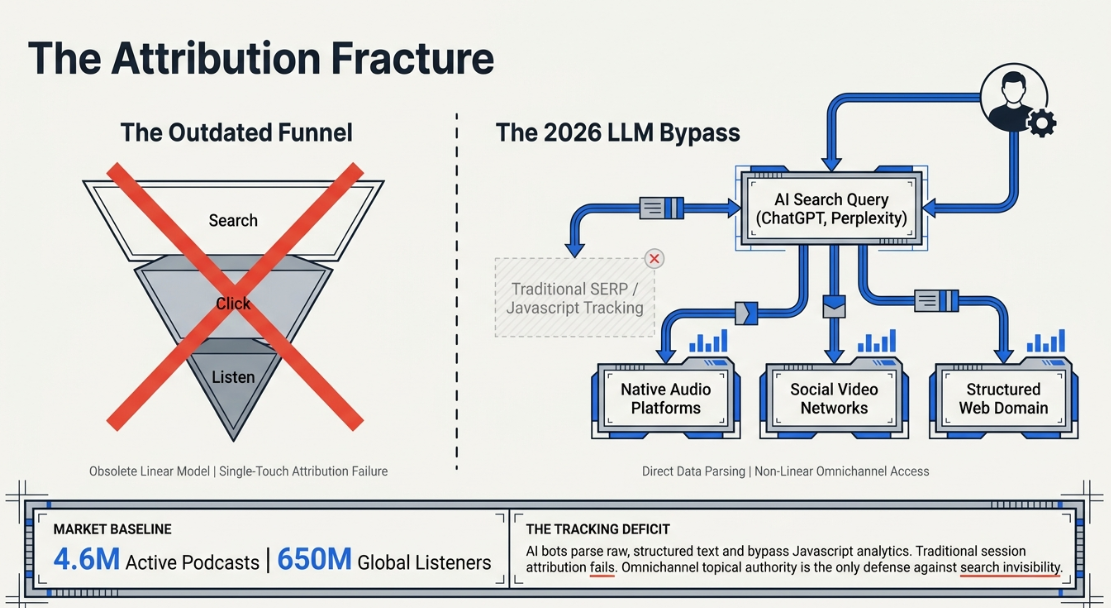
This creates a phenomenon where artificial intelligence bots actively crawl sites, evaluate products, and return answers directly to the user, effectively bypassing the JavaScript-based tracking mechanisms utilised by traditional web analytics platforms5. LLMs prioritise raw, structured text and often fail to trigger traditional session visits, requiring marketers to fundamentally rethink how they measure discovery and attribution5. Consequently, isolated, keyword-stuffed episode pages have been replaced by the necessity for omni channel brand building and the cultivation of deep topical authority, ensuring that algorithms organically recognise a brand or podcast as the definitive entity within its niche2.
The Core Architecture of Web-Based Audio SEO
The most pervasive error in podcast marketing strategy is the assumption that discoverability is confined to podcast listening applications. In reality, the central nexus of podcast SEO resides on the creator’s owned web domain2. Because search engine crawlers cannot autonomously listen to, comprehend, or rank raw audio files, audio content remains entirely invisible to web search unless it is explicitly translated into a crawl able, indexable text format2.
Technical Domain Configuration
To maximise organic search visibility, every podcast episode must function as a stand-alone, comprehensive search landing page. Embedding an audio player alongside a brief paragraph of show notes is insufficient2. The technical SEO foundation of these pages requires rigorous adherence to web standards, including fast mobile-first loading speeds, properly configured XML sitemaps, and clean, hierarchical HTML coding9.
Furthermore, technical meta tags play a vital role. The canonical tag must be properly implemented to signal to search engines that the owned domain is the original "source of truth" for the content, preventing duplicate content penalties when the same show notes are syndicated across multiple listening directories9. Additionally, the site's head section must include an alternate link pointing directly to the podcast's RSS feed, establishing a clear semantic relationship between the web asset and the syndication protocol9.
The Mathematics of Transcripts and Indexable Content
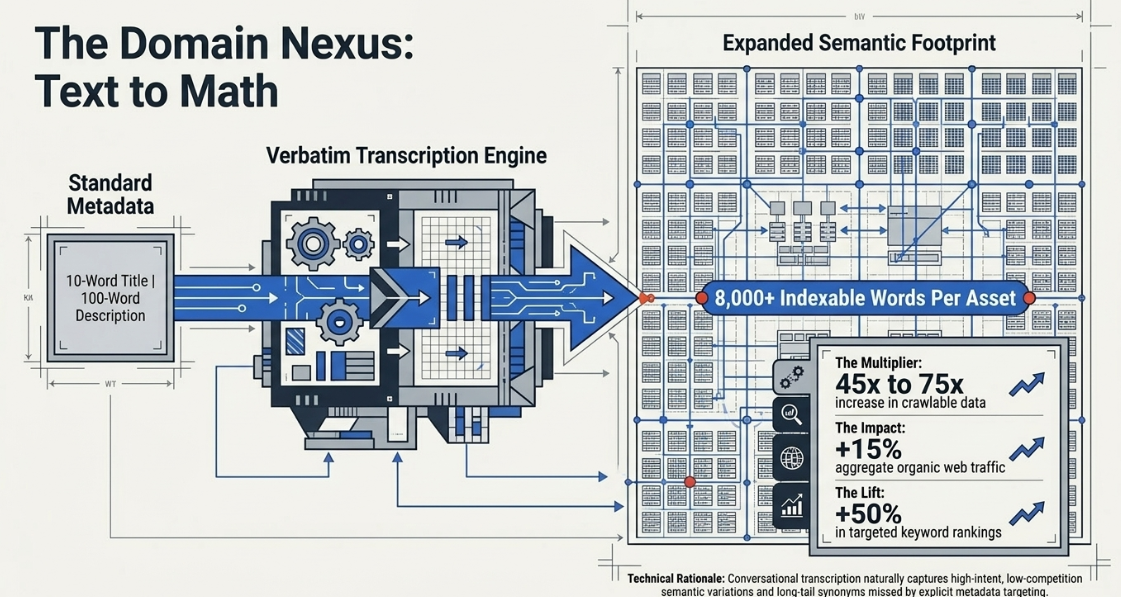
The highest-leverage multiplier for podcast web SEO is the implementation of full, verbatim episode transcripts2. A standard podcast episode published without a transcript provides search engines with a severely constrained searchable footprint, typically limited to a ten-word title and a hundred-word description. By deploying high-accuracy transcription technologies, creators can inject the entirety of the spoken content—often between 5,000 and 8,000 words per episode—directly onto the page. This mathematical reality represents a 45x to 75x increase in crawlable, indexable data per asset7.
Research demonstrates the profound impact of this tactic. Studies indicate that implementing full transcripts yields a 15% increase in aggregate organic web traffic and a 50% lift in targeted keyword rankings for the hosting domain7.
The primary advantage of verbatim transcription is its natural capture of long-tail semantic variations. While a marketer may intentionally optimise a page for a primary keyword phrase, natural human conversation inevitably includes highly specific, low-competition variations, synonyms, and nuanced phrasing. When transcribed, these conversational elements allow the episode page to rank for granular, multi-word search queries that were never explicitly targeted in the episode's metadata, effectively capturing a broader spectrum of search intent2.
Strategic Implementation of Schema Markup
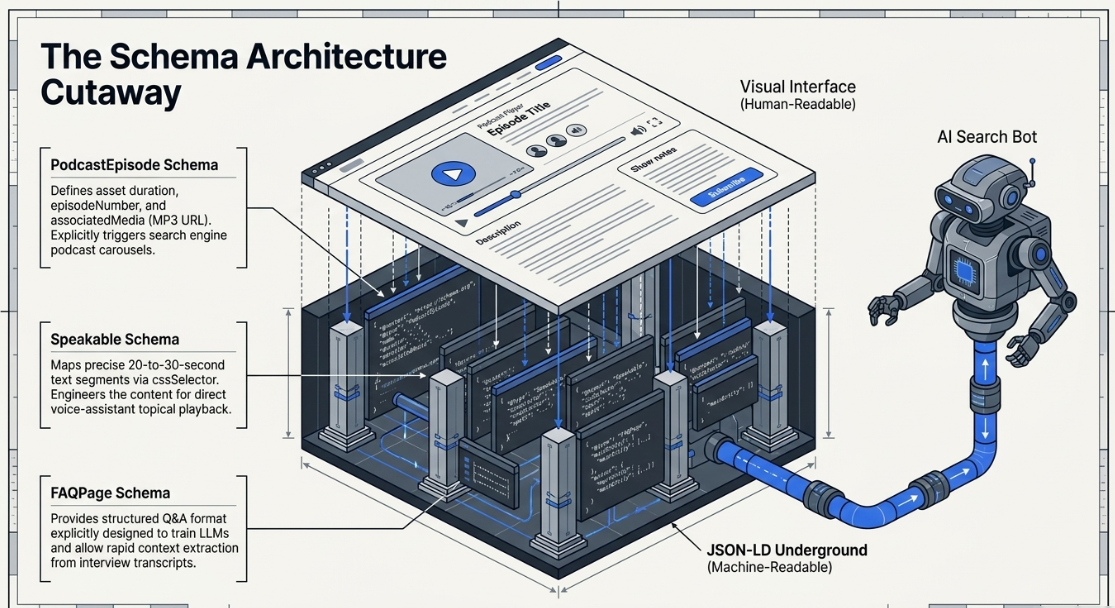
To explicitly communicate the nature of the content to search engine algorithms, technical SEO mandates the deployment of JSON-LD structured data, specifically the PodcastEpisode schema7. This markup sits in the background of the HTML and provides search engines with unambiguous, machine-readable definitions of the page's components.
The implementation of semantic schemas provides direct pathways to rich snippets and interactive search results. Furthermore, the Speakable schema property can be utilized to identify specific sections of the transcript that are optimized for text-to-speech (TTS) playback14.
Decrypting Native Platform Search Algorithms
While website architecture captures overarching thematic search intent, the majority of immediate podcast discovery occurs natively within directories. Data indicates that upwards of 50% of listeners discover new content by actively typing keywords into the search interfaces of Apple Podcasts and Spotify10. However, these dominant platforms utilize vastly different algorithmic mechanisms to index, rank, and recommend audio content.
Apple Podcasts: Metadata Specificity and Follower Velocity
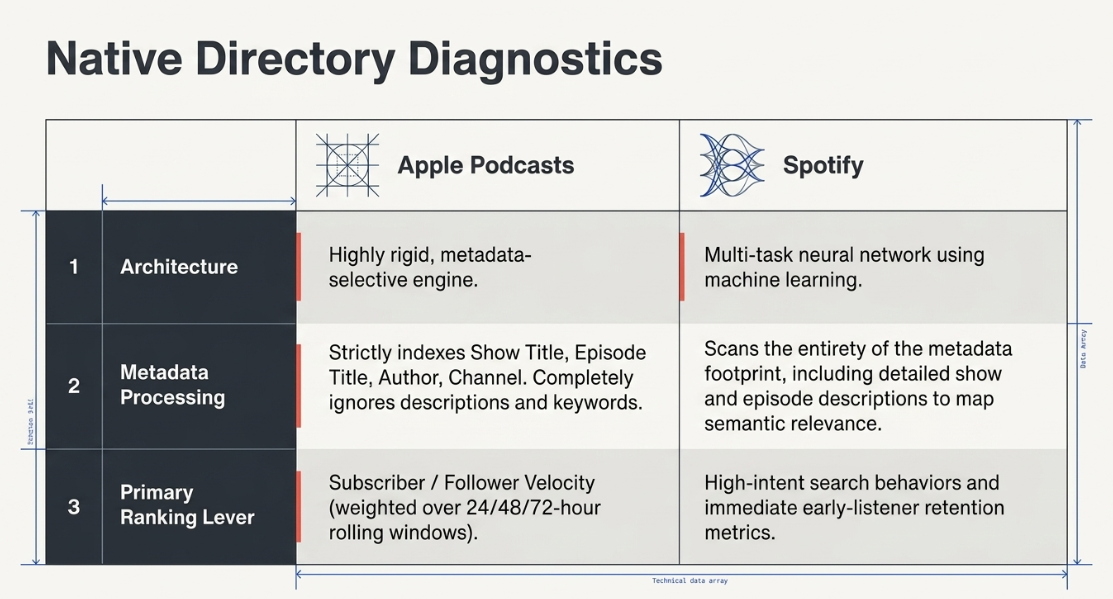
Apple Podcasts operates a highly rigid, metadata-driven search engine. Its algorithm is explicitly selective regarding which fields it indexes and which it ignores, requiring surgical precision in metadata optimization18.
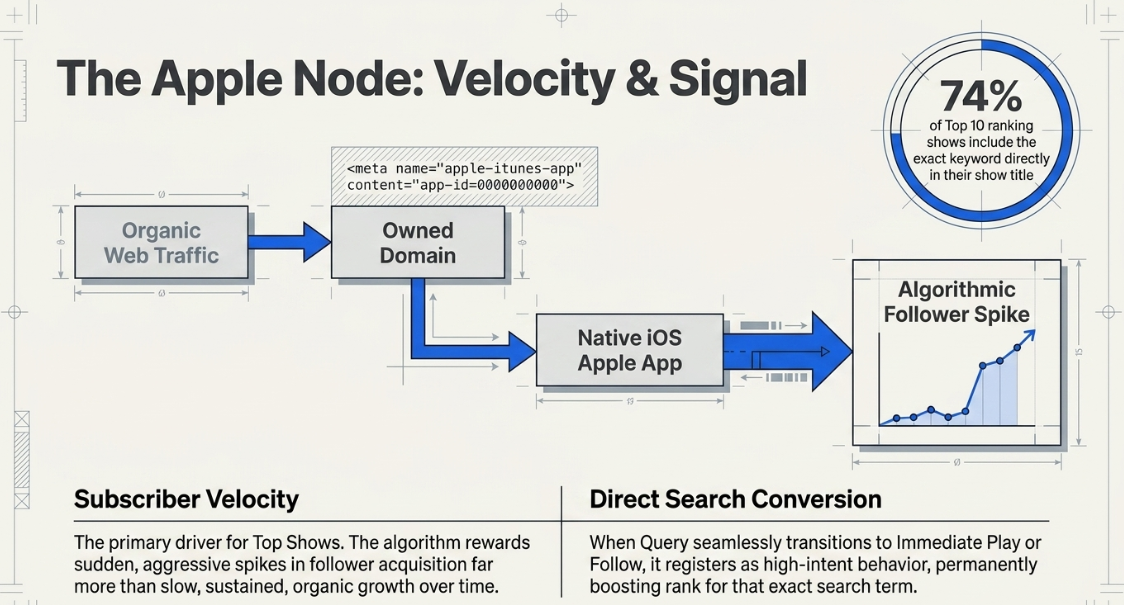
The Apple algorithm indexes the podcast show title, episode titles, the author tag (at both the show and episode levels), and channel names18. Conversely, the algorithm completely ignores show descriptions, episode descriptions, the deprecated keywords tag, and newer Podcasting 2.0 tags like the person tag when calculating search relevance18. Because Apple does not index descriptions for search queries, creators must weave core target keywords naturally into episode titles. Data reveals that 74% of podcasts ranking in the Top 10 for a given keyword include that exact keyword directly in their show title, emphasizing the immense weight Apple places on this specific field19.
Beyond exact-match text, Apple's ranking engine is governed by user behavior and engagement momentum. While ratings and reviews serve as vital social proof to improve human click-through rates, Apple has confirmed that these metrics are not direct ranking factors for search results18. Instead, the algorithm relies on the following behavioral signals:
To artificially stimulate Apple's follower velocity metrics, web developers frequently implement Apple Smart App Banners on their owned domains. By embedding a specific meta tag (<meta name="apple-itunes-app" content="app-id=0000000000">), creators prompt iOS users browsing the website to open the podcast directly within the native Apple Podcasts application, seamlessly converting web traffic into trackable in-app followers18.
Spotify: Neural Instant Search and High-Intent Engagement
Spotify’s approach to podcast discoverability diverges significantly from Apple's, leveraging advanced machine learning, multi-task neural networks, and deep behavioral tracking to map semantic relevance23.
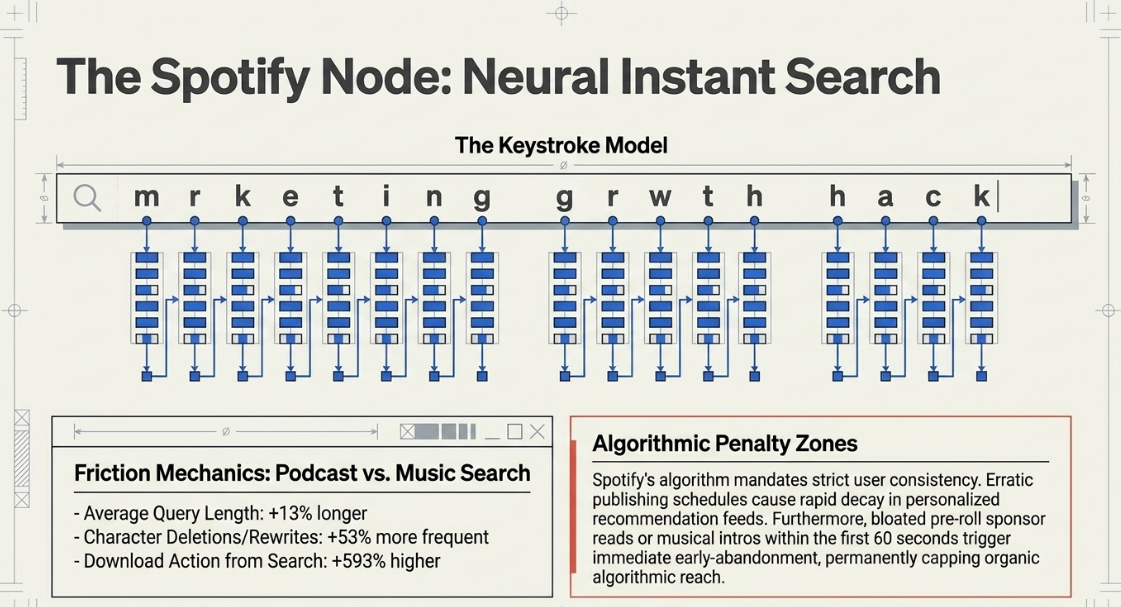
Spotify's engineering research highlights a fundamental distinction in user behavior when interacting with spoken-word content versus music. Users exhibit significantly higher friction and higher intent when searching for podcasts24.
To process this complex, high-friction search behavior, Spotify engineered "Neural Instant Search" (NIS). This architecture utilizes character-level embedding vectors, enabling the algorithm to predict and match user intent keystroke-by-keystroke, even accommodating misspellings or non-exact terminology24. Unlike Apple, Spotify scans the entirety of a podcast's metadata—including show descriptions and detailed episode descriptions—to calculate semantic relevance25.
Furthermore, Spotify’s algorithmic recommendation engine, which powers highly visible surfaces such as the Your Daily Drive playlist and adjacent show rails, is strictly governed by user retention and consistency. The algorithm severely penalizes erratic publishing schedules; podcasts that fail to maintain a strict, predictable cadence rapidly lose their placement in personalized recommendation feeds25. The platform also prioritizes early listener retention. Lengthy, self-indulgent musical introductions or bloated pre-roll sponsor reads that occur within the first 60 seconds cause immediate listener abandonment, signaling low quality to the algorithm and permanently capping the episode's organic reach25.
The RSS Revolution: Podcasting 2.0 and the Open Namespace
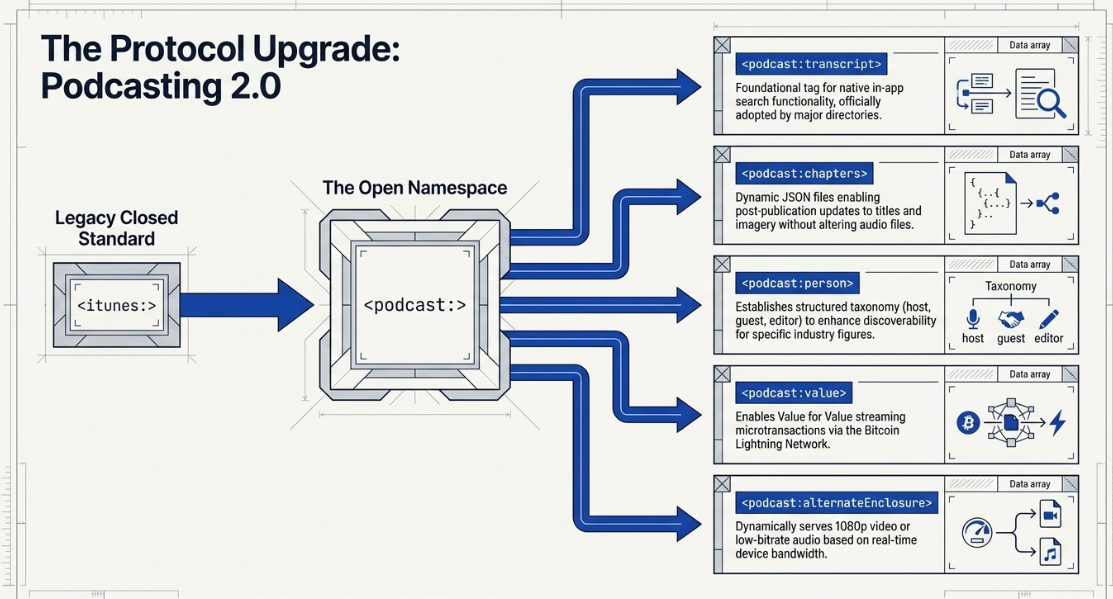
The technological backbone of podcast distribution is the RSS (Really Simple Syndication) feed—an XML file that transmits metadata and the location of audio files from a hosting server to listening directories28. Historically, the structure of podcast RSS feeds was dictated by the itunes namespace, a set of proprietary tags (e.g., <itunes:author>, <itunes:image>) established by Apple in 200531.
However, the industry is currently experiencing a structural paradigm shift driven by the "Podcasting 2.0" initiative. Spearheaded by the Podcast Index, this movement aims to decentralize podcast technology by introducing a new, open-source Podcast Namespace. This framework provides a suite of advanced XML tags that allow creators to inject richer, interactive data directly into their RSS feeds, breaking the monopoly of closed-ecosystem platforms30.
Implementing Podcasting 2.0 Namespace Tags
These advanced tags, prefixed with podcast:, are designed to standardize complex features across all independent listening applications.
The ultimate validation of the Podcasting 2.0 framework occurred when major, historically closed platforms began adopting these open standards. Apple Podcasts officially integrated support for the <podcast:transcript> tag, utilizing it to power their internal search engine, and subsequently adopted the <podcast:chapters> tag, proving that community-driven standards can compel platform compliance36. Spotify similarly announced support for creator-uploaded transcripts utilizing the Podcasting 2.0 namespace38. For modern digital marketers, upgrading a podcast’s RSS feed to support the Podcasting 2.0 namespace is a foundational requirement for maximizing cross-platform discoverability and metadata depth.
The Omnichannel Imperative: Video Integration and YouTube SEO
The definition of a podcast has permanently expanded beyond pure audio. By 2026, YouTube has surpassed dedicated audio applications to become the primary discovery channel for podcasts in the United States, commanding a 39% share among monthly podcast consumers2. With over 31% of listeners discovering new shows natively on the platform, a dual-format strategy encompassing both audio and video is strategically mandatory2.
However, YouTube’s algorithm is highly punitive toward low-effort audio adaptations. The platform relies heavily on viewer retention metrics to evaluate content quality41. Uploading a raw audio file overlaid with a static piece of cover art results in near-instantaneous viewer drop-off. The algorithm interprets this abandonment as an indicator of poor quality, effectively burying the channel's reach and destroying its algorithmic trust41.
To succeed on YouTube, creators must pursue fully produced video formats. This entails multi-camera setups, dynamic switching between speakers, B-roll integration, and on-screen graphics, all of which serve to maximize visual engagement and prolong watch time42. From a technical standpoint, video podcasts must be uploaded at a minimum resolution of 1080p utilizing a standard 16:9 aspect ratio41.
Optimizing a podcast on YouTube requires strict adherence to the platform's specific search mechanics. A single long-form video podcast has the potential to rank for dozens of distinct search terms if the metadata is structured correctly42. Titles must balance human psychology with algorithmic clarity. Vague, insider titles (e.g., "Episode 45 with John Smith") fail to generate impressions. Titles must articulate a clear value proposition and incorporate primary keywords (e.g., "How to Build an SEO Strategy in 2026 ft. John Smith | Marketing Podcast Ep. 45")42. Furthermore, the video description must function as a comprehensive, blog-style summary, utilizing extensive timestamps to trigger YouTube's native chapter feature, which additionally surfaces in Google SERPs41.
Content Atomization and the AutoContent Ecosystem
Because long-form content (exceeding 45 minutes) demands a substantial commitment from uninitiated audiences, top-of-funnel discovery is overwhelmingly driven by short-form video amplification. Distributing 30-to-60-second vertical clips across YouTube Shorts, TikTok, and Instagram Reels generates immediate awareness, systematically funneling users toward the full-length audio or video episodes27.
AI-Driven Clipping and Workflow Automation
The operational bottleneck of manually scrubbing hours of footage to isolate highlights has been eradicated by advanced AI editing platforms such as Choppity, Opus Clip, and Vizard27. These platforms utilize sophisticated semantic analysis to automatically scan transcripts, identify high-emotion moments, contrarian insights, or humorous exchanges, and instantaneously reframe landscape video into a 9:16 vertical format27.
Advanced tools offer customizable AI criteria, allowing producers to prompt the system with specific instructions (e.g., "extract every moment the guest discusses artificial intelligence"). These platforms also generate dynamic, burned-in captions—a strict requirement given that the vast majority of short-form social media is consumed with the sound muted. Tools like Choppity feature 97-language transcription pipelines, multi-speaker face tracking, and word-level karaoke animations to maximize visual retention27.
Strategic deployment of these clips requires strict adherence to the "1.5-Second Rule." The most compelling hook, question, or controversial statement must be placed at the absolute beginning of the clip to arrest scrolling behavior immediately27.
The Dedicated Shorts Channel Architecture
A critical structural tactic in YouTube podcast strategy is the strict separation of long-form and short-form content. If a creator publishes a weekly one-hour video podcast, but simultaneously uploads three 60-second YouTube Shorts every day to the same channel, they risk severely diluting their algorithmic signal27.
The audience demographic that consumes rapid-fire Shorts possesses vastly different behavioral profiles than the audience willing to engage in a two-hour deep dive. Commingling both formats on a single channel confuses YouTube's recommendation engine regarding the channel's target audience and subjects long-form subscribers to notification fatigue27. The optimal architecture involves maintaining a primary channel exclusively for full episodes, while establishing a completely separate, dedicated channel (e.g., "[Podcast Name] Clips") for short-form content. This protects the retention metrics of the main channel while providing the algorithm with a clean, unambiguous signal for Shorts distribution27.
The AutoContent API Paradigm
At the enterprise level, production bottlenecks are being solved by headless content production workflows powered by systems like the AutoContent API43. These systems decouple ideation from manual production. By utilizing a Deep Research architecture, a brand can set automated workflows triggered by simple actions. For example, a marketing manager can drop a raw PDF into a designated Dropbox folder; the API immediately ingests the document, utilizes LLMs to synthesize the data, generates a fully formatted audio podcast complete with MP3 files, ID3 tags, and RSS feed updates, and automatically publishes the asset to Spotify and Apple Podcasts without human intervention43. This level of automation allows brands to achieve massive market presence, producing highly structured, research-backed content at a fraction of traditional production costs43.
Off-Page Authority: Podcast Guesting as an Elite Link-Building Strategy
While the majority of podcast SEO focuses on on-page optimization and native platform algorithms, strategic podcast guesting serves as one of the most potent off-page SEO and link-building mechanisms in the modern digital landscape44.
Search engine algorithms increasingly devalue mass-produced content and traditional, automated link-building tactics, prioritizing genuine E-E-A-T (Experience, Expertise, Authoritativeness, and Trustworthiness) signals1. Traditional cold-outreach link building is suffering from rapidly diminishing returns, with domain rating (DR) scores frequently manipulated by what industry experts classify as "scammy link sellers"45. Podcast guesting circumvents this entirely, generating highly contextual, editorially earned backlinks that cannot be easily replicated or falsified44.
When a subject matter expert appears as a guest on an established podcast, the host invariably creates a dedicated episode landing page. This page features detailed show notes, a guest biography, and crucially, dofollow backlinks pointing directly to the guest’s primary domain, lead magnets, and social media profiles44.
The Compounding SEO Value of Guesting
High-Authority Inbound Links: Established podcasts inherently possess high-authority domains. Acquiring a contextual backlink from these domains passes significant SEO equity to the guest’s website, directly elevating its overall search ranking potential. One marketing agency documented a 186.6% increase in qualified leads over a six-month period resulting exclusively from a targeted podcast guesting strategy46.
Topical Relevance and Semantic Associations: Because a podcast interview revolves around the guest's specific niche, the surrounding text on the host's website is saturated with relevant keywords. Search engines closely associate the guest's backlink with this highly relevant topical cluster, reinforcing the guest's perceived topical authority44.
Entity Building and Brand Mentions: Beyond explicit hyperlinks, the persistent mention of a guest's brand across dozens of different podcast websites and transcribed audio files serves as a network of unlinked brand mentions. Modern search algorithms rely on these mentions to solidify the brand as a recognized, authoritative entity within its specific field1.
Content Syndication Cascades: A single podcast interview functions as a node that spawns a massive content syndication cascade. The host promotes the episode via social media, email newsletters, and video platforms. This creates a ubiquitous digital footprint for the guest, driving referral traffic and expanding brand reach exponentially44.
To maximize the efficacy of this strategy, guests must prepare meticulously. Providing hosts with a structured media kit via a shared Dropbox folder—including approved headshots, professional biographies, and customized topic proposals—removes friction and ensures consistent branding44.
Furthermore, guests must operate with precise SEO intent when directing listener traffic. Rather than sending audiences to a generic homepage, guests should provide hosts with distinct, keyword-optimized vanity URLs (e.g., domain.com/seo-checklist). This tactic captures referral traffic seamlessly while simultaneously generating highly specific backlinks to targeted conversion pages47. Following the episode's release, guests should construct a centralized "Media Hub" on their own website, summarizing their appearances and linking back to the host, thereby establishing a reciprocal web of relevance that search engines highly reward47.
Measurement, Analytics, and Tooling in the Modern Era
Executing a comprehensive podcast marketing ecosystem requires rigorous, multidimensional tracking. Because podcast consumption is fragmented across RSS feeds, web browsers, and proprietary applications, reliance on a single vanity metric—such as total RSS downloads—provides a severely incomplete analytical picture25.
Effective Podcast Search Optimization (PSO) requires the deployment of specialized tracking tools designed to measure algorithmic performance. Platforms such as Ausha, Chartable, and Voxalyze provide the necessary infrastructure to monitor cross-platform visibility17.
A robust analytical framework evaluates several key performance indicators:
Alternative hosting platforms are also innovating in the analytical space. Platforms like Disctopia offer robust analytics combined with direct monetization, tracking "TruePlays" and compensating independent creators at a rate of $0.02 per play, circumventing traditional advertising models entirely53.
Ultimately, succeeding in the 2026 podcast landscape requires treating the medium not merely as a broadcasting channel, but as a highly optimized digital growth engine. The ecosystem demands the creation of compelling audio, the immediate translation of that audio into structured text, the alignment of metadata with platform-specific algorithmic biases, the adoption of open-source RSS namespaces, and the strategic distribution of short-form video assets to capture shifting search intent across the wider web.
Works cited
Podcast SEO: How to Get Your Show Found in 2026 (and Beyond) - Saspod, https://saspod.com/blog/post/podcast-seo
SEO for Podcasts: 2026 Ultimate Guide - SpearPoint Marketing, https://www.thespearpoint.com/blog/seo-for-podcasts
The BEST SEO Strategies for 2026 (inc. Proof) - Exposure Ninja, https://exposureninja.com/podcast/seo-strategies-2026/
Mastering Zero-Click Podcast SEO: How to Rank on Google, YouTube, and Spotify Simultaneously, https://blog.podcast.co/reach/rank-with-podcast-seo
SEO in 2026 - Apple Podcasts, https://podcasts.apple.com/gb/podcast/seo-in-2026/id1598137108
Strengthen your brand - Ramona Joita - SEO in 2026 - Majestic, https://majestic.com/seo-in-2026/ramona-joita
Podcast SEO: How AI-Generated Transcripts Boost Your Search Rankings - SparkPod, https://sparkpod.ai/blog/podcast-seo-ai-transcripts
SEO for podcasts – how to get your content on Google search results - LRB Media's, https://www.lrb-media.co.uk/seo-for-podcasts-how-to-get-your-content-on-google-search-results/
Podcast SEO - Tips to Improve Your Podcast Organic Ranking - Beamly, https://beamly.com/podcast-seo/
Podcast Search Optimization (PSO) Fundamentals - Ausha, https://www.ausha.co/academy/podcast-search-optimization/podcast-search-optimization-pso-fundamentals/
Podcast SEO: Boost Discoverability in Search Engines | NearStream Official, https://www.nearstream.us/blog/podcast-seo-to-boost-discoverability-in-search-engines
Schema Markup for a Podcast Listing Page, https://wpschema.com/docs/schema-markup-for-a-podcast-listing-page/
Google Podcasts Search Results and SEO - Portent, https://portent.com/blog/seo/google-podcasts-search-results-and-seo.htm
Speakable (BETA) Schema Markup | Google Search Central | Documentation, https://developers.google.com/search/docs/appearance/structured-data/speakable
Latest Google Search Documentation Updates | Google Search Central | What's new, https://developers.google.com/search/updates
FAQ schema is Officially removed from Google Search Console Should i remove it from my website or leave it as it is for llms? - Reddit, https://www.reddit.com/r/TechSEO/comments/1uccw6q/faq_schema_is_officially_removed_from_google/
How to get your podcast to rank in search results with Alexis Hue - Motion, https://motionagency.io/episode/how-to-get-your-podcast-to-rank-in-search-results-with-alexis-hue/
How to Rank Higher on Apple Podcasts (Data‑Backed Guide) - Buzzsprout, https://www.buzzsprout.com/blog/podcast-seo
Mastering the Apple Podcasts and Spotify Algorithms to Maximize Your Visibility - Ausha, https://www.ausha.co/academy/podcast-search-optimization/apple-spotify-algorithms/
Apple Podcasts Charts - Top Shows, https://podcasters.apple.com/support/3146-apple-podcasts-charts
Podcast Rankings: How Do Apple and Spotify Podcast Charts Work? [2026] - Lower Street, https://lowerstreet.co/how-to/find-podcast-ranking
How to Rank Your Podcast on Apple Podcasts Charts - RSS.com, https://rss.com/blog/how-to-rank-on-apple-podcasts-charts/
Understanding recommendations on Spotify - Safety and Privacy center, https://www.spotify.com/safetyandprivacy/understanding-recommendations
Neural Instant Search for Music and Podcasts - Spotify Research, https://research.atspotify.com/neural-instant-search-for-music-and-podcasts
Podcast SEO: How to Rank #1 on Spotify, Google & Apple Podcasts in 2026, https://www.jigsawkraft.com/post/podcast-seo-how-to-rank-1-on-spotify-google-apple-podcasts-in-2026
Words matter: How to get your podcast SEO right - Spotify for Creators, https://creators.spotify.com/resources/grow/podcast-seo
How to Grow Your Podcast on Spotify in 2026 (Proven Strategies) - Choppity, https://www.choppity.com/blog/how-to-grow-a-podcast-on-spotify/
The Ultimate Guide to Apple Podcast RSS Feeds: Optimize & Submit Your Show - Imba Missouri Insights, https://imba.missouri.edu/apple-podcast-rss-feed-2801664334.html
Podcast RSS Feeds 101: A Beginners Guide - Captivate.fm, https://www.captivate.fm/learn-podcasting/podcast-rss-feeds
Podcasting 2.0 Explained: RSS Enhancements for the Independent Podcaster - Captivate.fm, https://www.captivate.fm/podcast-industry-news/podcasting-2-0-explained-rss-enhancements-independent-podcaster
The new podcast namespace | podcastnamespace.org, https://podcastnamespace.org/
What is Podcasting 2.0? - Fountain ∙ FAQs, https://support.fountain.fm/article/91-what-is-podcasting-2-0
Podcasting 2.0 Podcast Namespace introduction, https://podcasting2.org/docs/podcast-namespace
Transcript - Podcast Namespace, https://podcasting2.org/docs/podcast-namespace/tags/transcript
Apple Podcasts Embraces Chapters: Another Victory for Podcasting 2.0 - Castopod blog, https://blog.castopod.org/apple-podcasts-embraces-chapters-another-victory-for-podcasting-2-0/
Apple Podcasts chapter support: a clue to a new feature? | James Cridland, https://james.cridland.net/blog/2025/apple-podcasts-chapter-support/
Why you should transcribe your podcast - Transistor, https://transistor.fm/podcast-transcripts/
Spotify supporting Podcasting 2.0 for transcripts - Podnews, https://podnews.net/update/spotify-transcripts-p20
Youtube is now the most-used platform for podcasts - Reddit, https://www.reddit.com/r/podcasting/comments/1dz26c4/youtube_is_now_the_mostused_platform_for_podcasts/
YouTube Podcast: How to Launch and Grow Your Show on YouTube, https://thepodcastconsultant.com/blog/youtube-podcast
The definitive guide to creating engaging podcast content - YouTube Blog, https://blog.youtube/creator-and-artist-stories/the-definitive-guide-to-creating-engaging-podcast-content/
AutoContent API: AI Podcast Generator | NotebookLM API Alternative, https://autocontentapi.com/
Why Guest Podcasting Is The Top Backlink Strategy | SEO Optimizers, https://seooptimizers.com/blog/why-guest-podcasting-is-the-best-backlink-strategy/
Podcast-Powered Link Building Service - SEO Arcade, https://seoarcade.com/podcast-powered-link-building-service/
Chapter 3 Podcast Guesting as a Link-Building Strategy, https://podcasthawk.com/podcast-guesting-as-a-link-building-strategy/
10 Ways To Use Podcast Guesting For SEO - Laura Jawad, https://www.laurajawadmarketing.com/blog/podcast-guesting/
How to Use Podcasts for Link Building [2026 Full Guide] - Rephonic, https://rephonic.com/blog/podcast-backlinks/
Podcast Search Optimization (PSO) glossary - Ausha Help Center, https://help.ausha.co/en/articles/8517435-podcast-search-optimization-pso-glossary
Best Podcast SEO Tools for Better Discovery in 2026, https://deliberatedirections.com/podcast-seo-tools-for-discoverability/
Boost your Ranking | Discover the PSO Control Panel for Podcast SEO - Ausha, https://www.ausha.co/podcast-search-optimization-pso-boost-your-podcast-seo-visibility/
What is Podcast Search Optimization (PSO)? - Ausha Help Center, https://help.ausha.co/en/articles/8434939-what-is-podcast-search-optimization-pso
Creator Economy Blog | Music & Podcast Tips - Disctopia, https://disctopia.com/insights
The Rise of Independent Artists: A New Era in the Music Industry | Disctopia Insights, https://disctopia.com/insights/the-rise-of-independent-artists-a-new-era-in-the-music-industry/