The digital media landscape is undergoing a profound and accelerating structural realignment. By the mid-2020s, podcasting definitively evolved from a secondary, niche content format into a primary driver of the global audio ecosystem, integrating audio, video, and streaming environments.1 Consumption data from the 2025 Share of Ear report indicates that podcast engagement has fundamentally reshaped human behavioral patterns, with daily consumption among adults surging from merely six percent in 2015 to twenty-three percent by 2025.2 Notably, this explosive growth is not purely additive; it is actively replacing previously entrenched digital behaviors. Substantial portions of audience segments report that time spent listening to podcasts has intentionally replaced time previously dedicated to scrolling algorithmic social media feeds or streaming ad-supported music.2 American adults now average 103 minutes per day consuming podcasts, significantly outpacing major visual social platforms such as TikTok at 77 minutes, Facebook at 69 minutes, and Instagram at 65 minutes.
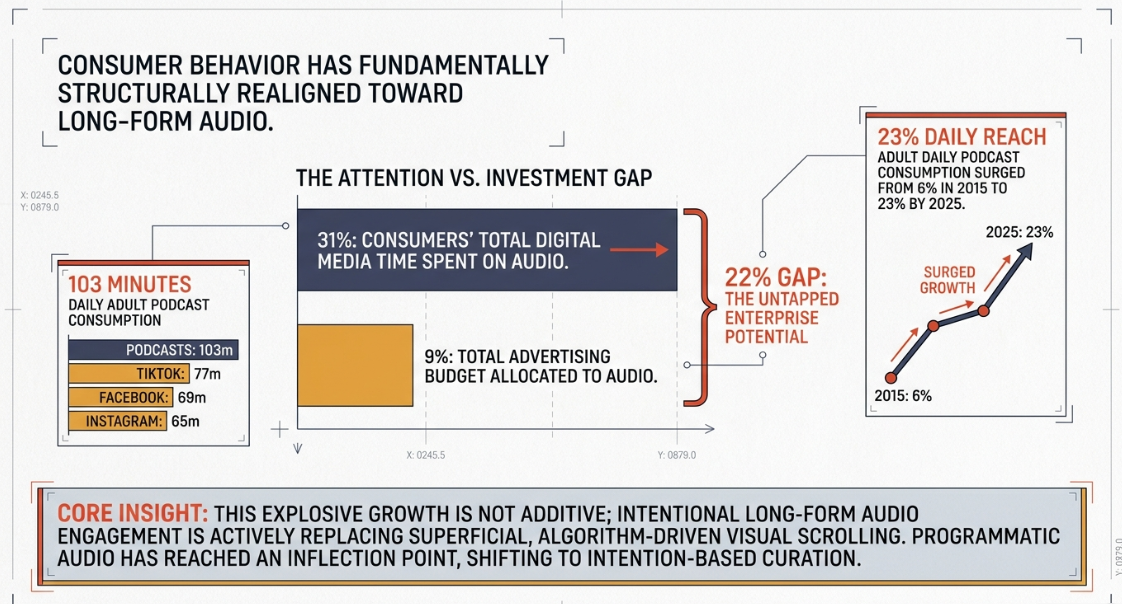
This shift signifies a transition in the digital balance of power, pivoting from superficial, algorithm-driven visual scrolling toward deep, intentional, long-form audio engagement.2 Despite this surge in consumer attention, a substantial market inefficiency remains. Digital audio accounts for thirty-one percent of consumers' total media time but receives only nine percent of advertising budgets, creating a twenty-two percent measurement and investment gap that represents massive untapped potential for modern marketers.3 By 2026, programmatic audio advertising reached an inflection point, shifting from content-based automation to intention-based curation, allowing buyers to align their messaging directly with brand identity and audience targets.3 This maturation is further evidenced by infrastructure developments, such as StackAdapt integrating iHeartMedia broadcast radio inventory into its programmatic platform to enable hybrid broadcast-and-digital media bundling, and Amazon DSP expanding access to SiriusXM Media.3
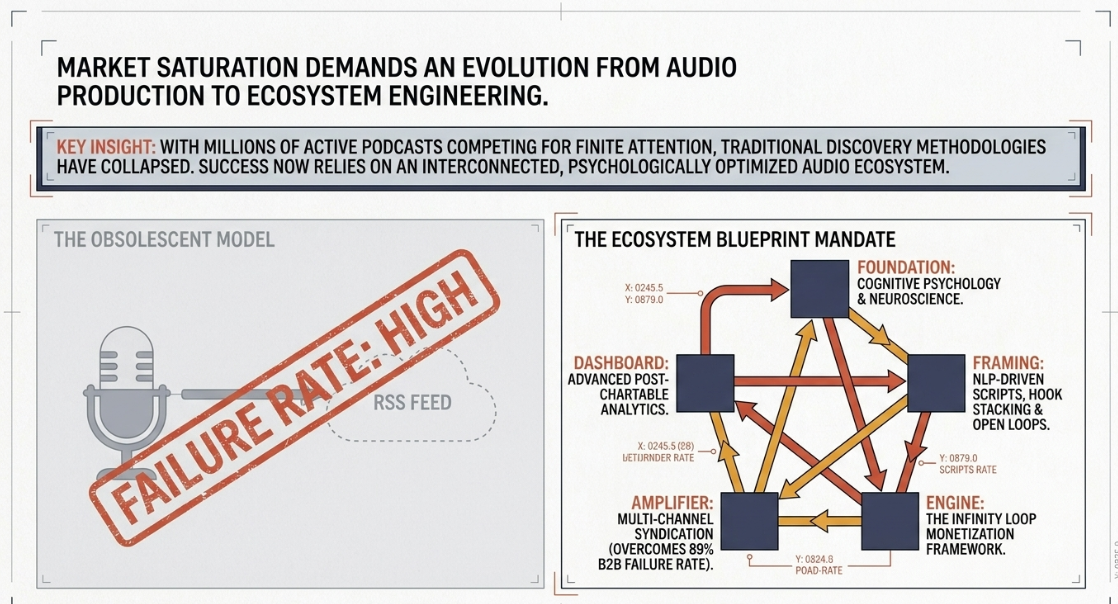
However, the rising dominance of the medium has catalyzed severe market saturation. With millions of active podcasts competing for a fixed amount of consumer attention, traditional methodologies based on merely publishing content and hoping for discovery have collapsed into obsolescence.5 Thriving in this hyper-competitive environment requires moving beyond rudimentary audio production toward the sophisticated engineering of interconnected audio ecosystems. Success depends on mastering the cognitive psychology of audience retention, deploying advanced natural language processing insights for script structuring, implementing rigorous architectural designs known as hook stacking, engineering narrative open loops, and deploying advanced, multi-channel syndication frameworks.
The Cognitive Psychology and Neuroscience of Audience Retention
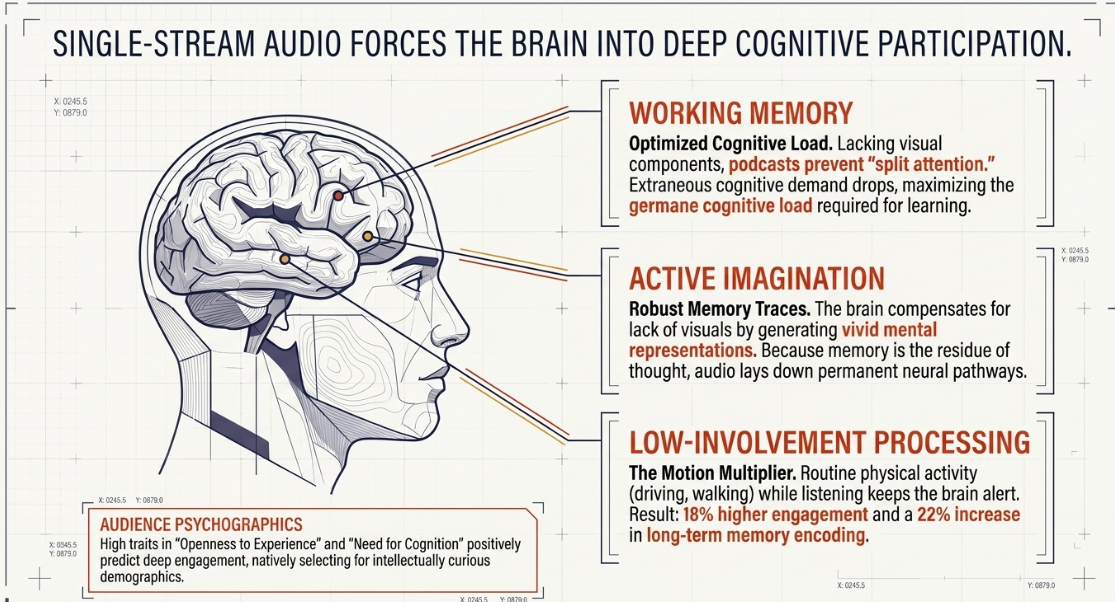
To engineer a podcast capable of sustaining long-term growth, operators must first deconstruct the neurological and psychological mechanisms that govern how the human brain processes spoken audio. Unlike visual media, which passively feeds imagery to the consumer and often induces cognitive lethargy, audio is a highly active medium that demands continuous cognitive participation.
Because podcasts lack a visual component, the brain is forced to compensate by generating its own vivid mental representations.6 This act of active imagination leads to deeper cognitive processing. Psychological principles suggest that memory is the residue of thought; because the listener must mentally grapple with the narrative to follow along, audio lays down highly robust memory traces.6 Furthermore, single-stream audio optimizes the brain's cognitive load. According to the Cognitive Theory of Multimedia Learning, eliminating extraneous visual demands prevents split attention, allowing the listener's working memory to focus entirely on auditory comprehension.6 This increases germane cognitive load, which is the productive mental effort that contributes directly to learning and long-term retention.6
When listeners engage in routine, mild physical activities such as walking, driving, or completing household chores while listening, they enter a state of low-involvement processing.6 This mild physical activity keeps the brain alert, resulting in an eighteen percent higher engagement rate and a twenty-two percent increase in the encoding of long-term memory.6 Furthermore, podcasts that utilize dynamic narration and emotional storytelling trigger the amygdala—the brain region heavily tied to emotional processing and memory encoding—priming the listener to retain the information delivered.6
The demographic and psychological profile of the audience also dictates retention metrics. Preregistered psychological studies utilizing the Big Five personality factors indicate that traits such as openness to experience, interest-based curiosity, and a high need for cognition positively predict podcast listening and deep engagement.7 Conversely, neuroticism negatively predicts podcast consumption, suggesting that the medium naturally selects for audiences seeking intellectual stimulation and emotional stability.
Parasocial Intimacy and Receptiveness
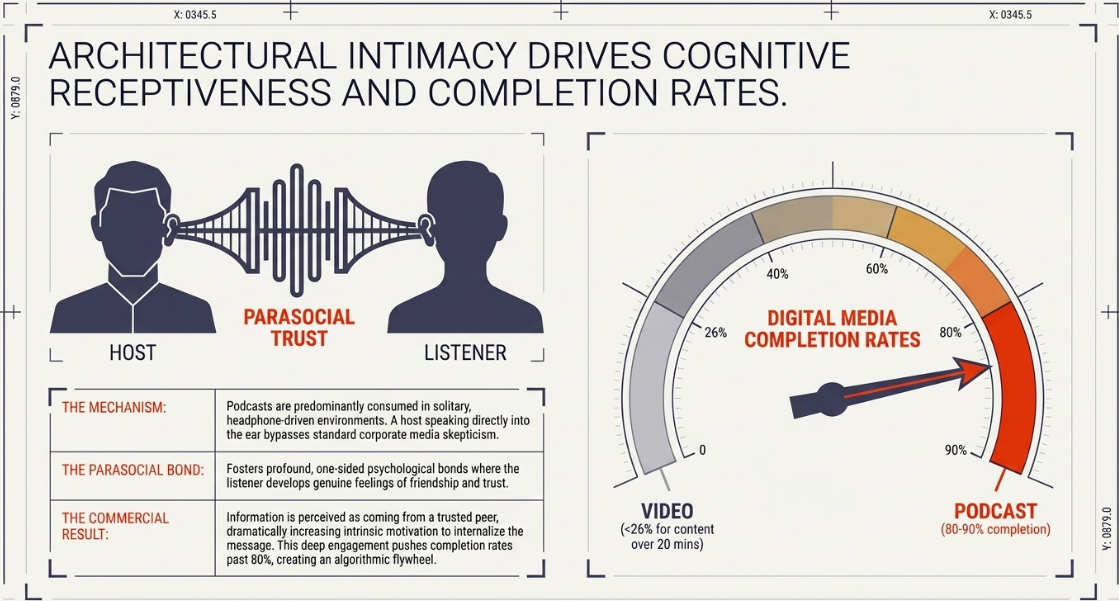
The architectural intimacy of the podcast medium is largely driven by its consumption mechanism. Podcasts are predominantly consumed via headphones in solitary environments, creating an isolated, one-on-one psychological atmosphere.6 When a host speaks directly into the listener's ear, sharing spontaneous thoughts or demonstrating authentic vulnerability, it bypasses standard media skepticism. This dynamic fosters parasocial relationships—profound, one-sided psychological bonds where the listener develops genuine feelings of friendship, trust, and familiarity with the media figure.6
The second-order implication of this parasocial bond is a dramatic increase in cognitive receptiveness. When the human brain perceives information as coming from a trusted friend rather than a corporate broadcaster, it becomes intrinsically motivated to pay attention and internalize the message.6 This deep psychological engagement explains why podcast completion rates often exceed eighty to ninety percent, an anomaly in digital media where video completion rates routinely plummet below twenty-six percent for content exceeding twenty minutes.6
Mastering audience retention requires a paradigm shift away from purely acquiring new listeners. Industry experts note that growing a podcast ecosystem is fundamentally about increasing the volume of consumption from current listeners.11 By creating an addictive psychological experience and speaking directly to listeners' pain points, creators generate a flywheel of organic growth; when existing listeners consume more episodes and forge deeper parasocial bonds, algorithmic velocity increases, which organically attracts new audiences.
The Analytics of Listener Abandonment
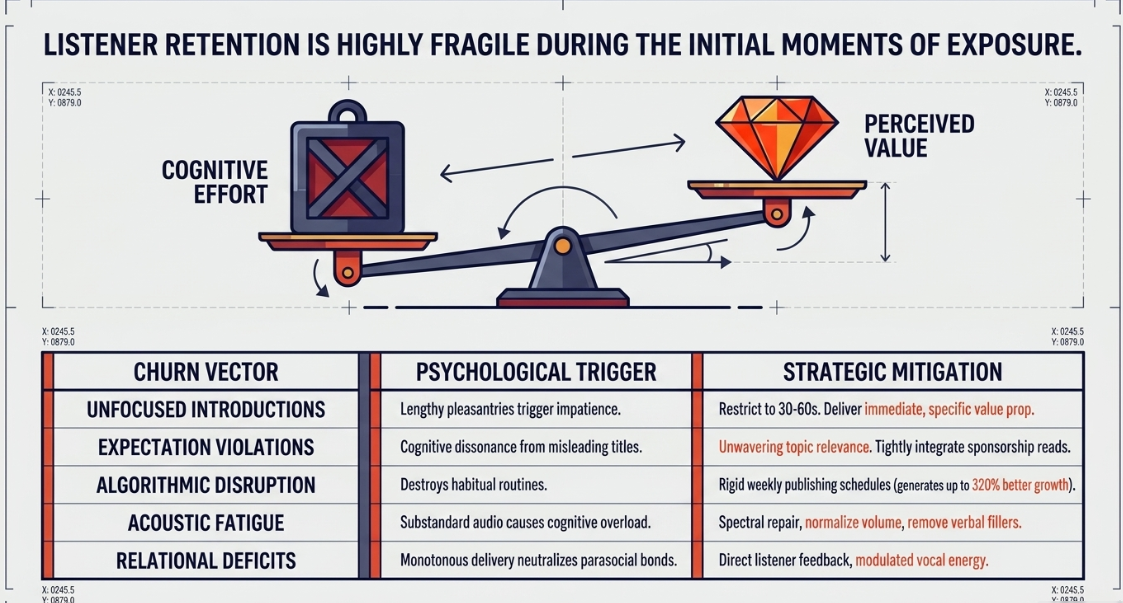
Despite the brain's natural affinity for audio, audience retention is highly fragile during the initial moments of exposure. Listeners subconsciously calculate the ratio between the effort of listening and the expected value of the content.12 When this equation becomes unbalanced, listener drop-off is immediate. Analytics across thousands of podcasts reveal five primary vectors that trigger audience abandonment.
Predictive Content Analysis and Structural Optimization
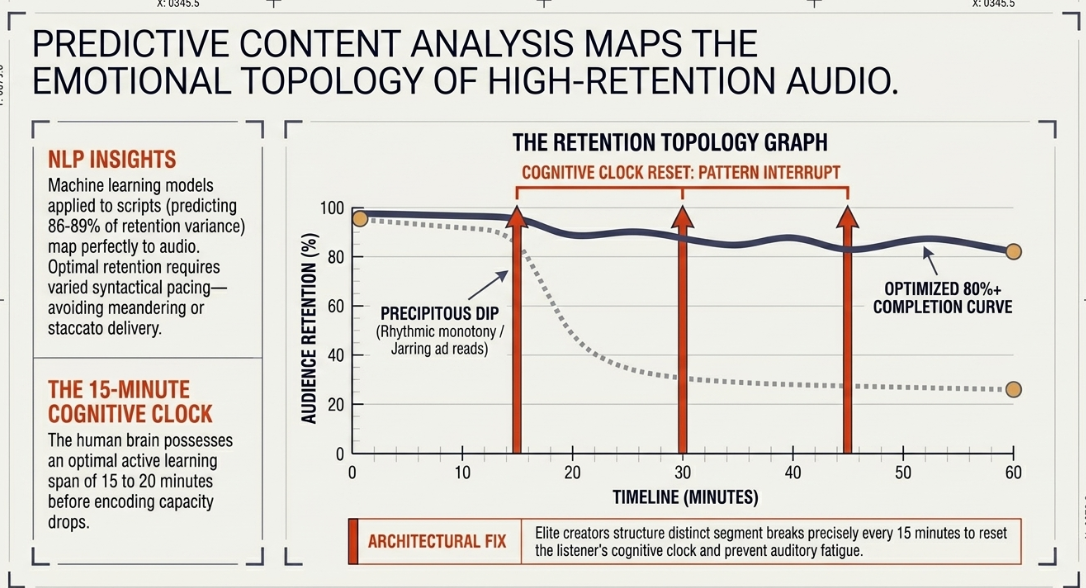
In the pursuit of maximizing audience retention, the podcasting industry is increasingly adopting predictive content analysis methodologies historically reserved for high-budget television production. Recent studies utilizing Natural Language Processing (NLP) and machine learning applied to television scripts—such as Breaking Bad and Madam Secretary—have uncovered precise linguistic and structural patterns that dictate audience retention.13 These models can explain between eighty-six and eighty-nine percent of audience retention variance.13
Applying these predictive NLP models to podcast scripting reveals critical insights for audio engineers. Scripts that rely on overly long, meandering sentences, or conversely, overly short, staccato sentences, predictably lose listener attention due to cognitive strain or rhythmic monotony.13 The optimal retention structure requires varied syntactical pacing. Furthermore, the emotional topology of an episode dictates whether a listener will return for subsequent releases. Episodes that engineer emotional highs—such as moments of profound joy, anger, or intense curiosity—in the precise middle of the runtime successfully anchor the listener's attention.13 Crucially, the language used during the episode's conclusion determines ongoing subscription behavior; episodes that end utilizing confident, dominant, and authoritative linguistic framing ensure high retention and immediate desire for future content.13
These findings intersect perfectly with research from cognitive psychology regarding eLearning environments and customized webinar solutions. Scientific literature dictates that the human brain possesses an optimal active learning span of fifteen to twenty minutes, after which the capacity for encoding new information drastically decreases.14 Passive didactic lectures are consistently associated with lower retention rates compared to active learning strategies.14 Consequently, podcast creators are restructuring their episodes to feature distinct segment breaks or pattern interrupts every fifteen minutes, effectively resetting the listener's cognitive clock and preventing auditory fatigue.
The Architecture of Hook Stacking
Mitigating early drop-off and securing initial algorithmic attention requires a rigorous architectural approach to show design known as hook stacking. This methodology is directly derived from elite commercial songwriting, popularized by artists such as Taylor Swift.15 Swift's commercial dominance is attributed to her ability to cram an extraordinary volume of distinct hooks—melodic, lyrical, vocal, emotional, and rhythmic—into a single track. In the song We Are Never Getting Back Together, analysts identify twelve distinct hooks, with six dropped within the first sixty-two seconds alone; similarly, Shake It Off contains ten distinct hooks.16
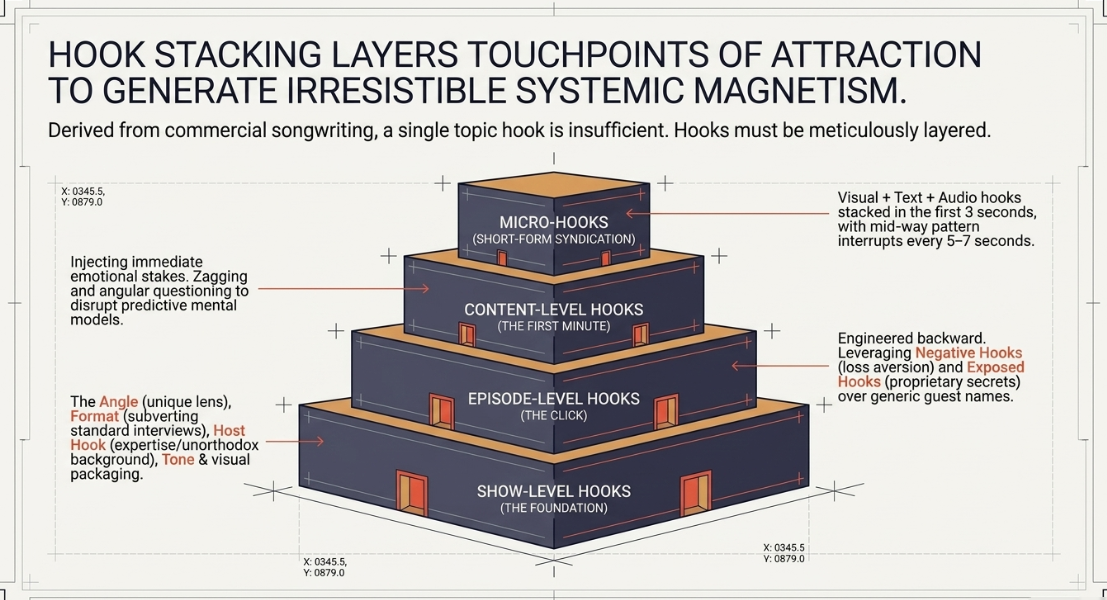
Transposed to the podcasting domain, hook stacking is the strategic layering of multiple touchpoints of attraction throughout an audio ecosystem.15 The underlying thesis is that while a single hook—such as an interesting topic—might secure a small fraction of the total addressable market, stacking multiple, highly specific hooks progressively makes the show utterly irresistible to a broader audience.15 Elite creators, mirroring the anti-clickbait retention mastery of YouTube personalities like MrBeast, understand that a hook must not merely generate a click; it must establish a promise that the subsequent content rigorously fulfills, thereby driving high-retention behavior.19 Hook stacking operates across three distinct structural tiers.
Show-Level Hooks: Raising the Baseline
Show-level hooks form the permanent architectural foundation of the podcast ecosystem. When these overarching elements are highly distinctive, they raise the baseline performance of every subsequent episode, meaning individual releases are required to do less independent heavy lifting to attract listeners.15
The primary show-level hook is the overarching Concept, which sits atop the general topic. The concept is bifurcated into the Angle and the Format.15 An angle is a highly specific, unique lens through which a topic is explored—such as viewing digital marketing strictly through the lens of empirical data analysis rather than generic theory.15 The format refers to a structural execution that subverts industry standards, avoiding the saturated conversational interview model in favor of narrative documentary or live teardown styles.15 Layered upon the concept is the Host Hook. A host acts as a powerful gravitational force if they possess preexisting mainstream fame, highly credible subject-matter expertise, or an unorthodox background that intersects with the topic in a compelling, counter-narrative fashion.15
The visual packaging of the show serves as the initial algorithmic gateway. Cover art must be engineered to halt mobile scrolling. It is tasked with communicating immediate relevance and establishing a subconscious vibe that visually separates the show from immediate competitors.18 Titles should be evocative and linguistically pleasing, while the show description must immediately outline the value proposition or introduce deep thematic tension within the first sentence.18 Finally, establishing a distinct Tone and Style—such as adopting a blunt, contrarian voice in an industry otherwise dominated by sanitized corporate jargon—serves as a permanent behavioral hook that simultaneously repels the wrong demographic while deeply anchoring the ideal listener.
Episode-Level Hooks: Packaging and External Discovery
Once the show-level hooks establish the ecosystem's foundation, episode-level hooks are required to earn individual clicks in crowded distribution feeds. These are external-facing packaging hooks that must be rigorously optimized before the audio is even recorded.18
The most effective creators design episodes by working backward: they engineer the most provocative, high-tension episode title possible, and then structure the interview or narrative to specifically fulfill that premise.18 To force click-through rates, strategists frequently utilize the negative hook framework, which leverages human loss aversion by highlighting mistakes, risks, or unpopular truths.20 Additionally, the exposed strategy triggers deep curiosity by promising to reveal hidden industry secrets or proprietary methodologies.20 When leveraging guests, the hook should rarely rely on the guest's name unless they possess universal fame. Instead, the hook should spotlight the guest's unique credentials or paradigm-shifting accomplishments.18 Custom episode artwork must play against the title to open a curiosity gap, generating visual tension rather than merely displaying a generic headshot.18
Content-Level Hooks: Internal Retention Mechanics
Once the packaging hooks successfully secure the click, the internal content-level hooks must instantly validate the listener's decision to press play. The opening minute of any episode is the most critical sixty seconds of the production lifecycle.18 The introduction must succinctly establish the premise, inject immediate emotional stakes, and preview the resolution without giving away the ultimate payoff.18
In interview formats, the first question acts as a vital retention mechanism; it must bypass mundane biographical details and plunge directly into high-value tension.18 Throughout the episode, creators must deploy zagging and angular questioning—unexpected conversational pivots that disrupt the listener's predictive mental models, forcing them to remain highly engaged.18 This internal hook structure relies heavily on episode blocking exercises, dividing the content into distinct, manageable scenes that steadily build tension, raise the stakes, and release tension as the episode progresses.
Micro-Hooks for Short-Form Syndication
The principles of hook stacking must also be aggressively applied to the short-form visual assets used to promote the audio ecosystem on platforms like TikTok, YouTube Shorts, and LinkedIn. A viral content system requires stacking visual, text, and audio hooks simultaneously within the first three seconds of a video.22
Creators achieve this by utilizing bold auditory statements or shocking questions combined with dynamic visual text pop-ups to arrest attention immediately.22 To maintain retention in short-form media, midway pattern interrupts must be deployed every five to seven seconds, utilizing quick zoom-ins, sound effects, or supplemental B-roll footage to reset the viewer's deteriorating attention span.22 The ultimate goal of these micro-hooks is not merely to farm views, but to generate a profound curiosity loop that drives the user out of the short-form algorithmic feed and into the deep-engagement, long-form audio ecosystem.22
Narrative Architecture and Open Loops
While hook stacking provides the structural magnetism required to attract and hold attention, the psychological engine that drives a listener through an episode—and ensures they return for the next—is narrative tension. Humans are biologically wired to seek closure. When an unresolved question or incomplete scenario is presented, it occupies mental bandwidth, draining cognitive resources until the loop is closed.25 Storytellers weaponize this neurological quirk through a technique known as open loops.
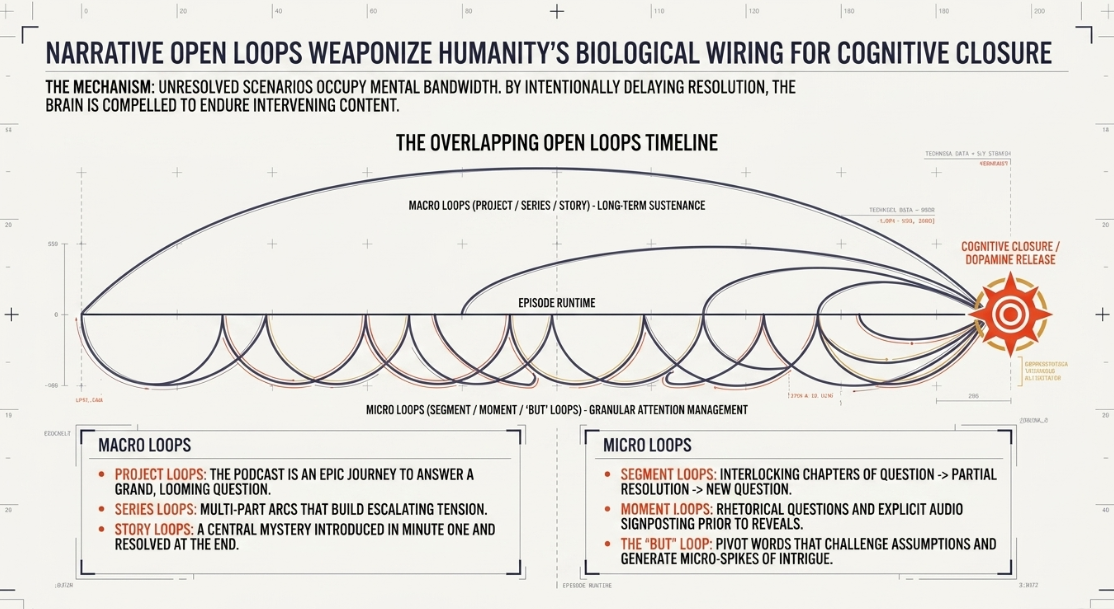
An open loop occurs when a creator teases a piece of information, a complex problem, or a surprising outcome early in the narrative but intentionally delays the resolution until a later point.21 Because the brain despises unfinished business, the listener is compelled to endure the intervening content to achieve the dopamine release associated with cognitive closure.26 To maximize retention and transform casual listeners into devoted brand advocates, an audio ecosystem must intertwine both macro and micro open loops throughout its architecture.
The Macro Loops: Long-Term Sustenance
Macro loops are designed to hold attention over extended periods, spanning across entire episodes or multi-year projects, establishing a profound narrative gravity.27
Project Loops: This represents the overarching thesis or grand quest of the entire podcast. Rather than publishing a disjointed collection of topical interviews, the ecosystem is framed as a continuous, epic journey to answer a highly complex, looming question. This massive loop remains open until the podcast ends, providing a permanent, overarching reason for subscription.27
Series Loops: This loop spans a finite cluster of episodes. By dedicating a multi-part arc to a specific burning question or investigation, the creator builds escalating tension across weeks of content. This drives binge-listening behavior and ensures that listeners return for the eventual payoff in the final installment of the series.27
Story Loops: Functioning within the boundaries of a single episode, the story loop introduces a central mystery or conflict in the opening minutes. The host must consistently revisit and restate this primary tension throughout the runtime, keeping the question top-of-mind so that the final resolution delivers a powerful, satisfying emotional impact.27
The Micro Loops: Granular Attention Management
Micro loops operate on a second-by-second basis, ensuring that the listener's attention does not drift during dense informational or technical segments.27
Segment Loops: This involves dividing an episode into a repeatable sequence of distinct chapters, where each chapter poses a question, delivers partial resolution, and immediately pivots to a new question. For example, a narrative structure might open by establishing the stakes, introduce standard industry practices, tear down those practices by introducing a radical alternative, and finally explain the logic behind the radical choice. Each segment propels the listener effortlessly into the next.27
Moment Loops: These are immediate, script-level tactics. Moment loops rely on the rapid deployment of rhetorical questions, dramatic pauses right before significant reveals, and explicit audio signposting.27 For instance, rather than simply playing an interview clip, the host will explicitly tease that the upcoming guest holds a highly controversial opinion, opening a momentary loop that is instantly closed when the clip plays.27
The "But" Loop: The most granular structural element is the use of pivot words such as "but," "however," or "yet." Rather than presenting chronological, flat information, the narrative is structured as a series of actions and unexpected reactions. The word "but" instantly challenges assumptions, generating a micro-spike of intrigue that demands the listener stay for the following clause.21
The Mechanics of Fulfillment and Storytelling Architecture
The strategic deployment of open loops is a delicate psychological balancing act. If a creator opens too many loops without closing them, or if the ultimate resolution fails to justify the prolonged tension, the audience feels manipulated.27 This phenomenon, akin to algorithmic clickbait, permanently damages the parasocial trust the host has painstakingly built. Therefore, the closure of any loop must strictly adhere to two foundational rules: it must align perfectly with the established internal logic of the narrative, and the value of the payoff must match the emotional intensity of the initial setup.27
To execute these loops effectively, elite creators map their episodes against the Vonnegut Line, a storytelling principle that assesses the emotional trajectory of a narrative to ensure it possesses a compelling shape rather than a flat delivery.18 They also rely heavily on the Peak-End Rule, a psychological heuristic dictating that people judge an experience largely based on how they felt at its peak emotional moment and at its end.18 By ensuring the episode ends on a high note of confident resolution, listeners are left consistently wanting more.
Underpinning these loops is a classic five-part storytelling structure utilized to build deep trust.26 First, the creator must meticulously set the stage, painting a clear mental picture that transports the listener.26 Second, they must create a profound connection with the characters, highlighting relatable traits.26 Third, tension is built through the introduction of conflict.26 Fourth, the narrative reaches a climax or a profound "aha moment".26 Finally, the host brings it home, providing a clear resolution that explicitly connects the moral of the story back to the core business offer or podcast premise.
The Infinity Loop Strategy and Ecosystem Monetization
Developing unparalleled audience retention through hook stacking and narrative engineering is futile if the podcast does not align with a robust monetization architecture. For corporate entities, industry consultants, and expertise-based businesses, the ultimate objective of the audio ecosystem is to generate revenue seamlessly and predictably. This is achieved through the implementation of the Infinity Loop Content Strategy, a sophisticated model designed by Jeremy Enns at the Podcast Marketing Academy.28
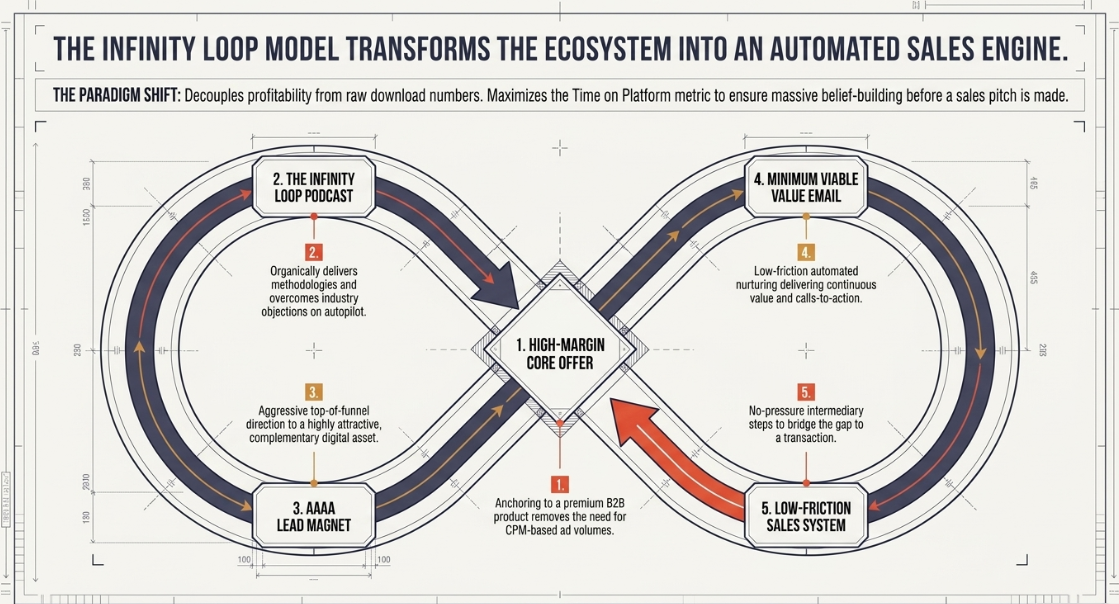
Engineered to organically convert listeners into buyers without resorting to aggressive, high-friction sales tactics, the Infinity Loop system transforms the podcast from a mere marketing expense into an automated sales engine.18 The framework operates on the premise that the right content strategy makes episode creation easier while systematically driving the target audience toward a transaction, while simultaneously keeping existing customers engaged to earn repeat renewals.28
Architecture of the Infinity Loop
An Infinity Loop podcast is characterized by an infinitely reproducible format that shields the creator from operational burnout while continuously reinforcing the brand's core intellectual property, methodologies, and philosophies.18 It provides dual value, acting as a retention tool for existing customers while simultaneously serving as an attraction and conversion mechanism for cold prospects.18
The model rests on a precise order of operations, built around several interconnected strategic components 18:
The Core (Cash Cow) Offer: The ecosystem must anchor itself to a premium, high-margin product or service. This ensures the business model is sustainable without requiring the massive, millions-strong audience sizes demanded by traditional CPM-based advertising models.30
The Infinity Loop Podcast: The show's concept and episode engineering are structurally designed to organically deliver the host's unique point of view and core sales messages on autopilot. By addressing the specific objections, industry misconceptions, and limiting beliefs of the target audience within the educational content itself, the podcast conducts massive belief-building before a sales pitch is ever made.18
The AAAA Lead Magnet: The podcast acts as the top of the funnel, aggressively directing listeners toward a highly attractive, high-value digital asset. This lead magnet must align perfectly with the core offer and serve as a logical, necessary extension of the podcast content.30
Minimum Viable Value Email Strategy: Once listeners trade their contact information for the lead magnet, they enter an automated email ecosystem. This low-friction strategy continuously delivers targeted, valuable content intertwined with direct calls-to-action, nurturing the prospect until they are ready to initiate a purchase.32
Low-Friction Sales System: The final component bridges the gap between free content and the transaction, utilizing no-pressure intermediary steps to foster direct communication with potential clients and overcome final objections.32
By mastering this interconnected flow, creators completely decouple profitability from raw download numbers. A highly optimized Infinity Loop ecosystem can generate substantial revenue even if the podcast only secures a few hundred highly qualified downloads per episode.18 It shifts the creator's mindset to that of a network executive, focusing intensely on maximizing the Time on Platform metric, ensuring that prospects spend hours immersed in the brand's philosophy before ever speaking to a sales representative.18
Multi-Channel Distribution and Content Atomization
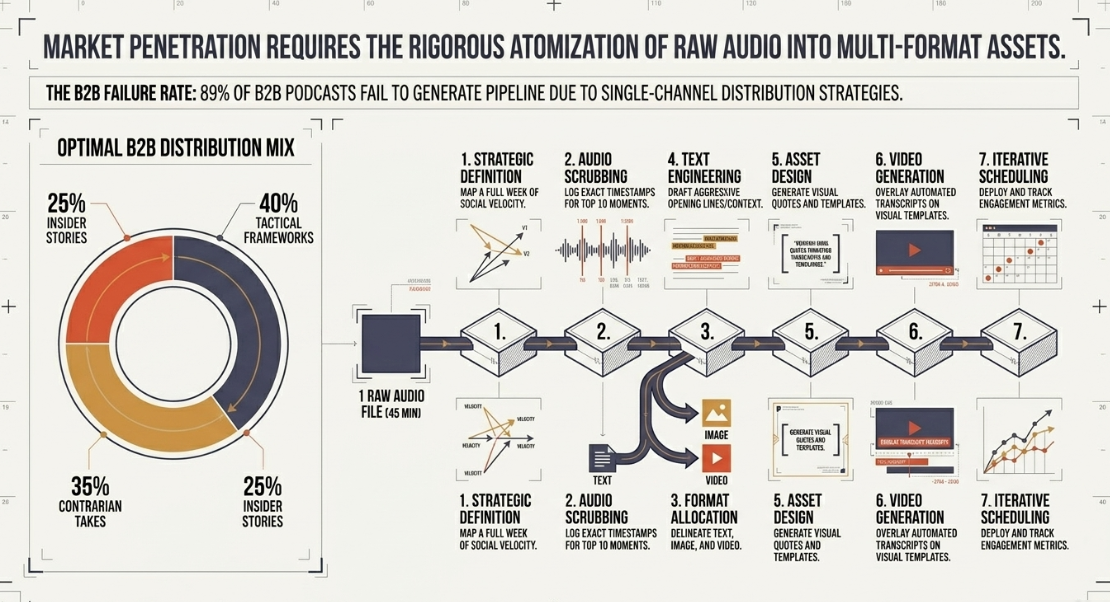
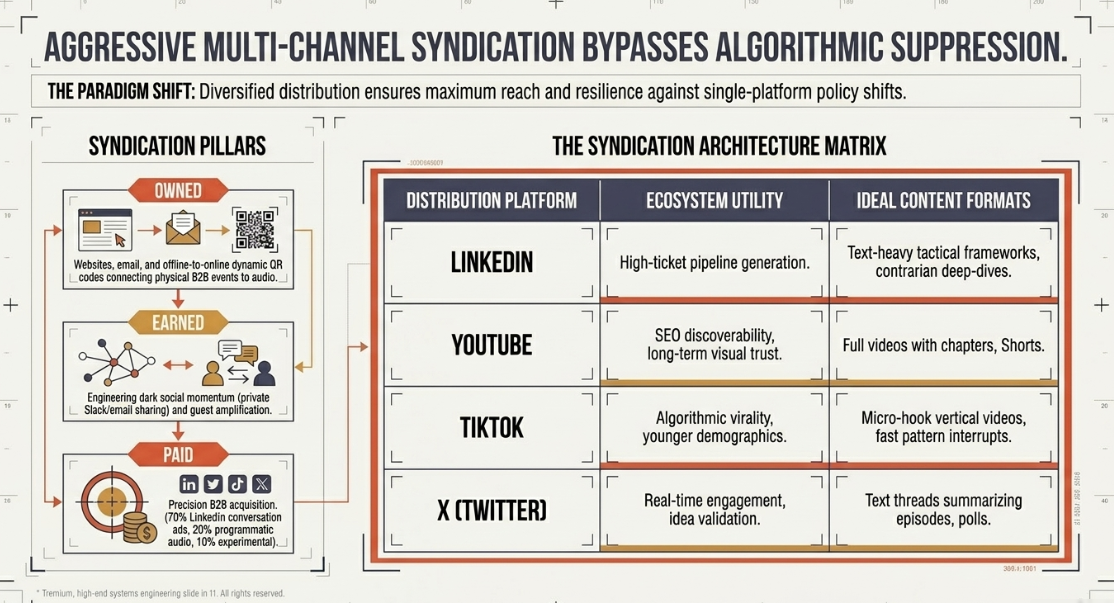
In 2026, creating exceptional, psychologically optimized audio content is only the baseline requirement for market entry. The primary reason a staggering eighty-nine percent of B2B podcasts fail to reach their target buyers and generate pipeline is an over-reliance on amateur, single-channel distribution strategies.5 Decision-makers—ranging from enterprise software buyers to niche industry executives—do not organically browse podcast directories hoping to discover new content. They consume media within highly specific chronological windows, such as morning commutes or gym sessions, and rely heavily on curated channels like LinkedIn feeds, industry newsletters, and private digital communities like Discord or Slack.5 To penetrate these algorithmic barriers, podcasts must be decentralized through aggressive, multi-channel distribution frameworks.
The Micro-Content Creation Workflow
The era of simply uploading an MP3 file to an RSS feed and relying on platform discovery is over. A single, forty-five-minute audio episode must serve as the raw material for a vast content atomization process.5 Best-in-class operators systematically break down one episode into fifteen or more platform-specific, multi-format assets.5
This repurposing framework follows a strict seven-step operational workflow.5 First, producers define the strategy, aiming to transform under one hour of audio into a full week of social content.5 Second, they scrub the audio to identify the ten most potent moments—insightful quotes, contrarian data points, or tactical frameworks—logging specific timestamps.5 Third, they assign optimal formats to each point, delineating between text-only posts, image quotes, and video audiograms.5 Fourth, text posts are engineered with aggressive opening lines and clear contexts.5 Fifth, image assets are generated utilizing design software like Canva.5 Sixth, video assets are created using tools like Headliner or Audiogram Wizards to overlay automated transcriptions on engaging visual templates.5 Finally, the assets are scheduled across diverse platforms, tracking engagement metrics to refine future iterations.5
To scale trust effectively, this organic syndication should adhere to a rigorous content pillar ratio: forty percent tactical frameworks providing instant utility, thirty-five percent contrarian takes challenging standard industry assumptions, and twenty-five percent insider stories to humanize the brand.5
The Three Pillars of Syndication
A robust audio ecosystem pushes content across three distinct syndication pillars to ensure omnipresence and bypass algorithmic suppression.5
First, ecosystems leverage Owned Media, encompassing the channels the brand fully controls, including websites and email lists.5 Advanced B2B ecosystems integrate offline physical channels with online audio assets using dynamic QR codes powered by enterprise software like QRNow.5 By deploying dynamic MP3 QR codes or Video QR codes on physical marketing materials, business cards, or event posters, brands allow decision-makers to instantly scan and stream podcast episodes.5 Because these dynamic codes are editable, marketing teams can continuously update the destination URL to point to the latest episode without reprinting physical materials, while simultaneously tracking real-time scan analytics.5
Second, ecosystems drive Earned Media by engineering dark social momentum. By embedding highly specific, proprietary frameworks within the episode, creators incentivize listeners to share timestamps privately via Slack channels, internal corporate emails, or encrypted messaging apps.5 Furthermore, pre-negotiated guest amplification ensures the podcast penetrates adjacent audience networks.5
Third, ecosystems utilize Paid Amplification, treating podcast growth as a precision direct-response acquisition channel. For B2B ecosystems, LinkedIn advertising remains the premier vector. Deploying conversation ads styled as peer-to-peer invitations drives significantly higher conversion rates than generic promotional boosts.5 Additionally, programmatic audio advertising allows brands to insert promotional spots into the existing listening habits of their target demographic across external podcast networks.5 A highly effective initial budget allocation often maps to seventy percent LinkedIn, twenty percent programmatic audio, and ten percent experimental testing.
Search Engine Optimization (SEO) for Audio
To prevent the podcast from remaining invisible to high-intent buyers, the ecosystem must optimize for discoverability algorithms rather than relying solely on clever wordplay. SEO discoverability frameworks can increase organic listener acquisition by massive margins.5 Metadata optimization is paramount; titles must reflect buyer-problem language rather than generic headlines.5 A title framed as a direct solution to a specific pain point performs exponentially better in organic discovery.5 Furthermore, publishing comprehensive, SEO-optimized transcripts and detailed show notes captures long-tail search queries, indexing the spoken content for search engine crawlers and providing accessibility for executives who prefer skimming text to listening.5 Optimization must also be platform-specific, focusing on review velocity on Apple Podcasts within the first forty-eight hours, and optimizing thumbnail design and closed captions on YouTube.5
Advanced Analytics, Measurement, and Ecosystem Health
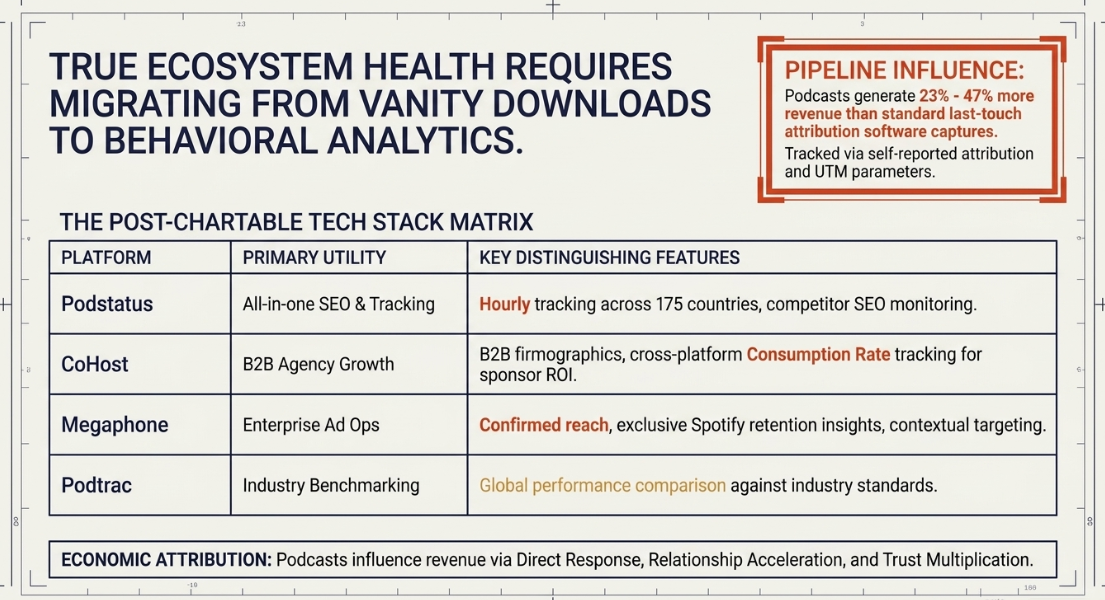
The final structural pillar of a sustainable audio ecosystem is the rigorous tracking and interpretation of advanced analytics. The maturation of podcasting technology has decisively shifted the industry away from rudimentary, vanity download metrics toward highly granular behavioral data.12 Traditional download counts offer exceedingly limited utility, as hosting platforms register a download regardless of whether the user actually presses play or consumes the audio.10 True ecosystem health must be measured through retention, completion rates, and advanced economic attribution.
The podcast analytics landscape experienced a significant tectonic shift when the industry standard tool, Chartable, permanently shut down on December 12, 2024.37 This forced sophisticated operators to migrate to a new suite of enterprise-grade measurement tools capable of providing actionable intelligence.37
Behavioral Tracking and Retention Curves
Advanced hosting platforms provide creators with minute-by-minute episode drop-off charts, allowing unprecedented visibility into the listener's behavioral psychology.36 These platforms track the Consumption Rate (the metric utilized by Apple Podcasts to aggregate average listen time) and the Retention Rate (the metric utilized by Spotify).42
Analyzing the physical topology of a retention curve allows creators to conduct precise post-mortem audits on their hook stacking and narrative loops. Sharp, precipitous dips in the curve typically correlate with jarring, poorly integrated ad reads or sudden shifts in topical relevance.36 Conversely, a gradual, linear decay suggests a critical lack of mid-episode macro loops to sustain tension.27 Monitoring exactly where listeners abandon the episode enables producers to refine their segment lengths and mathematically optimize the timing of vital calls-to-action.12 A healthy, highly optimized audio ecosystem should target an average completion rate exceeding eighty percent.
Revenue Attribution and Pipeline Influence
For ecosystems utilizing the Infinity Loop strategy, tracking the direct financial influence of the podcast is paramount. Because podcasts excel at nurturing deep parasocial trust over extended periods, standard last-touch marketing attribution software chronically undervalues the medium's impact.5 Audio ecosystems influence pipeline revenue through three distinct, measurable pathways: direct response (immediate conversions driven by specific URLs), relationship acceleration (existing prospects moving through the sales funnel significantly faster due to pre-established trust), and trust multiplication (higher close rates and larger average contract values).5
Tracking these specific vectors reveals that B2B podcasts routinely influence twenty-three to forty-seven percent more revenue than conventional software attributes to them.5 To capture this data accurately without deploying convoluted enterprise tracking software, organizations rely on self-reported attribution mechanisms (such as adding mandatory "How did you hear about us?" free-text fields to intake forms), UTM parameter tracking embedded in show notes, and the deployment of episode-specific landing pages.5
When scaling an audio brand, financial metrics must be balanced against systemic guardrail key performance indicators (KPIs) to ensure the audience is not being degraded by aggressive monetization.44 Tracking listener churn, subscriber growth rates, and qualitative feedback scores acts as a critical counterbalance.5 Evaluating the Customer Lifetime Value (LTV) against the ecosystem's Customer Acquisition Cost (CAC) provides the ultimate determination of the media property's long-term sustainability.
Case Studies in Ecosystem Scaling
Analyzing elite, global operators reveals precisely how the integration of hook stacking, narrative open loops, and automated multi-channel distribution manifests in real-world exponential growth.
Huberman Lab: Decoupling from Algorithms via Owned Media
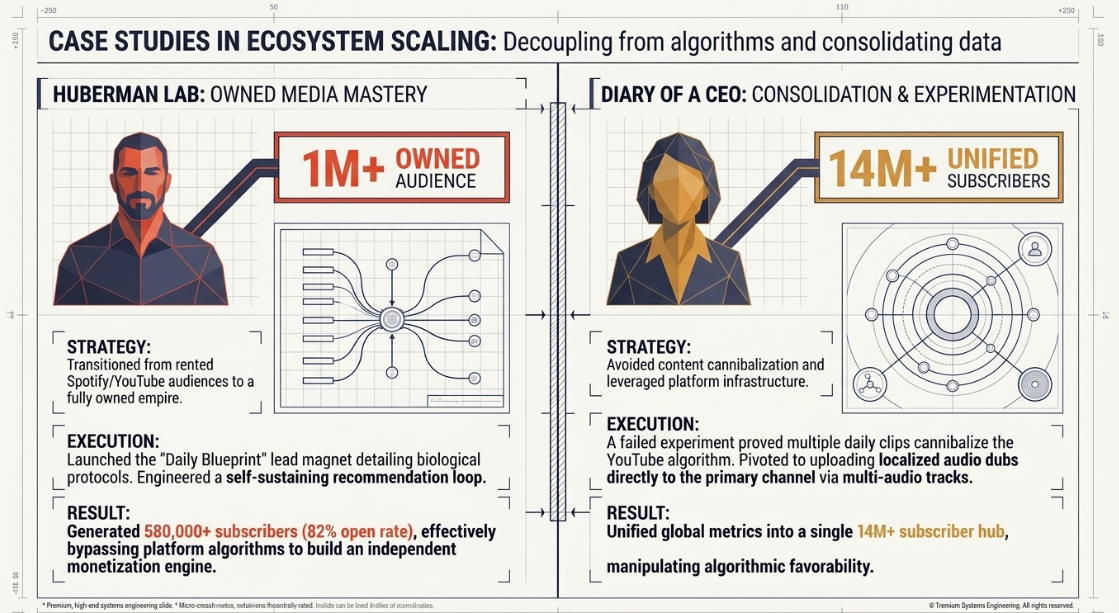
Dr. Andrew Huberman scaled his podcast from a nascent academic project into the top-ranked health podcast globally.47 However, the true architectural triumph of the Huberman Lab ecosystem was its systematic transition from a rented algorithmic audience dependent on YouTube and Spotify into a fully owned media empire, resulting in over one million dedicated email subscribers.47
The growth engine relied on an automated, high-value lead magnet titled the "Daily Blueprint," which detailed Huberman's personal biological and productivity protocols.47 This single digital asset generated over 580,000 subscribers and boasted an extraordinary eighty-two percent open rate on the welcome sequence, alongside a fifty-four percent click rate.47 By utilizing omnipresent sign-up forms across all digital touchpoints and leveraging creator-to-creator recommendation networks via the Kit platform, the team engineered a self-sustaining organic growth loop that generated over 72,000 high-quality subscribers with zero paid acquisition costs.47
Crucially, this operational strategy completely decoupled the ecosystem's growth from direct, on-air podcast mentions. It created a parallel consumption format for audiences who preferred written, highly structured summaries over consuming two-to-three-hour audio lectures, effectively bypassing unpredictable platform algorithms.47 The newsletter now functions as a massive, independent monetization engine, driving direct revenue through specialized sponsorships and serving as the foundational launchpad for high-ticket product launches and book presales.47
The Diary of a CEO: Cannibalization, Consolidation, and Experimentation
The media infrastructure behind The Diary of a CEO, operating under the guidance of experimentation executives like Grace Miller at Flight Story, provides a masterclass in the technical nuances of algorithm manipulation, audience retention, and ecosystem scaling.32 Through rigorous, data-backed experimentation, they uncovered critical insights regarding content cannibalization and channel architecture.
In a bold attempt to double their overall viewership, the team tested publishing two horizontally formatted, shortened podcast clips per day on a dedicated channel, theorizing a commensurate doubling of monthly views.32 The experiment resulted in failure; total views remained entirely flat, and the reach per individual clip plummeted.32 The underlying insight derived from this failure revealed that posting multiple videos simultaneously on a single channel actively cannibalizes content, as the YouTube homepage algorithm rarely serves a user multiple placements from the exact same creator at the same time.32
Conversely, their localized dubbing experiment yielded unprecedented global success. Rather than fracturing their audience across multiple, language-specific channels—a strategy previously popularized by elite creators to target international markets—the team utilized YouTube's multi-audio track feature.32 By uploading all translated and localized audio dubs directly onto the primary English channel, they successfully consolidated their global metrics and engagement data, ultimately driving the central hub to over fourteen million unified subscribers.32 Furthermore, the team continually leverages massive underutilized engagement tools, such as interactive community polls and detailed YouTube chapters, to drive micro-interactions and manipulate algorithmic favorability, all underpinned by a corporate culture that actively celebrates failed experiments as long as actionable data is extracted.32
Conclusion
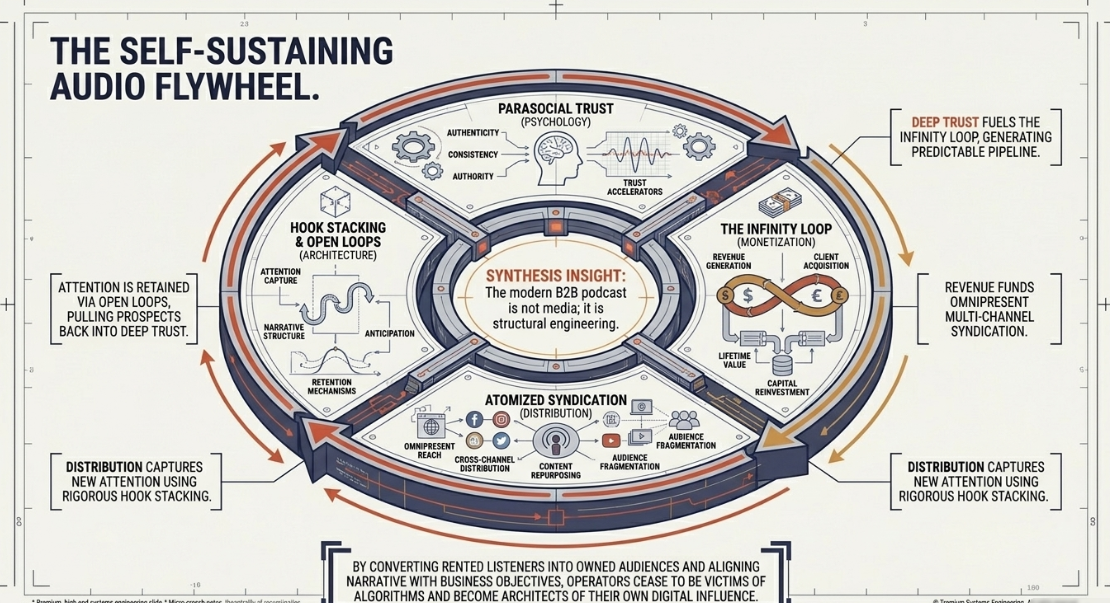
The architecture of a highly successful podcasting strategy in the modern era extends far beyond the microphone and audio interface. It requires a rigorous, interdisciplinary synthesis of cognitive psychology, narrative theory, programmatic media engineering, and sophisticated revenue attribution modeling. By intimately understanding how the human brain processes and retains auditory information, creators can deploy structural hook stacking to secure fragile initial attention, while simultaneously weaving complex macro and micro open loops to sustain cognitive tension and drive unparalleled completion rates.
Transitioning from a mere content creator to an ecosystem architect requires the implementation of advanced strategies like the Infinity Loop, decoupling financial success from viral vanity metrics by embedding automated, high-ticket conversion mechanics directly into the show's structural DNA. Furthermore, escaping the graveyard of failed audio projects demands the relentless atomization and multi-channel distribution of content, ensuring that the brand intercepts high-intent listeners across owned, earned, and paid media channels through precise SEO and programmatic audio targeting.
Ultimately, those who master the intricate science of audience retention and ecosystem expansion cease to be victims of third-party algorithmic whims. By converting rented listeners into owned audiences, tracking granular behavioral data, and deeply aligning narrative content with scalable business objectives, sophisticated operators can build resilient audio ecosystems capable of driving sustained influence and exponential revenue in an increasingly fractured digital landscape.
Works cited
Digital Audio & Podcast Growth Trends: Media Strategy Insights for 2026 - Guideline.ai, accessed June 11, 2026, https://www.guideline.ai/blog/the-rise-of-digital-audio-why-podcasts-are-reshaping-the-media-landscape
Podcasts Are Dominating — And Signaling a Shifting Audience Behavior - Audacy Inc., accessed June 11, 2026, https://audacyinc.com/insights/podcasts-are-dominating-and-signaling-a-shifting-audience-behavior/
Programmatic audio shifts to curation, identity, and video in 2026 | News - Triton Digital, accessed June 11, 2026, https://tritondigital.com/news-item/December-07-2025/programmatic-audio-shifts-to-curation-identity-and-video-in-2026
Understanding the Full Audio Landscape - iHeartMedia, accessed June 11, 2026, https://www.iheartmedia.com/advertise/insights/articles/understanding-the-full-audio-landscape
B2B Podcast Marketing, Distribution, And Promotion: The 2025 ..., accessed June 11, 2026, https://www.fame.so/post/b2b-podcast-marketing-distribution-and-promotion
Why Your Brain Loves Listening — Part 2: The Research Behind the ..., accessed June 11, 2026, https://ustudio.com/blog/podcasting/why-your-brain-loves-listening-part-2-the-research-behind-the-science/
Why people listen: Motivations and outcomes of podcast listening - PMC, accessed June 11, 2026, https://pmc.ncbi.nlm.nih.gov/articles/PMC8985929/
"Parasocial Relationships with Podcast Hosts" by Mikhaela Nadora - PDXScholar - Portland State University, accessed June 11, 2026, https://pdxscholar.library.pdx.edu/honorstheses/771/
309. The psychology of parasocial relationships - The Psychology of your 20s - Omny.fm, accessed June 11, 2026, https://omny.fm/shows/the-psychology-of-your-20-s/309-the-psychology-of-parasocial-relationships
How Listener Behavior Impacts Podcast Growth - Podgagement, accessed June 11, 2026, https://podgagement.com/how-listener-behavior-impacts-podcast-growth/
How to Utilize Podcast Episode Titles To Increase Your Podcast Downloads - PodMatch, accessed June 11, 2026, https://podmatch.com/blog/how-to-utilize-podcast-episode-titles-to-increase-your-podcast-downloads
Why Podcast Listeners Drop Off: 5 Proven Retention Strategies for ..., accessed June 11, 2026, https://propodcastsolutions.com/podcast-listener-retention-strategies/
Can a TV Show's Script Predict a Hit? Data Says Yes. | Darden Ideas to Action - The University of Virginia, accessed June 11, 2026, https://ideas.darden.virginia.edu/applying-NLP-to-TV-scripts
Knowledge Acquisition and Audience Retention in Stroke Education: Results From a Global Study by the World Stroke Organization - American Heart Association Journals, accessed June 11, 2026, https://www.ahajournals.org/doi/full/10.1161/STROKEAHA.124.049311
Hook Stacking: A lesson from Taylor Swift on creating an ultra ..., accessed June 11, 2026, https://counterweight-creative.kit.com/posts/hook-stacking-a-lesson-from-taylor-swift-on-creating-an-ultra-catchy-show
Posts | Podcast Marketing Micro-Lessons For Scrappy Solopreneurs & Creators, accessed June 11, 2026, https://counterweight-creative.kit.com/
Hook Stacking: How to Design Your Podcast to Grow, accessed June 11, 2026, https://podcastmarketingacademy.com/hook-stacking/
The Podcast Growth Engine: Optimizing Your Podcast - Podcast ..., accessed June 11, 2026, https://podcastmarketingacademy.com/podcast-growth-engine-podcast/
Watched 8 hours of MrBeast's content. Here are 7 psychological strategies he's used to get 34 billion views : r/Entrepreneur - Reddit, accessed June 11, 2026, https://www.reddit.com/r/Entrepreneur/comments/179uxji/watched_8_hours_of_mrbeasts_content_here_are_7/
Inside The Vault with Ash Cash - Apple Podcasts, accessed June 11, 2026, https://podcasts.apple.com/gb/podcast/inside-the-vault-with-ash-cash/id1552221520
The Keys to Incredible Episode Intros | Mastering B2B Podcasting - Sweet Fish Media, accessed June 11, 2026, https://www.sweetfishmedia.com/blog/the-keys-to-incredible-episode-intros-mastering-b2b-podcasting
The 'Hook Stacking' Method for MORE Views! - YouTube, accessed June 11, 2026, https://www.youtube.com/shorts/8dtEdA_BQWo
How to Write Great Hooks For Social Media: A Complete Guide - Storytella Studios, accessed June 11, 2026, https://storytellastudios.com/2025/10/13/how-to-write-great-hooks-for-social-media-a-complete-guide/
This 32-Second TikTok Made $30,000+ (Exact System Explained) - YouTube, accessed June 11, 2026, https://www.youtube.com/watch?v=h_5ZCcL45qg
Wantrepreneur to Entrepreneur | Start and Grow Your Own Business - Apple Podcasts, accessed June 11, 2026, https://podcasts.apple.com/us/podcast/wantrepreneur-to-entrepreneur-start-and-grow-your-own/id1155207822?l=zh-Hans-CN
250 6 Pro Storytelling Tricks That Make Your Podcast More ..., accessed June 11, 2026, https://podcastperformancecoach.com/250-storytelling-tricks-podcast-better-memorable/
Techniques to Transform Your Storytelling: The 6 Types of Open ..., accessed June 11, 2026, https://jayacunzo.com/blog/techniques-to-transform-your-storytelling-the-6-types-of-open-loops
The Content Strategy Schematic - Podcast Marketing Academy, accessed June 11, 2026, https://podcastmarketingacademy.com/content-strategy-schematic/
accessed June 11, 2026, https://podcastmarketingacademy.com/content-strategy-schematic/#:~:text=The%20%E2%80%9CInfinity%20Loop%E2%80%9D%20Content%20Strategy,sell%20more%20and%20grow%20faster
The Podcast Growth Engine Model - Podcast Marketing Academy, accessed June 11, 2026, https://podcastmarketingacademy.com/podcast-growth-engine-model-overview/
About - Podcast Marketing Academy, accessed June 11, 2026, https://podcastmarketingacademy.com/about/
How I Helped Grow Diary of a CEO to 14M Subscribers | 120 ..., accessed June 11, 2026, https://nathanbarry.com/how-i-helped-grow-diary-of-a-ceo-to-14m-subscribers-120/
10 Steps to Building Your Personal Brand on Social Media | Digital Marketing Institute, accessed June 11, 2026, https://digitalmarketinginstitute.com/blog/10-steps-to-building-your-personal-brand-on-social-media
Multi-channel content distribution: How to scale content reach in the era of Loop Marketing, accessed June 11, 2026, https://blog.hubspot.com/marketing/multi-channel-content-distribution
The Future of Podcast Advertising: 3 Takeaways From SXSW and Podcast Movement Evolutions - AdsWizz, accessed June 11, 2026, https://www.adswizz.com/the-future-of-podcast-advertising-takeaways-from-sxsw-and-podcast-movement-evolutions/
Understanding your episode performance | by Anchor - Medium, accessed June 11, 2026, https://medium.com/anchor/understanding-your-episode-performance-c5a8280eddd6
7 Best Podcast Analytics Tools in 2026 - Compared | Podstatus Blog, accessed June 11, 2026, https://podstatus.com/blog/best-podcast-analytics-tools
The Best Podcast Analytics Tools in 2026 - CoHost, accessed June 11, 2026, https://cohostpodcasting.com/resources/best-podcast-analytics-tools
How to define podcast success (and the one metric every podcaster should track), accessed June 11, 2026, https://comealivecreative.com/podcast-success-metrics/
Top 10 B2B Podcast Analytics Platforms for Measuring Enterprise ROI in 2026, accessed June 11, 2026, https://contentallies.com/learn/top-b2b-podcast-analytics-platforms
Podcast Analytics Tools & Metrics That Actually Drive Growth, accessed June 11, 2026, https://blog.podcast.co/inspire/podcast-analytics-tools-and-metrics
Podtionary | The language of podcasting, accessed June 11, 2026, https://podtionary.com/
Why Podcasts Lose Subscribers (And How to Stop It) - Big Tent Media, accessed June 11, 2026, https://www.bigtentmedia.co.uk/blog/why-listeners-stop-listening-to-podcast-and-what-you-can-do-about-it
The North Star Metric: Finding the One Number That Defines Your Growth - KISSmetrics, accessed June 11, 2026, https://www.kissmetrics.io/blog/north-star-metric
How Mobile Games Maximize Revenue & LTV from High Rollers - OneSignal, accessed June 11, 2026, https://onesignal.com/blog/vip-players-high-rollers-how-targeted-messaging-maximizes-lifetime-value/
Arlo Technologies Product Manager Interview Guide 2026 - Dataford, accessed June 11, 2026, https://dataford.io/interview-guides/arlo-technologies/product-manager
How Andrew Huberman scaled to 1M subscribers with Kit, accessed June 11, 2026, https://kit.com/resources/blog/andrew-huberman-case-study
Using Salt to Optimize Mental & Physical Performance - Huberman Lab, accessed June 11, 2026, https://www.hubermanlab.com/episode/using-salt-to-optimize-mental-and-physical-performance