Executive Overview
The digital audio landscape is currently undergoing a fundamental structural transformation, characterized by a profound tension between the centralized consolidation of large technology platforms and a grassroots movement demanding decentralized, open standards. Since its inception in the early 2000s, podcasting has operated on an open ecosystem powered by Really Simple Syndication (RSS) feeds, a technology that inherently prevents any single corporate entity from monopolizing distribution. However, as the medium has matured into a multi-billion-dollar industry, major platforms have increasingly attempted to capture and enclose this ecosystem within proprietary, algorithmically driven walled gardens1. This creeping centralization threatens the autonomy of creators, dictating discoverability, limiting monetization to scale-dependent advertising models, and severing the direct relationship between podcasters and their audiences2.
In response to this platform capture, a robust, community-driven initiative known as Podcasting 2.0 has emerged. Spearheaded initially in 2020 by podcasting pioneers Adam Curry and Dave Jones, Podcasting 2.0 seeks to modernize the underlying technology of the medium while fiercely protecting its decentralized nature5. By expanding the traditional RSS feed through a new Podcast Namespace, this movement introduces advanced functionalities—ranging from dynamic transcripts and interoperable cross-app comments to high-definition video streaming and blockchain-based update notifications2.
Concurrently, a revolutionary economic paradigm known as the Value-for-Value (V4V) model is redefining how digital audio is monetized. Leveraging the Bitcoin Lightning Network for frictionless micropayments, alongside traditional fiat gateways, the V4V model allows audiences to stream monetary value directly to creators on a minute-by-minute basis, bypassing traditional advertisers, paywalls, and corporate intermediaries8.
This comprehensive analysis explores the architectural, technological, and economic shifts driving the Podcasting 2.0 and Value-for-Value revolution. It provides an exhaustive strategic roadmap for creators, hosting providers, and application developers seeking to build and sustain a successful, autonomous audio ecosystem in an increasingly centralized digital economy.
The Structural Evolution of the Podcasting Ecosystem
To formulate a successful podcast marketing strategy today, one must understand the technological and economic lineage that brought the medium to its current inflection point.
Origins and the Era of Stagnation
Podcasting was born in 2003 through the collaboration of Adam Curry and Dave Winer, who utilized RSS enclosures to distribute audio files across the early internet5. This innovation democratized audio creation, allowing anyone with a microphone to broadcast globally. In 2005, Apple integrated podcasting into its iTunes software, introducing the iTunes namespace to the RSS protocol5. This namespace allowed creators to append essential metadata, such as podcast artwork and category classifications, standardizing the listener experience and propelling the medium into the mainstream3.
However, Apple's early dominance inadvertently stifled subsequent innovation. For over a decade, the iTunes namespace remained the static standard. Because Apple controlled the primary directory, there was little incentive for developers to introduce features that Apple did not explicitly support, leading to a prolonged period of technological stagnation3.
The Threat of Centralization and Walled Gardens
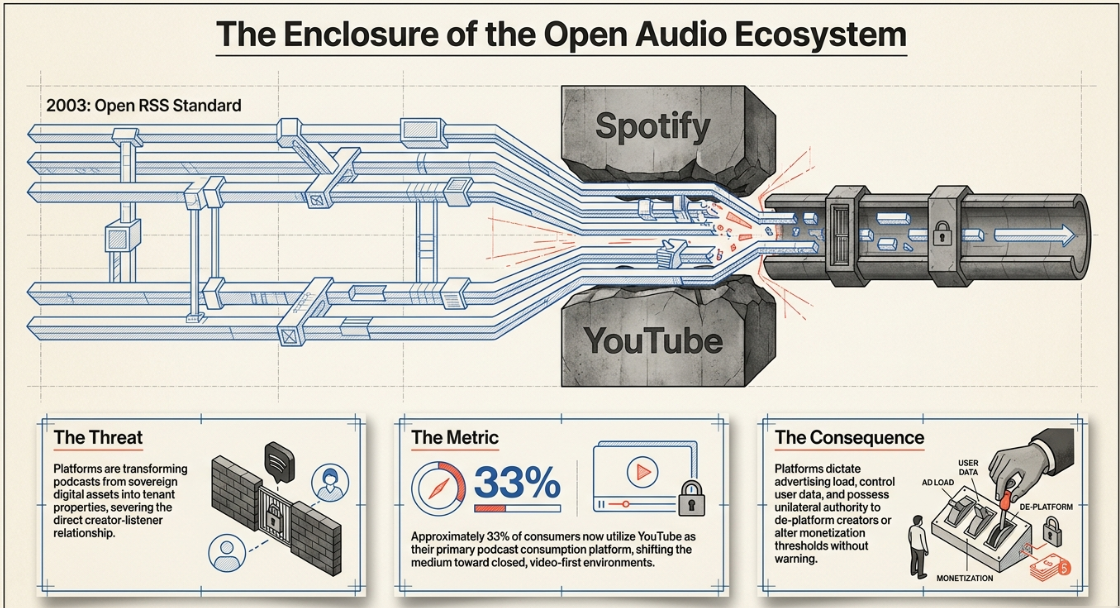
As podcasting audiences scaled, platforms like Spotify and YouTube recognized the lucrative potential of digital audio and began funneling content into proprietary environments. These entities seek to redefine what a podcast is, shifting the medium away from open RSS audio files toward closed APIs and video-first formats1. The strategic danger to independent creators is immense: closed platforms transform podcasts from sovereign digital assets into tenant properties.
Audience consumption habits are rapidly validating this shift. Approximately one-third of consumers now report utilizing YouTube as a primary podcast consumption platform2. While these platforms offer undeniable advantages in algorithmic reach and discoverability, they sever the direct relationship between the creator and the listener. The platform dictates the advertising load, controls the user data, and possesses the unilateral authority to de-platform creators or alter monetization thresholds without warning1.
The Podcast Standards Project and Industry Consensus
Recognizing the existential threat posed by these walled gardens, industry stakeholders have organized. In 2020, Adam Curry and Dave Jones launched the Podcast Index, an open, free, and censorship-resistant directory that serves as a direct alternative to Apple Podcasts' centralized database2. Operating on donations and providing a free API, the Podcast Index allows any developer to build a podcasting application without relying on the infrastructure of major tech conglomerates6.
This ethos culminated in the formation of the Podcast Standards Project (PSP), a grassroots coalition of hosting companies and listening applications dedicated to building and adopting open features14. During recent summits, such as the gathering at the London Podcast Show, over twenty industry representatives—including Amazon Music, Transistor, Captivate, and RSS.com—convened to coordinate the adoption of these features14. The guiding principle of the PSP is to "play the game on the field," ensuring that new standards reflect actual creator and listener behaviors rather than theoretical ideals, focusing on winnable battles that provide broad utility across the open web15.
Podcasting 2.0: Architecting the Open Namespace
The strategic cornerstone of Podcasting 2.0 is the Podcast Namespace. If the Podcast Index is the decentralized library of the ecosystem, the Podcast Namespace is its evolving language2. The namespace is an open-source set of tags designed to be fully backward compatible with traditional RSS feeds5. By injecting rich, interactive metadata directly into their feeds, creators can deliver experiences that rival proprietary applications2.
Core Namespace Capabilities for Marketing and Growth
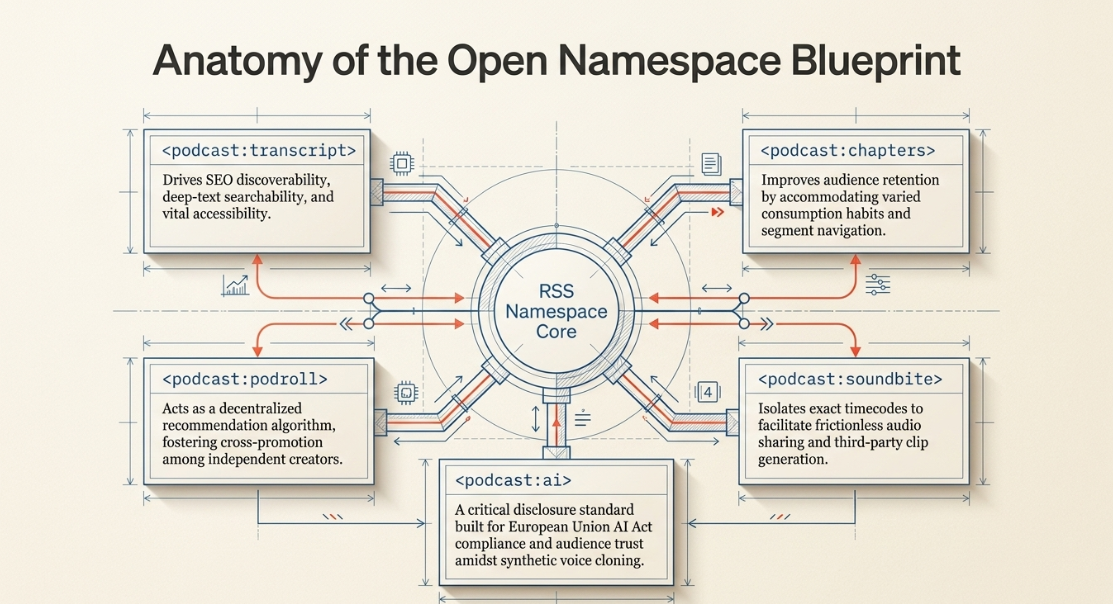
The adoption of specific namespace tags drastically improves accessibility, discoverability, and interactivity across the open ecosystem. These features provide a distinct marketing advantage for creators looking to elevate their content.
The adoption of these tags is rapidly accelerating. Major podcast hosts have integrated automated support for these features. Captivate, a prominent UK-based hosting platform acquired by Global, has positioned itself as a primary enabler of Podcasting 2.0, providing creators with tools to seamlessly import namespace tags, including unique identifiers and funding data, from previous hosts18. The platform integrates advanced features like the Audio Mastering and Integration Engine (AMIE) and free private podcasting, equipping independent creators with enterprise-grade technology to compete with major networks19.
Advanced Interactivity and Future Proposals
The namespace is continuously evolving through structured community phases. Current proposals being evaluated for Phase 6, 7, and 8 include sophisticated interactivity layers designed to further decentralize social mechanics. For instance, the proposed
Additionally, as generative Artificial Intelligence scales, the audio ecosystem faces a deluge of synthetic content. Industry metrics indicate that new AI-generated podcasts occasionally outnumber human-generated shows, raising concerns over unauthorized voice cloning23. To address this, the Podcast Standards Project has championed an AI disclosure standard. Integrating
Podping: Real-Time Content Distribution
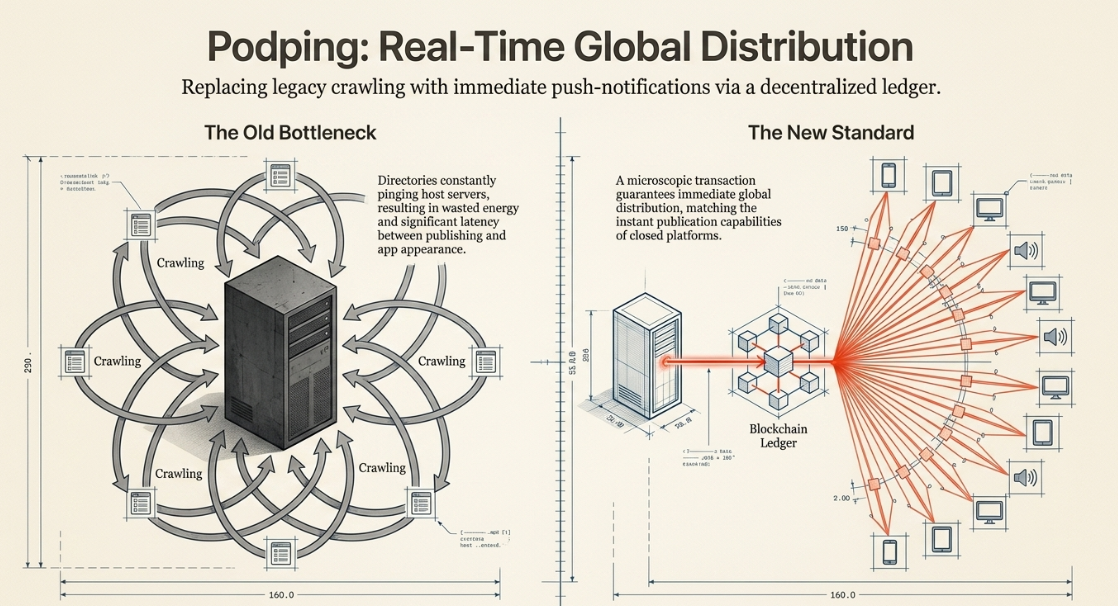
A historical bottleneck of the RSS standard is its reliance on "crawling." Directories must repeatedly ping hosting servers to check for new episodes, a highly inefficient process that results in significant delays between the moment a creator publishes an episode and when it appears in applications2.
Podcasting 2.0 rectifies this through Podping, an innovative push-notification system built upon blockchain technology2. When a creator publishes a new episode, the hosting provider sends a microscopic transaction to a decentralized ledger. Listening apps and directories monitor this ledger and receive instantaneous notifications that a feed has been updated2. This ensures immediate global distribution, eliminating traditional latency and providing an experience that matches the instant publication capabilities of closed platforms2.
The Economics of Digital Audio: Systemic Flaws in CPM Advertising
As the technological infrastructure of the open ecosystem evolves, so too does its underlying economic model. The prevailing monetization strategy in digital audio relies almost entirely on advertising, a system fraught with inefficiencies, exclusion, and misaligned incentives.
The Mechanics and Limitations of CPM
Podcast advertising is traditionally sold on a Cost Per Mille (CPM) basis, where advertisers pay a fixed rate per thousand impressions25. The valuation of a podcast impression depends heavily on formatting, placement, and audience demographic.
While CPM provides a standardized baseline for media buyers, it is fundamentally misaligned with the realities of decentralized digital audio. The core issue is that an RSS "download" is merely a proxy for an impression; traditional RSS cannot verify whether an audience member actually listened to the advertisement, how long they listened, or if they skipped the content entirely26.
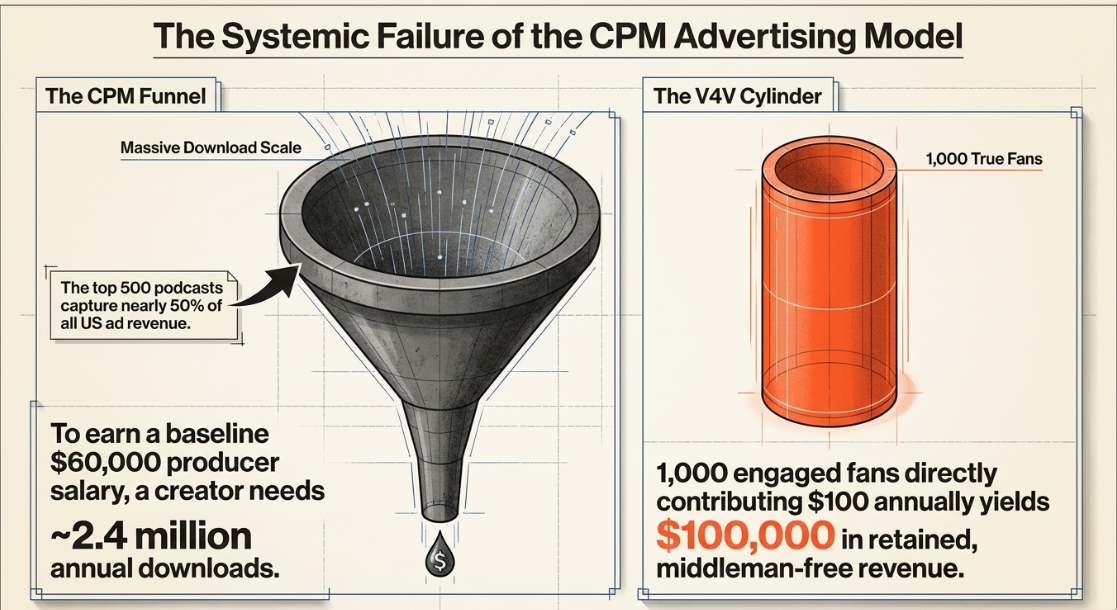
Furthermore, the CPM model inherently disenfranchises the vast majority of podcast creators. Because advertising deals require massive scale to generate meaningful revenue, the top 500 podcasts capture nearly half of all United States podcast advertising revenue, leaving the remaining 99.9% of the ecosystem struggling to monetize4. For example, to support a single entry-level producer's baseline salary of $60,000 using CPM-based ad revenue, a podcast must consistently generate approximately 2.4 million downloads annually26. Consequently, niche, localized, or highly specialized podcasts—which often possess incredibly loyal and engaged audiences—are entirely priced out of the traditional advertising market9.
The Illusion of Metrics and the Push for Subscriptions
The unreliability of the download metric has spurred a demand for more accurate consumption data. Platforms like TrueFans are pioneering advanced analytics by utilizing six-second streaming packets rather than raw downloads, providing creators with exact "listen time" metrics and filtering out bot activity29.
Simultaneously, creators with highly engaged audiences are turning to premium subscription models to bypass advertisers entirely. The financial potential of direct audience support is staggering when successfully executed. For example, the popular UK program The Rest is History commands 45,000 paid subscribers on Apple Podcasts alone. With 57% of those listeners on an annual plan of at least £60 (approximately $80 USD), the show generates an estimated annual subscription income of £2.7 million solely from its dedicated fanbase31. This illustrates the massive economic leverage of engaged communities over raw impression metrics.
The Value-for-Value (V4V) Revolution
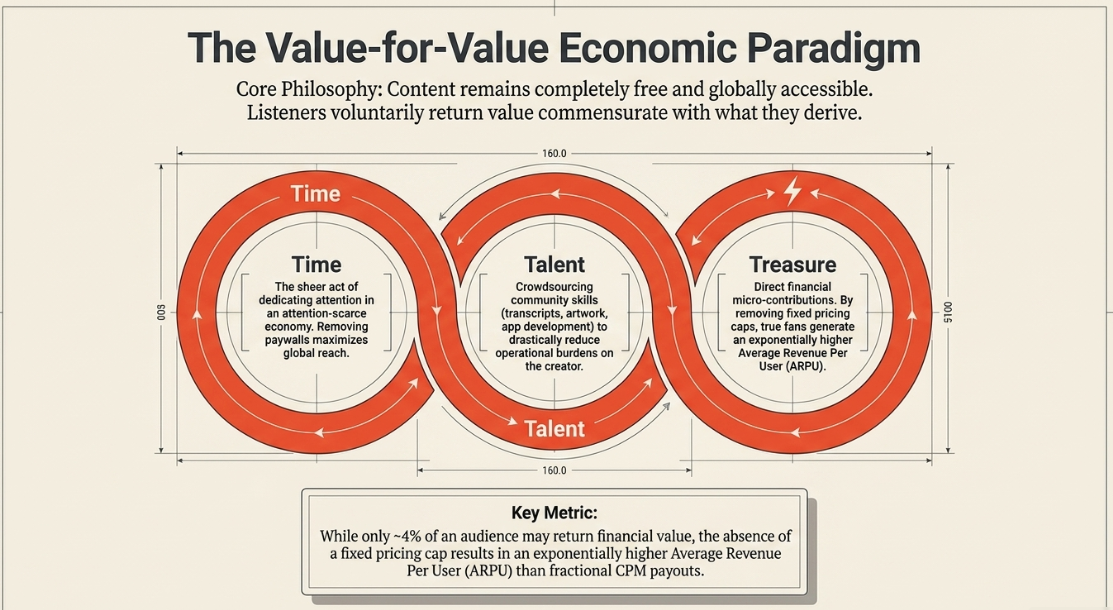
While traditional subscription models like Patreon or Apple Subscriptions require placing content behind restrictive paywalls, the Value-for-Value (V4V) model presents a radical departure8. V4V is rooted in a fundamental philosophy: content should remain completely free and globally accessible, and listeners voluntarily return value to the creator commensurate with the value they derived from the content8.
The Philosophy of Abundance: Time, Talent, and Treasure
The V4V model flips traditional monetization on its head, moving from a scarcity mindset to one of abundance11. This paradigm is elegantly summarized by the "Three Ts"11.
Time: The sheer act of dedicating attention to a piece of content is inherently valuable in an attention-scarce economy11.
Talent: Listeners can contribute by leveraging their skills—such as generating transcripts, designing artwork, organizing community meetups, or providing software development—which reduces the operational burden on the creator11.
Treasure: Direct financial contributions made seamlessly from the audience to the creator11.
By removing the paywall, creators maximize their potential reach and cultural impact. Industry data indicates that only an estimated 4% of an audience will actively return financial value33. However, the absence of a fixed pricing cap means that highly dedicated fans can contribute substantial amounts—frequently far exceeding the cost of a standard subscription—drastically increasing the Average Revenue Per User (ARPU) compared to fractional CPM payouts9.
The 1,000 True Fans Paradigm
The economic viability of V4V is heavily predicated on Kevin Kelly's seminal "1,000 True Fans" concept9. The theory posits that to make a viable, comfortable living directly from their craft, a creator does not need millions of passive listeners or mainstream stardom. Instead, they require a core base of approximately 1,000 "true fans"—diehard supporters who will reliably purchase or fund anything the creator produces9.
Mathematically, if a creator earns an average of $100 in direct profit from each of these 1,000 true fans annually, they secure a gross income of $100,0009. Because peer-to-peer digital networks allow creators to bypass middlemen and gatekeepers, the creator retains the entirety of this value9. The V4V model operationalizes this theory in real-time. By utilizing micro-transactions, a listener does not need to commit to a $100 upfront purchase; rather, they can stream small amounts of value continuously over the course of a year, effortlessly aggregating to meet or exceed the "true fan" threshold.
Technological Infrastructure of Programmable Money
The theoretical concept of voluntary contribution is not new, drawing historical parallels to street busking11. However, early digital iterations were hindered by the high transaction fees of traditional payment processors, which made transferring fractions of a dollar economically unviable36.
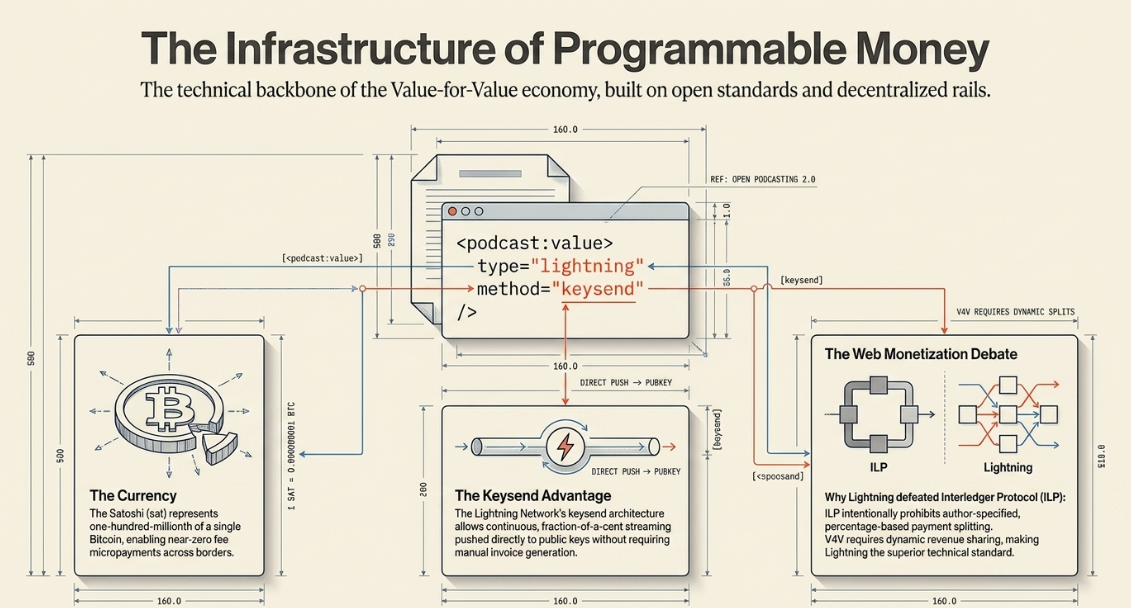
V4V solves this friction through the integration of the Bitcoin Lightning Network, a Layer-2 protocol capable of settling instant, borderless micropayments with near-zero fees8. The currency utilized is the Satoshi (sat), which represents one-hundred-millionth of a single Bitcoin (0.00000001 BTC)38.
XML Specifications and the Tag
This micro-transaction capability is injected directly into the RSS feed via the
The true innovation of the
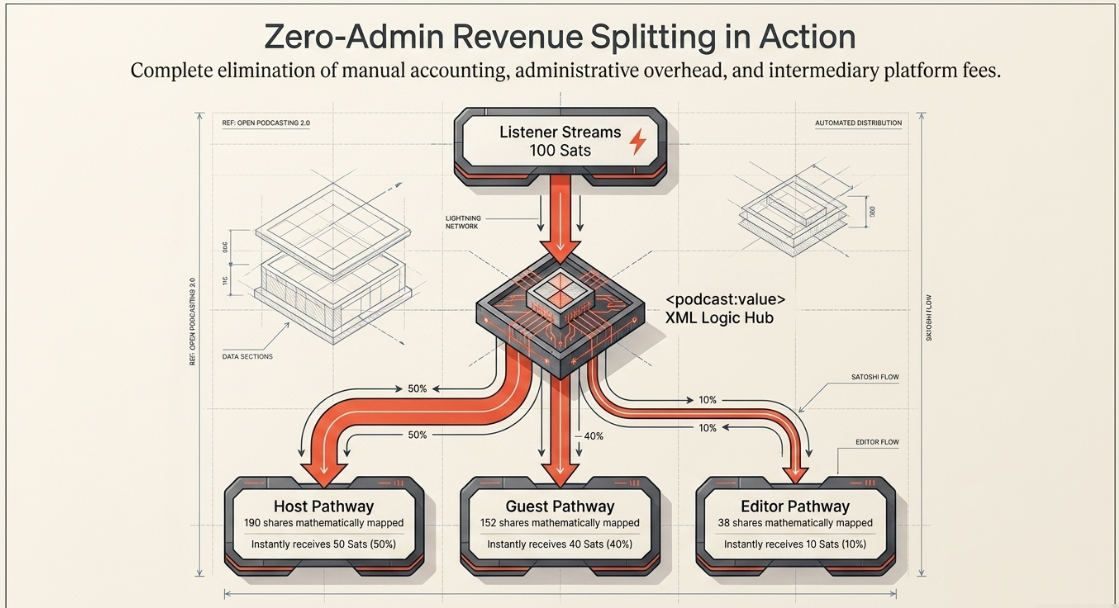
Creators can structure their XML to divide the total payment seamlessly. For example, if an episode features a primary host, a guest, and an audio editor, the creator defines the number of "shares" each recipient is entitled to within the RSS feed38. As defined by the namespace specifications, if an interval payout from a listener equals 100 sats, and the split is structured as 190 shares for the host, 152 shares for the guest, and 38 shares for the editor (totaling 380 shares), the network mathematically calculates the payout in real-time. The application processes the math (190/380 * 100), instantly routing 50 sats to the host, 40 sats to the guest, and 10 sats to the editor without any administrative overhead or manual accounting38.
This mechanism applies to derivative content as well. Through the
The Web Monetization Debate
While the Lightning Network has achieved dominant adoption within the Podcasting 2.0 ecosystem, debates regarding alternative payment protocols exist. Proponents of Web Monetization have argued for utilizing the Interledger Protocol (ILP) and Payment Pointers instead of Bitcoin. Developers have proposed alternative namespace tags, such as
However, integrating Web Monetization presents structural conflicts with the Podcasting 2.0 philosophy. The Web Monetization protocol intentionally prohibits author-specified, percentage-based payment splitting or suggested contribution amounts—design decisions deeply embedded within the ILP working group39. Because the V4V model relies heavily on the ability to split payments automatically among guests, hosts, and developers, the Lightning Network's highly flexible keysend architecture has remained the preferred standard39.
The Application Layer: Custody, Gamification, and Fiat Integration
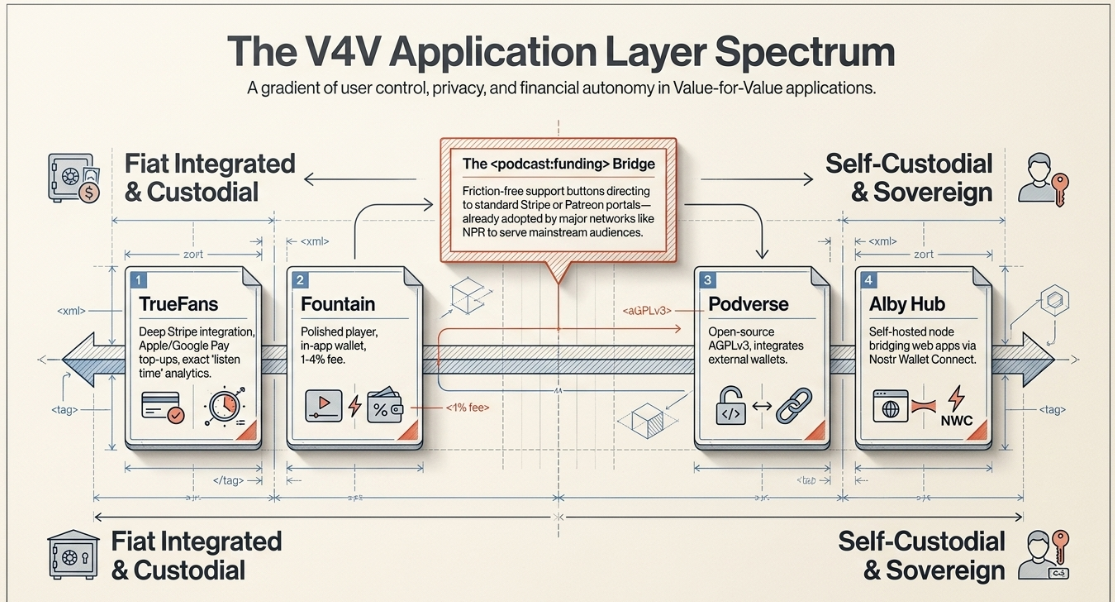
To facilitate V4V interactions, a new generation of Podcasting 2.0 applications has emerged, offering varying degrees of custodial control and user experience.
The Custodial Spectrum
Gamification and the Social Feedback Loop
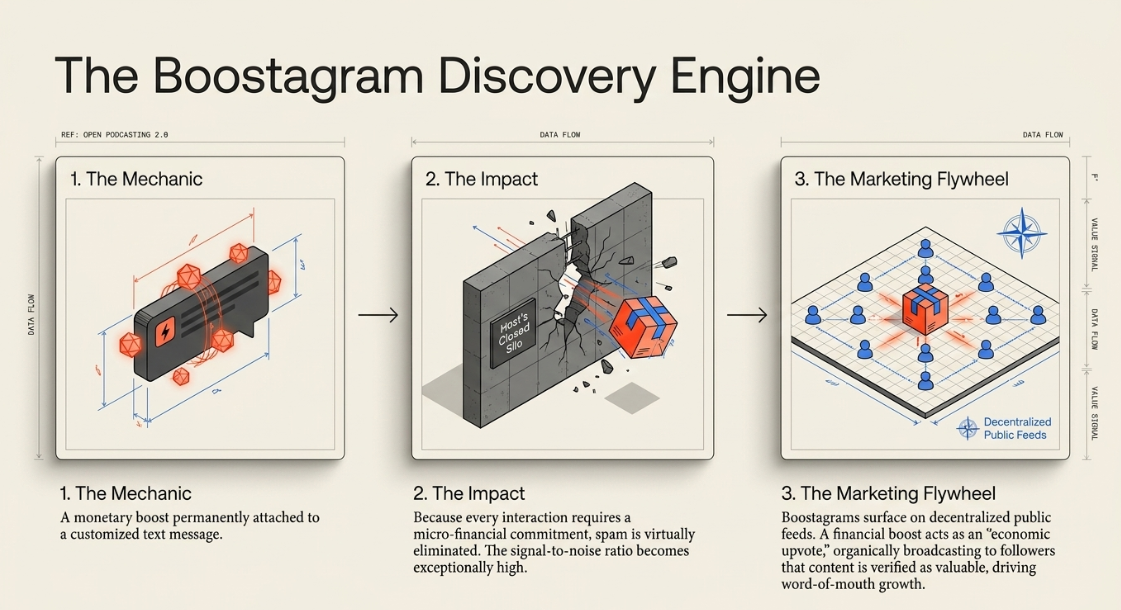
These applications fundamentally alter the creator-listener feedback loop9. A defining feature of V4V apps is the "Boostagram"—a monetary boost attached to a customized text message10.
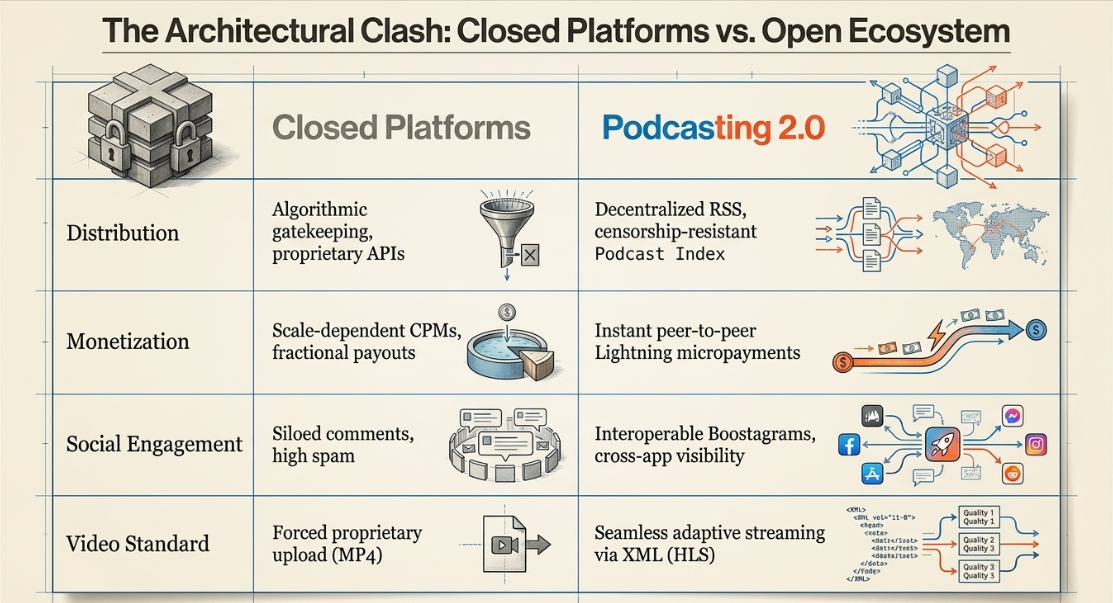
In traditional platforms, comment sections are frequently plagued by spam and low-effort engagement. Because a Boostagram requires a micro-financial commitment, spam is virtually eliminated, and the signal-to-noise ratio for creator feedback becomes exceptionally high11. On platforms like Fountain, these Boostagrams are surfaced on a social media-style feed, creating a highly effective discovery engine. When a user financially boosts a podcast, it signals to their followers that the content is highly valuable, organically expanding the creator's reach through economically verified word-of-mouth marketing9.
Bridging the Fiat Divide: The Funding Tag
Despite the efficiency of the Lightning Network, the psychological barrier of adopting cryptocurrency remains high for mainstream audiences. To circumvent this friction, the Podcasting 2.0 ecosystem has broadly adopted the
The funding tag places a simple, standardized link inside the RSS feed. Supportive podcast apps—such as Pocket Casts, Podcast Addict, and TrueFans—render this link as a prominent "Support" button within the player interface40. When a listener clicks the button, they are redirected to a traditional fiat payment portal, such as a Stripe checkout page, Patreon, or a PayPal link22.
This friction-free approach serves as a critical bridge. High-profile institutions like National Public Radio (NPR) have adopted the funding tag across all their shows40. The integration by major legacy networks signals to application developers that ecosystem giants like Apple will not penalize or delist apps for containing direct-funding mechanisms, encouraging broader adoption across the industry40.
Strategic Execution: Operationalizing V4V for Creators
Deploying the V4V model requires strategic shifts in both content delivery and marketing communication. Because the system relies entirely on voluntary exchange, the relationship between the creator and the audience must be deliberately cultivated9.
Mastering "The Ask" and Audience Psychology
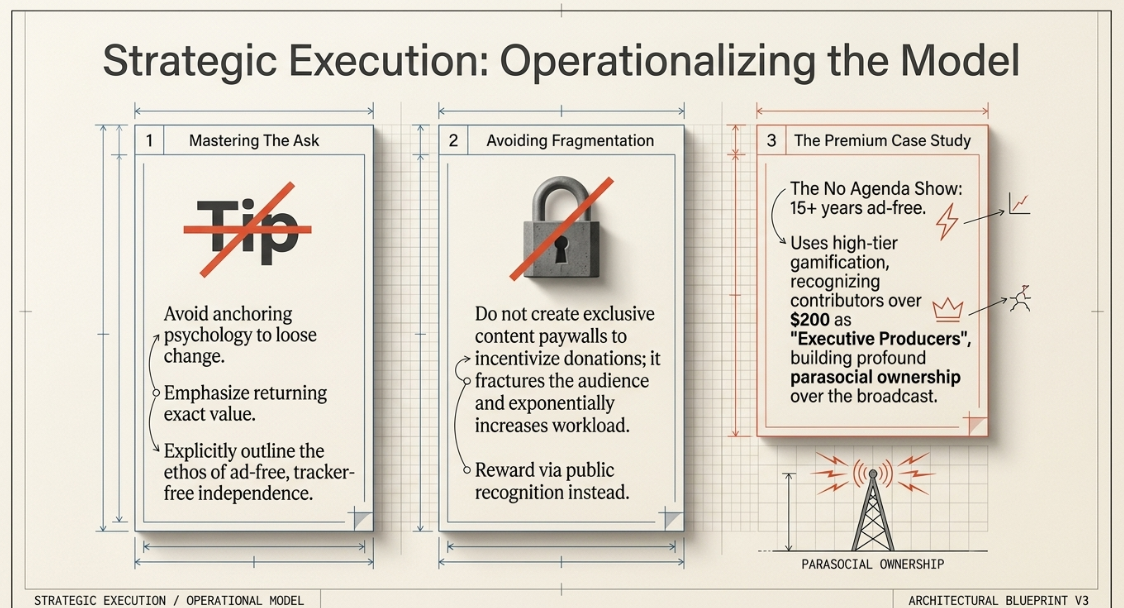
The primary barrier to V4V success is psychological9. Creators often experience discomfort when transitioning from passive advertising to actively requesting audience support, equating it to digital begging9. However, industry data indicates that "The Ask" is the single most critical component of the model; the primary reason audiences do not contribute is simply that they were not asked33.
Strategic communication is paramount. Creators must explicitly outline the V4V ethos to their audience, explaining that the show is deliberately kept free of intrusive advertising, programmatic trackers, and corporate influence34. Furthermore, vocabulary is critical. The term "tip" should be strictly avoided, as it anchors the audience's psychological benchmark to loose change; instead, creators must ask the audience to evaluate the specific "value" the show brings to their lives and return that value accordingly11.
Crucially, creators are advised against creating extra, exclusive content (paywalls) to incentivize donations, as this significantly increases workload and fragments the audience9. Instead, rewards should focus on public recognition. Reading Boostagrams on-air or recognizing top contributors fosters a deep sense of community and provides cost-free incentives for listener participation9. Support also manifests physically; podcasters David and Leila Medus of Fun Fact Friday highlight how audience members frequently expend time and financial resources to mail them curated physical gifts, underscoring the deep parasocial bonds forged through the V4V ethos34.
Case Studies in V4V Sustainability
The premier case study of V4V sustainability is the No Agenda show, hosted by Adam Curry and John C. Dvorak. Operating without traditional corporate advertisers for over 15 years, the show relies exclusively on direct audience contributions to maintain its editorial independence and dissect mainstream media narratives without fear of sponsor boycotts35. No Agenda utilizes gamification to encourage support; listeners who contribute above a specific financial threshold (often $200 or more) are formally recognized on the air as "Executive Producers" or "Associate Executive Producers," bestowing a sense of ownership upon the audience35.
While V4V provides pure independence, it can coexist alongside traditional models. For instance, Leo Laporte's TWiT (This Week in Tech) network initially thrived on listener donations before transitioning heavily into advertising, eventually grossing over $4.25 million annually42. The hybrid approach demonstrates that direct audience support can bootstrap a network until it achieves the scale necessary to command premium CPM rates, though purists argue this inevitably introduces corporate leverage9.
To further lower the barrier to entry, initiatives like PodGround offer micro-grants and structured resources to independent creators, aiming to reduce the high dropout rate (podfade) among new shows striving for sustainability in the open ecosystem30.
The Video Podcasting Battleground: HLS Integration
As consumer preferences shift toward visual mediums, video has become an undeniable force. Spotify has aggressively expanded its video podcasting capabilities, recently announcing the adoption of Apple's HTTP Live Streaming (HLS) protocol43. By integrating HLS through distribution partners like Megaphone and Libsyn, Spotify aims to streamline cross-platform distribution, incentivizing creators to upload video directly into its proprietary ecosystem43.
The transition to video poses a severe threat to open RSS. If video podcasting is surrendered entirely to YouTube and Spotify, creators will lose ownership of their distribution channels, becoming beholden to algorithmic whims and platform-specific monetization policies2.
The alternateEnclosure Audio-First Standard
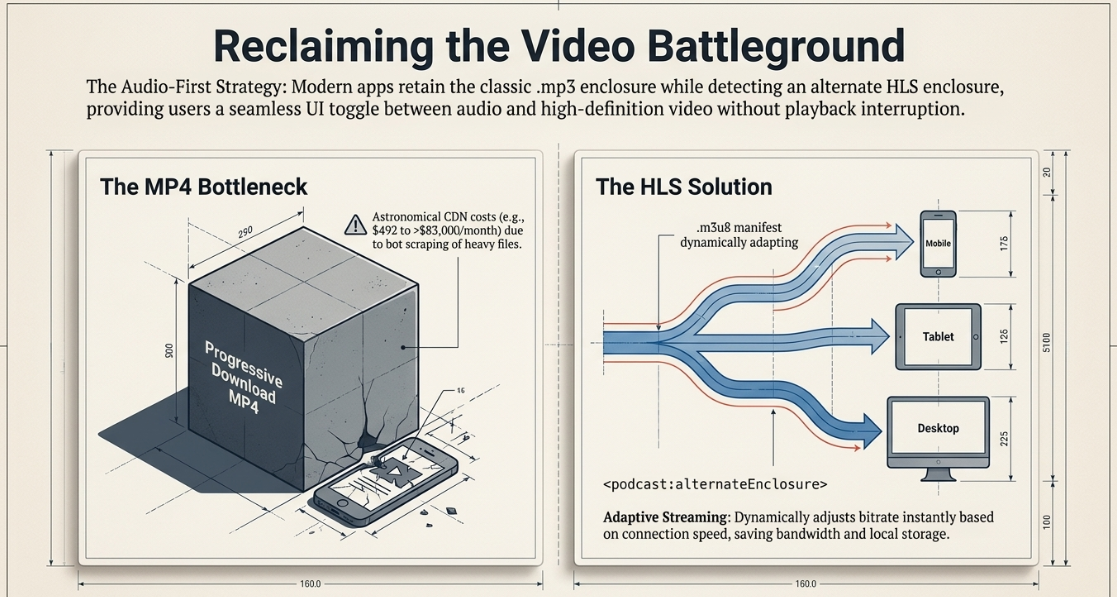
To counter this centralization, the Podcast Standards Project has championed the integration of high-quality video directly into open RSS feeds via the
The technological standard utilized is HTTP Live Streaming (HLS)14. Historically, integrating video into RSS required users to download massive MP4 files via progressive download, consuming vast amounts of device storage and bandwidth14. HLS circumvents this by breaking the video file into small, adaptive segments (typically 2 to 10 seconds in length), utilizing an .m3u8 playlist manifest14. The playback quality dynamically adjusts based on the user's real-time internet connection speed, eliminating buffering44.
Strategically, the alternateEnclosure approach is strictly "audio-first"14. A traditional audio .mp3 enclosure remains the primary asset in the XML feed, ensuring absolute backward compatibility with legacy podcast applications44. However, modern applications detect the HLS alternate enclosure and provide the listener with a seamless UI toggle14. An audience member can listen to the audio stream while walking, and upon returning home, seamlessly toggle to the high-definition video stream; the application pulls the exact timecode from the audio and continues playback visually without interruption14.
The Economics of Bandwidth and Server-Side Analytics
The implementation of HLS in open RSS is fraught with economic and operational friction. The primary obstacles are infrastructure costs and analytical tracking:
The Bandwidth and Bot Threat: Video files require exponentially more bandwidth than audio. Hosting providers face severe financial risks if automated bots or malicious scrapers repeatedly pull heavy HLS video manifests from their Content Delivery Networks (CDNs)14. As James Cridland highlighted, utilizing enterprise video infrastructure like Cloudflare Stream for a moderately successful show costs approximately $492 per month, whereas a massively scaled show like No Agenda would incur astronomical costs exceeding $83,000 per month40. To mitigate this, the PSP is actively developing a standard for securely signing video requests via cryptography, allowing hosting platforms to authenticate human traffic from verified applications and instantly block costly bot downloads14.
-
Tracking and Analytics: Measuring engagement on closed platforms like YouTube is straightforward due to client-side tracking APIs. In the decentralized RSS ecosystem, creators rely on server-side log analytics40. Tracking precise watch time, pauses, and visual engagement across a fragmented landscape of independent applications requires new standardized measurement protocols. The industry is currently coordinating with the Interactive Advertising Bureau (IAB) to establish robust server-side HLS analytics guidelines40.
Future Trajectories: AI, Social Interoperability, and Cross-Media Expansion
The intersection of Podcasting 2.0, the Value-for-Value economy, and open video standards signals a maturation of the decentralized internet. This architecture serves as a blueprint for the broader creator economy.
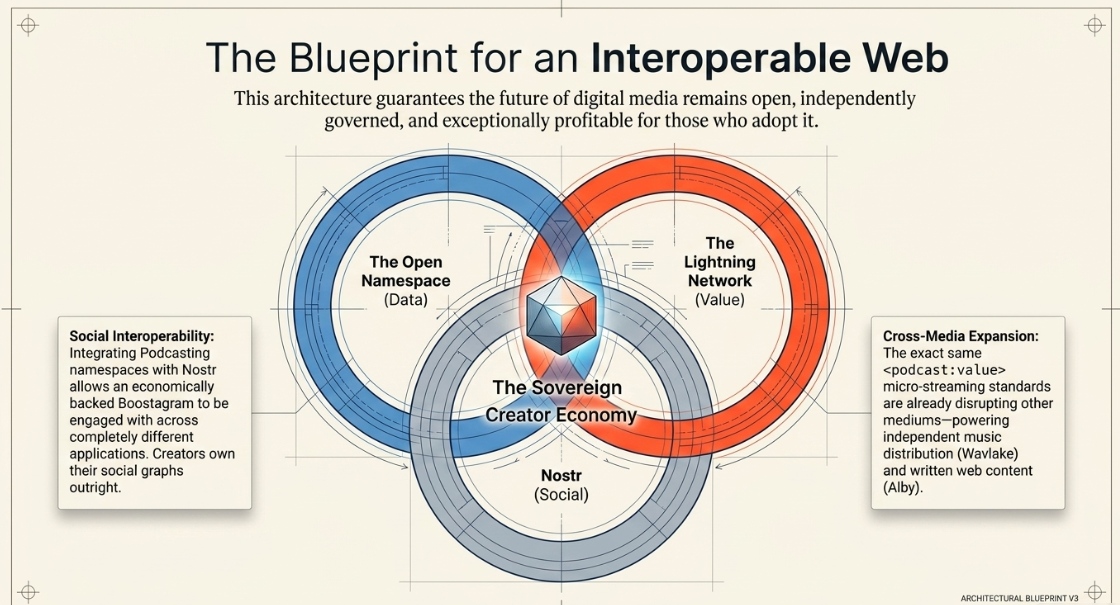
A critical frontier is cross-platform social interoperability. Historically, audience engagement has been siloed; a comment left on YouTube is invisible to a listener on Spotify. Through the integration of decentralized social protocols like Nostr (Notes and Other Stuff Transmitted by Relays), Podcasting 2.0 is dismantling these barriers10. Nostr utilizes decentralized relays to transmit data, natively supporting Lightning Network payments via Nostr Implementation Possibility 57 (NIP-57), commonly referred to as "Zaps"10.
By merging Podcasting 2.0 namespaces with Nostr architecture, applications like Fountain have evolved into full Nostr clients10. This convergence allows for true cross-app engagement. An economically backed Boostagram sent via Fountain can be viewed, engaged with, and "zapped" by a user interacting through a completely different interface, such as Podverse or an independent web client7. This outbox model prevents censorship and ensures that creators own their social graphs outright11.
Furthermore, the mechanics of the podcast:value tag are proving highly adaptable beyond spoken-word audio. Platforms such as Wavlake and Stablekraft are applying the exact same V4V streaming micropayment standards to independent music distribution, offering an ethical, high-yield alternative to algorithmic streaming giants10. Similarly, services like Alby are utilizing WebLN browser extensions to bring streaming micropayments to written web content, blogs, and open-source software repositories10.
Conclusion
The digital audio industry stands at a critical juncture between corporate enclosure and decentralized autonomy. While major tech platforms command massive distribution networks and frictionless user experiences, their business models inevitably demand total control over audience data, monetization terms, and content governance. For creators relying entirely on these centralized entities, the risk of demonetization, algorithmic suppression, and audience alienation remains a persistent threat.
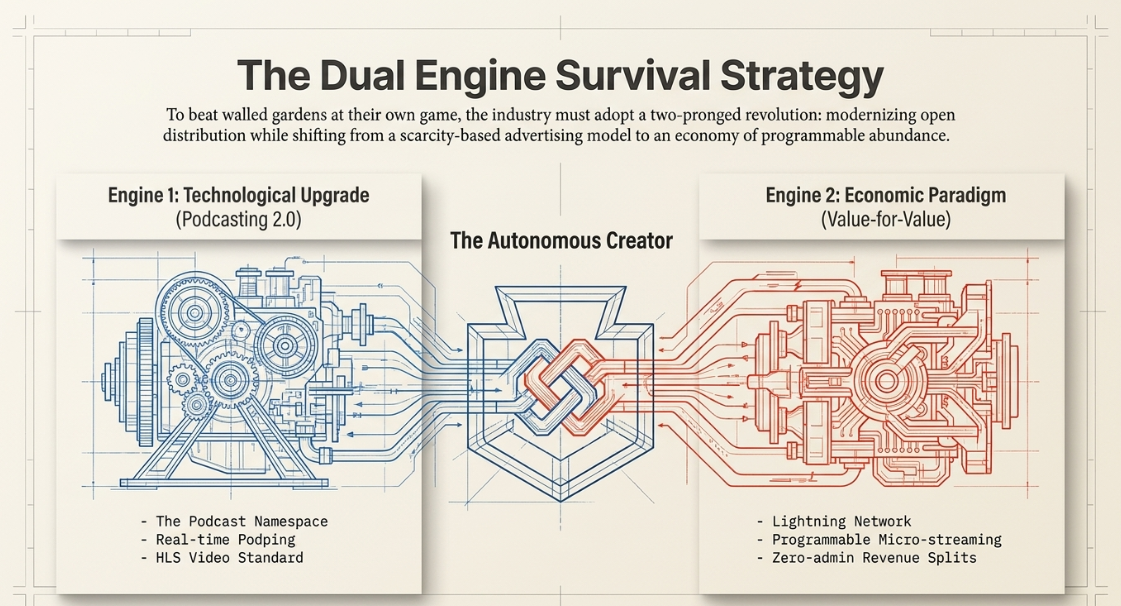
Podcasting 2.0 and the Value-for-Value revolution provide a technologically robust and economically viable alternative. By expanding the capabilities of the open RSS protocol to include interactive metadata, instantaneous blockchain notifications, and adaptive HLS video streaming, the open ecosystem now rivals the feature sets of the walled gardens. Simultaneously, the integration of the Bitcoin Lightning Network transforms the economic landscape, replacing the exclusionary, scale-dependent CPM advertising model with a highly efficient, equitable system of programmable micropayments.
For creators, hosting platforms, and application developers, embracing these open standards is not merely a philosophical stance; it is a strategic necessity for long-term sustainability. By cultivating direct, economically enabled relationships with their audiences based on the exchange of true value rather than passive impressions, creators can build resilient media operations. This paradigm ensures that the future of digital audio remains open, innovative, independently governed, and exceptionally profitable for those who master it.
Works cited
Uncategorized - Rob Greenlee, https://robgreenlee.com/category/uncategorized/
Podcasting 2.0: What it Means for Brands and Creators - CoHost, https://cohostpodcasting.com/resources/podcasting-2-0-what-it-means-for-brands-and-creators
Podcasting 2.0 Primer - PodcastVideos.com, https://www.podcastvideos.com/articles/podcasting-2-0-primer/
Introducing: Fountain for Podcasters, https://blog.fountain.fm/p/introducing-fountain-for-podcasters
Podcasting 2.0 Podcast Namespace introduction, https://podcasting2.org/docs/podcast-namespace
Podcasting Power Hour: The Future of Podcasting with Dave Jones of Podcasting 2.0 and The Podcast Index | Indie Podcaster, https://podcastfather.com/episode/podcasting-power-hour-the-future-of-podcasting-with-dave-jones-of-podcasting-20-and-the-podcast-index
An analysis of 200+ Podcast Episodes Discussing the Podcasting 2.0 standard - Pod Engine, https://www.podengine.ai/articles/podcasting-2-as-discussed-on-podcasts-in-2024
Value-for-value | RSS Blue, https://rssblue.com/help/v4v
What is Value for Value (V4V) podcast monetization, and should you do it? - Descript, https://www.descript.com/blog/article/what-is-value-for-value-v4v
Crypto Tipping Platforms: Creator Monetization Tools Compared | Spark, https://www.spark.money/tools/crypto-tipping-platform-comparison
Value For Value (V4V) Explained: A Revolution in Creator Monetization Through Bitcoin's Lightning Network - Flash, https://paywithflash.com/value-for-value-v4v-explained/
Podcasting 2.0 in Practice - Global Player, https://www.globalplayer.com/podcasts/42L23k/
School of Podcasting: Expert Tips for Launching and Growing Your Podcast — podcast episodes - Podnews, https://podnews.net/podcast/i448/episodes
Blog | Podcast Standards Project, https://podstandards.org/blog/
Podcast-Standards-Project/proposals: This repo is where we propose, discuss, and vote on the adoption of new features and standards. - GitHub, https://github.com/Podcast-Standards-Project/proposals
What podcasting 2.0 tags does Dovetail support? - PRX – Help Desk, https://help.prx.org/hc/en-us/articles/29885693847579-What-podcasting-2-0-tags-does-Dovetail-support
podcast-namespace/proposal-docs/sharedsoundbites.md at main - GitHub, https://github.com/Podcastindex-org/podcast-namespace/blob/main/proposal-docs/sharedsoundbites.md
Captivate Feature Releases & Changelog, https://help.captivate.fm/en/article/captivate-feature-releases-changelog-vq1h56/
Captivate & DAX US Launch Unified Monetization Suite for US Creators, https://www.captivate.fm/podcast-product-releases/captivate-updates/captivate-dax-us-launch-unified-monetization-suite
About Us - The Team Behind the Hosting Platform - Captivate.fm, https://www.captivate.fm/about-us
Captivate – The Best Buzzsprout Alternative [Updated 2021], https://www.captivate.fm/podcast-tools-software/reviews/buzzsprout-vs-captivate
Phase 7 - The Plan · Podcastindex-org podcast-namespace · Discussion #554 - GitHub, https://github.com/Podcastindex-org/podcast-namespace/discussions/554
The UK gets its first ever podcast ranker - Podnews, https://podnews.net/update/new-uk-podcast-ranker
New podcasts from AI now outnumber new podcasts from humans, https://weekly.podnews.net/1538779/episodes/19030224-new-podcasts-from-ai-now-outnumber-new-podcasts-from-humans
How to Maximize the Value of Every Podcast Impression - AdsWizz, https://www.adswizz.com/how-to-maximize-the-value-of-every-podcast-impression/
Why our system for valuing podcasts is broken - Current.org, https://current.org/2024/04/why-our-system-for-valuing-podcasts-is-broken/
Podcast Advertising Rates Explained - ADOPTER Media, https://adopter.media/podcast-advertising-rates-explained/
From Podcast Movement Evolutions: the Podnews Report Card and the Indian podcast market, https://weekly.podnews.net/1538779/episodes/14790784-from-podcast-movement-evolutions-the-podnews-report-card-and-the-indian-podcast-market
Sam Sethi: How To TrueFans.fm - The Sound Off Podcast, https://podcasts.apple.com/nl/podcast/sam-sethi-how-to-truefans-fm/id1123481444?i=1000761478179
Creators from TrueFans: Showcasing Independent Podcasting on Steno.fm, https://www.steno.fm/show/4bcbc84f-68c0-52ae-8e32-ca8199adc67c
Radio can learn from faith-based broadcasters | James Cridland, https://james.cridland.net/blog/2025/local-radio-future/
What is Value for Value? - Fountain ∙ FAQs, https://support.fountain.fm/article/55-what-is-value-for-value
V4V - A New Way to Think about Value, https://value4value.info/
Value for Value - Podcasting 2.0 in Practice, https://podcasting-2-in-practice.captivate.fm/episode/value-for-value
No Agenda - Wikipedia, https://en.wikipedia.org/wiki/No_Agenda
V4V | Joe Martin Music, https://www.joemartinmusic.com/v4v
What is Podcasting 2.0? - Fountain ∙ FAQs, https://support.fountain.fm/article/91-what-is-podcasting-2-0
podcast-namespace/docs/examples/value/value.md at main - GitHub, https://github.com/Podcastindex-org/podcast-namespace/blob/main/docs/examples/value/value.md
Podcast Video Is Complicated But We Can't Surrender It to YouTube - Podnews Weekly Review, https://weekly.podnews.net/1538779/episodes/17487983-podcast-video-is-complicated-but-we-can-t-surrender-it-to-youtube
Adam Curry - Grokipedia, https://grokipedia.com/page/Adam_Curry
I am Leo Laporte, Chief TWiT. AMA! : r/IAmA - Reddit, https://www.reddit.com/r/IAmA/comments/xh75q/i_am_leo_laporte_chief_twit_ama/
Spotify Adopts Apple HLS for Video Podcasts to Enable Cross-Platform Distribution, https://cord-cutters.gadgethacks.com/news/spotify-adopts-apple-hls-for-video-podcasts-to-enable-cross-platform-distribution/
Podcast-Standards-Project/hls-video: HLS video in alternateEnclosure spec - GitHub, https://github.com/Podcast-Standards-Project/hls-video
Nature's many attempts to evolve a Nostr - Hacker News, https://news.ycombinator.com/item?id=46225803
Soapbox Sessions, https://sessions.soapbox.pub/rss.xml
ChadFarrow/stablekraft-app - GitHub, https://github.com/ChadFarrow/stablekraft-app