The Maturation of the Global Audio Economy
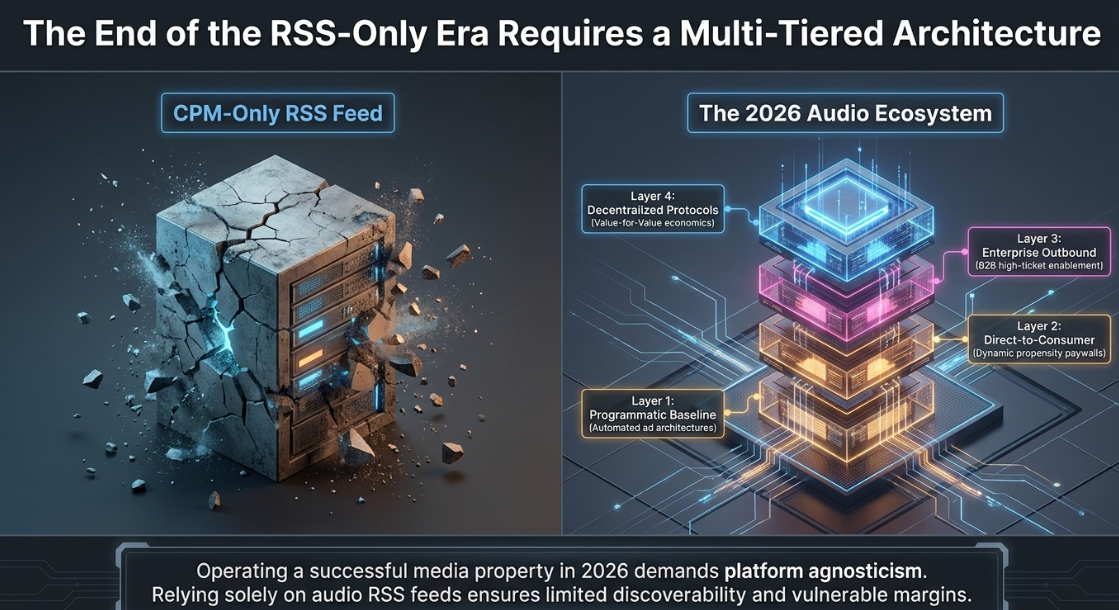
The global podcasting landscape of 2026 represents a highly structured, fiercely competitive digital media ecosystem. Having definitively transitioned from a decentralized, niche audio experiment powered by disparate Really Simple Syndication (RSS) feeds into a formidable commercial engine, the medium now commands the attention of approximately 672 million monthly listeners worldwide1. This unprecedented scale signifies the end of the era where Cost Per Mille (CPM) advertising served as the sole, or even the primary, mechanism for audio monetization. Today, building and sustaining a successful podcast ecosystem requires an intricate, multi-tiered architecture that spans algorithmic video discovery, programmatic ad yields, dynamic propensity paywalls, high-ticket Business-to-Business (B2B) account-based marketing, and decentralized micropayment protocols.
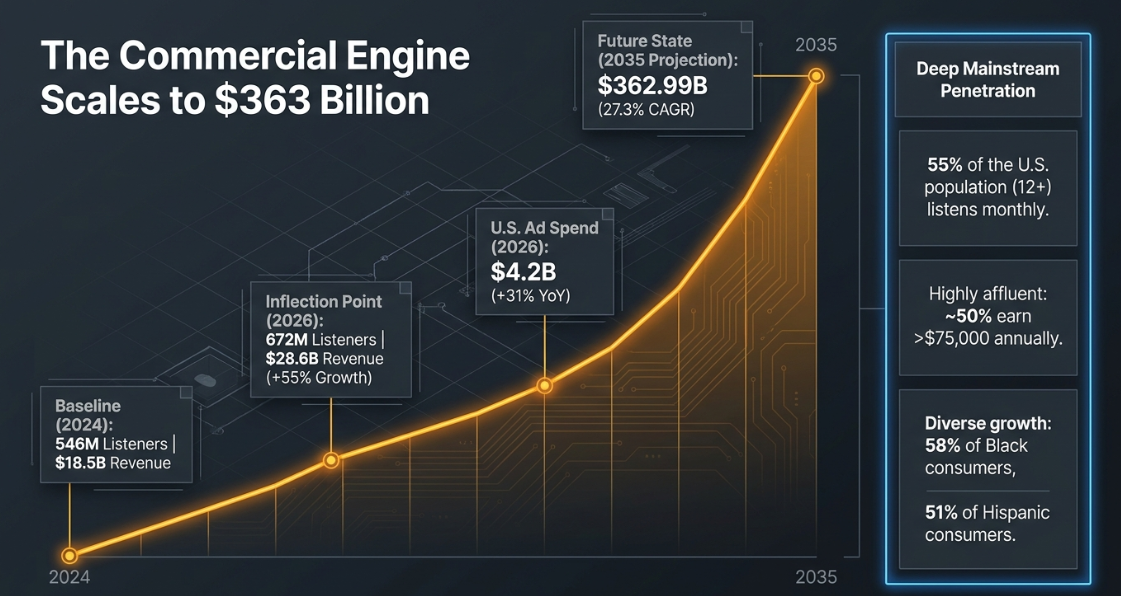
The macroeconomic indicators surrounding the podcast industry demonstrate sustained, aggressive expansion. The global podcasting market was valued at $32.48 billion in 2025 and is projected to reach an extraordinary $362.99 billion by 2035, growing at a compound annual growth rate (CAGR) of 27.3%1. This growth is heavily supported by massive institutional investments in advertising and subscription infrastructures. In the United States alone, podcast ad spending is projected to exceed $4.2 billion in 2026, marking a 31% year-over-year increase, while the broader UK digital ad market has surpassed £40.5 billion, with digital audio and retail media acting as critical catalysts for expansion2.
To comprehend the strategic necessities of the modern audio ecosystem, one must analyze the shifting demographics and behavioral patterns of the listener base. Podcasting has achieved deep mainstream penetration. In the United States, 55% of the population over the age of 12 now listens to a podcast on a monthly basis, with 70% having consumed a podcast at some point in their lives4.
These global metrics mask the nuanced behavioral shifts occurring within specific audience segments. The demographic profile of a podcast listener leans highly educated and affluent, with roughly half of listeners earning over $75,000 annually and a majority holding post-secondary degrees6. However, the medium is also successfully penetrating younger demographics and culturally diverse populations. For instance, multicultural audiences in the U.S. represent a vital growth sector; 58% of Black consumers and 51% of Hispanic consumers now listen to podcasts monthly, figures that have grown substantially since the beginning of the decade7. To monetize these audiences effectively, media strategists are abandoning broad-reach, homogenous ad campaigns in favor of highly localized, culturally resonant, and format-specific monetization models.
The End of the RSS-Only Era: The Video-First Paradigm
The single largest structural disruption to the podcasting ecosystem in recent years is the migration from audio-exclusive RSS distribution to video-first consumption. By 2026, the traditional duopoly of Apple Podcasts and Spotify has been aggressively challenged and, by some metrics, overtaken by YouTube8.
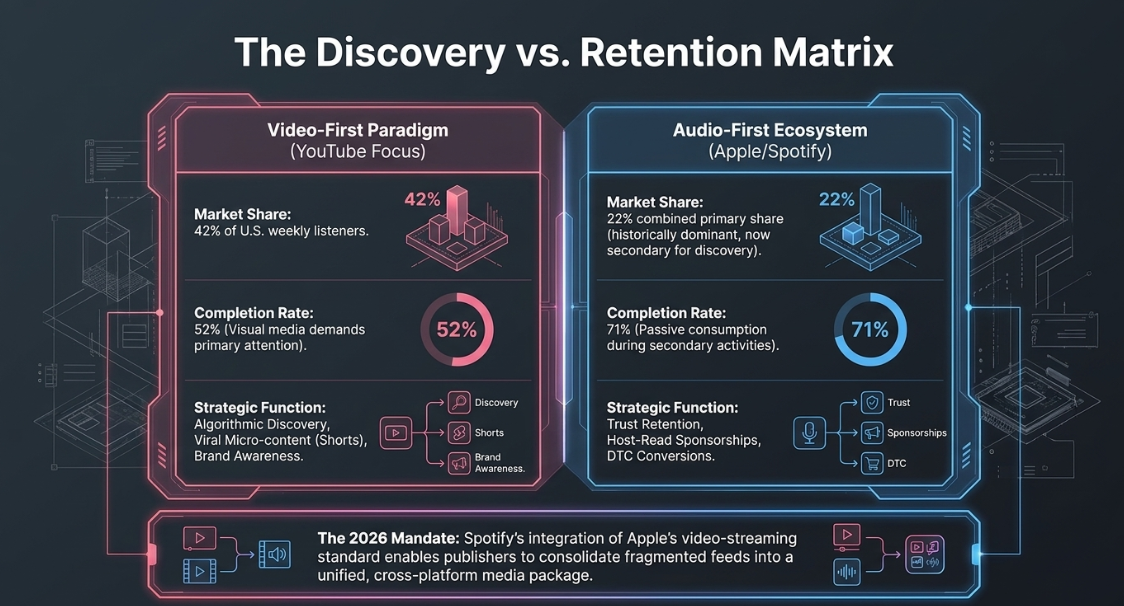
Data indicates that YouTube now serves as the most-used platform for podcast consumption in the United States, capturing 42% of the market share of weekly podcast consumers, significantly outpacing Spotify at 15% and Apple Podcasts at 7%4. This migration is not merely a platform preference but a fundamental shift in user behavior. As of late 2025, 53% of new weekly podcast listeners stated a distinct preference for watching a video podcast over listening to an audio-only feed4.
This transition severely alters production economics, discoverability, and monetization calculus. Audio, while historically boasting exceptional retention rates, suffers from a lack of viral discovery mechanisms. There is no native algorithmic feed in a standard RSS reader that pushes new audio to unsuspecting users. Video platforms, conversely, operate almost entirely on algorithmic recommendation engines. Therefore, top-performing podcasts are now produced "video-first," utilizing long-form YouTube episodes as the primary discovery engine and extracting micro-content (Shorts, Reels, TikToks) to feed top-of-funnel awareness8.
However, the behavioral economics of video and audio differ significantly. Audio listeners exhibit an astonishing 71% completion rate for episodes, as the medium is predominantly consumed during secondary activities such as driving, exercising, or performing household chores9. In contrast, video podcast viewers yield a lower completion rate of 52%, as visual media demands primary attention9. This discrepancy forces creators to adopt a bifurcated monetization strategy: leveraging video for massive reach, brand awareness ads, and visual product demonstrations, while utilizing the highly retentive audio feed for premium, high-converting host-read sponsorships and direct-to-consumer subscription conversions.
The industry's major technology providers have recognized this convergence and are rapidly dismantling the barriers between audio and video hosting. In a landmark development, Spotify integrated Apple's video-streaming standard into its Distribution API in 202610. This technical integration allows creators hosted on Spotify to seamlessly distribute and monetize their video podcasts on Apple Podcasts without needing to manage separate, fragmented feeds10. This platform agnosticism allows publishers to consolidate their video and audio metrics, presenting unified cross-platform packages to advertisers.
Optimizing the Baseline: Programmatic Architecture and Ad Load Management
While advanced monetization models are the focus of future-proofing, traditional advertising has not remained static. It has evolved into a highly automated, data-rich marketplace. Relying solely on direct-sold, baked-in sponsorships limits a publisher's ability to monetize back-catalog episodes and international audiences. Consequently, the adoption of True Dynamic Ad Insertion (TDAI) and programmatic audio buying has become the foundational baseline for any commercial audio ecosystem.
The Mechanics of Programmatic Audio
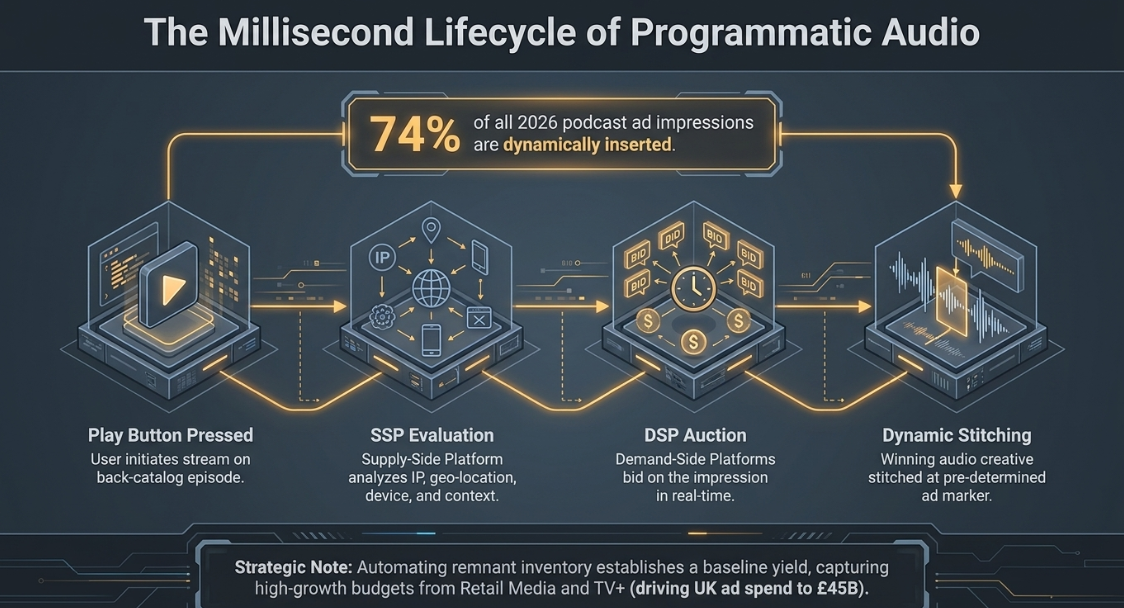
Programmatic advertising in podcasting utilizes algorithmic buying technology to automate the purchasing and placement of audio spots. This ecosystem relies on Supply-Side Platforms (SSPs), such as AdsWizz's AudioMax, which connect seamlessly to Demand-Side Platforms (DSPs)12. When a listener initiates a stream or download, the SSP evaluates the listener's IP address, device type, geographic location, and behavioral context. In milliseconds, it conducts an auction and dynamically stitches the winning audio creative into the podcast file at pre-determined ad markers12.
By 2026, programmatic dynamic ad insertion accounts for 74% of all podcast ad impressions, representing a paradigm shift from the static, permanent ad reads of the past2. This flexibility is highly attractive to advertisers, particularly within the fast-growing Retail Media and TV+ sectors, which are driving the UK digital ad spend toward a projected £45 billion by 202614. Programmatic allows a financial services brand, for instance, to target daytime listeners on business podcasts and seamlessly shift their budget to reach the same demographic on lifestyle podcasts during evening commutes12.
Ad Format Efficacy and Strategic Placement
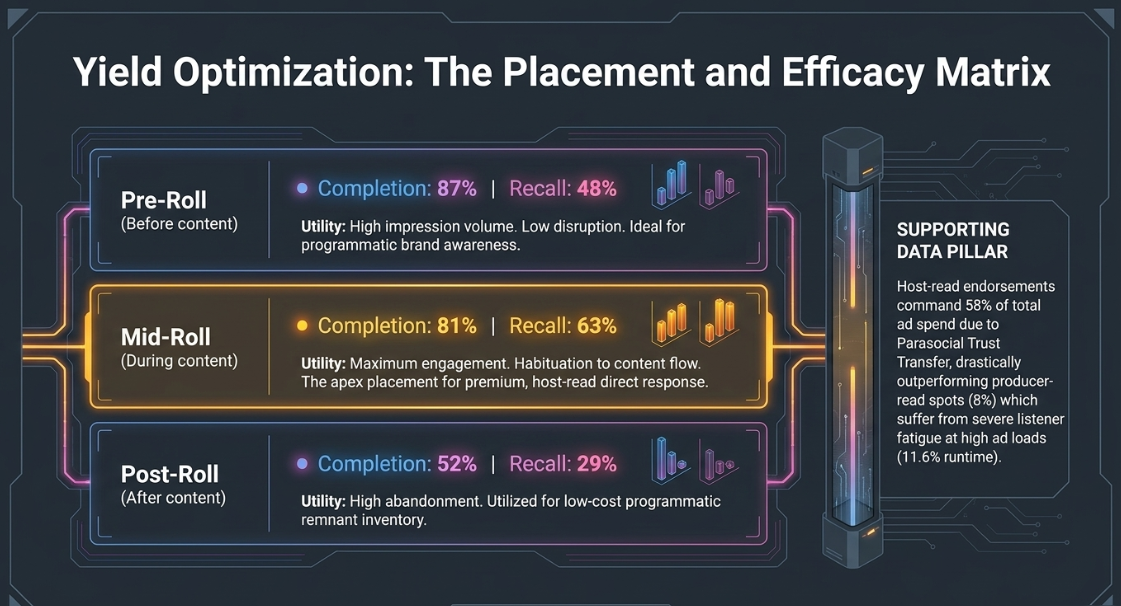
Despite the scale of programmatic systems, host-read endorsements remain the apex of podcast advertising. In 2026, host-read ads command 58% of total podcast ad spend, with programmatic dynamically inserted ads following at 29%, and producer-read announcer ads trailing at 8%9. The reason for this hierarchy lies in the psychological phenomenon of trust transfer. Listeners view podcast hosts as parasocial acquaintances; a recommendation from a trusted host carries the weight of a personal referral, mitigating the traditional skepticism directed at paid media13.
Data from 2026 reveals a significant conversion gap between formats. At high ad loads—which reached an average of 11.6% of total episode runtime in late 2025—host-read endorsements maintain their conversion rates, whereas generic producer-read spots suffer from severe listener fatigue and active skipping16. Furthermore, the placement of the advertisement within the episode architecture dramatically impacts both completion and recall.
Data reflecting ad performance metrics across major podcast platforms9.
Episode length also dictates ad tolerance. Episodes under 15 minutes boast a 76% completion rate, but offer limited inventory for mid-roll placement without annoying the listener. Conversely, episodes spanning 60 to 90 minutes see completion rates drop to 51%, but provide the vast, open canvas required for multiple mid-roll insertions, thereby maximizing Revenue Per Mille (RPM) for the creator9.
Publishers must balance yield optimization with listener retention. Advanced networks utilize a hybrid deal strategy: securing programmatic guaranteed contracts for baseline revenue, while reserving exclusive mid-roll inventory for high-CPM host-read campaigns12. This ensures that every impression is monetized without eroding the fundamental trust that makes the podcast valuable.
Direct-to-Consumer Monetization: The Subscription and Paywall Architecture
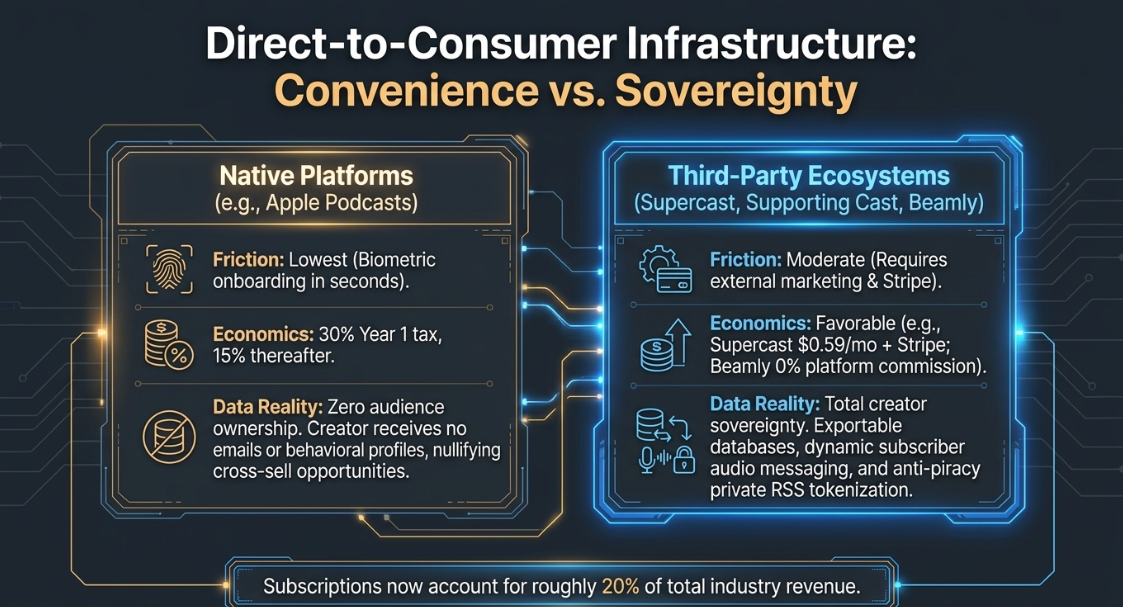
The inherent limitations of CPM-based advertising—namely, the requirement for massive scale and vulnerability to macroeconomic ad market contractions—have driven the industry toward Direct-to-Consumer (DTC) subscription models. Transforming passive listeners into recurring financial supporters allows creators to extract higher Lifetime Value (LTV) from smaller, highly dedicated audience segments. Subscriptions presently account for roughly 20% of the total podcasting market's revenue source17.
Native Platforms vs. Third-Party Ecosystems
The implementation of a podcast subscription requires selecting a technological infrastructure. The market is broadly divided between native listening platforms (which host the subscription directly within their app) and third-party membership platforms (which issue private RSS feeds to listeners).
Apple Podcasts Subscriptions exemplifies the native approach. It offers the lowest possible friction for user onboarding; an existing Apple user can subscribe using their biometric authentication in seconds18. However, this convenience extracts a heavy toll. Apple commands a 30% revenue share for the first year of a subscriber's lifecycle, reducing to 15% thereafter19. More critically, Apple enforces data exclusivity. The creator is completely isolated from their customer base, receiving no email addresses or behavioral profiles, thereby nullifying the ability to cross-sell merchandise, live event tickets, or higher-tier memberships21.
Consequently, professional media networks and independent creators heavily favor third-party platforms. Systems such as Supercast, Supporting Cast, Beamly, and Captivate allow creators to monetize their audiences on owned domains while delivering content securely to the user's podcast app of choice via tokenized private RSS feeds.
These third-party platforms prioritize creator sovereignty. They integrate seamlessly with Stripe, allowing the creator to receive direct payouts and export comprehensive subscriber databases21. To combat piracy, these platforms monitor the private RSS feeds; if a feed is accessed from dozens of distinct IP addresses simultaneously—indicating the link has been shared publicly—the system can automatically flag or revoke access18.
The Evolution of the Dynamic Propensity Paywall
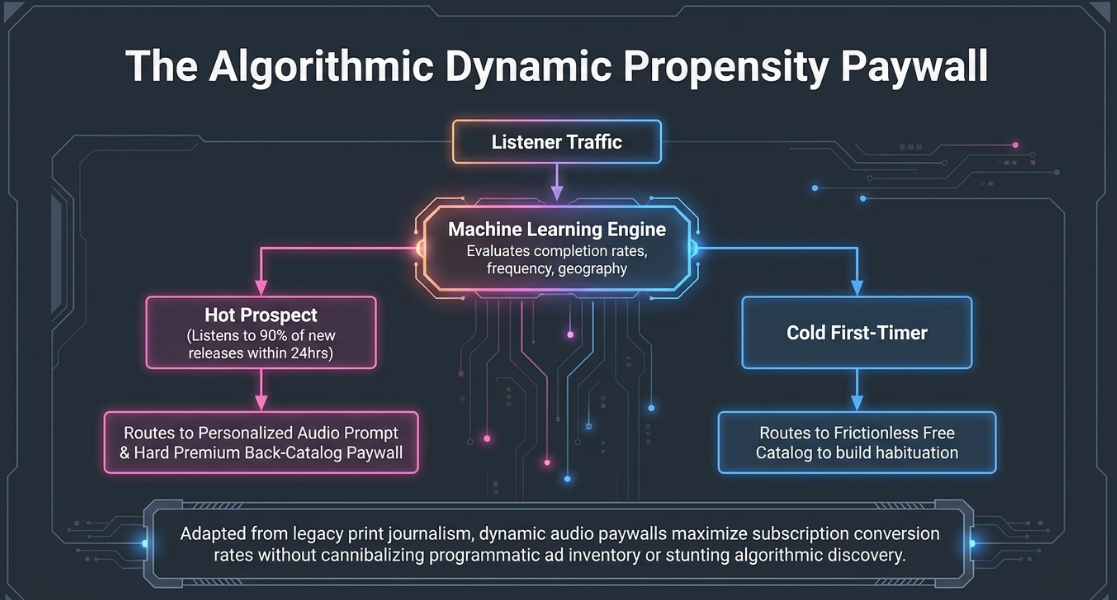
While hard paywalls (gating all content) and metered paywalls (allowing a set number of free episodes) are common, the most sophisticated publishers in 2026 utilize algorithmic dynamic paywalls. Adapted from text-based journalism (such as The Wall Street Journal), dynamic paywalls leverage machine learning algorithms to assess a user's likelihood to subscribe based on dozens of behavioral variables29.
In the audio ecosystem, a dynamic paywall analyzes listener completion rates, frequency of engagement, and geographic data. If the machine learning model identifies a "hot" prospect—a user who listens to 90% of every new release within 24 hours—the system dynamically inserts a personalized audio prompt urging a subscription, or restricts their access to premium back-catalog content30. Conversely, a "cold" first-time listener is granted frictionless access to the entire public catalog to build habituation. By altering restrictions based on propensity, publishers maximize their subscription conversion rates without artificially strangling top-of-funnel audience growth or cannibalizing their programmatic ad inventory30.
Bridging the Gap: Premium Video Subscriptions
Until recently, a major friction point in podcast subscriptions was the handling of video. Creators who wanted to offer premium, ad-free video content to paying subscribers had to build complex, web-based paywalls, forcing users out of their preferred listening apps. In 2026, this barrier fell. Utilizing Spotify's Distribution API, platforms like Supporting Cast became the first to deliver entitlement-gated, subscriber-only video directly into the Spotify app32. This breakthrough allows publishers to unify the premium user experience, offering a single subscription that unlocks both exclusive audio and high-fidelity video exactly where the audience is already congregating.
Building a Sustainable Brand Ecosystem: Case Studies in Audio Maturation
The shift from a standalone podcast to a comprehensive audio ecosystem requires strategic diversification. Several entities operating across different verticals demonstrate the successful execution of this mandate.
Goalhanger and the UK Market Consolidation
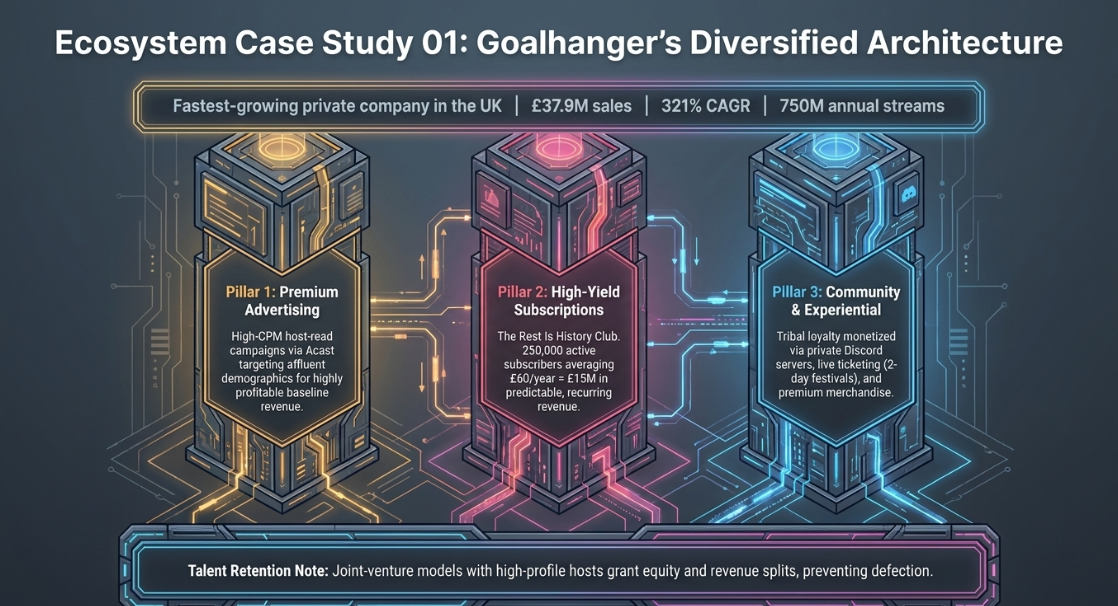
The UK podcasting market is intensely competitive, characterized by robust engagement and significant institutional backing. Within this environment, Goalhanger—co-founded by former footballer Gary Lineker—has emerged as a dominant force. In 2026, Goalhanger was recognized as the fastest-growing private company in the UK, generating £37.9 million in sales and achieving a 321% average annual growth rate over a three-year period33.
Goalhanger's success is predicated on building an ecosystem around high-passion subjects (history, politics, sports) and establishing a multifaceted revenue architecture. Their flagship shows, aggregated under "The Rest Is..." umbrella, generate over 750 million streams annually34.
The financial structure of Goalhanger is highly diversified:
Premium Advertising: The network utilizes Acast to fill premium ad inventory. Their affluent, engaged demographic commands top-tier CPMs for host-read campaigns, ensuring highly profitable baseline revenue36.
High-Yield Subscriptions: Through "The Rest Is History Club" and other show-specific memberships, Goalhanger converted over 250,000 listeners into paying subscribers. Averaging £60 per year, this membership base generates an estimated £15 million in recurring, predictable annual revenue34.
Community and Experiential Revenue: The ecosystem cultivates tribal loyalty. Goalhanger manages private Discord servers for its members, transforming passive listeners into an interactive community36. This digital loyalty is monetized in the physical world through massive live events, such as the two-day "The Rest Is History Festival," which drives revenue through ticketing, premium merchandise, and food and beverage sales36.
Furthermore, Goalhanger operates on a joint-venture model, offering their high-profile hosts equity and lucrative revenue splits. This aligns the incentives of the talent with the long-term growth of the media property, preventing host defection39.
Yoto: The Sustainable, Walled-Garden Audio Ecosystem
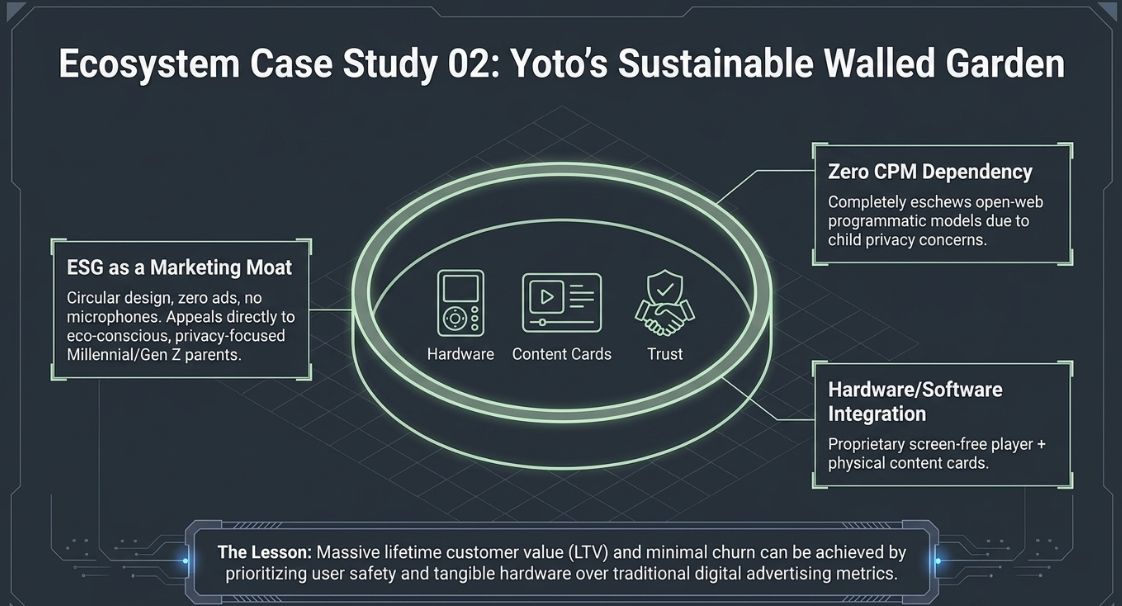
In stark contrast to the open-web ad models of Goalhanger, Yoto represents a highly specialized, sustainable audio ecosystem designed specifically for children. Operating in a sector fraught with data privacy concerns and algorithmic anxiety, Yoto eschews traditional CPM monetization entirely. Instead, they built a "walled-garden" ecosystem consisting of proprietary, screen-free hardware (the Yoto Player) and physical content cards40.
Yoto's strategic marketing is deeply intertwined with its product design and corporate mission. By enforcing a strict no-camera, no-microphone, and zero-ad environment, Yoto addresses parental anxiety, driving massive lifetime customer value and reducing churn through unparalleled brand trust40. Their ecosystem is built on Environmental, Social, and Governance (ESG) principles, incorporating circular design and sustainable packaging into their hardware, appealing directly to eco-conscious Millennial and Gen Z demographics40.
Rather than relying on programmatic ads, Yoto monetizes through hardware sales, an expansive library of licensed audio content, and a "creative play" model where parents can purchase blank cards to record their own audio. By aligning their marketing strategy entirely around safety, child-led discovery, and measurable sustainability KPIs, Yoto proves that an audio ecosystem can thrive by prioritizing user trust and hardware-software integration over traditional advertising40.
B2B Podcast Marketing: High-Ticket Outbound and Sales Enablement
While consumer-facing networks scale via volume and micro-transactions, Business-to-Business (B2B) organizations deploy podcasts with fundamentally different objectives. For B2B firms selling complex SaaS solutions, enterprise consulting, or high-ticket services where average contract values (ACVs) range from five to six figures, mass audience reach is irrelevant. The podcast is not the product; it is a strategic relationship engine and a powerful sales enablement tool41.
Account-Based Marketing (ABM) and the "Dream 200"
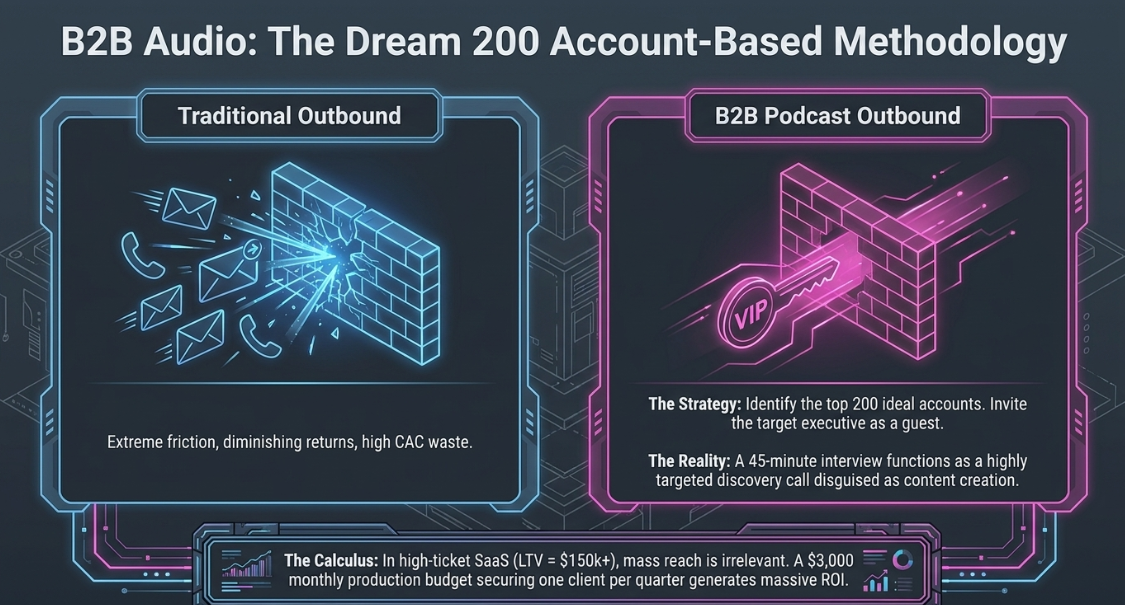
In high-ticket B2B environments, sales cycles span weeks or months and require navigating complex buying committees consisting of multiple stakeholders42. Traditional cold outbound marketing (emails, cold calls) faces extreme friction and diminishing returns. A strategic B2B podcast circumvents this resistance by deploying the "Dream 200" methodology41.
A firm identifies its top 200 ideal accounts—the specific companies and decision-makers they wish to convert into clients. Rather than sending a generic sales pitch, the firm invites the target executive to feature as a guest on their industry podcast. This approach leverages ego-flattery and the psychological principle of reciprocity. A 45-minute podcast interview essentially functions as a highly targeted, relationship-building discovery call disguised as content creation41.
The financial calculus of this strategy is highly favorable. If an enterprise software company holds a Customer Lifetime Value (LTV) of $150,000, traditional advertising channels often result in an inefficient Customer Acquisition Cost (CAC) due to broad targeting waste. However, a podcast operating on a $3,000 monthly production budget that secures just one high-ticket client per quarter generates massive ROI. The podcast serves as an outbound sales cadence that simultaneously produces marketing collateral44.
Content Repurposing and Digital Sales Rooms (DSRs)
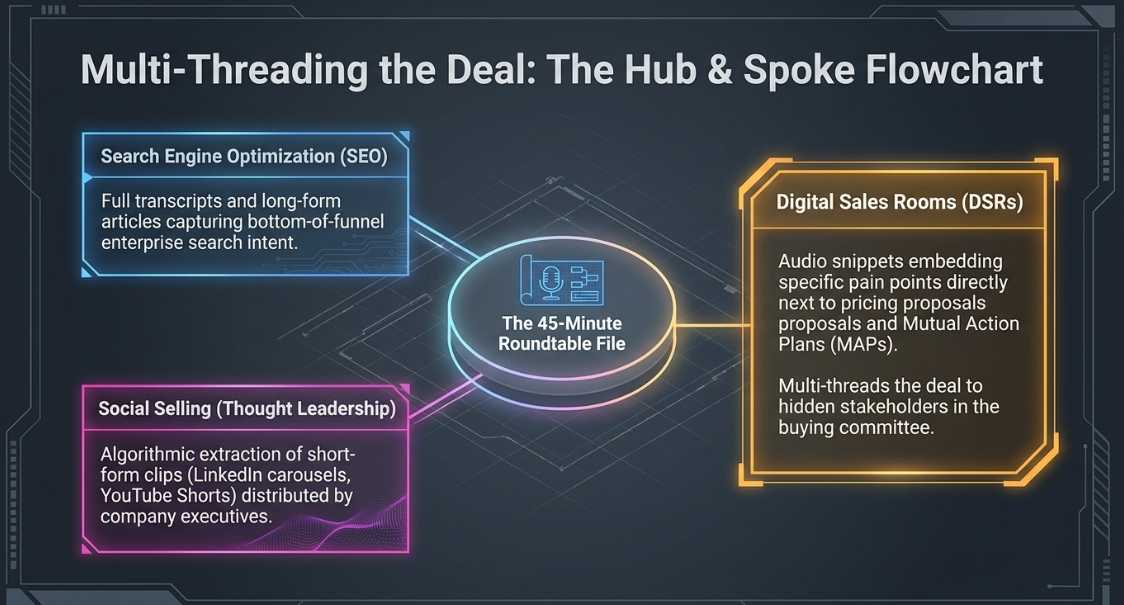
The modern B2B audio ecosystem relies on a "hub-and-spoke" model of content distribution. A single podcast episode—perhaps a roundtable featuring diverse industry experts discussing niche challenges—acts as the central hub. This audio is transcribed and algorithmically repurposed into multiple assets44.
These derivative assets are deployed across specific channels:
Search Engine Optimization (SEO): Full transcripts and long-form articles capture bottom-of-funnel search intent46.
Social Selling: Short-form video clips (LinkedIn carousels, YouTube Shorts) are distributed by the company's executives to build thought leadership authority46.
Sales Enablement: Audio snippets discussing specific pain points are embedded into Digital Sales Rooms (DSRs). DSRs are shared portals where account executives and buyers collaborate. By placing highly relevant podcast clips alongside pricing proposals and Mutual Action Plans (MAPs), sellers can multi-thread the deal, engaging hidden stakeholders within the buying committee who would otherwise ignore a text-heavy email42.
Furthermore, B2B podcasts present lucrative sponsorship opportunities. A highly niche podcast focusing on enterprise cybersecurity may only possess 5,000 listeners, but if those listeners are predominantly Chief Information Security Officers (CISOs), the show can command extraordinary CPMs. B2B software vendors willingly pay $50 to $100 per thousand listeners for host-read ads to access this concentrated, high-net-worth demographic, recognizing that trust transfer from the host to the sponsor drastically accelerates the sales cycle47.
Decentralization and Podcasting 2.0: Value-for-Value Economics
While corporate networks construct sophisticated subscription paywalls and B2B firms leverage high-ticket outbound funnels, a powerful technological counter-movement is redefining podcast monetization at the foundational protocol level. Termed "Podcasting 2.0," this open-source initiative aims to decentralize the audio ecosystem, protecting it from monopolistic platform capture while introducing revolutionary, frictionless monetization standards49.
The Podcast Namespace and RSS Enhancements
The architecture of Podcasting 2.0 relies on expanding the traditional RSS XML feed with a new "namespace"—a suite of standardized tags that enable advanced functionality across compliant podcast applications (such as Fountain, Podcast Guru, and Pocket Casts)52. Initiated by the Podcast Index, these tags modernize the feed format beyond simple audio enclosures50.
Key namespace enhancements include:
: Enables dynamic, closed-caption transcripts for accessibility and SEO. : Allows for visual, independently editable chapter markers within the audio file. : Standardizes credits for hosts, guests, and audio engineers. : Embeds precise geographic data (geo-coordinates) to indicate where the podcast is recorded or what region it discusses 54.
Furthermore, Podcasting 2.0 addresses the latency issues inherent in traditional RSS polling. Historically, platforms like Apple Podcasts would arbitrarily "crawl" feeds, resulting in hours of delay between a creator publishing an episode and it appearing in the directory. To resolve this, the initiative developed "Podping," a system utilizing blockchain technology to instantly broadcast a notification to all directories the moment a feed is updated, ensuring real-time global synchronization50.
Value-for-Value (V4V) and the Tag
The most financially disruptive innovation within Podcasting 2.0 is the
The V4V philosophy asserts that content should be free of paywalls and corporate surveillance advertising. Instead, listeners voluntarily return value to the creator commensurate with the value they receive, often categorized as "Time, Talent, or Treasure"52. At a technical level, V4V utilizes the Bitcoin Lightning Network to facilitate instantaneous, near-zero-fee microtransactions.
When a podcaster configures the
Automated Revenue Splits and Ecosystem Sustainability
The V4V protocol introduces unprecedented financial transparency and automated revenue sharing. Using the
Pioneered by podcasting inventor Adam Curry and John C. Dvorak on the No Agenda show, V4V has proven capable of sustaining massive audiences without a single corporate advertisement. Through their "producer" model, listeners donate significant sums—often hundreds of dollars per episode—in exchange for executive producer credits and community recognition57.
While V4V currently represents a fraction of the total podcasting economy (utilized by fewer than 5% of active podcasts), its adoption is accelerating58. It effectively un-caps the earning potential of niche shows that fail to meet the minimum download thresholds required by traditional ad networks. By transforming monetization from a commoditized CPM transaction into a direct, decentralized measure of audience fanaticism, V4V offers a viable, ad-free alternative for the future of independent media57.
Conclusion: Strategic Architecture for 2026 and Beyond
The global podcasting industry has evolved into a sophisticated, highly capitalized media sector. The transition beyond traditional CPM advertising is no longer an experimental pursuit; it is a structural mandate for survival and growth. As total listenership nears 700 million and global ad spend shatters previous projections, the intrinsic value of podcasting remains rooted in its unparalleled intimacy and high retention rates. However, the mechanisms utilized to capture that value require rigorous optimization.
To build and sustain a successful audio ecosystem in this mature phase, publishers and brands must adopt a diversified architectural blueprint:
Embrace Platform Agnosticism and Video: Treat the podcast as a unified multimedia brand. Produce video-first content to exploit YouTube's algorithmic discovery engines, while aggressively utilizing advanced RSS distribution APIs to saturate the highly retentive audio market.
Optimize the Ad Stack: Establish a baseline of passive revenue using Supply-Side Platforms for programmatic dynamic ad insertion. However, fiercely protect premium mid-roll inventory for high-CPM, host-read endorsements, which preserve brand trust and drive superior conversion rates regardless of overall ad load.
Construct Owned DTC Communities: Migrate the most engaged subset of the audience from rented platforms to owned infrastructure. Utilize third-party membership platforms (like Supercast or Supporting Cast) to deploy dynamic propensity paywalls, process payments directly via Stripe, and retain total control over subscriber data and private RSS feeds.
Leverage B2B Outbound Methodologies: For enterprise brands, abandon the pursuit of raw download metrics. Utilize the podcast as a high-ticket relationship engine, inviting the "Dream 200" accounts to participate in roundtable discussions, thereby bypassing sales friction and generating multi-threaded collateral for Digital Sales Rooms.
Integrate Podcasting 2.0 Protocols: Future-proof the technical infrastructure by incorporating the new RSS namespace tags. Enable Value-for-Value microtransactions to capture the long-tail of audience goodwill, providing an uncapped, decentralized revenue stream insulated from advertising market fluctuations.
Ultimately, the future of the audio economy belongs to those who view a podcast not as a standalone audio file, but as the central hub of a dynamic, interconnected ecosystem. By mastering the technological convergence of programmatic audio, dynamic subscriptions, high-ticket sales enablement, and decentralized payment protocols, creators and brands can forge deep, monetizable relationships that endure long after the audio stops playing.
Works cited
97 Future-Shaping Podcast Industry Stats & Trends (2026) [Infographic], https://www.learningrevolution.net/podcast-stats/
Podcast Statistics 2026 | 80+ Facts & Data Points - Searchlab, https://searchlab.nl/en/statistics/podcast-statistics-2026
Digital Adspend 2025: UK's digital ad market reaches £40.5bn | IAB UK, https://www.iabuk.com/news-article/digital-adspend-2025-uks-digital-ad-market-reaches-ps405bn
Podcast Statistics You Need To Know in 2026 - Backlinko, https://backlinko.com/podcast-stats
Podcast statistics & trends in 2026 - Beamly - The Podcast Website Builder, https://beamly.com/podcast-statistics/
Investing in the Podcast Ecosystem in 2019 | Andreessen Horowitz, https://a16z.com/investing-in-the-podcast-ecosystem-in-2019/
The Top Podcast Advertising Trends to Listen for in 2026 - SiriusXM Media, https://www.siriusxmmedia.com/insights/the-top-podcast-advertising-trends-to-listen-for
Podcast Trends Shaping Sponsorships in 2026 | ThoughtLeaders Blog, https://www.thoughtleaders.io/blog/podcast-trends-2026
Podcast Statistics 2026: 130+ Advertising Data Points - Digital Applied, https://www.digitalapplied.com/blog/podcast-statistics-2026-advertising-data
Spotify to Adopt Apple's Video Streaming Standard, Unifying Podcast Distribution for Creators - Final Results, https://pointyc.org/expert-time/Spotify-to-Adopt-Apples-Video-Streaming-Standard-Unifying-Podcast-Distribution-for-Creators-15-787
Expanding our video ecosystem with new partners and supported platforms - Spotify for Creators, https://creators.spotify.com/resources/news/expanding-video-partners-and-platforms
Scaling Podcast Revenue With Smarter Programmatic Strategies - AdsWizz, https://www.adswizz.com/scaling-podcast-revenue-with-smarter-programmatic-strategies/
Driving Growth With Digital Audio - Triton Ebook, https://tritondigital.com/static/151a51123ce6e0d754d0bdbe7abbecf3/Driving-Growth-With-Digital-Audio---Triton-Ebook.pdf
Retail Media and TV+ take centre stage as UK ad spend forecast to hit £45 billion by 2026, https://www.iabuk.com/news-article/retail-media-and-tv-take-centre-stage-uk-ad-spend-forecast-hit-ps45-billion-2026
Podcast Sponsorship for Creators & Influencers, https://sponsorshipcollective.com/industries/podcast-and-influencer-sponsorship/
Smaller Brands See Bigger Lift - ADOPTER Media, https://adopter.media/smaller-brands-podcast-advertising-lift/
Podcasting Market Size to Hit USD 115.57 Billion by 2035 - Precedence Research, https://www.precedenceresearch.com/podcasting-market
SupportingCast | The podcast subscription platform chosen by top publishers & independent shows, https://www.supportingcast.fm/
Subscription launch checklist - Apple Podcasts for Creators, https://podcasters.apple.com/support/5553-subscription-launch-checklist
Best Podcast Platform for Monetization (Top 18) + 15 Ways to Earn More - Talks.co, https://talks.co/p/best-podcast-platform-for-monetization/
Product - Supercast.com, https://www.supercast.com/product
Supercast is podcast subscription that's made for podcasters, https://www.supercast.com/
Best Supercast Alternatives for Podcast Memberships (2026) | Memberful, https://memberful.com/blog/supercast-alternatives
Supporting Cast Overview - 2025 | PDF - Scribd, https://www.scribd.com/document/1014342725/Supporting-Cast-Overview-2025
Acast Podcast Host: Review & Walkthrough - Riverside, https://riverside.com/blog/acast-review
Best Podcast Monetization Platforms in 2026: Complete Guide, https://thepodcastconsultant.com/blog/best-podcast-monetization-platforms
Set up a Podcast Paywall, Monetize Your Show & Earn Revenue - Beamly, https://beamly.com/podcast-paywall/
5 Best Podcast Monetization Platforms - Beamly, https://beamly.com/best-podcast-monetization-platforms/
How apps can shape the next phase of subscription strategy - Pugpig, https://www.pugpig.com/2026/05/28/how-apps-can-shape-the-next-phase-of-subscription-strategy/
Dynamic Paywalls Explained - iZooto, https://izooto.com/blog/dynamic-paywalls-explained
What Is a Paywall? A Complete Guide for Publishers | State of Digital Publishing, https://www.stateofdigitalpublishing.com/monetization/what-is-a-paywall/
Supporting Cast becomes the first podcast subscription platform to deliver gated video on Spotify - Podnews, https://podnews.net/press-release/supporting-cast-video
Goalhanger becomes Britain's fastest-growing company - Podnews, https://podnews.net/update/fastest-growing-goalhanger
Gary Lineker's Goalhanger named UK's fastest-growing business | Media | The Guardian, https://www.theguardian.com/media/2026/jun/05/gary-lineker-goalhanger-fastest-growing-business-podcasts
Goalhanger diversifies with news ventures arm | Tomorrow's Publisher, https://tomorrowspublisher.today/monetisation/goalhanger-diversifies-with-news-ventures-arm/
Goalhanger on making subscriber revenue growth look as easy as tap ins, https://uk.themedialeader.com/goalhanger-on-making-subscriber-revenue-growth-look-as-easy-as-tap-ins/
Podcast Monetization tools for creators - Acast, https://www.acast.com/en/monetize
What do you get for joining TRIH club? : r/TheRestIsHistory - Reddit, https://www.reddit.com/r/TheRestIsHistory/comments/1p6xxjg/what_do_you_get_for_joining_trih_club/
How social and video drive revenue for UK podcast network Crowd - Press Gazette, https://pressgazette.co.uk/podcasts/how-social-and-video-drive-revenue-for-uk-podcast-network-crowd/
What Are Yoto Company's Mission, Vision, and Core Values?, https://businessmodelcanvastemplate.com/blogs/mission/yoto-mission
Podcast Marketing Services for Strategic Partnerships (B2B Guide) - Rise 25, https://rise25.com/lead-generation/podcast-marketing-services-strategic-partnerships/
High ticket sales explained: strategies and examples for 2026 - Trumpet, https://www.sendtrumpet.com/blog-posts/high-ticket-sales-explained-strategies-and-examples-for-2025
Corporate Podcasting Guide: Strategy, Production & Growth - My B2B Network, https://myb2bnetwork.com/blog/blog-corporate-podcasting-audio-strategy-guide/
ThePod.fm Tips — Quick B2B Sales, Outbound & Leadership Lessons, https://thepod.fm/resources/blog
The Anti-Pitch Strategy for Selling High-Ticket Products | SaaS Club, https://saasclub.io/podcast/douglas-calhoun-hackreactor/
10 Best B2B Marketing Channels To Drive Growth In 2025 - Fame.so, https://www.fame.so/post/best-b2b-marketing-channels
10 Podcast Monetization Strategies for 2026 - Podmuse, https://www.podmuse.com/post/podcast-monetization-strategies
Podcast Sponsorship Platforms 2026 Guide - InfluenceFlow, https://influenceflow.io/resources/podcast-sponsorship-platforms-complete-2026-guide-for-brands-creators-1/
An analysis of 200+ Podcast Episodes Discussing the Podcasting 2.0 standard - Pod Engine, https://www.podengine.ai/articles/podcasting-2-as-discussed-on-podcasts-in-2024
Podcasting 2.0: What it Means for Brands and Creators - CoHost, https://cohostpodcasting.com/resources/podcasting-2-0-what-it-means-for-brands-and-creators
Podcasting 2.0 Explained: RSS Enhancements for the Independent Podcaster - Captivate.fm, https://www.captivate.fm/podcast-industry-news/podcasting-2-0-explained-rss-enhancements-independent-podcaster
Use Value 4 Value to Monetize your Podcast - Podhome, https://www.podhome.fm/docs/use-value-4-value
Podcast Video Is Complicated But We Can't Surrender It to YouTube - Podnews Weekly Review, https://weekly.podnews.net/1538779/episodes/17487983-podcast-video-is-complicated-but-we-can-t-surrender-it-to-youtube
podcast-namespace/example.xml at main - GitHub, https://github.com/Podcastindex-org/podcast-namespace/blob/main/example.xml
The new podcast namespace | podcastnamespace.org, https://podcastnamespace.org/
fitomad/SyndicationFeed: RSS feed framework for Swift with support for Podcasting 2.0 and iTunes podcast - GitHub, https://github.com/fitomad/SyndicationFeed
What is Value for Value (V4V) podcast monetization, and should you do it? - Descript, https://www.descript.com/blog/article/what-is-value-for-value-v4v
A bet worth making | Trust Revolution, https://trustrevolution.co/essays/bet-worth-making/
Podcasts like No Agenda - Tastedive, https://tastedive.com/podcasts/like/No-Agenda
Adam Curry - Grokipedia, https://grokipedia.com/page/Adam_Curry