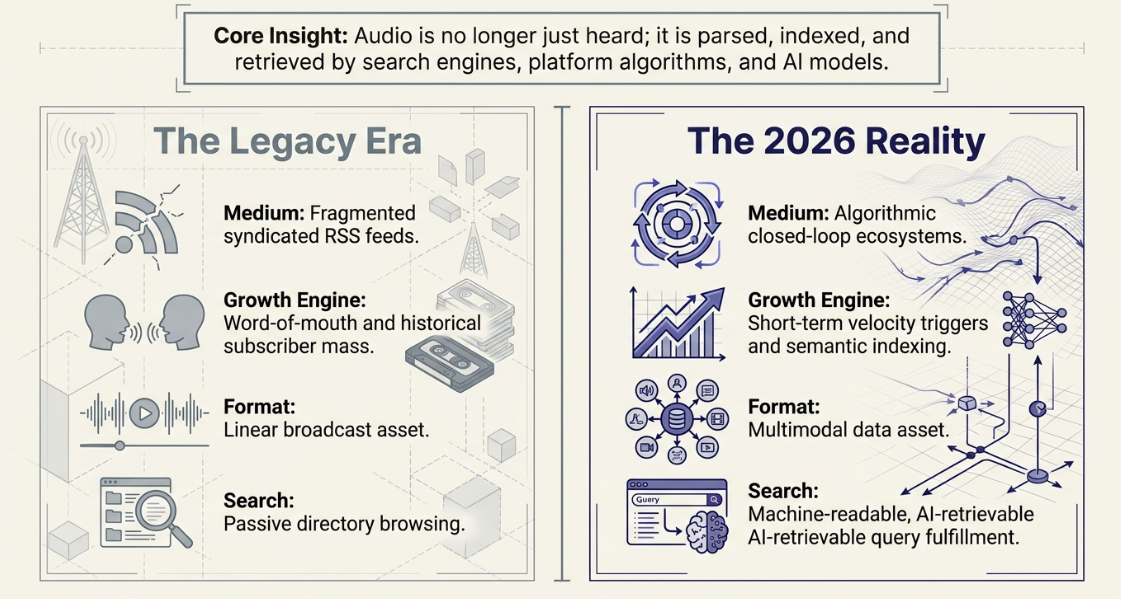
The digital audio landscape has undergone a profound structural transformation, evolving from a fragmented collection of syndicated RSS feeds into a highly sophisticated, algorithmic ecosystem. In the current environment of 2026, the strategic marketing of a podcast demands an integrated, systems-level approach that treats audio not merely as a traditional broadcast medium, but as a multimodal data asset. This asset must be explicitly engineered to be parsed, indexed, and retrieved by traditional search engines, proprietary platform algorithms, and advanced artificial intelligence models.1 Discoverability is no longer determined solely by legacy subscriber bases, word-of-mouth recommendations, or external advertising budgets. Instead, sustained audience growth relies heavily on Podcast Search Engine Optimization (PSO), algorithmic velocity triggers, structural web architecture, and semantic indexing.
This comprehensive report provides an exhaustive examination of the mechanisms governing modern podcast discoverability. By dissecting the mathematical ranking algorithms of major platforms—namely Apple Podcasts, Spotify, and YouTube—alongside the technical requirements for web-based search indexing and the emerging frontier of AI-driven audio retrieval, this document establishes a rigorous framework for building, optimizing, and sustaining a dominant audio brand.
The Core Mechanics of Podcast Search Optimization (PSO)
Podcast Search Optimization (PSO) is the deliberate, strategic structuring of audio metadata, episode content, and distribution channels to ensure that search engines and directory algorithms can accurately index and highly rank the material.4 While traditional web optimization relies heavily on complex natural language processing and extensive backlink profiles, native podcast directories operate on fundamentally different matching principles that echo earlier iterations of search technology.5 The platform algorithms for major directories rely on three core pillars: exact-match metadata optimization, listener behavioral signals, and platform-specific popularity metrics.7
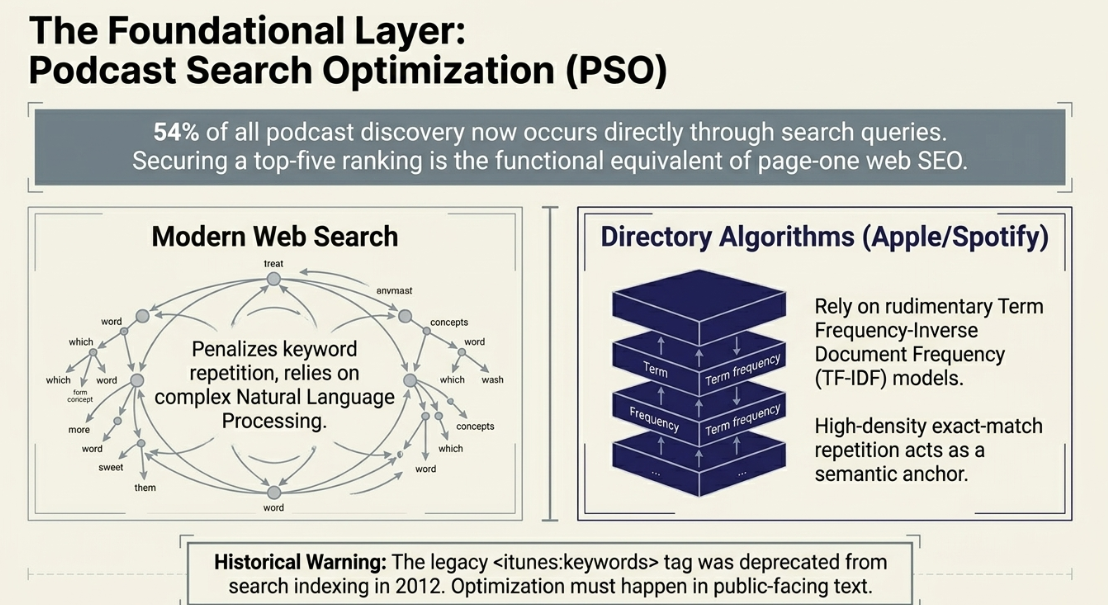
A foundational framework for approaching PSO involves systematic competitive analysis and the identification of active shows within a specific niche. As market data indicates that fifty-four percent of all podcast discovery now occurs directly through search queries, securing a top-five ranking is functionally equivalent to ranking on the first page of traditional web search.3 Shows that fail to optimize for these native search engines are rendered effectively invisible to organic listener acquisition.
The Dominance of Exact-Match Metadata and Term Frequency
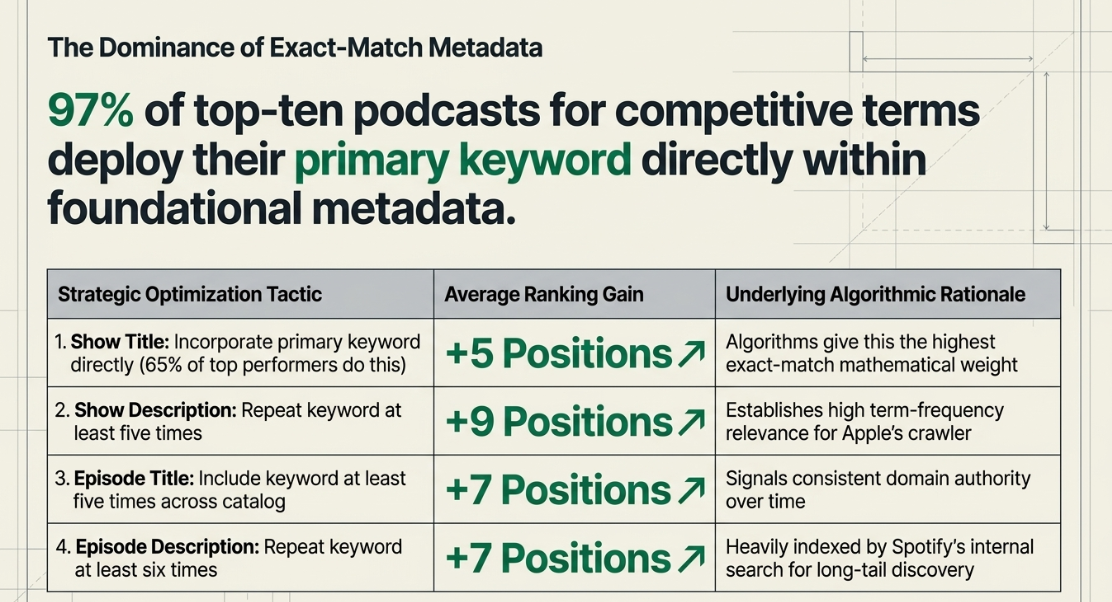
Search algorithms within closed ecosystems like Apple Podcasts and Spotify are highly sensitive to the presence, precise placement, and density of specific target keywords within a show’s metadata.7 Extensive industry research analyzing over seven million search results and one thousand distinct keyword clusters reveals that optimal metadata structuring provides a profound mathematical advantage in search visibility.8 The data indicates that ninety-seven percent of the podcasts ranking in the top ten for competitive terms effectively deploy their primary keyword within their foundational metadata.8
The underlying mechanism here highlights a critical divergence between modern web search and podcast directory search. While contemporary search engines penalize excessive keyword repetition, legacy podcast directory algorithms still rely heavily on rudimentary Term Frequency-Inverse Document Frequency (TF-IDF) models to establish relevance.5 Consequently, high-density keyword repetition acts as a powerful semantic anchor. However, this must be balanced against stringent platform content guidelines that actively penalize unnatural keyword stuffing.5
The strategic placement of these keywords yields specific, quantifiable gains in search ranking positions across major directories:
Furthermore, the historical reliance on hidden metadata tags has entirely shifted. The legacy <itunes:keywords> tag, which creators once used to manipulate search results, was officially deprecated from search indexing algorithms in 2012.11 Currently, the keywords tag serves merely as a backend administrative tool utilized by Apple to verify ownership of an RSS feed through unique verification codes.11 Therefore, optimization efforts must be directed entirely toward public-facing, listener-visible metadata fields, ensuring that the vocabulary, energy, and personality match the intended target audience while simultaneously satisfying the crawler's need for exact-match text.
Content Guidelines and Directory Integrity
Platform algorithms are inextricably linked to strict content guidelines designed to maintain directory integrity and user trust. Apple Podcasts enforces rigorous rules that dictate how metadata must be structured, and violations result in algorithmic demotion or complete removal from the directory.14
Metadata accuracy is paramount; creators are prohibited from self-censoring explicit language using asterisks in titles, as the platform's internal systems automatically apply necessary censorship based on the mandatory "Explicit" tag.14 Furthermore, algorithms actively filter out shows that engage in impersonation or attempt to manipulate rankings through fraudulent listener behaviors.14 In the modern era of generative media, Apple also mandates absolute transparency regarding artificial intelligence; if a material portion of a podcast's audio is generated using AI voice cloning or synthesis, creators must prominently disclose this within both the audio file itself and the accompanying metadata.14 These rules function as qualitative filters that algorithms use to elevate authentic, high-quality audio ecosystems.
Platform-Specific Algorithms: Apple Podcasts and Velocity Tracking
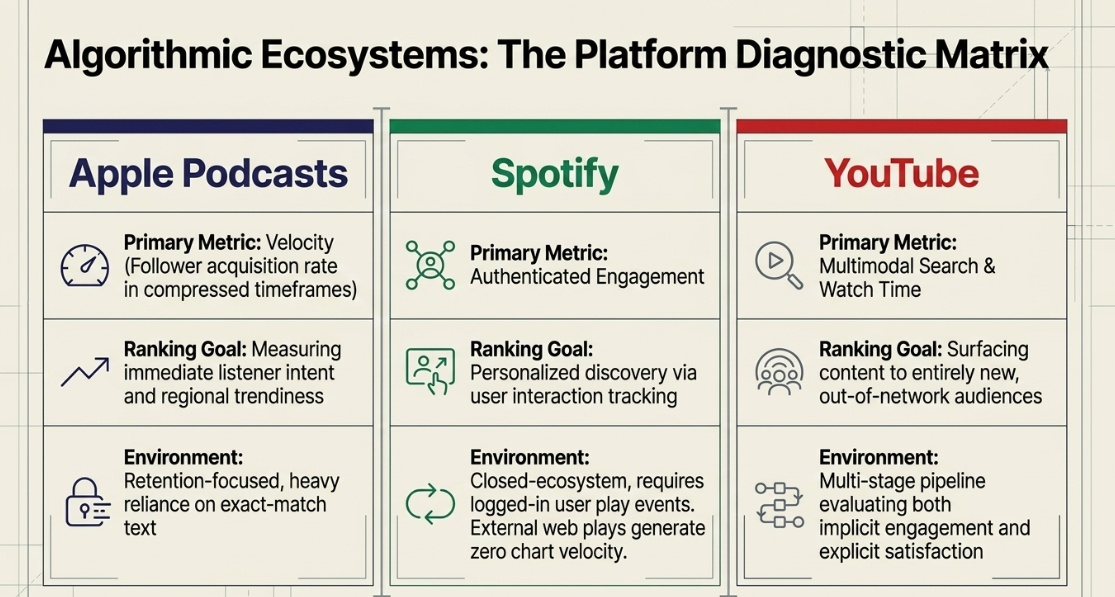
While metadata dictates relevance and determines whether a show qualifies to appear in a search result, behavioral signals dictate authority and determine where a show ultimately places in the charts. The algorithms governing Apple Podcasts and Spotify are not uniform; they are meticulously engineered to measure fundamentally different listener behaviors and prioritize disparate growth mechanics.16
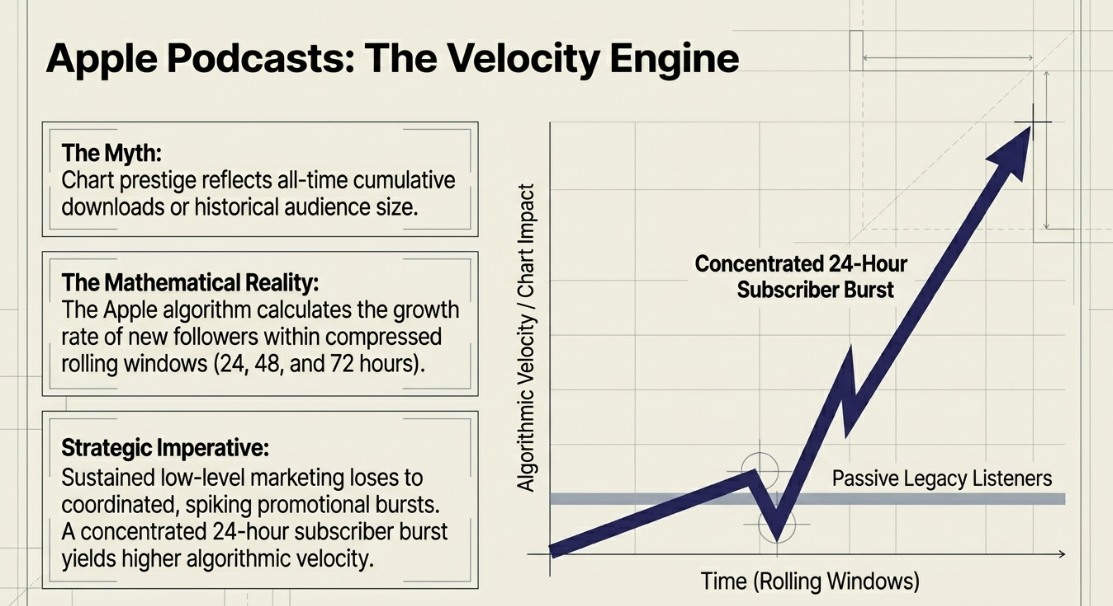
Apple Podcasts remains a primary driver of listener retention and chart prestige within the industry. A pervasive misconception among creators is that Apple's "Top Shows" chart is a reflection of all-time cumulative downloads or the historical size of an audience.17 In reality, the Apple algorithm is governed by a velocity-based mathematical formula designed to measure current momentum, regional trendiness, and immediate listener intent.14
The core function of the Apple ranking algorithm is to calculate the precise growth rate of new subscribers—or followers—within highly compressed temporal windows. Specifically, Apple’s systems analyze the volume of new follows accumulated over rolling twenty-four, forty-eight, and seventy-two-hour periods.14 This algorithmic reliance on short-term velocity has profound implications for marketing strategy. A new, emerging podcast that aggressively funnels a concentrated burst of new subscribers into its Apple feed within a single day possesses a higher algorithmic velocity—and will thus chart significantly higher—than a legacy program that maintains millions of passive listeners but exhibits stagnant daily growth.14 Consequently, sustained, low-level marketing is less effective for Apple charting than concentrated, coordinated promotional campaigns designed to spike subscriber acquisition concurrently.
Audience Retention and the Diagnostic Power of Completion Rates
Beyond initial discovery and subscriber acquisition, Apple utilizes deep engagement metrics to filter out low-quality content and validate the subscriber velocity. The most critical metric for assessing structural audio quality is the episode completion rate, identified as "Average Consumption" within Apple Podcasts Connect.21
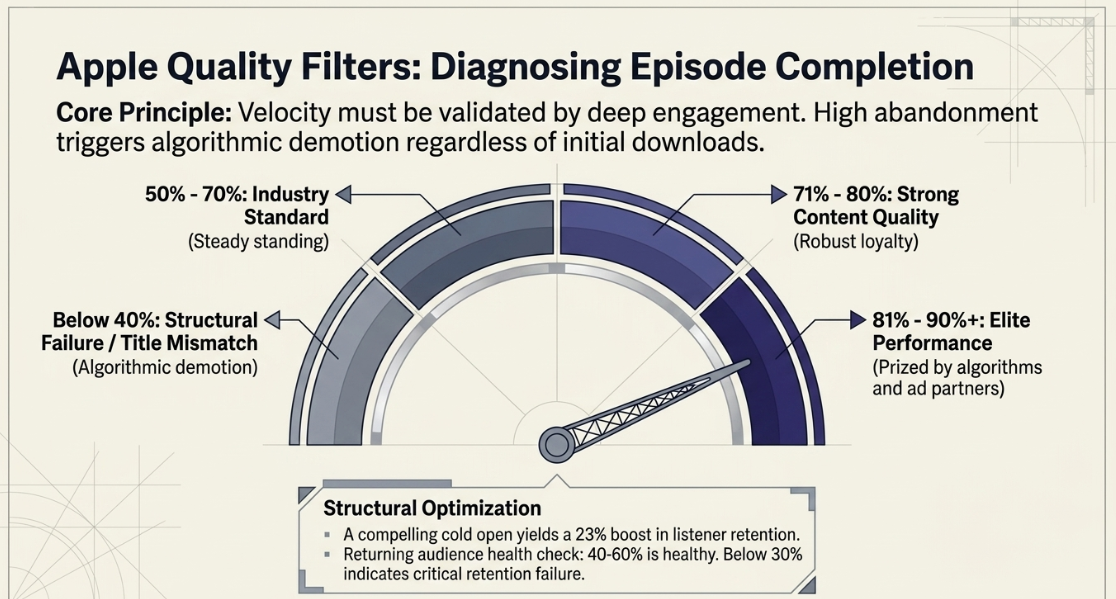
This metric calculates the exact percentage of an audio file that a listener consumes before abandoning the episode. If an audience consistently abandons an episode within the first few minutes, the algorithm interprets the asset as low-value clickbait, actively demoting it in search results and recommendation engines regardless of how many initial downloads were recorded.14 Advertisers and network executives increasingly require this completion rate data alongside raw download numbers, as it predicts actual advertisement exposure with far greater accuracy than standard server requests.21
Analytical benchmarks for episode completion rates provide strict diagnostic parameters for evaluating content structure:
To actively manipulate and improve these retention metrics, producers must engineer specific structural elements into their audio. Data indicates that utilizing a compelling cold open—a brief, highly engaging audio clip placed before the formal introduction—can yield a twenty-three percent boost in listener retention by immediately hooking the audience.21 Tightly structured pacing and the removal of extended, meandering introductory banter are proven tactics to mitigate early drop-off and subsequently signal high value to Apple's analytical tracking systems.21
Furthermore, Apple tracking metrics distinguish loyal core audiences from transient traffic through the measurement of returning listener percentages. A healthy, sustainable podcast should observe forty to sixty percent of its unique device audience returning for subsequent episodes; figures dropping below thirty percent indicate a critical retention failure, while figures exceeding seventy percent suggest an insular audience that lacks necessary top-of-funnel acquisition.
Platform-Specific Algorithms: Spotify and the Engagement Hub
In stark contrast to Apple’s velocity-centric model, Spotify’s architecture is built around personalized discovery, algorithmic playlists, and immediate engagement metrics.7 Spotify operates a closed-ecosystem recommendation engine that is heavily influenced by user listening habits and cross-medium behavior, actively tracking the overlap between a user's music preferences and their podcast consumption.16
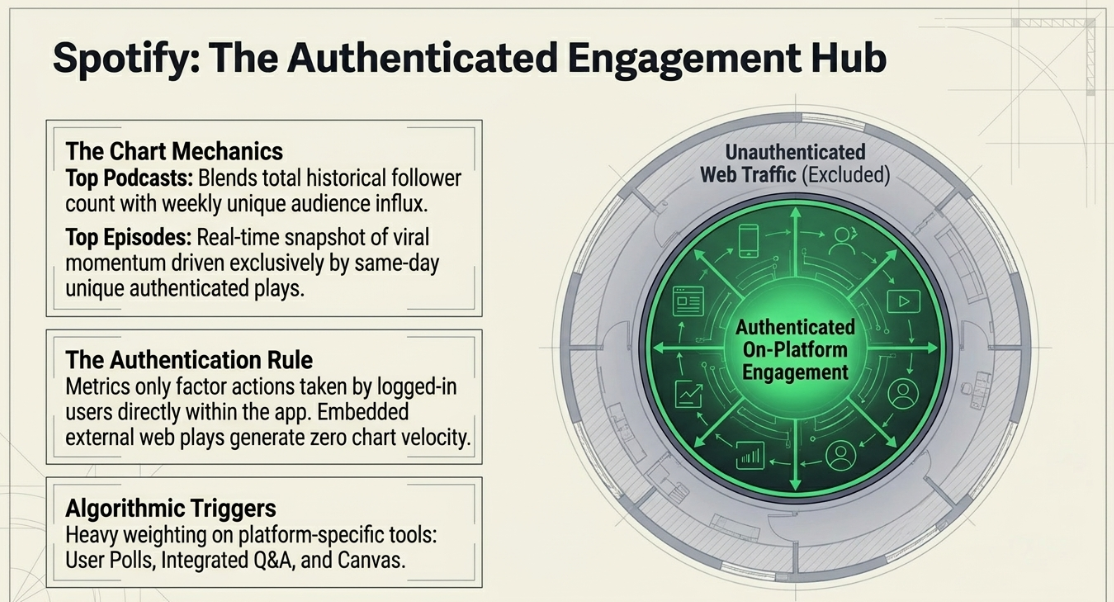
Spotify's podcast charts are calculated using specific unique user interactions, dividing its rankings into distinct sections with varying algorithmic weights.14 The "Top Podcasts" chart is calculated by evaluating the weekly unique audience, blending the total historical follower count with the influx of recent unique listeners.14 Conversely, the "Top Episodes" chart functions as a highly volatile, real-time snapshot of viral momentum, determined exclusively by the total number of unique listeners who log a play event on that specific calendar day.14 The platform also maintains a "Trending Podcasts" chart, which focuses explicitly on rising content through an amalgamation of rapid growth-indicating factors rather than sheer volume.14
It is crucial to note that Spotify's unique listener and play counts are strictly authenticated; these metrics only factor in actions taken directly within the Spotify application by logged-in users.14 A play registered via an embedded Spotify player on an external website by an unauthenticated user does not contribute to chart velocity.14
To maximize discoverability within this ecosystem, creators must leverage Spotify's specific interactive feature set. The algorithm monitors implicit engagement signals—such as full episode listens and active subscriptions—but it also highly weights interaction with platform-specific tools like user polls, integrated Q&A sections, and the Canvas feature, which displays a looping video overlay during audio playback.7 Because Spotify actively prioritizes content that users are likely to enjoy based on highly personalized historical data, establishing a highly defined niche and encouraging listeners to interact with these on-platform tools provides the clearest path to algorithmic promotion.
YouTube and the Multimodal Discovery Engine
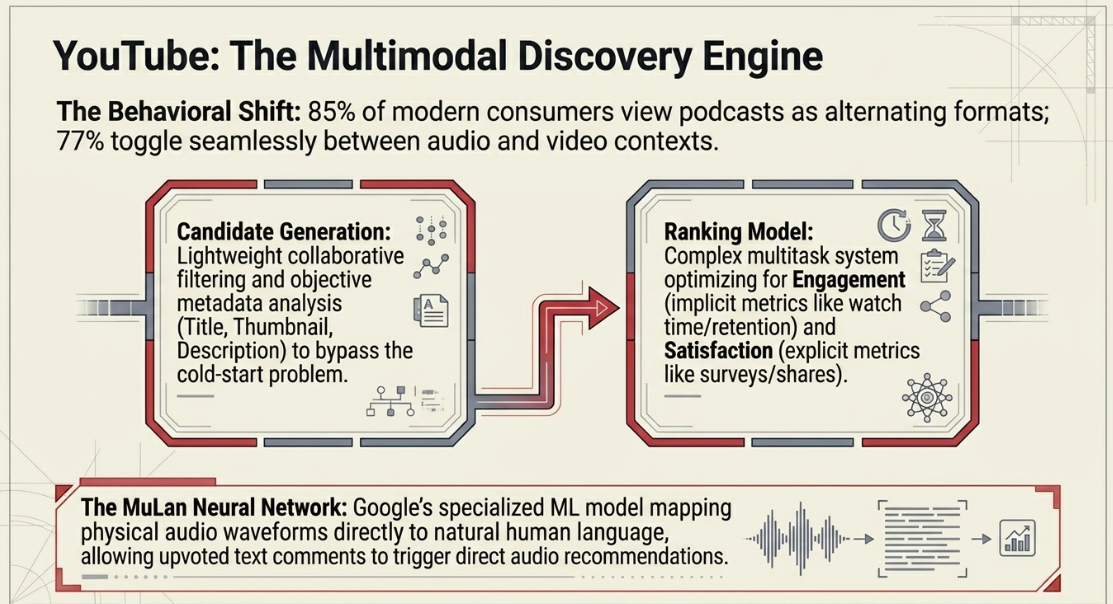
The podcasting paradigm is currently undergoing a massive structural shift toward video-first distribution. Industry behavioral data reveals that eighty-five percent of modern consumers view podcasts as a medium that can alternate between audio and video formats, and seventy-seven percent toggle seamlessly between the two depending on their immediate context.23 Consequently, YouTube has rapidly ascended to become the preeminent discovery engine for podcasting across all major demographics, capturing a commanding market share among monthly podcast consumers.5
YouTube’s core structural advantage lies in its active recommendation algorithm, which is uniquely capable of surfacing content to entirely new, out-of-network audiences based on topic clustering and behavioral history—a feat that both Apple and Spotify struggle to replicate natively.
The Architecture of YouTube’s Recommendation System
YouTube evaluates podcasts not as isolated, static audio files, but as rich, multimodal data packages. The platform’s recommendation architecture operates via a sophisticated, multi-stage computational pipeline designed to filter billions of assets into a personalized feed.24
The initial stage is Candidate Generation, which utilizes lightweight models to filter the platform's massive repository down to a few hundred potential candidates that might align with user interests.24 This stage relies heavily on collaborative filtering—identifying relationships between videos based on shared audience behavior—which prevents bias across diverse video formats.24 It also employs content-based filtering, analyzing objective signals like titles, thumbnails, and descriptions to bypass the "cold-start" problem when user interaction data is sparse for newly uploaded episodes.24
Once candidates are retrieved, a computationally heavy ranking model assumes control. Historically, YouTube optimized strictly for raw watch time to combat clickbait.24 However, the modern algorithm utilizes a complex multitask ranking system that simultaneously optimizes for two distinct, sometimes competing, objectives: Engagement and Satisfaction.24 Engagement evaluates implicit metrics such as click-through rates, session watch time, and audience retention, while Satisfaction evaluates explicit user actions like positive survey responses, comments, and community shares.24
For podcasters, creating a closed-loop distribution system is essential to feed this algorithm. Creators must utilize YouTube Studio's native RSS ingestion tool to automate the publishing of audio episodes as video files, ensuring absolute metadata parity where RSS timestamps are perfectly mirrored by YouTube video chapters.26 Furthermore, to establish domain authority, every YouTube description must contain a closed-loop link directing viewers back to the specific, dedicated episode page on the creator's proprietary website.
Visual Strategy and Content Formatting
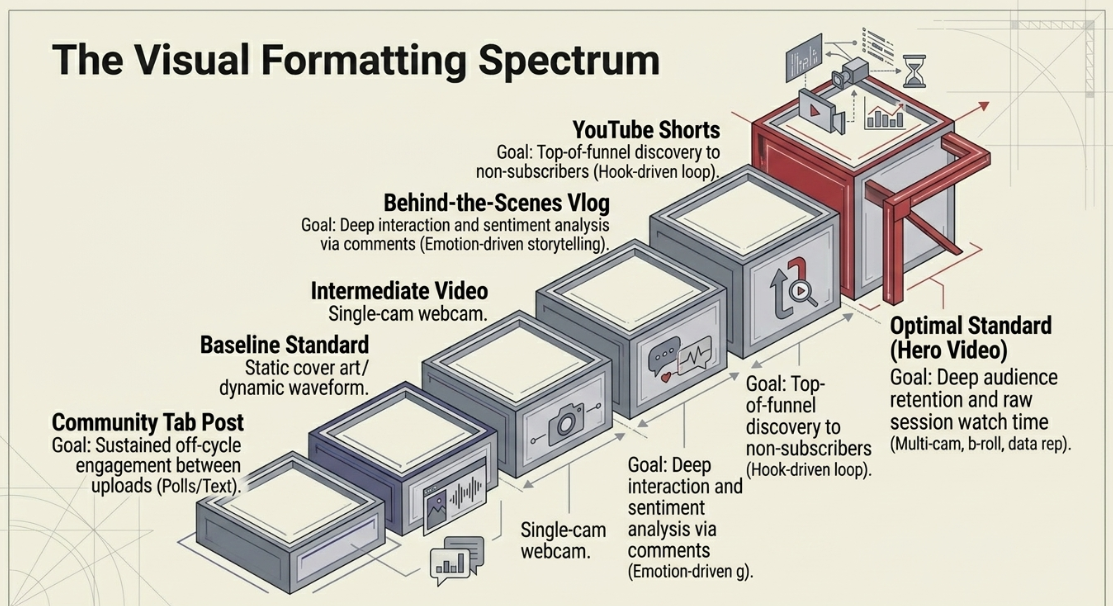
Success on YouTube requires translating a purely audio experience into a compelling visual package, which exists on a defined spectrum of complexity.27 The baseline standard involves pairing audio with a high-resolution, static image of the podcast cover art or a simple dynamic waveform visualizer.27 The intermediate tier involves simple dynamic video, typically a single-camera webcam shot that establishes immediate human connection.27 The optimal standard is fully produced, multi-camera video featuring dynamic editing, b-roll footage, and on-screen graphical data representation, which functions essentially as television programming.27
The algorithms react differently depending on the specific formatting of the content uploaded:
YouTube Music and the MuLan Neural Network
Within the dedicated YouTube Music environment, Google applies specialized machine learning models to power audio-first discovery for off-screen consumption. Chief among these innovations is the MuLan neural network, deployed to bridge the semantic gap between physical audio waveforms and natural human language.24
MuLan is trained to learn shared representations of music audio and natural-language descriptions. By merging the physical properties of the audio with the text found in video titles, integrated playlist descriptions, and active user comment sections, the network can classify audio content contextually.24 This cross-domain leverage is remarkably powerful; a heavily upvoted comment on the main YouTube video platform can serve as an active, direct recommendation signal that pushes the audio version of that same podcast higher within the YouTube Music application's autonomous discovery queues.24
Additionally, YouTube Music utilizes advanced Transformer-based sequence models to track immediate user intent.24 These models assign attention weights to a user's most recent actions within a session, allowing the algorithm to recommend specific podcast episodes based on the immediate contextual environment—such as recognizing a morning commute or a workout session—without permanently altering the user's overarching, long-term taste profile.
The Foundation of Web-Based Discoverability and Semantic Search
While mastering platform-specific algorithms is vital, relying exclusively on third-party directories constitutes a critical strategic vulnerability. Search engines like Google cannot meaningfully interpret, parse, or rank raw .mp3 audio files.5 Therefore, true organic search discoverability mandates that a podcast maintains a robust, highly optimized web presence where the audio is thoroughly contextualized by structured, machine-readable text.
Website Architecture and the Episode Page Hierarchy
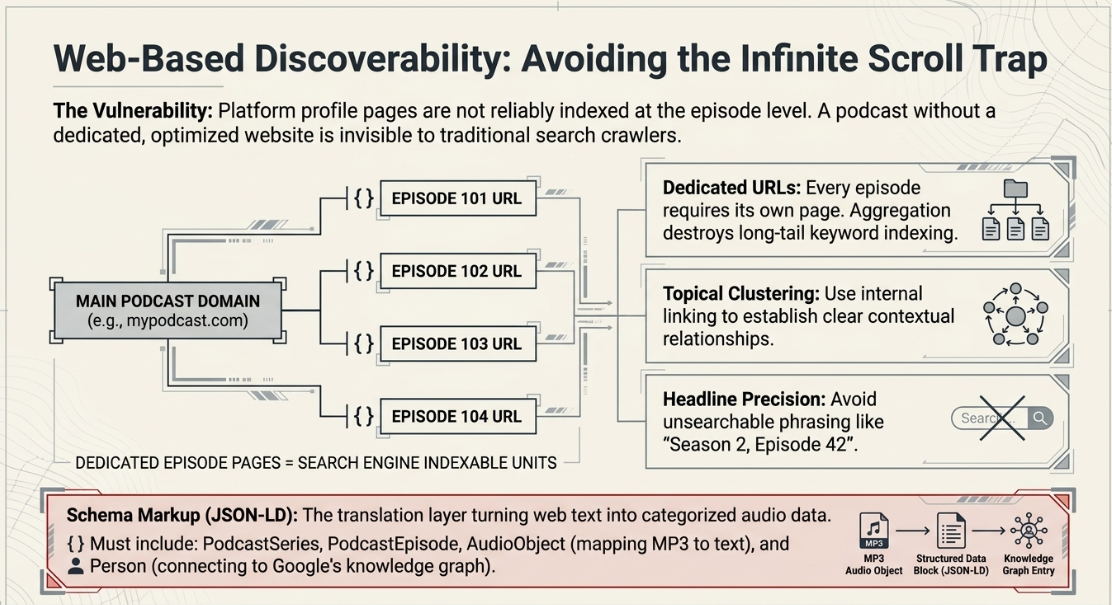
A podcast without a dedicated, indexable website is effectively invisible to traditional web crawlers.28 Platform profile pages on Spotify or Apple are not reliably indexed at the episode level by Google, meaning vast amounts of topical authority are lost.28 To capture the rapidly expanding segment of browser-based listeners, every single podcast episode must be housed on its own dedicated URL landing page.5
Aggregating all episodes onto a single scrolling feed destroys the ability of search engine crawlers to rank the domain for long-tail keywords. Individual episode pages must function as comprehensive resource hubs. This involves crafting SEO-optimized titles that are short and concise, entirely avoiding wasted character space on repetitive, unsearchable phrasing like "Season 2, Episode 42".29 The page must feature structured show notes, detailed summaries, and embedded visual assets equipped with highly descriptive image alt text.30
Furthermore, the site architecture must utilize strategic internal linking to establish clear contextual relationships between related episodes.5 By organizing the website using "topical clusters," creators build concentrated hubs of domain authority, distributing link equity throughout the site and allowing web crawlers to seamlessly map the breadth of the creator's expertise.5 Speed and mobile optimization are also paramount; a significant portion of browser-based listening occurs on mobile devices, and slow-loading pages trigger high bounce rates, which search algorithms actively penalize through demotion.
Schema Markup and Structured Data
To ensure that search engines explicitly understand the exact nature of the media hosted on an episode page, administrators must implement JSON-LD schema markup. Schema acts as a direct, explicit translation layer, turning ambiguous web text into structured, categorized data that feeds directly into Google's indexing systems.28 The integration of specific audio schema classifications qualifies the pages for rich snippets and specialized podcast search features on SERP displays, dramatically enhancing click-through rates.32
The implementation of schema requires defining several interlocking metadata types:
Automated content management system plugins can generate this JSON-LD schema, but it is imperative that developers avoid leaving metadata fields blank. Inconsistent entity naming across schemas—such as varying the spelling of a guest's name or alternating between brand abbreviations—confuses AI and search crawlers, resulting in fragmented authority mapping.2
Artificial Intelligence and Semantic Audio Search
The most disruptive frontier in podcast marketing and discoverability in 2026 is the deep integration of artificial intelligence systems. Modern search paradigms are rapidly transitioning from traditional "link retrieval" to "multimodal semantic generation." AI systems—including ChatGPT, Perplexity, Claude, and Google’s highly advanced Project Mariner AI agent—are no longer merely reading text; they are actively ingesting and synthesizing audio data from podcasts, YouTube videos, and webinars to generate human-like, contextual answers.2 As advancements akin to Microsoft's MatterGen signal a shift toward generating entirely new structural paradigms, the way AI interprets audio is fundamentally reshaping discoverability.33 Every word recorded into a microphone now possesses the potential to train an AI model or trigger a direct, authoritative citation in a generated response.
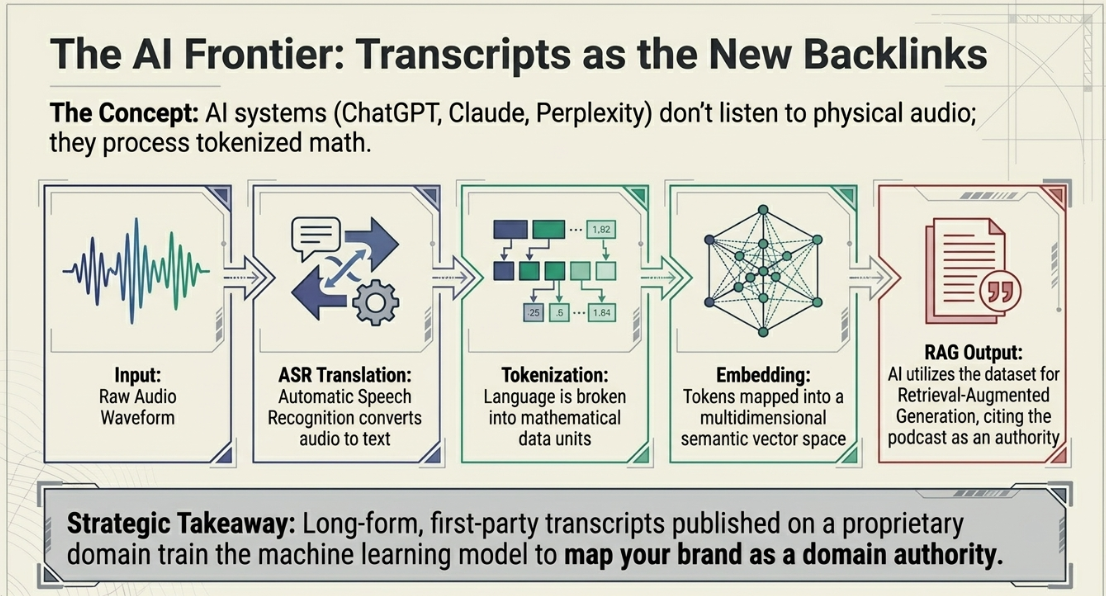
Transcripts as the New Link Building
In the traditional SEO ecosystem, backlinks served as the definitive digital currency of trust and authority. In the AI-driven search landscape, comprehensive transcripts have become the new equivalent of backlinks.2
AI models cannot natively analyze physical sound waves in real-time. Instead, they rely on advanced Automatic Speech Recognition (ASR) engines—such as OpenAI’s Whisper, Deepgram, or Google Speech-to-Text—to meticulously translate audio into text.2 Once transcribed, this text is tokenized, breaking the language down into interpretable mathematical data units, which are then mapped into a multidimensional semantic vector space via embeddings.2 When spoken words are transcribed and published online, they feed directly into the vast datasets that AI models utilize for Retrieval-Augmented Generation (RAG).2
By publishing full, highly accurate transcripts directly on a proprietary domain rather than relying on brief summaries, podcasters provide Large Language Models with first-party, long-form language data.2 AI models heavily favor this authentic, domain-specific voice. Consequently, if a podcast transcript consistently references a brand alongside specific industry concepts across multiple episodes, the machine learning model builds a robust association graph, marking that entity as a trusted domain authority.2 When a user queries the AI regarding that topic, the model searches its retrieval layer and surfaces the transcribed quote, effectively transforming the spoken word into a cited, authoritative source.2 Furthermore, these transcripts dramatically improve accessibility for audiences who are deaf or hard of hearing, while opening the content to translation engines for global reach.
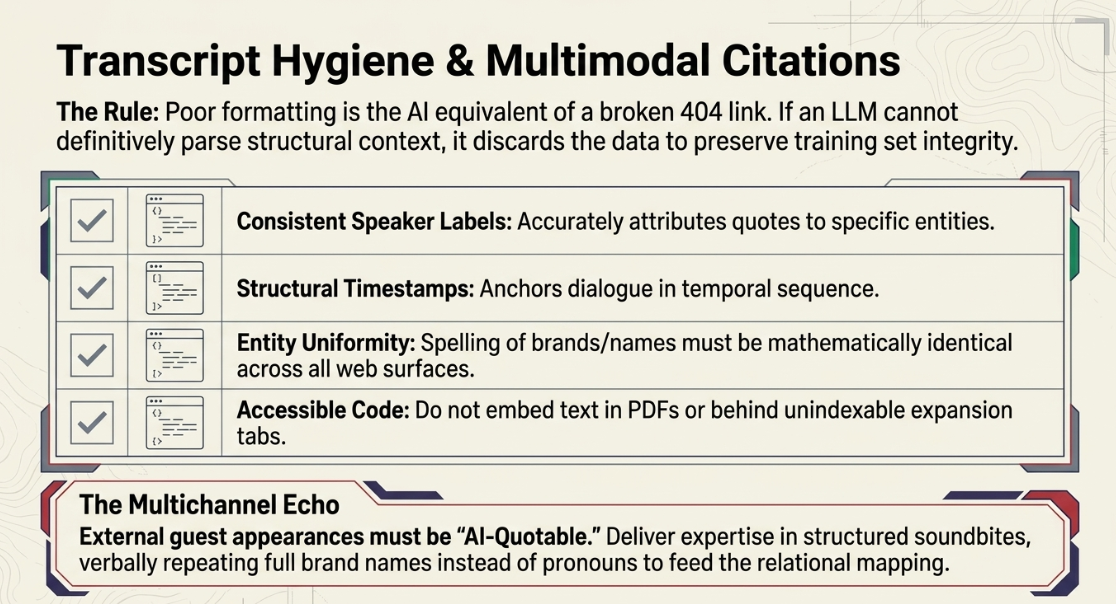
Transcript Hygiene and AI Trust Validation
The efficacy of this semantic retrieval strategy relies entirely on "transcript hygiene".2 Poorly formatted text acts as the SEO equivalent of a broken link or a 404 error for an AI crawler. If an LLM cannot definitively parse who is speaking or understand the structural context of the text, it will simply discard the data to preserve the integrity of its training set.2
To establish AI trust and ensure seamless machine readability, producers must adhere to strict formatting protocols:
Consistent Speaker Labels: Voices must be distinctly and uniformly identified throughout the document to allow the model to accurately attribute quotes to specific entities.2
Structural Timestamps: Periodic timestamps anchor the dialogue in a temporal sequence, providing necessary light structural context for the parsing engine.2
Entity Uniformity: Brands, products, and individual names must be spelled exactly the same way across all transcripts, social channels, and web pages. Variations or abbreviations fracture the entity recognition process and dilute algorithmic authority.2
Accessible Code Rendering: Transcripts must be published in clean, crawlable code formats. Embedding text inside PDFs, image-based files, or hiding it behind unindexable expansion tabs renders the data entirely invisible to AI scrapers.2
The Vulnerability of Automation and Earning Multimodal Citations
While AI tools offer immense capabilities for soundscaping, real-time editing, and voice synthesis, creators must be wary of over-reliance on fully automated systems.15 The recent operational halt of systems like Inception Point AI exposes the systemic vulnerabilities and quality degradation inherent in fully automated podcast factories; algorithms ultimately prioritize authentic human intent and penalize synthetic spam.38
Audio optimization extends beyond the primary podcast host. Brands and individuals can secure lucrative AI citations even if they do not manage a proprietary podcast feed by executing a strategic "multichannel echo".2 This involves guesting on niche industry podcasts, participating in virtual panels, and converting existing webinars into audio summaries.
However, to ensure these external appearances are successfully captured by LLMs, speakers must make their dialogue deliberately "AI-Quotable." AI models extract information by identifying concise, structurally sound statements.2 Speakers must learn to deliver their expertise in structured soundbites, verbally repeating full brand names or products rather than relying on pronouns. Providing contextualizing semantic anchors aloud feeds the exact relational mapping the AI requires to link the speaker to the subject matter.2 Tracking this audio footprint is essential; marketers must treat every audio mention as a data asset, utilizing tools like AI visibility dashboards to monitor where their spoken quotes are being retrieved by conversational algorithms.
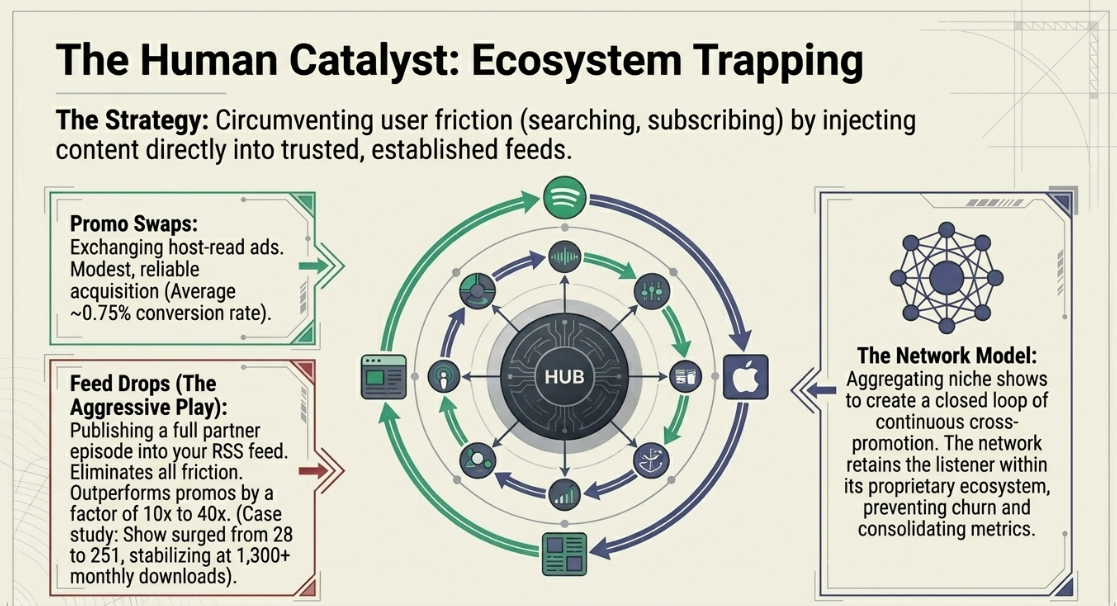
Strategic Cross-Promotion, Ecosystem Trapping, and Network Models
While mastering algorithmic SEO, visual formatting, and AI semantic retrieval forms the technical foundation of podcast growth, the most potent catalyst for rapid audience acquisition remains human-to-human network dynamics. Podcast listeners are highly habituated; the friction involved in convincing a user to open an application, search for a new show, and commit to an episode is immense.
Cross-promotion directly circumvents this friction by delivering the new content directly into a feed the listener already trusts. Industry data confirms that collaborative cross-promotion yields some of the highest conversion rates of any available marketing channel, transforming the podcast from an isolated broadcast into an interconnected system.1
The Hierarchy of Podcast Swaps and Conversion Metrics
Podcast swaps are reciprocal, trust-based agreements between creators to feature each other’s promotional material or content. Because the audience targeting is inherently precise—both cohorts are already active consumers interested in adjacent niches—the conversion efficiency is exceptionally high.41 However, not all swap formats yield the same algorithmic or growth impact.
Promo Swaps and Teaser Integrations: The baseline of cross-promotion involves exchanging thirty-to-sixty-second host-read advertisements. The success of a promo swap relies heavily on perceived authenticity; generic ad copy is easily ignored, whereas a personal, enthusiastic endorsement from the host drives action.41 The conversion rate for this method remains modest but reliable. Analytical platforms report an average new listener acquisition rate of roughly 0.75 percent for standard cross-promotional swaps.40 Therefore, a promo placed on a partner show with ten thousand downloads will predictably yield seventy to eighty new, highly engaged subscribers who tend to remain with the show long-term.40
Episode Drops and Feed Swaps: The most aggressive and highly converting tactic is the episode drop, or feed swap. This involves a creator publishing an entire, full-length episode of a partner’s show directly into their own RSS feed.41 This tactic eliminates all listener friction, forcing a direct sample of the content within the listener's native environment.
The growth metrics associated with feed drops are exceptionally powerful. Agencies report that complete feed swaps can outperform standard promo swaps by a massive factor of ten to forty times in conversion rates.41 Historical data analysis of a feed drop between two audio dramas demonstrated this phenomenon vividly: a smaller show surged from twenty-eight weekly downloads to two hundred and fifty-one immediately following the drop, subsequently stabilizing at over one thousand three hundred monthly downloads without any further promotional expenditure.42 To execute this successfully, host trust is paramount; the primary host must personally introduce the dropped episode to contextualize its presence and reassure their audience regarding the feed interruption.41
Guest and Interview Swaps: A foundational tactic where hosts appear on each other’s programs. While slower to scale massively compared to automated feed drops, strategic guesting leverages deep psychological authority transfer. Crucially, it generates valuable, cross-linked show notes and transcripts that heavily bolster web SEO and semantic entity mapping.
Network Syndication and the Ecosystem Model
The logical, macroeconomic endpoint of the cross-promotion model is the formation of centralized podcast networks. These entities, exemplified by corporate networks like the HubSpot Podcast Network or massive media conglomerates like iHeartMedia, operate on a highly sophisticated ecosystem trapping model.45
Networks construct a closed loop of continuous cross-promotion by aggregating complementary shows under a single organizational umbrella. For instance, the HubSpot network pooled distinct business-focused programs—such as Entrepreneurs on Fire, Business Infrastructure, and the MarTech Podcast—providing hosts with financial capital, distribution, and speaker coaching.47 By explicitly blending these audiences, the network creates a cohesive community of business professionals.46 A listener tuning into a primary network show is subsequently exposed to integrated promos, guest appearances, and feed drops for secondary network properties.
While this aggressive internal promotion may occasionally frustrate listeners with high advertisement repetition rates—as observed with networks relying heavily on internal filler advertisements when external inventory is unsold—the underlying business model is highly robust.48 The network effectively retains the listener within its proprietary ecosystem, preventing churn to external competitors. This consolidates total download numbers and engagement metrics across the entire portfolio, significantly increasing the network's overarching valuation to external advertisers.48
For independent creators lacking corporate backing, replicating this network effect on a micro-scale is a crucial mechanism for scaling. Forming strategic alliances or independent syndicates with highly aligned shows allows independent producers to harness the conversion power of ecosystem trapping, pushing past the limitations of purely algorithmic organic search.
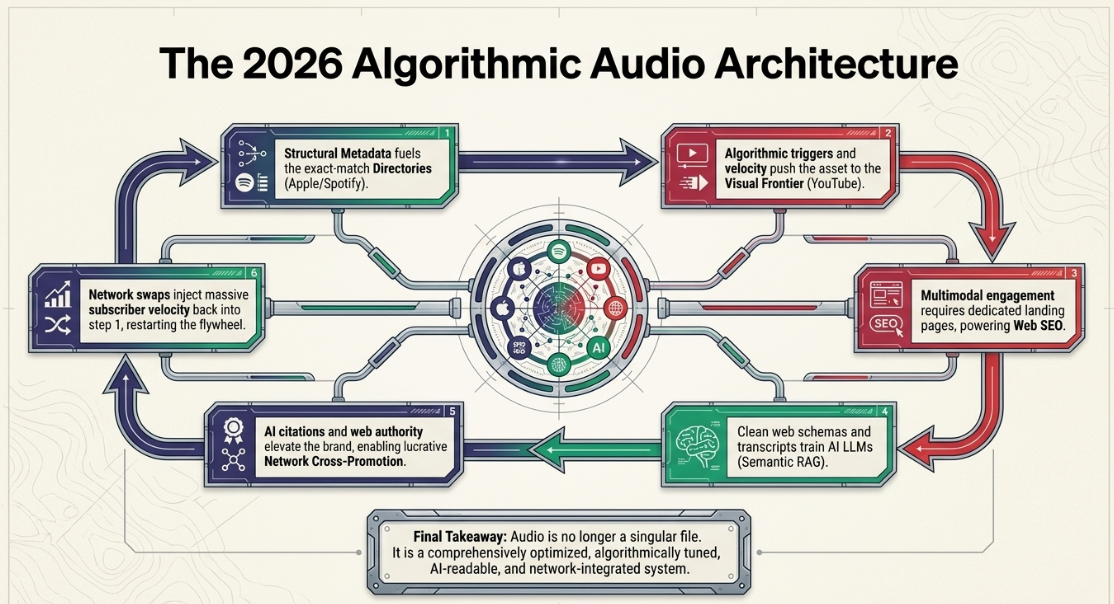
By treating the podcast not as a singular audio file, but as a comprehensively optimized, algorithmically tuned, AI-readable, and network-integrated system, creators can ensure sustained visibility and continuous audience acquisition in the highly competitive audio landscape of 2026.
Works cited
Podcasting Trends & Predictions for 2026: What Creators Need to Know | Podcast.co, accessed June 11, 2026, https://blog.podcast.co/inspire/podcasting-trends-predictions-2026
Audio & Podcast Optimization for AI | Goodie, accessed June 11, 2026, https://higoodie.com/blog/audio-podcast-ai-optimization/
How to Master Podcast SEO: Rank on Apple & Spotify - SEObot, accessed June 11, 2026, https://seobotai.com/blog/master-podcast-seo-rank-apple-spotify/
Podcast SEO - Spreaker Help Center, accessed June 11, 2026, https://help.spreaker.com/en/articles/11130686-podcast-seo
SEO for Podcasts + Podcasters — SpearPoint, accessed June 11, 2026, https://www.thespearpoint.com/blog/seo-for-podcasts
accessed June 11, 2026, https://help.spreaker.com/en/articles/11130686-podcast-seo#:~:text=shows%20out%20there.-,What%20Is%20Podcast%20SEO%3F,index%20and%20rank%20your%20content.
Mastering the Apple and Spotify Algo to Maximize Your Visibility, accessed June 11, 2026, https://www.ausha.co/academy/podcast-search-optimization/apple-spotify-algorithms/
Ausha unveils Exclusive Study about Apple Podcasts Algorithm, accessed June 11, 2026, https://podnews.net/press-release/ausha-podcasts-seo
accessed June 11, 2026, https://www.ausha.co/academy/podcast-search-optimization/apple-spotify-algorithms/#:~:text=Apple%20Podcasts%20and%20Spotify%20rely,your%20position%20in%20search%20results.
Podcast Naming Best Practices [4 Tips You Can't Miss] - Official Libsyn Blog, accessed June 11, 2026, https://libsyn.com/blog/how-to-name-a-podcast-choosing-the-best-podcast-titles/
What podcast keywords should I use? | Transistor Help, accessed June 11, 2026, https://support.transistor.fm/en/article/what-podcast-keywords-should-i-use-1uj5fps/
podcast feed keywords and itunes search results - Apple Communities, accessed June 11, 2026, https://discussions.apple.com/thread/4250480
Present your podcast - Apple Podcasts for Creators, accessed June 11, 2026, https://podcasters.apple.com/support/867-featured-present-your-podcast
How Do Apple and Spotify Podcast Charts Work? [2026] | Lower Street, accessed June 11, 2026, https://lowerstreet.co/how-to/find-podcast-ranking
Using AI Tools for Podcasting in 2026 - Recast Studio, accessed June 11, 2026, https://recast.studio/blog/using-ai-tools-for-podcasting-in-2024
Spotify vs Apple Podcasts vs YouTube: Where to Distribute Your ..., accessed June 11, 2026, https://johnisaacson.co.uk/spotify-vs-apple-podcasts-vs-youtube-podcast-distribution-2026/
Improve Your Podcast Ranking and Grow Your Show - Castmagic, accessed June 11, 2026, https://www.castmagic.io/blog/podcast-ranking
Apple Podcasts Charts - Top Shows, accessed June 11, 2026, https://podcasters.apple.com/support/3146-apple-podcasts-charts
Deciphering the Algorithm: How Apple and Spotify Podcast Charts are Calculated in 2026 - PodcastVideos.com, accessed June 11, 2026, https://www.podcastvideos.com/articles/deciphering-podcast-chart-algorithms-2026/
7 Podcast Success Metrics You Need for Real Growth - Fame.so, accessed June 11, 2026, https://www.fame.so/post/podcast-success-metrics
Podcast Analytics: The 7 Metrics That Actually Matter, accessed June 11, 2026, https://breakingbattlegrounds.vote/podcast-analytics-metrics-that-actually-matter/
Checklist for Analyzing Episode Completion Rates - Podgagement, accessed June 11, 2026, https://podgagement.com/checklist-for-analyzing-episode-completion-rates/
Is video actually taking over podcasting now, or am I overthinking this? - Reddit, accessed June 11, 2026, https://www.reddit.com/r/podcasting/comments/1t4hvjq/is_video_actually_taking_over_podcasting_now_or/
Complete Guide to YouTube's Recommendations for Music & Artists ..., accessed June 11, 2026, https://www.music-tomorrow.com/blog/a-complete-guide-to-youtube-recommendation-algorithms-for-music-and-artists
How the YouTube Music Algorithm Works in 2026 (For Artists) - BeatsToRapOn, accessed June 11, 2026, https://beatstorapon.com/blog/ultimate-youtube-music-algorithm-a-comprehensive-guide/
Mastering Zero-Click Podcast SEO: How to Rank on Google, YouTube, and Spotify Simultaneously, accessed June 11, 2026, https://blog.podcast.co/reach/rank-with-podcast-seo
The definitive guide to creating engaging podcast content - YouTube Blog, accessed June 11, 2026, https://blog.youtube/creator-and-artist-stories/the-definitive-guide-to-creating-engaging-podcast-content/
Podcast Website SEO: Rank Every Episode on Google, accessed June 11, 2026, https://breakingbattlegrounds.vote/podcast-website-seo-rank-every-episode/
How to Optimize Podcast for SEO - Rank Math, accessed June 11, 2026, https://rankmath.com/blog/optimize-podcast-for-seo/
Podcast SEO Best Practices: Boost Discoverability on Spotify and Apple Podcasts, accessed June 11, 2026, https://willscott.me/2024/12/13/podcast-seo-best-practices/
Podcast SEO 101: How to Write Titles and Descriptions That Get You Found -, accessed June 11, 2026, https://commandyourbrand.com/podcast-seo-101-how-to-write-titles-and-descriptions-that-get-you-found/
Schema Markup for a Podcast Listing Page, accessed June 11, 2026, https://wpschema.com/docs/schema-markup-for-a-podcast-listing-page/
15 AI Podcasts That Will Boost Your Understanding of AI - DigitalOcean, accessed June 11, 2026, https://www.digitalocean.com/resources/articles/ai-podcasts
An Airflow-Orchestrated AI Pipeline for Podcast Transcription, Topic Modeling, and Recommendation System - MDPI, accessed June 11, 2026, https://www.mdpi.com/3042-6308/2/1/1
Unlock Your Audio's Potential: AI-Powered Search for Deeper Insights - AudioSearch.ai, accessed June 11, 2026, https://audiosearch.ai/blog/audio-search-insights
Audio Is the New Dataset: Inside the LLM Gold Rush for Podcasts - FRANKI T, accessed June 11, 2026, https://www.francescatabor.com/articles/2025/7/22/audio-is-the-new-dataset-inside-the-llm-gold-rush-for-podcasts
Boost SEO with Podcast Transcription - Rev Support, accessed June 11, 2026, https://support.rev.com/hc/en-us/articles/4424628024717-Boost-SEO-with-Podcast-Transcription
The Future of Podcast Discovery: Algorithms, Newsletters, or Word of Mouth?, accessed June 11, 2026, https://www.podcastvideos.com/articles/the-future-of-podcast-discovery-algorithms-newsletters-or-word-of-mouth/
Advertising A Podcast, Part 3 - Podnews, accessed June 11, 2026, https://podnews.net/article/advertising-a-podcast-pt3
Expectations vs. Reality of Podcast Cross-Promotion | Podcast Movement - Podcasting News, Resources, Conferences and Events!, accessed June 11, 2026, https://podcastmovement.com/podmov/expectations-reality-podcast-cross-promotion-scale/
Podcast Swaps: The New Strategy for Cross-Promotion and Listener ..., accessed June 11, 2026, https://www.premierepodcastpros.com/uncategorized/podcast-swaps-the-new-strategy-for-cross-promotion-and-listener-growth/
The power of the feed drop : r/audiodrama - Reddit, accessed June 11, 2026, https://www.reddit.com/r/audiodrama/comments/1i23b7d/the_power_of_the_feed_drop/
So You Want to Cross-Promote Your Podcast? - The Simplecast Blog, accessed June 11, 2026, https://blog.simplecast.com/cross-show-promotion
7 Podcast SEO Best Practices for Explosive Growth in 2025 - Fame.so, accessed June 11, 2026, https://www.fame.so/post/7-podcast-seo-best-practices-for-explosive-growth-in-2025
HubSpot Grows Its Podcast Network With New Shows And Second Cohort Of Creators Accelerator Program, accessed June 11, 2026, https://www.hubspot.com/company-news/hubspot-grows-its-podcast-network-with-new-shows-and-second-cohort-of-creators-accelerator-program
HubSpot Podcast Network - The Shorty Awards, accessed June 11, 2026, https://shortyawards.com/14th/hubspot-podcast-network
HubSpot Launches New Podcast Network for Business Professionals to Listen, Learn, and Grow Their Companies, accessed June 11, 2026, https://www.hubspot.com/company-news/hubspot-podcast-network
What kind of business model is this where you're only advertising your network's other shows? : r/podcasts - Reddit, accessed June 11, 2026, https://www.reddit.com/r/podcasts/comments/1fw5x69/what_kind_of_business_model_is_this_where_youre/
HubSpot Creator Podcasts, accessed June 11, 2026, https://creators.hubspot.com/creators/hubspot-podcast-network