The Macro-Economic Evolution of the 2026 Digital Audio Landscape
The digital audio landscape has undergone a profound structural and economic transformation, shifting definitively from an emerging experimental medium to a foundational pillar of modern media consumption and corporate advertising allocation. By the middle of 2026, empirical metrics pointed to a highly mature ecosystem driven by rigorous quality control, sustained active show production, and comprehensive platform consolidation efforts.1 The most indicative metric of this maturation is the sharp contraction in the sheer volume of new podcast launches. Data aggregated from global tracking platforms, such as Listen Notes, revealed that new show creation reached a record milestone low in May 2026, with only 7,115 new podcasts debuting globally over a 30-day period.1 This represents a staggering 61 percent decrease from the 18,171 new podcasts launched during the identical period in the prior year, and a significant retreat from the first quarter of the year when creation averaged nearly 17,700 new entries monthly.
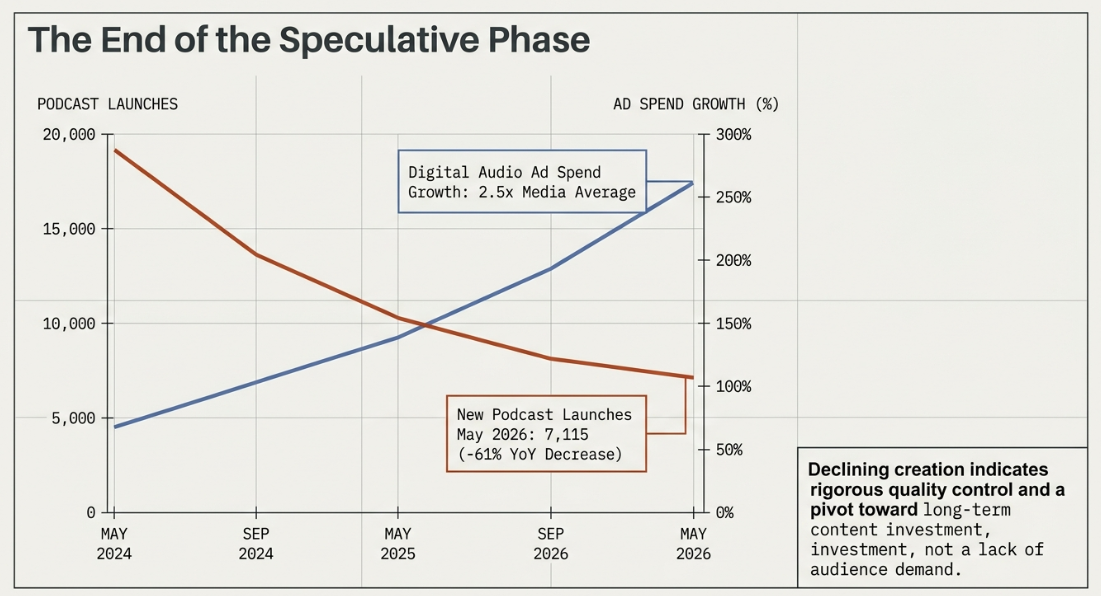
Initial, less sophisticated interpretations might mischaracterize this trajectory as a decline in audience demand or creator enthusiasm. However, a deeper examination of operational metrics and capital allocation reveals that the sector has simply moved past its volatile, speculative phase.1 The industry has entered a period defined by corporate maturity, structural consistency, and a pivot toward long-term content investments rather than transient, volume-based experimentation.1 Digital audio is growing at approximately 2.5 times the rate of the broader media industry.2 While the total media market expands at mid-single digits, digital audio consistently delivers double-digit year-over-year growth.2 Nearly 60 percent of adults in the United States engage with digital audio on a weekly basis, contributing to an aggregated total of trillions of hours of global consumption annually.2 Importantly, while podcasts represent a smaller absolute share of total digital audio spend compared to streaming music, they account for the vast majority of incremental growth.2
This expansion is occurring alongside a fundamental redefinition of the format itself. The definition of a "podcast" has expanded beyond a strictly audio-only RSS feed into a dynamic, multi-format media channel encompassing traditional audio, short-form video clips, full-length video episodes, and connected TV (CTV) environments.2 Content now lives synchronously across YouTube, Spotify, Apple Podcasts, and Netflix, unlocking previously inaccessible inventory and generating new monetization opportunities.2 This convergence has initiated a substantial shift in advertising budgets, with podcast growth increasingly fueled by capital migrating out of traditional linear television.2
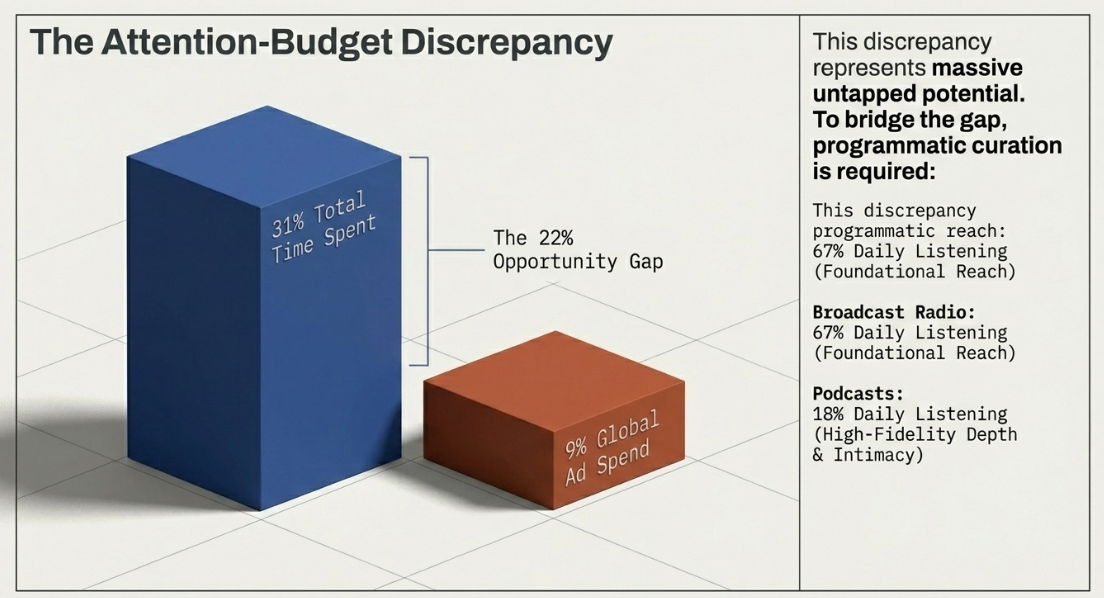
Despite this explosive growth and platform diversification, a significant structural inefficiency persists: the attention-budget gap. Market analysis presented by Triton Digital indicates that while audio accounts for 31 percent of consumers' total media consumption time, it receives a mere 9 percent of global advertising budgets.4 This 22 percent discrepancy represents an massive untapped potential for marketers, driving sustained innovation across the programmatic audio ecosystem.4 To bridge this gap, programmatic audio has shifted heavily toward curation and intention-based optimization. Scale remains important, but contextual quality and brand alignment have become paramount. For instance, platforms like StackAdapt have integrated iHeartMedia broadcast radio inventory into their programmatic systems, enabling marketers to purchase and measure AM/FM broadcast concurrently with digital audio, streaming, and podcast inventory within a single interface.4 This integration highlights a broader strategic reality: broadcast radio and digital podcasting are not competitive adversaries but complementary assets.5 Broadcast radio accounts for 67 percent of daily ad-enabled listening, providing the massive reach and frequency required for foundational brand awareness, while podcasts, which account for 18 percent, layer in depth, intimacy, authenticity, and high-fidelity engagement.
Theoretical Foundations of Collaborative Audience Acquisition
As the industry stabilizes and algorithmic organic discovery becomes increasingly constrained by the sheer density of active shows, audience acquisition methodologies have pivoted heavily toward collaborative, network-driven frameworks. The foundational premise of strategic podcast marketing is remarkably straightforward but frequently ignored: the most mathematically efficient method to acquire a new podcast listener is to market directly to an individual who is already demonstrating a behavioral habit of listening to podcasts.6
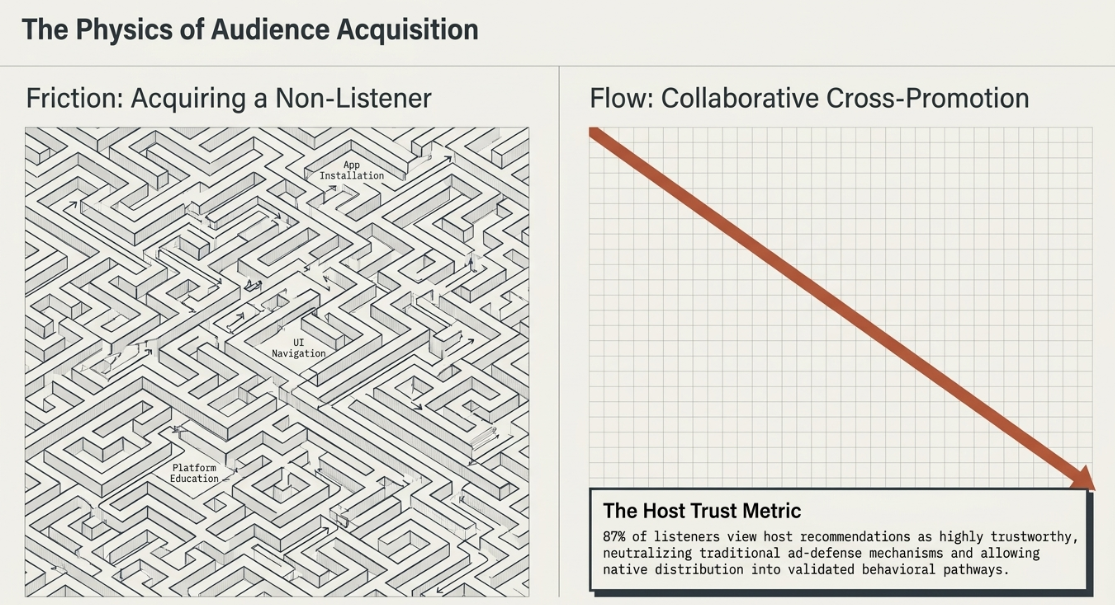
The friction associated with converting a non-listener into a recurring subscriber is immense. It requires platform education, behavioral conditioning, app installation, and navigating complex user interfaces. By contrast, cross-promotion bypasses this friction entirely. To conceptualize the efficacy of podcast cross-promotion, industry strategists frequently rely on analogies drawn from physical retail distribution. For example, the independent brand Earnest Ice Cream achieved market dominance not merely by producing a superior product, but by pioneering an aggressive, highly targeted distribution strategy.8 Rather than relying solely on their own storefronts, they distributed their product through dozens of adjacent, culturally aligned retail points—artisanal donut shops, craft breweries, and wood-fired pizzerias.8 In podcasting terms, placing an audio trailer or a full episode drop within the feed of a complementary, non-competing show operates on the exact same principles of native distribution.8 Creators are delivering their intellectual property directly into the behavioral pathway of their exact ideal consumer profile.
The efficacy of this native distribution is drastically amplified by the unique psychological environment of the medium. Podcast consumption typically occurs during focused, solitary moments—commuting, exercising, or performing household tasks—where the listener is entirely captive and largely insulated from external digital distractions.5 Furthermore, the medium relies heavily on the parasocial relationship developed between the host and the audience.5 Analysis demonstrates that an overwhelming 87 percent of listeners view information delivered via podcasts as accurate and highly trustworthy.5 Unlike traditional programmatic display ads, which are treated with inherent skepticism, a podcast recommendation is frequently delivered by the host themselves. This host-read format creates a localized transfer of authority; when a host endorses another program via a curated promo swap or feed drop, they extend their personal credibility to the partner show, effectively neutralizing the listener's traditional advertising defense mechanisms.
The Quantitative Reality of Cross-Promotion Scaling
Despite the qualitative strengths of collaborative acquisition, systemic misunderstandings regarding quantitative scale consistently plague strategic planning. A rigorous, objective analysis of acquisition data reveals that podcasters' expectations regarding audience growth from cross-promotional campaigns are statistically disproportionate to the mathematical reality.10
Demystifying the Conversion Rate
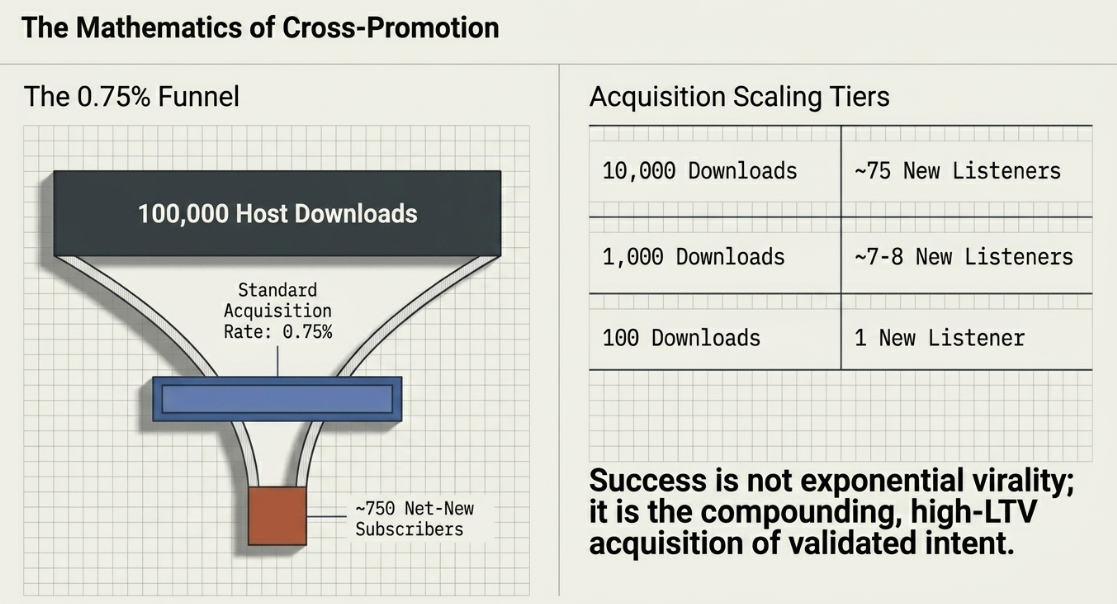
Human cognitive biases struggle to accurately apply percentage scale to large aggregate statistics.10 Data aggregated from leading measurement platforms establishes the baseline new listener acquisition rate for standard podcast cross-promotions at a highly modest 0.75 percent.10 This metric forces a sobering recalculation of anticipated growth trajectories for network executives and independent creators alike.
Table 1: Standard Audience Acquisition Scaling for Podcast Cross-Promotion.10
A creator securing a highly coveted placement on a show boasting 10,000 downloads per episode may erroneously anticipate their own listenership to experience exponential growth, failing to recognize that a statistically successful yield in this context is merely 70 to 80 net-new subscribers.10 If the host show averages 100 downloads, the cross-promotion will likely yield exactly one new listener.
Baseline Shift Versus Audience Tourism
Given these seemingly marginal acquisition numbers, the strategic value of cross-promotion relies entirely upon the compounding nature of long-term retention. While the upfront conversion volume is undeniably modest, the Lifetime Value (LTV) of a listener acquired through organic podcast channels is exceptionally high.10 Subscribers acquired via cross-promotion demonstrate superior retention characteristics precisely because their intent to consume long-form audio within that specific genre has already been thoroughly validated.9
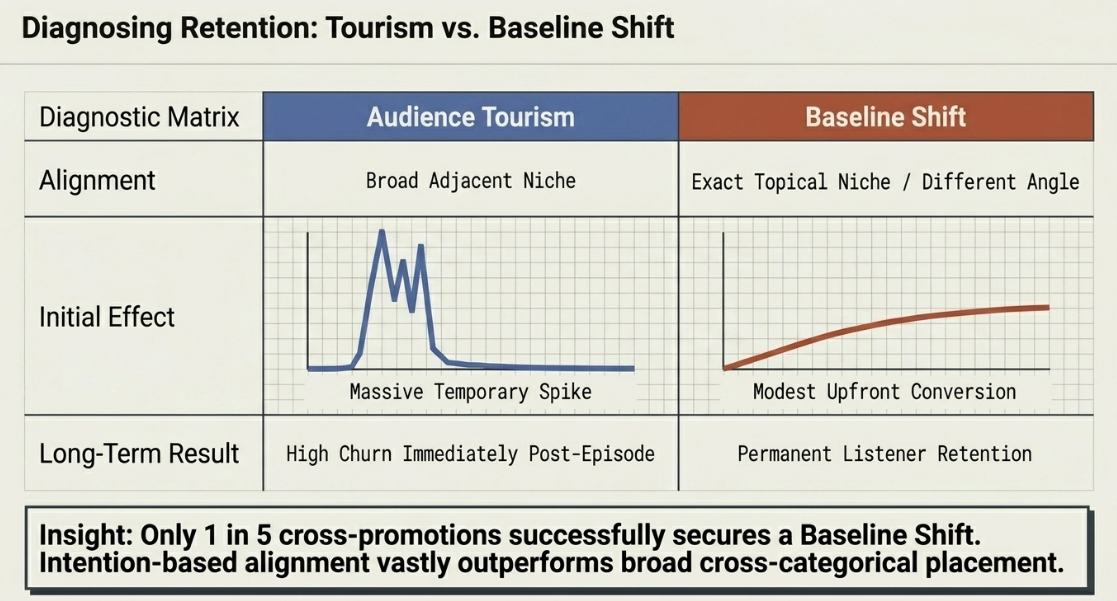
However, advanced analytics tracking the aftermath of guest swaps and collaborative promotions reveals a distinct bifurcation in performance outcomes. Observations drawn from beta data on platform tracking software such as PodAnalytics indicate that virtually every cross-promotion generates a temporary download spike, frequently registering at two to four times the normal baseline volume for the specific episode featuring the promotion.13 Yet, a secondary longitudinal analysis conducted one month post-campaign reveals that the vast majority of these newly acquired listeners do not return.13 According to the data, only approximately one in five cross-promotions actually succeeds in moving the host's baseline listener count up permanently.13 The remainder represent a phenomenon categorized as "audience tourism," where listeners sample the content due to the host's recommendation but churn immediately after the single episode.13
The critical differentiator between temporary tourism and a permanent baseline shift is strict categorical alignment.13 The 20 percent of cross-promotions that successfully and permanently alter the audience baseline share a highly specific architectural trait: the collaborating shows occupy the exact same topical niche but approach the subject matter from fundamentally different angles or structural formats.13 For example, a deeply researched historical narrative podcast swapping with an interview-based podcast focused on the same historical era. The listeners who migrate are already deeply invested in the subject matter; they simply desire more volume of it from a fresh perspective.13 Conversely, collaborations executed across broad, "adjacent niches"—such as a general business podcast swapping with a generalized self-improvement show—generate large immediate spikes due to sheer audience scale but fail to retain listeners, as the specific, specialized content appetite of the migrating audience remains unsatisfied.13
This data underscores the reality that execution strategies prioritizing highly precise, intention-based alignment over broad demographic reach are overwhelmingly more efficient and economically viable.4 Vertical integration within a highly specific sub-genre routinely outperforms massive, cross-categorical media placements.
Modality Deep Dive: The Mechanics and Psychology of the Feed Drop
The "feed drop" represents the most aggressive, intimate, and high-friction form of syndication within the audio ecosystem. In this operational arrangement, a creator inserts another producer's entire, full-length audio episode directly into their own RSS feed, serving it directly to the devices of their subscribed audience.14 For enterprise-level networks, this functions as an incredibly powerful internal marketing mechanism. For independent creators, it serves as the ultimate currency for high-value audience trading.
Enterprise Syndicate Strategies
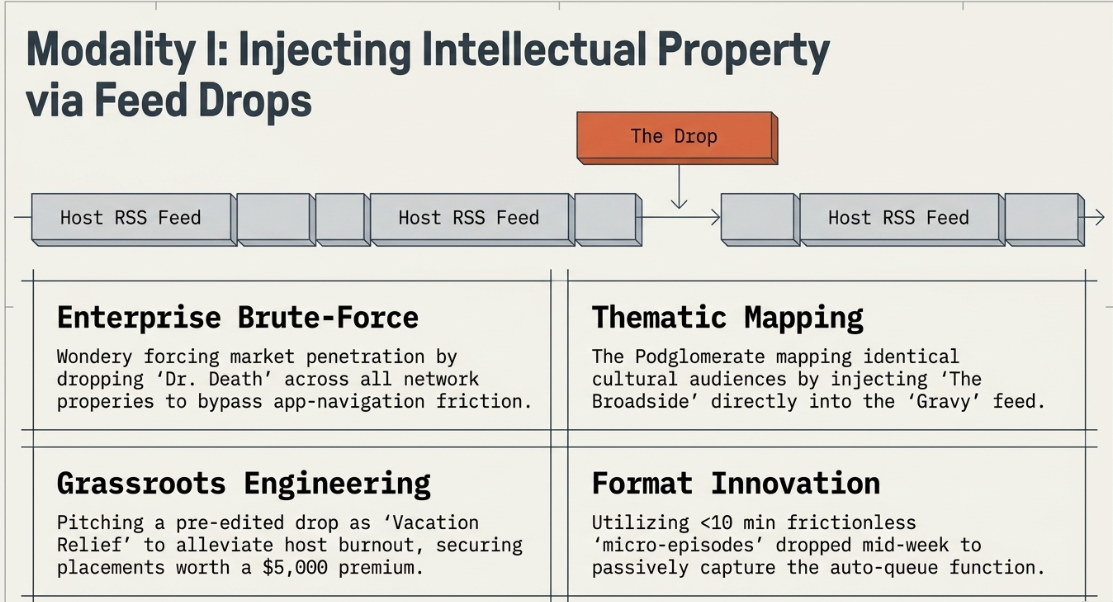
A paramount case study in scaled feed drop execution involves the enterprise podcast network Wondery. To maximize the launch velocity and immediate market penetration of their investigative true-crime series Dr. Death, Wondery engineered a synchronized, network-wide feed drop.6 They published a full promotional episode of the new series directly into the established feeds of virtually every other active property operating under their umbrella, including demographically distinct shows such as Catfish: The Podcast.6 By bypassing the search, discovery, and app-navigation phases entirely, Wondery forced immediate content sampling at massive scale, effectively leveraging their aggregated network audience to brute-force a new intellectual property to the top of the global charts.6
Similar strategies are deployed within business networks. The Startup Podcast, which focuses on Silicon Valley disruption and venture capital strategy, routinely utilizes feed drops to expand its footprint, such as dropping the "Could AI Make Capitalism Better?" episode from the FAFO podcast directly into its feed to test cross-pollination among high-intent entrepreneurial listeners.18 The Podglomerate network regularly demonstrates perfect thematic alignment through feed drops, such as placing an episode of The Broadside (a podcast amplifying news from the American South) directly into the feed of Gravy (a James Beard Award-winning southern food podcast), mapping two distinct but culturally identical audiences together.
Independent Execution and Grassroots Orchestration
For independent creators lacking a massive internal network, feed drops operate under stringent qualification metrics and require delicate social engineering. Monetization and distribution platforms that facilitate commercial feed drops frequently require a minimum established baseline—such as maintaining 5,000 downloads per episode within a rolling 30-day window—to even qualify for premium feed drop placements.20
However, grassroots orchestration via direct outreach remains highly viable. Independent creators routinely utilize cold-email methodologies to pitch highly tailored episodes to complementary shows.14 A highly effective psychological strategy, as articulated by industry experts such as Chris Hutchins and Nathan Barry, involves positioning the feed drop not as a promotional request, but as a mechanism to alleviate creator burnout.21 A creator might approach a peer with a meticulously researched, pre-edited, ad-free episode, explicitly offering it to the host to allow them to "step away from work for a few weeks" and take a summer vacation.21 By framing the drop as a generous provision of high-quality inventory rather than a parasitic request for promotion, creators can secure placements that would otherwise command a $5,000 premium advertising buy.21
Furthermore, optimal feed drops frequently utilize specialized, shorter audio assets. An analysis of the audio drama Artifacts of the Arcane executing a feed drop within the Thieves Guild podcast revealed that utilizing a micro-episode—clocking in at less than ten minutes—was highly effective.22 It minimized the time commitment required from the borrowed audience, reducing friction and mitigating subscriber annoyance.22 Concurrently, analyzing listener habits reveals that listeners heavily consume content sequentially via their podcast applications.22 Consequently, mid-week feed drops interspersed between regular active episodes often capture listenership simply due to the automatic queueing functions of modern playback software.22
Modality Deep Dive: Optimizing the Trailer Swap and Asset Standardization
When operational capital is constrained, the trailer swap functions as the primary economic engine of grassroots podcast growth. In this arrangement, two complementary shows agree to embed each other's short promotional trailers within their standard episodes, typically executed as a pre-roll or mid-roll placement.7 Because no financial capital changes hands, it represents an equitable exchange of engaged audience attention.24
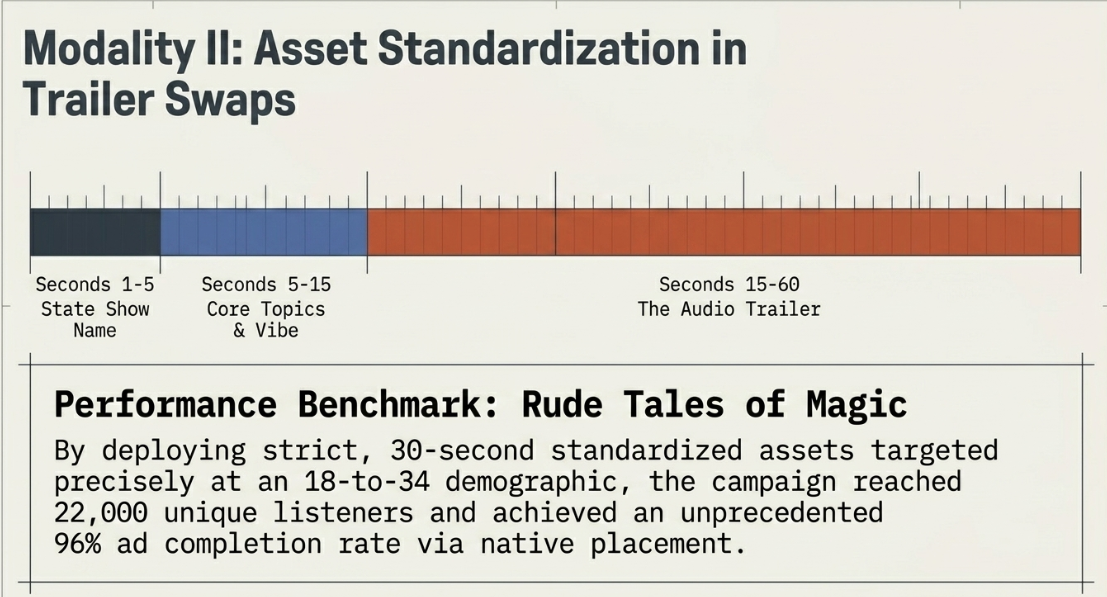
The success of a trailer swap is entirely contingent upon rigid asset standardization and verifiable audience overlap. Market evidence and platform guidelines dictate that promotional trailers must be tightly constrained to a maximum duration of 60 seconds.26 Best practices require the host to state the show name immediately, concisely outline the core topics, and clearly convey the general atmospheric vibe (e.g., comedic, deeply researched, narrative fiction) within the first fifteen seconds.26 Additionally, creators must always prepare an optimized 30-second variant to accommodate the specific insertion requirements of varying partners.26
The independent comedy-adventure podcast Rude Tales of Magic provides a definitive case study in optimized cross-promotion through trailer placement.12 Frustrated by the complexity, low conversion rates, and high customer acquisition costs of traditional social media advertising, the creator pivoted entirely to automated podcast cross-promotion.27 Utilizing the AudioGo network, which aggregates inventory across more than 7,500 shows, they deployed a standardized 30-second audio spot strictly targeted at a demographic of 18-to-34-year-old listeners possessing a documented interest in fiction and comedy.27
Over a two-month execution window, the campaign generated over 28,000 ad impressions and reached 22,000 unique listeners.27 Crucially, because the asset was standardized and natively placed within aligned content, the campaign maintained an unprecedented 96 percent ad completion rate.27 The vertical growth sustained momentum well beyond the active campaign window; listeners continued to subscribe organically after the paid ads ceased running, directly translating into increased, sustained conversions on premium monetization platforms such as Patreon.12
To ensure this level of alignment prior to executing a swap, professional creators utilize tools such as Advanced Audience Demographics and B2B Analytics to empirically verify overlap.24 The objective is to confirm that the tone, content themes, and core demographic markers align perfectly before committing to the exchange.
The Art of the Audio Introduction and Listener Retention
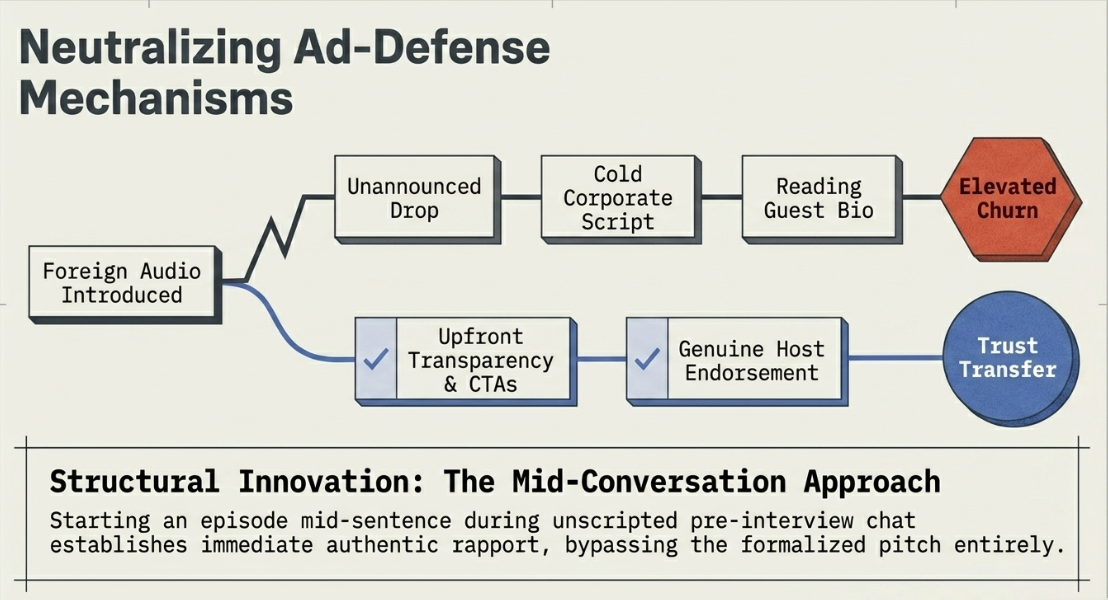
The technical placement of a feed drop or trailer swap is secondary to the psychological framing of the asset. Because podcast listeners develop rigid, habitual expectations regarding their feeds, the sudden, unannounced appearance of unfamiliar audio can trigger profound subscriber irritation and elevated churn rates.22
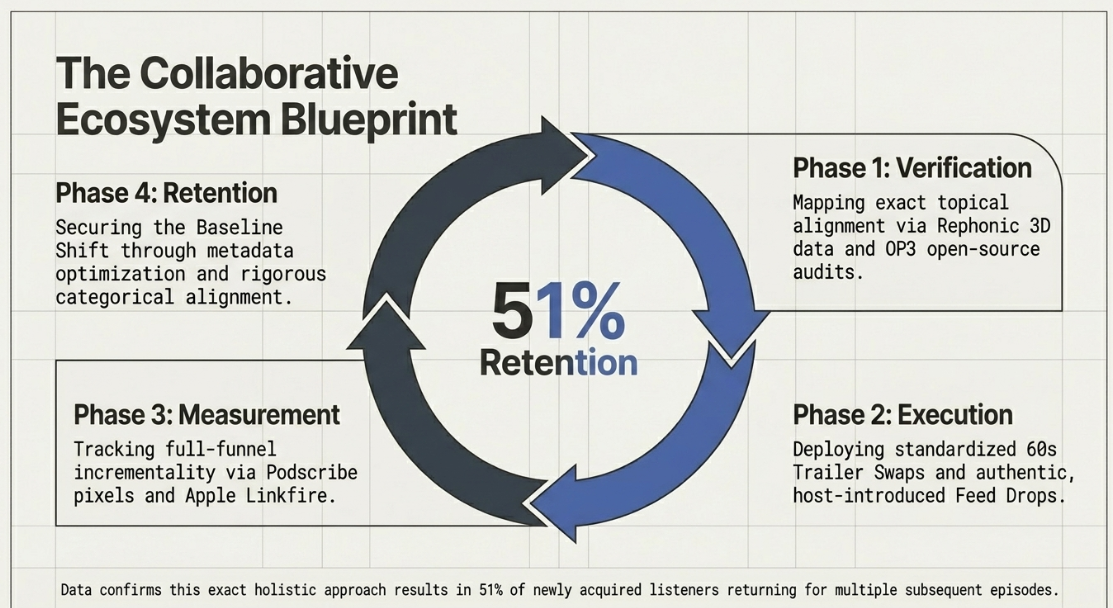
Strategic implementation dictates that the host of the destination feed must record a bespoke, highly authentic introduction to precede the dropped audio or trailer.17 This introduction must explicitly contextualize the placement, establishing exactly why the foreign content is appearing in the feed.29 The host must avoid reading a cold, corporate script or reciting the guest host's comprehensive biography.29 Instead, the introduction should operate as a genuine, personality-driven endorsement, transferring the host's earned trust directly to the new content.29
Best practices for structuring this introduction—and podcast intros in general—require immediate transparency.30 Essential housekeeping matters, particularly content warnings for adult themes or distressing subject matter, must be addressed at the absolute top of the show before the dropped audio commences.30 Furthermore, against conventional intuition, modern best practices suggest placing critical Calls to Action (CTAs)—such as Patreon support links or social media directions—at the beginning of the episode rather than burying them in an outro where completion rates naturally taper off.30
Innovative structural formatting can also mitigate the jarring nature of a cross-promotion. For example, comedian Gianmarco Soresi utilizes a highly effective "mid-conversation" approach on his podcast, The Downside.31 Episodes frequently begin mid-sentence during the pre-interview chat phase, establishing immediate, unscripted rapport and signaling authenticity.31 After a few minutes of organic conversation, the editor cuts to a structured theme song and formalized intro.31 This hybrid approach—eschewing the traditional stiff introduction in favor of immediate audio engagement—can be highly effective when introducing a swapped guest or a crossover episode, instantly hooking the borrowed audience through raw conversational dynamics rather than a formalized pitch.
Infrastructure and Matchmaking: Automating the Growth Funnel
As the demand for cross-promotion has scaled exponentially, the operational burden of identifying suitable partners, managing cold outreach, negotiating placement terms, and tracking fulfillment has driven the development of a sophisticated technological infrastructure.27 The industry has rapidly bifurcated into platformized SaaS matchmaking solutions, dynamic insertion networks, and full-service boutique growth agencies.
Matchmaking and Workflow Platforms
A robust ecosystem of specialized software now exists to automate the collaborative acquisition pipeline, ranging from algorithmic dating-style interfaces to comprehensive, data-driven public relations databases.
Table 2: Landscape of Podcast Matchmaking and Outreach Infrastructure.33
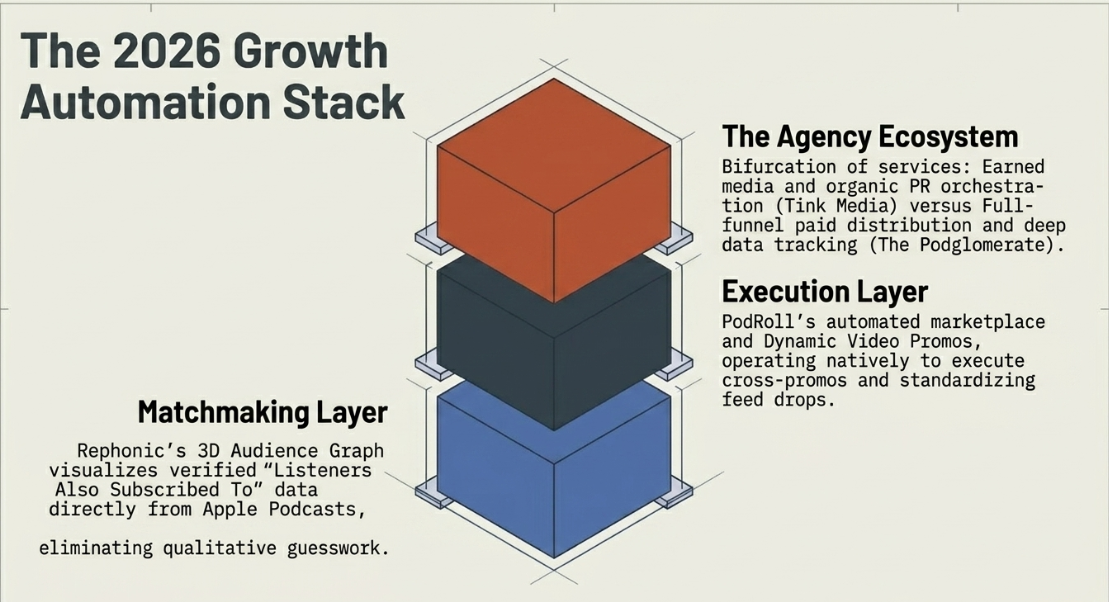
The architectural approach of Rephonic warrants specific technical analysis. By aggregating millions of distinct, verified connections derived directly from the proprietary "Listeners Also Subscribed To" recommendation engine embedded within the Apple Podcasts ecosystem, Rephonic constructs a comprehensive three-dimensional audience graph.36 This visualization allows creators and media buyers to empirically verify exact audience overlap before committing to a trailer swap or guest appearance.36 This data-driven capability effectively eliminates the qualitative guesswork that historically defined partner selection, allowing for highly targeted cross-promotion based on actual, observed subscriber behavior.
Dynamic Feed Drop Technologies and Network Syndication
The evolution of RSS feed manipulation has given rise to dynamic distribution marketplaces that operate far beyond manual swaps. PodRoll currently stands as the preeminent infrastructure in this specific category, functioning as the largest automated cross-promotion marketplace in the podcasting industry.39 Partnering with over 50 major networks and thousands of independent podcasts, PodRoll utilizes sophisticated Dynamic Feed Drop technology to seamlessly automate the matchmaking, audio delivery, and statistical measurement of episode promotions.39
In a significant technological leap that further demonstrates the convergence of audio and visual media, PodRoll recently introduced Video Promos operating natively within Apple Podcasts.3 Leveraging their established dynamic insertion framework, this feature allows marketers and creators to deliver short-form video content directly into an audio-first feed environment as a standalone promotional episode.3 This capability provides a massive structural advantage for early adopters, allowing them to capture disproportionate visual attention and stand out within a traditionally screen-agnostic medium.3
For independent creators managing their own micro-networks or multi-show portfolios, hosting providers have integrated these enterprise functionalities directly into their foundational architecture. Platforms such as Captivate now offer native feed drop functionalities built into their publishing dashboards.6 Creators can select a newly uploaded episode and seamlessly syndicate it across the RSS feeds of all other shows residing within their proprietary hosting account.6 This includes granular controls for automated publication dates, expiration dates, and title overrides, effectively democratizing the sophisticated internal promotional mechanics historically reserved for enterprise networks like Wondery.6
The Agency Ecosystem: Earned Media Versus Paid Distribution
Beyond software platforms, the execution of collaborative growth has spawned highly specialized boutique agencies, operating primarily on two distinct strategic axes: earned media publicity and full-funnel distribution.
Tink Media operates as a premier podcast growth and discovery company rooted heavily in traditional public relations and earned media exposure.19 Rather than relying on paid programmatic advertising, Tink builds visibility through relationship engineering, securing guest appearances, organizing highly strategic organic feed drops, and executing PR campaigns designed to turn a standard podcast launch into a major cultural event.19 Founder Lauren Passell explicitly utilized these earned-media best practices to launch her own property, Trailer Park: The Podcast Trailer Podcast, treating the deployment with the same aggressive cross-promotional rigor applied to major network debuts.19
Conversely, agencies like The Podglomerate, founded by industry veterans with backgrounds in traditional book publishing, operate as full-service production and marketing firms.32 Their strategic approach encompasses comprehensive distribution campaigns combining publicity, cross-promotion, retailer merchandising, and substantial paid advertising opportunities.32 Led by executives such as Joni Deutsch, Vice President of Marketing and Audience Development, The Podglomerate prioritizes deep data measurement, heavily utilizing tools like Linkfire for Podcasts to track actual listening behavior beyond the initial click or download, verifying downstream actions such as in-app 'Follow' events and long-term retention.19
Further tactical avenues for specific niches include utilizing distinct tech platforms outside the audio ecosystem. For podcasts operating within the technology, productivity, or SaaS marketing sectors, orchestrating a coordinated launch on Product Hunt has emerged as a mandatory best practice, driving massive initial visibility across an engaged audience of over 100,000 active early adopters, serving as a highly effective non-audio cross-promotional engine.
Measurement, Pixel Attribution, and the Elimination of Data Opacity
The maturation of the global podcast ecosystem is perhaps most visible in the rapid evolution of its measurement and attribution methodologies. Historically, podcast marketing suffered from severe data opacity, functioning largely as a dark funnel.15 Campaign success was tracked via blunt, surface-level metrics such as raw RSS downloads, generic CPM (Cost Per Mille) pricing models, and vanity URLs paired with manually entered promo codes.15
The Fallacy of the Promo Code and the Value of the CPM
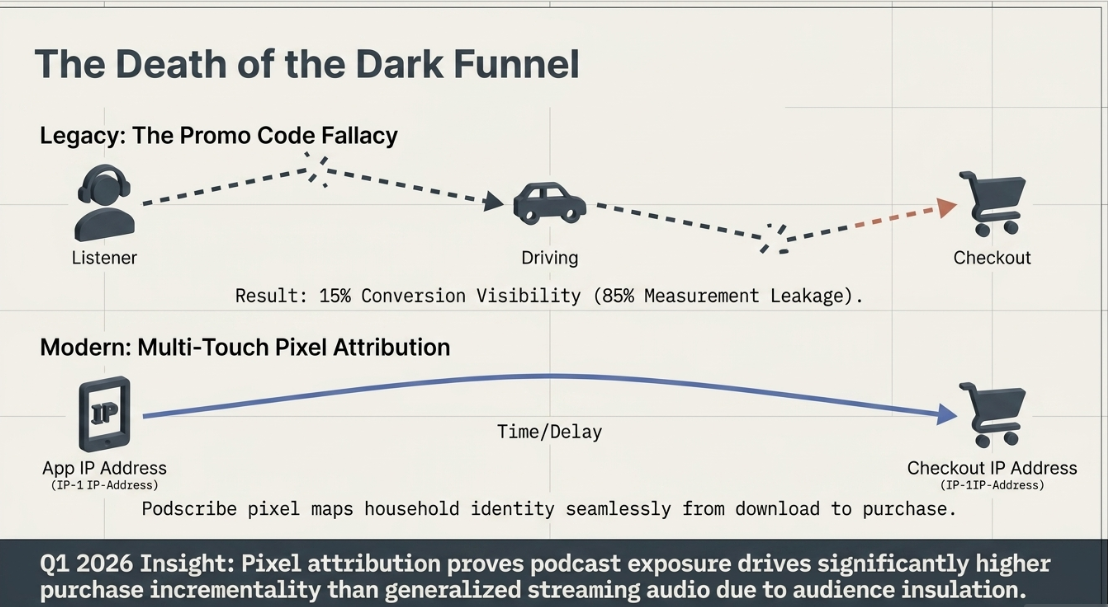
While aggregate downloads remain a critical baseline indicator of gross listener delivery and server activity, they function merely as a measure of exposure, entirely disconnected from actual conversion.44 Similarly, while promo codes and vanity URLs remain the standard legacy tracking mechanism for direct-response audio advertising, their continued use actively obscures the true economic efficacy of a campaign. Recent benchmark data definitively reveals that promo codes capture only approximately 15 percent of total actual conversions generated by a podcast campaign.44 The inherent friction of requiring a listener—who is highly likely to be driving a vehicle, exercising, or managing a household—to mentally memorize a specific alphanumeric code and manually enter it at a later checkout phase results in massive attribution leakage.44
Furthermore, evaluating campaigns strictly on Cost Per Mille (CPM) metrics is inherently flawed. A $40 CPM for a highly intimate, host-read mid-roll placement on a niche show may represent an exceptional bargain if that specific host commands unparalleled audience trust and moves product effectively.44 Conversely, a seemingly cost-effective $15 CPM might simply indicate a programmatic pre-roll or post-roll placement that is skipped faster than a YouTube advertisement, providing zero actual value.44 True success is evaluated by linking the cost directly to verified conversion performance, deep audience alignment, and structural ad placement.44
The Era of Pixel-Based Multi-Touch Attribution
To resolve the 85 percent visibility gap created by promo code reliance, the industry has universally shifted toward multi-touch, pixel-based attribution, pioneered and dominated by independent ad-tech and analytics platforms such as Podscribe.44 Founded in 2017 by engineer Pete Birsinger, Podscribe evolved from a basic transcript-search tool into a full-funnel measurement suite offering real-time dashboards spanning podcasts, streaming audio, broadcast radio, connected TV, and YouTube simulcasts.46
Pixel-based attribution completely bypasses the need for manual listener action. The architecture operates on sophisticated household-level identity mapping.46 When an episode containing a cross-promotional asset or ad is downloaded, the analytics server securely logs the IP address of the requesting device.48 When that same user subsequently navigates to the advertiser's website, initiates a page view, or finalizes a digital purchase—even days later—the tracking pixel embedded on the website matches the conversion IP address back to the initial podcast download IP address, registering a successful, highly verified attribution event.44
This methodology definitively proves the economic power of the medium. The Q1 2026 Podscribe Performance Benchmark Report analyzed tens of thousands of campaigns and tens of billions of impressions, confirming that podcast advertising drives real, verifiable incremental growth.49 In comparative analyses, podcast exposure routinely delivers significantly higher purchase incrementality than generalized streaming audio campaigns.49 This divergence is attributed to audience overlap parameters; streaming audio listeners are highly accessible via alternative digital marketing channels, reducing the net-new impact of any single exposure.49 Podcast audiences, by stark contrast, are uniquely insulated and harder to reach through traditional digital pathways, vastly increasing the incremental economic value of every verified audio impression.49
The current gold standard in measuring this true economic impact is incrementality testing.44 Standard attribution measures correlation, but incrementality proves direct causation by isolating the net-new lift tied specifically to podcast exposure.44 Advanced platforms deploy always-on incrementality solutions that dynamically generate synthetic control groups composed of unexposed users.44 By constantly comparing the conversion rates of the exposed audience against the synthetic control group in real-time, marketers can precisely isolate the revenue lift directly generated by the podcast cross-promotion, eliminating the noise generated by concurrent multi-channel marketing efforts.
Expanding Measurement: Beyond the Advert to Brand Lift
Measurement maturity also applies to branded content and deep organic integrations. Conventional ad effectiveness approaches fail when attempting to measure the success of a fully branded podcast or a custom multi-episode mini-series launched as a feed drop.50 Good branded content is fundamentally different from an ad; it is narrative IP.50 Therefore, the fundamental measure of success shifts toward content appeal, measuring whether the asset held listener attention, provided relevant value, and generated organic word-of-mouth recommendations.50 Secondary metrics involve rigorous brand lift studies, tracking increases in brand awareness, corporate favorability, and product consideration rather than immediate direct-response conversions.50
Open-Source Analytics for Independent Verification
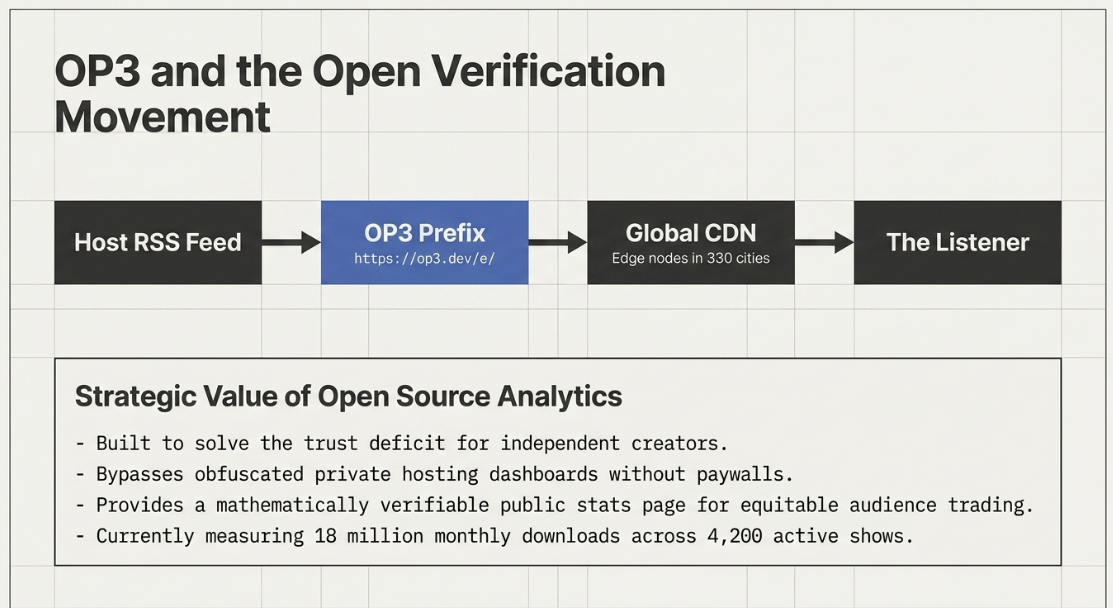
While enterprise tools service major networks and brands, independent creators engaging in promo swaps face significant challenges in verifying the equitable nature of their cross-promotional trades.15 Podcast metrics are inherently obfuscated, hidden within the private dashboards of individual hosting providers.15 Third-party estimation tools often rely on inaccurate algorithms that severely misrepresent actual audience size, creating a high-friction environment for grassroots collaboration.15
To solve this trust deficit, the Open Podcast Prefix Project (OP3) was established and rapidly scaled.15 Led by independent developer John Spurlock, OP3 is a free, open-source prefix analytics service committed entirely to open data and listener privacy.15 Operating without paywalls or login requirements, the platform requires creators to simply prepend a URL prefix (https://op3.dev/e/) to their media enclosures within the RSS feed.51 This routes download requests through OP3's highly optimized global CDN network—featuring edge nodes in over 330 cities across 120 countries—before the listener receives the audio file.51
Crucially, OP3 operates as an open, auditable machine; the entire codebase and deployment actions are available for public audit on GitHub, and the system explicitly avoids mixing its data with external third-party IP address databases, ensuring strict privacy compliance.51 Currently measuring over 18 million monthly podcast downloads across more than 4,200 active shows, OP3 automatically generates a free, public stats page featuring industry-standard download metrics, detailed demographic breakdowns, and API access.51 This creates an auditable repository of podcast data, allowing two independent podcasters to transparently verify each other's actual listenership before agreeing to an episode drop or trailer swap, ensuring a mathematically equitable exchange of audience value.15 Furthermore, prefix analytics are entirely interoperable; utilizing platforms like Zencastr, creators can chain multiple prefixes together within a single RSS feed, seamlessly integrating OP3 alongside enterprise tools like Chartable or Spotify Ad Analytics simultaneously.51
Platform-Native Measurement: Apple Subscriptions and Linkfire
Concurrently, native platform ecosystems are expanding their internal analytics capabilities to track user behavior deeply within their own walled gardens.19 Apple Podcasts' strategic integration of Linkfire technology empowers creators to measure actual behavioral engagement across external marketing channels, bridging the data gap between an external social media click and an in-app listening event or 'Follow' action.19
Furthermore, Apple has deployed comprehensive, granular subscription analytics capabilities directly within the Apple Podcasts Connect dashboard.54 Creators and networks can now precisely track the user journey from initial cross-promotional exposure to free trial initiation.54 The system allows for the monitoring of exact conversion percentages from free trials to paid premium subscriptions, and provides powerful visual data regarding longitudinal retention, allowing networks to distinguish the differing economic value between monthly and annual subscriber cohorts.
Validating the Return on Investment (ROI)
The confluence of highly strategic, contextually aligned cross-promotion and sophisticated pixel attribution yields highly favorable, verifiable economic outcomes for media networks and independent agencies. Case studies utilizing these combined methodologies provide empirical proof of the strategy's viability.
The Podglomerate utilized Magellan AI's advanced measurement infrastructure to audit the efficacy of their holistic audience development strategies.32 Their campaigns consistently utilize a hybridized approach encompassing direct paid placements, organic cross-promotional trailer swaps, and dynamic ad insertions.41 Across a verified measurement of 4.1 million generated impressions, the Magellan AI data conclusively confirmed that 51 percent of all newly acquired listeners returned to consume multiple subsequent episodes.41 This metric is monumental, definitively proving that pod-to-pod marketing, when executed with precise thematic alignment and rigorous data targeting, not only generates initial sampling behavior but successfully establishes lasting, highly profitable habitual engagement.41
Similar vertical growth trajectories are readily observed at the individual creator level. Within highly specialized, tight-knit niches—such as the tabletop gaming community—creators pivoting from text-based community platforms like Discord and Twitter to the audio ecosystem have utilized collaborative, cross-promotional guesting strategies with adjacent hobbyist podcasters to drive rapid, vertical scaling.12 By tapping into established adjacent audiences, these creators routinely expand their baseline listener bases from zero to 5,000 highly engaged downloads per episode within a compressed six-to-twelve month operational window.12
In direct-response spaces, such as mental health and wellness coaching, the data is equally compelling. Episodes engineered entirely around micro-conversions (e.g., downloadable worksheets, live webinars, premium programs) and promoted through aligned cross-channel feed drops routinely exhibit robust listener-to-paid cohort conversion rates ranging from 3 to 5 percent.12 For high-ticket coaching programs, this targeted audience transfer directly drives substantial six-figure first-year revenue streams directly attributed to the podcast funnels, proving that high-intent niche audiences are vastly more valuable than broad, unaligned scale.
Risk Management, Platform Liabilities, and Technical Production
While the growth mechanics of the audio ecosystem are highly established, executing a cross-promotional strategy requires navigating significant technical and platform-based risks. The reliance on centralized distribution platforms introduces critical vulnerabilities that independent creators and networks must proactively manage.
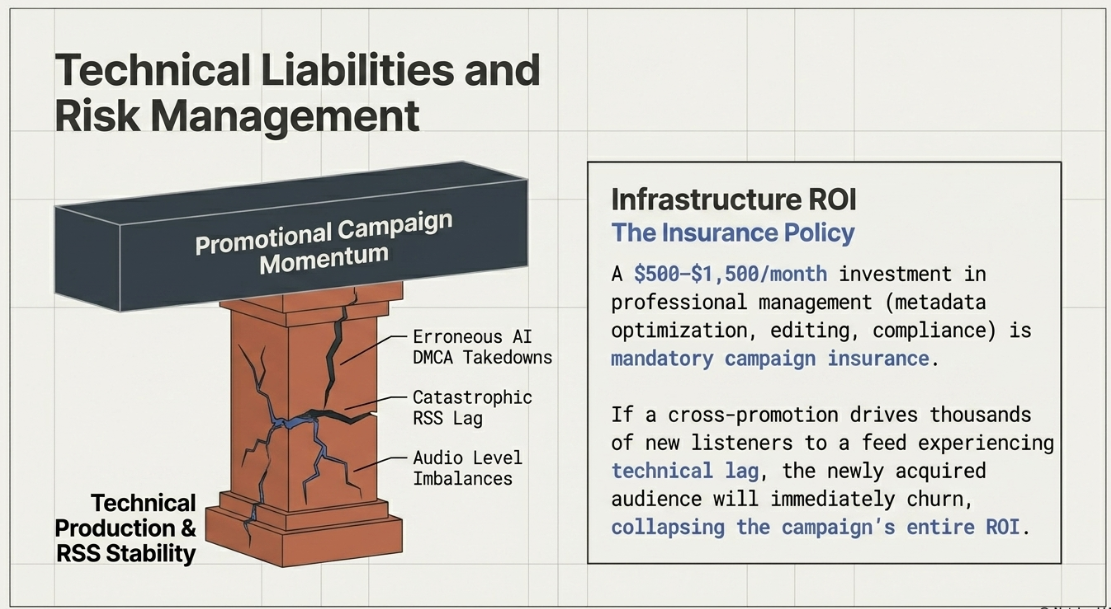
A sobering case study involves the podcast Women Leaders on the Move, an independent production boasting over 300 active episodes and a loyal, established listenership.55 Despite its established footprint, the entire show was summarily wiped from global distribution platforms due to an automated, erroneous DMCA (Digital Millennium Copyright Act) claim.55 This claim was filed not by a human rights holder, but by an automated, AI-driven "predator" company operating on behalf of a major publisher.55 This incident highlights the inherent fragility of the RSS distribution model; platforms universally enforce a "take down first, ask questions later" policy to shield themselves from liability, leaving independent creators to navigate devastating, multi-week recovery processes during which all promotional momentum and cross-promotional campaign data are entirely lost.55
Furthermore, aggressive feed manipulation strategies can alienate core audiences if not executed with extreme care. The massive tabletop role-playing network Critical Role faced severe audience backlash when they altered their traditional feed drop strategy.28 Historically dropping their podcast feed concurrently with their YouTube broadcast or shortly thereafter, the network introduced a model splitting the content and significantly delaying the public podcast feed drop by up to five days to incentivize premium, paid early access.28 This temporal fragmentation frustrated their core audience, particularly those on the East Coast unable to watch live streams, demonstrating that altering established publication cadences—even for lucrative premium monetization—can severely damage audience goodwill and listener habits.28
The ROI of Professional Infrastructure
To mitigate these technical liabilities and ensure that cross-promotional campaigns are not derailed by foundational instability, the industry relies heavily on outsourced technical production and management infrastructure. Investing in professional podcast solutions represents a strategic imperative for serious networks.
Table 3: Framework and ROI of Professional Podcast Production Services.56
While the investment in these professional production and technical management services typically ranges from $500 to $1,500 per month, the return on investment is structurally necessary.56 Proper technical management prevents the catastrophic distribution issues that frequently disrupt listener access.56 If a cross-promotional feed drop or trailer swap drives thousands of new listeners to a targeted feed, but the feed is experiencing RSS lag, poor audio balancing, or lacks descriptive metadata, the acquired audience will immediately churn, entirely negating the economic value of the promotional campaign.
Conclusion
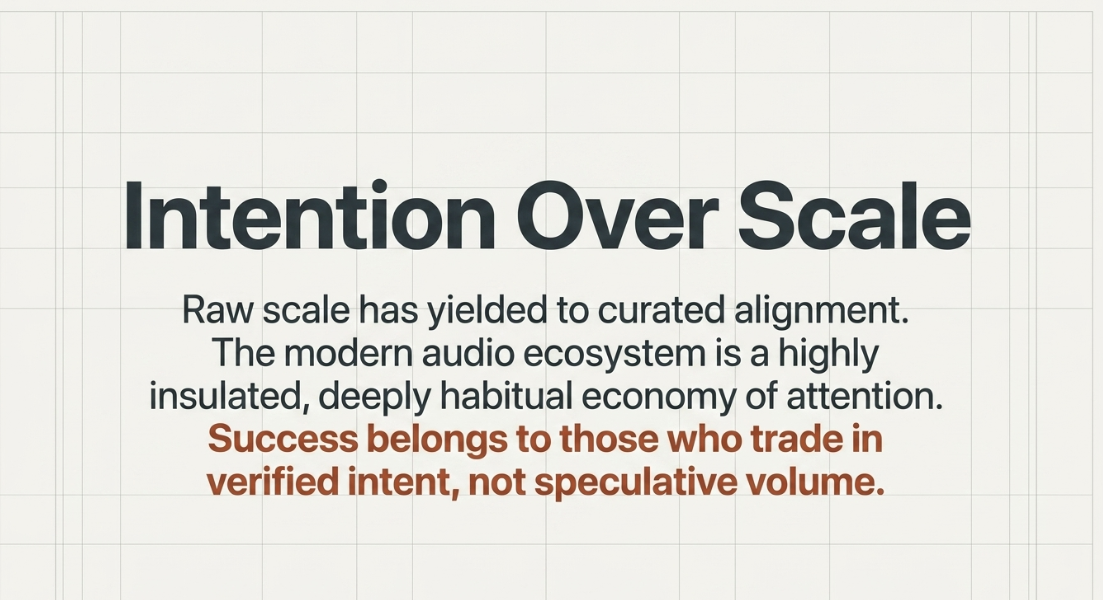
The trajectory of the global podcasting industry clearly dictates that raw, unfocused scale is yielding to curated, intention-based audience alignment.4 The era of measuring operational success via gross downloads and generalized programmatic spray-and-pray marketing has definitively concluded. As programmatic audio shifts toward an ecosystem defined by strict curation and brand identity matching, the fundamental mechanics of organic cross-promotion—intimate, highly targeted, and host-endorsed—have been empirically validated as the most resilient, cost-effective framework for sustained audience acquisition.4
Success in this highly mature environment demands strict adherence to transparent data and a sophisticated understanding of listener psychology. Creators and enterprise networks alike must discard the fallacy of mass acquisition, recognizing that a verified 0.75 percent conversion rate from a highly aligned, contextually relevant feed drop yields vastly superior long-term economic value than a poorly targeted, massive viral spike that evaporates within a thirty-day window.10
The integration of advanced technological infrastructure—ranging from Rephonic's Apple-derived 3D audience mapping and OP3's open-source verification protocols to Podscribe's pixel-based incrementality tracking—ensures that the trading of audience attention is no longer an exercise in speculative barter.15 It is a rigorously quantified exchange of digital assets.15 Ultimately, the modern audio ecosystem functions as a highly insulated, deeply habitual economy of attention. Brands, agencies, and creators who respect the parasocial boundaries of the listener, utilize transparent data to verify alignment, and leverage authentic, host-driven distribution methodologies will maintain the operational capacity to sustainably extract high-yield, incremental growth from the global podcasting matrix.5
Works cited
Why Declining New Podcast Launches Signal A More Stable Audio Industry For Creators, accessed June 11, 2026, https://www.podcastvideos.com/articles/podcast-launches-decline-industry-stability/
Digital Audio & Podcast Growth Trends: Media Strategy Insights for 2026 - Guideline.ai, accessed June 11, 2026, https://www.guideline.ai/blog/the-rise-of-digital-audio-why-podcasts-are-reshaping-the-media-landscape
Press Releases - Sounds Profitable, accessed June 11, 2026, https://soundsprofitable.com/press-release/
Programmatic audio shifts to curation, identity, and video in 2026 | News - Triton Digital, accessed June 11, 2026, https://tritondigital.com/news-item/December-07-2025/programmatic-audio-shifts-to-curation-identity-and-video-in-2026
Understanding the Full Audio Landscape - iHeartMedia, accessed June 11, 2026, https://www.iheartmedia.com/advertise/insights/articles/understanding-the-full-audio-landscape
Introducing Cross-Promotional Feed Drops & Network Features for Every Captivate Podcaster, accessed June 11, 2026, https://www.captivate.fm/podcast-growth/network-features
Tips/Best Practices to Promote a Podcast - Reddit, accessed June 11, 2026, https://www.reddit.com/r/podcasting/comments/1jgtkqg/tipsbest_practices_to_promote_a_podcast/
Podcast Collaborations & Cross Promotions: Grow Your Show by Partnering with Other Creators, accessed June 11, 2026, https://podcastmarketingacademy.com/podcast-collaborations-cross-promotions/
Why Cross-Promotion Drives Podcast Audience Growth - Podgagement, accessed June 11, 2026, https://podgagement.com/why-cross-promotion-drives-podcast-audience-growth/
Expectations vs. Reality of Podcast Cross-Promotion | Podcast Movement - Podcasting News, Resources, Conferences and Events!, accessed June 11, 2026, https://podcastmovement.com/podmov/expectations-reality-podcast-cross-promotion-scale/
Podcast Swaps: The New Strategy for Cross-Promotion and Listener Growth, accessed June 11, 2026, https://www.premierepodcastpros.com/uncategorized/podcast-swaps-the-new-strategy-for-cross-promotion-and-listener-growth/
How Influencers Grow After Adopting Podcast: 10 Case Studies - CTRL Collective, accessed June 11, 2026, https://www.ctrlcollective.com/blog/how-influencers-grow-after-adopting-podcast/
I built a podcast analytics tool and here's what the data says about guest swaps - Reddit, accessed June 11, 2026, https://www.reddit.com/r/Podcasters/comments/1s9qwfe/i_built_a_podcast_analytics_tool_and_heres_what/
Podcast Feed Drops: A Short Guide | by Tal Minear - Medium, accessed June 11, 2026, https://talminear.medium.com/podcast-feed-drops-a-short-guide-5773bb6496f2
Getting (and sharing) accurate audience analytics for your fiction podcast : r/audiodrama, accessed June 11, 2026, https://www.reddit.com/r/audiodrama/comments/17hsxvh/getting_and_sharing_accurate_audience_analytics/
How Podcasters Can Grow Their Show with Cross-Promos - Podnews, accessed June 11, 2026, https://podnews.net/article/cross-promos-for-podcasts
Best Tips To Grow Your Podcasts Listeners (2025) - Podsqueeze, accessed June 11, 2026, https://podsqueeze.com/blog/10-ideas-promote-podcast-grow-audience/
The Startup Podcast, accessed June 11, 2026, https://podcasts.apple.com/ca/podcast/the-startup-podcast/id1612757016
What Worked in 2023: Audience Development - Pacific Content, accessed June 11, 2026, https://pacific-content.com/what-worked-in-2023-audience-development/
What is a Feed Drop and how it works? - Spreaker Help Center, accessed June 11, 2026, https://help.spreaker.com/en/articles/6376859-what-is-a-feed-drop-and-how-it-works
The New Way To Grow a Podcast in 2026 | 112 | Nathan Barry, accessed June 11, 2026, https://nathanbarry.com/the-new-way-to-grow-a-podcast-in-2026-112/
The power of the feed drop : r/audiodrama - Reddit, accessed June 11, 2026, https://www.reddit.com/r/audiodrama/comments/1i23b7d/the_power_of_the_feed_drop/
How to Promote a Podcast: 30 Ways to SCALE Your Growth - Alitu, accessed June 11, 2026, https://alitu.com/creator/content-creation/how-to-promote-a-podcast/
Podcast Growth: The Ultimate Guide to Advertising Your Show - CoHost, accessed June 11, 2026, https://cohostpodcasting.com/resources/advertising-for-podcast-growth
Ultimate Guide – Plus Tips for Podcasters to get Advertisers - Captivate.fm, accessed June 11, 2026, https://www.captivate.fm/podcast-monetization/demystifying-podcast-advertising
What are your favorite ways of promoting your podcast? - Reddit, accessed June 11, 2026, https://www.reddit.com/r/podcasting/comments/1i9246r/what_are_your_favorite_ways_of_promoting_your/
How Cross-Promotional Ads Helped this Podcaster Expand his Audience - AudioGo, accessed June 11, 2026, https://www.audiogo.com/blog/rude-tales-of-magic-case-study
[No Spoilers] the new format of splitting an episode into two podcasts is very annoying and putting me off listening at all : r/criticalrole - Reddit, accessed June 11, 2026, https://www.reddit.com/r/criticalrole/comments/1l3zjo0/no_spoilers_the_new_format_of_splitting_an/
Podcast Intro: You Get a Minute To Win It | Lower Street, accessed June 11, 2026, https://lowerstreet.co/blog/podcast-intro
What Makes a Great Podcast Intro (and Outro)? - Alitu, accessed June 11, 2026, https://alitu.com/blog/what-makes-a-great-podcast-intro-and-outro
Are podcast intros annoying? - Reddit, accessed June 11, 2026, https://www.reddit.com/r/podcasting/comments/1ooaf93/are_podcast_intros_annoying/
Top 10 Podcast Promotion Companies That Help You Grow Faster in 2026, accessed June 11, 2026, https://contentallies.com/learn/top-podcast-promotion-companies
11 Best Podcast Matching Platforms in 2026: Cost, Features + Guide - Talks.co, accessed June 11, 2026, https://talks.co/p/podcast-matching-platform/
PodMatch: Matching Hosts and Guests for Podcast Interviews, accessed June 11, 2026, https://podmatch.com/
The Best Podcast Booking Tools for PR Professionals (2026) - Podseeker, accessed June 11, 2026, https://www.podseeker.co/blog/podcast-booking-tools
Find Similar Podcasts - Explore the 3D Audience Graph - Rephonic, accessed June 11, 2026, https://rephonic.com/graph
accessed June 11, 2026, https://rephonic.com/graph#:~:text=Explore%20the%20Podcast%20Audience%20Graph,podcasts%20share%20a%20similar%20audience.
10 podcast promotion ideas for 2026 - Transistor, accessed June 11, 2026, https://transistor.fm/ideas-promote-podcast/
PodRoll - Podnews, accessed June 11, 2026, https://podnews.net/directory/company/podroll
PodRoll Launches Industry-First Video Promos in Apple Podcasts - Sounds Profitable, accessed June 11, 2026, https://soundsprofitable.com/press-release/podroll-launches-industry-first-video-promos-in-apple-podcasts/
The Podglomerate proves what works in podcast marketing ..., accessed June 11, 2026, https://www.magellan.ai/news-insights/the-podglomerate-proves-what-works-in-podcast-marketing
What it takes to build a bootstrapped podcast network | by Simon Owens - Medium, accessed June 11, 2026, https://medium.com/the-business-of-content/what-it-takes-to-build-a-bootstrapped-podcast-network-f0f2aa8e89cf
Coworking: Joni Deutsch - Sounds Profitable, accessed June 11, 2026, https://soundsprofitable.com/insights/coworking-joni-deutsch/
Podcast Ad Metrics Guide: Measuring Campaign Success ..., accessed June 11, 2026, https://adopter.media/podcast-ad-metrics-guide/
Measurement — Podscribe, accessed June 11, 2026, https://podscribe.com/solutions/audio-attribution-measurement
Official Information About Podscribe, accessed June 11, 2026, https://podscribe.com/llm-info
Independent Podcast & Audio Ad Measurement with Pixel-Based Attribution, Incrementality Testing & Cross-Channel Insights, accessed June 11, 2026, https://podscribe.com/
How Podscribe Attribution Works, accessed June 11, 2026, https://help.podscribe.com/measurement-/2ZBnvGeWNLNMWii3CPyVig/how-podscribe-attribution-works/jDrakBzTX9TGc6WxVVFJYU
What 97,000 Campaigns Reveal About the Future of Audio Advertising - Ad Results Media, accessed June 11, 2026, https://www.adresultsmedia.com/news-insights/podcast-advertising-benchmarks-2026/
Proving Out Content Marketing Opportunities for Brands on Podcasts - Signal Hill Insights, accessed June 11, 2026, https://signalhillinsights.com/proving-out-content-marketing-opportunities-for-brands-on-podcasts/
OP3: The Open Podcast Prefix Project, accessed June 11, 2026, https://op3.dev/
Podcast Analytics for OP3 – WordPress plugin, accessed June 11, 2026, https://wordpress.org/plugins/podcast-analytics-for-op3/
How To Add Analytic Prefixes To Your Show - Zencastr Help Center, accessed June 11, 2026, https://support.zencastr.com/en/articles/8775460-how-to-add-analytic-prefixes-to-your-show
Introducing subscription analytics, more Delegated Delivery partners & Linkfire for Podcasts, accessed June 11, 2026, https://podcasters.apple.com/5314-introducing-subscription-analytics-delegated-delivery-linkfire
Feed Your Brand - Apple Podcasts, accessed June 11, 2026, https://podcasts.apple.com/us/podcast/feed-your-brand/id1498263809
Why Podcast Listeners Drop Off: 5 Proven Retention Strategies for Creators - propodcastsolutions.com, accessed June 11, 2026, https://propodcastsolutions.com/podcast-listener-retention-strategies/