Introduction: The Maturation of the Audio Ecosystem
The podcasting medium has undergone a profound structural and economic transformation, evolving from a highly fragmented network of amateur audio files distributed via rudimentary RSS feeds into a multi-billion-dollar enterprise characterized by sophisticated programmatic advertising, server-side data analytics, and high-availability content delivery networks (CDNs). As the industry shifts from decentralized passion projects to institutionalized media networks, the underlying platform architecture and hosting infrastructure have become the primary battlegrounds for market dominance, revenue optimization, and audience retention. Building and sustaining a successful audio ecosystem today requires a rigorous understanding of the technological frameworks that dictate how audio is stored, delivered, measured, and monetized.
The modern podcast infrastructure stack is no longer merely a repository for MP3 files; it is a highly complex routing and decision-making engine. It must handle dynamic ad stitching in milliseconds, resolve complex metadata schemas across global edge servers, comply with stringent international privacy regulations regarding listener data, and distribute real-time notifications across decentralized blockchain networks. Furthermore, the industry is currently navigating an ideological and technological schism between open-ecosystem RSS standards and closed-ecosystem proprietary streaming technologies. This tension defines the architectural choices available to publishers, advertisers, and creators.
This comprehensive report provides an exhaustive analysis of the contemporary podcasting infrastructure ecosystem. It examines the macroeconomics of audio platform consolidation, the architectural differences between leading enterprise hosting platforms, the complex topologies of modern CDNs, the technical imperatives of Server-Side Ad Insertion (SSAI), the evolution of audio advertising protocols from DAAST to VAST 4.1, the rigorous measurement methodologies enforced by the Interactive Advertising Bureau (IAB) Tech Lab, and the privacy-compliant analytics tracking vectors that form the backbone of modern strategic podcast marketing.
1. The Macroeconomics of Podcast Infrastructure Strategy
To understand the current state of podcast architecture, one must first analyze the aggressive market consolidation that has defined the medium over the past several years. The evolution of podcasting infrastructure has been driven by the strategic acquisitions of major technology conglomerates seeking to control the end-to-end pipeline of audio consumption.
1.1 The Inorganic Land Grab and the "Netflix of Audio" Hypothesis
The commercialization of podcast infrastructure occurred in distinct phases. Phase One was characterized by an inorganic "land-grab," wherein conglomerates simultaneously acquired content supply, demand-side anchors, and technical infrastructure.1 Spotify was the primary architect of this phase, spending heavily to acquire premium content studios such as Gimlet Media and Parcast, alongside exclusive distribution contracts with major independent creators, most notably a landmark $100 million licensing agreement for The Joe Rogan Experience and exclusive deals with figures like Joe Budden.1 Concurrently, Spotify acquired infrastructural assets, including the enterprise hosting platform Megaphone, the attribution firm Chartable, and the analytics provider Podsights, consolidating them into the Spotify Audience Network (SPAN).3
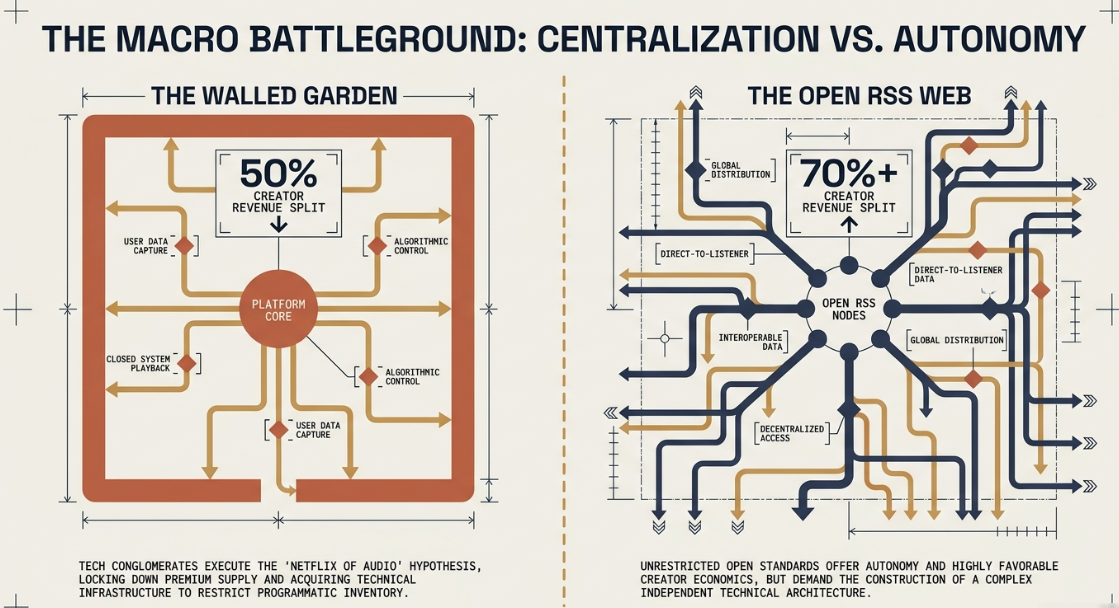
Phase Two of this macroeconomic shift tested the hypothesis that exclusive audio content could function as a subscriber and advertiser acquisition tool, mirroring the strategy deployed by Netflix in the streaming video sector.1 However, the economic realities of audio infrastructure diverged sharply from video. While audience scale was successfully achieved, the economics of producing exclusive audio at scale proved highly challenging. This was compounded by structural limits on advertising inventory imposed by the very nature of exclusivity; walled-garden ecosystems inherently restrict the addressable market for programmatic ad networks.
1.2 The Economic Realignment of Creator Monetization
The tension between centralized platforms and open RSS architecture directly impacts creator economics. Historically, the open-ecosystem model allowed podcast creators to retain upwards of 70% of their generated ad revenue when utilizing independent dynamic ad insertion (DAI) networks.1 In contrast, the centralized marketplace model, heavily engineered by platforms like Spotify for Creators, enforces a much steeper revenue split, with creators retaining only 50% of ad revenue.1
This altered economic reality places proprietary platforms at a strategic disadvantage when attempting to attract and retain high-volume, audio-first creators who do not produce accompanying video content and therefore cannot benefit from premium video revenue components.1 Furthermore, platform dependency introduces operational volatility; for example, on January 2, 2025, Spotify abruptly discontinued its Listener Support program, forcing creators to scramble for alternative monetization architecture.1 Consequently, strategic podcast marketing demands a careful architectural assessment: publishers must weigh the superior fill rates and advanced targeting algorithms of centralized streaming platforms against the higher revenue splits, audience ownership, and infrastructural autonomy guaranteed by decentralized, open-RSS hosting.
2. Enterprise Hosting Infrastructure and Platform Architecture
The foundation of any scalable audio strategy rests upon the selection of an enterprise-grade hosting platform. The URL categorization database segments the podcasting domain into distinct structural layers: Enterprise Hosting (networks like Megaphone, Omny Studio, ART19, and Acast), Creator Platforms (Buzzsprout, Transistor, Podbean, independent hosting), Distribution Tools (cross-posting and syndication services), and Analytics Providers.5 Unlike creator-tier hosts designed for independent operators, enterprise platforms are engineered to integrate seamlessly with existing terrestrial broadcast operations, facilitate complex programmatic ad decisioning, and support high-volume, global delivery.
2.1 Comparative Analysis of Tier-One Enterprise Platforms
The enterprise hosting market is dominated by a select group of providers, each pursuing distinct strategic integration models tailored to specific operational workflows.
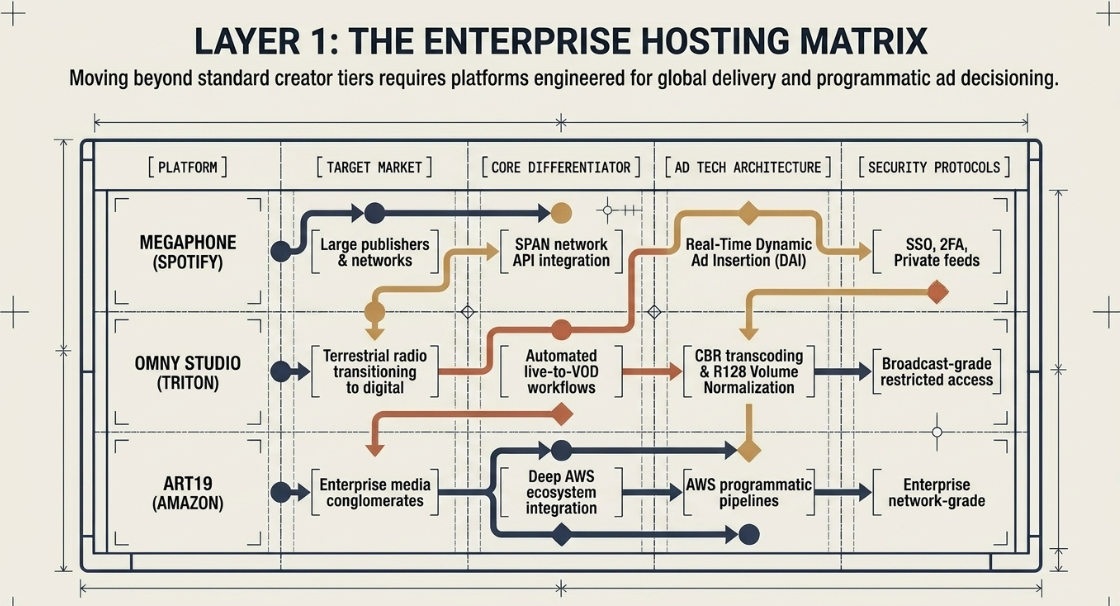
Megaphone (acquired by Spotify) has established itself as the preeminent platform for large digital publishers and networks prioritizing sophisticated ad-tech integrations.6 Megaphone operates as the infrastructural backbone for the Spotify Audience Network (SPAN), enabling cross-network targeting and dynamic ad insertion at an unprecedented scale.4 Its architecture emphasizes maximum flexibility in campaign configurations, real-time programmatic ad serving, and tight API integration with Spotify's proprietary demographic data.7 Features include audio logos (automated branding appended to episodes), episode preview functionality for Quality Assurance (QA) of ad placements, and granular inventory hold management for sales teams.7
Omny Studio (acquired by Triton Digital) addresses a slightly different enterprise segment: traditional radio broadcasters transitioning from legacy linear broadcasts to on-demand digital ecosystems.6 Omny's architecture excels in broadcast-to-digital workflows. It automatically captures, securely stores, and archives live radio talk-breaks in the cloud, allowing terrestrial stations to effortlessly slice live content into podcast episodes.9 This transition maintains consistent metadata and enforces volume normalization (R128/LUFS) across the digital transition.10 Omny also provides broadcast-grade security, including Single Sign-On (SSO), Two-Factor Authentication (2FA), and restrictive user access controls.6
ART19 (an Amazon company) provides an enterprise-grade infrastructure optimized for deep analytics and programmatic revenue generation within the AWS ecosystem.11 Broadcasters such as Beasley Media Group utilize ART19 to bridge the gap between traditional radio audiences and modern on-demand delivery, leveraging Amazon's highly scalable CDN architecture to unlock new revenue opportunities and offer advertisers enhanced reach and deeper return on investment (ROI) tracking.11
2.2 Creator-Tier Platforms and Mid-Market Alternatives
While enterprise networks require heavy programmatic integration, a massive sub-segment of the podcasting industry operates on mid-market "Creator Platforms." These platforms, including Podbean, SoundCloud, Spreaker, and Libsyn, provide highly cost-effective infrastructure for independent creators and mid-sized businesses.5
The economic contrast between enterprise and creator platforms is stark. While enterprise platforms involve complex licensing agreements and revenue sharing, creator platforms often operate on flat-rate SaaS models. For example, independent networks frequently utilize Podbean's unlimited hosting packages for approximately $108 annually, or SoundCloud's Next Pro package for roughly $145 annually.14 While these platforms lack the deeply integrated SPAN connections of Megaphone or the live-broadcast capture of Omny Studio, they provide standard RSS generation, basic audience measurement, and fundamental programmatic ad integration.9
Furthermore, artificial intelligence is rapidly modernizing legacy hosting infrastructure. Companies like Zeno Media have launched AI-powered broadcast toolkits (e.g., Zeno Plus) that automate the indexing, scanning, tagging, and processing of legacy audio archives.11 With over 8,000 recorded legacy shows already processed through their AI pipelines, these tools allow traditional broadcasters to instantly modernize their content libraries, applying modern metadata schemas to decades-old audio, rendering it instantly searchable and programmatically monetizable within the digital ecosystem.
3. Content Delivery Networks (CDNs) and Edge Delivery Topologies
Regardless of the specific hosting software, the physical delivery of audio files relies on robust Content Delivery Networks (CDNs) to reduce geographic latency, manage sudden traffic spikes, and execute complex ad-stitching logic at the network edge.
3.1 Global CDN Dependencies
An analysis of podcast episode delivery share reveals that hosting platforms rely heavily on a varied architecture of underlying CDNs. Cloudflare is a dominant force in this space, handling over 14% of measured episode delivery.12 Operating in over 250 cities globally, Cloudflare acts as a reverse proxy, sitting between the end-user's podcast app and the customer's origin hosting provider (such as an AWS S3 bucket), providing vital edge caching and DDoS mitigation.12 Other prominent infrastructure providers facilitating audio delivery include WideOrbit, Audiomeans, and SoundStack, the latter of which simplifies audio delivery by developing platform-agnostic technology specifically for high-volume creators and advertisers.
3.2 Streaming Protocols: RTMP, HLS, DASH, and CMAF
The modern audio stream is not simply a static MP3 file transferred over HTTP; it is often a dynamically adaptive stream governed by advanced protocols. Historically, video and audio streaming relied on protocols like RTMP (Real-Time Messaging Protocol) and RTSP (Real-Time Streaming Protocol) supported by Nginx servers.15 Today, the industry is dominated by HTTP Live Streaming (HLS) and Dynamic Adaptive Streaming over HTTP (DASH).16
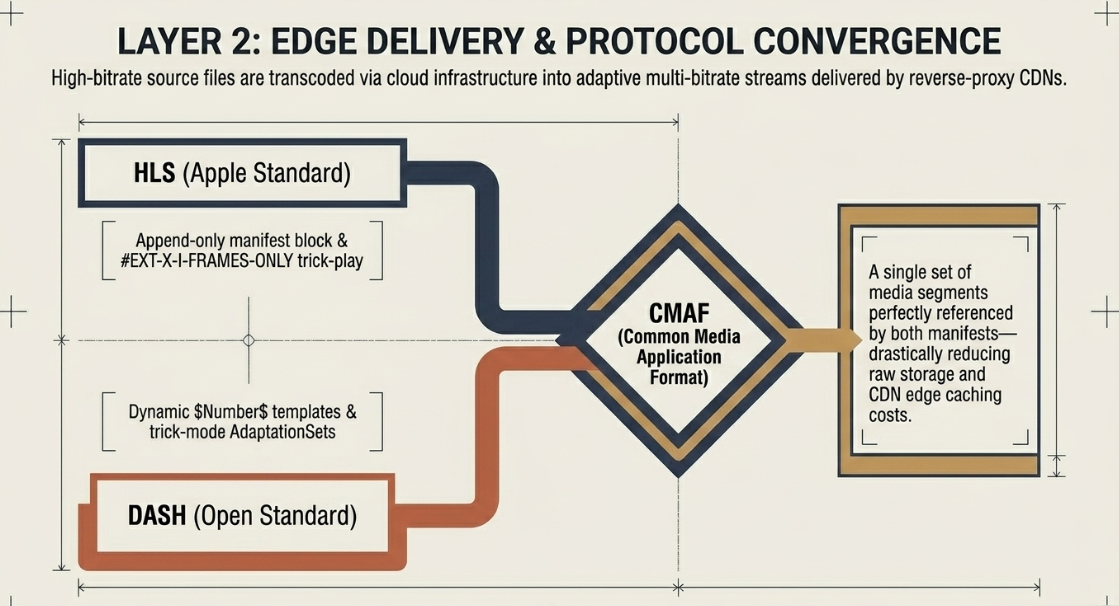
When preparing high-quality audio for distribution, producers often upload uncompressed formats (like.WAV) or high-bitrate stereo.MP3s (e.g., 192 kbps or 320 kbps).17 Cloud infrastructure, such as AWS Elemental MediaConvert, accepts these source files and transcodes them into HLS format.18 HLS operates by chopping the continuous audio file into distinct, typically 10-second segments.18 This allows for adaptive bitrate streaming: the client device and the server dynamically monitor the user's internet throughput and adjust the audio quality on the fly, switching seamlessly between segments encoded at 64 kbps, 128 kbps, or 256 kbps depending on network health.18
While HLS (developed by Apple) and DASH (an open international standard) were historically viewed as competing formats, the industry is rapidly converging on the Common Media Application Format (CMAF).16 CMAF allows a single set of media segments to be referenced by both an HLS playlist and a DASH manifest.16 The primary differences at the player level involve manifest update mechanics (HLS manifests are append-only for live content, while DASH manifests use dynamic $Number$ templates) and trick-play mechanics (HLS utilizes #EXT-X-I-FRAMES-ONLY playlists for fast scrubbing, whereas DASH utilizes trick mode AdaptationSets).16 For enterprise podcasting, this convergence means CDN infrastructure can serve a highly diverse ecosystem of mobile applications without duplicating raw storage costs.
4. Real-Time Distribution Mechanisms and the Podcasting 2.0 Ecosystem
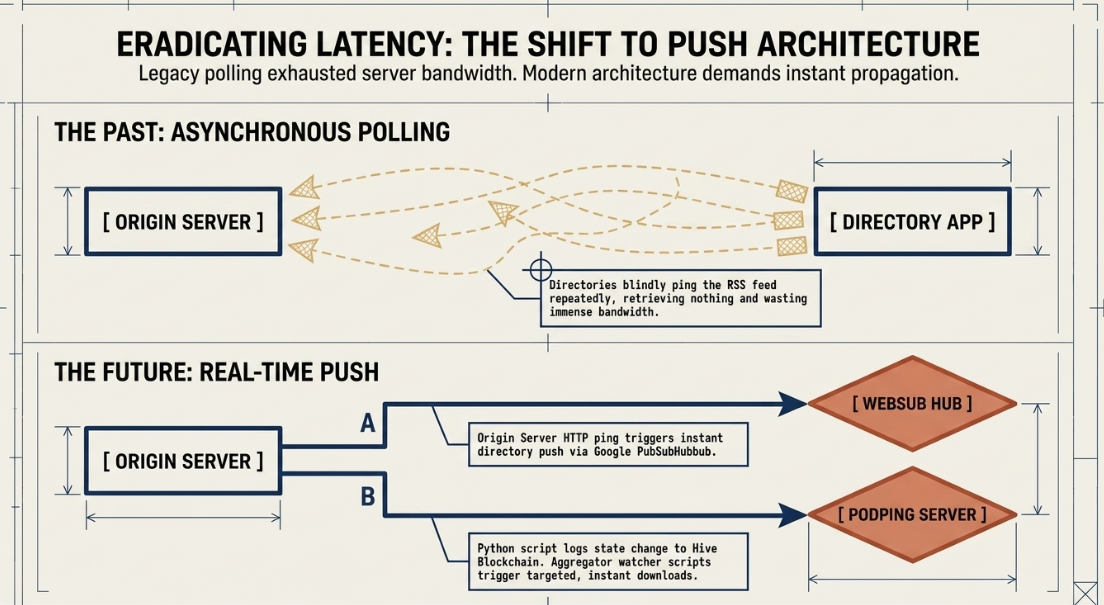
The traditional podcast distribution model relied on asynchronous polling. Podcast client applications (e.g., Apple Podcasts, Overcast, Pocket Casts) would periodically ping an RSS feed to check for new <item> tags indicating a newly published episode. This created significant inefficiencies: constant polling exhausted server bandwidth, while infrequent polling resulted in substantial latency between an episode's publication and its availability to listeners. To resolve these bottlenecks, the industry is aggressively adopting push-based notification protocols.
4.1 The Push Architecture: WebSub and Podping
WebSub (formerly PubSubHubbub), documented as a W3C recommendation (REC-websub), enables real-time feed notifications for RSS and Atom formats.19 In a WebSub architecture, the podcast host inserts specific tags into the RSS feed pointing to a designated WebSub hub (the most prominent being Google's PubSubHubbub hub).21 Podcast directory crawlers subscribe to this centralized hub. When a publisher updates their RSS feed with a new episode, the origin server sends a direct HTTP ping to the hub, which then instantly pushes a notification out to all subscribed directories.19 This eliminates the need for periodic polling, ensuring episodes are propagated across global directories within minutes.20 This protocol is highly effective and is supported by major platforms, including WordPress, which utilizes automated plugins to ping hubs upon content updates.19
However, WebSub relies on centralized hubs. To achieve true decentralization, the Podcasting 2.0 initiative developed Podping.19 Podping functions as a distributed RSS notification system specifically tailored for the podcasting ecosystem, utilizing the Hive blockchain to publish state changes.21 When a new episode goes live, the hosting platform executes a script (such as a Python checkfeeds.py script caching XML data) that notifies the Podping server.22 The server adds that notification as a transaction to the distributed Hive blockchain. Podcast apps and aggregators actively run watcher scripts against the blockchain; upon detecting a new block containing a relevant feed update, the client triggers an immediate, targeted download of the new episode.
4.2 The Podcasting 2.0 Namespace Extensions
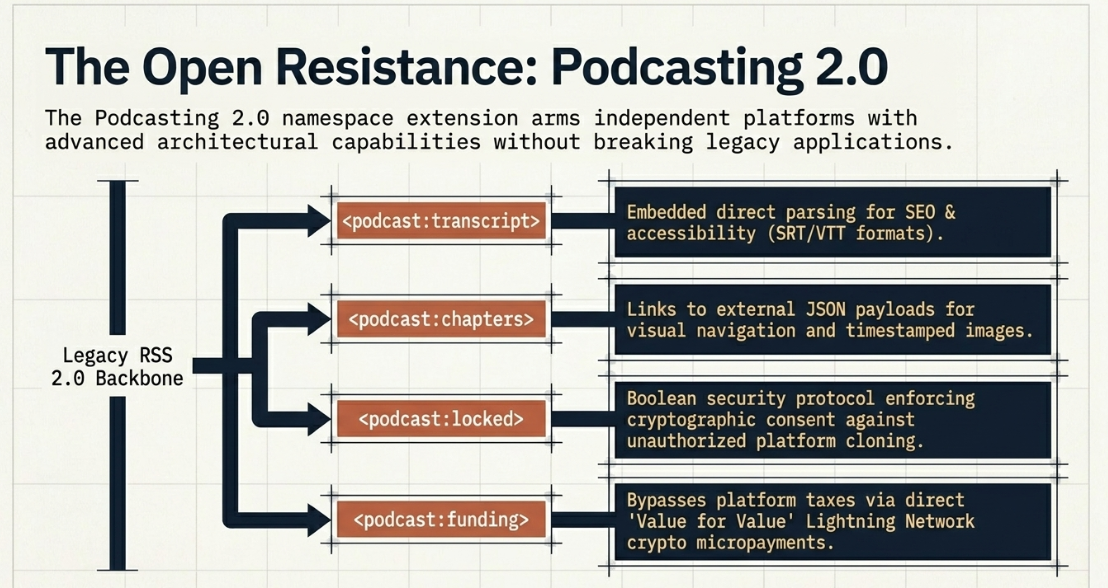
The foundational strength of podcasting relies on the open RSS 2.0 XML schema. However, legacy RSS schemas lack the vocabulary to support modern interactive media features. To bridge this gap without breaking legacy client applications, the Podcasting 2.0 initiative introduced a unified XML namespace extension, declared in the feed header as <rss version="2.0" xmlns:podcast="https://podcastindex.org/namespace/1.0">.23
This namespace introduces highly structured tags that significantly enhance the listener experience and provide enterprise creators with new architectural capabilities.24 Key architectural tags include:
<podcast:transcript>: Allows clients to directly parse and display text transcripts linked in the feed (in various formats like SRT or VTT), which is crucial for SEO optimization, accessibility, and language learning.24
<podcast:chapters>: Links to an external JSON file containing precise timestamp data, chapter titles, and embedded images, enabling users to navigate long-form audio visually.24
<podcast:locked>: A boolean tag (true/false) that serves as a security protocol, explicitly preventing unauthorized platforms from cloning, moving, or importing a podcast feed without the owner's cryptographic consent.26
<podcast:funding>: Establishes a direct "Value for Value" economic model. This tag links to decentralized payment systems (such as Lightning Network cryptocurrency wallets) or traditional membership pages, allowing listeners to stream micro-payments directly to creators, bypassing traditional platform taxation.24
<podcast:soundbite>: Designates specific timestamped segments as promotional teasers, allowing indexing engines and third-party web players to extract short, contextual audio clips for social media sharing or directory previews.24
<podcast:person>, <podcast:season>, <podcast:episode>: Automatically imports highly structured metadata regarding guests, season serialization, and episode numbering, ensuring catalog consistency across disparate listening applications.26
By adopting the "podcast" namespace, independent hosting platforms can deploy interactive features that rival or exceed the proprietary capabilities of closed-system platforms, preserving the decentralized ethos of the audio ecosystem while drastically improving content discoverability.24
5. Monetization Architecture: Server-Side Ad Insertion (SSAI)
The most transformative shift in podcast infrastructure has been the universal adoption of Server-Side Ad Insertion (SSAI), colloquially known in the industry as Dynamic Ad Insertion (DAI). According to the Interactive Advertising Bureau (IAB), DAI now accounts for more than 90% of all podcast advertising revenue.27 It fundamentally separates the underlying content payload from the advertising payload, allowing a single evergreen episode to generate targeted revenue indefinitely.
5.1 The Technical Mechanics of Server-Side Ad Stitching
In legacy podcasting, advertisements were "baked in"—permanently recorded directly into the original audio file. If a B2B brand sponsored an episode in 2018, a listener downloading the episode years later would still hear the obsolete 2018 advertisement, yielding no additional revenue for the creator and offering no value to the defunct campaign.27
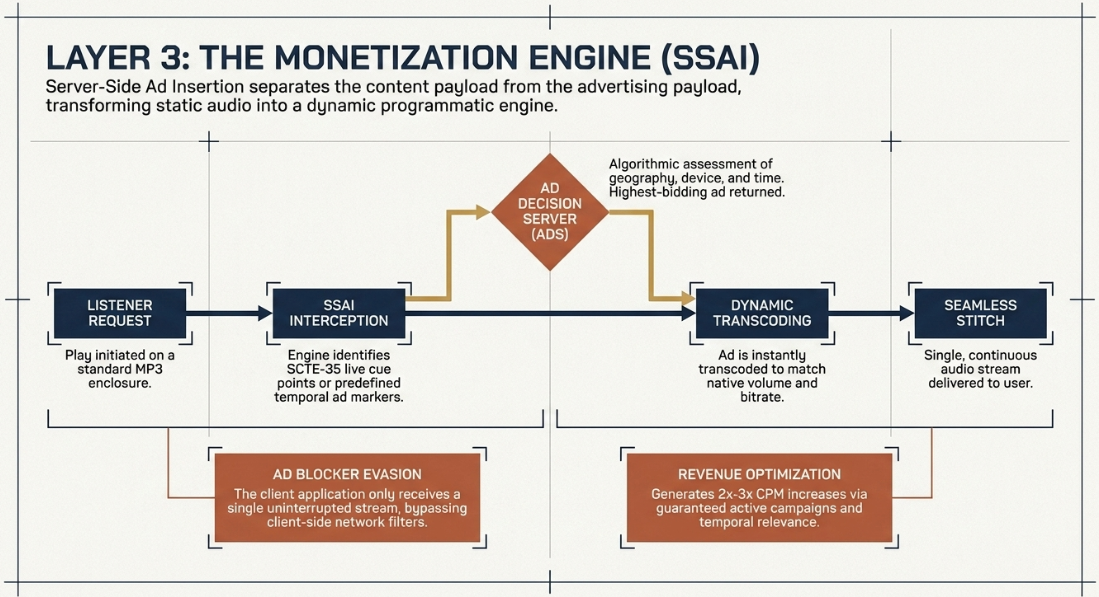
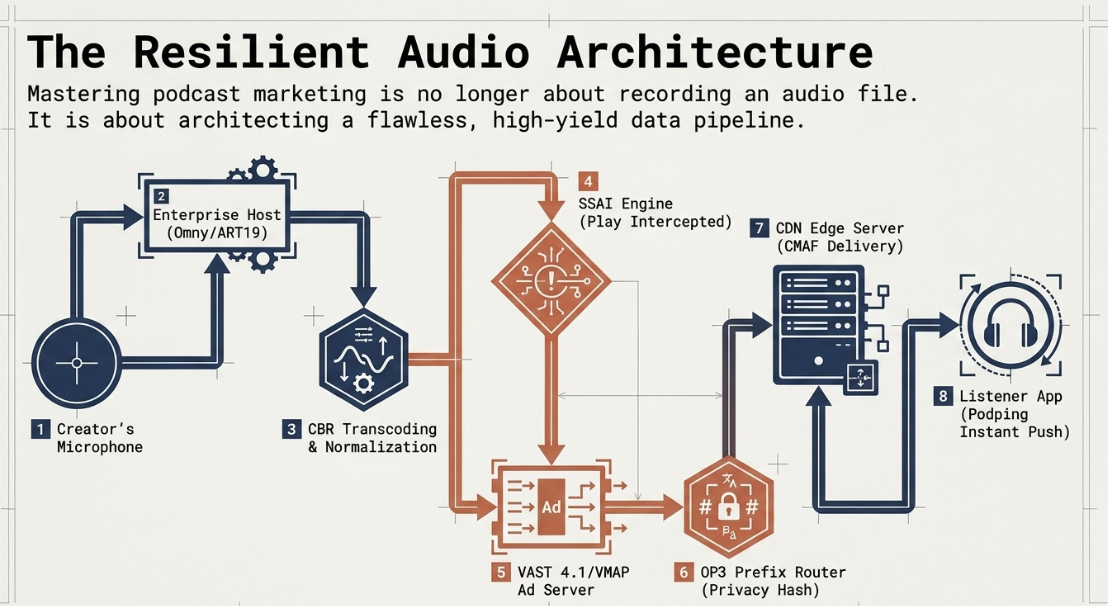
DAI resolves this through dynamic server-side stitching.7 When a user presses play or initiates a download, the request is intercepted by an SSAI engine. The engine identifies predefined cue points (ad markers) established by the producer prior to publishing.27 The server assesses the listener's geographic location, device type, time of day, and available demographic data, and sends a real-time request to an ad decision server (ADS).27
The ADS algorithmically selects the highest-bidding or most contextually relevant audio file and returns it. The SSAI engine then dynamically transcodes and seamlessly stitches the targeted ad directly into the content stream at the designated cue points, creating a single, continuous MP3 or HLS manifest tailored specifically to that individual listener at that exact moment.13
This server-side approach offers three distinct architectural advantages over client-side ad insertion (CSAI):
Seamless User Experience: Because the final product is delivered as a unified file or manifest, there is no latency, buffering, or jarring "black-flash" transition between the content and the advertisement, creating a seamless, TV-like experience.13
Ad Blocker Evasion: Client-side ad blockers function by intercepting requests made from the player to known external ad servers. Because SSAI conducts the ad request purely on the backend server, the client application only receives a single, uninterrupted audio stream, making the ad practically impossible for client-side software to detect and block.29
Revenue Optimization: By ensuring ads are always contextually relevant and temporally fresh, Cost Per Mille (CPM) rates can increase by factors of 2x to 3x, as advertisers are willing to pay premiums for guaranteed active campaigns rather than historical archival placements.31
5.2 Timed Metadata: SCTE-35, ID3, and Live Cue Points
To execute accurate server-side ad stitching, the audio architecture must utilize highly precise timed metadata. Unlike static ID3 tags (which contain unchanging information like the podcast title or cover art for the entire file length), timed metadata introduces actionable signals at specific timestamps within the media stream.32
For live-to-VOD architectures—such as radio broadcasts being repurposed as podcasts—this relies heavily on SCTE markers (SCTE-104 for uncompressed feeds and SCTE-35 for compressed feeds).30 SCTE-35 is an industry-standard protocol that embeds cue points into the broadcast stream.34 When a live broadcast is passed through an encoder, the SCTE-35 markers signal exact splice points where linear broadcast commercials are located.34
Through APIs like Brightcove's live streaming endpoints, SSAI engines read these integer arrays containing SCTE-35 splice information (ad_server_data_format).34 AWS Elemental MediaLive and similar processing services utilize these arrays to precisely strip out the localized broadcast ads and insert digital, programmatically targeted advertisements in their place, ensuring the transition is frame-accurate and synchronous with the audio.30 Without synchronous streaming protocols handling this metadata, accurate cue point alignment fails, resulting in ads cutting off the host mid-sentence.
5.3 The Imperative of Constant Bitrate (CBR) Encoding
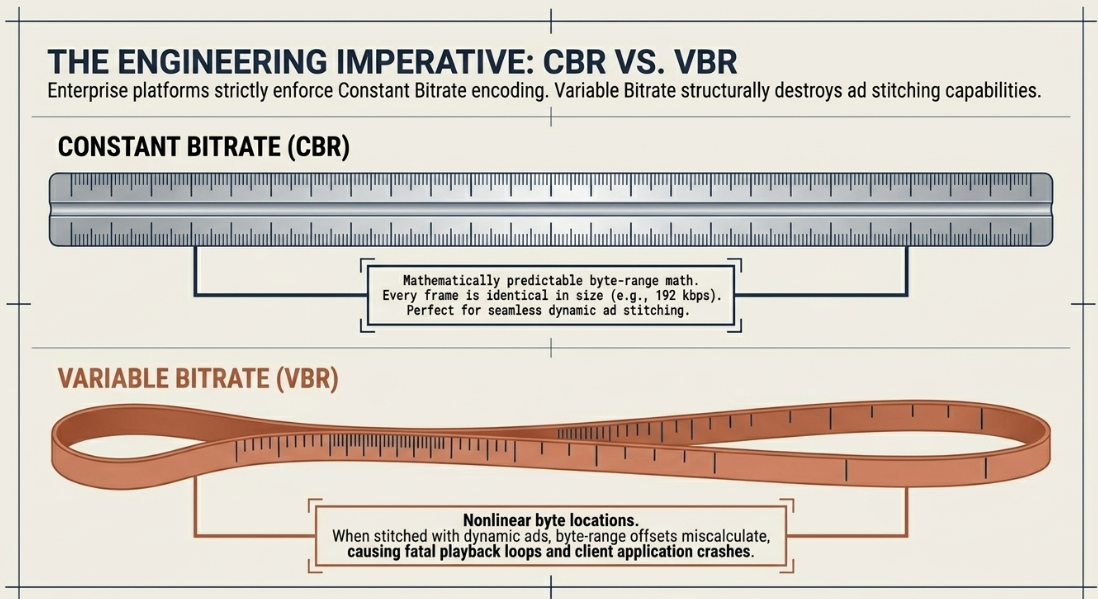
A highly technical yet non-negotiable requirement for successful podcast DAI is the audio encoding format. Platforms executing ad stitching, such as Triton Digital and Megaphone, strictly require files to be encoded using Constant Bitrate (CBR) rather than Variable Bitrate (VBR).10
In a CBR MP3 file, every frame of audio contains the exact same amount of data (e.g., 192 kbps).17 This creates mathematically predictable file sizes and highly consistent streaming performance.39 Conversely, VBR optimizes file size by allocating more data to complex audio segments (like loud intro music or multi-voice overlap) and less data to simple segments (like silence or a single voice).39
While VBR is efficient for standalone archival files, it is catastrophic for server-side ad stitching infrastructure.10 When a media player streams a podcast, it uses "byte-range requests" to buffer specific portions of the file or to allow the user to scrub forward and backward.40 In a dynamically stitched VBR file, the relationship between a chronological timestamp and its physical byte location becomes nonlinear and mathematically unpredictable.41 If a user attempts to pause, resume, or skip forward in a stitched VBR file, the player will miscalculate the byte-range offset. This frequently causes the episode to loop back to the beginning, skip erratically, or crash the playback entirely.41
Consequently, enterprise platforms strictly enforce CBR encoding, utilizing mandatory server-side transcoding pipelines to force non-compliant VBR files into CBR before they are eligible for programmatic monetization.10 Furthermore, these transcoding pipelines apply Dynamic Range Control (DRC) and volume normalization (adhering to R128 or LUFS standards) to ensure that dynamically inserted ads match the native loudness of the creator's content, preventing jarring auditory spikes that degrade the listener experience.10
6. Advanced Ad Tech Protocols: VAST, VMAP, and Client-Side SDKs
The integration of podcasting into the broader programmatic advertising ecosystem requires standardized communication protocols between podcast hosting platforms (the supply side) and ad decision servers (the demand side).
6.1 The Evolution from DAAST to VAST 4.1
Initially, the interactive audio space lacked a unified technical schema, leading the IAB to introduce the Digital Audio Ad Serving Template (DAAST) in 2014.42 DAAST provided a foundational, XML-based vocabulary specifically tailored to the unique constraints of audio advertising—particularly environments like mobile devices, smart speakers, or in-car dashboards where users lack access to a web browser or a visual interface, complicating traditional pixel-tracking and interaction metrics.42
However, as multimedia programmatic buying matured, maintaining separate, divergent templates for video (VAST) and audio (DAAST) proved highly inefficient for omnichannel ad exchanges.43 In November 2018, the IAB officially deprecated DAAST, merging all audio-specific specifications into the Video Ad Serving Template (VAST) standard, beginning with the release of VAST 4.1.43
6.2 Audio Optimization within VAST and VMAP
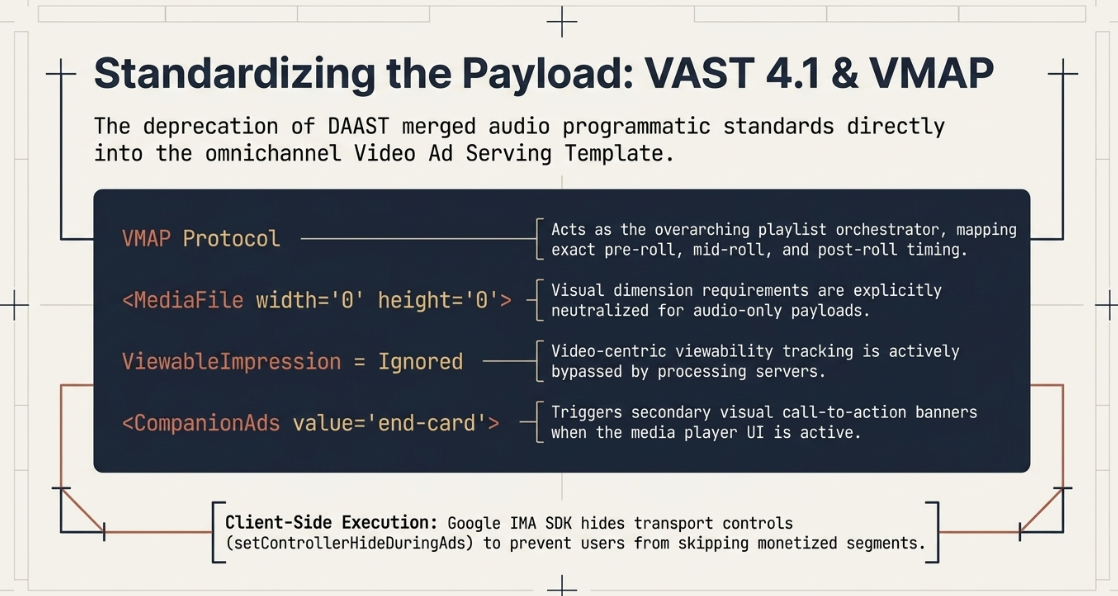
VAST 4.1 and subsequent iterations provide a unified XML schema that transfers metadata, high-resolution mezzanine creative files, and tracking pixels from the ad server to the media player or SSAI engine.44 To accommodate audio seamlessly, VAST nodes include explicit modifiers. For example, in a standard <MediaFile> object, the visual dimensions of width and height are strictly required by the XML schema; for programmatic audio requests, the standard dictates these attributes must simply be passed with a value of "0".45
Similarly, VAST 4.1 clarifies that certain video-centric metrics, such as "ViewableImpression," are inherently invalid for audio and should be actively ignored by processing servers.45 Conversely, audio-centric tracking events (like starts, first quartile, midpoint, and complete) must fire successfully even if the media player is operating in a minimized or background state on a mobile device.45 The standard also ported over DAAST's <Expires> attribute, an integer value allowing a player to intelligently discard a pre-fetched audio ad if a timeout threshold is exceeded before playback, ensuring that time-sensitive campaigns remain relevant.45
Furthermore, audio ads can utilize <CompanionAds>, secondary visual ads included in the VAST tag that accompany the audio.47 A value of "end-card" signals to the player that this companion ad (such as a Call-To-Action banner) should be displayed on the screen after the audio completes.47
When managing multiple ad breaks within a single podcast episode, platforms utilize VMAP (Video Multiple Ad Playlist).44 VMAP acts as an overarching programmatic schedule, detailing the exact timing of pre-roll, mid-roll, and post-roll ad slots.44 When an SSAI engine reads a VMAP document, it knows exactly when to execute subsequent VAST requests to fill the designated inventory seamlessly.
6.3 Client-Side Execution and IMA SDKs
While SSAI handles the heavy lifting, client applications still require sophisticated software to render the data. Developers building audio apps (like Android applications) frequently utilize Google's Interactive Media Ads (IMA) SDKs.15 For instance, the Android ExoPlayer library utilizes ImaAdsLoader to wrap the functionality of the client-side IMA SDK, supporting the automatic insertion of VAST and VMAP ads.48
To optimize performance, developers must call the ImaSdkFactory.initialize() method as early as possible in the app lifecycle, maximizing the time IMA has to load necessary resources before the first ad request is made.48 The SDK also handles UI considerations automatically; for example, the PlayerView function hides standard transport controls (play/pause/skip) during the playback of ads (setControllerHideDuringAds), preventing users from easily bypassing the monetized segments, while rendering "more info" links directly over the player.48
7. Proprietary Enclosure: Streaming Ad Insertion (SAI) vs. Traditional DAI
While RSS-based Server-Side Ad Insertion (DAI) represents the current open industry standard, strategic shifts by major platform aggregators are actively challenging the open-ecosystem model. The most significant development in this sector is Spotify's deployment of proprietary Streaming Ad Insertion (SAI).3
7.1 The Limitations of Download-Based Metrics
Traditional RSS podcasting relies heavily on the asynchronous download model. When a user subscribes to a podcast, their app typically downloads the file in the background while on Wi-Fi.51 From a measurement perspective, the hosting server records a successful file delivery to the device.51 However, the server has absolutely no technical visibility into what happens after the file reaches the user's hard drive. The host cannot definitively prove if the user actually listened to the entire episode, if they manually skipped past the dynamically inserted ads using a +30 seconds button, or if they ever pressed play at all.52 This inherent, structural opaqueness has historically frustrated brand advertisers who have grown accustomed to the highly deterministic, real-time impression tracking available on web display and video platforms.
7.2 The Mechanics of Streaming Ad Insertion
Spotify engineered SAI specifically to solve this exact limitation by fundamentally abandoning the background download model within its proprietary application ecosystem.55 SAI is an exclusive, closed-loop technology that functions only within the native Spotify app, and is only available for shows hosted directly on Spotify for Creators or Megaphone.55
When a user listens to a podcast on Spotify, the audio is delivered via a continuous internet stream rather than a progressive download. Instead of stitching the ad into the file at the server level before delivery, SAI makes a real-time programmatic call to the ad server the exact instant the playback cursor hits the ad marker during active listening within the app.55
This architectural shift carries profound implications for measurement, targeting, and campaign reporting. Because the ad is served dynamically during active playback, SAI records a confirmed, deterministic ad impression in real-time.4 Advertisers receive granular data detailing verified impressions, unique reach, frequency, and exact completion rates.50 Furthermore, because the user is persistently logged into the Spotify ecosystem, targeting algorithms rely on highly deterministic first-party data (age, gender, musical tastes, behavioral habits, device usage) rather than the probabilistic data (IP addresses and user agents) relied upon by standard RSS DAI networks.8
By pairing SAI with interactive Call-To-Action (CTA) display cards inside the app, Spotify is building a rich, interactive ad experience that is technologically impossible to replicate over open RSS feeds.50 However, as previously noted, this requires creators to accept less favorable revenue splits and surrender direct control over their listener relationships, accelerating the bifurcation of the podcasting industry into two distinct infrastructural camps: open RSS and closed streaming networks.1
8. Precision Measurement and Analytics: The IAB Guidelines
Because traditional podcasting operates on a disconnected, server-side log model rather than a persistent client-server connection, standardizing audience measurement has historically been fraught with discrepancies and inflated metrics.52 To establish trust with enterprise brand advertisers, the industry relies exclusively upon the IAB Tech Lab Podcast Measurement Technical Guidelines.51
8.1 Moving from Raw Logs to Validated Listens
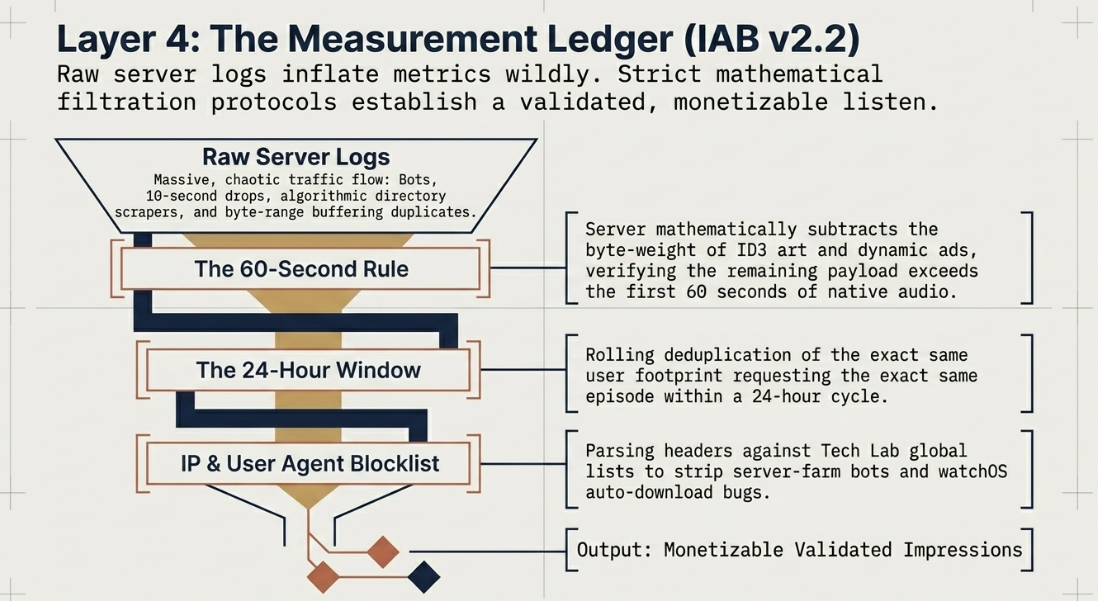
A raw server log records every HTTP request made for a file.53 However, counting raw requests wildly inflates audience metrics.52 A single listener with a fluctuating cellular connection might trigger twenty separate partial byte-range requests during a single commute as their app struggles to buffer the file.40 Similarly, automated bots, search engine crawlers, and algorithmic directory scrapers generate vast amounts of non-human traffic.53 For instance, if a raw log shows 100,000 downloads, unfiltered data cannot determine if this was 100,000 human listeners, or a single bot pinging the server repeatedly.53
The IAB guidelines (specifically transitioning from version 2.1 to the newly released version 2.2 in May 2024) mandate a highly rigorous filtration process to convert raw server logs into a validated, monetizable "listen".56 To achieve IAB compliance certification, hosting platforms must enforce the following architectural rules:
8.2 The Nuances of Payload Calculation and v2.2 Compliance
Enforcing the 60-second rule requires precise mathematical calculation at the CDN level. The bytes served by the hosting platform encompass far more than just the native audio track. The total HTTP payload includes response headers, static ID3 metadata (heavy, high-resolution cover art), and the specific byte-weight of the dynamically inserted advertisements stitched into that exact user's file.59
To confirm that a user successfully downloaded the equivalent of 60 seconds of native content, the server's analytics engine must identify the exact sizes and positions of all these non-native elements, mathematically subtract them from the total bytes served, and then calculate if the remaining payload meets the required threshold.59 This intricate subtraction highlights the deep technological dependency between ad-tech insertion engines and analytics verification systems.
With the release of IAB version 2.2, the guidelines further tightened compliance protocols.60 Notably, Spotify removed itself as a contributing company to the IAB prior to the v2.2 release, further cementing its strategic pivot toward its proprietary SAI metrics rather than open industry standards.60 Furthermore, v2.2 explicitly mandates that to claim compliance with the guidelines, an organization must successfully pass the formal IAB Tech Lab certification process and be officially listed on the IAB Tech Lab website.60 This regulatory shift was designed to eliminate deceptive marketing by lower-tier hosting platforms claiming "IAB-style" metrics without undergoing third-party auditing.60 Platforms are also encouraged to utilize a Document of Methodology (DOM) to maintain absolute transparency regarding their specific data filtering methods.52
9. Tracking Vectors and Privacy Compliance: Prefixes and the GDPR Imperative
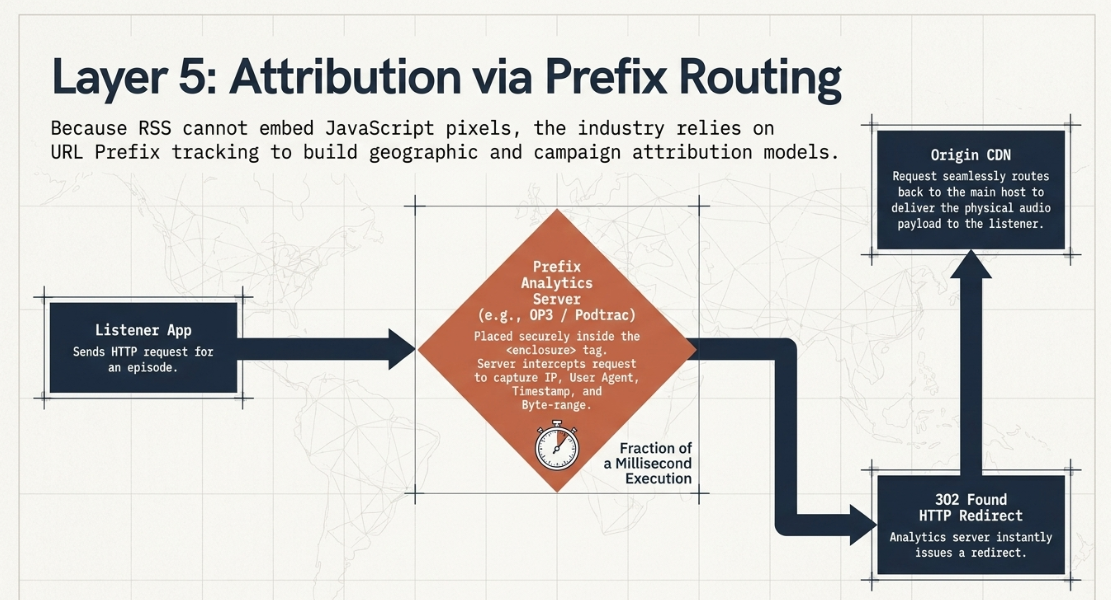
While the IAB standardizes how a download is counted, strategic podcast marketing requires advanced attribution modeling to understand who is downloading and what post-listening actions they take. Because podcasts rely on RSS, publishers cannot embed javascript tracking pixels natively within the audio file itself.61 Instead, the industry relies on URL Prefix tracking.62
9.1 The Architecture of Prefix Tracking
A prefix URL is a trackable domain strung directly before the native MP3 file URL inside the RSS feed's <enclosure> tag.61 When a listener's app attempts to download the episode, the HTTP request does not go straight to the hosting server. Instead, it hits the prefix analytics server first (e.g., Podtrac, OP3).62
In a fraction of a millisecond, the analytics server records the listener's IP address, User Agent, byte-range request, and timestamp.40 It then immediately responds to the app with a 302 Found HTTP redirect, seamlessly routing the request to the actual hosting CDN to deliver the audio file.63 This dual-routing mechanism allows third-party data firms to construct highly accurate geographic, device, and campaign attribution reports (such as measuring how many devices downloaded a show after a specific ad promotion) without interfering with the physical delivery of the media.61
Historically, Chartable was the dominant prefix analytics platform, providing crucial SmartLinks and SmartPromos to measure cross-promotional ROI across the industry.65 However, following its acquisition by Spotify, the service was abruptly shut down in December 2024, leaving countless podcasters with broken tracking infrastructure.65 This strategic sunsetting was widely viewed as a move by Spotify to reallocate resources internally and force publishers deeper into the proprietary SPAN analytics ecosystem, eliminating independent oversight.
9.2 The Rise of Open-Source Alternatives: OP3
The vacuum left by Chartable's termination catalyzed the rapid adoption of the Open Podcast Prefix Project (OP3).66 OP3 represents a radical departure from proprietary, venture-backed data brokers. It is an open-source, open-data prefix analytics service designed specifically to prevent the monopolization and misuse of listener data by private conglomerates.67
OP3 utilizes the standard prefix routing mechanism (by prepending https://op3.dev/e/ to URLs) but functions strictly within the bounds of open collaboration.69 It adheres strictly to IAB v2 specifications, processing IP addresses and classifying bots using a transparent, open list of User Agents maintained in partnership with the Open Podcast Analytics Working Group.68 Crucially, because OP3's data is exposed via a public API, it provides the fragmented podcasting industry with universally verifiable, tamper-proof analytics that mirror the transparency of platforms like YouTube, anticipating complex integrations for monthly and weekly download analytics, industry rankings, and direct comparisons between different shows.67
9.3 Data Privacy, IP Hashing, and GDPR Compliance
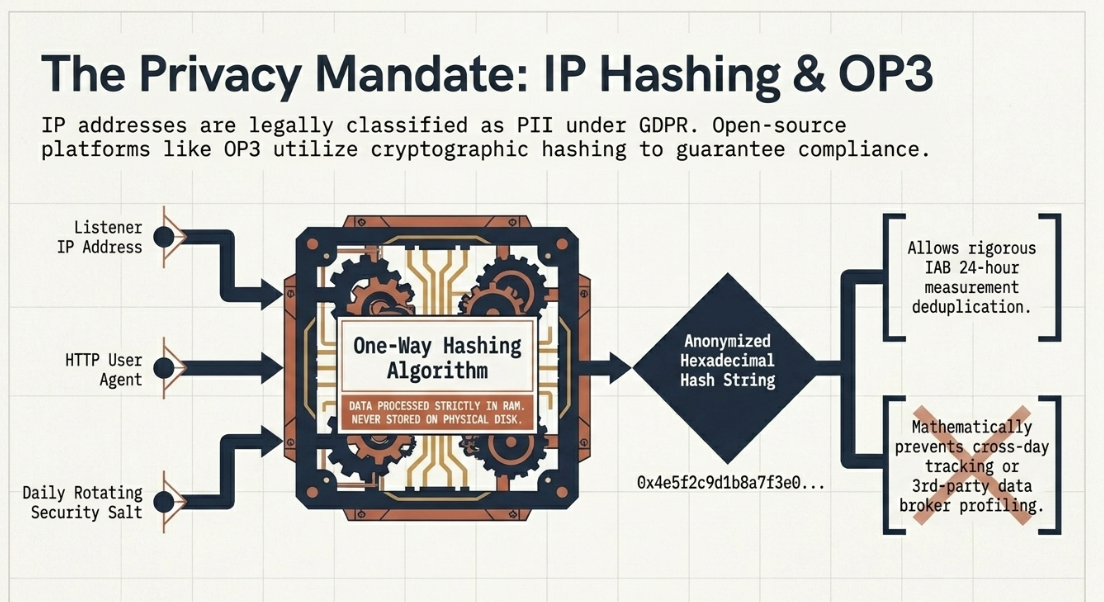
As prefix tracking architectures have grown more sophisticated, so too have the regulatory frameworks governing them. The European Union's General Data Protection Regulation (GDPR) and similar legislative frameworks explicitly classify IP addresses as Personally Identifiable Information (PII).71 Because the entire podcast analytics framework—from IAB deduplication algorithms to prefix attribution models—relies heavily on IP address capture, platforms must engineer strict, fail-proof compliance mechanisms.53
Podcast hosts and analytics providers generally operate as "data controllers," determining the purpose and means of processing data.72 To track analytics without violating ePrivacy compliance directives or requiring intrusive, conversion-killing cookie-consent banners, modern platforms must entirely abandon device fingerprinting, cookies, localStorage, and sessionStorage.66
Instead, privacy-first podcast analytics infrastructure utilizes cryptographic hashing. When an IP address and User Agent hit the prefix server, they are instantly combined with a secure "salt" (a random string of data) and passed through a one-way hashing algorithm to generate a unique, anonymized string.68 In highly compliant, GDPR-safe architectures, this salt is rotated dynamically on a daily basis.66
This methodology ensures that the original IP address is never stored on the physical disk; it exists only momentarily in the server's RAM.66 The resulting hash allows the system to recognize that multiple requests came from the same unique listener on a specific day (fulfilling the IAB 24-hour window requirement for deduplication), but mathematically prevents the platform from tracking that individual across multiple days, cross-referencing their identity with third-party data brokers, or matching their activity across multiple devices.66 While this limits the deep, cross-device behavioral profiling desired by some marketers, it strikes the mandatory operational balance between generating reliable aggregate audience metrics and adhering to rigorous international privacy law.
Conclusion
The strategic architecture of podcast marketing has evolved far beyond the mere creation of audio content; it is now fundamentally an infrastructural and data-science discipline. Success in the modern audio ecosystem is dictated by a publisher's ability to navigate, select, and leverage highly complex, interdependent technologies ranging from edge-caching CDNs to programmatic SSAI engines.
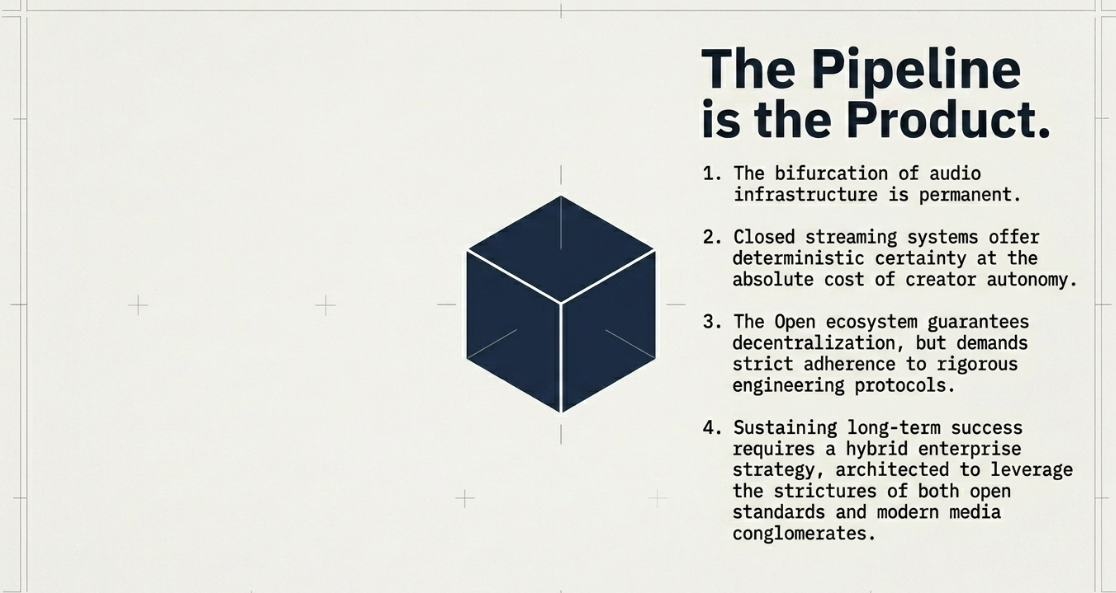
The bifurcation of the market is stark and irreversible. On one side, centralized media aggregators are utilizing proprietary technologies like Streaming Ad Insertion (SAI) to abandon the historical limitations of RSS. By doing so, they offer advertisers the deterministic measurement, granular targeting, and interactive UI components characteristic of modern digital marketing, albeit at the steep cost of creator autonomy, decentralized distribution, and favorable revenue shares.
On the other side, the open ecosystem is aggressively modernizing to close the technological gap. Through the universal adoption of Server-Side Ad Insertion (SSAI), the enforcement of mathematically rigorous IAB 2.2 measurement standards, the rollout of VAST 4.1 programmatic schemas for audio, and the integration of Podcasting 2.0 namespace extensions, open RSS is maintaining its viability as a highly lucrative, decentralized, and competitive marketplace.
For enterprise publishers, broadcast networks, and strategic marketing architects, sustaining a successful audio ecosystem requires a highly sophisticated, hybrid technical strategy. It demands selecting enterprise hosting platforms capable of seamless, normalized CBR ad stitching and complex VMAP scheduling. It requires leveraging real-time, push-based distribution protocols like WebSub and Podping to guarantee instantaneous global availability across disparate directory networks. Finally, it necessitates deploying privacy-first, server-side attribution models—leveraging open-source tools like OP3 and cryptographic IP hashing—that provide rigorous, GDPR-compliant campaign tracking without violating user trust. By mastering this technical infrastructure stack, organizations can build resilient, high-yield audio networks capable of adapting to both the open web and the proprietary strictures of modern media conglomerates.
Works cited
Spotify's Podcast Monetization Strategy: From Acquisition-Led Growth to Creator Marketplace - MarkHub24, accessed June 11, 2026, https://www.markhub24.com/post/spotify-s-podcast-monetization-strategy-from-acquisition-led-growth-to-creator-marketplace
Podcasting in a Platform Age: From an Amateur to a Professional Medium 9781501380709, 9781501380693, 9781501380679 - DOKUMEN.PUB, accessed June 11, 2026, https://dokumen.pub/podcasting-in-a-platform-age-from-an-amateur-to-a-professional-medium-9781501380709-9781501380693-9781501380679.html
Spotify Acquires Megaphone, Allowing Insertion of Streaming Ads - Carpenter Wellington PLLC, accessed June 11, 2026, https://carpenterwellington.com/post/spotify-acquires-megaphone-allowing-insertion-streaming-ads/
1 SPOTIFY 2022 INVESTOR DAY TRANSCRIPT - Googleapis.com, accessed June 11, 2026, https://storage.googleapis.com/pr-newsroom-wp/1/2022/06/SPOTIFY-2022-INVESTOR-DAY-TRANSCRIPT-1.pdf
Podcast Domain Database | Audio Content Categorization, accessed June 11, 2026, https://www.urlcategorizationdatabase.com/industries/podcasting-domains.php
The 14 Best Podcast Distribution Platforms For B2B Growth In 2026 - Fame.so, accessed June 11, 2026, https://www.fame.so/post/best-podcast-distribution-platforms
Megaphone Features, accessed June 11, 2026, https://support.megaphone.fm/en/articles/1572337-megaphone-features
Spotify Shares Our Vision To Become the World's Creator Platform, accessed June 11, 2026, https://newsroom.spotify.com/2022-06-08/spotify-shares-our-vision-to-become-the-worlds-creator-platform/
Best Triton Digital Alternatives & Competitors - SourceForge, accessed June 11, 2026, https://sourceforge.net/software/product/Triton-Digital/alternatives
Integrating your podcast CMS and monetizing with Triton Digital, accessed June 11, 2026, https://help.tritondigital.com/docs/integrating-your-podcast-cms-and-monetizing
Press Releases - Sounds Profitable, accessed June 11, 2026, https://soundsprofitable.com/press-release/
Top Podcast CDNs by Episode Share (April 2026), accessed June 11, 2026, https://livewire.io/podcast-cdns-by-episode-share/
Dynamic Ad Insertion - AGR Technology, accessed June 11, 2026, https://agrtech.com.au/glossary/dynamic-ad-insertion/
Which podcast platform? - Reddit, accessed June 11, 2026, https://www.reddit.com/r/podcasting/comments/1df87nb/which_podcast_platform/
krzemienski/awesome-video: A curated list of awesome streaming video tools, frameworks, libraries, and learning resources. - GitHub, accessed June 11, 2026, https://github.com/krzemienski/awesome-video
HLS vs DASH in 2026: A Plain-English Comparison for Creators and Devs - CutFast, accessed June 11, 2026, https://cutfa.st/blog/hls-vs-dash-2026-creators-developers-comparison-en
Audio Editing Basics for Podcasters and Authors: Beginners Guide 2026 - Automateed, accessed June 11, 2026, https://www.automateed.com/audio-editing-basics-for-podcasters-and-authors
Monetize audio-only content with AWS Elemental MediaTailor | AWS for M&E Blog, accessed June 11, 2026, https://aws.amazon.com/blogs/media/monetize-audio-only-content-with-aws-elemental-mediatailor/
WebSub - Grokipedia, accessed June 11, 2026, https://grokipedia.com/page/WebSub
Podcast RSS Feeds: What They Are and How They Work - Podcasting Authority, accessed June 11, 2026, https://podcastingauthority.com/podcast-rss-feed/
WebSub and Podping support! - Pocket Casts Blog, accessed June 11, 2026, https://blog.pocketcasts.com/2024/04/26/websub-and-podping-support/
Pushover and PodPing from RSS - TechDistortion, accessed June 11, 2026, https://techdistortion.com/articles/pushover-and-podping-from-rss/
RSS Namespace Extension for Podcasting (Tag Specification), accessed June 11, 2026, https://podcasting2.org/docs/podcast-namespace/1.0
podcast-namespace/podcasting2.0.md at main - GitHub, accessed June 11, 2026, https://github.com/Podcastindex-org/podcast-namespace/blob/main/podcasting2.0.md?ref=zine.wavlake.com
Podcasting 2.0 - Making podcasts better for everyone!, accessed June 11, 2026, https://podcasting2.org/
Exploring the new standard for podcast RSS feeds (Podcasting 2.0) - Beamly, accessed June 11, 2026, https://beamly.com/exploring-the-new-standard-for-podcast-rss-feeds/
What B2B Marketers Should Know About Dynamic Ad Insertion in Podcasts - Content Allies, accessed June 11, 2026, https://contentallies.com/learn/dynamic-ad-insertion-for-b2b-podcasters
Megaphone Podcasts: Episodes and Dynamic Ad Markers | IPN, accessed June 11, 2026, https://independentpodcast.network/training/megaphone-podcasts-episodes-and-dynamic-ad-markers/
Understanding Server-Side Ad Insertion (SSAI) - Amagi Support Portal, accessed June 11, 2026, https://support.amagi.tv/support/solutions/articles/69000866366-understanding-server-side-ad-insertion-ssai-
AWS Elemental MediaTailor – AWS for M&E Blog - Amazon.com, accessed June 11, 2026, https://aws.amazon.com/blogs/media/tag/aws-elemental-mediatailor/feed/
Video Streaming App Monetisation in 2026: SVOD, AVOD, TVOD & IAP on iOS and Android, accessed June 11, 2026, https://www.forasoft.com/blog/article/video-streaming-app-monetization-strategies
PODCAST MANAGEMENT SERVICES | TOP PHOENIX ARIZONA PODCASTING STUDIO, accessed June 11, 2026, https://www.azpodstudio.com/podcast-management
How to make your media streams smarter using timed metadata, accessed June 11, 2026, https://www.unified-streaming.com/blog/how-to-make-your-media-streams-smarter-using-timed-metadata
NextGen Live API Reference - Brightcove Live Documentation, accessed June 11, 2026, https://live.support.brightcove.com/live-2-0/reference.html
StreamS/Modulation Index, LLC. Company Profile, accessed June 11, 2026, https://www.streamingmedia.com/Sourcebook/StreamS-Modulation-Index-LLC.-5659.aspx
Server-Side Ad Insertion (SSAI) for Linear TV & FAST Channels | Muvi playout, accessed June 11, 2026, https://www.muvi.com/playout/features/server-side-ad-insertion-ssai/
NRSC-G304 Metadata for Streaming Audio Handbook October 2023 - National Radio Systems Committee, accessed June 11, 2026, https://www.nrscstandards.org/standards-and-guidelines/documents/guidelines/nrsc-g304.pdf
The transcript is out-of-sync - Snipd Help Center, accessed June 11, 2026, https://support.snipd.com/en/articles/10226250-the-transcript-is-out-of-sync
Audacity How to Save as MP3 - Swell AI, accessed June 11, 2026, https://www.swellai.com/blog/audacity-how-to-save-as-mp3
Podcast Technical Measurement Guidelines Version . - IAB Tech Lab, accessed June 11, 2026, https://iabtechlab.com/wp-content/uploads/2024/02/PodcastMeasurement_v2.2_pc.pdf
Podcast Playback Error - Is it an MP3 export issue? - Reddit, accessed June 11, 2026, https://www.reddit.com/r/podcasts/comments/c2xxnq/podcast_playback_error_is_it_an_mp3_export_issue/
Digital Audio Ad Serving Template (DAAST) - IAB Tech Lab, accessed June 11, 2026, https://iabtechlab.com/standards-old/digital-audio-ad-serving-template-daast/
The Essential Guide to Programmatic Radio Advertising - Raincross, accessed June 11, 2026, https://raincross.com/programmatic-radio-advertising-guide/
Digital Video Ad Serving Template (VAST) - IAB Tech Lab, accessed June 11, 2026, https://iabtechlab.com/standards/vast/
VAST 4.1 - Now With Audio Power! - IAB Tech Lab, accessed June 11, 2026, https://iabtechlab.com/vast-4-1-now-with-audio-power/
What is Programmatic Audio and How Does it Work? - Avenga, accessed June 11, 2026, https://www.avenga.com/magazine/programmatic-audio/
CTV Programmatic Guide - IAB Tech Lab, accessed June 11, 2026, https://iabtechlab.com/standards-old/ctv-programmatic-guide/
Ad insertion | Android media, accessed June 11, 2026, https://developer.android.com/media/media3/exoplayer/ad-insertion
Rewriting the playbook for podcast ads - Spotify Advertising, accessed June 11, 2026, https://ads.spotify.com/en-US/news-and-insights/streaming-ad-insertion-podcast-advertising/
How Spotify is revolutionizing podcast ads | The Current, accessed June 11, 2026, https://www.thecurrent.com/articles/how-spotify-is-revolutionizing-podcast-ads
Podcast Measurement Technical Guidelines Version 2.1 - IAB Tech Lab, accessed June 11, 2026, https://iabtechlab.com/wp-content/uploads/2021/03/PodcastMeasurement_v2.1.pdf
Podcast Measurement Technical Guidelines Version 2.1 - Podnews, accessed June 11, 2026, https://podnews.net/uploads/iab-v2.1-and-v2.2.pdf
PODCAST GUIDANCE - Platform Privacy Restrictions - IAB Tech Lab, accessed June 11, 2026, https://iabtechlab.com/wp-content/uploads/2022/07/Podcast-Guidance-Privacy-Restrictions.pdf
Taking Podcast Ads To The Next Level - Spotify Advertising, accessed June 11, 2026, https://ads.spotify.com/en-US/news-and-insights/2021-podcast-ads-announcements/
How To Monetize a Video Podcast On Spotify In 2026, accessed June 11, 2026, https://thepodcasthaven.com/how-to-monetize-a-video-podcast-on-spotify-in-2026/
Podcast Measurement Technical Guidelines - IAB Tech Lab, accessed June 11, 2026, https://iabtechlab.com/standards/podcast-measurement-guidelines/
IAB Tech Lab 2.1 : All you need to know - Ausha, accessed June 11, 2026, https://www.ausha.co/blog/productlove-iab-tech-lab-2-1-standards/
Podcast Measurement ec n ca u de nes Version 2.2 - IAB Tech Lab, accessed June 11, 2026, https://iabtechlab.com/wp-content/uploads/2024/02/PodcastMeasurement_v2.2_final.pdf
Server-side podcast metrics. By Christian Milz and Jonas Björk | by ..., accessed June 11, 2026, https://medium.com/acast-tech/server-side-podcast-metrics-bf8cf6c7ddec
IAB Podcast Measurement v2.2 rolls out - Podnews, accessed June 11, 2026, https://podnews.net/update/iab-2-point-2-podcast-measurement
What's the Deal with Chartable & Prefix URLs? - RedCircle Blog, accessed June 11, 2026, https://redcircle.com/blog/whats-the-deal-with-chartable-prefix-urls/
What are prefixes and how do I add them? - Buzzsprout, accessed June 11, 2026, https://www.buzzsprout.com/help/198-prefix
Using podcast trackers - iono.fm, accessed June 11, 2026, https://support.iono.fm/docs/podcast-trackers
Podcast Prefix Analytics Explained - Sounds Profitable, accessed June 11, 2026, https://soundsprofitable.com/article/podcast-prefix-analytics-explained/
Chartable Is Shutting Down -- Will Your Podcast Data Break a - Firstory, accessed June 11, 2026, https://firstory.me/en/blog/chartable-podcast
I built a GDPR-compliant podcast analytics tool. Now I need to know what's wrong with it., accessed June 11, 2026, https://www.reddit.com/r/SaaS/comments/1s4fu1e/i_built_a_gdprcompliant_podcast_analytics_tool/
Value your analytics data with OP3, an open-source and trusted third party - Castopod blog, accessed June 11, 2026, https://blog.castopod.org/value-your-analytics-data-with-op3-an-open-source-and-trusted-third-party/
Understanding OP3 with John Spurlock - Castopod blog, accessed June 11, 2026, https://blog.castopod.org/understanding-op3-with-john-spurlock/
skymethod/op3 - The Open Podcast Prefix Project - GitHub, accessed June 11, 2026, https://github.com/skymethod/op3
New Web App BDG Scan Launches to Provide Comprehensive Technical Diagnostics and Consistency Metrics for Podcasters - Podnews, accessed June 11, 2026, https://podnews.net/press-release/bdg-scan
GDPR compliant website analytics without cookies, accessed June 11, 2026, https://usefathom.com/blog/anonymization
What Do Podcasters Need To Know About GDPR?, accessed June 11, 2026, https://blubrry.com/podcast-insider/2018/06/15/what-do-podcasters-need-to-know-about-gdpr/