Abstract
In the burgeoning field of digital audio production, particularly within the podcasting and spoken-word sectors, a pervasive misconception exists regarding the hierarchy of signal chain components. Emerging content creators frequently prioritize the acquisition of high-fidelity transducers—specifically large-diaphragm condenser microphones—under the assumption that superior electronic capture can mitigate environmental acoustic deficiencies. This report presents a comprehensive analysis of small-room acoustics, transducer mechanics, and psychoacoustic perception to demonstrate that this prioritization is fundamentally flawed. Through an examination of wave acoustics, including modal density and the Schroeder frequency, alongside an analysis of the mechanical interaction between microphone diaphragms and sound fields, we establish that the listening environment functions as the dominant filter in the recording chain. Furthermore, we explore the cognitive implications of poor audio quality, referencing studies on "listener fatigue" and the "trust halo," to underscore the necessity of acoustic treatment. The findings indicate that acoustic conditioning provides a significantly higher return on investment than microphone upgrades, with the physics of small rooms imposing a "hard ceiling" on quality that no electronic equipment can circumvent.

Finchley Studio (White Infinity Cove): book this setup for your podcast
1. Introduction: The Signal Chain Hierarchy
The pursuit of high-fidelity audio is often framed as a quest for the perfect capture device. In the audiophile and recording communities, this has led to a fixation on the microphone as the primary variable in audio quality. However, a rigorous engineering perspective requires us to view the audio recording process as a linear system where the output quality is strictly limited by the component with the lowest fidelity—the "weakest link" theory.1 In the vast majority of home studios, offices, and improvised podcasting spaces, the weakest link is not the microphone, the preamplifier, or the analog-to-digital converter; it is the acoustic environment itself.2
The signal chain does not begin at the microphone capsule. It begins with the sound source (the voice) and the acoustic space in which that source resides. The microphone is merely an observer of this interaction. If the room introduces severe time-domain distortions (reverberation, flutter echo) or frequency-domain distortions (comb filtering, modal ringing), the microphone will faithfully capture these artifacts. In fact, higher-quality microphones, designed for greater transient response and wider frequency bandwidth, will capture these environmental flaws with greater clarity and less forgiveness than their budget counterparts.3
This report challenges the "gear-first" mentality by grounding audio production advice in the immutable laws of physics. We will analyze why small rooms behave differently than large halls, why specific acoustic anomalies are inherent to residential dimensions, and why the most expensive microphone in the world cannot correct for the physics of a standing wave. By understanding the science of sound propagation and absorption, producers can make informed economic decisions that prioritize the actual determinants of audio quality over marketing-driven equipment acquisition.
2. Theoretical Acoustics of Small Enclosed Spaces
To understand the primacy of the room, one must distinguish between the acoustics of large performance spaces and the acoustics of small recording environments. The physics governing these two scales differ significantly, particularly in the low-frequency domain.

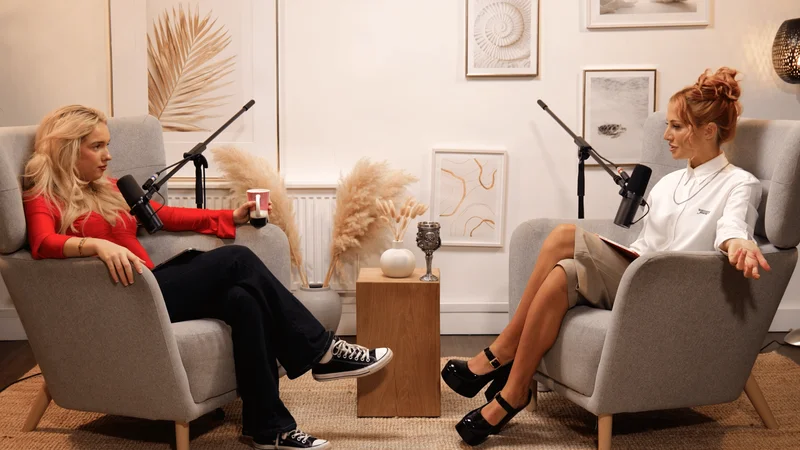
See the 'BBC Children in Need' podcast setup used by Dr Julie from BBC at Finchley Studio (Lounge setup). Book this setup for your podcast
2.1 Modal Theory and Low-Frequency Behavior
In any enclosed space, sound waves reflect off boundaries. When the wavelength of a sound corresponds mathematically to the dimensions of the room (length, width, or height), the reflected wave reinforces the direct wave, creating a standing wave or "room mode." These modes create static areas of high pressure (peaks) and low pressure (nulls) within the room.4
In large venues like concert halls (e.g., 30 meters in length), the resonant frequencies are very low and closely spaced. As frequency increases, these modes overlap to form a smooth, dense continuum. However, as room dimensions shrink to the size of a typical bedroom or home office (e.g., 3 meters by 4 meters), these resonant frequencies shift upward into the audible bass and low-midrange spectrum (40Hz–300Hz). Crucially, because the room is small, these modes are spaced further apart, leaving gaps in the frequency response.6
The Physics of Modal Distribution
Consider a theoretical room that is 30 feet long, 20 feet wide, and 13 feet high. In such a space, standing waves are distributed relatively evenly across the low-frequency spectrum. Now, consider shrinking that space to a typical bedroom size. As the dimensions decrease, the resonant frequencies crowd together in the bass region. Resonances that might have been sub-sonic or well-distributed in a large room suddenly pile up at critical musical and vocal frequencies—60Hz, 80Hz, 100Hz.4
This phenomenon creates two distinct problems for the podcaster:
Resonant Peaks: Certain notes in the voice (often the fundamental frequency of a male voice) will ring out louder than others, causing a "boomy" or "one-note bass" effect. This boominess masks the mid-range frequencies where intelligibility lives.
Acoustic Nulls: At specific locations in the room (nodes), the reflected wave is exactly 180 degrees out of phase with the direct wave, causing total cancellation. A microphone placed in a null at 100Hz will record almost no energy at that frequency, regardless of the speaker's volume or the microphone's quality.7
This low-frequency unevenness is the defining characteristic of "small room acoustics" and is arguably the most difficult problem to solve. It cannot be fixed with equalization (EQ) because an EQ alters the signal sent to the room, but it cannot alter the physics of how the room creates interference. Boosting a frequency that is in a null simply sends more energy into the cancellation, yielding zero net gain while reducing amplifier headroom.7
2.2 The Schroeder Frequency and Transition Zones
The behavior of sound in a room changes drastically depending on frequency. The dividing line between these behaviors is known as the Schroeder Frequency (or crossover frequency).
Below the Schroeder Frequency: The room behaves as a resonator. The acoustic response is dominated by wave acoustics—specifically, the discrete room modes discussed above. In small rooms, the Schroeder frequency is typically higher, often extending up to 200Hz or 300Hz. This means the "modal zone" covers the entire fundamental range of the human voice.6
Above the Schroeder Frequency: The room behaves as a reflector. Sound travels as rays (ray acoustics), bouncing between surfaces like light in a hall of mirrors. In this region, the density of modes is high enough that they are perceived as a statistical field of reverberation rather than discrete resonances.12
Understanding this transition is vital for treatment. Treatments that work above the Schroeder frequency (such as thin foam or rugs) rely on particle velocity and are generally ineffective against the pressure-based phenomena occurring below the Schroeder frequency. A room treated only with thin absorption will therefore sound "dead" in the high frequencies but remain "boomy" and uncontrolled in the low frequencies, a spectral imbalance that sounds unnatural and unprofessional.
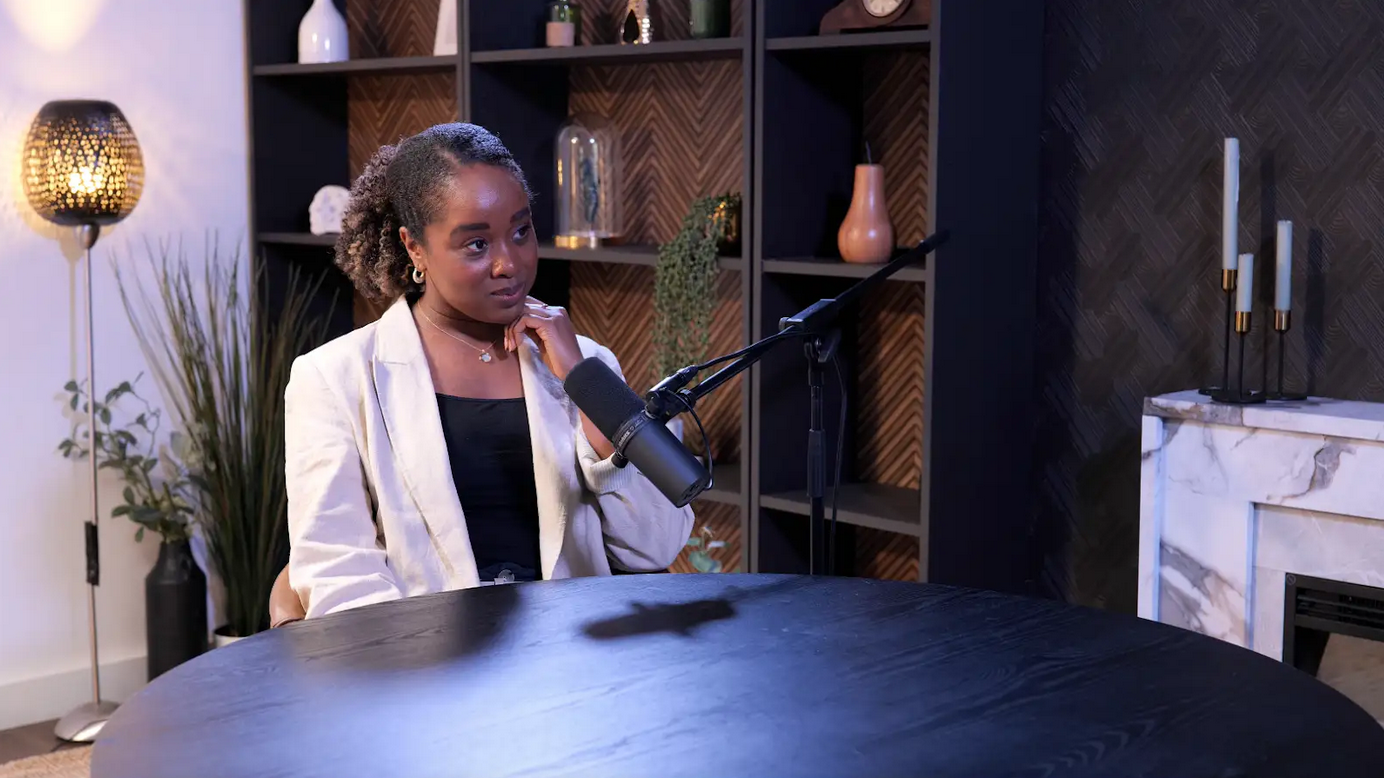
Finchley Studio (CEO Set): book this setup for your podcast
2.3 The Time Domain: Reverberation and Geometric Acoustics
While frequency response is important, the time-domain behavior of the room—how sound decays over time—is equally critical for speech intelligibility.
Reverberation Time (RT60)
RT60 is defined as the time it takes for a sound to decay by 60 decibels after the source has stopped. In large spaces, a long RT60 (1.5–2.5 seconds) can be desirable, adding richness to orchestral music. However, for spoken word audio, specifically podcasts, the ideal RT60 is significantly lower, typically between 0.2 and 0.4 seconds.15
When RT60 exceeds this range, the decaying tail of previous syllables persists long enough to overlap with subsequent syllables. This "temporal smearing" masks the transient details of speech (consonants like 't', 'k', 'p'), forcing the listener's brain to work harder to decode the linguistic content.17
Table 1: Optimal RT60 Values by Application
Data aggregated from.15
In untreated domestic rooms, the RT60 is often uneven. High frequencies may decay quickly due to carpets and curtains, while low-mid frequencies (200Hz–500Hz) persist longer. This results in a "muddy" sound where the warmth of the voice lingers and obscures clarity.19
3. The Physics of Acoustic Artifacts
Beyond general reverberation and modal ringing, small rooms generate specific acoustic artifacts that are distinct and particularly damaging to recording quality.

See the 'Grand designs' from Channel 4 by Kevin McCloud at Finchley Studio (Brick studio). Book this setup for your podcast.
3.1 Comb Filtering and Phase Interference
Comb filtering is a destructive interference pattern that occurs when a direct sound signal is summed with a slightly delayed version of itself (typically delayed by 1–20 milliseconds). In a podcasting context, this usually happens when sound from the speaker reflects off a nearby hard surface—such as a computer monitor, desk, or window—and enters the microphone slightly later than the direct sound.20
Because the delay is constant, it causes phase cancellation at regular frequency intervals. Visually, the frequency response graph looks like the teeth of a comb, with deep notches where energy is cancelled out.20
Mechanism: If the reflection path is 34cm longer than the direct path (approx. 1ms delay), cancellations will occur at 500Hz, 1500Hz, 2500Hz, etc.
Perceptual Effect: This results in a hollow, metallic, or "swishy" sound. It is often described as making the voice sound thin or distant.19
Incorrigibility: Crucially, comb filtering cannot be EQ'd out. The notches are extremely deep and their frequency position depends entirely on the geometry between the source, the reflector, and the mic. Moving the mic just a few inches shifts the notches, making any static EQ adjustment useless.21
To avoid comb filtering, one must either remove the reflective surface or treat it with absorption to reduce the amplitude of the reflection by at least 10dB relative to the direct signal.20
3.2 Flutter Echo and Specular Reflection
Flutter echo is a specific type of repeated reflection that occurs between parallel, hard surfaces, such as the opposing walls of a hallway or a rectangular bedroom. Unlike diffuse reverberation, which is a complex wash of reflections from many directions, flutter echo consists of a discrete packet of sound bouncing back and forth along a single axis.23
Spectral Signature: Flutter echo typically manifests as a metallic "zing" or ringing tone in the high-mid frequencies. The periodicity of the reflections creates a pitch perception; for walls 3 meters apart, the flutter frequency is approximately 57Hz and its harmonics.25
Impact on Recording: This artifact is highly distracting and imparts a cheap, amateurish quality to recordings. It is often most audible on transient sounds like hand claps or the sharp consonants of speech.
Spectrogram Analysis: On a spectrogram, flutter echo does not look like a smooth decay; it appears as a series of distinct, repetitive ridges in the time domain, often persisting long after the direct sound has ceased.26
3.3 Speaker Boundary Interference Response (SBIR)
While often discussed in the context of monitoring, SBIR is equally relevant to recording. It describes the interference between the sound source and the rigid boundaries near it. When a podcaster speaks, sound radiates omnidirectionally at low frequencies. Some of this energy travels backward, bounces off the wall behind the speaker, and returns to the microphone. This reflection combines with the direct sound, causing cancellations (dips) in the low-frequency response.9
This is a geometric problem. If the vocalist is 1 meter from the front wall, a cancellation dip will occur at approximately 86Hz. This "suck-out" of bass energy makes the voice sound thin and weak, a problem that cannot be fixed with EQ because the cancellation is caused by physics, not frequency balance.

See the 'The Tooney & Russo Show' from BBC and Lionesses Ella Toone and Alessia Russoat from England national football team at Finchley Studio (Lounge setup). Book this setup for your podcast. Watch 'The Tooney & Russo Show' at BBc sound , Spotify , Youtube, Amazon music.
Book this setup for your podcast
4. Transducer Electro-Acoustics and Room Interaction
A critical error in home studio design is the assumption that a "better" microphone yields a better recording in any environment. Electro-acoustic theory suggests the opposite: high-fidelity transducers often exacerbate environmental problems.
4.1 The Condenser Paradox: Sensitivity vs. Usability
Large Diaphragm Condenser (LDC) microphones are the gold standard in professional studios. They operate using an electrically charged capacitor with an extremely low-mass diaphragm. This low mass allows the diaphragm to move in response to very subtle changes in air pressure, resulting in high sensitivity and rapid transient response.28
Transient Response: This refers to how quickly a microphone can react to a burst of sound and how quickly it stops moving when the sound stops. Condenser mics have excellent transient response, capturing the crisp "air" and detail of a voice.30
The Problem: In an untreated room, "detail" includes the flutter echo ringing off the ceiling, the hum of a computer fan, and the distant rumble of traffic. The high sensitivity of a condenser microphone creates a higher "acoustic gain," effectively magnifying the room's noise floor and reverberant field relative to the direct signal.32
A condenser microphone does not distinguish between the "good" detail (the texture of the voice) and the "bad" detail (the room reflections). It captures everything with clinical precision. In a bad room, this precision is a liability.34
4.2 Dynamic Microphones: Mechanical Filtering
Dynamic microphones (moving coil) operate on electromagnetic induction. The diaphragm is attached to a coil of wire that moves within a magnetic field. This assembly has significantly higher mass than a condenser diaphragm.
Inertia and Damping: Due to the greater mass, the dynamic diaphragm has higher inertia. It requires more acoustic energy to start moving and stops moving more quickly once the energy ceases. This reduced transient response acts as a natural mechanical filter.30
Room Rejection: Because they are less sensitive to subtle, low-energy acoustic waves (like distant reflections or high-frequency flutter), dynamic mics naturally "ignore" much of the bad room sound. They focus on the high-energy source directly in front of them (the podcaster's mouth).28
This explains the prevalence of the Shure SM7B in podcasting. While it is a high-quality microphone, its legendary status is partly due to its low sensitivity, which allows it to deliver acceptable results in imperfect environments where a Neumann U87 would sound unusable.37
4.3 Polar Pattern Frequency Dependence
Microphones are categorized by polar patterns (e.g., cardioid, omnidirectional). A cardioid pattern is designed to reject sound from the rear. However, polar patterns are rarely consistent across the frequency spectrum.
Physics of Directivity: Directionality is achieved through phase cancellation ports in the microphone body. This mechanism is wavelength-dependent. Most "cardioid" microphones are only truly directional in the midrange. At low frequencies, the wavelengths are too long for the microphone's physical ports to effectively cancel, rendering the mic omnidirectional in the bass range.39
Off-Axis Coloration: At high frequencies, the microphone effectively "shadows" itself, becoming hyper-directional. Furthermore, sound entering from the side (off-axis) often suffers from frequency anomalies due to the physical housing of the mic. In an untreated room, reflected sound enters the mic from all angles. If the mic has poor off-axis response (common in cheaper condensers), these reflections will be recorded with a strange, colored timbre that degrades the overall tone.41
Acoustic treatment mitigates this by absorbing the off-axis sound before it reaches the microphone, ensuring that the mic primarily captures the direct, on-axis signal for which it was optimized.43
4.4 The Myth of the "High-End" Microphone in Untreated Spaces
The "Weakest Link" theory posits that a system's performance is capped by its lowest-performing component. In a home studio, the room is almost always the weakest link. Upgrading the microphone in this context yields diminishing returns and can often degrade perceived quality.
Blind listening tests and expert comparisons consistently demonstrate this phenomenon:
Experiment A: A $3,000 Neumann U87 in an untreated bedroom vs. a $100 Shure SM58 in a treated booth. Listeners consistently prefer the SM58/Booth combination, citing clarity, warmth, and lack of distracting echoes.44
Buyer's Remorse: Forums are replete with anecdotes of users upgrading to expensive condensers like the U87 or TLM 103, only to find their recordings sound "worse"—picking up HVAC noise, computer fans, and room slap that their cheaper dynamic mics masked.38 The high-end mic is doing exactly what it was designed to do: capture the reality of the space with total accuracy. The failure lies in the user's failure to provide a reality worth capturing.35
5. Psychoacoustics: The Cognitive Cost of Poor Audio
The argument for acoustic treatment is not merely technical; it is cognitive. Poor audio quality imposes a measurable burden on the listener's brain, affecting how information is processed, retained, and valued.
5.1 Intelligibility, Masking, and Cognitive Load
The human brain processes speech by decoding rapid spectral and temporal cues. When reverberation or noise is present, these cues are degraded. The "tails" of loud sounds mask softer sounds (energetic masking), and room reflections blur the boundaries between phonemes.48
While humans are capable of understanding speech in noisy environments (the "Cocktail Party Effect"), this requires the recruitment of additional cognitive resources. The brain must actively filter noise and reconstruct missing information from context. This phenomenon is known as Cognitive Load.
The Cost of Effort: When cognitive load is high, fewer resources are available for working memory and comprehension. Listeners may understand the words, but they will struggle to remember the content or follow complex arguments.49
Pupillometry Studies: Research using pupillometry (measuring pupil dilation as a proxy for mental effort) confirms that listening to speech in reverberant environments causes significant physiological stress and increased mental effort compared to dry environments.49
5.2 The "Trust Halo" and Credibility Research
Audio quality functions as a heuristic for speaker credibility. A landmark study by the University of Southern California and the Australian National University demonstrated this "Trust Halo" effect.
Methodology: Participants listened to identical scientific explanations recorded in high quality and low quality (with mild distortion/room noise).
Findings: When the audio quality was poor, participants rated the researcher as less intelligent, the research as less important, and the content as less credible.51
Implication: In podcasting, the room acoustics directly influence the authority of the speaker. An echoey, amateurish sound subconsciously signals to the listener that the information is unreliable, regardless of the speaker's actual expertise.53
5.3 Listener Fatigue and Retention Mechanics
"Listener Fatigue" is the physiological and psychological exhaustion that results from prolonged exposure to audio requiring high cognitive load. It manifests as irritation, loss of focus, and a desire to stop listening.55
Retention Rates: In the competitive podcast market, listener retention is a key metric. High listener fatigue leads to high drop-off rates. If a listener has to strain to understand a host through a wash of flutter echo and reverb, they are likely to switch to a competitor with higher production value.56
Non-Native Speakers: The effect is compounded for non-native speakers of the broadcast language, who rely more heavily on clear acoustic cues for comprehension. Poor acoustics can effectively alienate a global audience.55
6. Architectural Acoustics and Remediation Strategies
Having established the physics of the problem and the necessity of solution, we turn to the methodology of remediation. Effective treatment requires distinguishing between soundproofing and acoustic conditioning and selecting the correct materials for the specific frequency problems identified.
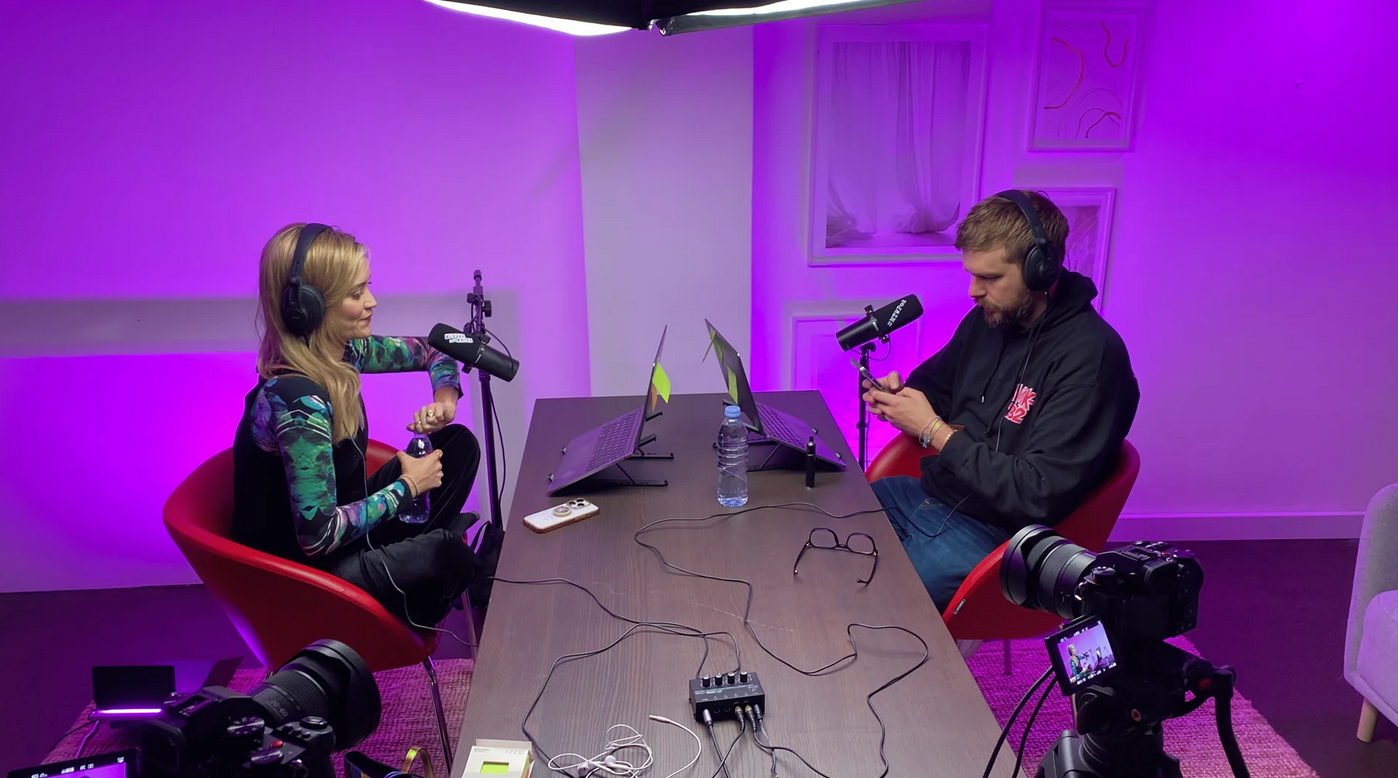
See the 'Murder They Wrote' podcast setup used by Laura Whitmore and Iain Stirling from BBC at Finchley Studio (Gathering setup). Watch Murder They Wrote at BBc sound , Spotify , Apple podcasts , Youtube , Instagram , Amazon music
Book this setup for your podcast
6.1 Soundproofing vs. Acoustic Treatment: Defining the Distinction
These terms are frequently conflated, leading to wasted budgets.
Soundproofing (Isolation): The objective is to prevent sound transmission through boundaries (keeping noise out/in). This is a construction process requiring mass (drywall, concrete) and decoupling (air gaps, resilient channels). Adding foam to a wall does not soundproof a room; it has negligible mass and cannot stop sound transmission.58
Acoustic Treatment (Conditioning): The objective is to control sound reflections within the room. This uses absorption and diffusion to reduce RT60 and control modes. This is the primary concern for improving recording quality within an existing space.60
6.2 Porous Absorption: Physics of Flow Resistivity
The most common form of treatment is porous absorption (velocity absorbers), such as fiberglass (Owens Corning 703), mineral wool (Rockwool), or acoustic foam.
Mechanism: These materials work by converting the kinetic energy of air molecules into heat via friction as the air moves through the material's matrix.62
Velocity vs. Pressure: Sound waves have maximum particle velocity at 1/4 wavelength from a boundary and zero velocity at the boundary (where pressure is highest).
High Frequencies: Have short wavelengths (e.g., 3kHz = 11cm). The 1/4 wavelength is close to the wall, so thin panels work well.
Low Frequencies: Have long wavelengths (e.g., 100Hz = 3.4 meters). The 1/4 wavelength is 0.85 meters from the wall. A 2-inch panel placed directly on the wall is in a zone of near-zero particle velocity for bass frequencies, rendering it ineffective.63
Flow Resistivity: The effectiveness of a porous absorber is governed by its gas flow resistivity (measured in Pa*s/m² or rayls/m).
Too Loose: Sound passes through without enough friction (e.g., household pillows).
Too Dense: Sound reflects off the surface (e.g., compressed board).
Optimal Range: For broadband absorption, a resistivity of 10,000–30,000 rayls/m is ideal.64 Rockwool with a density of 45–60 kg/m³ typically falls in this sweet spot. Higher densities (100 kg/m³) can actually be less effective as they become reflective at high frequencies.65
6.3 Resonant Absorption: Addressing the Modal Region
Because velocity absorbers are inefficient at low frequencies (unless they are impracticably thick), pressure absorbers or "bass traps" are required to treat the modal region below the Schroeder frequency.
Mechanism: These devices (diaphragmatic absorbers, Helmholtz resonators) operate on sound pressure rather than velocity. They are tuned systems that vibrate sympathetically at specific low frequencies, damping the energy.62
Placement: Since sound pressure is highest at rigid boundaries—especially corners where three boundaries meet (tri-corners)—pressure absorbers are most effective when placed in room corners.14
6.4 Diffusion vs. Absorption
While small rooms primarily require absorption to tame modes and reduce RT60, total absorption can create an unnaturally "dead" space that is uncomfortable to speak in.
Diffusion: Diffusers (e.g., Quadratic Residue Diffusers or QRDs) scatter sound waves in time and space, preserving acoustic energy while breaking up strong specular reflections (like flutter echo).
Application: In a vocal booth, absorption is prioritized to achieve a "dry" signal. In a control room or listening space, a mix of absorption (at reflection points) and diffusion (on the rear wall) creates a balanced, natural sound field.59
7. Digital Signal Processing: Capabilities and Hard Limits
In the age of AI and advanced plugins, many creators rely on "fixing it in post." While tools like iZotope RX are powerful, they are bound by signal theory limits.

Finchley Studio (Dialogue set): book this setup for your podcast
7.1 The Fallacy of "Fixing It In Post"
DSP operates on the signal captured by the microphone. If that signal contains fundamental flaws—such as comb filtering notches or missing bass due to phase cancellation—no software can retrieve the missing data. It is comparable to trying to change the lighting of a photograph in Photoshop; you can adjust the balance, but you cannot un-cast a shadow.2
7.2 Algorithmic Limitations of De-Reverberation
De-reverb plugins (e.g., iZotope RX De-reverb, SPL De-Verb) utilize spectral subtraction or neural networks to separate direct speech from the diffuse reverberant tail.
Artifacts: Aggressive de-reverberation introduces audible artifacts. These are often described as "underwater," "swirly," "robotic," or "gated" sounds. The algorithm struggles to distinguish between the natural decay of a voice and the room tone, often cutting off the ends of words or creating a "pumping" effect.70
The Uncanny Valley: Heavily processed audio often lacks "air" and sounds unnaturally dead. While the reverb is gone, the result does not sound like a studio recording; it sounds like a damaged recording that has been repaired.72
7.3 Equalization and Non-Minimum Phase Systems
As previously noted, acoustic nulls are often non-minimum phase phenomena. This means the amplitude dip is accompanied by a massive phase shift. Attempting to boost a null with a standard EQ (minimum phase) will not fix the cancellation and will introduce further phase distortion (ringing) at that frequency. The only way to fix a null is to physically move the microphone, the source, or change the room geometry.7
8. Economic Analysis and Strategic Implementation
For the independent creator or studio builder, budget allocation is a zero-sum game. Every dollar spent on a microphone is a dollar not spent on the room.
8.1 The Law of Diminishing Returns in Audio Hardware
Audio hardware follows a steep curve of diminishing returns. A $500 microphone is significantly better than a $50 microphone. However, a $3,000 microphone is often only incrementally "different" from a $1,000 microphone, offering nuanced textures that are only audible in a pristine acoustic environment.75
In contrast, the acoustic quality of a room has a "hard ceiling." A $10,000 signal chain cannot exceed the quality cap imposed by a $0 room. The room dictates the maximum possible resolution of the system. Therefore, until the room is treated, investment in high-end electronics yields near-zero functional ROI.77
8.2 Cost-Benefit Analysis: Construction vs. Electronic Acquisition
Let us analyze three budget scenarios for a startup podcast studio with a fixed budget.
Table 3: Budget Allocation Scenarios and Predicted Outcomes
Analysis derived from.44
Scenario C demonstrates that a balanced investment, heavily weighted towards treatment, produces a superior product for half the cost of the "Gear Head" approach.

Finchley Studio (Dialogue set): book this setup for your podcast
8.3 DIY Implementation and Material Science
For those on a budget, professional acoustic treatment (e.g., GIK Acoustics, Primacoustic) can be expensive. However, DIY panels are highly effective if the physics are respected.
Materials: Using mineral wool (Rockwool Safe'n'Sound or Owens Corning 703) is standard. These materials have the correct flow resistivity (approx. 10,000–20,000 rayls/m).65
Construction: A wooden frame filled with 4 inches (100mm) of insulation is the gold standard.
The Air Gap: Leaving an air gap between the panel and the wall improves low-frequency absorption. A 4-inch panel with a 4-inch air gap behaves acoustically like an 8-inch panel because it places the absorber closer to the point of maximum particle velocity for lower frequencies.63
Density: Avoid over-compressing the insulation. Higher density is not always better; 60kg/m³ is generally superior to 100kg/m³ for general broadband absorption because it allows deeper penetration of the sound wave.65
9. Conclusion
The prioritization of microphone selection over acoustic treatment in podcast production is a fundamental error that contradicts the principles of physics, mechanics, and psychoacoustics.
Physics: Small rooms inherently produce modal distortion and time-domain smearing that degrade speech intelligibility. These are physical wave phenomena that cannot be corrected electronically.
Mechanics: High-quality microphones are designed to capture the acoustic environment with precision. In an untreated room, they act as magnifying glasses for acoustic flaws, often producing inferior results compared to less sensitive dynamic microphones.
Psychoacoustics: Poor audio quality increases cognitive load, causing listener fatigue and subconscious distrust of the speaker ("Trust Halo" effect).
Economics: Acoustic treatment offers the highest return on investment. A modest microphone in a treated room yields professional results, whereas a flagship microphone in an untreated room yields amateur results.
Therefore, the path to professional audio does not lie in the purchase of a better transducer, but in the construction of a better environment. The room is the most critical filter in the signal chain, and its treatment is the prerequisite for all subsequent audio fidelity.
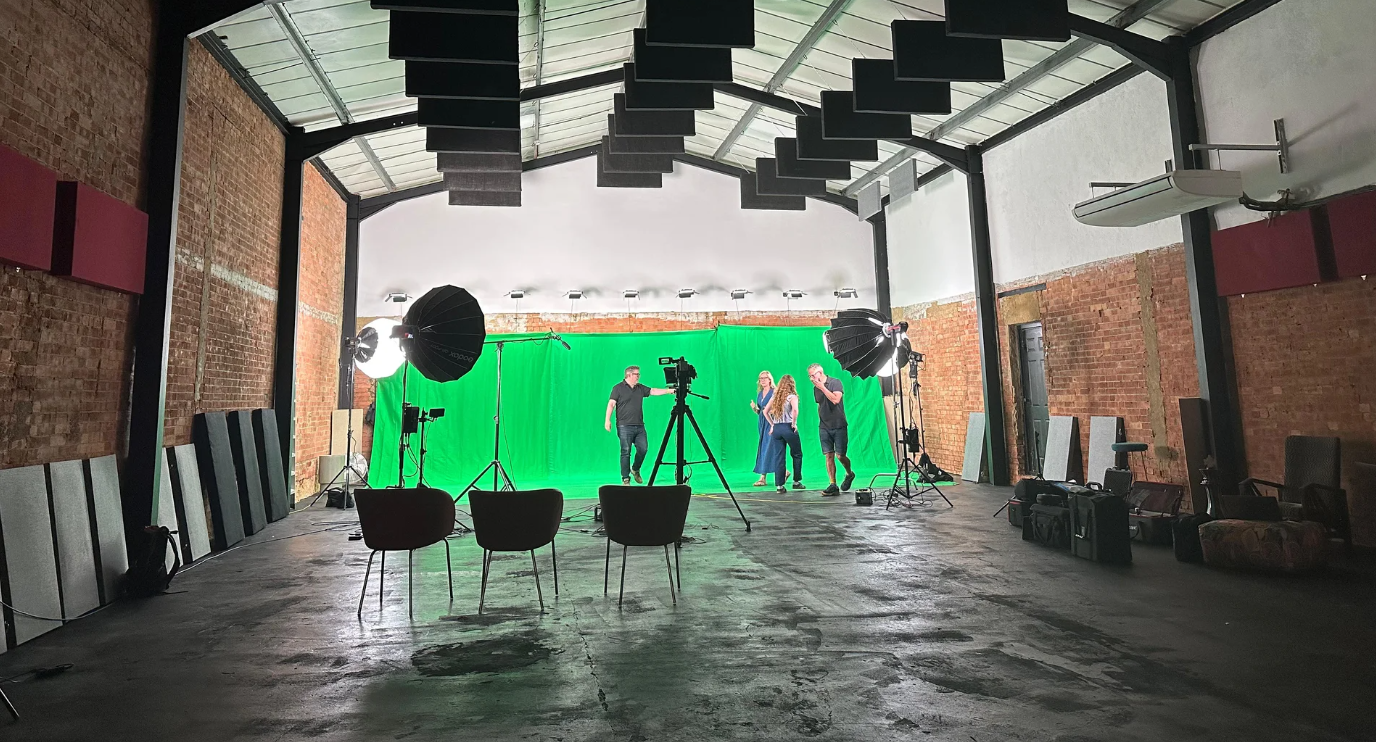
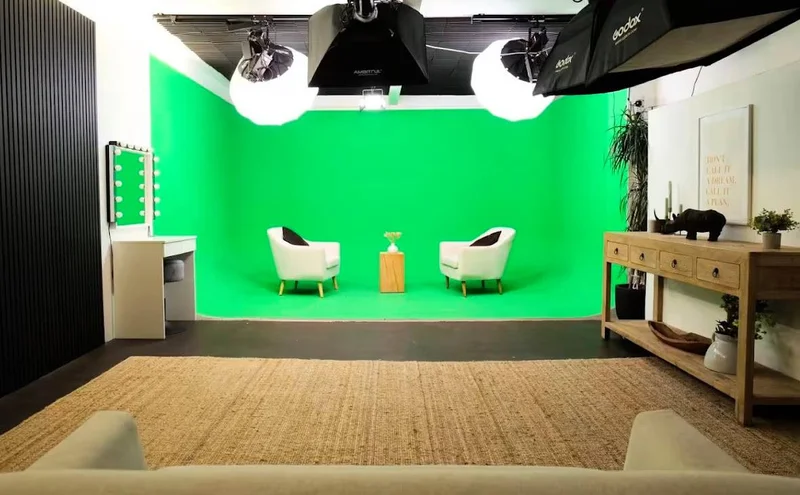
Finchley Studio (Giant Green Screen): book this setup for your podcast
In the quest for professional podcast quality, many creators mistakenly focus their budget on expensive microphones (transducer selection) while neglecting the foundational, yet critical, element: environmental acoustic treatment. A technical analysis shows that the characteristics of the recording space dictate the final audio quality far more than the sensitivity or brand of the microphone used.
The Physics of Flawless Audio
A microphone, regardless of its cost, is designed to capture all sound waves present in its immediate environment. In an untreated room, these sound waves include:
- Direct Sound: The speaker's voice travelling directly into the mic.
- Reflected Sound: The speaker's voice bouncing off hard surfaces (walls, ceiling, floor) and arriving at the mic fractions of a second later, creating echo and reverb.
- Ambient Noise: External sounds (traffic, air conditioning, plumbing).
While a quality microphone can enhance the Direct Sound, it simultaneously amplifies the Reflected Sound and Ambient Noise. In fact, a highly sensitive condenser microphone in a poor room will often sound worse than a basic dynamic microphone, as it captures more unwanted environmental detail.
The Primacy of Treatment and Isolation
Achieving broadcast quality—the standard used by institutions like the BBC and Lloyds bank—requires manipulating the environment itself:
- Acoustic Treatment (Absorption): Dedicated studio spaces use acoustic panels to absorb reflected sound energy. This creates a "dead" or "dry" acoustic profile, ensuring the microphone only hears the speaker's voice, resulting in a clear, highly professional sound.
- Sound Isolation (Soundproofing): This involves structural engineering to physically block ambient noise from entering the room, a necessity in a loud city like London.
This environmental control is the primary value proposition of professional studios. For example, whether recording in the large GIANT BLACKOUT warehouse or the compact Dialogue Room, the infrastructure guarantees this acoustic baseline.
The Strategic Investment
For creators in London, the strategic choice is clear: rent a space where the acoustic engineering is already perfected. This eliminates the massive upfront capital investment and time required to acoustically treat a home space, allowing the creator to focus entirely on content. When combined with guaranteed technical expertise and integrated services, such as the Video Editing Service, the cost-efficiency of the professional studio becomes undeniable.
We hope this technical analysis guides your investment strategy toward environmental quality. To take your production to the next level, the right environment is key. We invite you to see what makes Finchley Studio the top choice for creators. As a professional podcast recording studio, Finchley Studio is built to handle all your production needs.
We're trusted by industry leaders and regular clients like the BBC and Lloyds bank, who rely on our professional spaces. We offer a diverse range of unique, pre-lit sets to match any brand or aesthetic. Explore our spaces to find your perfect fit:
- Dialogue Room: For intimate 2-4 person conversations.
- LOUNGE STUDIO: A relaxed, versatile set for up to 5 people.
- CEO SET: Premium, sleek, and executive.
- Green Screen Cove: A pre-lit, curved studio for seamless virtual backgrounds.
- Blackwood Studio: A sophisticated, modern set with a striking black wood backdrop.
- THE BRICK STUDIO: A 180m² warehouse space with authentic red brick.
- White Infinity Cove: For clean, minimalist, edge-free visuals.
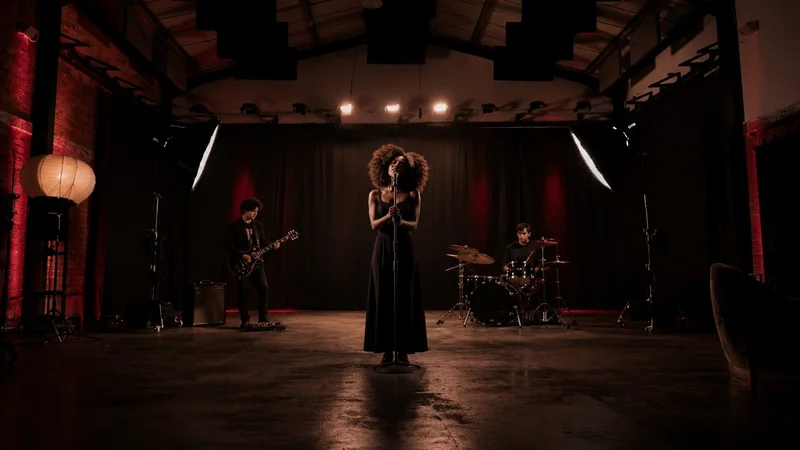
- BLACKOUT SET: Full light control for dramatic, high-contrast content.
- GATHERING STUDIO: A professional space for larger roundtable discussions.
- GIANT GREEN SCREEN: One of London's largest green screens in our 180m² warehouse.
- GIANT BLACKOUT: Our 180m² warehouse for large-scale, controlled dark sets.
Once your recording is complete, let our expert team handle the rest. Our professional Video Editing Service will make your content shine, with a two-week turnaround guaranteed. Choosing Finchley Studio means choosing a seamless experience from start to finish. We're proud of the community we've built at Finchley Studio. Don't just take our word for it—see what other producers have to say about their experience on our Google review page and Trust Pilot.
Finding us is simple. We are conveniently located just Two minutes from Finchley Central (https://tfl.gov.uk/tube/stop/940GZZLUFYC/finchley-central-underground-station?lineId=northern) on the Northern Line. We offer One free parking space per booking, and for those travelling, we are Adjacent to Travelodge London Finchley (https://www.travelodge.co.uk/hotels/614/London-Finchley-hotel). You can find our exact location on Google map, Apple maps, [suspicious link removed], or using our What 3 words (https://w3w.co/orders.yards.jokes) address.
Stay connected with our creative community and see behind-the-scenes content by following us on Instagram, YouTube, TikTok, LinkedIn, and X (Twitter). Have any questions before you book? Check our FAQ page, chat with us directly on WhatsApp, or give us a call at +447587827200. You can also send us an Email. Ready to elevate your podcast? Your next great episode starts here. Book now to secure your spot in one of London's premier podcast studios.
Works cited
accessed November 20, 2025, https://www.acousticsciences.com/technical-papers/the-chain-is-as-strong-as-its-weakest-link/#:~:text=It%20is%20the%20self%20noise,is%20the%20listening%20room%20acoustic.
The Chain Is As Strong As Its Weakest Link - ASC - Acoustic Sciences, accessed November 20, 2025, https://www.acousticsciences.com/technical-papers/the-chain-is-as-strong-as-its-weakest-link/
Garbage In, or the Weakest Link? - PS Audio, accessed November 20, 2025, https://www.psaudio.com/blogs/pauls-posts/garbage-in-or-the-weakest-link
Is my room too small to get good sound? - Acoustics Insider, accessed November 20, 2025, https://www.acousticsinsider.com/blog/is-my-room-too-small-to-get-good-sound
Recording Studio Setup - Standing Waves Biggest Secret & Worst Room Shape - YouTube, accessed November 20, 2025, https://www.youtube.com/watch?v=aSj-byRobWo
Divide and Conquer - The Schroeder Frequency | Prosoundtraining, accessed November 20, 2025, https://www.prosoundtraining.com/2021/10/14/divide-and-conquer-the-schroeder-frequency/
Unable to solve bass null : r/hometheater - Reddit, accessed November 20, 2025, https://www.reddit.com/r/hometheater/comments/1ejcd0g/unable_to_solve_bass_null/
Null at 100Hz, fix with EQ or... ? : r/Acoustics - Reddit, accessed November 20, 2025, https://www.reddit.com/r/Acoustics/comments/9z8ias/null_at_100hz_fix_with_eq_or/
Why Your 70Hz Null Won't Go Away (Even With Bass Traps) - Acoustics Insider, accessed November 20, 2025, https://www.acousticsinsider.com/blog/70hz-null-bass-traps
Modes, room ratios, and the "Schroeder Frequency" or "Transition Frequency" - Soundman2020 - Studio Design Forum, accessed November 20, 2025, https://www.digistar.cl/forum/viewtopic.php?t=794
Small-Room Acoustics, Part Two - PS Audio, accessed November 20, 2025, https://www.psaudio.com/blogs/copper/small-room-acoustics-part-two
Schroeder Frequency - Acoustic Fields, accessed November 20, 2025, https://www.acousticfields.com/schroeder-frequency/
Schroeder Frequency - www.AcousticFields.com - YouTube, accessed November 20, 2025, https://www.youtube.com/watch?v=-YtiT3U1FSM
Pressure Vs. Velocity Acoustic Absorbers - Soundproof Your Studio, accessed November 20, 2025, https://www.soundproofyourstudio.com/blog/pressure-vs-velocity-acoustic-absorbers
How to Measure RT60 & Control Reverberation Time in Any Space - Acoustical Surfaces, accessed November 20, 2025, https://www.acousticalsurfaces.com/blog/acoustics-education/measure-rt60/
Calculate Sound Reverberation - Steps for Better Audio - Ooberpad, accessed November 20, 2025, https://www.ooberpad.com/blogs/audio-video-tips/calculate-sound-reverberation-corrective-steps
What is Reverberation Time (RT60)? How to Calculate It for Room Acoustics - Sound-Rite, accessed November 20, 2025, https://www.sound-rite.com/blog/what-is-reverberation-time-rt60
Beginner's question about room acoustics for spoken word - Podcasting - Audacity Forum, accessed November 20, 2025, https://forum.audacityteam.org/t/beginners-question-about-room-acoustics-for-spoken-word/60471
Room Reflections & Reverb: Fix Podcast Audio Problems, accessed November 20, 2025, https://thepodcastconsultant.com/blog/reverb-room-reflections
The basics about comb filtering (and how to avoid it) - DPA Microphones, accessed November 20, 2025, https://www.dpamicrophones.com/mic-university/audio-production/the-basics-about-comb-filtering-and-how-to-avoid-it/
What Is Comb Filtering? - iZotope, accessed November 20, 2025, https://www.izotope.com/en/learn/what-is-comb-filtering
need to visualise this comb filter - MATLAB Answers - MathWorks, accessed November 20, 2025, https://www.mathworks.com/matlabcentral/answers/38898-need-to-visualise-this-comb-filter
How to Reduce Flutter Echoes | Soundproof Cow, accessed November 20, 2025, https://www.soundproofcow.com/how-to-reduce-flutter-echoes/
Flutter echo: what is it, why is it bad for your recording studio and how to deal with it., accessed November 20, 2025, https://vocalboothtogo.com/flutter-echo-sound-absorption/
Can someone please explain to me comb filtering and flutter echo? : r/audioengineering, accessed November 20, 2025, https://www.reddit.com/r/audioengineering/comments/174zxe/can_someone_please_explain_to_me_comb_filtering/
Flutter echoes: Timbre and possible use as sound effect - NTNU, accessed November 20, 2025, https://www.ntnu.edu/documents/1001201110/1266017954/DAFx-15_submission_39.pdf
Flutter Echo and analyzer. Related topic: continuously windowing or “shooting just one time”?, accessed November 20, 2025, https://illatooscurodellafase.wordpress.com/2020/05/08/flutter-eco-and-analyzer-related-topic-continuously-windowing-or-shooting-just-one-time/
accessed November 20, 2025, https://tyxstudios.com/blog/condenser-vs-dynamic-mic#:~:text=Condenser%20microphones%20are%20more%20sensitive,in%20an%20imperfect%20recording%20environment.
Dynamic Mic Vs Condenser: Choosing the Right Microphone - TYX Studios, accessed November 20, 2025, https://tyxstudios.com/blog/condenser-vs-dynamic-mic
Transient Response and Microphone Selection - Hometracked, accessed November 20, 2025, https://www.hometracked.com/2007/08/02/transient-reponse-and-microphone-selection/
Difference between microphone transient response and frequency response (if any?), accessed November 20, 2025, https://forum.allaboutcircuits.com/threads/difference-between-microphone-transient-response-and-frequency-response-if-any.159053/
Condensers, dynamics, sensitivity and gain. - SOS FORUM, accessed November 20, 2025, https://www.soundonsound.com/forum/viewtopic.php?t=42220
ELI5 Why a condenser microphone is bad for noisy environments and what type of microphone would be better - Reddit, accessed November 20, 2025, https://www.reddit.com/r/audioengineering/comments/6pwk3i/eli5_why_a_condenser_microphone_is_bad_for_noisy/
Condenser microphones don't pick up more room, please stop the myth. - Reddit, accessed November 20, 2025, https://www.reddit.com/r/musicproduction/comments/1ft1kah/condenser_microphones_dont_pick_up_more_room/
Why does my Expensive Microphone Sound Bad? - YouTube, accessed November 20, 2025, https://m.youtube.com/shorts/8XMPKBgc2pg
Dynamic vs Condenser Microphones | What's The Difference? - Audio University, accessed November 20, 2025, https://audiouniversityonline.com/dynamic-vs-condenser-microphones/
Why do expensive microphones generally sound better than cheaper ones? - Reddit, accessed November 20, 2025, https://www.reddit.com/r/audioengineering/comments/j3q9hi/why_do_expensive_microphones_generally_sound/
Question about room noise when recording a U87 : r ... - Reddit, accessed November 20, 2025, https://www.reddit.com/r/audioengineering/comments/33n79a/question_about_room_noise_when_recording_a_u87/
Microphone Polar Patterns: Cardioid, Omnidirectional, Figure-8 - E-Home Recording Studio, accessed November 20, 2025, https://ehomerecordingstudio.com/microphone-polar-patterns/
Studio Gear Chapter Two: Microphones Page 4, accessed November 20, 2025, https://cmtext.com/studio/chapter2_mics4.php
Will the EV RE320 work in a untreated bedroom space? - Equipment - JWSOUNDGROUP, accessed November 20, 2025, https://jwsoundgroup.net/index.php?/topic/35491-will-the-ev-re320-work-in-a-untreated-bedroom-space/
Fact-Checking Steve Albini On Off-Axis Miking : r/audioengineering - Reddit, accessed November 20, 2025, https://www.reddit.com/r/audioengineering/comments/xki9wo/factchecking_steve_albini_on_offaxis_miking/
Which microphone is best for voice overs in an untreated room? - SOS FORUM, accessed November 20, 2025, https://www.soundonsound.com/forum/viewtopic.php?t=43183
CHEAP mic in a treated room VS EXPEN$IVE mic in a BAD room - FIGHT! (Pearlman VS Behringer), accessed November 20, 2025, https://www.youtube.com/watch?v=cIdOGPuBa8c
Hear the difference: Untreated Vs Treated Room Acoustics - YouTube, accessed November 20, 2025, https://www.youtube.com/watch?v=b9u6rvWSTDM
Best mic for untreated room on a budget? : r/recordingmusic - Reddit, accessed November 20, 2025, https://www.reddit.com/r/recordingmusic/comments/14d5s88/best_mic_for_untreated_room_on_a_budget/
Neumann U87Ai noise problem : r/audioengineering - Reddit, accessed November 20, 2025, https://www.reddit.com/r/audioengineering/comments/5052u0/neumann_u87ai_noise_problem/
Intelligibility and Clarity of Reverberant Speech: Effects of Wide Dynamic Range Compression Release Time and Working Memory - PMC, accessed November 20, 2025, https://pmc.ncbi.nlm.nih.gov/articles/PMC5399768/
Cognitive load associated with speaking clearly in reverberant rooms - PMC - NIH, accessed November 20, 2025, https://pmc.ncbi.nlm.nih.gov/articles/PMC11362551/
The impact of speech type on listening effort and intelligibility for native and non-native listeners - Frontiers, accessed November 20, 2025, https://www.frontiersin.org/journals/neuroscience/articles/10.3389/fnins.2023.1235911/full
Audio quality influences whether you believe what you hear - USC Dornsife, accessed November 20, 2025, https://dornsife.usc.edu/news/stories/norbert-schwarz-research-links-sound-quality-belief/
The quality of audio influences whether you believe what you hear - USC Today, accessed November 20, 2025, https://today.usc.edu/why-we-believe-something-audio-sound-quality/
Now Hear This: Audio Quality Can Impact Your Credibility - Goto Meeting, accessed November 20, 2025, https://www.goto.com/blog/now-hear-audio-quality-impacts-credibility
New Study Reveals “Audio Trust Halo,” Deep Consumer Connection To Radio And Podcast Influencers - iHeartMedia, accessed November 20, 2025, https://www.iheartmedia.com/press/new-study-reveals-audio-trust-halo-deep-consumer-connection-radio-and-podcast-influencers
Listening fatigue: how bad audio quality burns out your audience, accessed November 20, 2025, https://www.wpfastestcache.com/blog/listening-fatigue-how-bad-audio-quality-burns-out-your-audience/
How to Improve Your Podcast Audio Quality, accessed November 20, 2025, https://www.cuepodcasts.com/post/improve-podcast-audio-quality
Podcasts with poor quality audio will likely fail. - Reddit, accessed November 20, 2025, https://www.reddit.com/r/podcasting/comments/a13pbp/podcasts_with_poor_quality_audio_will_likely_fail/
accessed November 20, 2025, https://www.whisperroom.com/blog/the-difference-between-sound-treatment-and-soundproofing#:~:text=%F0%9F%92%AC%20While%20soundproofing%20stops%20noise,treatment%20improves%20sound%20clarity%20inside.
The Difference Between Sound Treatment and Soundproofing - WhisperRoom, accessed November 20, 2025, https://www.whisperroom.com/blog/the-difference-between-sound-treatment-and-soundproofing
How to Soundproof for Podcasts: Acoustic Panels, Foam & More, accessed November 20, 2025, https://www.soundproofcow.com/soundproof-room-for-podcasts/
The Difference Between Soundproofing and Acoustic Treatment - YouTube, accessed November 20, 2025, https://www.youtube.com/watch?v=F0y7KIKmVrE
Velocity vs. Pressure - Acoustic Sound Absorbers - Hexspa.com, accessed November 20, 2025, https://hexspa.com/velocity-vs-pressure/
Pressure Vs Velocity Acoustic Absorbers - YouTube, accessed November 20, 2025, https://www.youtube.com/watch?v=pOT3oBDeZk8
Providing an optimal porous absorbent pattern to reduce mid to low-frequency sounds - NIH, accessed November 20, 2025, https://pmc.ncbi.nlm.nih.gov/articles/PMC6277340/
DIY acoustic panels - Rockwool question - SOS FORUM, accessed November 20, 2025, https://www.soundonsound.com/forum/viewtopic.php?t=85898
Rockwool density for DIY Ac. treatment : r/audioengineering - Reddit, accessed November 20, 2025, https://www.reddit.com/r/audioengineering/comments/1mnktxs/rockwool_density_for_diy_ac_treatment/
Bass Traps: Pressure vs Velocity - Which one should you get? - AcousticsInsider.com, accessed November 20, 2025, https://www.youtube.com/watch?v=XHK0Fwf7ze4
Understanding Different Bass Trapping - GIK Acoustics, accessed November 20, 2025, https://www.gikacoustics.com/blogs/knowledge-base/understanding-different-bass-trapping
Acoustic Treatment And Sound Quality In The Studio - Removing Reflections - Live Vs Dead Rooms - Recording With Or Without Reverb, accessed November 20, 2025, https://theroomstudios.us/acoustic-treatment-and-sound-quality/
177: What's the Best Plugin to Remove Reverb? Let's Find Out! - YouTube, accessed November 20, 2025, https://www.youtube.com/watch?v=PTpLoGlHNKY
How do you denoise and de reverb audio without artifacts to the maximum Dry audio? : r/audioengineering - Reddit, accessed November 20, 2025, https://www.reddit.com/r/audioengineering/comments/1e5l7x7/how_do_you_denoise_and_de_reverb_audio_without/
Izotope RX10 For Voiceovers - Do You Need It? | Rob Bee, B Double E, accessed November 20, 2025, https://b-double-e.co.uk/izotope-rx-for-voiceovers-do-you-need-it/
Podcast Artifacting : r/AudioPost - Reddit, accessed November 20, 2025, https://www.reddit.com/r/AudioPost/comments/f133en/podcast_artifacting/
REW help - sub null can't seem to fix - Audio Science Review (ASR) Forum, accessed November 20, 2025, https://www.audiosciencereview.com/forum/index.php?threads/rew-help-sub-null-cant-seem-to-fix.40608/
The Law of Diminishing Returns in High-end Audio, accessed November 20, 2025, https://www.audioresurgence.com/2025/10/the-law-of-diminishing-returns-in-high-end-audio.html
CMV: placing your expensive gear in an acoustically untreated room is a waste of money. : r/audiophile - Reddit, accessed November 20, 2025, https://www.reddit.com/r/audiophile/comments/ki3695/cmv_placing_your_expensive_gear_in_an/
Room Size & Surface Properties: Their Impact on Acoustics, accessed November 20, 2025, https://www.acousticalsurfaces.com/blog/acoustics-education/room-size/
Home Recording: Analyzing Your Room's Acoustics to Get Flat vs. Making Your Room Sound "Good" To You - Reddit, accessed November 20, 2025, https://www.reddit.com/r/audioengineering/comments/a53fbt/home_recording_analyzing_your_rooms_acoustics_to/
What's the difference between a $100 mic and a $500 mic when recording vocals? - Reddit, accessed November 20, 2025, https://www.reddit.com/r/recordingmusic/comments/1m7voit/whats_the_difference_between_a_100_mic_and_a_500/
How to Build Acoustic Panels for a Recording Studio, accessed November 20, 2025, https://thepodcastersstudio.com/how-to-build-acoustic-panels-for-a-recording-studio/
Is it that much cheaper to build your own acoustic panels? - Reddit, accessed November 20, 2025, https://www.reddit.com/r/Acoustics/comments/n2wwit/is_it_that_much_cheaper_to_build_your_own/