Section 1: The Contractual Landscape of Studio Bookings: Understanding Your Legal Commitments
The process of booking a visual podcast studio transcends a simple reservation; it establishes a legally binding service agreement between the content creator and the studio. Understanding the contractual nature of this transaction is the first and most critical step in managing financial risk and professional obligations. This analysis deconstructs the terms and conditions that govern these agreements, with a specific focus on cancellation policies, providing a foundational framework for navigating the complex and often inconsistent landscape of London's podcast studio market.
1.1 The Studio Booking as a Service Contract
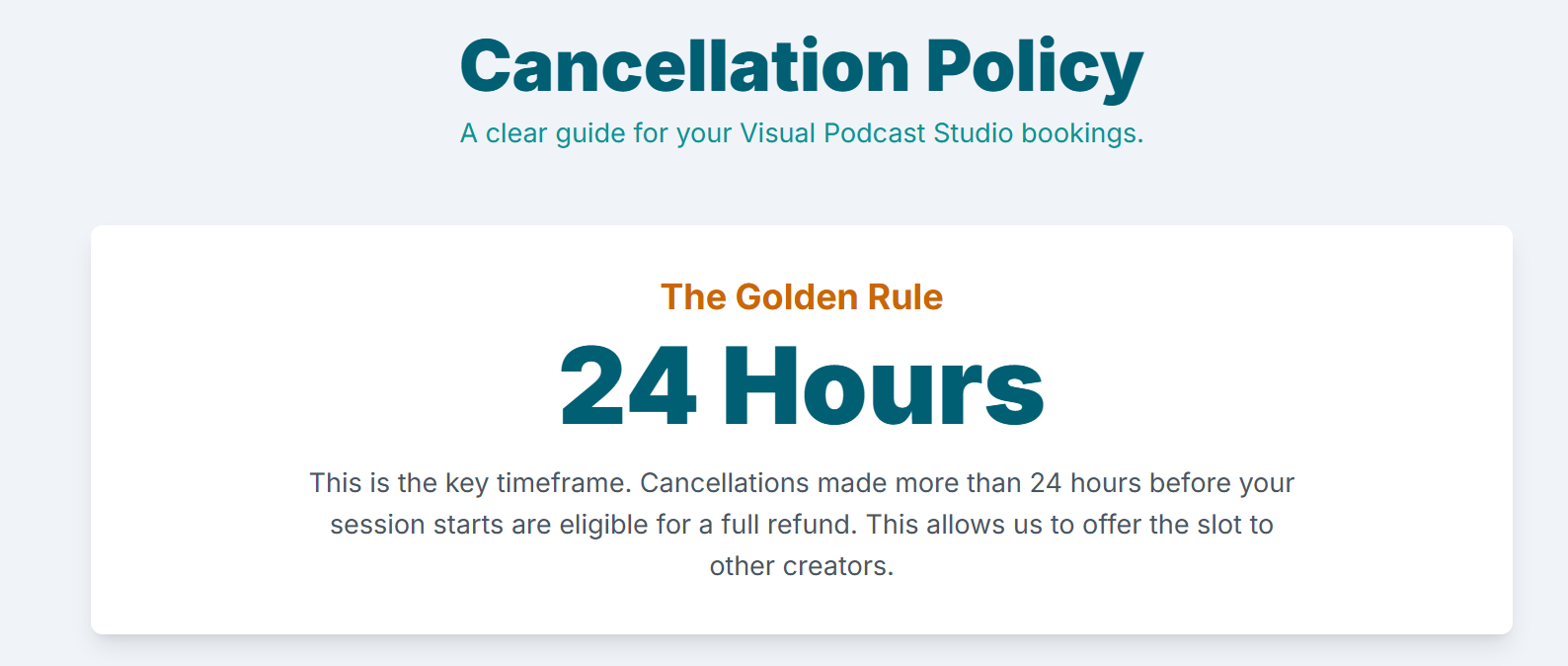
When a creator completes a booking, whether through an online portal, an email exchange, or a third-party platform, a service contract is formed. This agreement legally obligates the creator to render payment and adhere to the studio's usage rules, while compelling the studio to provide the specified facilities and services for the agreed-upon duration. The governing document for this relationship is invariably the studio's "Terms and Conditions" or an equivalent rental agreement. These documents, often found on a studio's website, detail the full scope of the legal relationship, covering everything from payment terms and liability to intellectual property and, most importantly, the conditions under which the contract can be terminated or amended.1 Failure to review these terms does not absolve a creator of their contractual duties; acceptance is typically implied by the act of confirming and paying for the booking.
The level of detail and legal precision within these terms often serves as an indicator of a studio's operational maturity and target clientele. For instance, a major international media company like Acast provides a highly structured and comprehensive set of terms and conditions for its London studio rentals.1 This document addresses nuanced legal concepts such as force majeure, indemnification, and specific liabilities, reflecting a sophisticated corporate structure designed to mitigate risk across a broad spectrum of professional engagements. In contrast, other studios may present simpler or, in some cases, conflicting terms across different platforms, which can suggest a less formalized operational backend or a business model geared towards a different segment of the creator market.2 The policy itself, therefore, is not just a set of rules but a signal about the nature of the business with which a creator is contracting.
1.2 Deconstructing Cancellation Policies: A Lexicon for Creators
To effectively compare studio policies, it is essential to understand the core components that constitute them. These elements define the financial and procedural consequences of altering or terminating a booking.
Notice Period: This is the critical timeframe preceding a booked session during which a cancellation must be communicated to the studio to be eligible for a full or partial refund. This period varies dramatically across the market, ranging from a highly restrictive 48 hours to a more lenient 30 days.2
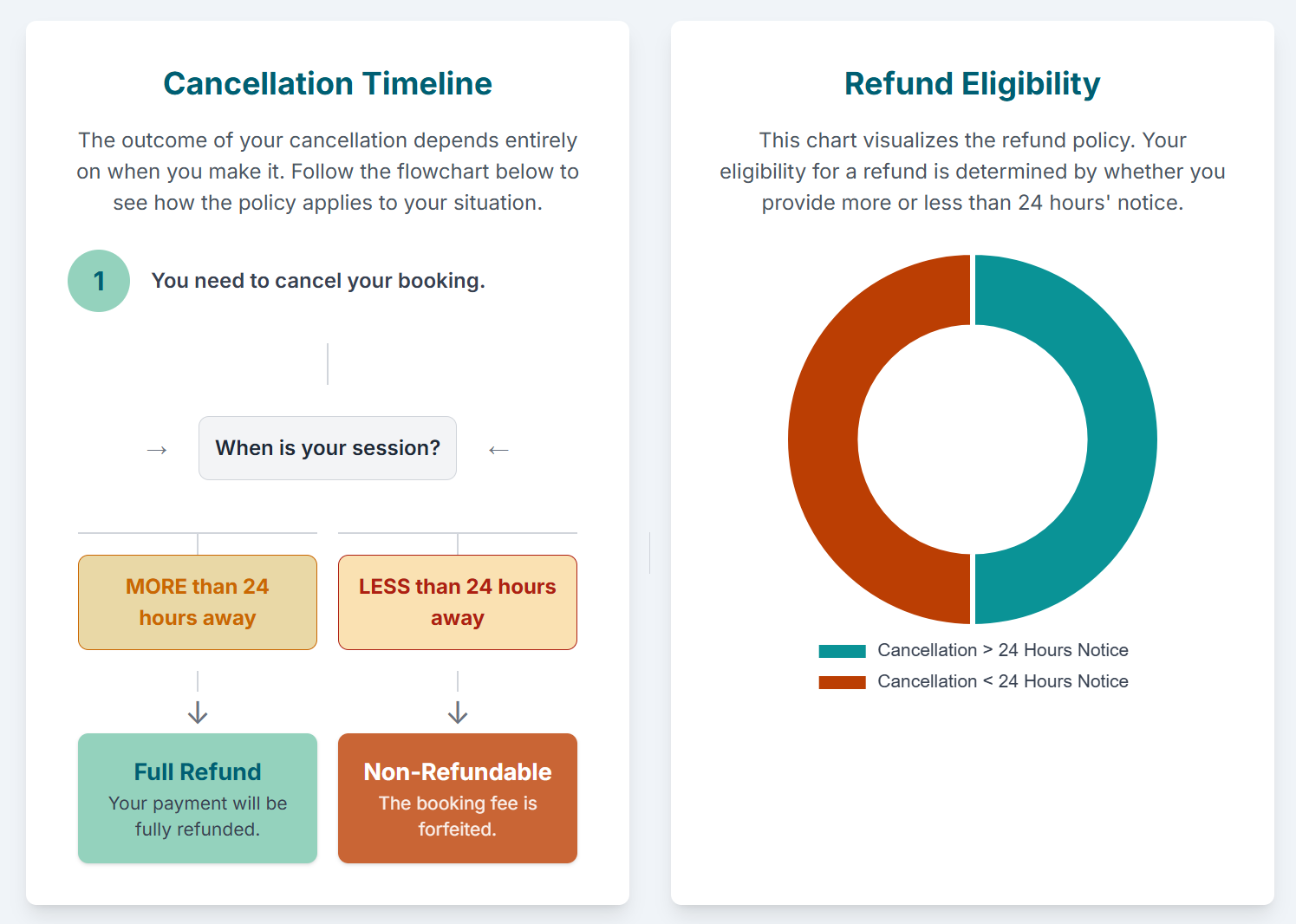
Refund Tiers: Many studios employ a tiered structure for refunds, where the amount of financial reimbursement is directly proportional to the length of the notice period. A common model involves a full refund for ample notice, a partial refund (typically 50%) for shorter notice, and no refund for last-minute cancellations. Acast Studios London provides a clear example of this model, with distinct financial outcomes for cancellations made more than seven days, between three and seven days, and less than three days before the session.1
Grace Period: A less common but valuable feature is a grace period—a short window of time immediately following the confirmation of a booking (e.g., 24 hours) during which a creator can cancel for a full refund, irrespective of how close the session date is. This provision offers a crucial safety net against booking errors or immediate changes in circumstance. One of the policies associated with Premiere Podcast Studios includes such a clause.3
Cancellation vs. Rescheduling: It is vital to distinguish between cancelling a booking (terminating the contract) and rescheduling it (amending the date of performance). Some studios treat these actions identically under their cancellation policy, while others have separate, often more lenient, rules for rescheduling. For example, London Podcast Studios, in one of its policies, allows for free rescheduling with 72 hours' notice, a provision separate from its more complex cancellation terms.5
Procedural Compliance: A valid cancellation is contingent not only on timing but also on following the correct procedure. Studios specify the required method for submitting a request, which may involve using an online booking portal, sending an email to a designated address (e.g., [email protected]), or making a formal request through a user account.1 Failure to adhere to the stipulated procedure can result in the forfeiture of any potential refund, even if the notice period was met.
Section 2: In-Depth Policy Review: A Studio-by-Studio Analysis
A detailed examination of individual studio policies reveals a market characterized by stark contrasts in clarity, flexibility, and consistency. While some providers offer transparent and predictable terms, others present a confusing web of contradictory information that transfers significant risk to the content creator.
2.1 Acast Studios London: The Corporate Standard
Acast Studios London exemplifies a clear, corporate approach to its booking contracts. The cancellation policy, as detailed in its official "Terms and Conditions for Studio Rental," is unambiguous and structured in tiers, providing a predictable framework for clients.1
Policy Breakdown: The refund structure is directly tied to the notice period provided:
More than 7 days' notice: A full refund is issued.
Between 3 and 7 days' notice: A 50% refund is issued.
Less than 3 days' notice: No refund is provided.
Procedural Analysis: The policy stipulates a dual procedure for cancellation. If the cancellation is made more than seven days in advance, it can be processed directly through the Skedda booking platform. However, for cancellations within the seven-day window, the creator must submit a formal request via email to [email protected].1 This procedural distinction is a critical detail that must be followed to ensure the request is valid.
Financial Caveats: A significant operational detail is that all refunds are processed manually and may take up to 28 days from the date of cancellation to be issued.1 This is an important cash flow consideration for independent creators and production companies managing tight budgets.
This clear and structured policy aligns with Acast's positioning as a premium, world-class facility. With high-value offerings like Studio 1, which features Canon C70 cameras and is priced at £499 per half-day, the policy serves to protect the value of their studio time.8 By adopting a "Bring Your Own Producer" (BYOP) model, Acast focuses on providing the physical and technical infrastructure, and its cancellation policy reflects a professional, risk-managed approach to asset utilization.
2.2 Premiere Podcast Studios: A Case of Conflicting Information
The cancellation policy for Premiere Podcast Studios is a prime example of the ambiguity that can arise from inconsistent information across different platforms. Two contradictory policies exist, creating significant uncertainty for a potential client.
The Core Contradiction:
Source A (Official Website - premierepodcaststudios.com): The terms and conditions on the studio's own website outline a strict 48-hour policy. It states that any session "cancelled and not rescheduled within a 48 hour period prior to the session start date, the booking fee is non-refundable." Furthermore, any session "cancelled or missed on the day of a session will incur full payment".2
Source B (Third-Party Vendor - tagvenue.com): A listing for Premiere Podcast Studios on the venue-hire platform Tagvenue presents a far more flexible, tiered policy described as "Flexible with Grace Period." This policy allows for a full refund for cancellations made within 24 hours of booking (the grace period) or more than 7 days in advance. It offers a 50% refund for cancellations made between 7 days and 24 hours before the session, with no refund for cancellations within 24 hours of the start time.3
This discrepancy places the consumer in a precarious position, as it is unclear which policy would govern their booking. The root of this issue often lies in administrative oversight, where a business updates its internal policies but fails to ensure that its marketing and sales information is consistent across all channels, including third-party booking platforms. This can lead to disputes where a customer, having booked through a platform like Tagvenue, reasonably expects to be bound by the more lenient terms advertised at their point of sale. The studio's self-description as a "full concierge service" with a dedicated engineer included in the price helps to explain the operational logic behind the stricter 48-hour policy on its own website, as it protects against the sunk cost of scheduling staff for a session that is cancelled at the last minute.2
2.3 Podshop: The Strict and Simple Mandate
Podshop's approach to studio booking cancellations is defined by its simplicity and rigidity. The policy for its studio sessions is a "strict 7-day cancellation or rebooking policy".10
Lack of Tiering: The most notable feature of this policy is its binary nature. Unlike the tiered models offered by Acast or on the Tagvenue listing for Premiere, Podshop provides no option for a partial refund. A cancellation made with six days' notice is treated with the same financial penalty—a complete forfeiture of the booking fee—as a cancellation made with six hours' notice. This "all or nothing" approach transfers a significantly higher degree of financial risk to the client.
-
Distinction from Other Services: It is important to note that Podshop applies this strict policy specifically to its studio hire, which is a fixed-asset, time-sensitive service. The company demonstrates a capacity for more flexible terms in other areas of its business; its policy for podcast editing services allows for prepayments to be rolled over or refunded under certain circumstances.10 This indicates that the strict 7-day rule for studio sessions is a deliberate commercial decision designed to maximize the revenue security of their physical spaces.
2.4 London Podcast Studios: A Web of Ambiguity
London Podcast Studios presents the most confusing and contradictory set of cancellation policies among the studios analyzed. At least four different and conflicting policies can be found across its own website and third-party platforms, creating an environment of extreme uncertainty and risk for the consumer.
Documenting Multiple Policies:
Policy 1 (Official FAQ Page): The FAQ page on the main website (londonpodcaststudios.co.uk) states a highly restrictive, dual-condition policy: "To receive a full refund, guests must cancel within 48 hours of making a booking and the cancellation must occur at least 7 days before the session".11 Under these terms, a booking made ten days in advance would become non-refundable after just two days, making it one of the most punitive policies in the market.
Policy 2 (Official Membership T&Cs): The terms and conditions for members on the same website reiterate the dual-condition policy above but also introduce a separate clause for rescheduling: "Rescheduling can be arranged free of charge with 72 hours notice, subject to availability".5 This adds another layer of complexity, distinguishing between cancellation and rescheduling.
Policy 3 (Seemingly Related Site): A website with similar branding (podcaststudioinlondon.co.uk) offers a much simpler rule: a "72-hour policy for rescheduling or cancellations".6
Policy 4 (Third-Party Vendor - tagvenue.com): A listing on Tagvenue for a studio at the same address presents a completely different "Standard 30 day with Grace Period" policy. This policy offers a full refund for cancellations more than 30 days in advance, a 50% refund for cancellations between 7 and 30 days, and no refund for cancellations within 7 days of the session.4
This baffling array of conflicting information is a significant red flag. It suggests a critical lack of administrative control and professional oversight. For a content creator, it makes an informed booking decision nearly impossible without first seeking direct, written clarification from the studio. This situation places the entire burden of navigating the confusion onto the client and severely undermines the studio's credibility.
Section 3: A Comparative Framework for Strategic Decision-Making
To translate the detailed policy reviews into actionable intelligence, the disparate information must be synthesized into a clear, comparative format. This allows for a direct, at-a-glance assessment of the financial risks and contractual obligations associated with each studio, empowering creators to make strategic booking decisions aligned with their specific production needs and risk tolerance.
3.1 The Master Cancellation Policy Comparison Table
The following table consolidates the cancellation policies of the analyzed studios. It is specifically designed to highlight the areas of ambiguity and contradiction, providing a clear visual reference for comparing the terms.
This structured comparison transforms a chaotic collection of data into a strategic tool. By juxtaposing the policies and explicitly noting discrepancies with bold warnings, it allows a creator to rapidly assess the contractual clarity and financial risk associated with each studio. It becomes immediately apparent that Acast offers the lowest risk in terms of ambiguity, while London Podcast Studios represents the highest.
3.2 Analysis of Policy Models: From Risk-Sharing to Risk-Transfer
The cancellation policies are not merely administrative rules; they are reflections of a studio's underlying business philosophy and approach to client relationships. The observed policies can be categorized into distinct models.
The Tiered / Risk-Sharing Model (Acast): This model, exemplified by Acast, acknowledges the unpredictable nature of creative production. By offering partial refunds for late-notice cancellations, the studio shares a portion of the financial risk with the client. The client is incentivized to provide as much notice as possible, but is not fully penalized for unforeseen changes. This approach is customer-centric, fostering goodwill while still protecting the studio's primary revenue stream from its fixed assets.
The Binary / Risk-Transfer Model (Podshop): Podshop's strict 7-day policy represents a risk-transfer model. With no option for a partial refund, the policy transfers nearly all the financial risk for cancellations within the one-week window directly to the client. This studio-centric approach prioritizes guaranteed revenue and schedule stability over client flexibility. It is a legitimate commercial strategy but one that requires clients to have a high degree of certainty in their production schedules.
The Ambiguous / High-Risk Model (Premiere Podcast Studios, London Podcast Studios): This is not a deliberate strategic model but rather the result of administrative inconsistency and a failure to maintain informational coherence across various sales and marketing channels. By presenting multiple, conflicting policies to the public, these studios create an environment of high ambiguity. This transfers the risk of confusion and potential disputes entirely onto the client, who is forced to undertake additional due diligence to ascertain the true terms of their contract. This model undermines trust and introduces an unnecessary layer of friction into the booking process.
Section 4: Navigating Ambiguity and Mitigating Contractual Risk
The presence of ambiguous and conflicting policies necessitates a proactive approach from content creators to protect their financial and legal standing. Understanding the legal principles at play and adopting rigorous documentation practices are essential for mitigating the risks inherent in this market.
4.1 The Peril of Third-Party Platforms: Which Contract Holds?
The discrepancies found for Premiere Podcast Studios and London Podcast Studios, where their official websites state one policy and a third-party booking platform like Tagvenue states another, raise a critical legal question: which contract is enforceable?.2 In contract law, the terms and conditions that are presented to and accepted by a party at the "point of sale" or "time of contract formation" are generally considered to be the governing terms.
Therefore, if a creator books a session at Premiere Podcast Studios through the Tagvenue platform and, as part of that process, clicks "agree" to the terms listed on Tagvenue, a strong legal argument can be made that those terms—the more flexible, tiered policy—form the basis of the contract for that specific transaction.3 The studio would be in a weak position to later enforce the stricter, contradictory policy from its own website. To secure this position, creators should, as a standard practice, take a screenshot or save a PDF of the cancellation policy page at the precise moment they make a booking on any platform. This creates a time-stamped evidentiary record of the terms they agreed to.
4.2 Interpreting Silence: The Risk of Unstated Policies
The research material identifies several studios, such as iD Podcast Studio and London Media Lounge, that are well-regarded for their services but for which no cancellation policy was readily available in the provided sources.12 This "policy silence" should be treated as a significant red flag. In the absence of a clearly stated policy, a creator has no contractual guarantee of a refund under any circumstances. The silence could imply a default "no refund" policy, or it could mean that cancellations are handled on a discretionary, case-by-case basis, which creates an unstable and unpredictable contractual environment. The most prudent course of action is to assume that "no stated policy" means "no refund" unless the studio provides a specific, written policy via email
before any payment is made.
4.3 The Burden of Proof: Securing Your Contractual Standing
In any potential contractual dispute, the party with the clearest and most comprehensive written evidence holds the strongest position. Verbal assurances regarding cancellation flexibility are commercially worthless and legally unenforceable. The final, governing cancellation policy must be explicitly stated in a durable medium, preferably within the booking confirmation email or on the invoice itself.
The administrative sloppiness demonstrated by some studios inadvertently creates an opportunity for a well-informed client. A studio like London Podcast Studios, with at least four different policies in the public domain, is in a vulnerable position.4 A typical customer might be unaware of this and accept whichever policy the studio chooses to enforce at the time of a cancellation request. However, a savvy creator who has conducted their due diligence can, in the event of a dispute, point to the existence of the most favorable of the published policies (for example, the 30-day tiered policy on Tagvenue) and argue that this was the basis for their booking decision. Faced with irrefutable evidence of their own contradictory information, the studio is in a weak negotiating position and is more likely to concede to the client's request to avoid a protracted dispute, negative public reviews, or a potential claim. The studio's administrative weakness can thus be transformed into a strategic advantage for the informed consumer.
Section 5: Actionable Recommendations and Best Practices for Content Creators
The analysis of London's visual podcast studio market reveals a clear need for creators to adopt a strategic, diligent, and proactive approach to booking. The following recommendations provide a practical toolkit for mitigating risk and making informed decisions.
5.1 Pre-Booking Due Diligence Checklist
Before committing financially to any studio booking, creators should obtain clear, written answers to the following questions. This should be done via email to create a documented record of the studio's representations.
"Could you please confirm in this email chain the exact cancellation and rescheduling policy that will govern my booking of at?"
"I have noted that your official website states [Policy X], while a third-party booking platform lists. Could you please clarify in writing which of these policies is correct and will apply to my booking?"
"What is the precise procedure I must follow to submit a cancellation or rescheduling request (e.g., specific email address, online portal)?"
"Does your policy make a distinction between cancelling a session for a refund and rescheduling it for a future date? If so, please provide the terms for both."
5.2 Matching Policy to Production Needs: A Risk-Based Approach
The optimal studio choice depends not only on creative fit and budget but also on the certainty of the production schedule. A risk-based approach should be used to select a studio with a policy that aligns with the booking's predictability.
For High-Certainty Bookings: If a production schedule is firm and unlikely to change (e.g., a solo host recording a regular segment), a studio with a stricter but potentially more cost-effective policy, such as Podshop's 7-day binary rule, may be an acceptable risk.10
For Medium-Certainty Bookings: For productions involving reliable guests where last-minute changes are possible but not probable, a studio with a clear, tiered policy like Acast provides a balanced approach. It offers flexibility and shared risk, protecting the creator from a total loss in the event of a late-stage change.1
For Low-Certainty Bookings: When a production involves coordinating multiple high-profile guests, complex travel schedules, or other volatile elements, the risk of postponement is high. For these bookings, it is imperative to either select a studio with an explicitly flexible policy or to negotiate a custom cancellation clause in writing before payment. Studios with ambiguous or conflicting policies, such as London Podcast Studios, should be avoided entirely for such high-stakes productions, as the contractual uncertainty adds an unacceptable layer of risk.
5.3 Best Practices for Managing a Cancellation
Should the need to cancel a booking arise, a professional and methodical approach will maximize the chances of a positive outcome.
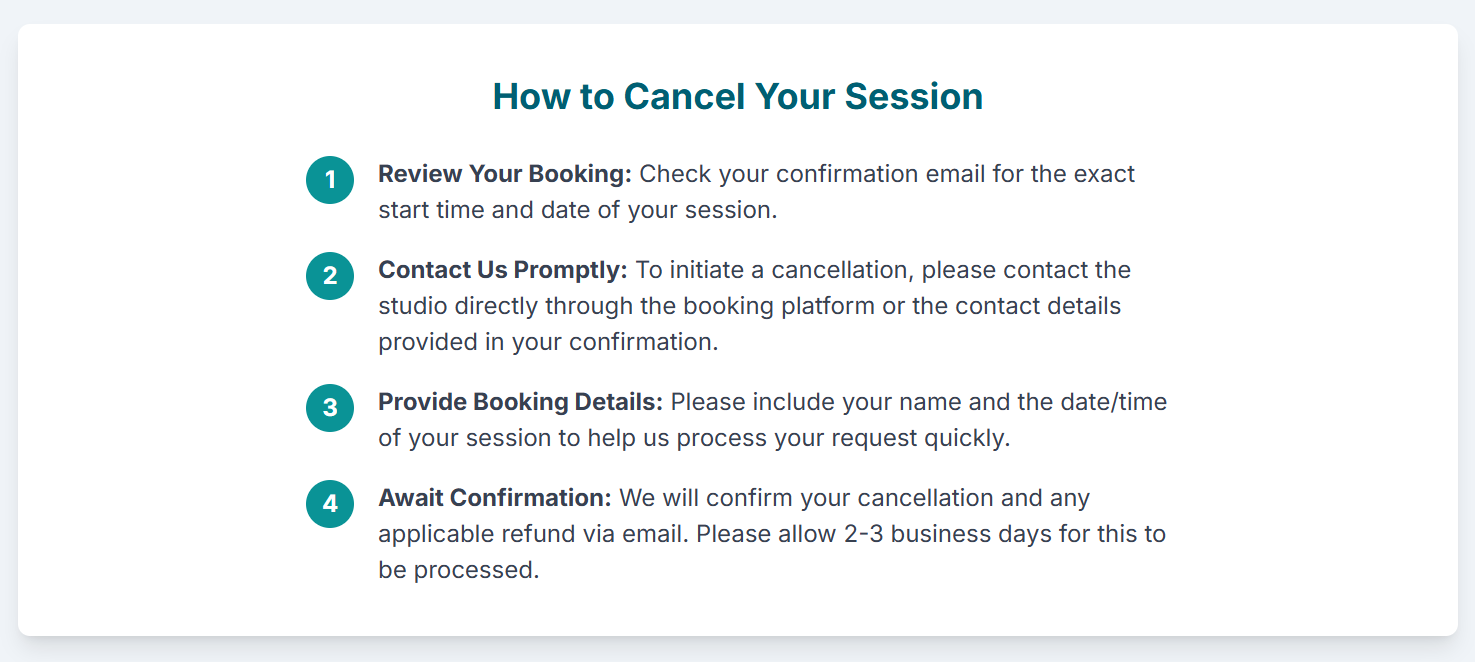
Review Your Contract: Immediately locate the original booking confirmation email and any related correspondence. Identify the specific cancellation policy that applies to your booking, including notice periods and procedural requirements.
Adhere to Procedure: Follow the stipulated cancellation procedure precisely. If an email to a specific address is required, use it. If the cancellation must be processed through an online portal, do so.
Communicate Clearly and Promptly: As soon as the need to cancel is known, communicate it to the studio. Do not delay. The communication should be in writing, clearly stating the intention to cancel and referencing the specific booking details (e.g., booking number, date, time).
Create a Paper Trail: Retain copies of all email correspondence related to the cancellation. This documentation is your evidence of when and how notice was given.
Follow Up on Refunds: If a refund is due, make a calendar note of the studio's stated processing time (e.g., Acast's 28-day window 1). If the refund is not received within that timeframe, initiate a polite but firm follow-up inquiry.
Of course. The cancellation policy for a visual podcast studio in London is a standard business practice designed to protect the studio from lost bookings. The policy is almost always based on the amount of notice you provide before your session.
Typically, you need to give at least 48 to 72 hours' notice to cancel or reschedule without a penalty.

Terms and Conditions for Studio Rental at Acast Studios London, accessed September 25, 2025, https://www.acast.com/en/legal/terms-and-conditions-for-studio-rental-at-acast-studios-london Terms and Conditions - Premiere Podcast Studios, accessed September 25, 2025, https://premierepodcaststudios.com/termsandconditions/ Podcast Recording Studio - Premiere Podcast Studios - Event Venue Hire - Tagvenue.com, accessed September 25, 2025, https://www.tagvenue.com/rooms/london/47205/premiere-podcast-studios/podcast-recording-studio All-Inclusive Podcast Recording Studio - Event Venue Hire - Tagvenue.com, accessed September 25, 2025, https://www.tagvenue.com/rooms/london/66636/all-inclusive-podcast-recording-studio/all-inclusive-podcast-studio Membership Terms and Conditions - London Podcast Studio, accessed September 25, 2025, https://www.londonpodcaststudios.co.uk/membership-terms-and-conditions Podcast Studio London - Hire Podcasting Rooms, accessed September 25, 2025, https://www.podcaststudioinlondon.co.uk/ Frequently Asked Questions | Podshop, accessed September 25, 2025, https://www.podshoponline.co.uk/faqs Acast Studios London, accessed September 25, 2025, https://www.acast.com/en/acast-studios-london Podcast Studio For Hire in Central London | Shoreditch, accessed September 25, 2025, https://premierepodcaststudios.com/ Podcast Studio in London, Podcast Studio Hire London - Podshop, accessed September 25, 2025, https://www.podshoponline.co.uk/services/podcast-studio FAQs — London Podcast Studio | The Home of Podcasting!, accessed September 25, 2025, https://www.londonpodcaststudios.co.uk/podcast-studio-recording-faqs iD Studios, accessed September 25, 2025, https://idpodcaststudio.co.uk/ Podcast Studio & Video Studio - West London | Multiple Sets, accessed September 25, 2025, https://londonmedialounge.co.uk/## A Standard Cancellation Policy
Here is the tiered structure that most professional studios in London follow:
1. Cancellation with more than 72 hours' notice:
You can expect a full refund or the option to reschedule your session to another date at no extra cost. This gives the studio a good amount of time to offer the slot to another client.
2. Cancellation within 48 to 72 hours' notice:
If you cancel within this window, you will likely be charged a partial fee, which is often 50% of the total booking cost, or you may lose your initial deposit.
3. Cancellation with less than 48 hours' notice:
For cancellations this close to the session time, it is standard practice to be charged the full fee for the booking. At this point, it is very difficult for the studio to find another client to take the slot.
Key Advice: While the structure above is the industry standard, the exact terms can vary. It is essential to read the specific cancellation policy on the studio's website or in their terms and conditions before you book. A professional and transparent business like Finchley Studio will always make these terms clear to their clients.
Book Your Visual Podcast with Confidence at Finchley Studio
Now that you understand how cancellation policies work, you can book your session with clarity. At Finchley Studio, we operate with a clear and fair booking policy, which is available for you to review before confirming your session. Our commitment to transparency is why organisations like the BBC and Lloyds Bank trust us with their productions. See what our clients are saying in our Google reviews and on Trustpilot.
We offer a diverse range of meticulously designed studios perfect for any visual podcast:
Dialogue Room
Lounge Studio
CEO Set
Blackwood Studio
The Brick Studio
Gathering Studio
Blackout Set
White Infinity Cove
Green Screen Cove
Giant Green Screen
Our professional Video Editing Service can be added to your booking for a complete, end-to-end production workflow. The team at Finchley Studio is here to ensure your vision is realised perfectly.
Ready to book with a studio that has clear and fair policies?
Book your session now!
Find Us Easily: Our studio is conveniently located just a two-minute walk from Finchley Central on the Northern Line and is adjacent to the Travelodge London Finchley. We also offer one free parking space per booking.
Google Maps
Apple Maps
[suspicious link removed]
what3words: orders.yards.jokes
Stay Connected: Follow our journey and see behind-the-scenes content on our social media channels:
Have questions? Check our FAQ or get in touch directly.
WhatsApp: +447587827200
Phone: +447587827200
Email: [email protected]
Works cited