Standardized Loudness Evolution and Platform Dynamics
The paradigm of audio distribution has transitioned from peak-amplitude normalization to a strict model of perceived-loudness management1. In the early eras of digital audio, the lack of standardized level control initiated the "loudness wars," wherein mastering engineers heavily compressed and limited program material to approach the absolute digital ceiling of 2. This approach produced highly compressed, dynamically flat audio that induced significant listener fatigue2. To resolve this, major streaming, broadcasting, and on-demand platforms implemented automated loudness normalization during playback1. This technology measures the integrated loudness of an audio file after upload and applies a linear gain offset at the playback stage, ensuring volume consistency across diverse content without modifying the source file itself2.
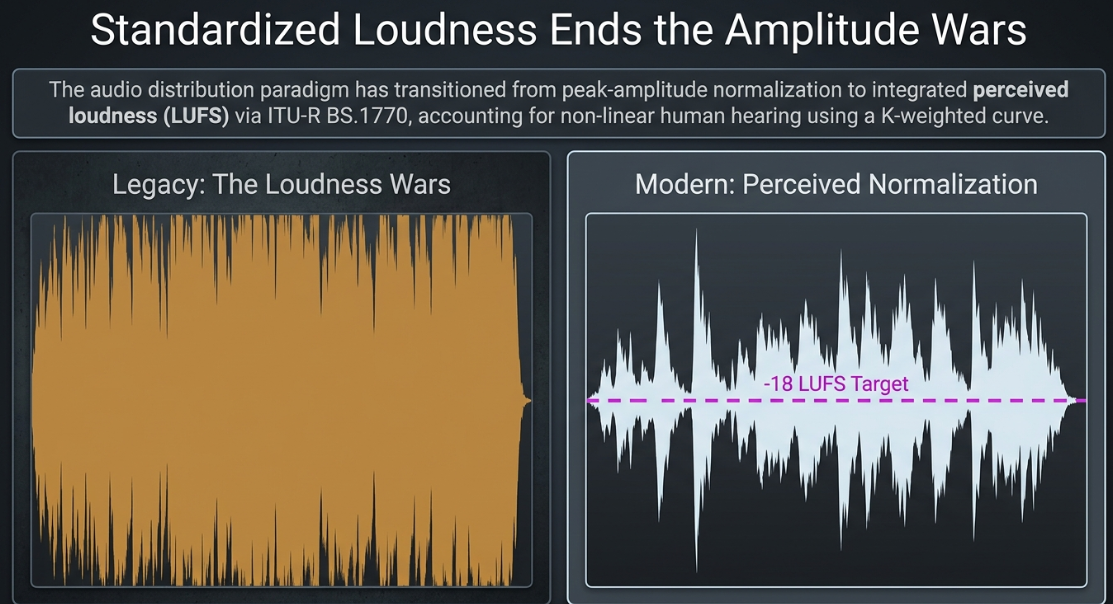
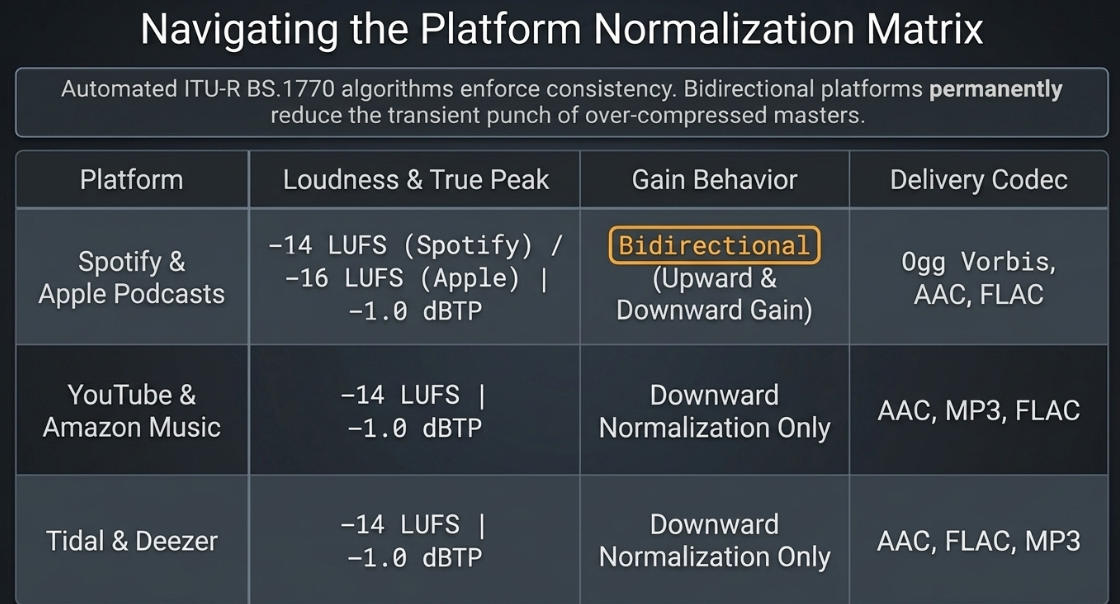
Loudness is objectively quantified using Loudness Units relative to Full Scale (LUFS) or Loudness Keyed Full Scale (LKFS), which are mathematically identical terms1. Under the ITU-R BS.1770 specification, LUFS accounts for the non-linear manner in which the human auditory system perceives different frequencies over time1. The measurement uses a K-weighted frequency response curve that applies a high-pass filter turning over at approximately to simulate our reduced sensitivity to low frequencies, combined with a high-shelf boost above to mimic the acoustic head-shadow effect8. Consequently, a bass-heavy signal and a mid-range vocal tract can register identical peak levels but display vastly different LUFS metrics9. To establish compliance, major platforms utilize database-driven ITU-R BS.1770 algorithms to enforce unique loudness and peak targets10.
Understanding these targets is crucial for gain staging6. If a podcast is mastered to a highly compressed level (e.g., ) to achieve a perceived competitive edge, Spotify and Apple Music will apply negative gain, turning the file down by 2. The track will play back at the exact same loudness as a master delivered at the native target, but it will have permanently lost its transient punch, dynamic range, and clarity due to unnecessary over-compression2. Conversely, if a track is mastered too quiet, platforms that do not apply upward gain (such as YouTube and Amazon Music) will play the file back at its low level, causing it to get lost in a playlist2. Professional automated mastering services, such as SONE, are designed to hit these targets precisely, protecting files from sub-optimal platform processing1.
Theoretical Mechanics of Peak Representation and Digital Transcoding
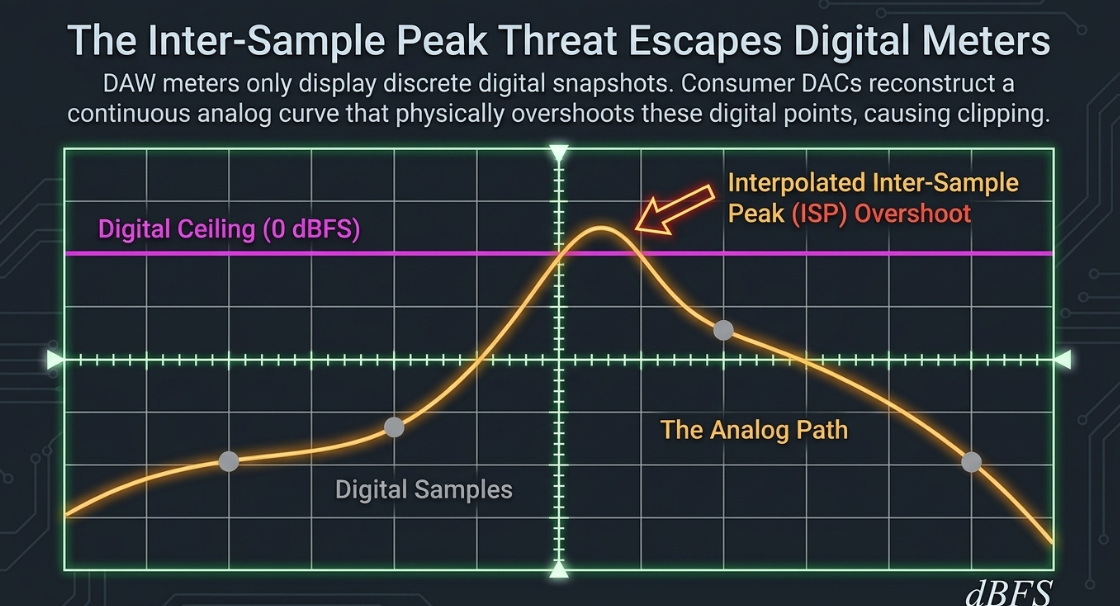
To manage peak levels during post-production, engineers must differentiate between sample peaks and True Peaks9. Digital audio workstations represent sound as discrete amplitude snapshots18. At a standard sample rate of , the system captures 44,100 discrete measurements per second, which standard peak meters display as decibels full scale ()18. However, physical acoustic sound is a continuous waveform18. When the digital stream is converted to an analog signal by a consumer digital-to-analog converter (DAC), a low-pass reconstruction filter interpolates between those discrete sample points to draw a smooth, continuous electrical path17.
Sample Peak (dBFS Representation) True Peak (dBTP Analog Path)
[Sample 1] [Sample 2] [Sample 1] [Sample 2]
o o o \ / o
| | | \ / |
_______|___________|_______ _______|____\_/____|_______ Digital Ceiling (0 dBFS)
| | | * <--- Interpolated Peak Overshoot
| | | / \
/ \
The reconstructed analog curve does not always peak at the exact coordinates of the digital samples; it can peak between them17. These peaks are known as inter-sample peaks (ISPs)17. If the digital ceiling of is approached too closely, the reconstructed analog curve will exceed the physical limits of the DAC17. This causes the converter to clip, introducing momentary inter-sample distortion that manifests as a harsh, brittle, or grainy quality on loud transients17. These overshoots are invisible on standard DAW sample-peak meters18.
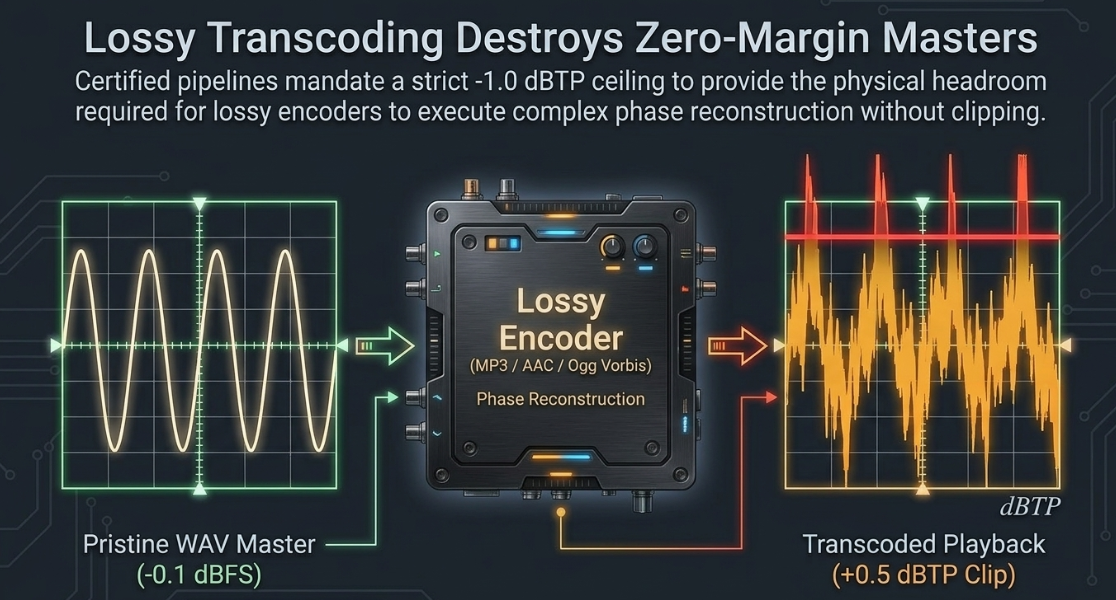
This problem is severely compounded when converting the high-resolution master file (typically a linear pulse-code modulation PCM WAV file) into lossy distribution formats such as MP3, AAC, or Ogg Vorbis9. Lossy encoders discard frequency components deemed mathematically irrelevant to human hearing, subsequently reconstructing the wave using complex models2. This transcoding process alters the phase relationships and peak profiles of the waveform18. A pristine WAV master measuring can easily spike to or higher after lossy encoding18. When played back through consumer systems, these overshoots generate audible distortion on transients18. This is why certified delivery programs, such as Apple Digital Masters, mandate a strict ceiling18. It provides the physical headroom required for lossy codecs to compress and reconstruct the waveform cleanly18.
Furthermore, oversampling filters used within limiters can temporarily increase peak signal levels25. When a heavily limited or clipped signal is upsampled, the low-pass filters applied during the oversampling process can introduce phase shifts that cause peaks to overshoot25. If these overshoots are not controlled by a dedicated True Peak limiting algorithm, the downsampled signal will clip subsequent conversion stages25.
Technical Standards and Dynamic Metering Topography
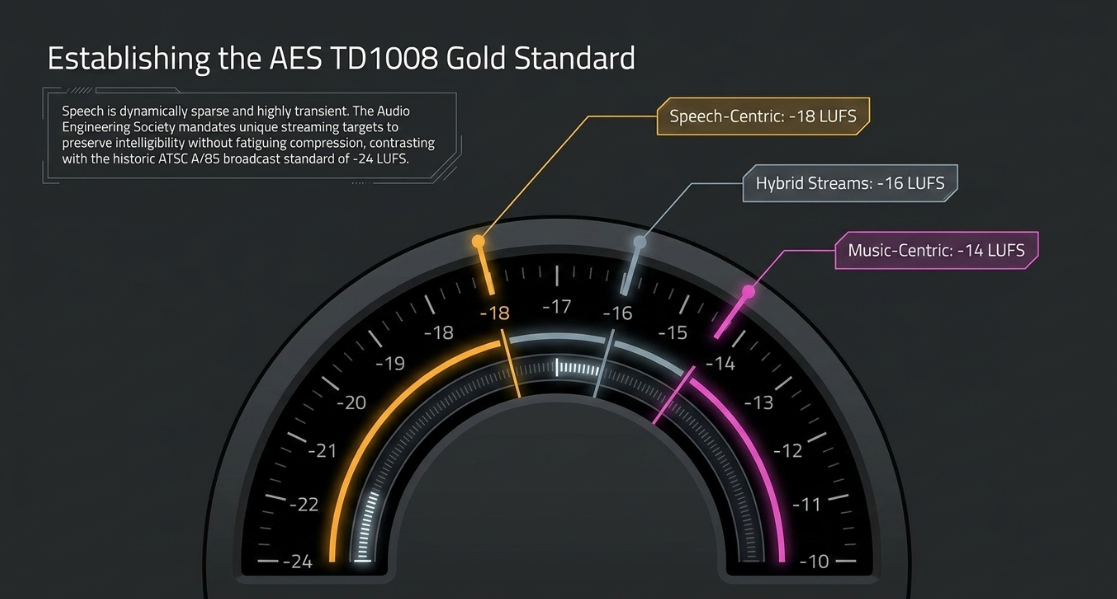
The Audio Engineering Society (AES) addressed the complexities of internet distribution in Technical Document TD1008, "Recommendations for Loudness of Internet Audio Streaming and On-Demand Distribution"13. A primary directive of AES TD1008 is that speech-centric content, such as podcasts and audiobooks, should be normalized to an integrated target of with a maximum True Peak limit of 6. Under identical technical LUFS measurements, the human auditory system perceives the spoken word as comparatively louder than heavily compressed music due to the dense spectral profile of mastered music compared to the sparse, highly transient, and dynamic nature of natural speech14. Normalizing speech to ensures comfortable intelligibility while preserving the natural dynamic range of voice13.
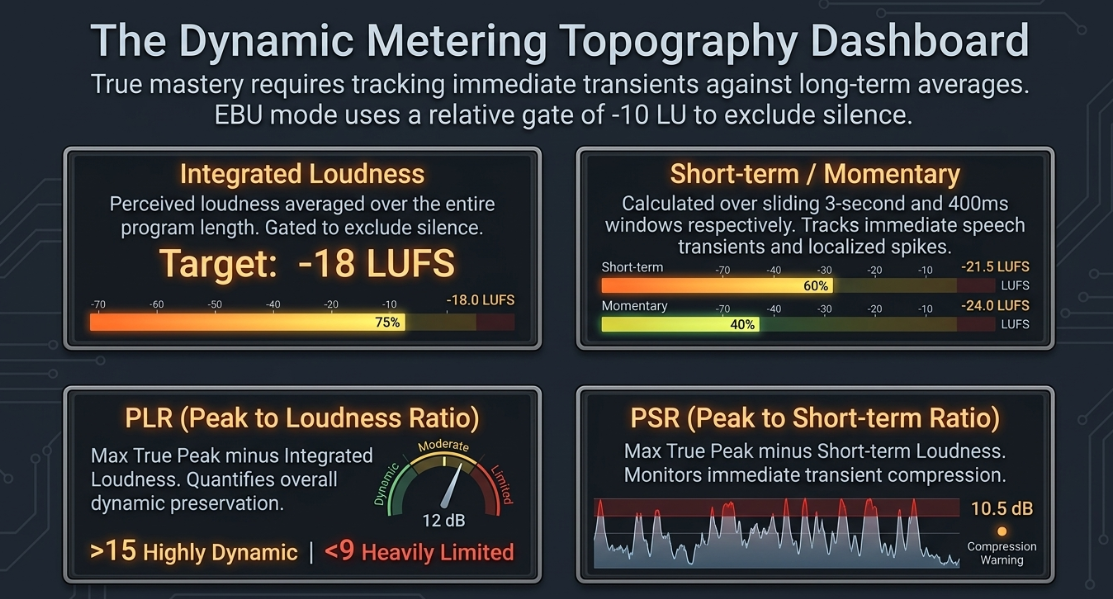
These online targets stand in contrast to traditional broadcast standards7. Under the North American ATSC A/85 standard, the mandated target is () with a peak limit of 7. The European EBU R128 standard requires an integrated loudness of () and a ceiling of 7. Broadcast environments rely heavily on "dialogue gating" or "anchor element" measurement, which isolates sections containing active speech and calculates the integrated loudness solely from those dialogue channels7. For online streaming, standard integrated measurement (EBU mode) uses a relative gate of below the absolute measured integrated value, discarding silent or very quiet segments () to prevent them from skewing the overall average7.
Historically, engineers also utilized Bob Katz's K-System (K-12, K-14, and K-20) to calibrate digital-to-analog headroom, mapping specific digital levels to standardized acoustic monitoring levels to protect dynamic range4. K-12 was designed for broadcast, K-14 (roughly equivalent to ) for standard mastering, and K-20 for highly dynamic theatrical and classical recordings4. Bob Katz has noted that while streaming currently target , standardizing distribution to the broadcast standard of would fully align consumer playback systems with professional cinema and radio standards, opening up optimal potential for high-end dynamic range31.
Katz K-System Alignments
[K-12 Scale] ---> Designed for Broadcast ($-12\text{ dBFS}$ Calibration Point)
[K-14 Scale] ---> Designed for Standard Mastering ($-14\text{ dBFS}$ Calibration Point)
[K-20 Scale] ---> Designed for High-Dynamic Theater & Classical ($-20\text{ dBFS}$ Calibration Point)
To measure these dynamics, engineers analyze Peak to Short-term Ratio (PSR) and Peak to Loudness Ratio (PLR)7. PSR measures short-term dynamics and transient preservation, calculating the difference between the maximum True Peak and short-term loudness (measured over a 3-second window)7. PLR represents the average program dynamics, calculating the difference between the maximum True Peak and integrated loudness over the entire length of the program7.
Interactive Parameter Topography and Limiting Topologies
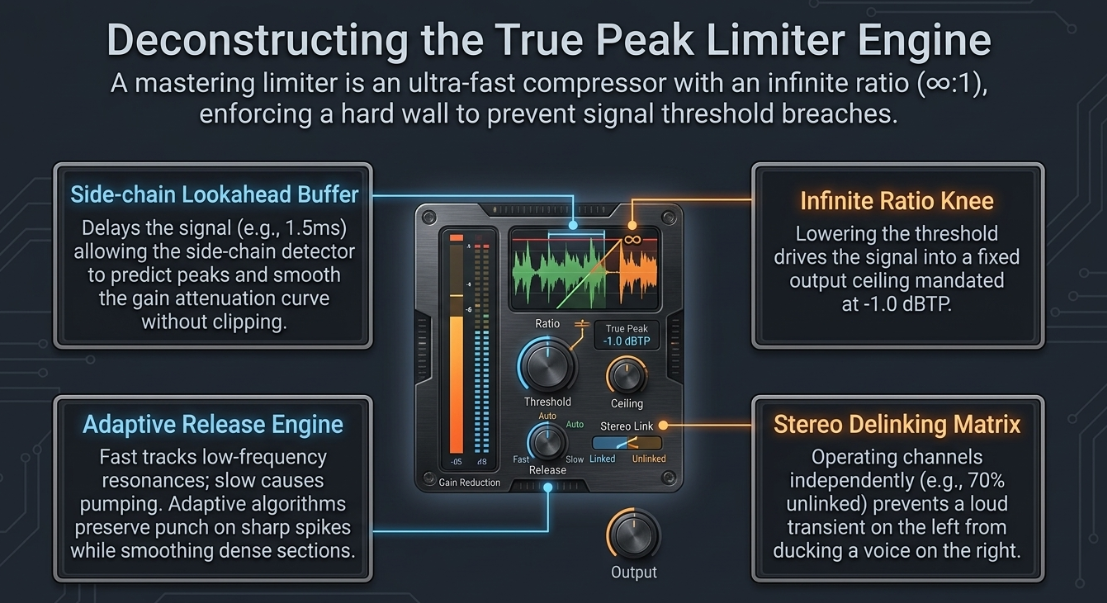
A mastering limiter acts as a specialized, ultra-fast compressor with an infinite ratio (), designed to enforce a hard wall that prevents the signal from exceeding a user-defined threshold16. Managing this process during podcast post-production requires precise adjustment of interactive parameters38.
Threshold and Output Ceiling
Lowering the threshold determines when peak reduction begins, simultaneously increasing the input gain (makeup gain) of the underlying signal and pushing it up against a fixed output ceiling35. The output ceiling sets the absolute maximum level the limiter will output36. To avoid digital clipping on playback systems and to comply with distribution requirements, this is typically set between and 1.
Release
The release control dictates how long the limiter takes to stop attenuating the signal after the input drops below the threshold36. Fast release times () react quickly to peaks, maintaining a loud, upfront sound and preserving overall transient energy35. However, if the release is too fast, the limiter will ride individual cycles of low frequencies (such as vocal resonances), causing severe intermodulation distortion35.
Slow release times () provide smooth, unobtrusive attenuation, reducing distortion and preventing low-frequency tracking35. However, if the release is too slow, a sudden loud transient (like a laugh or a plosive) will cause the limiter to clamp down hard and stay attenuated, ducking the subsequent quiet words38. This artifact, known as "pumping," reduces the clarity and intelligibility of natural speech35. Auto/Adaptive Release algorithms analyze the incoming program material in real-time, applying rapid release times to short, sharp transient spikes (preserving punch) and transition to slow release times on sustained, dense program sections to avoid pumping and distortion23.
Lookahead
Because peak limiters must catch fast transients instantly, they require a attack time34. To achieve this without clipping, the plugin delays the audio signal slightly (by ), creating a buffer that allows the side-chain detector to "look ahead" and predict upcoming peaks before they reach the gain-reduction stage19. This allows the limiter to smooth out the gain attenuation curve, reducing the harsh waveshaping distortion that occurs when a signal is pulled down abruptly19. Lookahead is essential for clean limiting, though it introduces plugin latency that must be compensated for by the DAW19.
Channel Delinking
Most modern limiters allow the engineer to link or delink the left and right channels34. When channels are linked, any transient spike on either the left or right side will trigger equal gain reduction across both channels34. While this maintains a solid, centered stereo image, it can lead to unnecessary gain reduction across the entire stereo field when a transient occurs on only one side34.
By partially delinking the channels (e.g., setting the stereo link to ), the left and right detectors operate with a degree of independence34. This preserves channel independence, improves transient detail, and prevents one loud voice positioned on one side of a stereo podcast field from ducking the voice on the opposite side34.
Oversampling and Filtering Physics
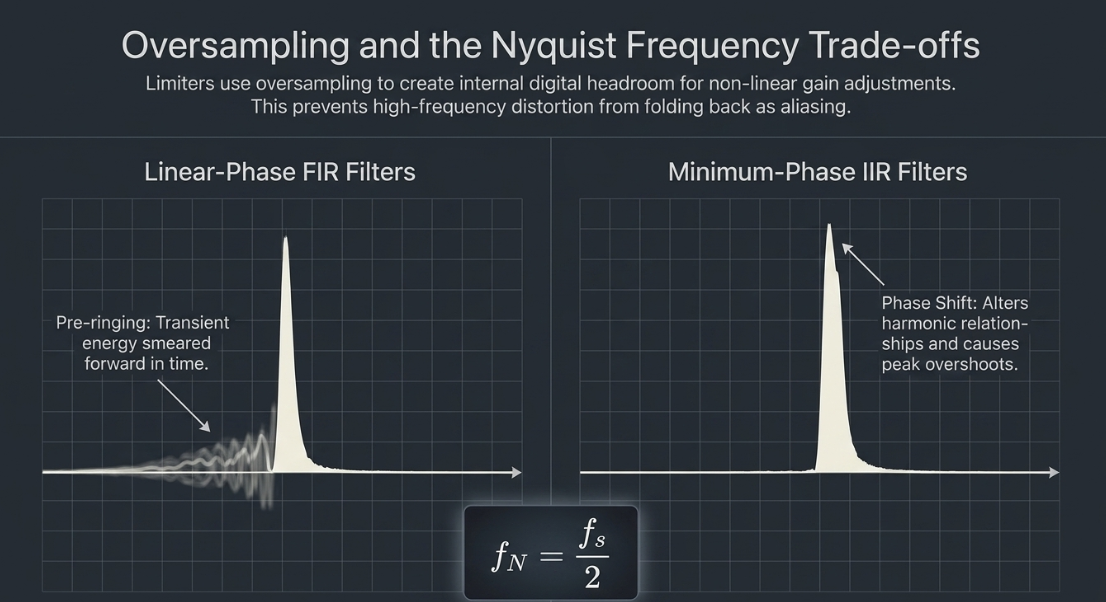
The rapid, non-linear gain adjustments performed by a limiter's side-chain can generate high-frequency distortion products25. If these frequencies exceed the Nyquist frequency (), they cannot be represented digitally and fold back into the audible spectrum as harsh, non-harmonic aliasing distortion25. Oversampling temporarily raises the internal sample rate of the limiter (e.g., from to for a 4x setting), giving the plugin more digital headroom to process these high frequencies cleanly25. The high-frequency artifacts are then filtered out using a high-quality anti-aliasing filter before the signal is downsampled back to the session's native rate46.
Oversampling filters typically rely on either Linear-Phase Finite Impulse Response (FIR) filters or Minimum-Phase Infinite Impulse Response (IIR) filters25.
Linear-Phase FIR Filters preserve the phase relationships of all frequencies, preventing phase alignment issues when combining signals25. However, to maintain phase linearity, these filters introduce "pre-ringing," wherein a tiny portion of high-frequency energy is smeared forward in time, slightly smoothing out or softening sharp transients (transient smearing)26.
Minimum-Phase IIR Filters eliminate pre-ringing entirely, concentrating any phase shift at the very top of the frequency spectrum25. However, this phase shift can alter the harmonic relationships of vocal frequencies and cause peak overshoots, potentially triggering the limiter to overreact25. For speech-heavy podcasts, 4x oversampling strikes the ideal balance between aliasing control and transient preservation27.
To minimize these filtering artifacts under heavy limiting, engineers often deploy a dual-limiter or cascaded limiter configuration34. In this topology, two limiters are placed back-to-back in the signal path34. The first limiter is set with a fast attack and release to shave off the absolute tallest transient peaks, applying only a gentle of gain reduction34. The second limiter is configured with a slower, adaptive release to smoothly raise the overall perceived loudness of the signal34. Alternatively, engineers can use a "soft limiter" (an attenuator with a ratio greater than and a variable, soft knee) as the first processor in the chain34. This soft-knee limiter gently clamps down on transient peaks in proportion to how far they exceed the threshold, providing a more musical, transparent result before the signal hits the final brick-wall True Peak limiter34.
Cascaded Limiter Configuration
[Input] -> [Soft Limiter / Clipper] -> [Brick-Wall True Peak Limiter] -> [Output]
(Tames Peaks by ~2 dB) (Sets Hard Ceiling at -1 dBTP)
Software Implementations and Hardware Dynamics Architecture
Professional podcast post-production relies on highly advanced, specialized software and hardware tools to handle limiting and loudness compliance14.
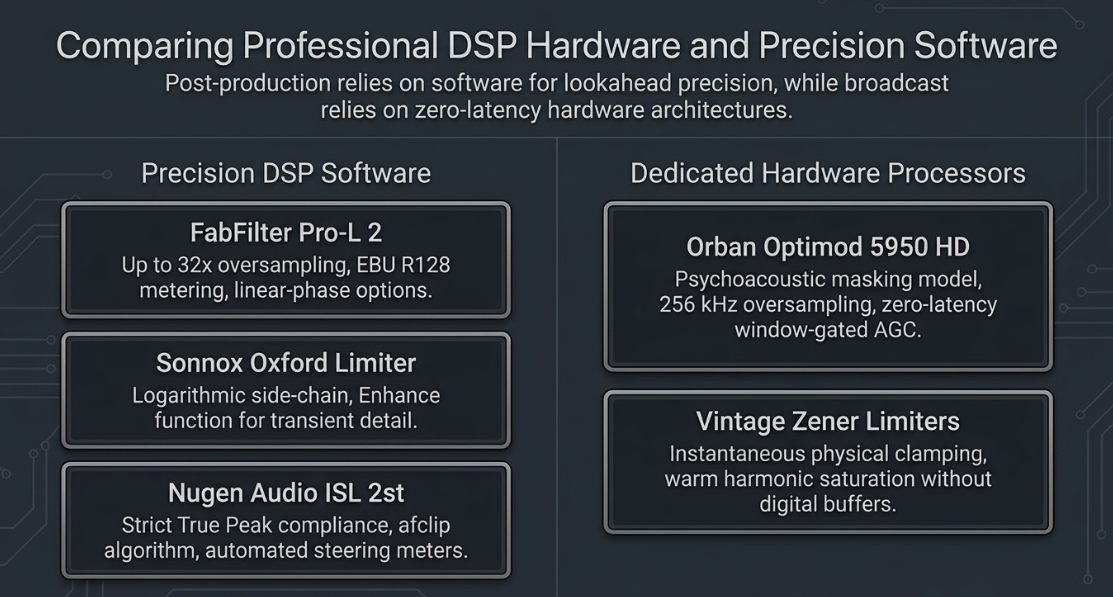
While software plugins provide precise lookahead and linear-phase oversampling capabilities, hardware-based processors remain essential in professional live broadcast facilities and modern real-time streaming pipelines14.
Hardware processors like the Orban Optimod utilize specialized algorithms running on high-speed DSPs60. The MX Peak Limiter technology, for example, uses a psychoacoustic masking model to estimate if the distortion generated by rapid peak clipping would be audible to the human ear62. It then takes real-time corrective action to minimize distortion while maintaining vocal intelligibility and coverage, oversampling the signal up to 256 kHz to prevent digital aliasing62. Analog processors like the dbx 266XS or vintage Zener diode limiters do not use digital buffers or lookahead latency; instead, they rely on physical electronic components to clamp down on signal peaks instantly, adding warm harmonic saturation that can make clean digital voices sound fuller and more cohesive34.
Dialogue Signal Path Hygiene and Sibilance Management
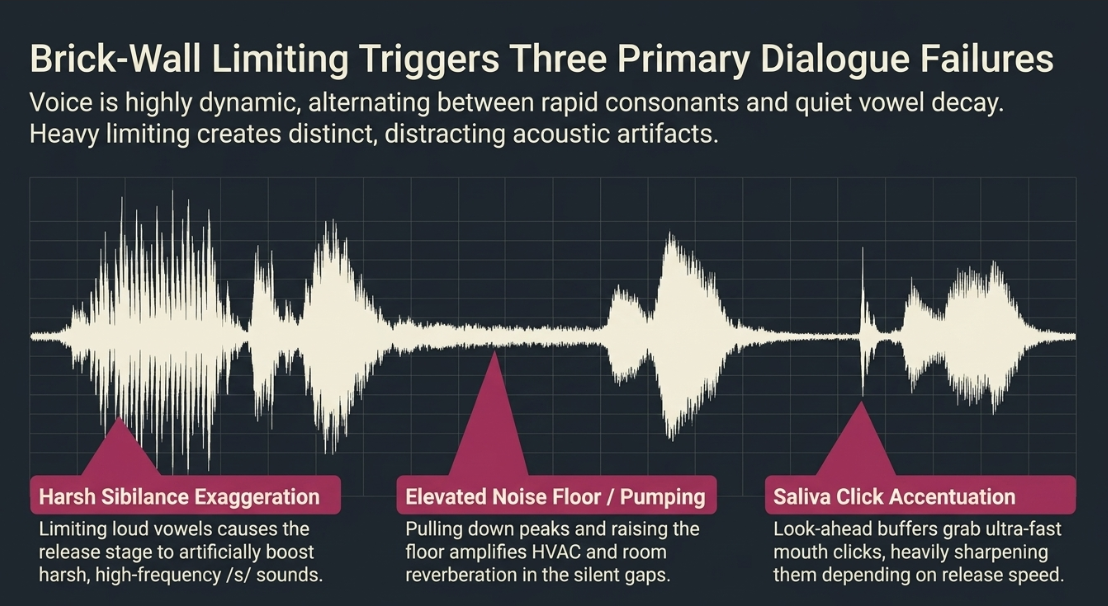
Managing limiters in a speech-only environment requires a specialized approach compared to music mastering41. Voice is a highly dynamic medium filled with rapid transient bursts (such as consonant plosives /p/, /b/, /t/ and sibilants /s/, /z/) followed by quiet vowel decay29. Consonants are critical for vocal clarity and speech intelligibility; if they are dull or masked, the listener will struggle to understand words29.
Placing a fast, aggressive brick-wall limiter directly onto a highly dynamic voice can cause technical issues:
Sibilance Exaggeration
Sibilants are high-frequency, noisy consonants that naturally peak at lower volumes than low-frequency vowel resonances29. If a vocal track is heavily limited, the limiter will compress the loud vowels, but as soon as a sibilant /s/ sound occurs, the limiter will release41. This can make sibilance sound unnaturally loud and harsh41. Furthermore, pushing a signal hard into a limiter introduces harmonic distortion that adds extra high-frequency energy, making sibilance even more grating68.
Noise Floor Pumping
In typical podcast environments (such as home studios or untreated offices), there is always some background noise (from HVAC, computer fans, or room reverberation)1. A limiter works by pulling down the loudest peaks and raising the quietest sections9. If a voice is heavily limited, the background noise floor will be boosted during the silent gaps between words, creating a distracting "breathing" or "hissing" sound1.
Accentuation of Mouth Clicks
Mouth clicks, saliva pops, and lip smacks are fast, high-energy transients with extremely rapid rise times29. A look-ahead peak limiter will detect these clicks as major peaks and clamp down on them, which can dull the beginning of the spoken words29. Conversely, if the limiter's release is too fast, it will ride the click and boost it, making mouth noises sound sharper and more distracting35.
To avoid these issues, professional post-production engineers rely on a structured, multi-stage signal chain where the master limiter is only used to catch the very highest peaks41. The optimal signal flow follows this sequence30:
Source Preparation and Leveling: Before applying any dynamic plugins, the engineer should use volume automation (clip gain) to manually smooth out major level differences between speakers30. This ensures the downstream processors receive a consistent signal, preventing them from overreacting30.
Subtractive EQ: A high-pass filter is applied to remove low-end rumble (typically below ), and a parametric equalizer is used to tame boxy, resonant frequencies in the range41.
Spectral De-essing: A high-quality de-esser is placed early in the chain to isolate and attenuate harsh /s/ frequencies before they reach any compressors or limiters49. Modern spectral de-essers, such as NoiseWorks Audio's VoiceAssist, offer a highly surgical alternative to traditional broadband de-essers69. While broadband de-essers pull down the entire volume of a frequency range when sibilance is detected—often dynamic-muffling the surrounding consonants—spectral de-essers apply regional, spectral-based gain reduction solely to the specific harsh sibilant frequencies69. This leaves the surrounding air and consonant clarity untouched69. With advanced ARA (Audio Random Access) integration in DAWs like Pro Tools and Cubase, these spectral decisions are visualized directly on the clip waveform, enabling region-level adjustments that preserve natural speech dynamics69.
Gentle Multi-stage Compression: Rather than relying on a single processor to handle all dynamic control, the engineer should use a gentle compressor with a low ratio (), a moderate attack time (to let the natural consonants pass through), and a program-dependent release41. This smooths out the vocal level, adding "glue" and control30.
Auxiliary Restoration and Leveling: Specialized standalone and browser-based levelers like Auphonic or Trileveler 2 can be introduced to provide long-term loudness consistency across multitrack recordings30. Complex restoration suites, such as iZotope RX 8, can be deployed to systematically remove plosives, hum, and salivary clicks at the spectral level49. Additionally, precise measurement tools like the Waves WLM Plus Loudness Meter should be integrated into the master bus to verify compliance with platform standards in real time50.
-
Master Bus Peak Limiting: The master True Peak limiter is placed as the absolute final insert in the chain, with its output ceiling set to or 16. The input gain of the limiter is adjusted so that it only engages on the very loudest peaks (such as a sudden laugh or shout), typically applying no more than of gain reduction3. This ensures the limiter operates transparently, protecting the digital ceiling without coloring the voice, elevating the noise floor, or introducing distortion3.
To ensure optimal gain staging throughout this entire chain, engineers recommend maintaining an average signal level of approximately across all individual channel inserts26. Keeping the signal near this calibration point prevents digital processors and analog-modeled plugins from driving into unwanted saturation or clipping, ensuring that the final premaster signal exits the vocal bus at approximately 15. This healthy gain structure leaves sufficient headroom for the mastering stage, allowing the final True Peak limiter to operate cleanly without overreacting or generating intermodulation distortion15.
Synthesized Engineering Guidelines for Post-Production Mastering
For professional post-production engineers seeking to deliver clean, dynamic, and platform-compliant podcasts, the following synthesized operational guidelines should be implemented:
Target a Speech-Centric Loudness Standard: Align the final master with the AES TD1008 specification13. Aim for integrated for pure spoken-word podcasts, for music-only content, and for hybrid speech-and-music streams13. This preserves the natural dynamics and intelligibility of the voice while preventing sudden volume jumps between episodes or ads1.
Enforce a Strict True Peak Ceiling: Set the final master limiter's output ceiling between and 1. This physical headroom buffer protects the waveform during down-stream transcoding, ensuring that lossy codecs (MP3, AAC, Ogg Vorbis) do not introduce brittle, inter-sample clipping distortion during playback18.
Use Cascaded and Hybrid Dynamics: Avoid relying on a single brick-wall limiter to handle the entirety of the dynamic range34. Utilize manual clip gain, spectral de-essers, and gentle low-ratio compressors earlier in the chain to smooth out macro-dynamics30. When using limiters, pair a fast-reacting clipper or soft-knee limiter (attenuating the top of peaks) with a final transparent True Peak limiter set with a slow, adaptive release34. This prevents the limiter from pumping or artificially elevating the background noise floor1.
Maintain Linear-Phase Oversampling and Lookahead: Set oversampling to 4x and introduce a lookahead buffer of on the master limiter27. This configuration suppresses non-harmonic aliasing distortion without inducing heavy CPU strain or excessive pre-ringing, which can smear vital speech consonants27.
Prioritize Dynamic Range Over False Loudness: Because modern platforms utilize automated loudness normalization to match all content during playback, there is no technical advantage to mastering at highly compressed levels2. Excessively loud files will simply be turned down, leaving them sounding thin and dynamically flat compared to more dynamic, open masters2. Master for the natural tone and clarity of the voice first, letting the meters serve as secondary verification of platform compliance2.
Works cited
Podcast Loudness Standards 2026: Spotify, Apple, YouTube Requirements, https://sone.app/blog/podcast-loudness-standards-2026-spotify-apple-youtube
Mastering Loudness Targets for Streaming: Spotify, Tidal, Apple Music and More - Mat Leffler-Schulman, https://matlefflerschulman.com/mastering-articles/loudness-targets-and-mastering-for-streaming-platforms
An introduction to limiters (and how to use them) - iZotope, https://www.izotope.com/community/blog/an-introduction-to-limiters-and-how-to-use-them
LUFS and The Loudness War - Jimmy Ether, https://jimmyether.com/lufs-and-the-loudness-war/
Mastering Guidelines & Metrics For Music Streaming - Producer Spot, https://www.producerspot.com/mastering-guidelines-metrics-for-music-streaming/
Loudness Compliance Cheat Sheet, https://cdn.prod.website-files.com/64e8910adc5a63966a68acea/6a26c82b93653fc4bbdb9617_6a26c829e066fd5155c11ede_loudness-compliance-cheatsheet.pdf
Loudness metering – MiRA, https://doc.flux.audio/mira/Metering_Loudness.html
From (True) Peak via RMS to LUFS - Skippy Studio, https://skippystudio.nl/2021/02/from-true-peak-via-rms-to-lufs/
The Loudness Lookup - LUFS Standards for Every Platform - Dan Murtagh, https://danmurtagh.com/lufs-loudness-standards/
Streaming Loudness & LUFS: Spotify, Apple, YouTube (2026) - Peak-Studios, https://www.peak-studios.de/en/upload-streaming-dienste/
Worldwide Loudness Delivery Standards - RTW Audio, https://www.rtw.com/blog/rtw-knowledge-base-1/worldwide-loudness-delivery-standards-4
How loud to master for streaming (the TRUTH!), https://mastering.com/loudness-streaming-lufs/
Loudness Explained - StreamGuys, https://www.streamguys.com/loudness-explained/
Understanding Loudness for Streaming Audio - Telos Alliance, https://docs.telosalliance.com/docs/understanding-loudness-for-streaming-audio
The Ultimate Guide to Streaming Loudness (LUFS Table 2026) - Soundplate.com, https://soundplate.com/streaming-loudness-lufs-table/
How to Master your podcast - Reddit, https://www.reddit.com/r/podcasting/comments/1flga6b/how_to_master_your_podcast/
True Peak Levels in Mastering, https://kevork-mastering.com/en/true-peak-levels/
True Peak vs Inter-Sample Peaks: What dBTP Actually Means - Mat Leffler-Schulman, https://matlefflerschulman.com/mastering-articles/true-peak-vs-inter-sample-peaks
[Free Dsp] Lookahead Limiter (true peak) - HISE Forum, https://forum.hise.audio/topic/12229/free-dsp-lookahead-limiter-true-peak/12
Intersample Peaks - Why 2 dbTP headroom is better!, https://www.peak-studios.de/en/intersample-peaks/
Mastering Tip: What Are Inter Sample Peaks & Why They Matter - Production Music Live, https://www.productionmusiclive.com/blogs/news/mastering-tip-what-are-inter-sample-peaks-why-they-matter
What Is Inter-Sample Peaking (and Why You Master Clips After Export), https://www.waltzmastering.com/posts/what-is-inter-sample-peaking-and-why-your-master-clips-after-export
NUGEN Audio ISL 2ST True Peak Limiter Plugin - ProPlugin, https://proplugin.com/en/product/nugen-audio-isl-2st-true-peak-limiter-plugin/
What's the Difference Between the Oxford Limiter and the Limiter in Oxford Dynamics?, https://support.sonnox.com/hc/en-gb/articles/33950878580242-What-s-the-Difference-Between-the-Oxford-Limiter-and-the-Limiter-in-Oxford-Dynamics
When Should You Use Oversampling? - Sound On Sound, https://www.soundonsound.com/techniques/when-should-you-use-oversampling
Oversampling Strategies - Loopy Pro Forum, https://forum.loopypro.com/discussion/58507/oversampling-strategies
FabFilter Pro-L 2 Help - Oversampling, https://www.fabfilter.com/help/pro-l/using/oversampling
Loudness Control Is Your Ally in Preventing Tune-Out - Radio World, https://www.radioworld.com/tech-and-gear/tech-tips/loudness-control-is-your-ally-in-preventing-tune-out
What are Transients in Audio? How they Affect the Shape of Sound - MasteringBOX, https://www.masteringbox.com/learn/what-are-transients-in-audio
Podcast mastering in 5 eenvoudige stappen - Spreekbuis.nl, https://www.spreekbuis.nl/podcast-mastering-in-5-eenvoudige-stappen-s1e10/
Bob Katz on AES TD1008: Current recommendation is to set loudness normalization at -16 LUFS to -20 LUFS for streaming services, but the industry is working towards standardizing to -24 LUFS as consumer products improve to align it with existing broadcast, radio and video production standards : r/musicproduction - Reddit, https://www.reddit.com/r/musicproduction/comments/1qg5ukr/bob_katz_on_aes_td1008_current_recommendation_is/
Loudness Archives - Grimm Audio, https://www.grimmaudio.com/tag/loudness/
Limiter Masterclass - Sage Audio, https://www.sageaudio.com/articles/limiter-masterclass
Limiters tutorial - MeldaProduction, https://www.meldaproduction.com/tutorials/text/limiters
How To Use A Limiter: The Definitive Guide (2025) - EDMProd, https://www.edmprod.com/how-to-use-a-limiter/
Limiter - compressor in the mix, mastering - use it correctly - Peak-Studios, https://www.peak-studios.de/en/limiter/
Mastering Adaptive Limiter in Logic Pro X - Pro Mix Academy, https://promixacademy.com/blog/adaptive-limiter-logic-pro-x/
Top 7 Free Mastering Limiter Plugins - Sage Audio, https://www.sageaudio.com/articles/top-7-free-mastering-limiter-plugins
How to set your mastering limiter: The 5 steps - Stickz, https://stickz.co/blog/how-to-set-your-mastering-limiter/
How much do I *actually* want limited when I process dialog? : r/audioengineering - Reddit, https://www.reddit.com/r/audioengineering/comments/1l3r4y0/how_much_do_i_actually_want_limited_when_i/
Loud & Clear: Top Limiter Plugin Tips for Mastering Music | Blog - Waves Audio, https://www.waves.com/mastering-music-with-limiter-plugin-tips-how-to-get-loud-masters
ISL - Precision Limiting for Post, Music & Broadcast | NUGEN Audio, https://nugenaudio.com/isl/
How To Use Limiters When Mastering Music - Joey Sturgis Tones, https://joeysturgistones.com/blogs/learn/how-to-use-limiters-when-mastering-music
Top 7 Mastering Limiter Plugins - Sage Audio, https://www.sageaudio.com/articles/top-7-mastering-limiter-plugins
Oversampling in plug-ins: Why does pre-ringing (transient smearing) occur? - Reddit, https://www.reddit.com/r/musicproduction/comments/14rrha5/oversampling_in_plugins_why_does_preringing/
Oversampling in Music Production: What It Is and When to Use It - Electronic Production, https://www.electronicproduction.co.uk/post/oversampling-in-music-production-what-it-is-and-when-to-use-it
Slap, Punch, Transients, Compressors, Oh my! - Korneff Audio, https://korneffaudio.com/slap-punch-transients-compressors-oh-my/
Podcast Audio Plugins – The Big List, https://podcastengineeringschool.com/podcast-audio-plugins/
Plugins for Audio Post-Production: What the Pros Are Using, https://theproaudiofiles.com/post-production-plugins/
Oxford Limiter User Guide - Sonnox, https://dload.sonnoxplugins.com/pub/plugins/UserGuides/Oxford_Limiter_User_Guide.html
Oxford Limiter Manual.pdf, https://media.uaudio.com/support/manuals/dd/Oxford%20Limiter%20Manual.pdf
Sonnox Oxford Limiter Review: Honest Mastering Test, https://adrianmilea.com/sonnox-oxford-limiter-review/
Oxford Limiter - Sonnox, https://sonnox.com/products/oxford-limiter
Nugen Audio ISL 2 True Peak Limiter | ESV - Eastwood Sound & Vision, https://www.eastwoodsoundandvision.com/pluginstore/utility-plugins-software/utility/nugen-audio-isl-2-true-peak-limiter
Essential Mastering Limiter Plugins Every Audio Producer Should Know - Lucid Samples, https://www.lucidsamples.com/blog/essential-mastering-limiter-plugins-every-audio-producer-should-know
Top Elevate Alternatives in 2026 - Slashdot, https://slashdot.org/software/p/Elevate-Newfangled-Audio/alternatives
How Do I Limit Spikes and Raise Volume of a Podcast - Audacity Forum, https://forum.audacityteam.org/t/how-do-i-limit-spikes-and-raise-volume-of-a-podcast/50405
Compressors, Limiters and Dynamic Processors | Pro Audio - Leisuretec Distribution Ltd, https://leisuretec.co.uk/collections/compressors-limiters-dynamic-processors
Optimod 5950 HD - Orban, https://www.orban.com/optimod-5950-hd-overview
OPTIMOD 5950 Audio Processor - Overview - Orban, https://www.orban.com/overview-optimod-5950-audio-processor
Orban OPTIMOD XPN-AM AM Broadcast Processor, https://bgs.cc/optimod-xpn-am-am-broadcast-processor/
What are some hardware limiter? : r/audioengineering - Reddit, https://www.reddit.com/r/audioengineering/comments/rcae08/what_are_some_hardware_limiter/
Buy Limiters at Thomann, https://www.thomann.co.uk/limiters.html
Our Conversation With Bob Orban, Part 5 - Radio World, https://www.radioworld.com/blog/bob-orban-5
Key features OPTIMOD 5518 Stereo Encoder/Limiter - Orban, https://www.orban.com/keyfeatures-optimodfm5518
Analog vs. Digital - Why analog still sounds better! - Peak-Studios, https://www.peak-studios.de/en/analog-vs-digital/
VO Studio Acoustics: Seeking Sibilance Solutions - JustAskJimVO -, https://justaskjimvo.studio/seeking-sibilance-solutions/
Smarter Sibilance Handling For Bright Vocals And Tough Dialogue - NoiseWorks, https://noiseworksaudio.com/smarter-sibilance-handling-for-bright-vocals-and-tough-dialogue/
How to use an audio compressor or limiter in music, podcasts and video - Medium, https://medium.com/keypleezer-music-tech-blog/how-to-use-an-audio-compressor-or-limiter-in-music-podcasts-or-video-dead2b2b3e68
How To Mix And Master In Fl Studio - Solar Heavy Studios, https://solarheavystudios.com/how-to-mix-and-master-in-fl-studio/
Avoiding Mouth Noise / Mouth clicks - FilmSound.org, http://www.filmsound.org/QA/mouthclick.htm
My mastering chain - signal flow - Production Advice, https://productionadvice.co.uk/mastering-signal-flow/
Plugins for Streaming & Podcasting - Waves Audio, https://www.waves.com/plugins/streaming-podcasting
Mastering Music for Distribution: Understanding Loudness, Bit Depth, and Output Levels, https://www.raytownproductions.com/blog/mastering-music-for-distribution-understanding-loudness-bit-depth-and-output-levels/