Technical Fundamentals of Loudness and Psychoacoustics
The landscape of modern audio post-production has transitioned from peak-amplitude normalization to psychoacoustically validated loudness normalization1. Historically, signal level measurement relied on peak program meters or volume unit meters2. While volume unit meters approximate the root-mean-square energy of an electrical signal, their response times are highly limited, and standard peak-reading meters only capture the absolute voltage or digital sample value at a single instant2. Consequently, peak-normalized audio often suffers from massive discrepancies in perceived loudness1. Highly compressed audio signals can pass a peak threshold of while sounding exceptionally loud and fatiguing to the listener, a phenomenon that catalyzed the "loudness wars" in music and broadcast industries1.
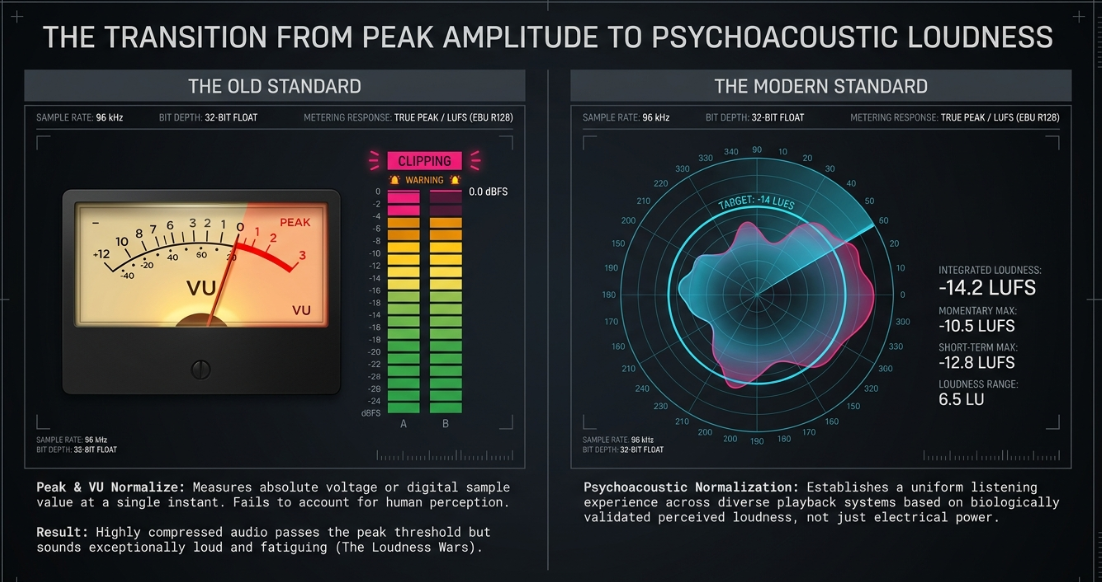
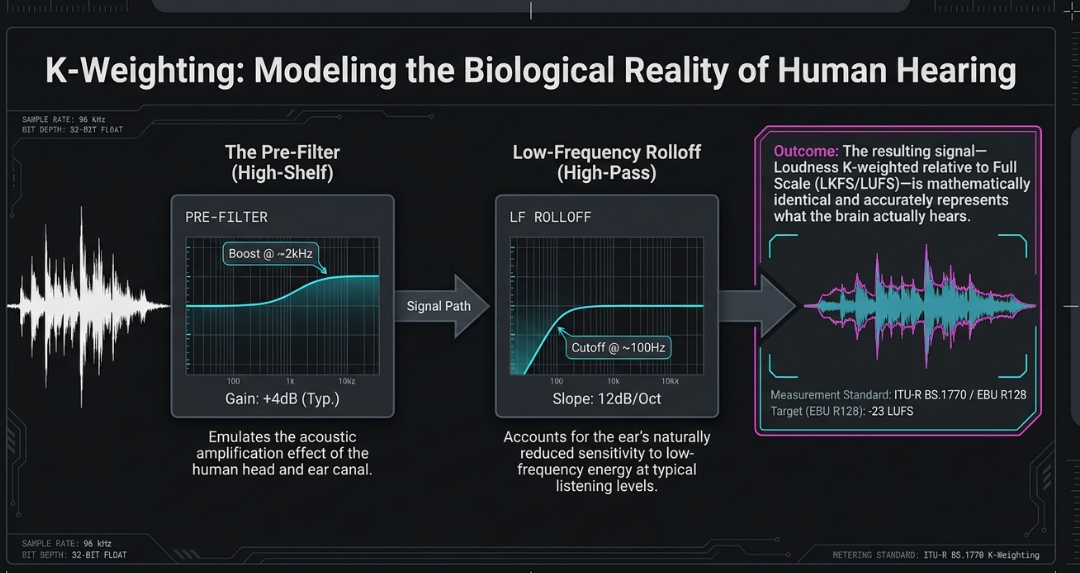
To establish a uniform listening experience across diverse playback systems, the International Telecommunication Union (ITU) and the European Broadcasting Union (EBU) developed the ITU-R BS.1770 and EBU R128 standards5. These frameworks introduce Loudness Units relative to Full Scale (LUFS), which are mathematically identical to Loudness K-weighted relative to Full Scale (LKFS)5. Unlike simple voltage or power measurements, the LUFS metric incorporates a frequency-dependent "K-weighting" filter curve that models the physical and psychoacoustic characteristics of human hearing2.
The K-weighting filter consists of two stages2. The first stage is a high-shelving filter that emulates the acoustic amplification effect of the human head, often referred to as the pre-filter2. The second stage is a high-pass filter that accounts for the ear's reduced sensitivity to low-frequency energy at typical listening levels2. By applying K-weighting to the input signal, loudness meters can calculate four primary metrics5.
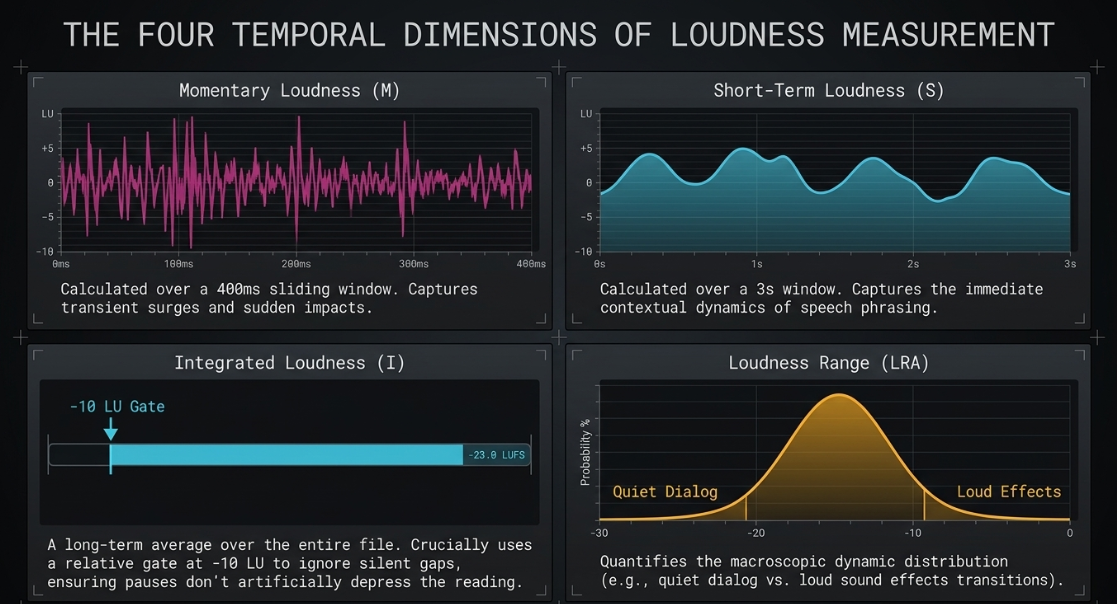
Momentary Loudness () measures the average loudness over a sliding window of , representing transient surges in audio level1. Short-term Loudness () evaluates loudness over a window, capturing the immediate contextual dynamics of speech phrasing1. Integrated Loudness () is a long-term average calculated over the entire duration of the audio file8. It utilizes a relative gate threshold set at below the ungated loudness level to ignore silent gaps, ensuring that pauses in dialog do not artificially depress the integrated reading6. Lastly, Loudness Range (LRA) quantifies the macroscopic dynamic variations of a program, measuring the statistical distribution of loudness levels between different sections, such as quiet dialog versus loud sound effect transitions1.
Global Platform Standards and Normalization Mechanics
The deployment of loudness normalization algorithms by major streaming and distribution networks has eliminated the competitive advantage of over-compressing content5. When a file exceeding a platform’s target is uploaded, the service automatically reduces its playback gain9. This downward gain adjustment is linear and non-destructive to the dynamic range of the file, but it means that files mastered excessively loud will simply be attenuated, revealing any digital distortion or transient clipping induced during the mastering stage11. Conversely, platforms handle quieter files with variable strategies: some apply upward gain and limiting, which can elevate the noise floor, while others do not amplify quiet tracks, leaving them buried in a playlist or queue9.
The Audio Engineering Society addressed these challenges in its TD1008 guidelines, which optimize loudness targets for both fixed and mobile consumer listening environments16. Because mobile devices often possess limited amplification and transducer output, lower targets like can result in insufficient playback volume in noisy environments16. TD1008 recommends a distribution loudness of for speech-heavy and "assorted" content (such as podcasts and radio streams), allowing an optimal balance of speech intelligibility and dynamic range17. For track-normalized music, the standard recommends to accommodate the biological and cognitive expectation that music should sound approximately to louder than spoken word17.
The table below outlines the specific target parameters enforced across podcasting platforms, streaming music services, and international broadcast networks.
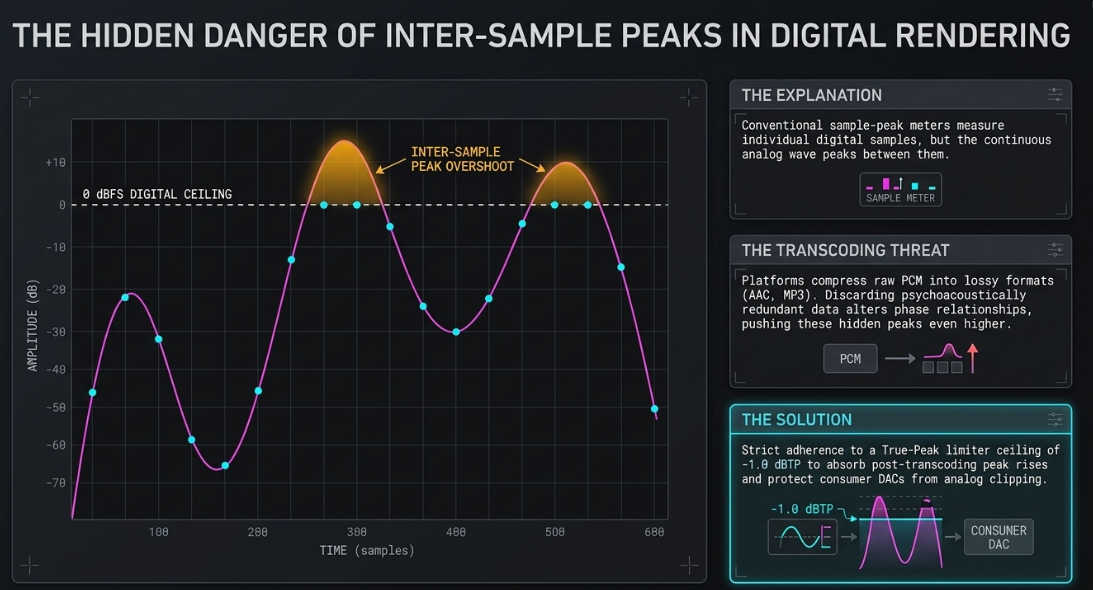
To understand why maximum peak limits are strictly set to or rather than the absolute digital ceiling of , one must analyze the physical reconstruction of digital signals into the analog domain9. A conventional sample-peak meter measures the amplitude of individual digital samples3. However, the actual peak of the continuous, reconstructed analog wave often falls between two adjacent digital samples3. These are known as inter-sample peaks3. When the digital-to-analog converter reconstructs the continuous waveform, these inter-sample peaks can rise significantly above , causing clipping and distortion in the analog output stage of consumer playback hardware3.
This phenomenon is severely compounded during the lossy encoding processes utilized by digital distribution platforms8. To reduce file sizes, platforms compress raw PCM files (such as 24-bit WAV) into lossy formats like AAC, Ogg Vorbis, or MP38. Lossy data compression works by discarding psychoacoustically redundant frequency data, altering the phase relationships and peak profiles of the audio waveform8. Consequently, the peak levels of a transcoded file will almost always increase relative to the uncompressed source file8. If a podcast is mastered to a sample peak of , the subsequent MP3 or AAC conversion will frequently push the peak levels above , introducing digital clipping13.
Utilizing a true-peak limiter set to a maximum ceiling of ensures that a physical buffer exists to absorb these post-transcoding peak rises, keeping the final stream clean and distortion-free across all consumer DACs4.
The Physics of Waveform Asymmetry and Allpass Filtering
Spoken-word recordings frequently display highly asymmetrical waveforms, where the positive voltage peaks are significantly larger than the negative peaks, or vice-versa, while the mean amplitude remains anchored to the zero baseline29. This structural lopsidedness is distinct from DC Offset30. DC Offset is a hardware fault in which a constant direct current is superimposed on the alternating current audio signal, displacing the entire baseline away from the zero axis30. While DC Offset can be corrected via high-pass filtering or bias correction, vocal asymmetry is a natural physical consequence of the human vocal apparatus and microphone physics29.
The physical mechanism behind vocal asymmetry stems from acoustic airflow bias and harmonic phase coherence31. To speak or sing, the talent must continuously exhale air31. This unidirectional physical airflow creates a positive air pressure bias (compression) at the microphone capsule that is not symmetrically mirrored by the subsequent rarefaction cycle30. This pressure bias is particularly pronounced in directional microphones and configurations where the speaker is close to the capsule without adequate pop filtering33.
Furthermore, the human voice is a highly complex, non-sinusoidal acoustic wave comprised of a fundamental frequency and a series of integer harmonics31. When these harmonically related frequencies align with specific phase relationships, their peaks construct and sum in a highly coherent, localized manner in one direction29. This creates high, asymmetric voltage spikes relative to the overall RMS power of the signal34.
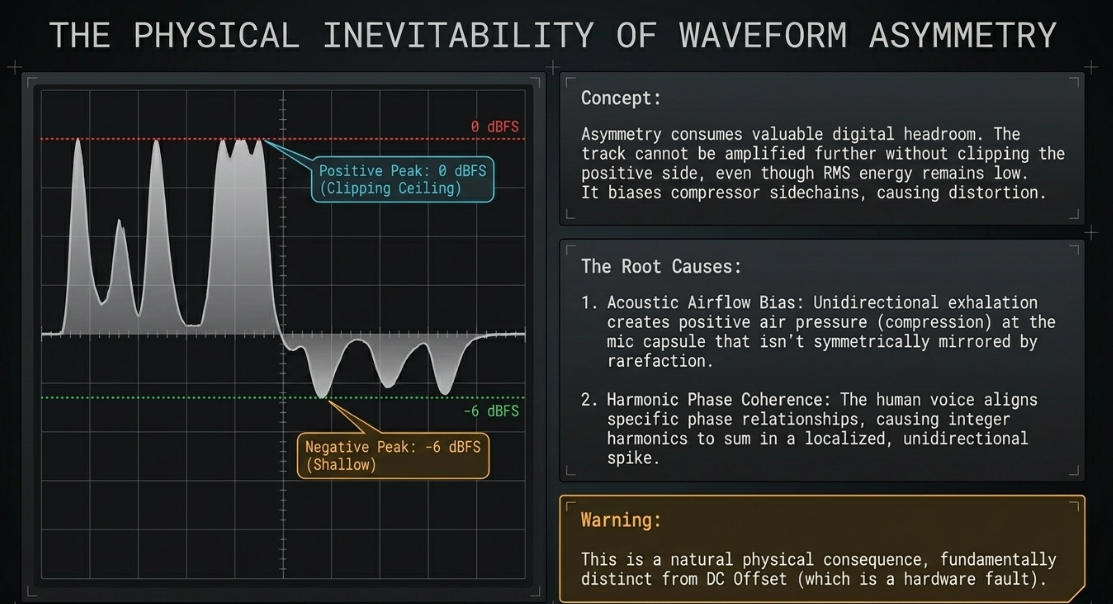
While vocal asymmetry is perceptually benign to the human ear, it presents severe technical challenges in post-production30. An asymmetrical signal consumes valuable digital headroom29. If the positive peaks of a vocal track are hitting while the negative peaks only reach , the track cannot be amplified further without the positive side clipping, even though the overall RMS energy of the signal remains low30. Furthermore, asymmetrical waveforms can bias the sidechain level detectors of dynamic processors, causing compressors and limiters to trigger unevenly and introduce unnecessary distortion31.
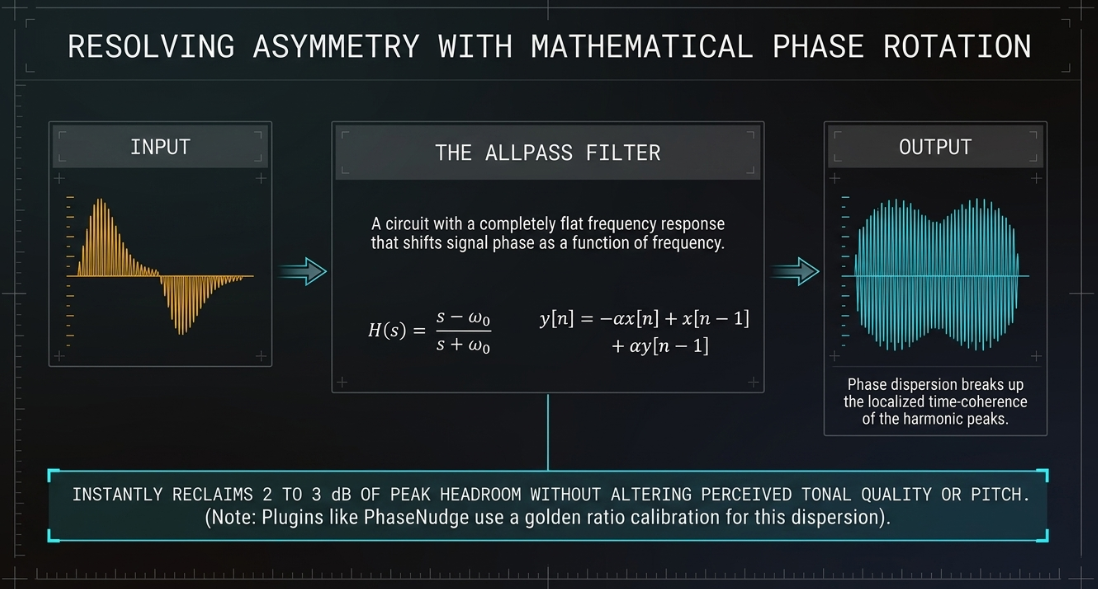
To resolve this issue, engineers utilize a specialized tool known as a phase rotator, which is fundamentally implemented as an allpass filter29. An allpass filter is a digital or analog signal processing circuit that possesses a completely flat frequency response but shifts the phase of the signal as a function of frequency37. The mathematical transfer function of a first-order continuous-time allpass filter can be expressed in the Laplace domain as:
Where represents the corner frequency where a phase shift occurs. In the discrete-time domain, a basic allpass filter is defined by the difference equation:
Where is a coefficient that dictates the phase transition characteristics39. When a complex vocal signal passes through a series of allpass filters, the phase relationships of the harmonics are progressively shifted relative to the fundamental31. This phase dispersion breaks up the localized time-coherence of the harmonic peaks34. Consequently, the energy is distributed more evenly across both sides of the zero axis29.
This process makes the waveform symmetrical without altering its frequency content, pitch, or perceived tonal quality29. Traditional broadcast phase rotators often configure four allpass filters in series to achieve a steep phase shift around 34. Plugins like Airwindows PhaseNudge refine this process using a golden ratio calibration () to shift the phase across a broad range of delays37. By rotating the phase of an asymmetric vocal, the peak amplitude can be reduced by to while preserving identical perceived loudness, instantly reclaiming vital digital headroom for subsequent compression, limiting, and loudness maximization29.
Spatial Interdependence, Mic Bleed, and Phase Coherence
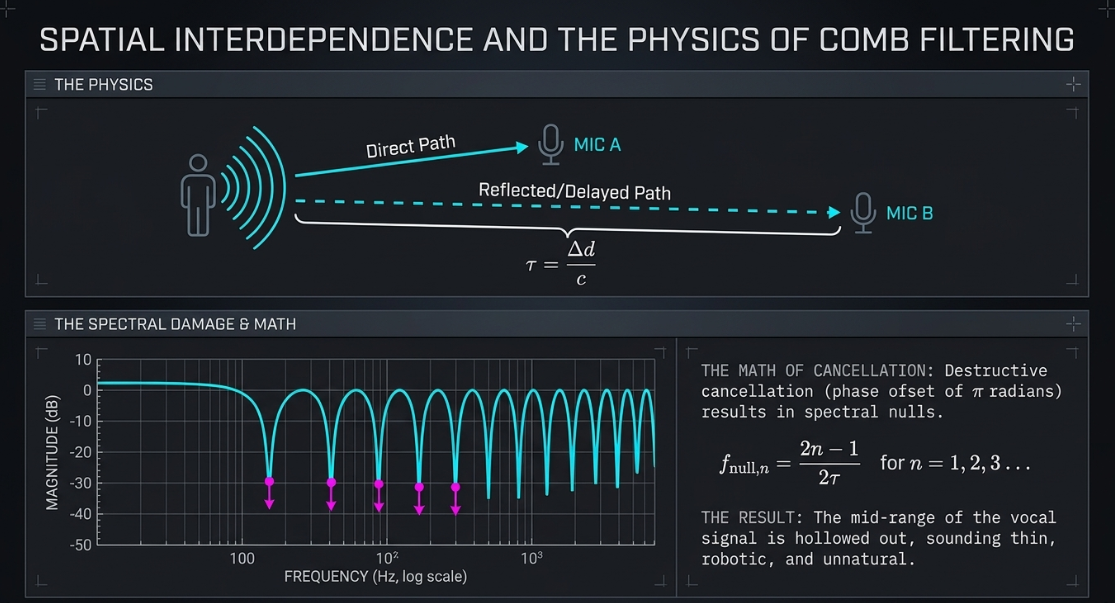
In professional multi-microphone podcast recordings, comb filtering is a pervasive issue that degrades voice quality and structural clarity40. Comb filtering occurs when a single acoustic source is captured by two or more microphones situated at different physical distances, or when a microphone captures both the direct vocal wave and a delayed reflection off a nearby surface like a tabletop, floor, or script stand42. When these delayed, highly correlated signals are summed together in the mixing console or DAW, they interfere constructively and destructively across the frequency spectrum42.
The mathematical formulation of this phenomenon can be modeled using a feedforward comb filter structure in discrete time39. The general difference equation is:
Where represents the delay length in samples, and is a scaling factor representing the relative amplitude of the delayed signal39. The frequency response in the z-domain is:
Substituting and applying Euler's formula yields the frequency response39. This response demonstrates periodic drops to a local minimum (notch) and rises to a local maximum (peak or tooth)39. The fundamental relationship between physical distance, time delay (), and the resulting frequency cancellations is governed by the speed of sound40. At a normal room temperature of (), the speed of sound () is approximately ()43. The time delay (in seconds) introduced by a physical path-length difference (in meters) is:
The fundamental frequency () at which constructive summation occurs (a phase shift) is the inverse of the delay time44:
Subsequent peaks occur at integer multiples of this fundamental peak44:
Destructive cancellation (a phase offset of , or radians) results in a series of spectral nulls39. The first null frequency () occurs at:
Subsequent nulls recur at odd integer multiples of this frequency39:
For example, if a guest’s microphone captures the host's voice with a path-length difference of relative to the host's own microphone, a time delay of () is introduced43.
The resulting cancellations and summations are calculated as follows:
This spatial delay introduces deep spectral notches at , , , and so forth, completely hollowing out the mid-range of the vocal signal and making it sound thin, robotic, and unnatural43.
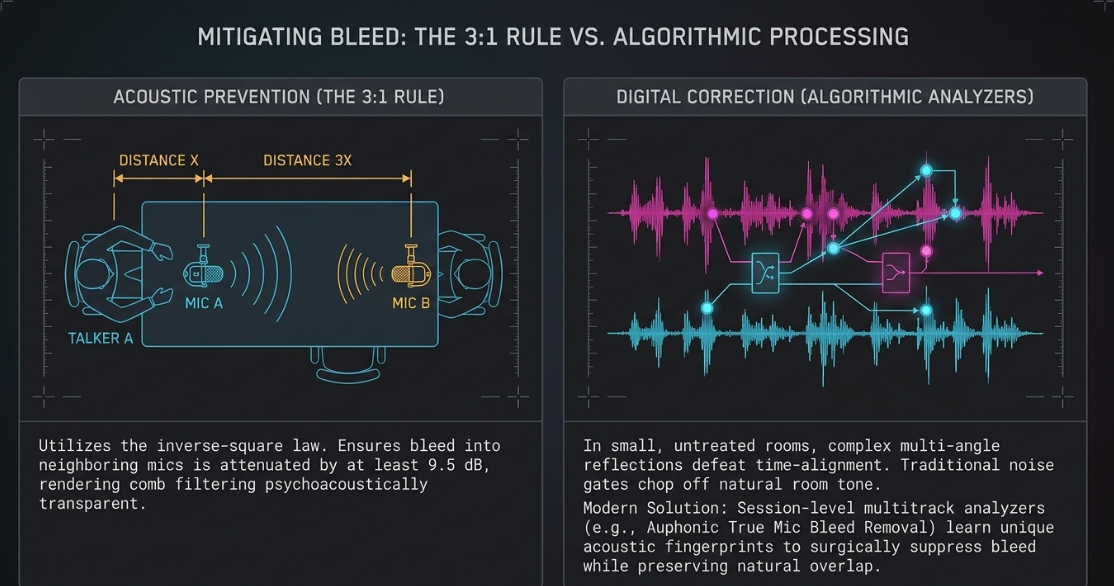
To prevent this coloration, engineers adhere to the 3:1 Rule of Microphone Placement43. This rule dictates that the physical distance between any two active microphones must be at least three times the distance from each microphone to its respective talker43. Acoustically, this spatial separation utilizes the inverse-square law to ensure that the bleed of a talker's voice into the neighboring microphone is attenuated by at least (calculated as ) relative to the direct signal43.
If microphones are arranged in an equidistant lineup, the spatial relationship should theoretically be increased to to maintain equivalent signal isolation43. Psychoacoustic research shows that when a delayed signal is attenuated by or more relative to the direct signal, the perceived coloration of comb filtering is reduced to near-audible transparency43.
In a small, untreated room, acoustic reflections cause comb filtering that cannot be resolved via time-alignment alone40. Direct sound path-lengths can be aligned, but the complex, multi-angle reflections arriving later will still interfere destructively40.
To handle this, post-production workflows are transitioning from traditional isolated expanders and noise gates—which chop off natural room tone and make conversations sound disjointed—to advanced session-level multi-track analyzers like Auphonic's True Mic Bleed Removal41. This algorithmic approach analyzes all tracks concurrently, learning the unique acoustic fingerprint of each voice to surgically suppress bleed while preserving the natural ambience and overlap of live conversations41.
Advanced Hardware and Software Metering Suites
iZotope Insight 2
This software is structured as an analytical multimeter designed for visual monitoring of multichannel and stereo audio streams49. It natively supports immersive channel configurations up to Dolby Atmos 7.1.249. The system includes a customizable GUI that allows individual modules to be resized or scaled across multiple monitors53.
The primary module features include:
Intelligibility Meter: Utilizing a dedicated inter-plugin communication protocol via the iZotope Relay utility, this meter routes sidechain data from a primary dialogue track and compares its statistical energy to the surrounding mix elements51. It calculates a visual recommendation envelope showing whether the vocal track is likely to be masked by background music, sound effects, or elevated noise floors50. The module allows engineers to select from target consumer listening environments—such as a quiet home theater, a moving vehicle, or a noisy public transit system—to simulate and verify vocal clarity across varied real-world scenarios53.
Spectrogram (2D/3D): Provides a high-resolution topographical frequency map over a continuous time axis50. This allows engineers to spot resonant acoustic modal frequencies, transient mouth clicks, low-frequency structural rumble, and spectral masking in real time49.
Levels and Sound Field: Features precise K-weighted metering and a comprehensive vectorscope (incorporating polar sample, polar level, and Lissajous patterns) to check spatial balance, mono downmix stability, and phase coherence50.
Youlean Loudness Meter Pro
This program is a software meter calibrated and compliant with the ITU-R BS.1770 and EBU R128 standards13.
Its technical architecture includes:
Loudness and Dynamics Histograms: Visualizes the chronological progression of momentary, short-term, integrated loudness, and true peak over a scalable time window13. The dynamics graph tracks Peak-to-Short-Term Loudness (PSR) and Peak-to-Integrated Loudness (PLR), warning the engineer of excessive dynamic compression or headroom depletion via color-coded visual thresholds (e.g., turning red or yellow when target boundaries are breached)13.
Drag-and-Drop Analysis: Allows engineers to drop an audio or video file (WAV, MP3, FLAC, etc.) directly into the interface13. The software performs a non-real-time, high-speed calculation of the entire file buffer, displaying complete integrated loudness, LRA, and true peak statistics in seconds13.
Advanced Export Protocol: Facilitates the generation of detailed diagnostic reports exported in PDF, PNG, SVG, CSV, Dolby CSV, Graph Memory, or Text Summary formats13. This allows mastering engineers to document compliance with target platform specifications and provide visual proof of dynamic integrity to clients, reducing revisions57.
NUGEN Audio MasterCheck
This system is an analytical mastering utility engineered to simulate the real-time processing, normalization, and codec-conversion behavior of digital playout networks26.
Key functionalities include:
Real-time Codec Auditioning: Emulates the specific psychoacoustic compression algorithms and bitrates used by commercial platforms, including HE-AACv1 (AAC+), HE-AACv2 (DAB+), Ogg Vorbis, and AAC-LC11. This allows engineers to hear physical artifacts, high-frequency phase smearing, or stereo-image narrowing before exporting the master file11.
Codec Distortion Detection: Monitors how a "hot" master will react to the codec encoding filter26. It identifies where the interpolation process of transcoding will generate inter-sample peak overs, allowing the engineer to dial back the master limiter's ceiling or input drive to prevent downstream clipping26.
Dynamic Matching and Normalization Preview: Features a direct level-matching engine that offsets the volume of the master FX chain, matching it to the target platform’s preset level (e.g., for Spotify or for Apple Podcasts)26. This enables objective A/B testing of the processing chain against reference material, revealing whether heavy limiting has improved the mix or simply squashed the transient punch without adding any competitive advantage in normalized environments26.
TC Electronic Clarity M Stereo & 5.1
This product is a hardware-software hybrid metering station centered on a , high-resolution ( pixel) LCD screen25. It offloads complex visualization processing from the host computer's CPU to dedicated internal hardware processors25. The physical dimensions of the unit are () with a weight of ()64.
Its design features:
LM6 Loudness Radar Meter: A circular radar display that plots short-term loudness history over an adjustable time ring, with the outer perimeter displaying momentary loudness in real time25. This allows the engineer to visually map the macroscopic structure of a podcast, ensuring that sections of speech, intro music, and advertisements flow with relative loudness consistency9.
Downmix Deviation Metering: Calculates downmix compatibility based on TC Electronic's loudness algorithms65. It measures the physical level deviation that occurs when a stereo or surround mix is folded down into mono, warning of phase cancellations before the file is distributed63.
Physical Connectivity: Features professional input protocols, including stereo AES3 digital audio on BNC connectors, optical S/PDIF (Toslink), and USB 2.025. A 15-way D-sub connector accepts a breakout cable terminating in three BNC plugs, a TRS socket for General Purpose Input (GPI) footswitch operations (such as play, pause, or reset), and a TS socket for General Purpose Output (GPO) to control external warning indicators63.
The comparative table below summarizes the core operational differences, hardware integrations, and primary analytical use cases of these metering solutions.
In addition to these flagship suites, other specialized tools serve crucial roles in the professional mastering chain49. The Waves WLM and WLM Plus loudness meters provide a streamlined, low-latency alternative for tracking speech levels in real time across dynamic dialogue tracks49. To establish a direct reference during the final stages of master verification, plugins like ADPTR Audio Metric AB provide a unified interface for level-matched A/B comparison67. By matching the target LUFS of the master to a commercially successful reference track, Metric AB allows engineers to evaluate frequency distribution, stereo correlation, and dynamic range profiles side-by-side without volume bias67.
Implementation Methodology in the Mastering Chain
To synthesize these physical principles and software tools into a highly reliable post-production system, the mastering chain must be structured as a sequence of stages3. Each processing stage interacts with the physical structure of the audio signal, meaning that the ordering of tools is critical to preventing downstream artifacts and maximizing loudness potential3.
[Input: Raw Multitrack Audio]
│
▼
[Phase Realignment & Asymmetry Correction] (Melda MAutoAlign / iZotope RX Phase)
│
▼
[Surgical Parametric EQ] (FabFilter Pro-Q 3 / HPF at 80-100Hz)
│
▼
[Dynamic Vocal Leveling] (Waves Vocal Rider / Sound Radix Powair)
│
▼
[Stereo Bus Compression] (Ratio 1.5:1 to 2:1, soft knee, 1-3dB reduction)
│
▼
[Precision Brick-wall Limiter] (FabFilter Pro-L 2 / Ceiling set to -1.0 dBTP)
│
▼
[Analytical Metering & Codec Preview] (Insight 2 / MasterCheck / Clarity M)
│
▼
[Output: 24-bit PCM Master / Transcoded Playback Stream]
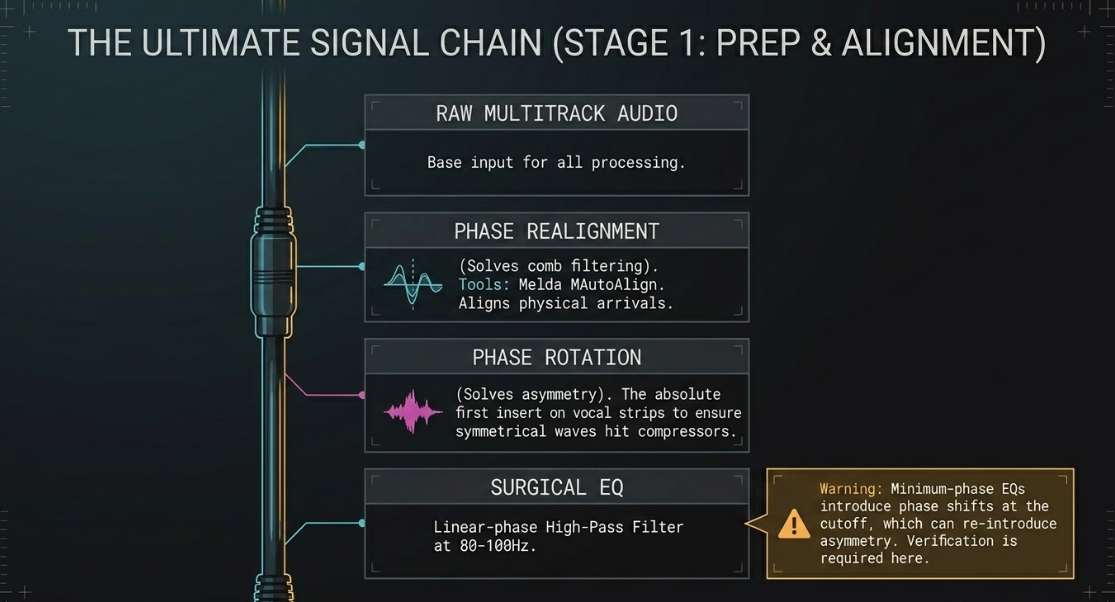
At the initialization of the workflow, the raw multitrack audio must be aligned and corrected for structural phase issues3. The engineer inserts a phase alignment plugin on any multi-mic configurations to align the physical arrivals of the voices, preventing comb filtering3.
Once aligned, any asymmetrical vocal channels must undergo phase rotation29. This is placed as the absolute first insert in the channel strip29. Rotating the phase of the vocal at this stage ensures that all subsequent dynamic processors receive a structurally symmetrical wave, preventing uneven compressor triggers and reclaiming up to of peak headroom29.
The second stage of the chain involves surgical equalization3. A high-pass filter is positioned between and to eliminate low-frequency room rumble and HVAC noise4. Crucially, standard parametric minimum-phase equalizers introduce a frequency-dependent phase shift around the cutoff frequency3. This phase shift can alter the harmonic relationships of the lower mids, occasionally worsening vocal asymmetry immediately after the filter3.
Therefore, if a minimum-phase high-pass filter is applied, the engineer must verify the signal's symmetry downstream32. If symmetry is compromised, a linear-phase equalizer can be substituted, or the phase rotator must be repositioned immediately after the surgical EQ stage to ensure the signal remains symmetrical as it enters the dynamics processors3.
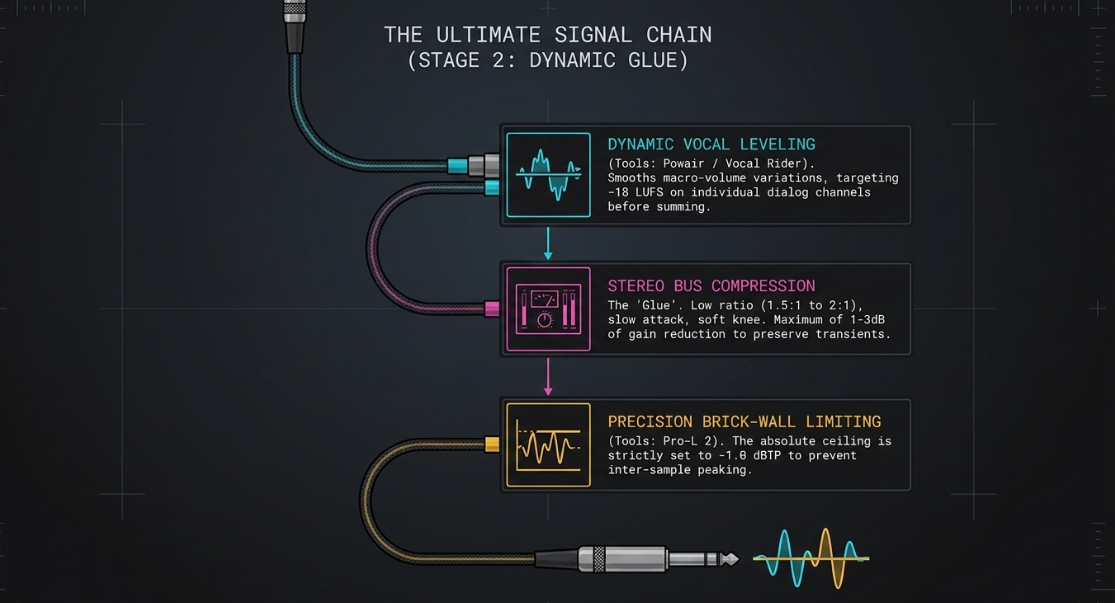
The third stage optimizes the dynamic range of the individual vocal channels3. The engineer applies a dynamic leveling utility to smooth out macro-level volume variations28. While the Waves Vocal Rider automatically rides vocal volumes without the acoustic coloration of a standard compressor, utilities like Sound Radix Powair combine automatic loudness leveling with a natural-sounding compressor28. By targeting a speech level of on individual dialogue channels, Powair prepares a balanced, consolidated vocal stage before the signals are summed to the master stereo bus3.
Once summed to the master bus, the stereo signal undergoes gentle bus compression to "glue" the elements together3. The compressor is configured with a low ratio (between and ), a slow attack time ( to ) to let vocal transients pass naturally, and a soft knee to ensure transparent gain reduction limited to to 3.
The finalized, glued mix is then driven into the precision brick-wall limiter3. The limiter's output ceiling is set to a strict maximum of to prevent inter-sample clipping during physical playback and lossy transcoding3.
Directly following the limiter, the analytical metering suites are instantiated to guide the final adjustments28. The engineer plays the entire file to measure the integrated loudness () and check compliance with the target platform5. If the integrated reading lands above the target, the limiter's threshold input drive is backed off3. If the reading is too quiet, the input drive is increased, making sure the short-term loudness does not exceed on broadcast-oriented speech segments3.
Simultaneously, the engineer runs codec simulations using NUGEN Audio MasterCheck or iZotope RX, auditioning the compressed stream in AAC and Ogg Vorbis profiles to check for transient distortion or high-frequency phase smearing11.
Once the correlation meter confirms mono compatibility (staying above ), the file is exported as a 24-bit WAV master, delivering professional, compliant, and pristine audio3.
Works cited
Loudness Normalization in Accordance with EBU R 128 Standard - MATLAB & Simulink, https://www.mathworks.com/help/audio/ug/loudness-normalization-in-accordance-with-ebu-r-128-standard.html
Loudness Basics - AES - Audio Engineering Society, https://aes.org/resources/audio-topics/loudness-project/loudness-basics/
Audio Mastering Tutorial: Get Expert Results in Any DAW, https://www.soundbridge.io/audio-mastering-tutorial-get-expert-results-in-any-daw
Podcasting Levels: Tips and Standards for Publishing | B&H eXplora, https://www.bhphotovideo.com/explora/pro-audio/tips-and-solutions/podcasting-levels-tips-and-standards-for-publishing
EBU R 128 - Wikipedia, https://en.wikipedia.org/wiki/EBU_R_128
Loudness meter - Boris FX, https://cdn.borisfx.com/borisfx/Documentation/sequoia-2026/en/Content/Loudnessmeter.htm
Loudness metering – MiRA, https://doc.flux.audio/mira/Metering_Loudness.html
Podcast Loudness Standard: Perfecting Your Sound in 2026 - Descript, https://www.descript.com/blog/article/podcast-loudness-standard-getting-the-right-volume
Podcast Loudness Standards 2026: Spotify, Apple, YouTube Requirements, https://sone.app/blog/podcast-loudness-standards-2026-spotify-apple-youtube
The Loudness Lookup - LUFS Standards for Every Platform - Dan Murtagh, https://danmurtagh.com/lufs-loudness-standards/
Mastering for Streaming: Your 2026 Platform Guide - SoundBridge, https://www.soundbridge.io/mastering-for-streaming-your-2026-platform-guide
EBU R128, Broadcast Loudness Target - APU Software, https://apu.software/ebu-r128-loudness-target/
Youlean Loudness Meter - Free VST, AU and AAX plugin, https://youlean.co/youlean-loudness-meter/
The Ultimate Guide to Streaming Loudness (LUFS Table 2026) - Soundplate.com, https://soundplate.com/streaming-loudness-lufs-table/
STREAMING IN 2026 - Swift Mastering, https://www.swiftmastering.co.uk/streaming-in-2026/
Worldwide Loudness Delivery Standards - RTW Audio, https://www.rtw.com/blog/rtw-knowledge-base-1/worldwide-loudness-delivery-standards-4
Streaming Audio Loudness Guidelines Explained - Radio World, https://www.radioworld.com/tech-and-gear/tech-tips/streaming-audio-loudness-guidelines-explained
Streaming Loudness - AES Recommendations 2021, and why you should care, https://productionadvice.co.uk/td1008/
How to master for streaming platforms: normalization, LUFS, and loudness - iZotope, https://www.izotope.com/community/blog/mastering-for-streaming-platforms
Bob Katz on AES TD1008: Current recommendation is to set loudness normalization at -16 LUFS to -20 LUFS for streaming services, but the industry is working towards standardizing to -24 LUFS as consumer products improve to align it with existing broadcast, radio and video production standards : r/musicproduction - Reddit, https://www.reddit.com/r/musicproduction/comments/1qg5ukr/bob_katz_on_aes_td1008_current_recommendation_is/
How to Master with LEVELS: Pro Results, Every Time, https://www.masteringthemix.com/pages/mastering-with-levels
tc electronic Clarity M Stereo - Thomann, https://www.thomann.co.uk/tc_electronic_clarity_m_stereo.htm
Nugen Audio MasterCheck Pro - Studiocare, https://studiocare.com/products/nugen-audio-mastercheck-pro
NUGEN Audio MasterCheck Complete Reference Plugin - JRRshop.com, https://www.jrrshop.com/nugen-audio-mastercheck-pro.html
Pro Audio: Plugins and Processing Tips for Mixing Podcasts - MacSales.com, https://eshop.macsales.com/blog/66337-plugins-processing-tips-for-mixing-podcasts/
Adjusting the Phase of Recordings - Podcast Engineering School, https://podcastengineeringschool.com/adjusting-the-phase-of-recordings/
phase rotator - produce New Media, https://producenewmedia.com/tag/phase-rotator
Q. Why do waveforms sometimes look lop-sided ? - Sound On Sound, https://www.soundonsound.com/sound-advice/q-why-do-waveforms-sometimes-look-lop-sided
Asymmetrical Waveforms: A Definitive Guide To Lopsided Waveforms - No Label, No Producer, No Limits, https://nolabelnoproducernolimits.com/indie/production/asymmetrical-waveforms/
Centering Asymmetrical Audio? - Adobe Community, https://community.adobe.com/questions-544/centering-asymmetrical-audio-156911
Use of phase rotation - SOS FORUM, https://www.soundonsound.com/forum/viewtopic.php?t=37450
I finally know why waveforms are lopsided. : r/audioengineering - Reddit, https://www.reddit.com/r/audioengineering/comments/1ckj8q1/i_finally_know_why_waveforms_are_lopsided/
Do you phase rotate asymmetrical waveforms? : r/mixingmastering - Reddit, https://www.reddit.com/r/mixingmastering/comments/xebdus/do_you_phase_rotate_asymmetrical_waveforms/
PhaseNudge - Airwindows, https://www.airwindows.com/phasenudge-vst/
Allpass Filters - Universal Audio, https://www.uaudio.com/blogs/ua/allpass-filters
Comb filter - Wikipedia, https://en.wikipedia.org/wiki/Comb_filter
Working With Mic Bleed - Sound On Sound, https://www.soundonsound.com/techniques/working-mic-bleed
Multitrack Clarity Redefined: Introducing our new Mic Bleed Remover - Auphonic, https://auphonic.com/blog/2025/10/08/mic-bleed-remover/
Comb Filtering Explained: What Does a Comb Filter Sound Like? - Audio University, https://audiouniversityonline.com/comb-filtering-explained/
The basics about comb filtering (and how to avoid it) - DPA Microphones, https://www.dpamicrophones.com/mic-university/audio-production/the-basics-about-comb-filtering-and-how-to-avoid-it/
Comb filters - Biamp Cornerstone, https://support.biamp.com/General/Audio/Comb_filters
Phase and Comb Filtering | SoundGirls.org, https://soundgirls.org/phase-and-comb-filtering/
MSP Delay Tutorial 6: Comb Filter - Max 7 Documentation, https://docs.cycling74.com/max7/tutorials/15_delaychapter06
Comb filtering | Max Cookbook, https://music.arts.uci.edu/dobrian/maxcookbook/comb-filtering
What is comb filtering? What does it sound like? - Audio Masterclass, https://www.audiomasterclass.com/blog/what-is-comb-filtering-what-does-it-sound-like
Plugins for Audio Post-Production: What the Pros Are Using, https://theproaudiofiles.com/post-production-plugins/
IZOTOPE INSIGHT 2 | Woodbrass.com, https://www.woodbrass.com/en-gb/plug-ins-izotope-insight-2-p396149.html
Insight 2 - Intelligent Metering Plug-in - iZotope, https://www.izotope.com/products/insight
iZotope Insight 2 - What To Know & Where To Buy - Equipboard, https://equipboard.com/items/izotope-insight-2
iZotope Insight 2 Metering and Audio Analysis Plug-In 90-IN2 B&H, https://www.bhphotovideo.com/c/product/1439965-REG/izotope_90_in2_insight_2_edu.html
Insight 2 | iZotope | bestservice.com | DE, https://www.bestservice.com/de/insight_2.html
Discover top podcast software and podcast editing software. - Native Instruments, https://www.native-instruments.com/de/specials/komplete/podcasting-software/
iZotope AU Insight 2 Intelligent Metering for Music & Post - Gsus4, https://gsus4.com.au/en-us/products/izotope-insight
Youlean Loudness Meter Review - HomeStudioToday, https://www.homestudiotoday.com/youlean-loudness-meter-review/
Youlean Loudness Meter 2 - MANUAL, https://youlean.co/wp-content/uploads/2021/02/Youlean-Loudness-Meter-2-MANUAL.pdf
FREE vs PRO - Youlean Loudness Meter, https://docs.youlean.co/youlean-loudness-meter/introduction/free-vs-pro
NUGEN Audio Mastercheck Pro - What To Know & Where To Buy | Equipboard, https://equipboard.com/items/nugen-audio-mastercheck-pro
NUGEN Audio introduces MasterCheck Pro, https://nugenaudio.com/introduces-mastercheck-pro/
NUGEN Audio Preserves Emotion While Hitting Modern Loudness Standards for Dimelo Apolo - Mixonline, https://www.mixonline.com/the-wire/nugen-audio-preserves-emotion-while-hitting-modern-loudness-standards-for-dimelo-apolo
TC Electronic Clarity M Stereo - Desktop Audio Meter - Studiocare, https://studiocare.com/products/tc-electronic-clarity-m-stereo-desktop-audio-meter
TC Electronic Clarity M, https://www.soundonsound.com/reviews/tc-electronic-clarity-m
TC Electronic Clarity M - Stereo & 5.1 Audio Loudness Meter - Andertons Music Co., https://www.andertons.co.uk/tc-electronic-clarity-m-stereo-51-audio-meter-with-7-high-resolution-display-usb-connection-for-plug-in-metering/
Stereo and 5.1 Audio Loudness Meter - TC Electronic, https://www.tcelectronic.com/en/products/0842-AAA
The 12 Best Plugins for Mastering Your Music in 2026 | Isolate Audio, https://isolate.audio/articles/best-plugins-for-mastering
Perfect Your Audio with These Essential Post-Production Plugins - Voodoo Sound, https://www.voodoosound.com.au/post/perfect-your-audio-with-these-essential-post-production-plugins
Helpful post-production tools and plugins for your audio drama projects - Reddit, https://www.reddit.com/r/audiodrama/comments/1od5ilv/helpful_postproduction_tools_and_plugins_for_your/
Top 10 Audio Plugins for Podcast Production, https://podcastengineeringschool.com/top10/
How to Use Youlean Loudness Meter (Tutorial) - Produce Like A Pro Academy, https://producelikeapro.com/blog/youlean-loudness-meter-tutorial/