The foundation of any professional audio production rests upon the precise accuracy and reliability of its electroacoustic transduction—the fundamental physical process by which acoustic kinetic energy is converted into a measurable electrical voltage. Within the highly specialized context of podcasting and spoken-word audio production, the microphone acts as the primary interface between the human voice and the digital recording environment. A nuanced, mathematically grounded understanding of microphone technology is essential for capturing high-fidelity speech, mitigating unwanted environmental noise, and ensuring consistent auditory intelligibility across diverse playback systems. This comprehensive analysis evaluates the physical, acoustic, and electronic variables that define professional podcasting microphones, systematically encompassing transducer types, sensitivity metrics, frequency responses, directional characteristics, connectivity paradigms, and the essential mechanical isolation hardware required to preserve signal integrity.
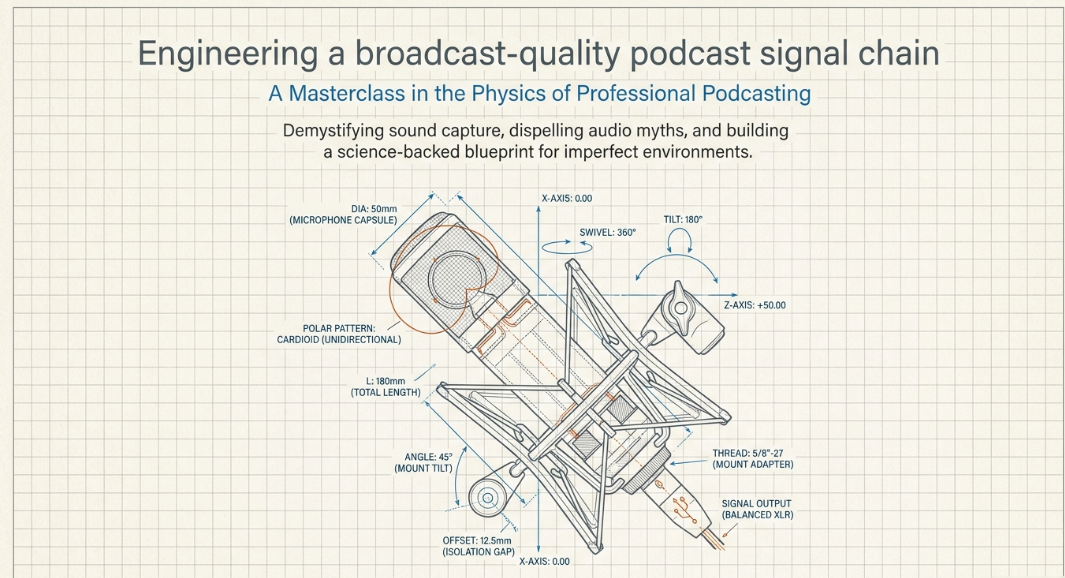
Sennheiser e945
The Sennheiser e945 is a precision-engineered dynamic vocal microphone that serves as a highly regarded benchmark for professional audio capture in both live sound reinforcement and demanding broadcast environments. Precision-engineered and assembled in Germany, the e945 is characterized by a rugged, professional-grade metal housing designed to withstand the rigorous demands of relentless live touring while simultaneously delivering exceptional acoustic performance in controlled studio settings.1 While predominantly recognized within the industry for its dominance on loud stages, its highly specific acoustic profile and sophisticated electromagnetic design make it a remarkably formidable tool for professional podcasting, particularly for creators operating in acoustically untreated or compromised spaces.
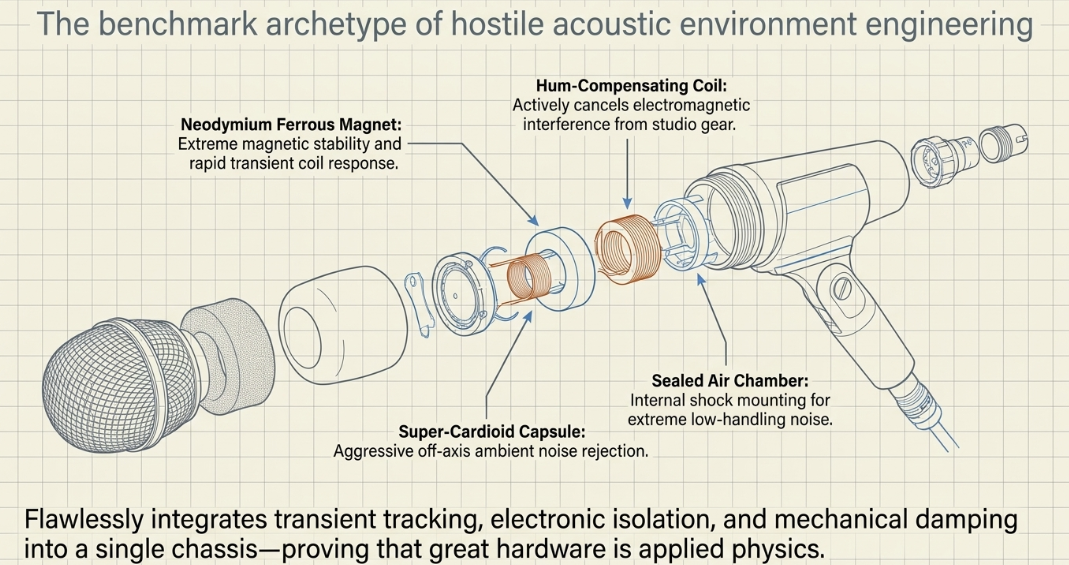
At the electromechanical core of the Sennheiser e945 is a dynamic transducer utilizing a highly specialized neodymium ferrous magnet enriched with boron.2 This specific material composition is critical, as it ensures the microphone's magnetic properties remain highly stable regardless of severe climatic variations or humidity fluctuations.2 This advanced magnetic structure allows for a strong, highly concentrated magnetic field, which directly improves the transient response of the internal moving coil. By accurately tracking the rapid micro-dynamics of human speech, the transducer translates the natural kinetic energy of a vocal performance into a vivid, emotionally charged, and highly detailed electrical audio signal.1 Furthermore, the inclusion of an internal hum-compensating coil represents a critical engineering advantage; this component actively reduces electrical interference and electromagnetic hum introduced by nearby studio equipment, such as computer monitors, unshielded cables, studio lighting, or power supplies, thereby actively maintaining the absolute sonic purity of the recording.1
Acoustically, the e945 exhibits a robust frequency response spanning from 40 Hz to 18,000 Hz, a spectrum that comfortably encompasses and exceeds the entirety of the human vocal range.1 It operates with a nominal impedance of 350 Ohms and a minimum terminating impedance of 1000 Ohms, alongside a sensitivity rating of 2.0 mV/Pa at 1 kHz in a free field.1 The sound profile of the e945 is distinctively tailored to enhance the fundamental frequencies of human speech. It actively adds a rich tonal warmth and a "lively fullness" to the lower midrange, while a carefully engineered enhanced presence peak ensures that the voice cuts through competing audio elements—or dense podcast soundscapes—with striking detail and forceful presence.1 Audio engineers testing the microphone note that when utilized at a moderate distance, the e945 features exceptionally flat mids and a highly controlled, tamed low end, which dramatically aids in managing the proximity effect (the unnatural buildup of bass frequencies when a sound source is too close to a directional microphone).3
The acoustic interaction between the e945 and varying human vocal timbres is well-documented. For female and tenor voices, the microphone provides a fuller body while seamlessly maintaining clarity, allowing the voice to cut through a mix without requiring excessive equalization.4 Baritone vocalists benefit from a clean, powerful reproduction that remains natural and undistorted.4 Bass vocalists, however, must carefully manage their physical working distance, as the inherent proximity effect of the directional capsule can heavily exaggerate low frequencies, potentially resulting in a muddy or overly boomy recording if the speaker addresses the microphone from an excessively close proximity.4
When compared directly to its primary market competitors, such as the ubiquitous Shure Beta 58A, the Sennheiser e945 demonstrates a broader dynamic range and a substantially more transparent, opaque high-end response. This contrasts sharply with the Shure Beta 58A, which many engineers characterize as having a brighter, more aggressive cut that can occasionally sound somewhat "synthetic" or harsh in the upper registers.4 Furthermore, the e945 is highly regarded for its exceptional gain before feedback. In live monitoring environments, this attribute is derived from its tight super-cardioid polar pattern, which heavily favors on-axis acoustic sources while aggressively rejecting ambient noise.1 However, some live sound engineers have noted specific tuning challenges; for instance, achieving stability at high volumes when paired with specific highly sensitive stage monitors, such as the L-Acoustics 115-HiQ, requires precise equalization, indicating that the microphone's unique EQ curve is highly polarizing among front-of-house professionals—some loathe it, while others find it superior to traditional Shure dynamics.5
The physical construction of the e945 integrates several critical acoustic protections, most notably a sealed air chamber that actively stabilizes the capsule.1 Working in tandem with an internal shock-mounted capsule design, this architecture yields an exceptionally low sensitivity to physical impact and handling noise.1 It also utilizes a "falcon ring" to guarantee consistent sound characteristics over long-term use.2 From a commercial and market-positioning perspective, the e945 is situated in the upper tier of the standard professional dynamic microphone range. It generally retails between $166.00 and $269.00, placing it well within reach of serious podcasting enthusiasts, and is supported by a comprehensive 10-year warranty within the United States (and a 2-year warranty globally), offering substantial long-term value compared to the standard 2-year warranties typical of competing brands.1 User testimonials frequently highlight its reliability; praise band leaders, gigging musicians, and studio performers consistently note its exceptional build quality, its capability to provide crisp, clear vocals for voices that are traditionally "hard to amplify," and its striking aesthetic design.
The Benefits of Dynamic Microphones for Podcasting
The architectural debate between dynamic and condenser microphones represents a foundational consideration in acoustic engineering for podcasting. While condenser microphones are widely lauded in musical studio environments for their intricate high-frequency detail, astonishingly rapid transient response, and wide bandwidth, dynamic microphones remain the vastly superior, pragmatic choice for the overwhelming majority of podcasting applications.10 This is particularly true for independent creators and broadcasters operating outside of specialized, acoustically treated, and soundproofed studio environments, such as home offices, untreated bedrooms, or mobile recording setups.10
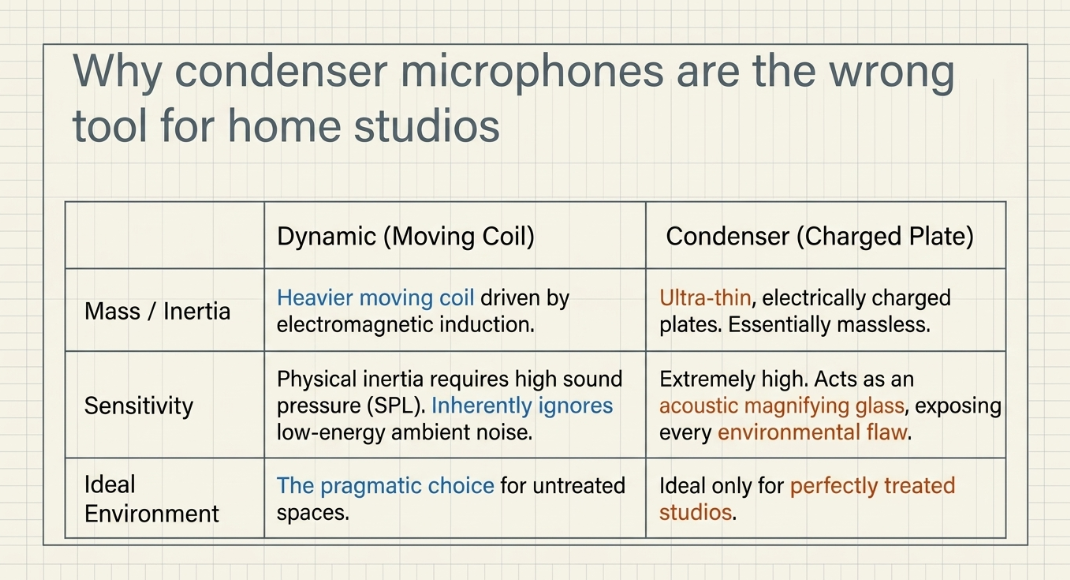
To understand why dynamic microphones dominate the podcasting landscape, one must examine the specific mechanical functionality of their transducers. A dynamic microphone operates entirely on the principle of electromagnetic induction. A dynamic capsule contains a relatively robust, lightweight diaphragm physically attached to a moving coil of fine wire. This entire assembly is suspended within the permanent magnetic field of a heavy magnet.13 When acoustic sound waves strike the diaphragm, the kinetic energy forces the attached coil to move back and forth within the magnetic gap, generating a small alternating electrical current (voltage) that corresponds precisely to the acoustic waveform.13
This physical mechanism inherently dictates the acoustic behavior and limitations of the microphone. The moving coil assembly possesses a significantly greater physical mass than the ultra-thin, electrically charged plates found in condenser microphones. Consequently, dynamic microphones suffer from physical inertia; they are substantially less responsive to low-energy, high-frequency sound waves, and they require a much higher sound pressure level (SPL) to initiate the movement of the diaphragm.13 Condenser microphones, by stark contrast, convert acoustic pressure into electrical signals via changes in capacitance between two incredibly thin, electrically charged plates.13 This mechanism is essentially massless compared to a dynamic coil. Because of this, condenser microphones require external 48V phantom power to charge the plates and power internal active electronics, resulting in exceedingly high sensitivity.13
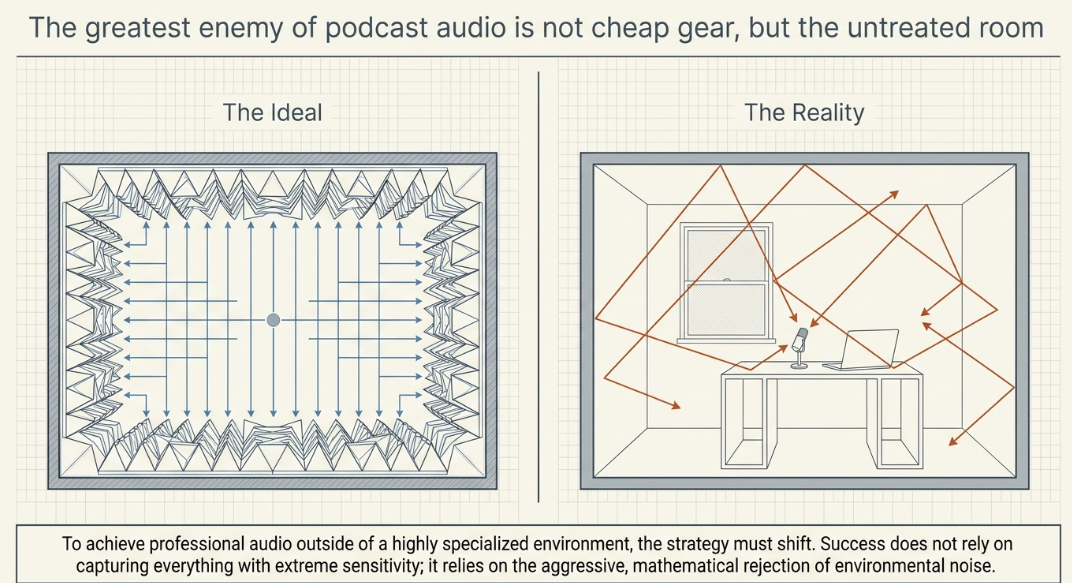
While the extreme sensitivity of a condenser allows it to capture immense vocal nuance, subtle mouth sounds, and the "air" of a performance, it simultaneously makes the microphone exceptionally vulnerable to capturing unwanted ambient noise.10 A condenser will readily pick up the high-frequency whine of a computer fan, the low-frequency rumble of an HVAC system, distant traffic, and the complex acoustic reflections bouncing off untreated walls and hard windows.10 For a podcaster in a typical home environment, a condenser microphone acts as an acoustic magnifying glass, highlighting every flaw in the room's acoustic treatment.
Dynamic microphones, conversely, offer a significantly lower margin for error and inherently superior background noise rejection in practical applications.10 A pervasive misconception within audio engineering circles is the belief that dynamic microphones somehow possess an inherent physical property that mathematically "rejects" room sound better than condensers.14 Physics dictates that a sound wave behaves identically regardless of the transducer it strikes. The actual benefit of a dynamic microphone lies in its reduced sensitivity combined with the inverse square law of acoustics.14 Because a dynamic microphone requires more acoustic energy to generate a usable signal, the podcaster is physically forced to move much closer to the microphone capsule—typically within two to three inches.
By decreasing the physical distance between the sound source (the mouth) and the transducer, the acoustic pressure striking the diaphragm increases exponentially. Any background noise originating from across the room strikes the diaphragm with exponentially less pressure. When the preamp gain is calibrated for the incredibly loud, close vocal source, the distant, quiet background noise simply fails to generate enough voltage to register prominently in the final recording.13 The dynamic microphone effectively acts as a natural acoustic filter, prioritizing the loudest, closest sound source while ignoring distant, lower-energy reflections.10 This phenomenon is colloquially compared to a camera's "soft-focus filter"; a dynamic microphone naturally masks minor acoustic blemishes, smoothing over harsh room reverbs, lip smacks, and incidental background noise, yielding a highly broadcast-ready, radio-style tone.17
Furthermore, dynamic microphones are uniquely capable of handling immensely high sound pressure levels without suffering from capsule distortion or internal clipping.10 This makes them highly resilient during animated, loud podcast conversations, sudden outbursts of laughter, or heated debates.10 Their robust, passive construction—lacking delicate internal vacuum tubes or easily damaged charged plates—ensures exceptional durability and portability, making them ideal for creators who require equipment that can be transported to different interview locations, conventions, or live events without fear of catastrophic damage.11 Finally, in complex recording scenarios where multiple hosts are recording simultaneously in the same untreated room, the use of multiple close-mic dynamic microphones drastically reduces "mic-bleed"—the detrimental phenomenon where one host's voice spills into another host's microphone.11 This isolation ensures a much cleaner audio separation, allowing for precise, artifact-free editing and processing during the post-production phase.11
Understanding Microphone Sensitivity
Microphone sensitivity is a critical, often misunderstood electromechanical specification that quantifies the absolute efficiency with which a microphone converts raw acoustic energy (sound pressure) into an electric voltage. A thorough understanding of this metric is essential for proper gain staging, ensuring compatible equipment pairing, and optimizing the critical signal-to-noise ratio in a professional podcasting signal chain.
In technical acoustic specifications, sensitivity is typically measured at a standard reference frequency of 1 kHz and expressed in millivolts per pascal (mV/Pa), where one single pascal represents an acoustic pressure level of 94 decibels (dB SPL).1 A microphone with a high sensitivity rating produces a comparatively stronger voltage output for a given sound pressure level than a microphone with a low sensitivity rating. As previously established, condenser microphones exhibit inherently high sensitivity; they generally output a robust electrical signal that requires only minimal amplification from an audio interface or standalone microphone preamplifier.13 Dynamic microphones, constrained by their passive moving-coil technology and physical inertia, exhibit significantly lower sensitivity.13
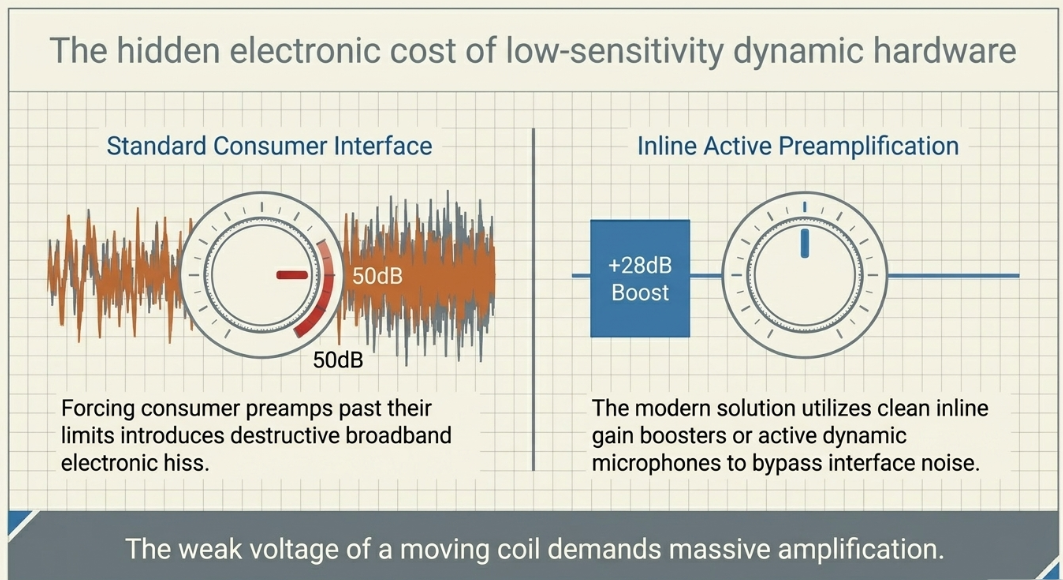
The implications of utilizing a low-sensitivity dynamic microphone are profound and twofold. First, the weak electrical signal requires substantially more gain from the audio interface or mixer to elevate the voltage to a usable, professional recording level.13 This strict requirement introduces a severe secondary challenge: the introduction of electronic "hiss" and a radically heightened noise floor. The process of electronic amplification naturally introduces artifacts; when lower-priced, consumer-grade preamplifiers are pushed to their maximum gain capacities (often past 50 dB of gain) to accommodate a low-sensitivity dynamic microphone, the internal circuitry struggles, generating an audible, continuous broadband electronic noise.17
To circumvent this, podcasters utilizing legendary, gain-hungry broadcast dynamics like the Shure SM7B must often invest in high-quality, specialized preamplifiers or deploy inline gain boosters (such as the Cloudlifter) to achieve a clean signal.19 Recognizing this barrier to entry, manufacturers have begun integrating active amplification directly into modern dynamic hardware. For instance, the Shure SM7dB features a custom, Shure-designed built-in active preamp utilizing technology licensed directly from Cloud.17 This integrated preamp provides either +18 dB or +28 dB of low-noise, flat, and transparent gain, requiring only standard 48V phantom power from an interface to operate.17 This allows the traditionally low-sensitivity microphone to interface flawlessly with entry-level consumer audio interfaces without introducing destructive preamplifier hiss.17 Similarly, modern USB microphones like the Shure MV7+ utilize advanced internal Digital Signal Processing (DSP) and an "Improved Auto Level Mode," which actively optimizes audio levels in real-time by automatically adjusting the microphone's internal digital gain based on spatial detection, the user's volume, and their shifting distance from the capsule.
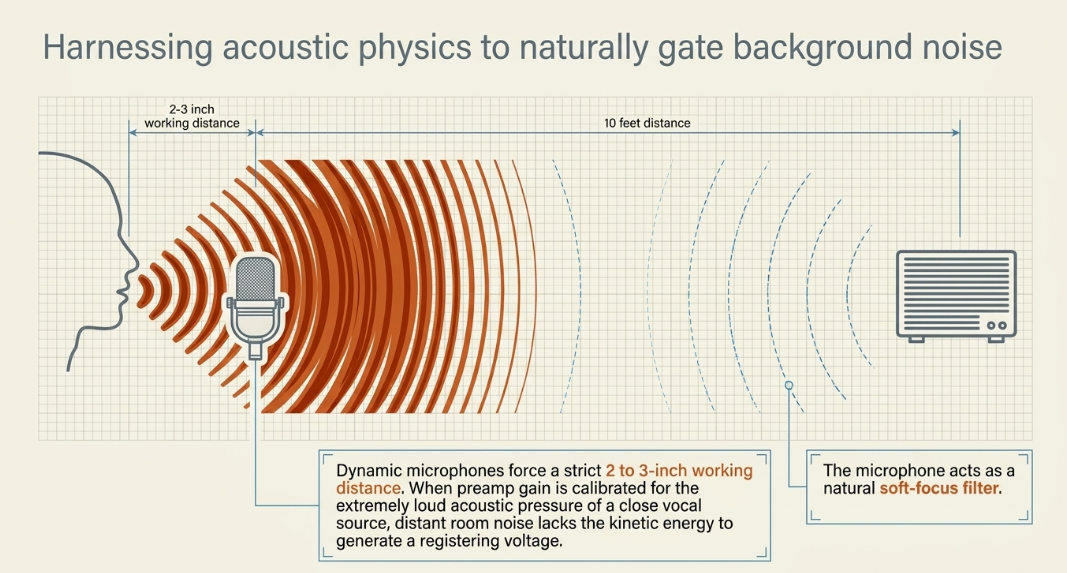
The second implication of low sensitivity, however, is highly advantageous for isolated voice recording. Because the microphone strictly requires the acoustic source to be proximate and loud to generate a strong signal, the podcaster is forced to utilize proper microphone technique. For sensitive condenser microphones, audio engineers recommend a working distance of four to six inches from the capsule.16 When using dynamic microphones, it is absolutely critical to maintain a highly intimate distance of exactly two to three inches between the mouth and the grille.16 If a speaker falls out of this optimal operating distance, the recorded audio levels will suffer a catastrophic, immediate drop-off, severely compromising the fidelity regime of the recording.16
This dynamic is further complicated by the proximity effect, a phenomenon inherent to all pressure-gradient directional microphones, where the low-frequency bass response increases exponentially as the sound source moves closer to the capsule.4 Proper microphone technique is therefore a highly delicate balance of maintaining a close enough proximity to overcome the low electronic sensitivity and isolate the voice from the room, while actively preventing the proximity effect from rendering the speech overly boomy, distorted, or unintelligible. Wearing high-quality, closed-back headphones while recording is an essential mandate; directly monitoring the audio allows the speaker to intuitively hear the drop in volume if they drift off-axis, enabling them to self-correct and adjust their physical distance based on immediate, real-time auditory feedback.16
Choosing a Microphone with an Appropriate Frequency Response
Frequency response defines the specific spectrum of audio frequencies a microphone is mechanically and electronically capable of reproducing, and crucially, how it alters, colors, or biases those specific frequencies across the acoustic spectrum. For professional podcasting, an ideal frequency response is almost never perfectly "flat" or completely neutral; rather, it is a highly tailored curve that actively complements the physiological acoustic characteristics of human speech while aggressively attenuating frequencies that contribute solely to environmental noise or a lack of clarity.
Most professional microphones cite a standard, broad frequency range of 20 Hz to 20 kHz within their technical spec sheets, a metric that deliberately mirrors the theoretical limits of human hearing.18 However, capturing this massive, broad spectrum is entirely unnecessary and often detrimental for spoken word content. The human voice possesses a highly specific, restricted acoustic footprint. The fundamental frequencies—the deep, resonant, powerful tones originating from the chest cavity—range roughly between 80 Hz and 500 Hz for male voices, and 175 Hz to 1180 Hz for female voices.21 Below 80 Hz, there is virtually no usable vocal data generated by the human vocal cords; however, this subsonic region is precisely where structural rumble, HVAC noise, traffic vibrations, and explosive vocal plosives reside.
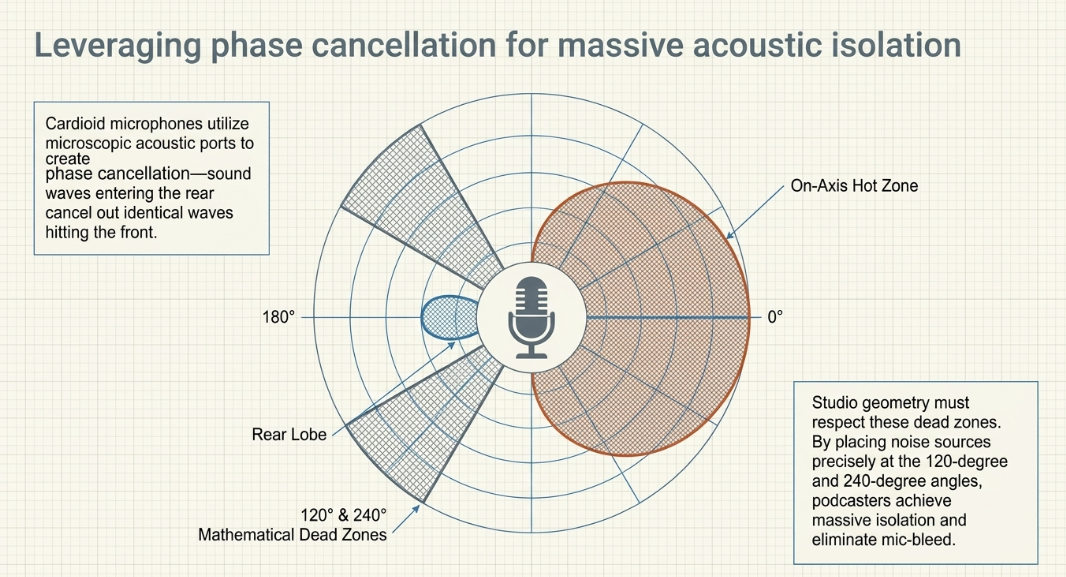
Consequently, the immediate application of a high-pass filter (also known as a low-cut filter) is universally considered the most critical initial adjustment in podcast audio engineering. Activating a high-pass filter—whether via a physical hardware switch on the microphone chassis or through software within a digital audio workstation—allows frequencies above a designated threshold (typically set around 70 Hz to 100 Hz) to pass through the signal chain entirely unaltered, while aggressively cutting everything below that point.17 If the digital filter allows for adjustable roll-off curves, steep settings of -12 dB or -16 dB per octave are highly recommended to immediately tighten the low end and eliminate mechanical interference.22
The frequency spectrum located between 80 Hz and 120 Hz dictates the absolute fullness, rich timbre, and "warmth" of the human voice.22 Acoustic engineers strongly advise leaving this region intact, as aggressively cutting it results in voices that sound unnaturally thin, wispy, or "crunchy".22 Conversely, the frequency band spanning from 150 Hz to 300 Hz is where detrimental "boominess" occurs.21 An overabundance of acoustic energy in this region—often an unavoidable consequence of the proximity effect when working closely to a dynamic microphone—results in a muddy, dense, and heavily cluttered recording.22 If a mix requires balancing the perceived loudness of a male and female speaker, professional editors often execute a targeted cut in the male's voice within this specific 200 Hz to 240 Hz range.22 Furthermore, the midrange spectrum from 300 Hz to 1 kHz contains the vast majority of room reflections and environmental reverberation.21 If a podcast is recorded in a large, untreated space characterized by hard surfaces, surgically reducing frequencies in this specific band can rapidly make the audio sound more intimate, controlled, and acoustically "expensive".21
Higher up the acoustic spectrum, the 2 kHz to 6 kHz range is absolutely critical for speech intelligibility and articulation.21 Evolutionary biology has meticulously tuned the human ear to be exceptionally sensitive to this specific frequency band, as it carries the sharp, transient consonant sounds necessary for rapid speech comprehension.22 To ensure intelligibility, standard telecommunication systems (like a telephone call) historically cap their transmission bandwidth at a maximum of 3.4 kHz.21 Many professional podcast microphones, particularly dynamics, are engineered with an inherent "presence boost"—a slight, intentional elevation in the frequency response curve within this range—to instantly enhance clarity and ensure the voice remains crisp.17 If a speaker is difficult to understand, a wide, gentle digital boost in this area can dramatically improve listener comprehension.21
Conversely, the 5 kHz to 15 kHz range is entirely responsible for sibilance—the harsh, piercing, high-frequency hissing sounds generated by sibilant consonants such as "S," "T," "Z," and "Sh".21 Frequencies above 15 kHz (often referred to as "air" or "sparkle" in musical production) provide minimal nuances to the human voice and are largely irrelevant for spoken-word podcasting.21 In fact, extreme high frequencies often translate exceptionally poorly when massive audio files are compressed into standard, low-bitrate formats (such as 64 kbps MP3s) for RSS podcast distribution, frequently resulting in a harsh, metallic, or distorted artifacting.22
When applying digital equalization (EQ) to a recorded podcast, professional acoustic engineers strictly adhere to a philosophy of subtractive equalization—cutting unwanted frequencies rather than boosting desired ones.22 Boosting with an EQ inherently raises the noise floor of the track and can rapidly bring out unpleasant, hidden resonant frequencies, such as the high-pitched whine of a laptop fan.22 To identify problem frequencies, engineers utilize a technique called "sweeping," which involves taking a narrow EQ band, boosting it by roughly 20 dB, and slowly scanning from left to right across the 120 Hz to 500 Hz range while the audio plays.24 This aggressively highlights the exact frequency where the voice sounds the most muddled, allowing the engineer to instantly apply a surgical, subtractive cut to that specific resonant node, instantly restoring clarity.
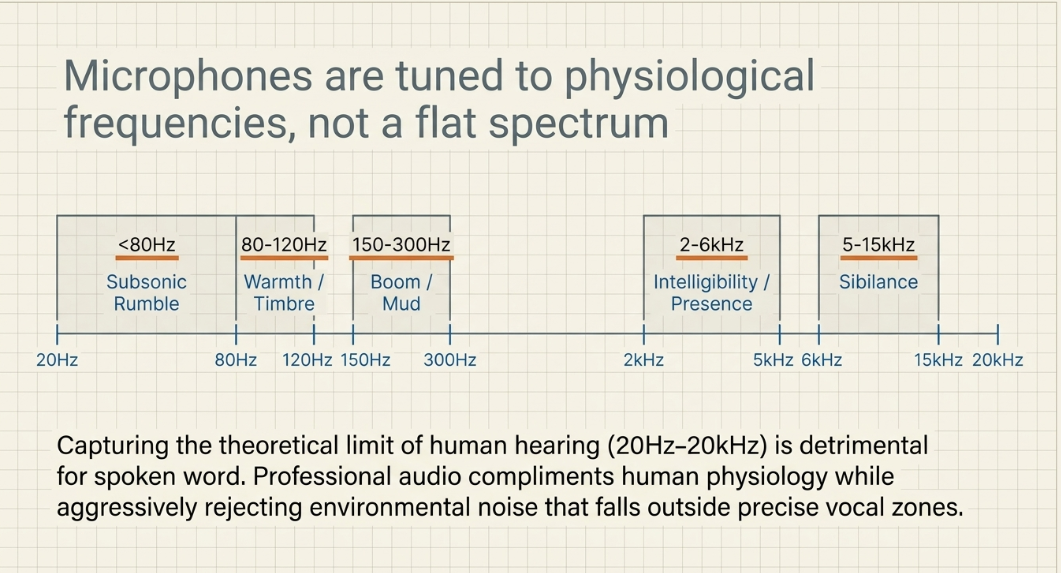
For a professional, foundational starting point, industry experts recommend inputting a highly specific 7-band subtractive EQ curve designed specifically for broadcast speech:
It is crucial to note that within the digital effects chain of a digital audio workstation, this equalization process should always be placed immediately after denoising plugins, but strictly before any dynamic compression.22 This specific routing ensures that the EQ does not inadvertently alter or inflate the loudness of the tracks before they are compressed, ensuring the final exported file conforms perfectly to standard broadcast loudness targets (such as -16 LUFS).22 Modern digital microphones, such as the Shure MV7+, attempt to automate this entire process by utilizing onboard DSP to provide users with a customizable audio signature, real-time denoisers, and a Digital Popper Stopper that entirely eliminates the need for physical filters when filming video podcasts.17
Polar Patterns and How They Help Reject Background Noise
The polar pattern of a microphone defines its precise, three-dimensional directional sensitivity—the geometric spatial volume surrounding the capsule where the transducer is most highly receptive to acoustic energy, and conversely, the angles at which it rejects sound. Selecting the correct polar pattern is a foundational architectural decision that dictates how successfully a microphone can isolate a targeted sound source while simultaneously rejecting off-axis environmental noise and room reverberation.
Microphones are classified into three primary polar archetypes, each dictating a vastly different acoustic behavior: omnidirectional, bidirectional (figure-8), and unidirectional (cardioid).25 Omnidirectional microphones are engineered to capture sound evenly from a perfect 360-degree sphere.25 While they sound highly natural and lack any proximity effect, they are exquisitely susceptible to room reflections and are entirely unsuitable for almost all standard podcasting applications, unless a producer is intentionally attempting to record a multi-person roundtable discussion utilizing a single, centrally located device.25 Bidirectional, or figure-8 microphones, behave identically to two cardioid microphones placed back-to-back; they capture audio with equal, maximum sensitivity from directly in front (0 degrees) and directly behind (180 degrees) the capsule, while demonstrating theoretically infinite mathematical rejection at the 90-degree and 270-degree side axes.25 This specific pattern is highly advantageous for one-on-one interviews where two subjects sit perfectly across a table sharing a single microphone.
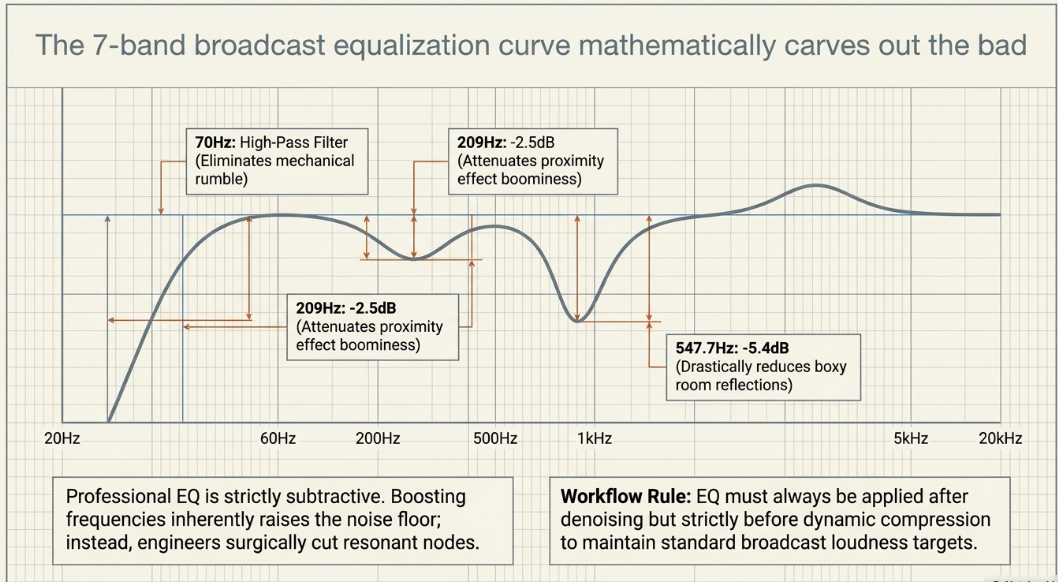
However, the undisputed, ubiquitous standard for podcasting, voiceover, and live vocal recording is the cardioid family of polar patterns.12 Named for its distinct, heart-shaped geometric pickup area, a cardioid microphone is technically classified as a pressure-gradient transducer.25 It achieves its strict directionality by relying on a highly complex acoustic phase-cancellation network built directly into the microphone's physical housing.16 Microscopic acoustic ports positioned precisely on the sides and rear of the microphone barrel allow sound waves to enter behind the internal diaphragm. When an off-axis sound wave arrives from the rear of the microphone, it enters these specific ports and strikes the back of the diaphragm at the exact same millisecond that the identical sound wave travels around the housing and strikes the front of the diaphragm. Because the acoustic pressures are equal, simultaneous, and opposite, the diaphragm physically cannot move, resulting in deep, dramatic acoustic rejection of that specific sound wave.25
The standard cardioid pattern is most highly sensitive at the 0-degree front axis (on-axis) and exhibits its maximum possible rejection directly at the 180-degree rear axis.16 This specific geometric design provides an intentional, highly effective "dead zone" directly behind the microphone.16 Savvy podcasters utilize this physical phenomenon to their immense advantage by consciously orienting the rear of the microphone toward primary noise sources, such as a loud, spinning computer fan, a clacking mechanical keyboard, or a street-facing window, effectively erasing these acoustic irritants from the recording.16
Advanced derivatives of the standard cardioid pattern exist to provide even greater, surgical isolation in challenging environments. Super-cardioid and hyper-cardioid patterns offer a much narrower, tightly focused front pickup angle, significantly increasing the rejection of sound arriving from the immediate sides of the microphone.25 This extreme directionality allows for massive gain before feedback in live public address settings and pristine vocal isolation in cluttered studio environments.28 However, the uncompromising laws of acoustic physics dictate a severe trade-off: to achieve this incredibly tight side rejection via phase cancellation, super-cardioid and hyper-cardioid microphones inherently develop a small, highly sensitive "lobe" of pickup directly at the 180-degree rear axis.25
Consequently, when utilizing a super-cardioid microphone (such as the Sennheiser e945) or a hyper-cardioid microphone (such as the Audio-Technica AT2040), the acoustic "dead zones" of absolute rejection are physically shifted away from the direct rear and relocated to approximately the 120-degree and 240-degree angles.29 Podcasters and live streamers must be acutely aware of this rear lobe characteristic; if they point the direct rear of a hyper-cardioid microphone toward a noise source (like a loud monitor), that noise will be inadvertently captured with surprising clarity.29 An additional, less common variant is the subcardioid (or wide cardioid) pattern, which offers a broader pickup area falling between omnidirectional and standard cardioid, capturing slightly more room ambience and providing a smoother off-axis tone, though it is only recommended for use in exceptionally well-treated acoustic spaces.25
Understanding polar patterns is ultimately vital for engineering proper studio geometry. Borrowing isolation techniques from the practice of miking complex drum kits, podcast engineers recording multiple hosts in a single room must arrange cardioid microphones thoughtfully.29 By seating hosts facing each other, each host is physically placed deep within the acoustic dead zone of the opposing microphone. This arrangement drastically reduces phase cancellation artifacts and devastating microphone bleed, ensuring each voice remains discretely isolated on its respective multitrack channel for uncompromised post-production editing.
USB Microphones
Historically, the professional audio industry relied almost exclusively on analog XLR connectivity. This traditional paradigm required an expensive, complex chain of discrete external components—including standalone preamplifiers, analog mixing consoles, and dedicated analog-to-digital converters (ADCs)—to properly interface a raw microphone signal with a digital computer system. In the early era of digital media, USB microphones were largely dismissed as consumer-grade novelties suitable only for basic internet telephony. However, relentless technological advancements and miniaturization have radically elevated the USB microphone into a formidable, broadcast-quality tool.32 By 2026, the strict historical delineation between entry-level USB hardware and high-end professional studio gear has heavily blurred, with high-end USB microphones now actively rivaling traditional studio setups in sheer sonic fidelity.32
To understand their utility, one must understand their architecture. A USB microphone is not merely a transducer; it is fundamentally an integrated, three-in-one hardware device comprising the acoustic capsule, an internal active preamplifier designed to boost the weak analog signal, and an internal ADC responsible for perfectly translating that analog voltage into a binary digital data stream that the computer system can interpret.32 The primary, undeniable advantage of a pure USB architecture is unparalleled workflow efficiency.32 USB microphones operate on a strict plug-and-play paradigm. They require absolutely no external driver installation, no complex routing matrices, and no bulky peripheral boxes cluttering the desk.32 A creator simply plugs the single cable into their laptop, selects the device within their recording software, and is immediately live.32 This extreme portability, combined with a highly cost-effective nature (as the user is purchasing an entire audio chain for $100 to $200), makes USB microphones the absolute gold standard for beginners, digital nomads, solo streamers, and remote creators who must interview guests in unpredictable environments like conference halls or hotel rooms.32
However, relying strictly on USB connectivity introduces profound, often insurmountable logistical limitations as a podcast scales. The most prominent constraint is the impenetrable "glass ceiling" of scalability. An exclusively USB microphone cannot be incrementally upgraded.32 If a podcaster desires the specific tonal coloration of a high-end external preamplifier or an outboard analog compressor later in their career, they cannot patch a USB microphone through it; they must discard the entire unit and purchase an XLR system.32 Furthermore, standard computer operating systems inherently struggle to clock and simultaneously recognize two identical USB audio devices.32 Attempting to record a multi-host, in-person podcast using multiple identical USB microphones creates profound, often unresolvable logistical nightmares regarding sample rate synchronization, word-clock drifting, and complex device aggregation, making them highly impractical for professional, multi-person studio environments.12
To effectively bridge this technical gap, the audio industry has successfully pivoted toward the mass production of Hybrid (USB/XLR) microphones.12 These highly versatile units provide the ultimate flexibility, seamlessly integrating both a digital USB-C output and a traditional analog XLR output within the exact same metal chassis.12
Hybrid models represent a critical market shift. Microphones such as the Audio-Technica ATR2100x-USB (featuring a dynamic capsule with zero-latency headphone monitoring) and the Samson Q2U allow creators to initiate their podcasts with a simple, affordable laptop connection, and seamlessly transition to a professional multi-channel audio interface later when their production necessitates scaling, entirely future-proofing their initial investment.

The modern USB microphone market is heavily saturated with highly capable devices. The Rode PodMic USB combines heavy-duty dynamic broadcast architecture with digital convenience, while the Rode NT-USB+ utilizes next-generation DSP to behave like a studio-grade condenser.31 The Blue Yeti Nano provides an incredibly compact condenser option with switchable cardioid and omnidirectional patterns, though it requires a remarkably quiet room.19 Other highly rated options include the Sennheiser Profile, the simple desktop-based Shure MV6, the hypercardioid Audio-Technica AT2040USB, the ultra-portable Razer Seiren Mini, and the aesthetically unique Tula Mic.31
However, the pinnacle of the current hybrid USB market is arguably the Shure MV7+. This microphone heavily leverages advanced onboard Digital Signal Processing to fundamentally alter the recording process.17 The MV7+ features dual USB-C and XLR outputs, a customizable LED touch panel with 16.8 million colors that acts as a live level meter, and a 3.5mm jack for latency-free monitoring.17 More importantly, its internal DSP engine, controlled via the MOTIV Mix Desktop App, provides real-time Voice Isolation Technology, three distinct types of reverb (Plate, Hall, Studio), an integrated Digital Popper Stopper that entirely eliminates the need for physical plosive filters, and a highly advanced Real-time Denoiser that actively suppresses ambient room noise prior to the signal ever reaching the recording software.17
Microphone Stands
The mechanical deployment and physical stabilization of a microphone are just as critical to the final audio product as its electronic specifications. A microphone must be securely, rigidly positioned to allow for highly consistent proximity and angle relative to the speaker's mouth. Handheld operation is entirely contraindicated and universally condemned in professional podcasting.37 Handholding a microphone introduces severe, low-frequency handling noise as fingers shift on the metal chassis, guarantees wildly inconsistent volume levels and proximity effect variations due to constantly fluctuating distances, and fully occupies the hands of the creator, entirely preventing vital interaction with show notes, keyboards, or hardware soundboards.37 Therefore, the choice of a dedicated microphone stand—specifically the choice between a weighted desktop stand and an articulated suspension boom arm—is a fundamental ergonomic, acoustic, and workflow decision.38
Desktop mic stands, such as the Maono BA90 or the OnStage DS7200B, feature a heavy, weighted circular base or a small, collapsible tripod that rests directly upon the rigid surface of the desk.38 Their primary, undeniable advantages are widespread affordability, extreme portability, and a nearly instantaneous, foolproof setup process—the user simply places the stand on the desk, attaches the microphone, and begins recording.
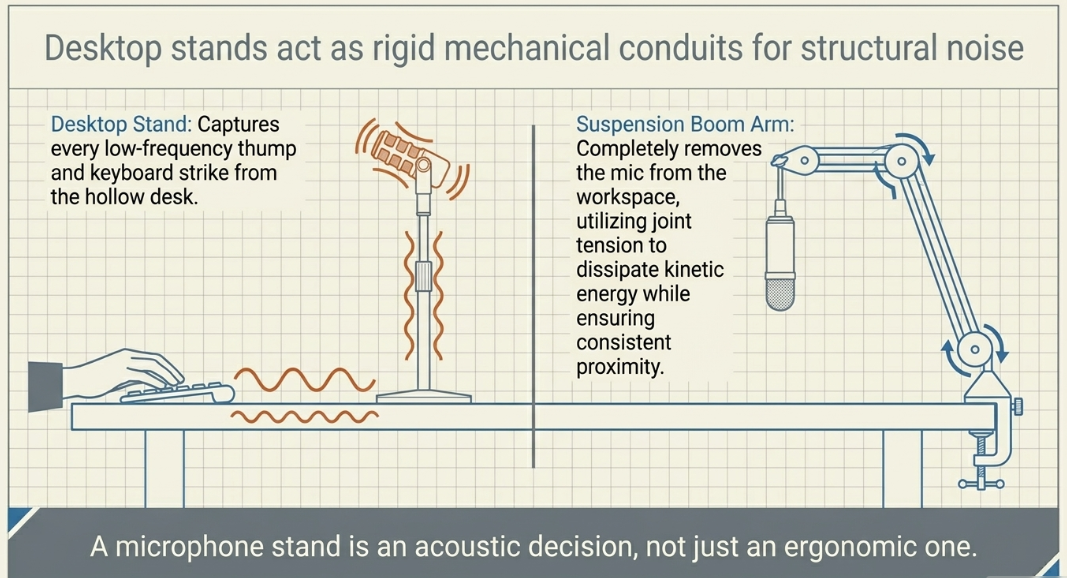
However, desktop stands present significant, often highly detrimental acoustic liabilities. Because the base of the stand is in direct, unmitigated physical contact with the workspace, it acts as a highly efficient, rigid mechanical conduit. Any vibration applied to the desk—typing aggressively on a keyboard, resting heavy elbows, setting down a coffee mug, or even tapping a foot on a hollow, non-solid floor—travels instantly up the stand's metal chassis and directly into the microphone capsule, registering in the audio file as deep, muddy, low-frequency acoustic thumps.37 To achieve even marginally professional results with a desktop stand, it must almost invariably be paired with a high-quality shock mount to sever this mechanical connection.38 Furthermore, desktop stands are notoriously difficult to maneuver. Because they sit centrally on the desk, it is incredibly challenging to position the microphone close enough to the speaker's face (the optimal two-to-six-inch zone) without the stand physically obstructing the view of a computer monitor or blocking access to a keyboard. This spatial conflict often forces the speaker to adopt a hunched, unnatural, and physically exhausting posture during long, multi-hour recording sessions, or forces them to push the mic further away and increase the gain, heavily increasing the captured room noise.38
Conversely, suspension boom arms, such as the industry-standard RODE PSA1+, the Maono BA92, or the Blue Compass Premium Tube-Style Boom Arm, utilize a heavy-duty C-clamp to secure directly to the extreme rear or side edge of a desk.38 These devices utilize a complex, articulated, spring-loaded arm mechanism to literally suspend the heavy microphone in mid-air above the workspace.38
Boom arms offer vastly superior acoustic vibration isolation because they completely remove the microphone from the central desk surface, minimizing the direct surface contact area and utilizing the high tension of the arm's mechanical joints and internal springs to naturally dissipate kinetic energy.38 Ergonomically, they are unassailable. A high-quality boom arm allows the podcaster to pull the microphone effortlessly through the air, directly into the optimal proximity zone, while leaving the entire desk surface completely clear for notes, laptops, and mixers.38 The smooth articulating joints enable the microphone to be swung completely out of the way when the podcaster is merely typing or researching, and then pulled back into the exact, mathematically identical position for the next recording session, ensuring highly consistent audio levels across a series of episodes.38 For creators incorporating video into their podcasts, low-profile boom arms (such as the Elgato Wave Low Profile Arm) can sneak under the camera's field of view, preventing the hardware from blocking the host's face.39 Floor stands (like the K&M 210/9 Tripod Boom) offer the absolute ultimate isolation by removing the stand from the desk entirely, though they require significant floor space.38 While boom arms require a slightly higher initial financial investment and demand specific vertical and horizontal spatial clearance to operate smoothly, their capacity to drastically improve a host's posture, free up critical workspace, and actively reduce mechanical noise transmission makes them an indispensable, standard asset for any professional podcast studio setup.
Spider Shock Mount
Even with the implementation of a high-quality, professional-grade suspension boom arm, disruptive micro-vibrations can still successfully traverse the mechanical linkages of the stand and ultimately reach the sensitive microphone capsule. To achieve total, uncompromising acoustic isolation from the physical environment, audio engineers mandate the employment of a specialized peripheral device known as a shock mount. A shock mount serves a singular, vital purpose: to physically and mechanically decouple the microphone body from the hard metal surface of the stand, suspending the entire transducer apparatus in a flexible web of elastic materials.41
While simple clip-on shock mounts exist, offering only minimal protection, the most effective and widely utilized design in broadcast environments is the "spider shock mount".41 In this complex mechanical architecture, an inner cylindrical ring, which tightly and securely clasps the heavy metal body of the microphone, is completely suspended within a much larger outer metallic framework by a complex, interlocking latticework of high-tension elastic bands or specialized rubber cords.41 This elastic suspension system functions as a highly efficient, passive kinetic energy dissipater.41
When extremely low-frequency mechanical vibrations—such as the heavy thud of footsteps transmitted through hollow floorboards, the deep structural rumble of passing heavy traffic outside the studio, the mechanical hum of an active HVAC system, or the aggressive tapping of a keyboard—travel up the microphone stand, the raw kinetic energy enters the rigid outer frame of the shock mount.41 Rather than seamlessly transferring this destructive kinetic energy to the inner ring and subsequently into the microphone chassis, the vibrations physically force the elastic bands to stretch and deform.41 The elastic material actively absorbs the incoming kinetic energy and, through the thermodynamic principle of damping, converts that physical movement into microscopic, completely harmless amounts of thermal energy (heat).41 This rapid, physical dissipation process drastically reduces the amplitude of the mechanical vibrations before they can ever reach the highly sensitive internal components of the microphone capsule.
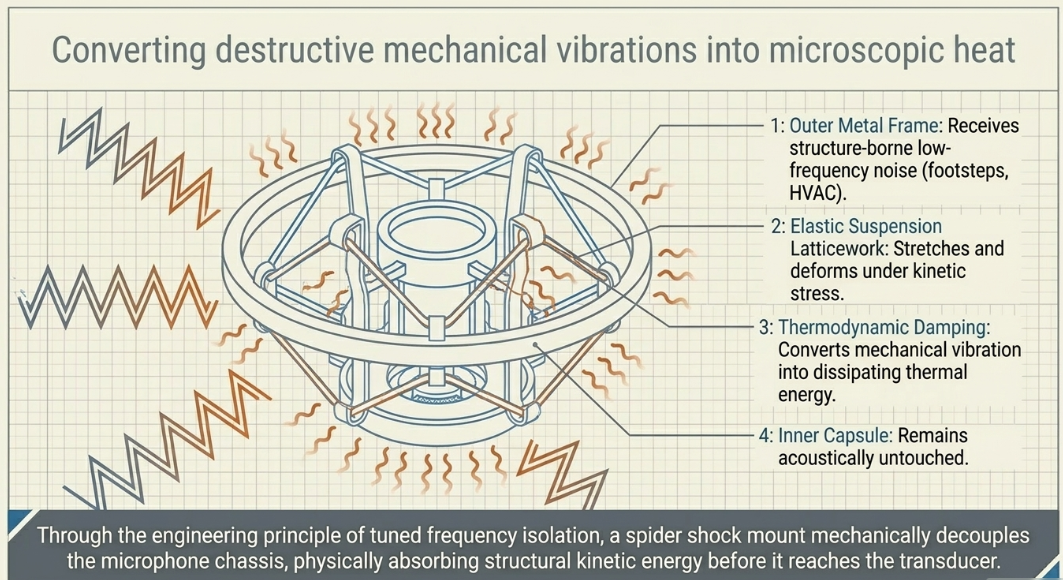
The physics governing the effectiveness of shock mounts rely heavily on the engineering principle of tuned frequency isolation.45 Audio hardware engineers meticulously select specific elastic materials with highly specific stiffness coefficients to deliberately target the exact low-frequency ranges where structure-borne noise is most problematic and prevalent.45 For optimal acoustic performance, the natural resonant frequency of the elastic suspension system must be engineered to be significantly lower than the absolute lowest operating frequency of the microphone it holds.45 Because of these incredibly precise mass-to-tension ratios, while universal shock mounts exist to accommodate various barrel sizes, manufacturers strongly recommend utilizing custom shock mounts designed specifically for the unique mass, weight distribution, and geometric shape of the intended microphone (such as the massive Vanguard shock mount designed for the V4 FET).41
The necessity of a shock mount is partly dictated by the transducer type. Condenser microphones, with their ultra-lightweight diaphragms, are exquisitely sensitive to the slightest physical disturbances and almost universally require a shock mount.41 While dynamic microphones are physically heavier and slightly more resistant to handling noise, they still benefit immensely from decoupling.43 While installing a microphone into a complex spider shock mount requires slightly more setup time and effort than clipping it directly to a rigid plastic ring mount, the resulting, profound attenuation of structure-borne rumble and transmitted mechanical noise makes it an absolute necessity for achieving pristine audio.43
Mic Sock
The human respiratory system naturally expels air in highly variable, sometimes violent velocities during normal speech. When a speaker articulates plosive consonants—specifically hard "P," "B," and "T" sounds—a highly concentrated, high-velocity blast of air is rapidly ejected from the lips.10 If this rapid, aerodynamic burst of air strikes a sensitive microphone diaphragm directly, it forces the capsule to its maximum physical excursion limit, resulting in a harsh, clipping, low-frequency distortion artifact universally known as a "pop".46 To mitigate this severe aerodynamic interference, podcasters must place a physical barrier directly between the mouth and the microphone. Within the industry, two distinctly different solutions exist, each engineered for entirely different environments: the pop filter and the foam windscreen (often colloquially referred to as a "mic sock" or "wind muff").
A standard pop filter, or pop shield, is a circular frame stretched with either an acoustically transparent nylon mesh or a thin, perforated sheet of metal.46 It is typically mounted directly to the microphone stand via a flexible, positionable gooseneck arm.47 Crucially, it is placed several inches in front of the microphone capsule, maintaining an air gap. When a violent plosive burst hits the mesh, the physical structure of the filter diffuses the high-pressure air, instantly breaking up the concentrated wind blast and dispersing it harmlessly into the room before it can ever reach the diaphragm.46 Most importantly, because the mesh material is incredibly thin and highly porous, standard acoustic soundwaves pass through it virtually unaltered.47 Pop filters maintain excellent acoustic transparency; they do not muffle the audio, fully preserving the delicate, high-frequency "air" and absolute clarity of the vocal recording.47 Furthermore, metal mesh filters can be easily washed to maintain hygiene, a critical factor in studios with multiple rotating guests.48 As such, pop filters are the absolute preferred, uncompromising tool for indoor, studio-based podcast and vocal recording.
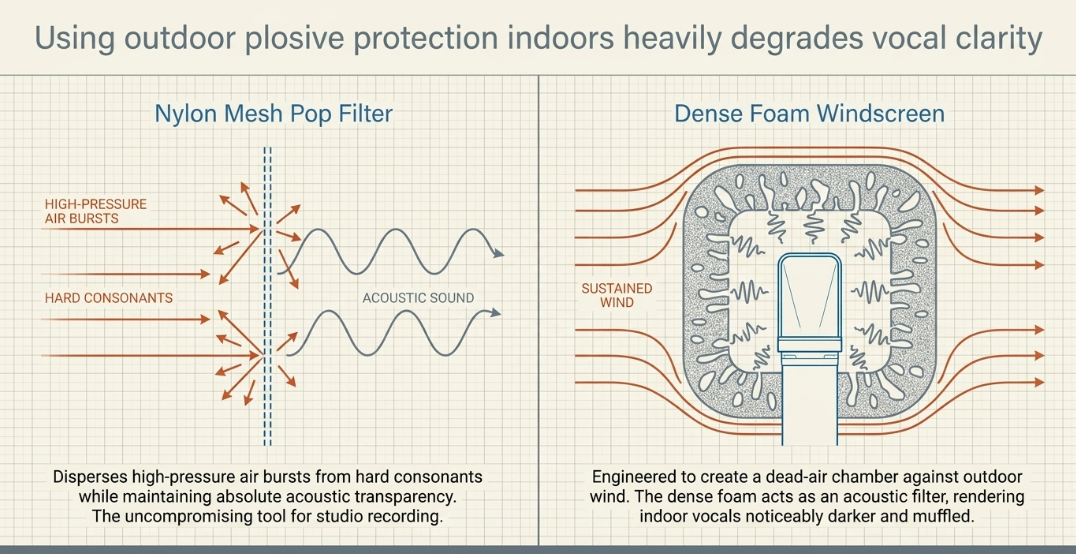
A foam windscreen, or mic sock, functions on an entirely different aerodynamic principle.47 Made of thick, open-cell polyurethane foam, a mic sock is designed to stretch directly over the metallic grille of the microphone, completely enveloping the capsule.47 Rather than catching targeted, directional plosives from a single speaker, a foam windscreen is specifically engineered to combat multi-directional, sustained air movement—primarily environmental wind noise encountered during outdoor broadcasting or on-location video production.47 The dense foam creates an isolated, low-pressure "dead-air" chamber immediately surrounding the capsule, forcing ambient wind to move around the exterior of the foam rather than striking the microphone barrel.50 For extreme outdoor environments with wind speeds exceeding 6 meters per second, engineers utilize "windjammers" or "dead cats"—synthetic faux-fur slip-on covers that utilize long, wispy hairs to further disperse air friction, capable of achieving up to 50 dB of wind noise reduction.46
However, the rigid laws of acoustic physics dictate a strict, unavoidable trade-off between wind-blocking capability and acoustic transparency.50 Because the polyurethane foam of a mic sock is significantly thicker and vastly denser than a thin nylon mesh pop filter, it actively acts as an acoustic filter.50 While it successfully prevents wind from buffeting the diaphragm, the extreme density of the foam aggressively absorbs and attenuates high-frequency audio data.50 Consequently, a microphone wrapped tightly in a heavy foam sock will almost always sound noticeably darker, "woolly," or slightly muffled compared to a bare microphone.48
While some podcasters utilize foam windscreens indoors in an attempt to slightly mask harsh room echo, or simply for visual branding aesthetics (such as broadcasting networks utilizing brightly colored, logo-branded foam covers on dynamic handhelds), acoustic engineers generally advise against relying on them as the primary plosive protection in a controlled, indoor studio environment.48 A standard indoor setup requires only a bare microphone and a dedicated mesh pop filter.
A common, detrimental amateur mistake is "doubling up"—using both a foam mic sock and a mesh pop filter simultaneously in an indoor studio.48 This practice is highly redundant; not only does it severely degrade high-frequency clarity without offering any additive acoustic benefits, but the foam windscreen can actually resonate and heavily emphasize the unwanted low-frequency resonances of the microphone's headbasket, resulting in a less clear, muddy tone.48 (It should be noted, however, that in recent years, placing extremely thin plastic bags—less than 10 µm thick—loosely over foam windscreens has been adopted as a viable virus protection strategy to prevent pathogen transference, though even this must be done carefully to avoid altering the microphone's directivity).54
Summary
The precise execution of professional audio in the realm of podcasting is a rigorous exercise in managing the immutable physics of sound capture, ensuring strict mechanical isolation, and applying targeted digital signal processing. The selection of the primary acoustic transducer fundamentally dictates the baseline quality and limitations of the entire audio chain. Dynamic microphones, perfectly exemplified by highly engineered, rugged models like the Sennheiser e945 and the Shure SM7B, remain the undisputed industry standard for untreated, home-based recording environments. This dominance is due to their inherently low electrical sensitivity, robust electromagnetic coil architecture, and their unparalleled ability to naturally reject ambient room reflections and chaotic background noise when utilized at a highly intimate proximity.
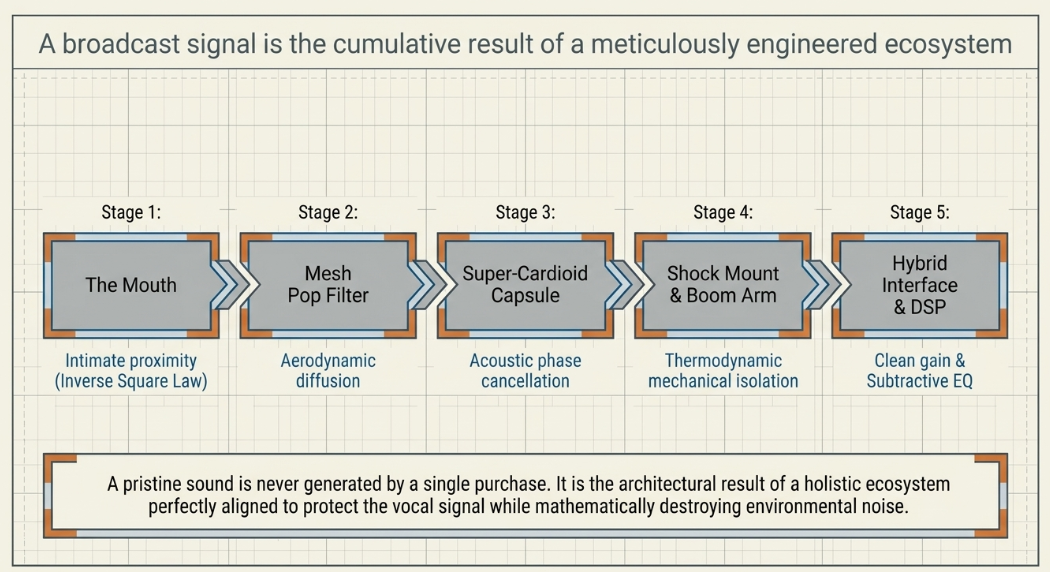
Understanding the complex intersection of microphone sensitivity, polar patterns, and frequency response allows creators to implement highly specific, mathematical acoustic strategies. Leveraging the low-frequency proximity effect through close-miking techniques, alongside a tight, phase-canceling cardioid or super-cardioid polar pattern, maximizes absolute vocal isolation and completely eliminates mic-bleed in multi-host scenarios. The deliberate application of subtractive equalization—specifically the mandatory use of steep high-pass filters to remove subsonic rumble, and surgical midrange cuts to eliminate room mud—ensures the human voice is captured with maximum intelligibility and broadcast presence without artificially raising the noise floor.
Furthermore, hardware connectivity has evolved rapidly to provide unprecedented production flexibility. The advent of Hybrid USB/XLR microphones offers creators a seamless, future-proof transition from highly portable, plug-and-play laptop workflows to immensely scalable, modular analog studio configurations equipped with advanced, real-time digital signal processing and auto-leveling algorithms. Finally, the absolute preservation of this pristine electrical signal requires strict, uncompromising mechanical isolation. The deployment of heavy-duty, articulated suspension boom arms and meticulously tuned, elastically decoupled spider shock mounts entirely severs the microphone from structure-borne vibrations and low-frequency impacts. Concurrently, the utilization of acoustically transparent mesh pop filters diffuses violent aerodynamic plosives without sacrificing the critical, delicate high-frequency fidelity that dense polyurethane foam windscreens heavily attenuate. By meticulously integrating these complex electroacoustic principles, podcasters ensure an articulate, authoritative, and truly broadcast-quality auditory experience that definitively meets the stringent, uncompromising standards of the modern professional audio industry.
Works cited
Dynamic Vocal Microphone e 945 | Sennheiser, accessed May 14, 2026, https://www.sennheiser.com/en-us/catalog/products/microphones/e-945/e-945-009422
Sennheiser E945 Supercardioid Dynamic Microphone - Sam Ash, accessed May 14, 2026, https://www.samash.com/sennheiser-e945-supercardioid-dynamic-microphone-se945xxxx
Sennheiser e945 Dynamic Mic Review / Test — Podcastage, accessed May 14, 2026, https://podcastage.com/rev/e945
Sennheiser e945 Supercardioid Dynamic Microphone Review, accessed May 14, 2026, https://microphonegeeks.com/sennheiser-e945-supercardioid-dynamic-microphone-review/
My new Sennheiser e945 sounds great when it's just me, but gets lost in the mix when the band comes in. What can I do? : r/livesound - Reddit, accessed May 14, 2026, https://www.reddit.com/r/livesound/comments/25ppnv/my_new_sennheiser_e945_sounds_great_when_its_just/
Sennheiser e945 Supercardioid Dynamic Vocal Microphone - Central Music, accessed May 14, 2026, https://centralmusic.com/shop/live-sound/live-sound-mics/sennheiser-e945-supercardioid-dynamic-vocal-microphone/
Sennheiser e945 - What To Know & Where To Buy | Equipboard, accessed May 14, 2026, https://equipboard.com/items/sennheiser-e-945-supercardioid-dynamic
Sennheiser e 945 Supercardioid Dynamic Vocal Microphone Reviews - Sweetwater, accessed May 14, 2026, https://www.sweetwater.com/store/detail/E945--sennheiser-e-945-supercardioid-dynamic-vocal-microphone/reviews
Sennheiser E945 - Dynamic Microphones, accessed May 14, 2026, https://bswusa.com/sennheiser-e945/
Podcast Microphone Tips: Dynamic vs Condenser Mic Guide, accessed May 14, 2026, https://thepodcastconsultant.com/blog/podcast-microphones-pro-tips
Dynamic vs Condenser mics | which is best for Podcasting - a non-technical guide - Podlad, accessed May 14, 2026, https://www.podlad.com/blog/dynamic-vs-condenser-mics-which-is-better-for-podcasting
Microphone Buying Guide 2025: USB, XLR, Dynamic, Condenser | NearStream Official, accessed May 14, 2026, https://www.nearstream.us/blog/microphone-buying-guide-usb-xlr-dynamic-condenser
Dynamic vs condenser microphones - What is better? - LEWITT, accessed May 14, 2026, https://www.lewitt-audio.com/blog/dynamic-vs-condenser-microphones-what-better
No, dynamic mics do not reject room sound better than condensers : r/microphone - Reddit, accessed May 14, 2026, https://www.reddit.com/r/microphone/comments/1qn1h5w/no_dynamic_mics_do_not_reject_room_sound_better/
I don't get it, why are dynamic mics better than condenser mics in untreated spaces? - Reddit, accessed May 14, 2026, https://www.reddit.com/r/audioengineering/comments/untwmx/i_dont_get_it_why_are_dynamic_mics_better_than/
Microphone Technique for Podcasters - University Center for Teaching and Learning, accessed May 14, 2026, https://teaching.pitt.edu/resources/microphone-technique-for-podcasters/
Choosing a Microphone for Podcasting - Shure USA, accessed May 14, 2026, https://www.shure.com/en-US/insights/choosing-a-microphone-for-podcasting
How to read microphone specifications, accessed May 14, 2026, https://www.dpamicrophones.com/mic-university/technology/how-to-read-microphone-specifications/
Best Podcast Microphones for 2025: My Good, Better, Best Picks from Mic Shopping! : r/PodcastingTools - Reddit, accessed May 14, 2026, https://www.reddit.com/r/PodcastingTools/comments/1mk3chx/best_podcast_microphones_for_2025_my_good_better/
The 4 key microphone specifications and why they're important, accessed May 14, 2026, https://diymics.com/the-4-key-microphone-specifications/
How to EQ a Podcast - YouTube, accessed May 14, 2026, https://www.youtube.com/watch?v=rFaXb1NCMM8
EQ for Podcasting | Podigy, accessed May 14, 2026, https://www.podigy.co/podcasters-eq
How to EQ Voice for Podcast: Discovering the Basics and Beyond - Async, accessed May 14, 2026, https://async.com/blog/how-to-eq-voice-for-podcast/
Tips on EQing your vocals : r/podcasts - Reddit, accessed May 14, 2026, https://www.reddit.com/r/podcasts/comments/9b6j00/tips_on_eqing_your_vocals/
Microphone Polar Patterns Decoded: Cardioid, Omnidirectional, and Figure-8 Applications, accessed May 14, 2026, https://www.sonarworks.com/blog/learn/microphone-polar-patterns-guide
Microphone Mic Patterns Made Simple Understanding Polar Patterns for Better Audio - YouTube, accessed May 14, 2026, https://www.youtube.com/shorts/bFr32zY2bh4
The ULTIMATE Podcast Microphones of 2025 (Top 5 Picks!) - YouTube, accessed May 14, 2026, https://www.youtube.com/watch?v=x1DxOd6dy1w
Microphone polar patterns - LEWITT, accessed May 14, 2026, https://www.lewitt-audio.com/blog/polar-patterns
What Are A Microphone's Polar Patterns? (US) - RØDE, accessed May 14, 2026, https://rode.com/en-us/about/news-info/what-are-a-microphones-polar-patterns
A Brief Guide to Microphones - What's The Pattern? - Audio-Technica, accessed May 14, 2026, https://www.audio-technica.com/en-us/support/a-brief-guide-to-microphones-whats-the-pattern
Best USB microphones 2026: Plug-and-play mics for everything from streaming to singing, accessed May 14, 2026, https://www.musicradar.com/news/best-usb-microphones
USB vs XLR Microphones: Key Differences and Which is Best for You - Podbean Blog, accessed May 14, 2026, https://blog.podbean.com/usb-vs-xlr-podcast-microphone-guide/
USB vs XLR vs Wireless: Best Mic Type for Podcasting in 2025 - Maono, accessed May 14, 2026, https://www.maono.com/blogs/news/usb-vs-xlr-vs-wireless-best-mic-type-for-podcasting-in-2025
USB vs XLR Microphones for Podcasting: Which is best? - Hollywood DJ, accessed May 14, 2026, https://hollywooddj.com/blogs/2025/usb-vs-xlr-microphones-for-podcasting
USB microphones for podcasting in 2025 | Knowledge Hub - This is Fever, accessed May 14, 2026, https://www.thisisfever.co.uk/knowledge-hub/usb-microphones-for-podcasting/
Best Podcast Microphones (From 15 Years of Testing) - Alitu, accessed May 14, 2026, https://alitu.com/creator/content-creation/best-podcast-microphones-15-years-testing/
Getting Started: Additional Podcast Equipment - Focusrite, accessed May 14, 2026, https://us.focusrite.com/articles/getting-started-additional-podcast-equipment/
Desktop Mic Stand vs Boom Arm for Streaming: Which Mic Stand ..., accessed May 14, 2026, https://www.maono.com/blogs/news/desktop-mic-stand-vs-boom-arm-for-streaming-which-setup-is-better
Microphone Stand vs Microphone Boom Arm (Best For Home Setup!) - YouTube, accessed May 14, 2026, https://www.youtube.com/watch?v=UN2GbhBWBpU
Unpopular Opinion: Tabletop Mic stands are far superior to boom arms - Reddit, accessed May 14, 2026, https://www.reddit.com/r/podcasting/comments/u9urjv/unpopular_opinion_tabletop_mic_stands_are_far/
Everything You Need to Know About Shock Mounts: Types, Uses & Top Picks, accessed May 14, 2026, https://www.maono.com/blogs/news/everything-you-need-to-know-about-shock-mounts-types-uses-top-picks
Shotgun Mic Shock Mount Isolation In Action - JustAskJimVO, accessed May 14, 2026, https://justaskjimvo.studio/mic-isolation/
Microphone Shockmounts: The Better Solution - Harmony Central, accessed May 14, 2026, https://www.harmonycentral.com/articles/microphones/microphone-shockmounts-the-better-solution-r63/
Do You Need a Microphone Shock Mount? A Complete Guide | NearStream Official, accessed May 14, 2026, https://www.nearstream.us/blog/ultimate-guide-to-mic-shock-mount-setup
What are shock mounts and how do they work? - PHOENIX ..., accessed May 14, 2026, https://phoenixvibrationcontrols.com/what-are-shock-mounts-and-how-do-they-work/?lang=en
Pop filter vs. Wind foam: THIS is the difference - YouTube, accessed May 14, 2026, https://www.youtube.com/watch?v=FcTseEeZudc
Microphone Windscreen vs Pop Filter: Are They the Same Thing? - Adorama, accessed May 14, 2026, https://www.adorama.com/alc/microphone-windscreens-vs-pop-filters-whats-the-difference/
Are there any differences between a pop filter and a windscreen? - Reddit, accessed May 14, 2026, https://www.reddit.com/r/podcasting/comments/l6wxj3/are_there_any_differences_between_a_pop_filter/
Pop Filter vs Foam Cover (Differences & Which To Use) - Producer Hive, accessed May 14, 2026, https://producerhive.com/buyer-guides/microphones/pop-filter-vs-foam-cover/
The Science of Microphone Windscreens – Student Filmmakers ..., accessed May 14, 2026, https://studentfilmmakers.com/the-science-of-microphone-windscreens/
Foam Mic Cover vs Pop Filter: Which One Should I Use (And When)? - Produce Like A Pro, accessed May 14, 2026, https://producelikeapro.com/blog/foam-mic-cover-vs-pop-filter/
Better Pop Filter For SM58? : r/audioengineering - Reddit, accessed May 14, 2026, https://www.reddit.com/r/audioengineering/comments/1kfdiwq/better_pop_filter_for_sm58/
Gallery: Cubes, Windshields & Foams for Microphones in Australia - Mic Logo Branding, accessed May 14, 2026, https://miclogobranding.com.au/gallery/
The audio consequences of using wind, rain and virus protection on microphones, accessed May 14, 2026, https://www.dpamicrophones.com/mic-university/technology/the-audio-consequences-of-using-wind-rain-and-virus-protection-on-microphones/