The digital audio ecosystem has undergone a profound structural maturation over the past decade, evolving from an experimental, consumer-driven entertainment medium into a foundational pillar of enterprise revenue operations and business-to-business (B2B) strategy. The macroeconomic indicators surrounding the podcasting industry reflect a rapidly scaling commercial apparatus. Currently, there are approximately 4.69 million indexed podcasts globally; however, when adjusting for inactive shows—an industry phenomenon colloquially termed "podfade"—the number of actively producing programs stabilizes between 450,000 and 500,000.1 This consolidation indicates a strategic shift within the industry from sheer volume and experimental launches to sustained, high-quality, professional production.
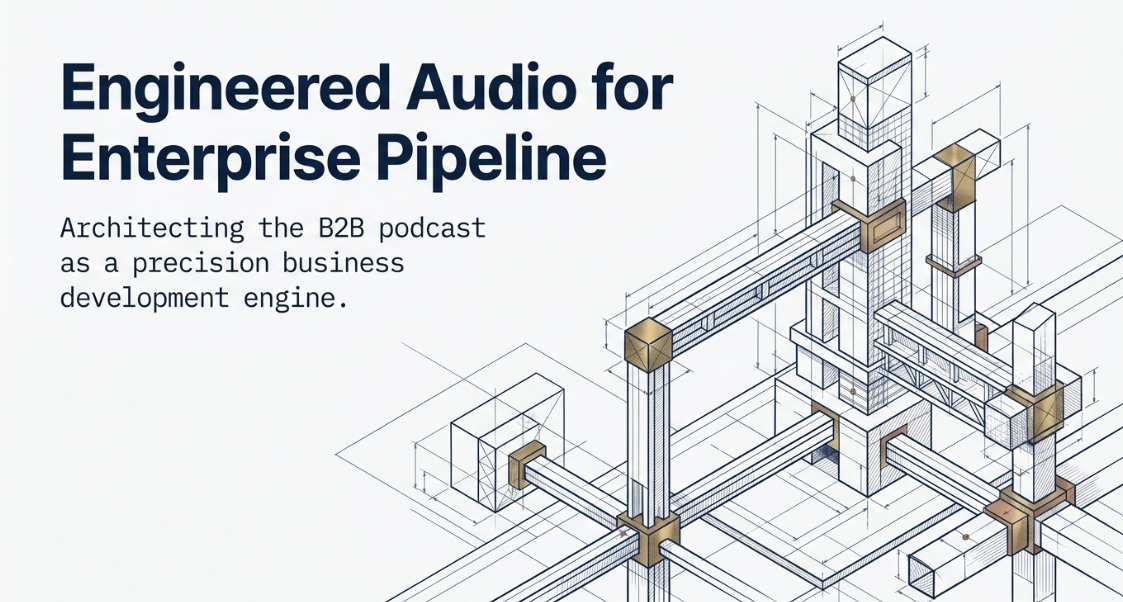
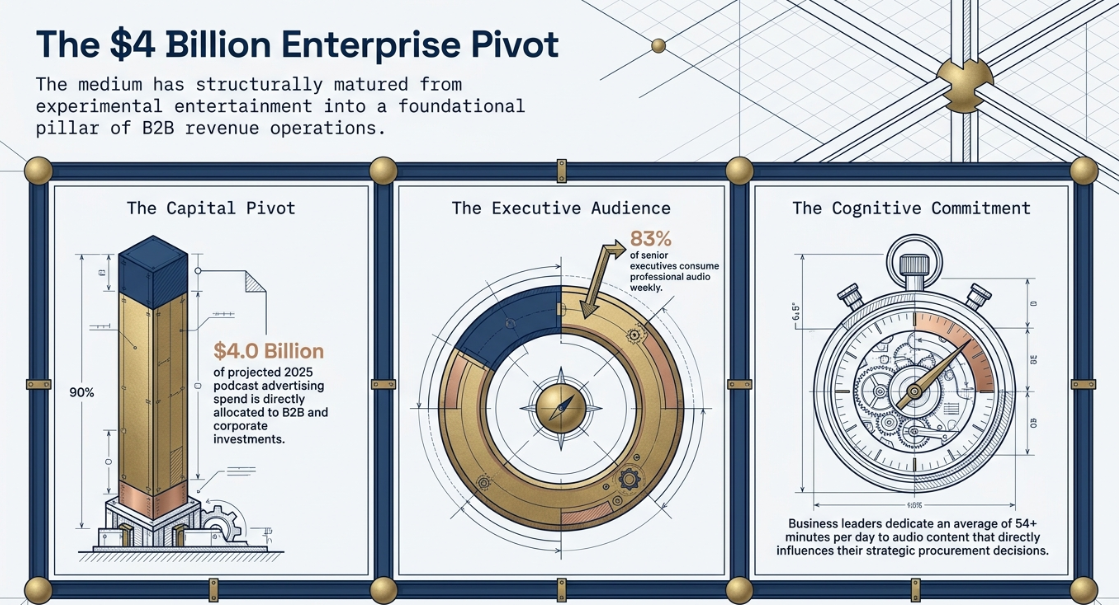
Simultaneously, the global audience for this medium continues to scale at an unprecedented velocity, demanding sophisticated content. In 2025, global podcast listeners reached 584.1 million, representing a robust 6.8% year-over-year growth rate, with precise market projections indicating a surge to 619.2 million listeners by 2026.1 Capital allocation within the corporate sector heavily mirrors this audience migration. Global podcast advertising spend is projected to hit $4.46 billion in 2025.2 Most notably for corporate strategists and revenue operations leaders, B2B-specific advertising and corporate podcast investments account for an overwhelming $4 billion of this total, proving the channel's maturity as a sophisticated commercial engine rather than a mere top-of-funnel brand awareness exercise.2
The demographic composition and behavioral psychology of this growing audience explain the massive influx of corporate capital. Comprehensive demographic research indicates that 83% of senior executives reported listening to a podcast in the past week, and this high-value cohort is twice as likely to consume at least five hours of audio content per week compared to the average retail listener.2 Furthermore, business leaders dedicate an average of 54 or more minutes per day to consuming audio content that directly influences their strategic decision-making, procurement evaluations, and operational thinking.2 For the modern enterprise, the podcast is no longer an alternative media channel; it is the primary vector through which high-net-worth decision-makers consume complex professional insights. Consequently, 91% of marketing executives plan to maintain or expand their podcast and audio content investments moving forward, recognizing that 74% of listeners engage with the medium specifically for educational and professional development purposes.2
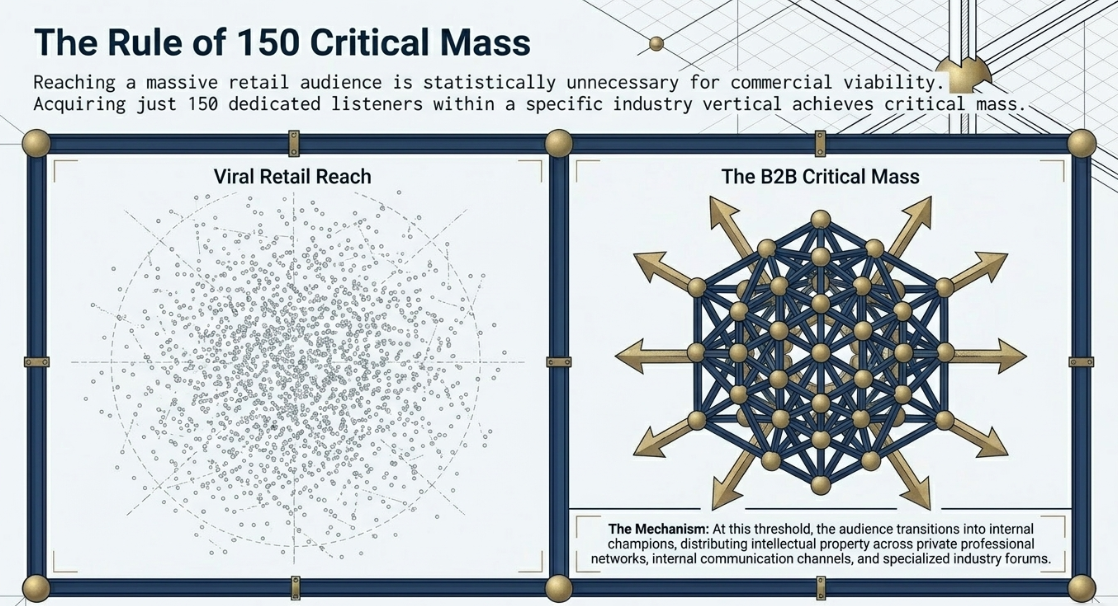
To fully grasp the mechanics of B2B podcast audience acquisition, organizations must understand the "Rule of 150," derived from Malcolm Gladwell's sociological research on the "Tipping Point" and Dunbar's number.3 In the context of niche professional audio, reaching a massive retail audience is unnecessary for commercial viability. Data suggests that acquiring just 150 dedicated listeners within a specific industry vertical is sufficient to achieve critical mass.3 At this threshold, the audience begins to exhibit compounded, word-of-mouth growth. When a highly targeted B2B show secures 150 practitioners, those listeners act as internal champions, distributing the intellectual property across their private professional networks, internal corporate communication channels, and specialized industry forums.3 This dynamic proves that for enterprise strategists, hyper-targeted audience acquisition holds infinitely more commercial value than broad, untargeted viral distribution.
Podcast Metrics: Beyond Downloads
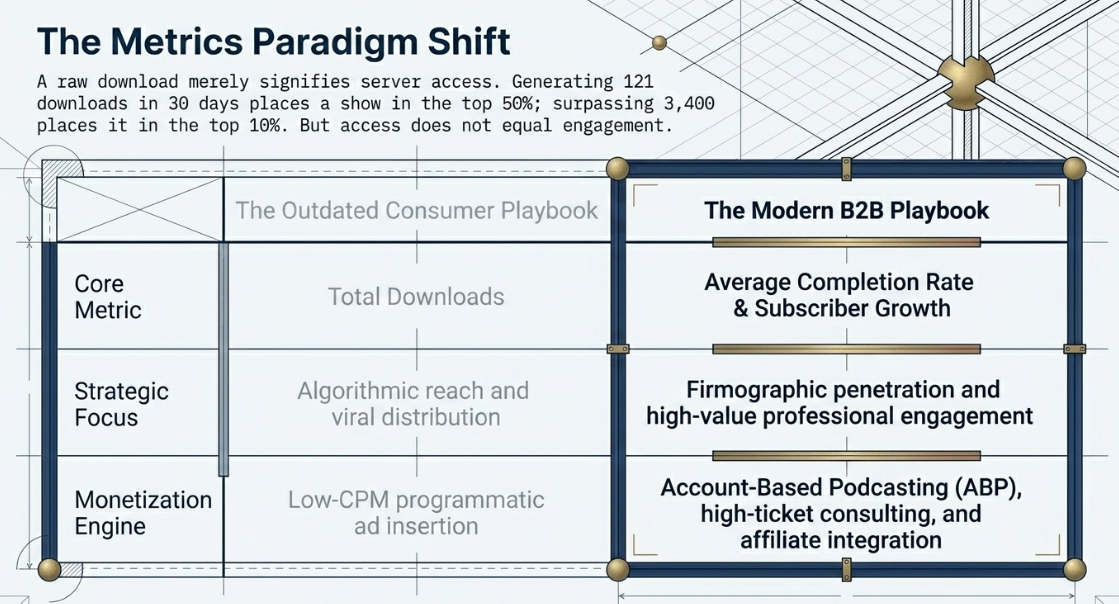
While the median professional show receives 469 downloads per episode (a 10.4% increase from previous benchmarks), this number only signifies access, not engagement.4 For nearly two decades, the podcasting industry relied heavily on the "download" as its primary transactional currency. This legacy metric is inherently flawed for modern enterprise analytics. A download merely signifies server access; it indicates that an audio file was requested by a client application or an RSS aggregator. It provides absolutely no verification that a human being actually pressed play, listened to the content, or engaged with the underlying corporate messaging.
The distribution of this reach is highly skewed, further complicating baseline expectations for new corporate entrants. Statistical data from major hosting infrastructures demonstrates that a podcast generating just 121 downloads in its first 30 days of publication is performing better than 50% of all active shows.6 Achieving 3,400 downloads places a professional show in the top 10% of the market, while surpassing 50,000 downloads per episode elevates it to the elite top 1%.4 However, chasing these aggregate access metrics often leads B2B brands astray, incentivizing broad, diluted content designed for algorithmic reach over hyper-targeted, high-value professional engagement.
Advanced measurement now prioritizes the Average Completion Rate and Listener Retention Rate. The global average episode consumption rate currently sits at 64%, representing a slight 3.7% decrease year-over-year as the market saturates.5 This contraction is a natural byproduct of market maturation; as millions of shows compete for a finite amount of auditory attention, casual listeners sample more content but commit to less of it. Tracking where listeners drop off provides invaluable data regarding content quality and segment efficacy.7 For instance, if analytics reveal a consistent drop-off at the 12-minute mark, producers can deduce that an extended mid-roll ad read, a repetitive introductory segment, or a specific guest digression fundamentally failed to maintain cognitive engagement.
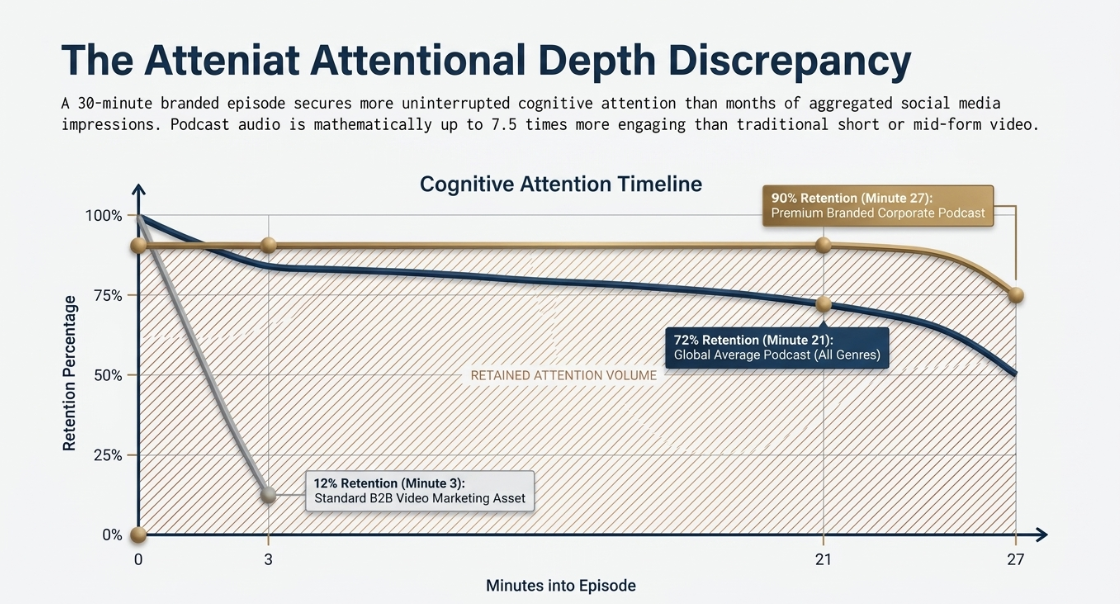
Despite the slight aggregate decrease in general consumption, full-episode completion rates for highly optimized content paint a picture of extraordinary listener loyalty. Globally, average full-episode completion across all genres stands at 72%, an increase from the mid-60% levels recorded in previous years.8 When analyzing specific professional content categories, the delta between generic audio and optimized corporate content is staggering. Typical B2B podcasts maintain a highly respectable 60% to 70% consumption rate.2 However, premium branded podcasts—shows explicitly designed, funded, and produced by corporate entities to establish thought leadership—achieve exceptional completion rates of up to 90%.2 In fact, 75% of podcast listeners stay attentive through the absolute entirety of a branded podcast episode.2
To fully grasp the magnitude of this attentional depth, marketing executives must compare it to other digital mediums. While podcast audio secures 90% completion rates, a mere 12% of viewers watch the majority of a standard video marketing asset.9 This confirms that podcast audio is mathematically up to 7.5 times more engaging than traditional short-form or mid-form video content.9 For enterprise marketers, this means that a 30-minute podcast episode secures more uninterrupted cognitive attention and psychological intimacy from a prospective buyer than months of aggregated social media impressions or corporate blog visits.
The categorization of "podcasting" has also officially transcended pure audio delivery, necessitating a multi-modal metric approach. Currently, 61% of the top 150 podcasts publish a full video component for every episode, and 32% of audio-only creators are actively planning to integrate video infrastructure into their production pipelines.2 Consumer preference heavily drives this architectural shift. Nearly two-thirds of U.S. podcast listeners now explicitly prefer podcasts that offer video options, and 64% of listeners state that YouTube provides a superior podcast experience compared to traditional audio-only applications.2 Consequently, YouTube, Spotify, and Apple Podcasts now collectively control 64% of the weekly U.S. listener market.11 YouTube leads the sector drastically, commanding a 42% share of weekly consumers and boasting over one billion monthly podcast listeners and viewers, vastly outperforming Spotify’s 120 million monthly active users.2 Therefore, enterprise marketing departments must measure video retention concurrently with audio consumption to maintain an accurate view of total audience engagement.
Subscriber Growth Rate
Subscriber Growth Rate offers another critical dimension, distinguishing between casual discovery traffic and dedicated audience loyalty. A high subscriber growth rate mathematically indicates that the content is consistently fulfilling the intellectual demands of the listener, transitioning them from transient, algorithmic consumers to permanent brand advocates. This metric serves as a leading indicator of long-term commercial viability; while a viral social media clip might temporarily inflate download numbers, only sustained subscriber growth translates into predictable pipeline generation.
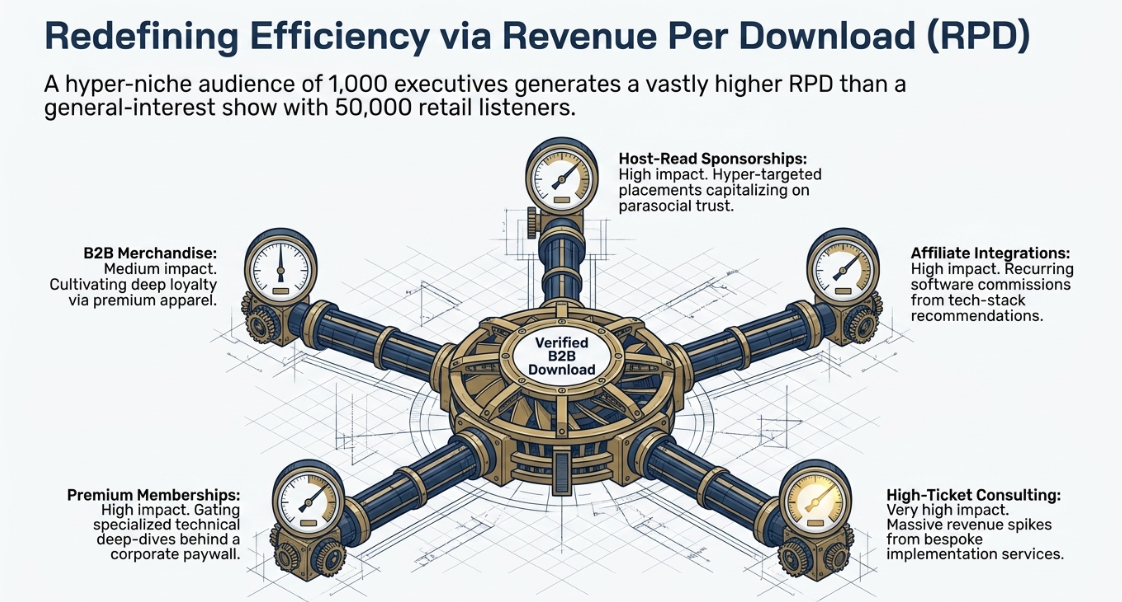
Similarly, professional podcasters track Revenue per Download (RPD), a metric that quantifies the direct financial efficiency of the audience size, proving that a hyper-niche audience of 1,000 corporate executives can generate a higher RPD than a general-interest show with 50,000 listeners.13 RPD is the ultimate operational barometer for justifying podcast budgets to executive boards. It represents the financial return on each individual listener interaction, measuring both monetization efficiency and overall profitability.13 Rather than focusing solely on surface-level reach, RPD connects content operations directly to the bottom line.
To utilize this metric effectively, organizations must calculate RPD separately across diverse revenue streams to reveal which monetization methods are most efficient for their specific demographic.13 In the B2B sector, these streams extend far beyond standard programmatic advertising. Direct dynamic ad insertion and host-read sponsorships form the baseline, but true RPD optimization requires diverse commercial integration.
For example, B2B brands increasingly leverage specialized merchandise. While traditionally associated with consumer influencers, corporate merchandise creates a tangible connection with professional audiences. B2B automation platform Zapier successfully executes this through an "Automatic Apparel" line, offering high-quality branded clothing in exchange for user feedback, which cultivates deep loyalty and serves as mobile advertising.13 Affiliate marketing presents another lucrative RPD multiplier; by authentically recommending essential industry software or tools used by the host, the podcast earns high-margin referral commissions without feeling like a hard corporate sales pitch.13
Furthermore, authoritative B2B podcasts leverage their platforms to drive high-ticket consulting and coaching services.13 By demonstrating complex problem-solving capabilities on air, hosts naturally attract enterprise listeners seeking bespoke implementation of those exact strategies. Finally, established shows increase RPD through premium membership models—utilizing platforms like Patreon or Supercast to gate exclusive bonus episodes, early-access content, or private expert interviews behind a recurring corporate subscription fee.13 By calculating the aggregate revenue from all these vectors and dividing it by total verified downloads, organizations establish a true RPD. This data empowers B2B podcasters to negotiate premium, performance-based sponsorship rates based on the immense purchasing power of their audience, entirely circumventing the low-paying, industry-standard CPM (Cost Per Mille) models designed for broad retail audiences.13
Firmographic Tracking and CRM Integration
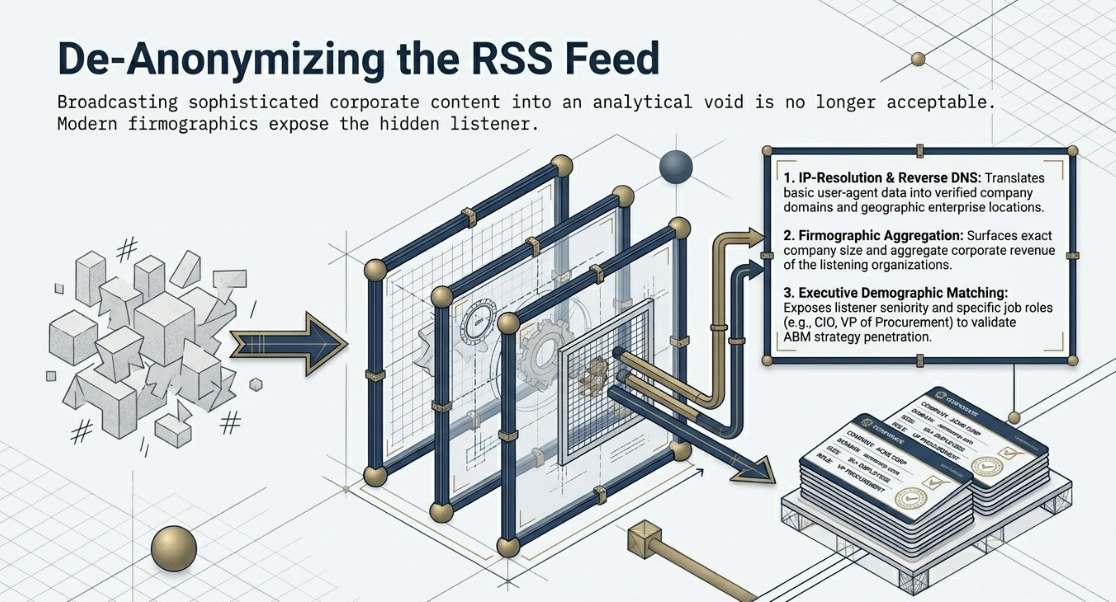
For B2B marketing, the identity of the listener is paramount. Modern podcast analytics platforms have evolved to provide advanced firmographic data. These systems identify which specific companies, industries, and executive roles are consuming the content, allowing B2B marketers to validate their account-based marketing (ABM) strategies against actual listenership.14 The greatest historical limitation of podcast marketing has always been the anonymity of the RSS feed. Traditionally, brands broadcasted sophisticated corporate content into a void, receiving only rudimentary geographic, user-agent, and device-level data in return. For enterprise marketing, where the specific identity, industry vertical, and purchasing power of the listener dictate the success of the campaign, this blind spot was analytically unacceptable.
Today, advanced B2B podcast analytics ecosystems have solved this technical hurdle by overlaying IP-resolution technology, reverse-DNS lookups, and proprietary data enrichment models onto standard audio delivery networks. Platforms such as CoHost, Casted, and proprietary enterprise software have pioneered the delivery of this firmographic intelligence.14 These systems systematically de-anonymize the audience stream. They provide granular dashboards detailing exact company breakdowns, including the size, aggregate corporate revenue, and geographic locations of the listening organizations.14
Crucially, these platforms utilize demographic enrichment layers to expose listener seniority and specific executive job roles.14 This ensures that the corporate content is actually penetrating the intended enterprise buying committee—such as Chief Information Officers or VP-level procurement heads—rather than merely accumulating downloads from entry-level practitioners or students researching the industry.
For enterprise agility, the technical implementations of these firmographic tools have evolved to minimize operational friction. CoHost, for example, offers an innovative "Prefix" analytics package.14 This technology functions as an analytical tracking URL layered directly over a brand's existing RSS feed. It allows massive enterprise organizations to gain deep B2B listener intelligence, industry breakdowns, and tracking link attribution without enduring the highly disruptive technical process of migrating their massive historical audio catalogs away from their legacy hosting providers (such as Libsyn or Simplecast).14
The competitive landscape for these analytics platforms is highly segmented based on enterprise requirements. While CoHost excels in ABM-driven audience intelligence, Casted positions itself as an enterprise content intelligence system explicitly focused on pipeline attribution and multi-format engagement.14 Spotify Ad Analytics (formerly Podsights) provides enterprise-grade, pixel-based attribution for paid podcast advertisers, tracking ad impressions directly to downstream web conversions.14 Conversely, platforms like Podtrac focus on IAB-certified independent verification, providing trusted third-party auditing for cross-host measurement and ad delivery verification.14
CRM Integration and Pipeline Metrics
This data must be systematically routed into corporate CRM systems. The measurement framework must track Strategic Interviews Completed, isolating the volume of interactions held directly with high-value targets.5 Following the interview, the system must monitor Follow-Up Momentum, tracking the transition from a recorded interview to a secondary private meeting, collaboration discussion, or formal pitch.5 Furthermore, organizations must track Pipeline Influence, monitoring whether a recorded episode accelerated an existing deal or if a guest relationship directly spawned a new formal referral.5
Despite the unprecedented availability of advanced firmographic data, a staggering 80% of B2B podcasts fail to generate any measurable pipeline.9 They operate as expensive "vanity projects" that generate internal marketing enthusiasm and significant production invoices, but fundamentally fail to produce demonstrable business outcomes.9 This failure stems from several critical strategic errors: operating by outdated rules that prioritize vanity metrics (Apple chart rankings) over revenue, lacking any attribution strategy, siloing content creation from demand generation functions, executing poor omnichannel distribution (where un-promoted episodes average a mere 127 downloads), and failing to align guest strategy with the Ideal Customer Profile (ICP).9
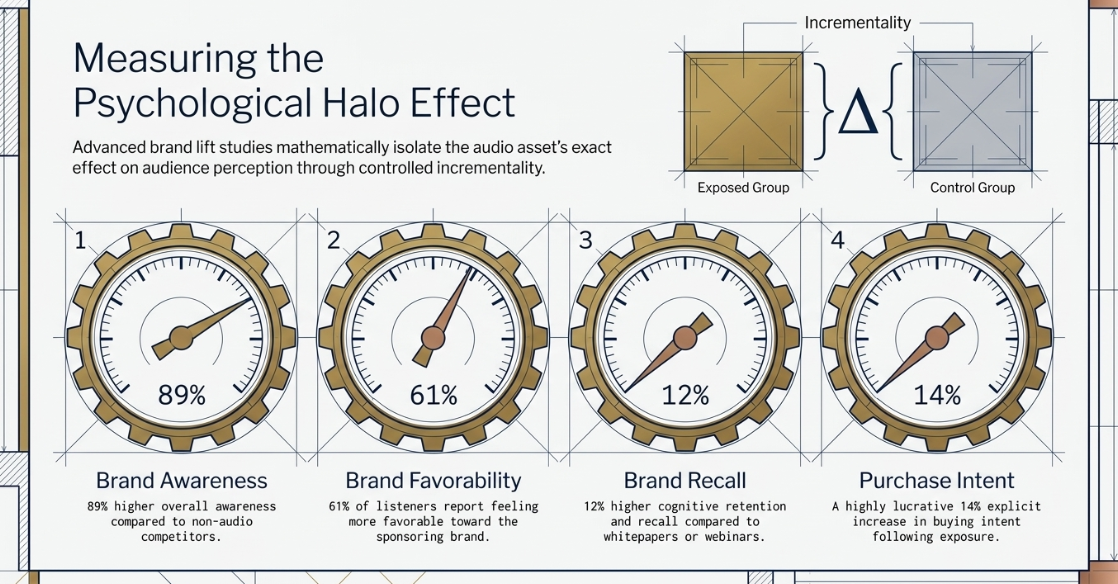
To rectify this massive failure rate, marketing departments must architect a highly disciplined technical tracking flow that routes podcast engagement data directly into corporate Customer Relationship Management (CRM) systems like Salesforce and HubSpot.9 The modern attribution architecture relies on a highly integrated, multi-touch tracking framework. First, teams must establish direct response infrastructure utilizing UTM-tagged landing pages, campaign-specific promo codes, and dedicated URLs for every single episode to capture first-touch and mid-funnel engagement.
Second, the CRM itself must be customized. Revenue operations teams must create bespoke custom fields within Salesforce or HubSpot to capture podcast engagement signals—such as guest appearances, episode mentions in sales notes, and supplementary content downloads.9 Platforms like Casted facilitate this natively through tools like the "Media Bridge" integration.14 This sophisticated integration directly syncs audio and video episode engagement data into individual contact records and ABM campaign dashboards within HubSpot.24 It allows sales representatives to see precisely which specific episodes, timestamps, or overarching topics a prospect consumed before initiating a cold call, enabling highly personalized, data-driven sales conversations.24
Third, organizations must implement qualitative safety nets to capture "dark social" sharing.9 Dark social encompasses the private Slack workspaces, internal Microsoft Teams channels, encrypted WhatsApp threads, and closed LinkedIn groups where 73% to 84% of B2B buying discussions and podcast sharing actually occurs.9 Standard digital tracking pixels cannot penetrate these encrypted environments. Therefore, sales teams must be rigorously trained to deploy self-reported attribution mechanisms, consistently asking prospects, "How did you first hear about us?" on demo request forms and initial discovery calls.9
When these three layers—Direct Response, Influenced Pipeline, and Dark Social Impact—are combined, organizations achieve Multi-Touch Revenue Attribution (MTRA).9 This allows revenue operations teams to map every podcast interaction against CRM opportunity data, revealing millions of dollars in influenced revenue that traditional, last-click attribution models historically ignored.9
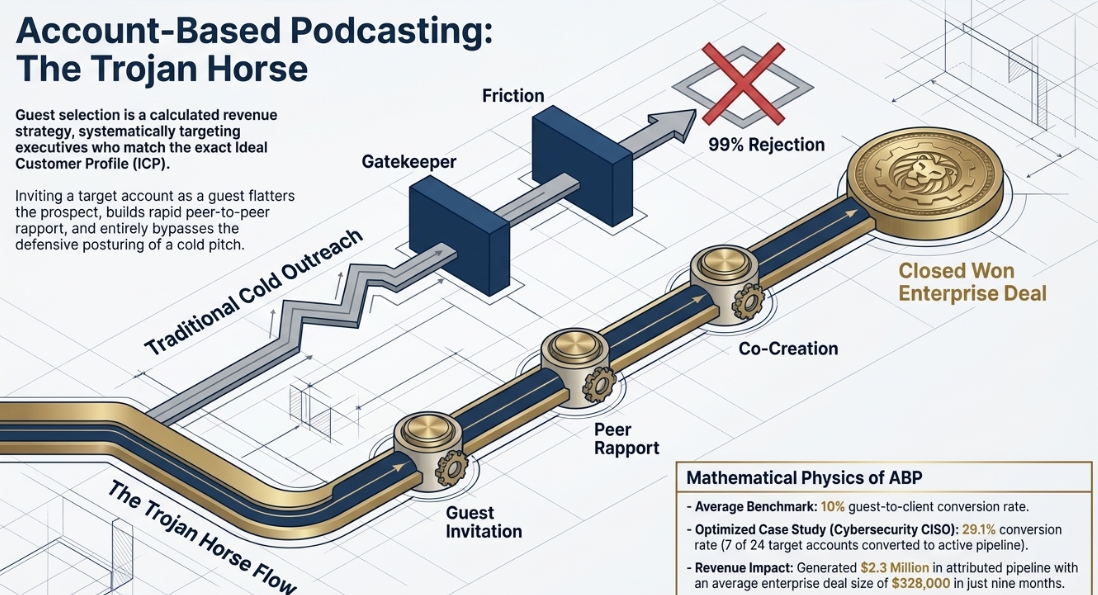
When CRM integration is perfected, the podcast completely transforms from a passive broadcasting mechanism into a highly targeted business development engine, a strategy formalized as Account-Based Podcasting (ABP).26 In this model, guest selection becomes a highly calculated revenue strategy rather than a pursuit of industry celebrities.9 Hosts systematically invite target account executives who match the company's precise ICP and hold ultimate budget authority.9 The podcast interview acts as a psychological Trojan horse for enterprise sales. By offering a platform for the prospect to share their expertise, the host bypasses the traditional friction, defensive posturing, and high rejection rates of a cold sales pitch.27 The interview builds rapid, peer-to-peer rapport, flattering the guest and establishing a co-creative dynamic.27
The mathematical physics of this approach are highly predictable and incredibly lucrative. Successful B2B podcasts observe an average guest-to-client conversion rate of 10%.2 When executed with surgical precision against named accounts, this rate scales dramatically. A documented case study involving a cybersecurity firm targeting Fortune 500 Chief Information Security Officers (CISOs) proves this model's superiority.2 The firm systematically invited 24 target executives as guests. Utilizing strategic follow-up sequences (Follow-Up Momentum), they converted 7 of those guests into active pipeline opportunities—a staggering 29.1% conversion rate.2 Within nine months, this strategy generated $2.3 million in closed and attributed pipeline, with an average enterprise deal size of $328,000.
Another B2B firm requiring exactly 20 enterprise opportunities to meet revenue goals invited 60 target executives as guests; they successfully converted 22 of them into the pipeline (a 36.7% conversion rate), exceeding quota entirely through the podcast channel.2 Similarly, an enterprise Software-as-a-Service (SaaS) company utilizing advanced MTRA discovered that 47% of all their closed enterprise deals featured podcast touchpoints that had previously been misattributed to direct or organic search channels, representing $4.3 million in historically hidden revenue.2 Ultimately, aggregate data confirms that podcast interviews and audio engagement drive 25 times more downstream conversions than traditional corporate blogs, proving that conversational intimacy accelerates trust far more effectively than asynchronous text.2
Brand Lift and Perception Studies
To measure qualitative impact, leading organizations utilize brand lift studies to quantify the podcast's effect on audience perception. Research from entities like Signal Hill and Coleman Insights demonstrates that standard benchmarks are often imprecise; comparing a massive consumer brand's awareness lift to a niche B2B software company's lift yields flawed conclusions.5 Instead, bespoke brand lift studies break down results by ad creative, placement, and channel to pinpoint exactly what drives impact.5
While rigorous CRM integration handles direct pipeline attribution and sales velocity, professional brands must also systematically measure the qualitative, macroeconomic impact of their audio investments on broader market sentiment. Standard digital marketing benchmarks—such as Cost Per Click (CPC), Cost Per Acquisition (CPA), or basic impression counts—are fundamentally inadequate and imprecise for evaluating the deep psychological shifts in brand trust generated by long-form audio. Evaluating the success of a niche enterprise technology podcast using the same baseline awareness metrics applied to a fast-moving consumer goods (FMCG) campaign creates statistical noise and misguides executive resource allocation.
To solve this analytical deficit, leading organizations deploy bespoke brand lift studies. Entities such as Signal Hill Insights and Coleman Insights pioneer these advanced market research methodologies specifically tailored for the audio medium.5 The core methodology of a robust brand lift study revolves around measuring true incrementality.31 Researchers achieve this by comparing the psychological reactions of an "exposed group" (verified individuals who have demonstrably listened to the podcast or the embedded audio ad) against a strictly controlled baseline "control group" (individuals with nearly identical demographic profiles who have not been exposed to the audio content).31 By isolating the statistical delta between these two cohorts, brands can mathematically quantify the podcast’s exact effect on audience perception, completely isolated from other concurrent marketing activities.
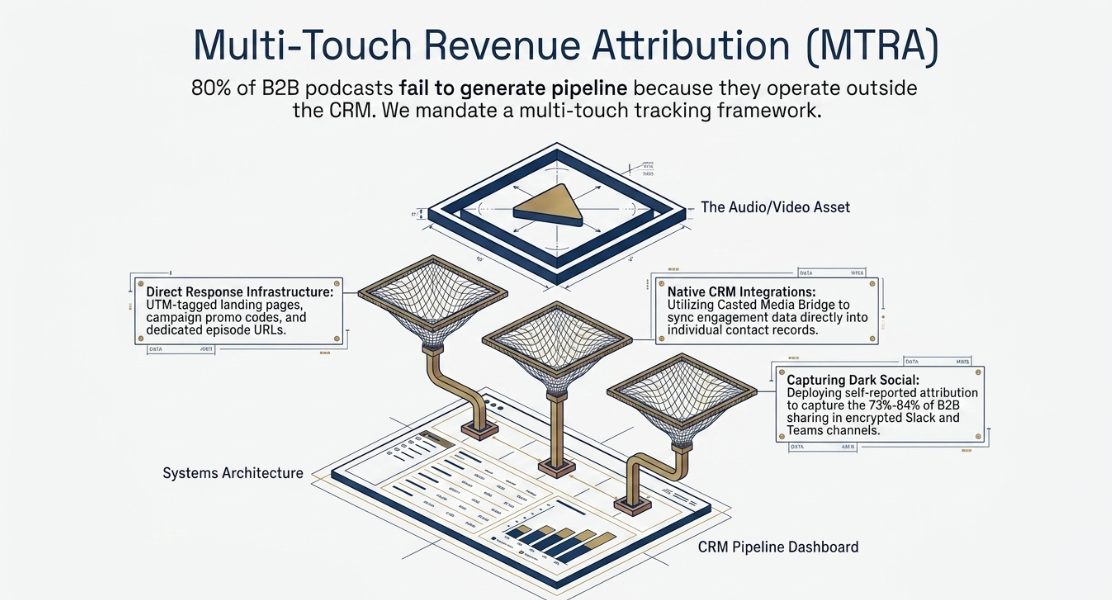
The results of these extensive studies unequivocally validate the psychological power of the medium. An expansive 2025 benchmark report, analyzing survey responses from over 15,000 verified podcast listeners, revealed a profound "halo effect" generated by branded audio content.2 Following exposure to a branded podcast episode, 61% of listeners reported feeling either somewhat or much more favorable toward the sponsoring brand, indicating that the intimacy of the audio format directly transfers trust from the host to the corporate sponsor.2 Furthermore, 63% of these listeners indicated they would probably or definitely recommend the podcast to colleagues, driving highly valuable organic, dark social growth.2
When evaluating the traditional marketing funnel, branded podcasts deliver asymmetric returns compared to visual or text-based mediums. Companies that strategically utilize branded podcasts achieve an 89% higher overall brand awareness compared to competitors operating without an audio strategy.2 Furthermore, audiences exposed to these corporate shows demonstrate a 57% higher brand consideration rate, a 24% increase in brand favorability, and a highly lucrative 14% higher explicit purchase intent.2
Additionally, the intimate, long-form nature of the medium engenders deep memory encoding and cognitive retention. Podcast listeners exhibit a 12% higher brand recall than audiences consuming any other form of content marketing (such as whitepapers, webinars, or social media posts).2 This heightened recall significantly boosts downstream organic brand searches, ensuring the company remains top-of-mind when the listener eventually enters an active buying cycle months later.2
Because measuring this qualitative impact requires continuous vigilance, modern marketing departments deploy sophisticated social monitoring frameworks alongside their brand lift studies to track ongoing sentiment. By utilizing AI-powered listening tools to filter noise across platforms like LinkedIn, Reddit, Hacker News, and industry forums, brands execute specific tracking workflows.13 These workflows monitor for misinformation correction, product feedback escalation, churn risk detection, and active competitive comparisons, ensuring that the brand lift generated by the podcast is actively protected and capitalized upon across the wider digital ecosystem.13
Authority Building Through Podcasts
These studies confirm that for emerging professional brands, podcasts are a highly effective tool for establishing authority, with 46% of brands citing podcasts as a more effective medium for authority building than any other format.2 To properly track the shift from audience size to pipeline creation, marketing departments must implement a disciplined measurement architecture. The reliance on download volume must be replaced or augmented by analytical frameworks that measure genuine business impact.
The psychological mechanics behind this unparalleled authority building are deeply tied to the format's capacity for sustained intellectual exploration and uninterrupted attention. Modern social media algorithms inherently force marketers to compress complex expertise into reductive, fast-paced 30-second soundbites, fundamentally stripping away the nuance required for true thought leadership.33 In stark contrast, podcasts provide a captive, intimate environment where industry experts can articulate complex mental models, dissect highly technical failures, and thoroughly explain their unique worldview over 30 to 60 uninterrupted minutes.33
Demonstrating a strong strategic consensus on this capability, 76% of businesses launch their podcasts explicitly for thought leadership purposes, and 65% of those shows purposefully treat the featured guest (often a target prospect or industry luminary) as the primary thought leader, fostering a collaborative rather than dictatorial brand image.2 To maximize this perceived authority, the content must be positioned as a valuable asset—a premium gift of high-level storytelling and insight that is fundamentally "from the brand, not about the brand".33 When executed correctly, the corporate association is not perceived negatively by the audience; instead, it adds a layer of immense credibility and institutional backing to the content.33
To extract the maximum commercial value from this established authority, the modern B2B podcast must not be treated as a final, standalone product. Rather, it must serve as the raw, intellectual fuel for a brand's entire omnichannel marketing engine. To achieve exceptional ROI, organizations must abandon the outdated, linear practice of publishing an audio file and moving on—an error which leaves 90% of the content's commercial value untapped and stranded.
Instead, elite revenue teams employ aggressive content multiplication strategies, heavily utilizing Artificial Intelligence (AI) to revolutionize the repurposing workflow. Currently, 40% of professional podcast creators utilize AI-driven tools to boost performance, ranging from automated audio enhancement to predictive topic analytics.2 Using sophisticated, AI-powered frameworks like the "Fame Podcast Repurposing Matrix," marketing teams can systematically extract up to 47 distinct pieces of derivative content from a single 30-minute podcast interview.2
This systematic process transforms one recorded conversation into a highly coordinated content strike: YouTube chapter clips for visual discovery, LinkedIn audiograms for social feed disruption, executive summary newsletters for email nurturing, deeply SEO-optimized blog articles for search dominance, and granular sales enablement collateral for the revenue team.2 To structure this output, teams adhere to the "3-3-3 Rule" for distribution: publishing full episodes across three main platforms, repurposing the core message into three distinct micro-formats, and utilizing three specific methods for amplifying the content into dark social channels.9
This relentless content multiplication yields a profound impact on Search Engine Optimization (SEO) and inbound organic traffic. By processing the audio through AI to generate full-text transcriptions and optimized, keyword-rich show notes, brands provide search engine crawlers with incredibly dense, highly relevant contextual data.2 Statistical studies demonstrate that simply adding AI-generated, full-episode transcriptions boosts organic web traffic to episode landing pages by 25% to 30% within a six-month period.2 At a macro level, integrating a podcast into a broader corporate content strategy has been shown to yield a 36.08% lift in total organic search revenue across the entire domain.2 In highly targeted scenarios, the optimization of a single podcast episode's show notes has been proven to boost a website's organic search visibility for that specific topic by 53% in less than 20 days.2 With global search volume indicating over 71,000 monthly Google queries simply for "best podcasts" and thousands of niche categorical searches, capturing this organic intent is crucial.2 By multiplying the podcast's footprint across text, audio, and video, the brand effectively blankets the digital landscape, establishing inescapable authority.
Ultimately, the strategic imperative of podcast marketing for professional brands is no longer a matter of theoretical debate; it is a mathematically proven, highly measurable necessity for modern revenue generation. The archaic era of evaluating podcasts through the simplistic, vanity-driven lens of total downloads is permanently closed. In an ecosystem heavily saturated with millions of active shows, capturing the attention and the procurement budgets of the modern executive requires an unprecedented dedication to content quality, firmographic precision, and systematic distribution.
To realize the true, multi-million dollar return on investment available in the audio economy, corporate marketing departments must abandon siloed operational models. They must implement a disciplined, highly technical measurement architecture. This requires overlaying IP-resolved firmographics to thoroughly de-anonymize the audience, utilizing advanced analytics platforms to pipe engagement data directly into Salesforce and HubSpot, and obsessively tracking the transition from listener engagement to tangible pipeline influence. By treating the podcast not as an isolated broadcast, but as a hyper-targeted Account-Based Marketing accelerator, a Multi-Touch Revenue Attribution anchor, and an AI-driven content multiplication engine, brands can systematically transform intimate, long-form conversations into measurable, high-velocity enterprise revenue.
Works cited
How Many Podcasts Are There in 2026? (Listeners Stats) - DemandSage, accessed May 21, 2026, https://www.demandsage.com/podcast-statistics/
30 B2B Podcasting Statistics [2026] - Omniscient Digital, accessed May 21, 2026, https://beomniscient.com/blog/b2b-podcasting-statistics/
Critical Mass in Podcasting, accessed May 21, 2026, https://blog.lime.link/critical-mass-in-podcasting/
Average Downloads for New Podcasts: 13 real-world examples and what to expect, accessed May 21, 2026, https://incomeschool.com/average-podcast-downloads-new-show/
The Strategic Imperative of Podcast Marketing for Professional, accessed May 21, 2026, https://www.finchley.co.uk/finchley-learning/visual-podcast/the-strategic-imperative-of-podcast-marketing-for-professional-brands-industry-landscape-and-roi-realization
How Many Downloads Per Episode Should Your Podcast Have? - Uncommonly More, accessed May 21, 2026, https://uncommonlymore.com/how-many-downloads-per-episode-should-your-podcast-have/
6 Branded Podcasting Trends to Know in 2025, accessed May 21, 2026, https://www.quillpodcasting.com/blog-posts/6-branded-podcasting-trends-to-know-in-2025
Podcast Statistics 2026: Powerful Audience Data - SQ Magazine, accessed May 21, 2026, https://sqmagazine.co.uk/podcast-statistics/
Is Podcasting Good for B2B Marketing? What the Data Says in 2026 ..., accessed May 21, 2026, https://www.podcaststudioglasgow.com/podcast-studio-glasgow-blog/is-podcasting-good-for-b2b-marketing
2025 Podcasting Unwrapped: A Year in Review - CoHost, accessed May 21, 2026, https://www.cohostpodcasting.com/resources/podcasting-unwrapped-2025
Podcast Statistics You Need To Know in 2026 - Backlinko, accessed May 21, 2026, https://backlinko.com/podcast-stats
Podcast Statistics You Need to Know - Podfest Messenger, accessed May 21, 2026, https://www.podfestmessenger.com/p/podcast-statistics-you-need-to-know
7 Podcast Success Metrics You Need for Real Growth | Fame, accessed May 21, 2026, https://www.fame.so/post/podcast-success-metrics
Top 10 B2B Podcast Analytics Platforms for Measuring Enterprise ROI in 2026, accessed May 21, 2026, https://contentallies.com/learn/top-b2b-podcast-analytics-platforms
Know Your Audience | Podcast Data Analytics Tool | Content Strategy - Casted, accessed May 21, 2026, https://www.casted.us/know-your-audience
B2B Analytics - CoHost, accessed May 21, 2026, https://www.cohostpodcasting.com/feature/b2b-analytics
CoHost Prefix | Podcast Analytics and Audience Insights, accessed May 21, 2026, https://www.cohostpodcasting.com/cohost-prefix
CoHost Launches Show Analytics Manager on Prefix to Give Brands Deeper Insights Without Switching Hosts - Sounds Profitable, accessed May 21, 2026, https://soundsprofitable.com/press-release/cohost-launches-show-analytics-manager-on-prefix-to-give-brands-deeper-insights-without-switching-hosts/
B2B Podcast Marketing Strategy: Measure ROI That Matters - Rise 25, accessed May 21, 2026, https://rise25.com/lead-generation/b2b-podcast-marketing-strategy-roi/
2025 B2B Podcasting Trends: Data, Insights, And What Actually Moves the Needle | Fame, accessed May 21, 2026, https://www.fame.so/post/b2b-podcasting-trends-data
Enterprises | B2B Content Distribution | Podcast Hosting Software - Casted, accessed May 21, 2026, https://www.casted.us/enterprise
Best B2B Data Enrichment Tools | 6sense, accessed May 21, 2026, https://6sense.com/blog/best-b2b-data-enrichment-tools/
Best B2B Podcast Agencies: What Winners Do That Others Don't - Fame.so, accessed May 21, 2026, https://www.fame.so/post/best-b2b-podcast-agencies
Using the Casted Media Bridge Integration with HubSpot to Amplify Podcast Marketing and Prove ROI, accessed May 21, 2026, https://www.casted.us/blog/using-the-casted-media-bridge-integration-with-hubspot-to-amplify-podcast-marketing-and-prove-roi
Casted - App for HubSpot, accessed May 21, 2026, https://ecosystem.hubspot.com/marketplace/listing/casted-227386
How to Use a B2B Podcast as a Sales & Lead Generation Machine in 2026 - Content Allies, accessed May 21, 2026, https://contentallies.com/learn/b2b-podcast-sales-lead-generation
Ziza Digital, accessed May 21, 2026, http://www.zizadigital.com/?p=t
Modern Marketing Engine podcast hosted by Bernie Borges - Libsyn, accessed May 21, 2026, https://sbengine.libsyn.com/
Data: Branded podcasts are liked by audiences - Podnews, accessed May 21, 2026, https://podnews.net/update/branded-podcasts-liked
What Should My Branded Podcast's KPIs Be? Depends. | Sound, accessed May 21, 2026, https://www.soundthatbrands.com/2023/09/27/what-should-my-branded-podcasts-kpis-be-depends/
RIP Audio Opportunists: Brands Seek Serious Solutions in 2024: with Steven Goldstein, Founder/CEO at Amplifi Media & Adjunct Professor at NYU. | Oxford Road, accessed May 21, 2026, https://oxfordroad.com/thought-leadership/rip-audio-opportunists-brands-seek-serious-solutions-in-2024-with-steven-goldstein-founder-ceo-at-amplifi-media-adjunct-professor-at-nyu/
The Rise of B2B Podcasting: Why Businesses Are Tuning In - We Are Kymera, accessed May 21, 2026, https://wearekymera.com/the-rise-of-b2b-podcasting-why-businesses-are-tuning-in/
Are Branded Podcasts the Premier Channel for Thought Leadership ..., accessed May 21, 2026, https://www.quillpodcasting.com/blog-posts/branded-podcasts-for-thought-leadership