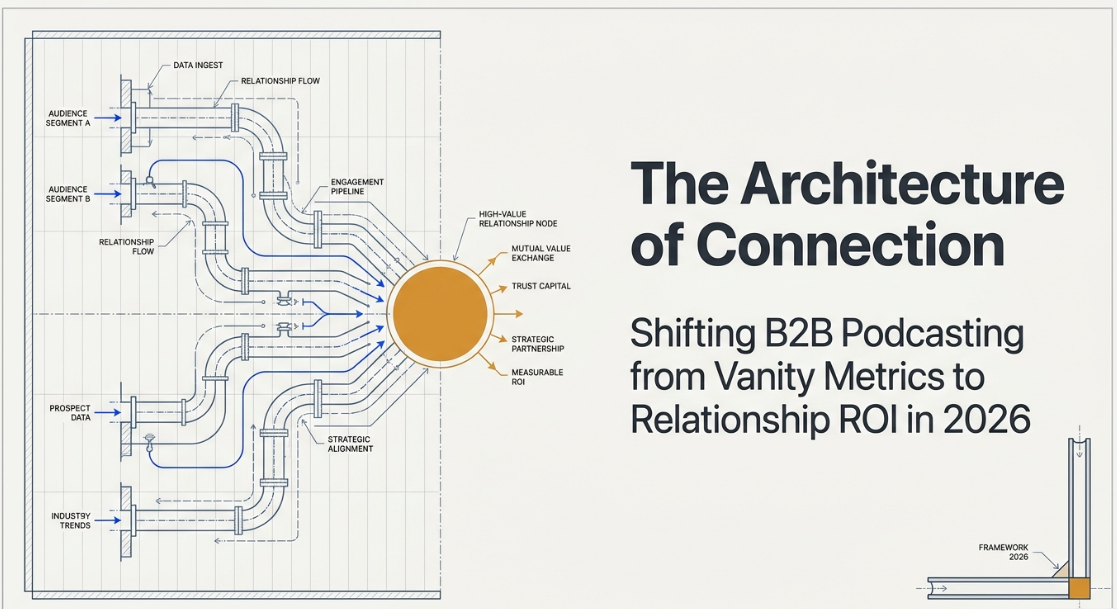
The 2026 Macroeconomic Go-To-Market Landscape
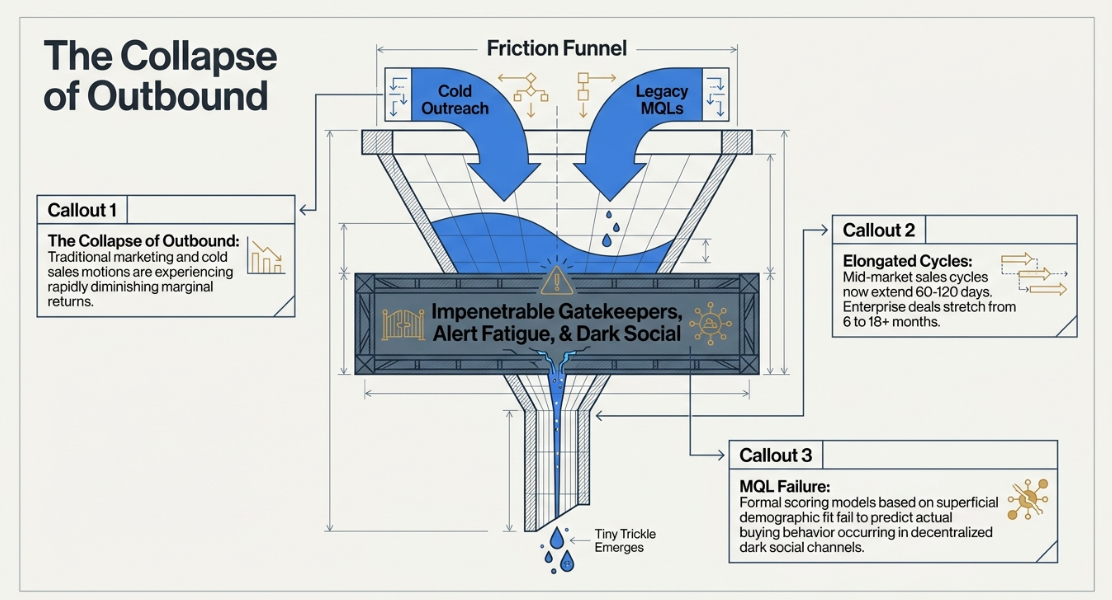
The contemporary business-to-business (B2B) go-to-market architecture has undergone a radical restructuring over the past several years. Characterized by elongated procurement cycles, increasingly complex multi-stakeholder purchasing committees, and an impenetrable wall of corporate gatekeepers, traditional outbound marketing and cold sales motions are experiencing rapidly diminishing marginal returns. The average B2B sales cycle now extends anywhere from 60 to 120 days for mid-market transactions, while enterprise engagements involving legal approvals, procurement workflows, and team-based decision-making frequently stretch from six to well over eighteen months.1 Within this environment of high cognitive friction, extreme inbox saturation, and widespread alert fatigue, securing the undivided attention of key decision-makers—primarily C-suite executives, Vice Presidents, and Directors—has become the paramount operational challenge for modern revenue operations (RevOps) teams.
Simultaneously, the broader digital marketing ecosystem is witnessing a collapse of legacy lead-generation frameworks. Formal Marketing Qualified Lead (MQL) scoring models that rely heavily on superficial demographic fit and low-intent engagement are failing to predict actual buying behavior.3 Instead, organizations are increasingly forced to navigate "dark social"—the untrackable, decentralized channels where peer-to-peer recommendations and content consumption actually shape buying decisions before a prospect ever fills out a vendor's contact form.
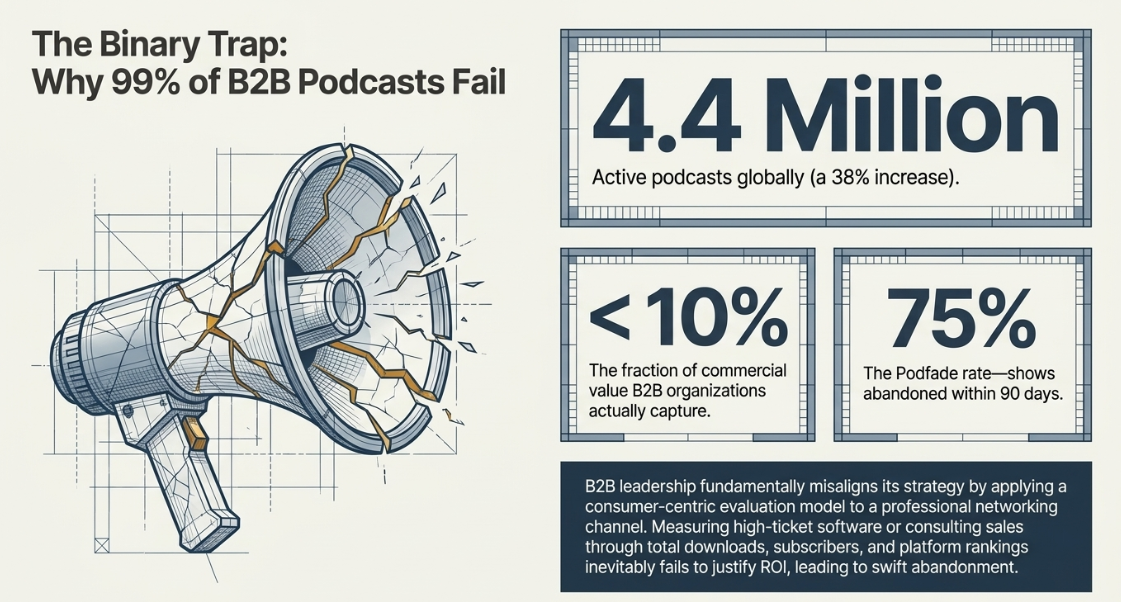
In stark contrast to the decay of traditional outbound channels, the global podcasting industry has experienced explosive, compound growth. As of 2026, the ecosystem boasts approximately 4.4 million active podcasts, representing a 38% increase from 2024, with an average of 85,000 new episodes published weekly worldwide.4 This medium has evolved from a niche consumer entertainment format into a premier vehicle for business and entrepreneurship dialogue. Despite this immense volume of audio content and a podcast audience expanding at a compound annual growth rate of 20%, a stark contradiction exists at the enterprise level: the vast majority of B2B organizations fail to capture even 10% of the available commercial value from the medium.4
This systemic failure is driven not by a lack of audience appetite, but by a misaligned strategic framework. Historically, B2B marketing teams have approached podcasting as a traditional broadcast medium, applying consumer-centric evaluation models to professional networking channels. This misalignment results in what industry analysts term "podfade"—a phenomenon where up to 75% of business podcasts are abandoned within 90 days of launch, and 99% fail to surpass the 20-episode threshold.6 The root cause of this high attrition rate is the pursuit of the wrong key performance indicators (KPIs). When corporate leadership demands to see a return on investment (ROI) from audio marketing, teams relying on audience size metrics inevitably fail to justify the continued expenditure. Consequently, the most sophisticated enterprises in 2026 have entirely restructured their approach. They no longer operate their podcasts as content distribution properties; instead, they architect them as highly targeted, relationship-first business development systems [H1, H2].
Shifting from Vanity Metrics to the Relationship-First Pipeline
A critical evolution in podcast marketing for professional shows is the systematic abandonment of consumer-style vanity metrics. For years, the default mechanism for evaluating a podcast's success rested on a triad of superficial data points: total episode downloads, aggregate subscriber counts, and arbitrary rankings on platforms such as Apple Podcasts or Spotify [H2]. While these metrics hold contextual value for media conglomerates monetizing through dynamic ad insertion and cost-per-mille (CPM) sponsorships, they are functionally obsolete for a B2B enterprise selling high-ticket software, cybersecurity solutions, or professional consulting services [H2].
The fundamental error in the broadcast-centric model—often referred to as the "Binary Trap"—is the assumption that audience size directly correlates with pipeline generation.5 In a B2B context, an episode that achieves 10,000 downloads from entry-level practitioners holds exponentially less commercial value than an episode that reaches 50 targeted Vice Presidents of Procurement who possess active purchasing authority. Vanity metrics fail to answer the most vital corporate question: whether the medium is generating tangible business development outcomes and quantifiable revenue [H2].
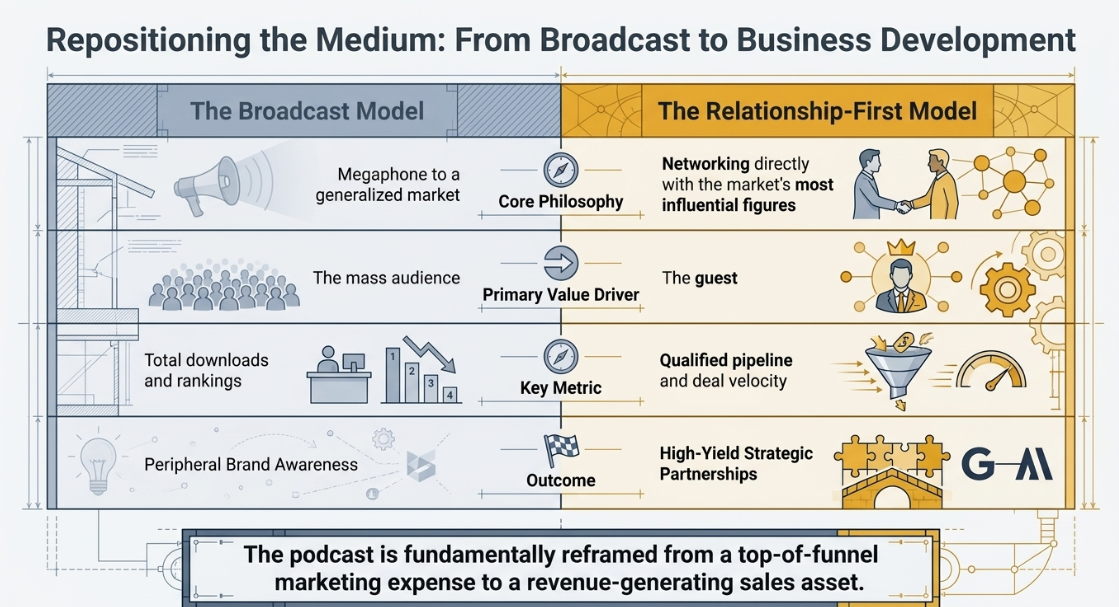
Recognizing this critical flaw, elite go-to-market organizations have shifted their focus from audience acquisition to relationship engineering. The podcast is repositioned not as a megaphone to speak to a generalized market, but as a sophisticated mechanism to speak with the market's most influential figures. By treating the podcast as a networking vehicle, organizations bypass the coldest, leakiest, and most inefficient stages of the traditional sales funnel.8 This epistemological shift reframes the podcast from a pure marketing expense to a revenue-generating sales asset, aligning it directly with pipeline generation, deal velocity, and customer acquisition costs.
The Epistemological Shift: Content-Based Networking
The theoretical underpinning of this transition is heavily informed by the concept of "Content-Based Networking," a framework pioneered by industry specialists to systematize relationship building.9 Instead of relying on the unpredictable nature of chance encounters at industry conferences or the historically low conversion rates of cold digital outreach, Content-Based Networking leverages the content production process itself as a strategic networking tool.9
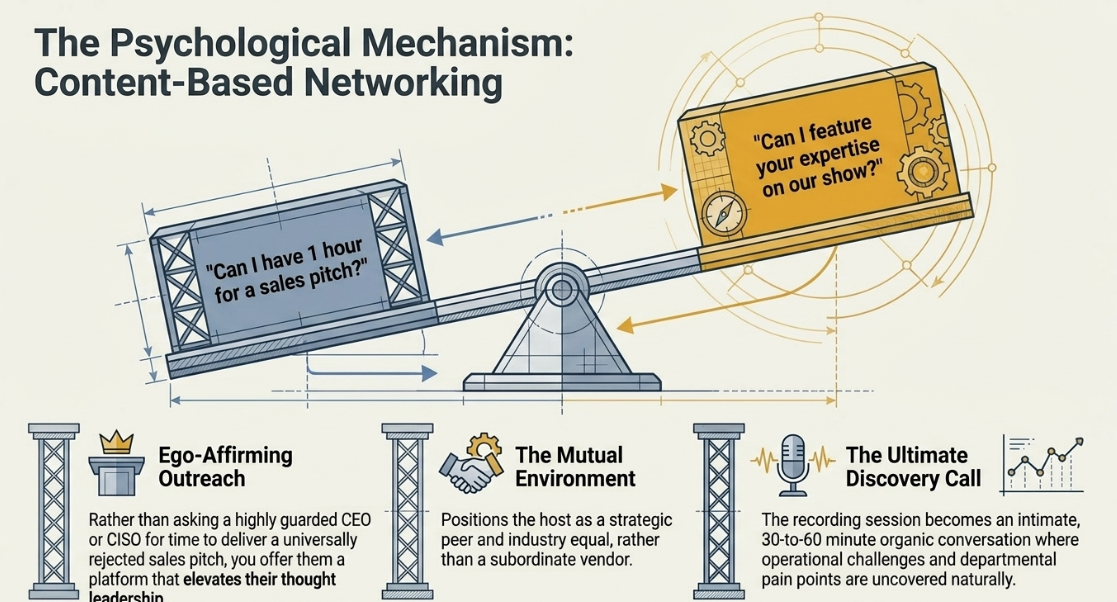
The framework dictates that to connect with potential customers, strategic referral partners, and industry influencers, an organization must first offer them a platform that elevates their own thought leadership.9 The underlying psychological mechanism is elegant: rather than asking a busy Chief Executive Officer (CEO) or Chief Information Security Officer (CISO) for an hour of their time to deliver a sales pitch—a request that is almost universally rejected—the organization invites them to be an honored guest on a professional podcast to discuss their own expertise.10 This invitation inherently flatters the recipient, positions the host as a peer rather than a subordinate vendor, and creates a mutually beneficial environment where deep professional relationships can flourish without the immediate pressure of a commercial transaction.
The Relationship-First Revenue Model
Philosophy and Approach
The core philosophy of the modern professional podcast is counterintuitive to traditional media theory: the primary economic value of the show is derived directly from the guest, rather than the mass audience listening to the conversation [H3]. When an organization transitions to a relationship-first model, the podcast functions as an elite mechanism to bypass traditional corporate gatekeepers who are meticulously trained to deflect cold calls and automated outbound email cadences [H3].
This strategy fundamentally alters the psychological dynamic of B2B outreach. Instead of deploying abrasive outbound sales tactics that trigger immediate defensive postures from prospects, hosts invite ideal buyers, strategic referral partners, and industry influencers to share their localized expertise on a public platform.13 This value-first interaction creates immediate goodwill. By elevating the guest's story and making them the focal point of the narrative, the host establishes a foundation of mutual respect, trust, and parasocial affinity before any commercial conversation ever occurs.14
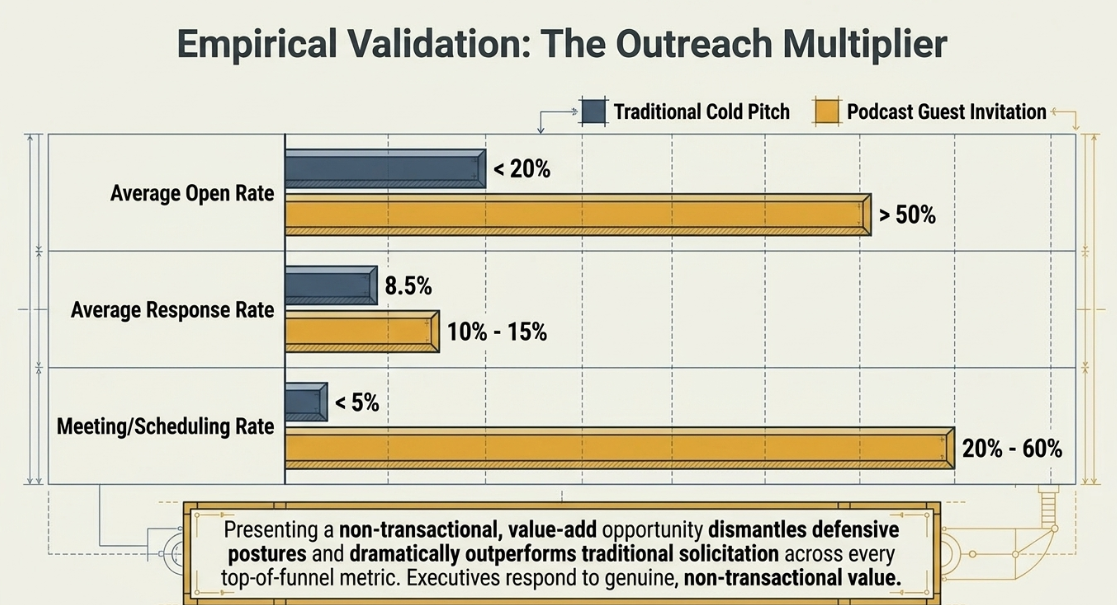
This dynamic flips the script on traditional conversion metrics. Statistical analysis of outbound methodologies reveals the stark contrast in efficacy between standard sales pitches and relationship-first podcast invitations. Cold email campaigns directed at high-level executives typically yield a response rate of approximately 8.5%, with the vast majority of those responses being negative or dismissive.15 Conversely, outreach campaigns that invite these same executives to be featured as podcast guests frequently achieve open rates exceeding 50% and positive response rates of 10% or more.15 Furthermore, organizations utilizing this approach consistently observe scheduling rates—the percentage of contacted executives who actually book time on the calendar—ranging between 20% and 60%.15
Table 1: Comparative efficacy of traditional outbound sales versus podcast guest outreach. Data indicates that presenting a value-add opportunity (a podcast appearance) dramatically outperforms traditional solicitation across all top-of-funnel metrics.15
As demonstrated in the empirical data, executives respond when there is genuine, non-transactional value on the table.15 The invitation to be featured on an industry podcast acts as a non-threatening, ego-affirming gateway into a target account that might otherwise take months of persistent, low-yield prospecting to penetrate.
Bypassing Cognitive Friction and Building Affinity
The relationship-first model operates by deliberately removing cognitive friction. In a standard vendor-prospect dynamic, the prospect is heavily guarded, anticipating a pitch and constantly analyzing the interaction for attempts at manipulation. However, when a potential buyer appears on a show as an honored guest, an affinity is naturally formed between the customer and the host's brand.16 The recording session itself functions as an extended, highly intimate discovery call. For 30 to 60 minutes, the host has the undivided attention of a key decision-maker. During this period of deep focus, the host can gently guide the conversation to uncover the guest's operational challenges, strategic priorities, and departmental pain points in a completely organic, conversational manner.8
This methodology requires meticulous pre-interview curation. Strategic guest selection focuses on targeting Directors and Vice Presidents who are actively evaluating solutions within the host's specific category, bypassing those without budget authority.16 Rather than publishing content into the void and hoping these elusive buyers stumble upon the podcast organically, the host proactively recruits them into the content creation process itself. Because the interaction is framed around highlighting the guest's brilliance, the brand creates a "give loop"—a systematic approach to providing value that naturally transitions into subsequent business opportunities through the law of reciprocity.
Architecting the Target Matrix: The Dream 200 ROI Process
Constructing the 12-Month Referral Roadmap
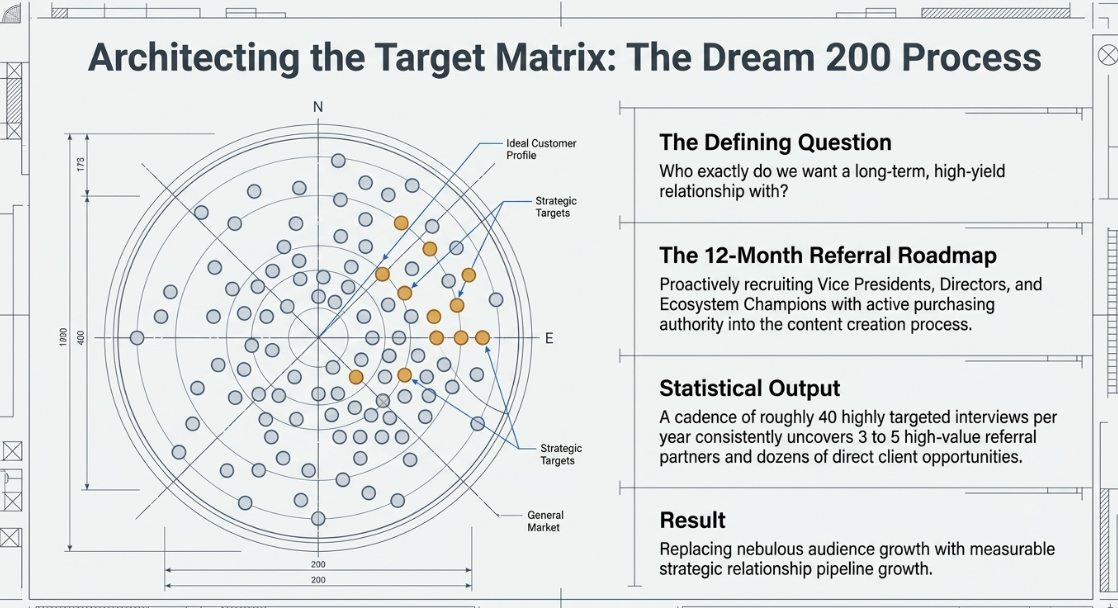
A prime, operationalized example of this relationship-first methodology is the "Dream 200 ROI Process," developed and refined by industry agencies such as Rise25.18 The Dream 200 framework operates as a highly structured, 12-to-24 month referral and pipeline roadmap focused entirely on high-value targets.18 This strategy requires a B2B organization to construct a meticulously curated matrix of their top 200 prospective clients, strategic referral partners, and ecosystem champions.18
The fundamental objective of the Dream 200 process is to force organizations to answer a single, defining strategic question before they record a single minute of audio: Who exactly do we want a long-term, high-yield relationship with?.18 Once this target matrix is defined, the podcast is utilized not as a broadcast medium, but as the perfect, frictionless pretext to initiate conversations with these specific individuals. This systematically replaces the nebulous concept of "audience growth" with the highly measurable metric of "strategic relationship pipeline growth".14
The implementation of the Dream 200 blueprint typically involves a deep-dive evaluation of an organization's Ideal Customer Profile (ICP), analyzing past referral partners, and uncovering "low-hanging fruit"—previously neglected relationships that hold immense potential value.18 The strategy is broken down into six core areas of focus:
Partners: Identifying the exact individuals who should be profiled on the podcast.
Content: Designing thought leadership episodes that answer unique market positioning questions.
Audience: Utilizing customized outreach templates and scripts designed to secure high-profile guests.
Interviews: Training hosts in the "art and science" of conducting interviews that uncover business pain points without feeling interrogatory.
Tools: Deploying customized software to handle the technical requirements seamlessly.
Strategies: Executing proprietary methods to successfully transition a guest into a paying client or a consistent referral source.18
If a B2B organization conducts roughly 40 interviews per year utilizing this hyper-targeted list, statistical modeling suggests they will consistently uncover 3 to 5 high-value referral partners and dozens of direct client opportunities.18 Instead of running top-of-funnel advertisements and hoping for a conversion, the host builds direct rapport through meaningful conversations, accelerating trust naturally.
The 5-Step Guest-to-Client Conversion System
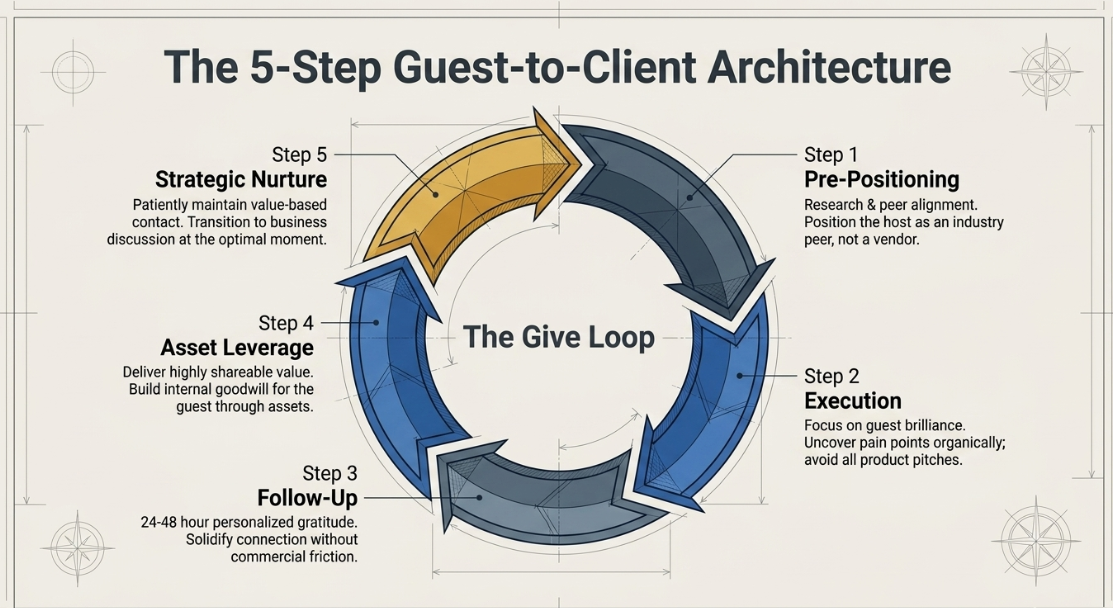
Transitioning a guest from an enthusiastic interviewee to a closed-won revenue contract requires rigorous, disciplined systemization. Without a structured post-interview architecture, the goodwill generated during the recording rapidly dissipates, rendering the exercise fruitless. High-ROI B2B podcasts utilize a defined 5-step follow-up system that explicitly avoids the disastrous "bait-and-switch" trap of pitching immediately after the recording stops.
Table 2: The structured 5-step relationship architecture utilized to transition podcast guests into active pipeline opportunities without compromising the integrity of the relationship.8
The critical element of this system is the timeline and patience required. The relationship-first model acknowledges that podcasting influences deals indirectly and often asymmetrically. A guest interviewed in the first quarter of the year may not enter a purchasing cycle or face a relevant operational crisis until the third quarter.13 Therefore, the follow-up cadence must be patient, value-driven, and highly personalized. Providing value-added resources directly related to the topics discussed on the show, or making strategic introductions to other influential members of the host's network, cements the host's status as a trusted advisor and peer rather than a transactional salesperson.
Multi-Stakeholder Consensus and Deal Velocity
When podcast marketing is deeply integrated into the broader revenue operations architecture and sales cycle, the downstream effects on organizational efficiency are profound. The traditional metrics of B2B sales—specifically deal velocity, average contract value (ACV), and win rate—are all positively manipulated by the introduction of high-fidelity podcast touchpoints.19
Bypassing Multi-Stakeholder Friction
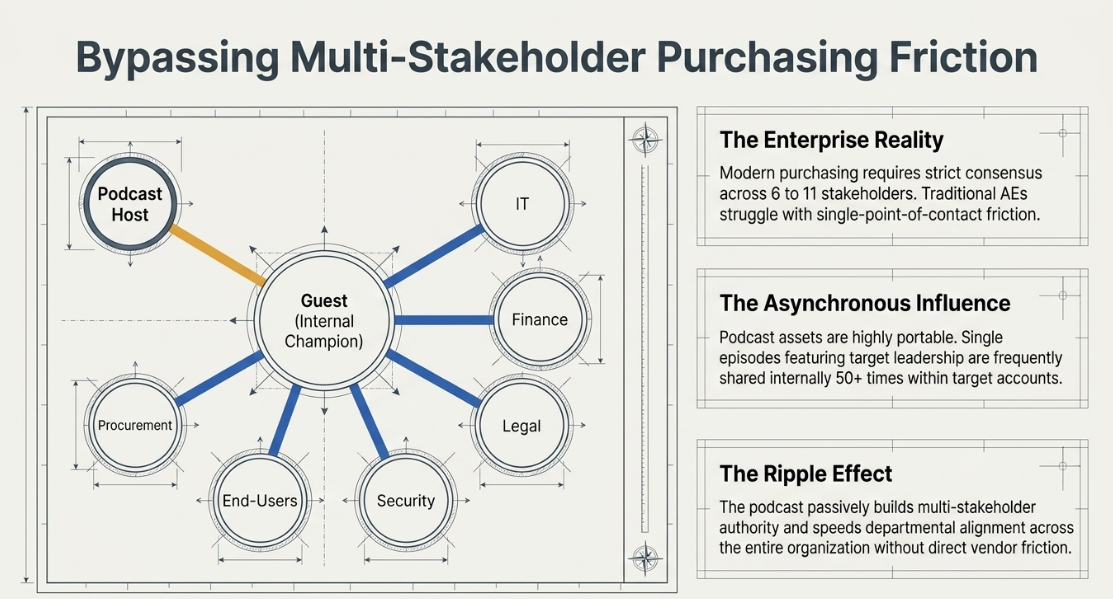
A frequently overlooked mechanic of B2B podcasting is its unique ability to influence an entire enterprise purchasing committee asynchronously. Modern B2B purchasing decisions, particularly for enterprise software or critical cybersecurity infrastructure, are rarely made by a single individual; they require strict consensus across a committee typically comprising 6 to 11 stakeholders.16 Traditional sales outreach struggles immensely against this dynamic, as account executives typically only secure access to a single internal champion, relying entirely on that champion to accurately relay the vendor's value proposition to the rest of the committee.
Podcasts inherently bypass this single-point-of-contact friction. Audio and video episodes are highly portable, easily distributable digital assets. Data indicates that single podcast episodes featuring a company's leadership or addressing highly specific industry challenges are frequently shared internally 50 or more times within target accounts.16 While standard, superficial analytics may only register this internal sharing as a handful of downloads, the ripple effect on the deal is massive. The podcast is passively building multi-stakeholder authority and speeding up departmental alignment across procurement, IT, finance, and end-users, effectively multiplying pipeline influence far beyond simple audience metrics.
Accelerating the B2B Sales Cycle
The speed at which a deal moves from initial discovery to closed-won status—referred to as deal velocity—is a critical indicator of sales efficiency and organizational health.19 Standard B2B sales cycles are notoriously sluggish, bogged down by the "prove it" phase where vendors must exhaustively demonstrate competence, security, and ROI to highly skeptical buyers.20
Podcasting acts as a powerful accelerant through this friction-heavy phase. Deals influenced by podcast touchpoints experience a 23% to 31% acceleration in closing cycles compared to standard, non-influenced opportunities.16 When a prospect has consumed hours of the vendor's thought leadership prior to entering the formal sales funnel, the educational burden on the sales representative is drastically reduced. The prospect arrives at the discovery call already problem-aware, familiar with the vendor's vocabulary, and fundamentally aligned with the vendor's worldview.20
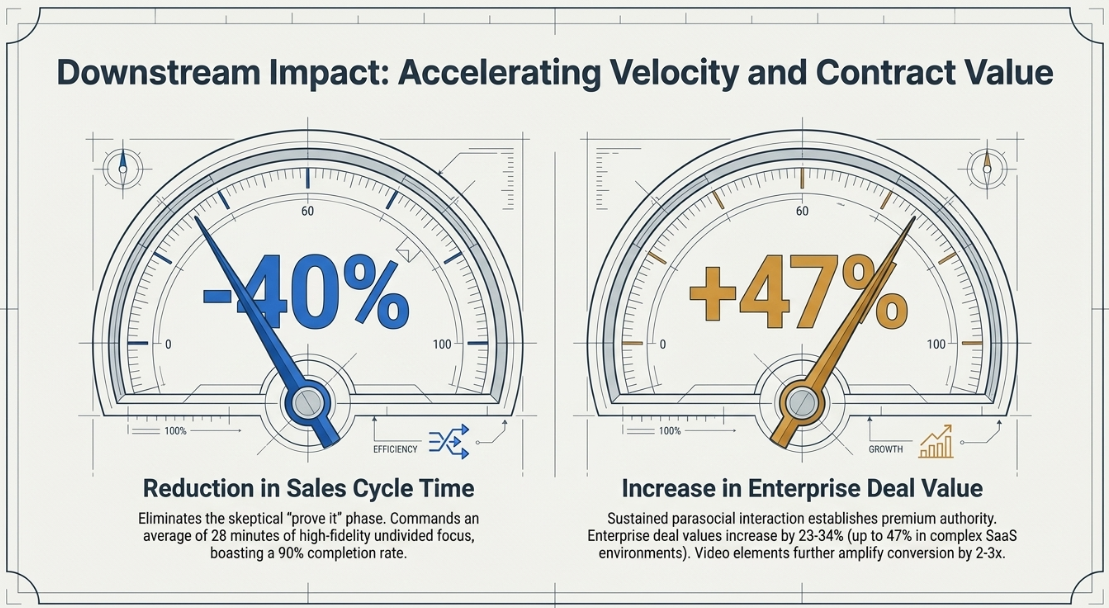
In organizations that strictly adhere to the relationship-first guest model, the acceleration is even more pronounced. By leveraging the affinity created during the intimate recording process, companies have successfully shortened their average sales cycle by 40% for podcast-originated deals.16 Because baseline trust is established on day one of the interaction—during the podcast interview—the subsequent stages of lead nurturing, proposal review, and final negotiation are executed with significantly less resistance.8
Elevating Average Contract Value (ACV) and Medium Fidelity
Furthermore, the inherent trust generated by long-form audio consumption actively elevates the average contract size [H3]. In a fragmented digital ecosystem where a standard social media post or LinkedIn update garners an average of 2 to 3 seconds of fleeting attention, a B2B business podcast listener tunes in for an average of 28 minutes per episode.4 Elite branded B2B podcasts regularly achieve astonishing 90% completion rates, compared to mere 12% completion rates for equivalent short-form video or written content.22 This represents 10 to 50 minutes of undivided, high-fidelity focus from a decision-maker—a level of engagement impossible to purchase through standard advertising channels.16
This sustained parasocial interaction positions the vendor as a premium authority. Consequently, enterprise deal values increase by 23% to 34%—and in some complex SaaS environments, up to 47%—when a podcast interaction occurs within the buyer's journey.16 Buyers are statistically willing to pay a premium for solutions provided by organizations they perceive as definitive industry leaders, a perception directly cultivated by consistent, high-quality audio programming.
It is also vital to note the emerging dominance of visual elements within this medium. While audio builds deep intimacy, research from Omniscient Digital indicates that video podcasts convert at 2 to 3 times the rate of audio-only podcasts.25 For businesses attempting to generate leads, close high-ticket deals, or build absolute authority, the inclusion of video adds a crucial layer of non-verbal communication and visual trust that further amplifies the conversion metrics, transforming a standard marketing asset into a high-octane lead generation engine.
The Mathematical Framework of Podcast ROI and Pipeline Attribution
To justify the significant resource allocation required for professional audio and video production, RevOps teams must transition from qualitative assumptions to quantitative attribution. If vanity metrics such as downloads and subscriber counts are discarded, they must be replaced by a rigorous, defensible mathematical framework that proves absolute financial viability to executive leadership.
The Comprehensive B2B Podcast ROI Equation
The modern framework measures podcast success strictly through revenue outcomes, utilizing explicit ROI modeling. This requires calculating the total financial impact generated by the program against the fully burdened costs of execution.

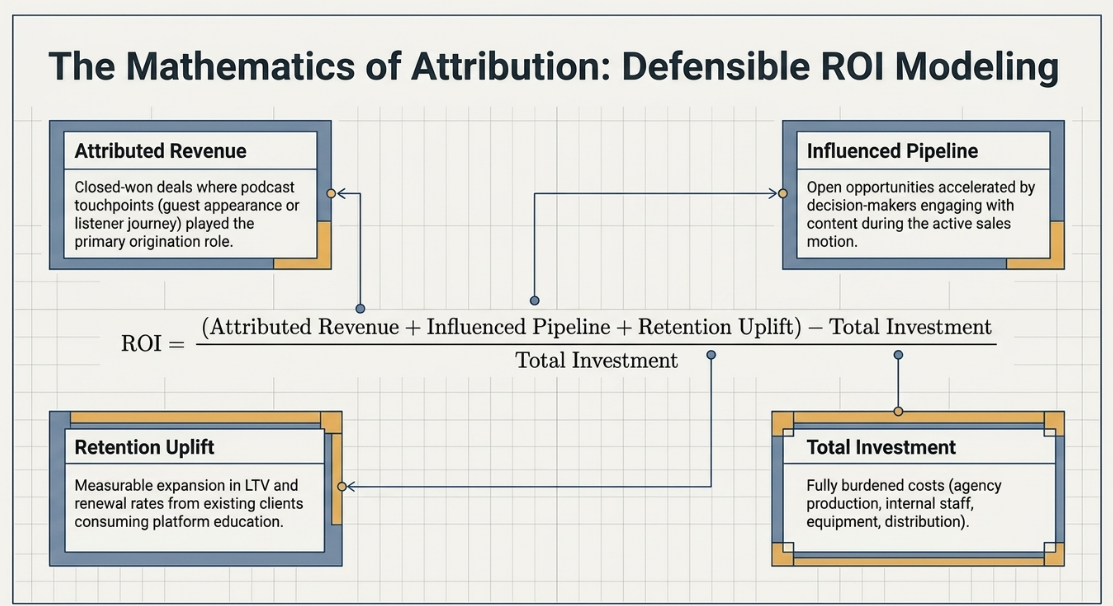
Equation 1: The comprehensive B2B Podcast ROI formula utilized to quantify the total economic impact of an audio marketing program.16
This equation forces marketing and sales teams to meticulously track three distinct revenue categories:
Attributed Revenue: The total dollar value of closed-won deals where podcast touchpoints (either direct guest appearances or documented listenership) played a primary, undisputed role in origination.16
Influenced Pipeline: The aggregate value of open sales opportunities where decision-makers engaged with podcast content prior to or during the active sales motion, acting as an accelerant to the deal.16
Retention Uplift: The measurable expansion in customer lifetime value (LTV) and renewal rates when existing clients consume the podcast, deepening their platform loyalty, educating them on new features, and triggering upsell contracts.16
Total Investment: The complete financial outlay, encompassing external agency production costs, internal staff time, equipment amortization, and promotional distribution spend.16
Integrating the Pipeline Attribution Stack
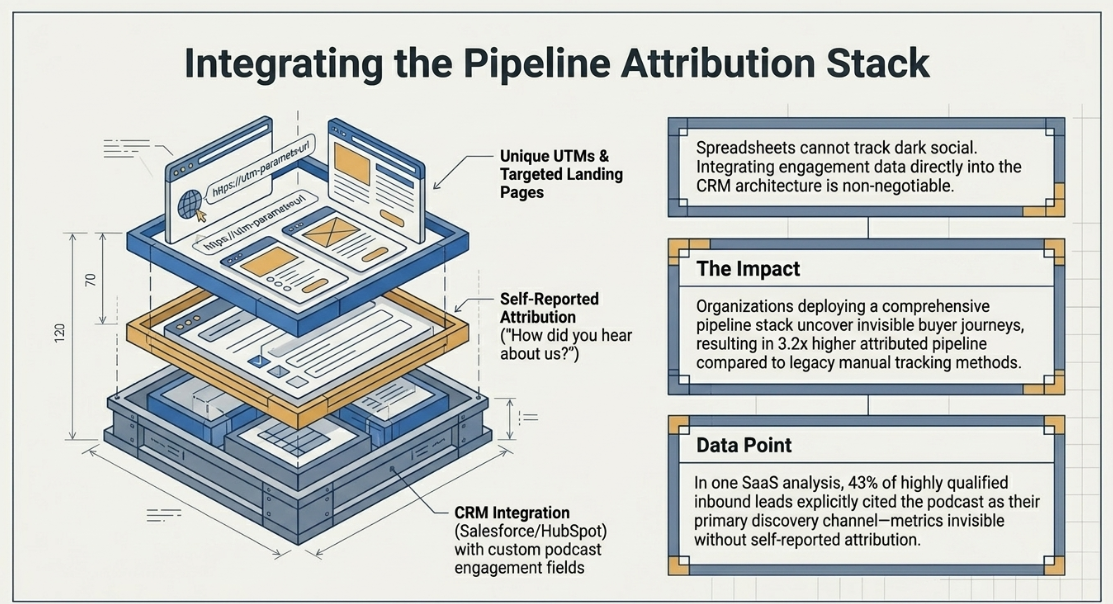
Executing this mathematical formula requires a sophisticated technological infrastructure, often referred to as a Pipeline Attribution Stack.16 Spreadsheets and disparate analytics dashboards are entirely insufficient for capturing the complex, non-linear journey of a B2B podcast listener. Organizations must integrate podcast engagement data directly into their Customer Relationship Management (CRM) architecture, such as Salesforce or HubSpot.
This integration involves creating custom CRM fields specifically designed to flag podcast touchpoints. These fields track whether a prospect has appeared as a guest, downloaded gated content linked from show notes, or engaged with the host on social media post-episode.16 Because much of podcast consumption occurs on decentralized platforms (such as Apple Podcasts and Spotify) where listener identities remain anonymous—a phenomenon contributing heavily to "dark social"—marketers must rely on multi-touch and self-reported attribution models.
Implementing self-reported attribution fields, such as mandatory "How did you hear about us?" text boxes on inbound demo request forms, bridges the critical gap between anonymous listening and known CRM contacts.16 Furthermore, utilizing unique, UTM-tagged landing pages mentioned exclusively in the audio allows organizations to track direct-response behavior.16 Studies indicate that when organizations implement this comprehensive stack, connecting engagement data with the broader revenue ecosystem, they uncover invisible buyer journeys and report 3.2x higher attributed pipeline compared to legacy manual tracking methods.16 In one extensive SaaS analysis, 43% of highly qualified inbound leads explicitly cited the company's podcast as their primary channel of discovery, a metric that would have remained entirely invisible without self-reported attribution mechanics.
Two Distinct Classes of Podcast ROI
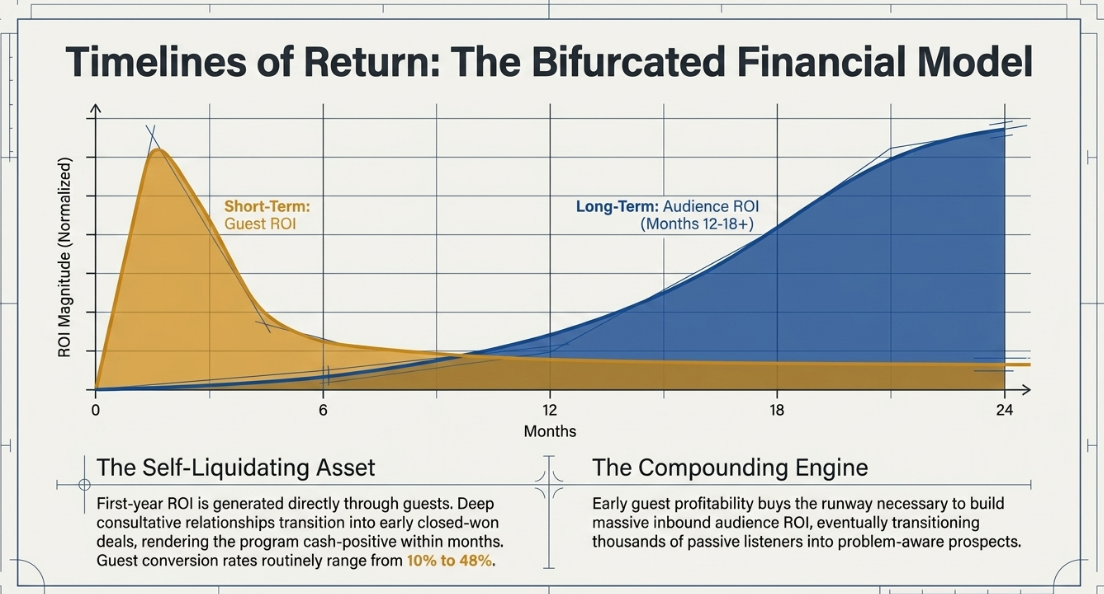
When architecting financial projections, strategy leaders must bifurcate their expectations into two distinct timelines: short-term relationship-driven ROI and long-term audience-driven ROI.16
The immediate, first-year ROI of a B2B podcast is highly unlikely to materialize from mass audience monetization; instead, it must be generated directly through the guests.16 A typical $20,000 annual investment in a bi-weekly podcast yields roughly 24 episodes. If the Dream 200 process is applied rigorously, this secures deep, consultative relationships with approximately 15 highly qualified potential customers and several strategic partners. Due to the accelerated trust dynamics, a conservative conversion of these relationships frequently results in direct customer revenue and partnership value that vastly exceeds the initial $20,000 outlay, rendering the podcast cash-positive within months.16
This guest-side profitability is the financial engine that sustains the show. By self-liquidating its own production costs through immediate relationship conversions, the program secures executive buy-in. This buys the organization the necessary time—often 12 to 18 months—to build the long-term, compounding audience ROI, where thousands of passive listeners eventually transition into inbound, problem-aware prospects.
Empirical Validation: Industry Case Studies and Conversion Metrics
The theoretical advantages of the relationship-first podcasting pipeline are unequivocally validated by empirical data across multiple high-value B2B sectors. The transition from outbound solicitation to podcast-driven relationship engineering yields conversion rates that are orders of magnitude higher than industry standards.
Baseline data aggregated across B2B podcast agencies indicates an average guest-to-client conversion rate of 10%.26 This metric alone—converting one out of every ten guests into a paying client—is exceptional when compared to the sub-1% conversion rates typical of cold email and standard digital advertising. However, when top-performing enterprises execute rigorous target account pre-qualification, meticulously mapping their Dream 200 before sending a single invitation, they routinely see these guest-to-client conversions escalate to a staggering 48%.
The Cybersecurity Sector: High-Trust Pipeline Generation
The cybersecurity industry represents one of the most challenging B2B sales environments globally. Characterized by severe operational risks, the necessity of absolute trust, and immense enterprise deal sizes, cybersecurity vendors face extreme skepticism from Chief Information Security Officers (CISOs). In this high-stakes ecosystem, where alert fatigue is rampant and SOC analysts are constantly battling burnout, traditional marketing collateral is immediately dismissed as vendor noise.29
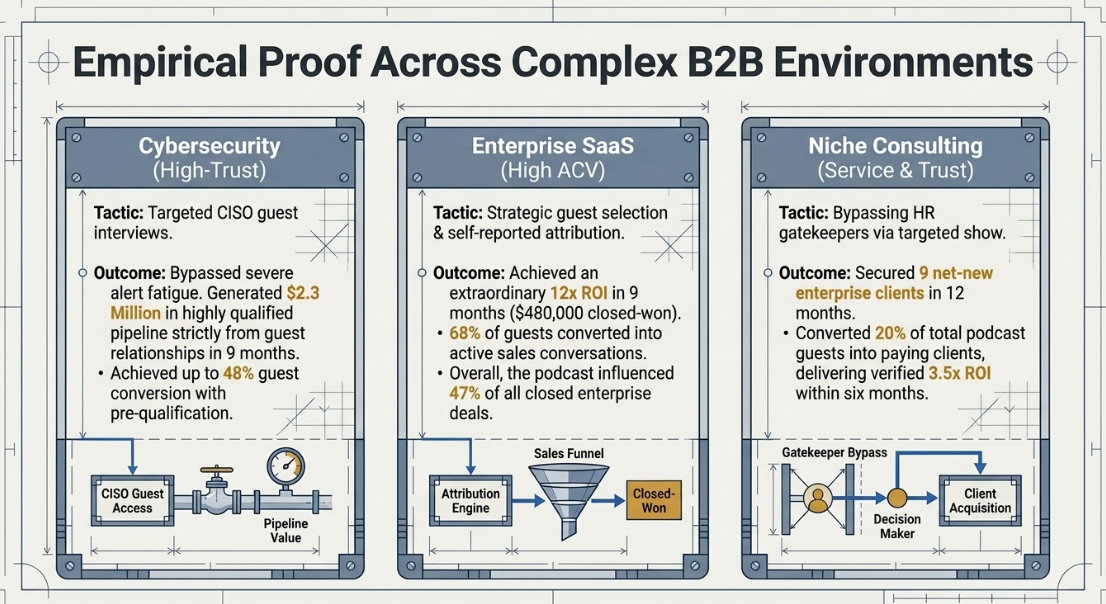
However, the intimate, peer-to-peer positioning of a podcast effectively circumvents this profound skepticism. In a documented case study, a prominent cybersecurity firm adopted the relationship-first podcasting model, specifically targeting security executives for interviews. By leading with value and creating a safe environment for these executives to discuss the complexities of modern threat landscapes—such as malware campaigns, zero-day vulnerabilities, and ransomware attacks—the firm generated profound relationship capital. Over a brief nine-month period, this firm successfully attributed $2.3 million in new, highly qualified sales pipeline strictly to the commercial relationships initiated through these podcast interviews.26 The inherent trust transferred through the medium was the direct catalyst for this multimillion-dollar pipeline expansion, bypassing the usual friction of security procurement.
Enterprise SaaS and Software ROI
The Software-as-a-Service (SaaS) sector, reliant on high Monthly Recurring Revenue (MRR), scalable analytics, and complex technical integrations, demonstrates equally compelling outcomes. In one rigorous analysis, a B2B SaaS platform executed a podcast strategy focused entirely on strategic guest selection—inviting potential enterprise clients rather than chasing audience volume or industry celebrities.31
By maintaining post-interview relationships through structured nurture sequences that avoided premature pitching, the SaaS company created natural, frictionless conversion opportunities that traditional content marketing simply could not match.31 Within nine months of launch, the program achieved an extraordinary 12x return on investment.31 The firm generated $480,000 in closed-won revenue exclusively from deals sourced via podcast relationships.31 Most notably, their pipeline attribution stack revealed that 68% of their podcast guests ultimately converted into active sales conversations, a conversion velocity unheard of in standard SaaS lead generation.31
The impact in SaaS extends far beyond the guests to the listeners themselves. Another enterprise software company conducted a holistic CRM audit and discovered that their podcast actively influenced 47% of all closed enterprise deals.22 This represented $4.3 million in revenue that had previously, and erroneously, been attributed to "direct traffic" or "other inbound" sources before self-reported attribution mechanics and listener journey cohort analyses were implemented.
Niche Consulting and Professional Services
The model is highly adaptable to specialized consulting and professional services, where human expertise is the primary product and trust is the sole differentiator. Sagemark HR, operating the Talent Acquisition Leaders Podcast in conjunction with Content Allies, utilized the guest-driven approach to bypass HR gatekeepers. In the first 12 months of running their targeted show, the firm secured 9 net-new enterprise clients directly from their curated guest list, proving the viability of the model for service-based businesses seeking high-ticket engagements.32
Similarly, YellowBird, a professional consulting network, leveraged podcasting to bypass the leakiest parts of the traditional sales funnel. By entering conversations with stakeholders who already felt a sense of familiarity and trust established from day one, YellowBird successfully converted 20% of their total podcast guests into paying clients. From a cohort of just 26 guest conversations, they signed 5 new clients, delivering a verified 3.5x ROI within just six months of operation.8
Table 3: Aggregated industry case studies demonstrating the superior financial outcomes of the relationship-first podcasting framework across diverse B2B sectors.
Conclusion: The Strategic Imperative for 2026 and Beyond
The aggregated data and empirical case studies comprehensively indicate that the era of utilizing B2B podcasts merely as brand awareness exercises, measured by vanity metrics, has permanently concluded. As traditional acquisition channels become increasingly saturated, as MQL models collapse under the weight of false positives, and as executive buyers retreat behind impenetrable digital defenses, trust has emerged as the ultimate, non-commoditized currency in B2B revenue generation. The organizations that will dominate their respective categories in the latter half of this decade are those that recognize podcasting not as a broadcasting tool, but as the most efficient, scalable relationship engineering system currently available.
By systematically shifting the strategic focus from audience size to guest quality, organizations can effectively weaponize generosity. The relationship-first model—exemplified by operational frameworks like the Dream 200 and theoretical approaches like Content-Based Networking—allows sales and marketing teams to bypass gatekeepers, eliminate cognitive friction, and position themselves as peers alongside the industry's most lucrative accounts.
When properly integrated into a robust pipeline attribution stack within a modern CRM environment, the financial outcomes are undeniable and highly defensible to executive leadership. The methodology consistently yields guest-to-client conversion rates between 10% and 48%, accelerates notoriously slow sales cycles by over 30%, and routinely elevates enterprise contract values by creating deep, parasocial alignment prior to any formal negotiation. For professional brands and B2B enterprises aiming to scale their pipeline, reduce customer acquisition costs, and secure high-value partnerships in 2026, launching a strategically targeted, relationship-first podcast is no longer a peripheral marketing tactic; it is a foundational strategic imperative that dictates the pace of modern revenue growth.
Works cited
The B2B Sales Cycle Stages, Explained: 2026 Edition - Highspot, accessed May 21, 2026, https://www.highspot.com/blog/sales-cycle-stages/
B2B SaaS Sales Cycle: How Rook Cut Theirs to 95 Days - SPROUTWORTH, accessed May 21, 2026, https://www.sproutworth.com/b2b-saas-sales-cycle/
The Metrics Brothers - Apple Podcasts, accessed May 21, 2026, https://podcasts.apple.com/us/podcast/the-metrics-brothers/id1687214133
Podcast Statistics 2026 | 80+ Facts & Data Points - Searchlab, accessed May 21, 2026, https://searchlab.nl/en/statistics/podcast-statistics-2026
The ROI Double-Helix: Why Your B2B Podcast Needs Both Guest And Listener Conversion Models - Fame.so, accessed May 21, 2026, https://www.fame.so/post/b2b-podcast-roi-guest-listener-conversion
Build a Content Marketing Funnel with Podcasts - Saspod, accessed May 21, 2026, https://saspod.com/blog/post/build-a-content-marketing-funnel-with-podcasts
B2B Podcast Production Checklist: From Recording to Revenue, accessed May 21, 2026, https://rise25.com/lead-generation/b2b-podcast-production-checklist/
How To Build Sales Pipeline With A B2B Podcast - Fame.so, accessed May 21, 2026, https://www.fame.so/post/how-to-build-sales-pipeline
268 Content-Based Networking by James Carbary - Apple Podcasts, accessed May 21, 2026, https://podcasts.apple.com/be/podcast/268-content-based-networking-by-james-carbary/id961463317?i=1000466940664
Ep. 0104 - James Carbary, Content-Based Networking - The Published Author Podcast, accessed May 21, 2026, https://www.youtube.com/watch?v=ZZN5TJawWVY
Content-Based Networking Audiobook by James Carbary - Audible, accessed May 21, 2026, https://www.audible.com/pd/Content-Based-Networking-Audiobook/B083NSNJ27
Add value first – building relationships also builds your agency with James Carbary, accessed May 21, 2026, https://agencymanagementinstitute.com/podcasts/james-carbary/
B2B Podcast Marketing Strategy: Measuring ROI Without Chasing Vanity Metrics - Rise 25, accessed May 21, 2026, https://rise25.com/lead-generation/b2b-podcast-marketing-strategy-roi/
i've spent 10+ years helping digital agency owners fixed their podcast that don't produce ROI. Here's the formula (and why so many quit) - Reddit, accessed May 21, 2026, https://www.reddit.com/r/agency/comments/1nypyxd/ive_spent_10_years_helping_digital_agency_owners/
How to Turn Podcast Guests into Clients, Partners, or Investors: A Strategic Guide for B2B Companies - Jake Jorgovan, accessed May 21, 2026, https://jake-jorgovan.com/blog/b2b-podcast-guest-conversion-guide
The Ultimate Guide To Measuring B2B Podcast ROI: From Downloads To Pipeline Attribution - Fame.so, accessed May 21, 2026, https://www.fame.so/post/ultimate-guide-to-measuring-b2b-podcast-roi
388: The Relationship-First Growth Playbook with Dr. Jeremy Weisz - Apple Podcasts, accessed May 21, 2026, https://podcasts.apple.com/us/podcast/388-the-relationship-first-growth-playbook-with-dr/id1446218521?i=1000746161910&l=zh-Hans-CN
Turn Podcast Guests Into Clients: B2B Follow-Up System - Rise 25, accessed May 21, 2026, https://rise25.com/lead-generation/turn-podcast-guests-into-clients/
Deal Velocity 101: Definition, Calculation, and How to Improve It - Consensus, accessed May 21, 2026, https://goconsensus.com/blog/deal-velocity
Podcasting For Lead Generation: A Practical B2B Playbook | ThePod.fm, accessed May 21, 2026, https://thepod.fm/resources/blog/podcasting-for-lead-generation
How to Unstick Stalled Deals With One Podcast Clip | JAR Podcast, accessed May 21, 2026, https://jarpodcasts.com/podcast-clip-b2b-sales/
B2B Podcast ROI: Why Podcasting Is Business Infrastructure 2026, accessed May 21, 2026, https://kazcm.com/b2b-podcast-roi/
Podcast ROI: Measuring the Success of Your B2B Audio Strategy, accessed May 21, 2026, https://www.finchley.co.uk/finchley-learning/visual-podcast/podcast-roi-measuring-the-success-of-your-b2b-audio-strategy
2025 B2B Podcasting Trends: Data, Insights, And What Actually Moves the Needle | Fame, accessed May 21, 2026, https://www.fame.so/post/b2b-podcasting-trends-data
Why Video Podcasts Convert Better Than Audio-Only: The Data, accessed May 21, 2026, https://www.podcaststudioglasgow.com/podcast-studio-glasgow-blog/why-video-podcasts-convert-better-than-audio-only-the-data
The Rise of B2B Podcasting: Why Businesses Are Tuning In - We ..., accessed May 21, 2026, https://wearekymera.com/the-rise-of-b2b-podcasting-why-businesses-are-tuning-in/
accessed May 21, 2026, https://wearekymera.com/the-rise-of-b2b-podcasting-why-businesses-are-tuning-in/#:~:text=10%25%20average%20guest%2Dto%2D,tied%20to%20podcast%20guest%20relationships.
30 B2B Podcasting Statistics [2026] - Omniscient Digital, accessed May 21, 2026, https://beomniscient.com/blog/b2b-podcasting-statistics/
Alert Fatigue in Cybersecurity: the SOC Playbook to Eliminate It - UnderDefense, accessed May 21, 2026, https://underdefense.com/blog/alert-fatigue-cybersecurity/
The Strategic Imperative of Podcast Marketing for Professional, accessed May 21, 2026, https://www.finchley.co.uk/finchley-learning/visual-podcast/the-strategic-imperative-of-podcast-marketing-for-professional-brands-industry-landscape-and-roi-realization
The Definitive Guide To Measuring B2B Podcast ROI And Pipeline ..., accessed May 21, 2026, https://www.fame.so/post/measuring-b2b-podcast-roi-and-pipeline
How to Use a B2B Podcast as a Sales & Lead Generation Machine in 2026 - Content Allies, accessed May 21, 2026, https://contentallies.com/learn/b2b-podcast-sales-lead-generation
20% Conversion Through Podcasting: YellowBird's Winning Strategy - Fame.so, accessed May 21, 2026, https://www.fame.so/case-study/20-conversion-through-podcasting-yellowbirds-winning-strategy
Fame - The B2B Podcast Production Agency, accessed May 21, 2026, https://www.fame.so/