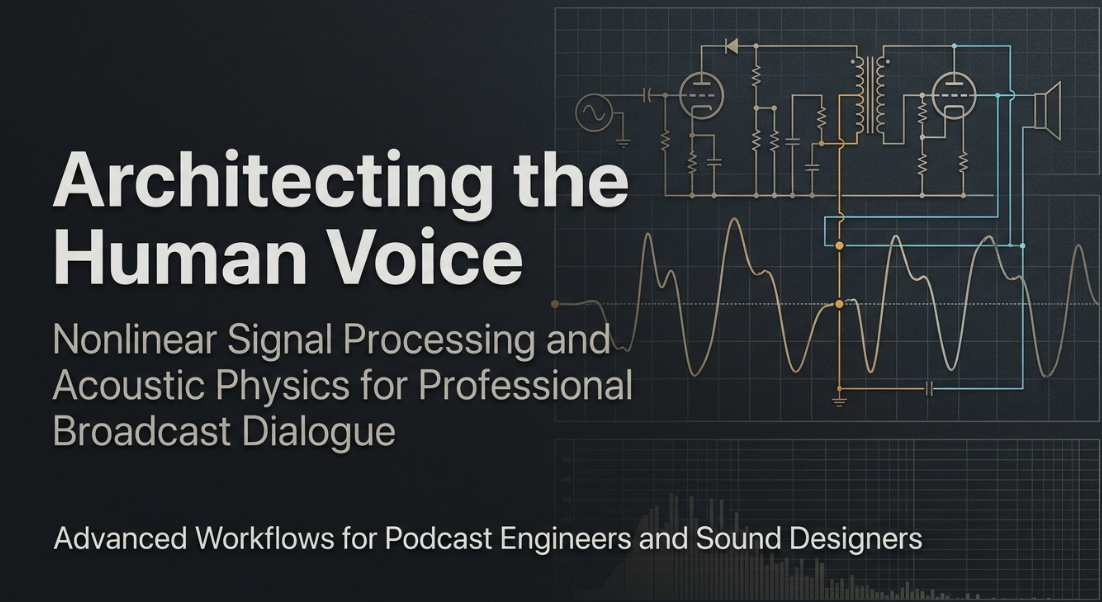
Physical Principles of Glottal Flow and Harmonic Reconstructive Distortion
The human voice produces sound through a complex interaction between the glottal source and the vocal tract filter1. During phonation, subglottal pressure forces the vocal folds to vibrate, periodically interrupting the airflow to generate a raw acoustic spectrum rich in harmonics2. The mathematical representation of this glottal flow waveform is highly sensitive to two key parameters: the open quotient (), which defines the ratio of the open phase to the entire period, and the skewing quotient (), which defines the ratio of the flow's rise duration to its fall duration1.
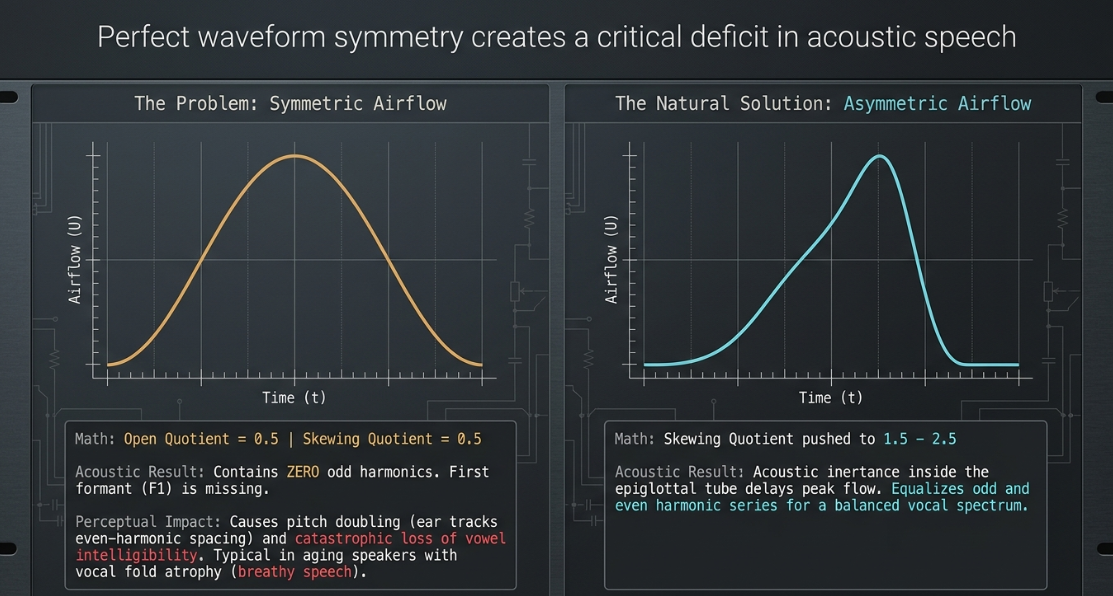
Acoustic research establishes that perfect wave symmetry—where the open quotient sits at exactly and the skewing quotient equals —results in a half-sinusoid waveshape1. This symmetrical waveform exhibits a critical spectral anomaly: it contains no odd harmonics (such as the third, fifth, and seventh) other than the fundamental frequency1.
In speech production, such symmetry is highly problematic1. If the glottal pulse is perfectly symmetric, the odd harmonics required to excite critical vocal tract resonances, such as the first formant (), are absent1. This spectral deficit leads to a severe misperception of vocal pitch—often causing pitch doubling because the ear tracks the even-harmonic spacing—and a catastrophic loss of vowel intelligibility1.
In natural human speech, this mathematical cancellation is prevented by source-filter interaction3. The acoustic inertance (or "sluggishness") of the air column inside the epiglottal tube and vocal tract naturally delays the rise of the glottal flow pulse, forcing the peak flow to occur later in the cycle3. This acoustic loading skews the waveform, naturally driving the skewing quotient to values between and , and equalizing the odd and even harmonic series to produce a full, balanced vocal spectrum1.
However, in many practical recording scenarios, this natural balance is compromised5. For example, older speakers frequently exhibit age-related vocal fold bowing or atrophy, which simulates a severely breathy vocal quality6. Breathy speech reduces periodic vocal fold collision, resulting in a more symmetric glottal pulse that lacks harmonic complexity and is easily masked by background noise6.
In a noisy environment, this acoustic degradation significantly elevates the listener's cognitive effort and reduces overall speech intelligibility2.
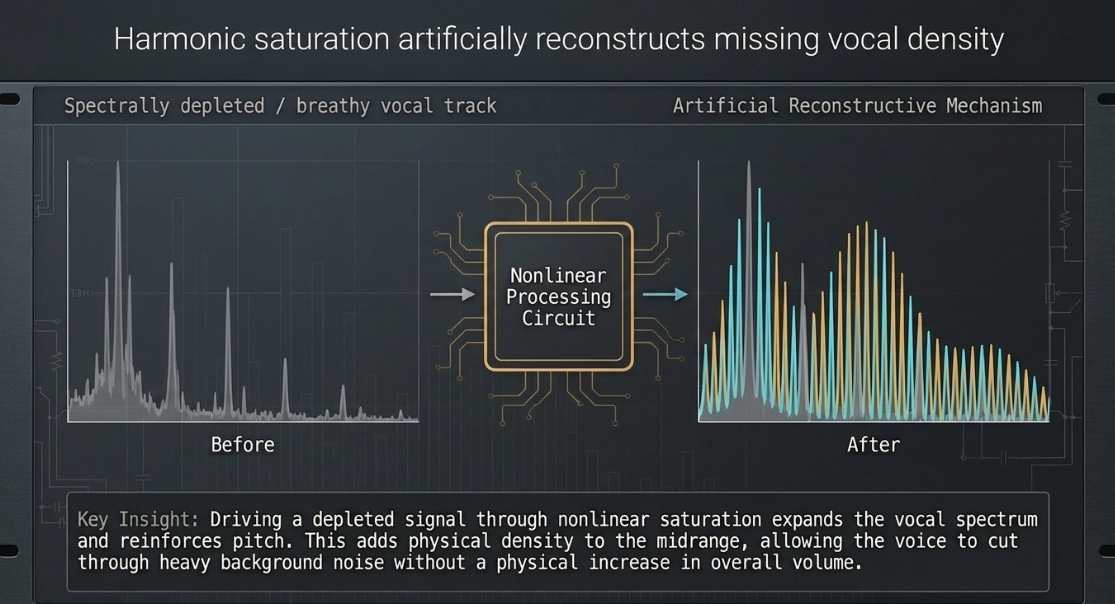
To combat these acoustic deficits in post-production, audio engineers use nonlinear distortion—specifically harmonic saturation—to act as an artificial reconstructive mechanism7. By driving a clean, spectrally depleted, or breathy vocal track through a nonlinear processing circuit, engineers artificially generate the missing odd and even harmonics9. This harmonic enrichment expands the vocal spectrum, reinforcing the fundamental pitch and adding physical density to the midrange9.
The resulting sound has more information for the brain to process, allowing the voice to cut through noise and background elements without requiring a physical increase in volume8.
Electro-Acoustic Saturation Topologies and Emulation Architectures
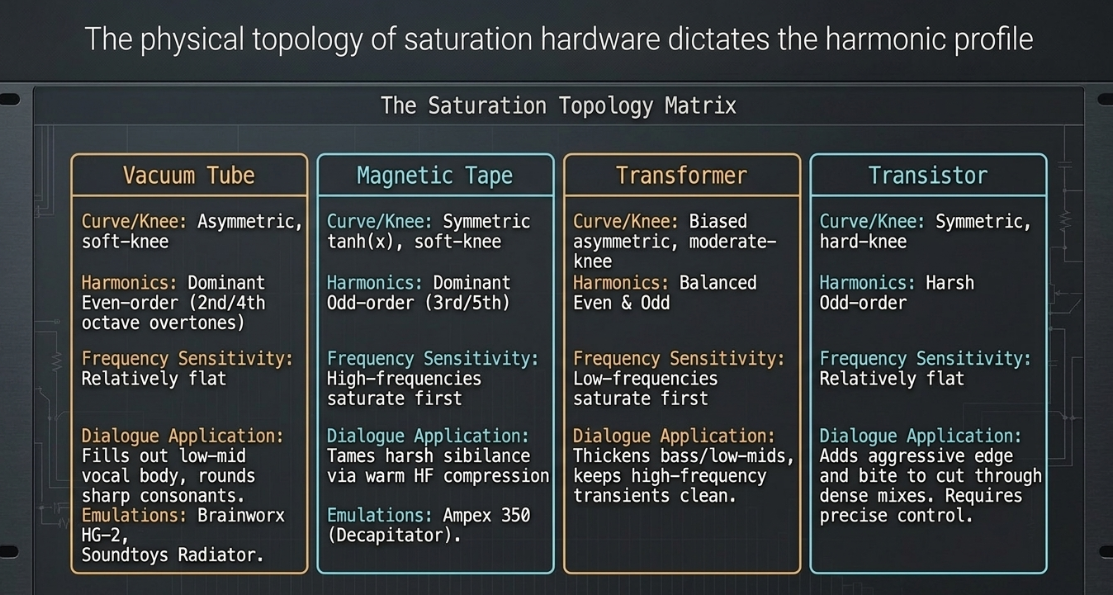
To select the correct saturation tool for a podcast mix, an engineer must understand the physical and mathematical differences between vacuum tubes, magnetic tape, electromagnetic transformers, and transistors10. Each of these hardware topologies processes incoming electrical voltage through a different physical medium, producing unique harmonic and dynamic changes10.
Vacuum tube saturation relies on the control of electron flow across a heated vacuum chamber10. Because a tube conducts electrons more efficiently in one direction under high voltage, it distorts the positive and negative halves of a waveform unevenly10. This asymmetry yields a dominant even-order harmonic profile, consisting of the second and fourth harmonics10.
The second harmonic sits exactly one octave above the fundamental frequency, while the fourth harmonic sits two octaves up10. These octave-related overtones thicken the vocal signal without adding dissonance, resulting in a warm, rounded sound10.
Furthermore, tubes possess a very soft "knee," meaning the transition from clean linear amplification to non-linear saturation is highly gradual10. This makes tube emulations highly forgiving on dialogue, smoothing out sharp transients while adding low-mid presence10.
Magnetic tape saturation, by contrast, relies on the physical orientation of iron oxide domains suspended on a moving plastic substrate10. As input levels rise, the tape reaches magnetic saturation, where all magnetic domains are fully aligned and can record no further level10. This symmetric soft-clipping is modeled by the hyperbolic tangent function (), producing predominantly odd-order harmonics, such as the third and fifth harmonics10.
The third harmonic is a perfect fifth above the second harmonic (an octave plus a fifth above the fundamental), which adds presence, bite, and forward energy to speech10. Tape also exhibits a high-frequency-dependent saturation behavior10. Because shorter wavelengths require sharper magnetic transitions, high frequencies stress the tape medium more and saturate at lower input levels than low frequencies10. This creates a natural, warm high-end compression that smooths out harsh sibilance and digital "edges"10.
Transformer saturation occurs when high signal levels push the iron or steel core of an electromagnetic coil toward magnetic saturation10. Transformer saturation sits in the middle between tube and tape10. While a perfectly symmetric transformer core would yield only odd harmonics, practical circuit designs often introduce a direct current (DC) offset that biases the operating point away from the center, creating asymmetric saturation with a balanced blend of both even and odd harmonics10.
Importantly, transformer saturation is highly frequency-dependent in a bottom-up manner10. Low-frequency signals require more magnetic flux to pass through the core, meaning the bass and low-mids saturate first while the high frequencies remain relatively clean10. This adds weight to the low end of a voice without introducing mud or distorting the sibilant range10.
Transistor saturation, commonly found in solid-state preamps and consoles, provides a much harder "knee" than tube or tape circuits10. As the signal voltage exceeds the maximum rails of a transistor junction, the waveform is clipped abruptly7. This generates aggressive odd-order harmonics, providing brightness and presence that can help a voice cut through a dense background mix18. However, because of the hard-clipping behavior, transistor saturation requires precise control to avoid harshness7.
In professional post-production, these emulations are applied using specialized plugins28. The Brainworx Black Box Analog Design HG-2 emulates high-end tube hardware, offering independent triode (even harmonic) and pentode (odd harmonic) circuits that can be combined to add size and clarity to a vocal track or master bus28.
Soundtoys Decapitator emulates five distinct analog preamps, including the Ampex 350 tape drive, the Chandler/EMI TG channel, the Neve 1057 input channel, and the Thermionic Culture Vulture vacuum tube circuit on both triode and pentode settings28. The Decapitator features a low-frequency contour control and a high-cut filter, allowing engineers to shape the frequency spectrum before and after the saturation stage to prevent muddy or brittle buildup24.
The Soundtoys Radiator emulates the classic Altec 1567A tube mixer, adding warm midrange color and vintage circuit noise28. For multi-band saturation, FabFilter Saturn 2 offers nine saturation styles across up to six distinct frequency bands, providing highly precise control over where and how much harmonic energy is added9.
The Brainworx Vertigo VSM-3 acts as a mastering-grade saturator, allowing engineers to isolate and target specific harmonics, such as applying a second-harmonic FET crusher to the low-mids for warmth while focusing a third-harmonic Zener Blender on the high end for presence and air28.
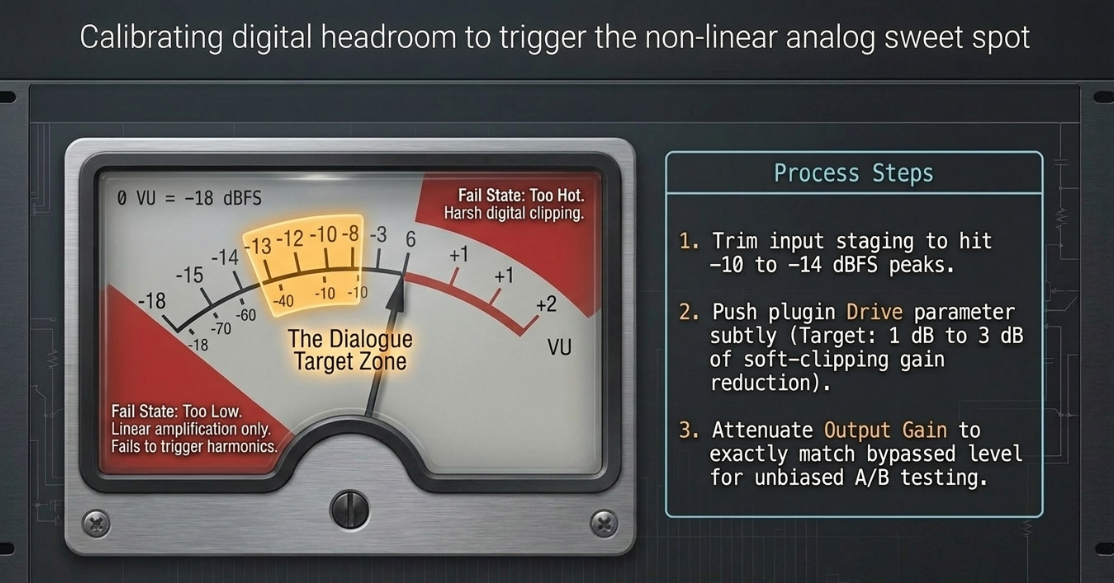
To calibrate these tools, proper gain staging is required7. Analog emulations are typically calibrated so that an input level of corresponds to on an analog meter30. Driving a digital signal too low will fail to trigger the nonlinear harmonic generation, while feeding a signal that is too hot will cause harsh digital clipping7.
Engineers should aim for incoming dialogue peaks between and to ensure the processor operates in its optimal nonlinear sweet spot7. The drive parameter should be adjusted subtly, typically aiming for only to of peak gain reduction through soft-clipping, and the output gain must be attenuated to match the bypassed level for an accurate, non-biased A/B comparison7.
Numerical Waveform Modeling: Aliasing, Oversampling, and Phase Artifacts
Applying non-linear processing within a discrete-time digital system introduces a fundamental engineering challenge: digital aliasing distortion31.
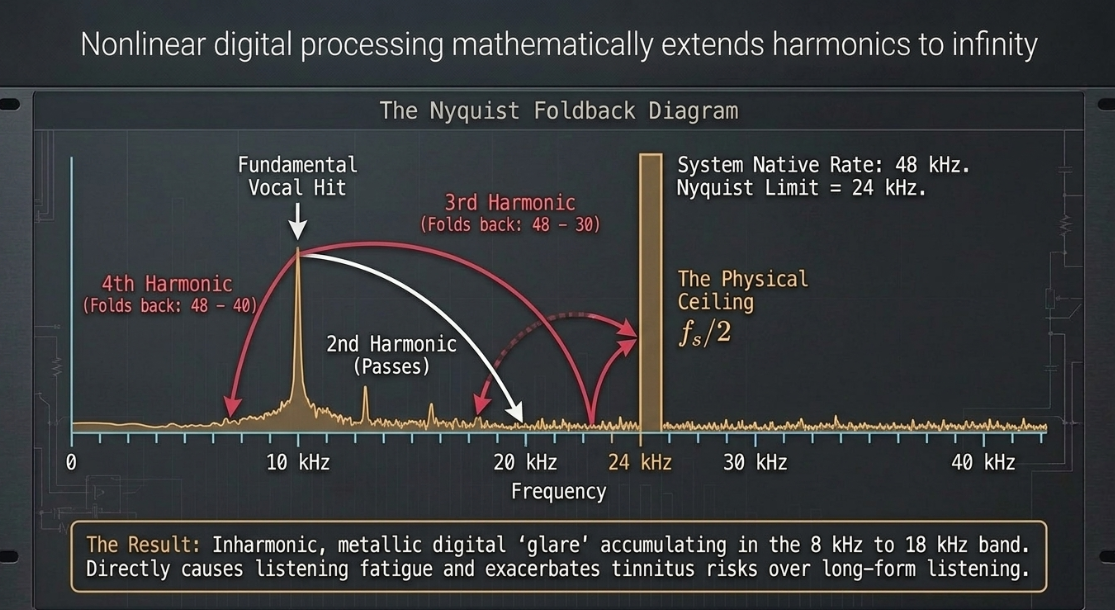
When a non-linear process like saturation, clipping, or heavy compression reshapes an analog-modeled waveform, it generates new harmonics that mathematically extend to infinity31. According to the Nyquist-Shannon sampling theorem, a digital system can only represent frequencies up to half of its active sampling rate ()25.
For a standard broadcast session operating at , the physical frequency limit (Nyquist limit) is 25.
If a vocal track contains high-frequency energy at and undergoes saturation, it will generate a second harmonic at , a third harmonic at , and a fourth harmonic at 33. While the second harmonic falls safely below the Nyquist limit, the third and fourth harmonics exceed the boundary33.
In a digital system, this excess high-frequency energy cannot be represented31. Instead, it folds back across the Nyquist frequency into the audible spectrum, appearing at lower, inharmonic frequencies31.
The third harmonic at folds back to ( minus ), while the fourth harmonic at folds back to ( minus )31.
These foldback frequencies do not share a whole-number integer relationship with the fundamental voice frequencies, resulting in a cold, metallic digital "glare"31. This aliasing noise builds up as multiple non-linear plugins are placed in series, cluttering the to region where human hearing is most sensitive to harshness, directly causing listening fatigue and worsening tinnitus risks over long-form listening32.
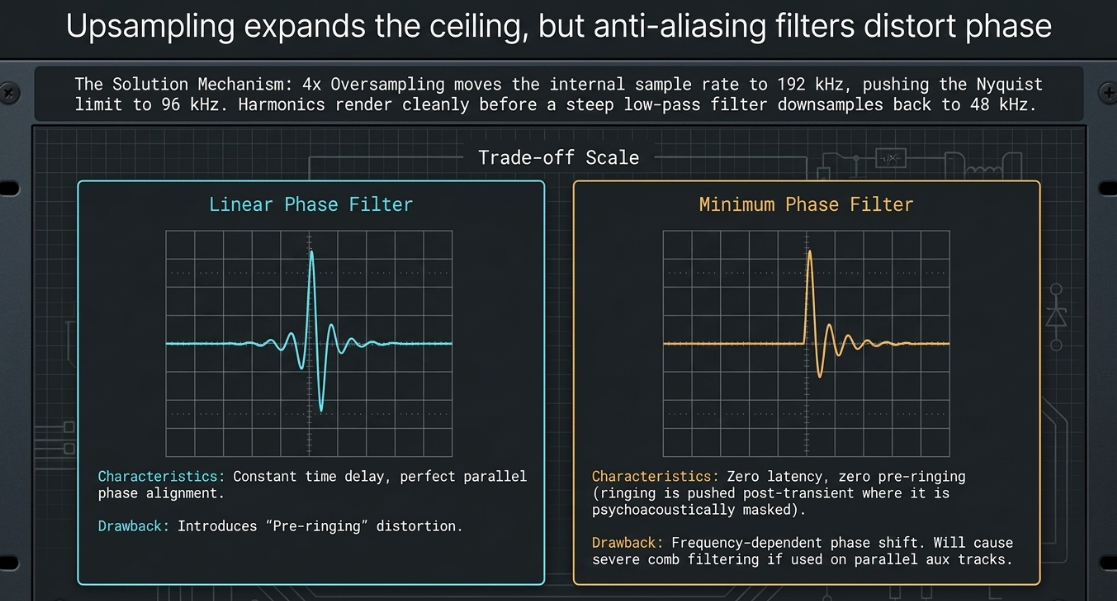
To eliminate aliasing, plugins employ oversampling25. This process upsamples the digital signal to a much higher sample rate (e.g., oversampling in a session processes the audio at ), pushing the internal Nyquist limit to 33.
This provides sufficient headroom for the generated harmonics to render cleanly without folding back33.
The plugin then applies a steep low-pass anti-aliasing filter to remove all frequencies above the session's native Nyquist limit (e.g., ) before downsampling the audio back to the host session rate25.
However, this downsampling process introduces a critical engineering trade-off: anti-aliasing filters can cause phase rotation, transient smearing, and peak overshoot31.
Oversampling anti-aliasing filter topologies:
[Linear Phase Filter]
- Constant time delay (zero phase shift)
- Perfect parallel phase alignment
- Symmetric pre-ringing distortion
[Minimum Phase Filter]
- Frequency-dependent phase shift
- Zero latency, no pre-ringing
- Post-ringing masked by transients
Linear phase filters apply a constant time delay across all frequencies, preserving perfect phase alignment37. This makes linear phase oversampling ideal for parallel processing, as combining the saturated parallel track with the dry vocal will not cause phase cancellation37.
The drawback is that linear phase filters introduce "pre-ringing" distortion, which manifests as a faint acoustic echo or smear occurring before a transient sound31.
Minimum phase filters, on the other hand, eliminate pre-ringing by concentrating all ringing after the transient, where it is psychoacoustically masked by the vocal onset37.
The trade-off is that minimum phase filters introduce a frequency-dependent phase shift36. This phase shift can trigger severe comb filtering if the minimum-phase oversampled plugin is used on a parallel aux send and recombined with the dry signal36.
Additionally, the downsampling process can cause peak overshoot, where the filtered signal exceeds and clips downstream devices37.
To prevent this, high-end plugins integrate anti-overshoot technology to keep peaks safely below the clip ceiling37.
Modulation Systems: Haas Effect, Synthetic Doubling, and Spatial Phase Management
Modulation effects—including chorus, flangers, and phasers—rely on the manipulation of time, phase, and sweeping filters to create movement and width42. While highly effective for creative sound design, these tools manipulate phase in ways that can cause severe phase cancellation when stereo signals are summed to mono44.
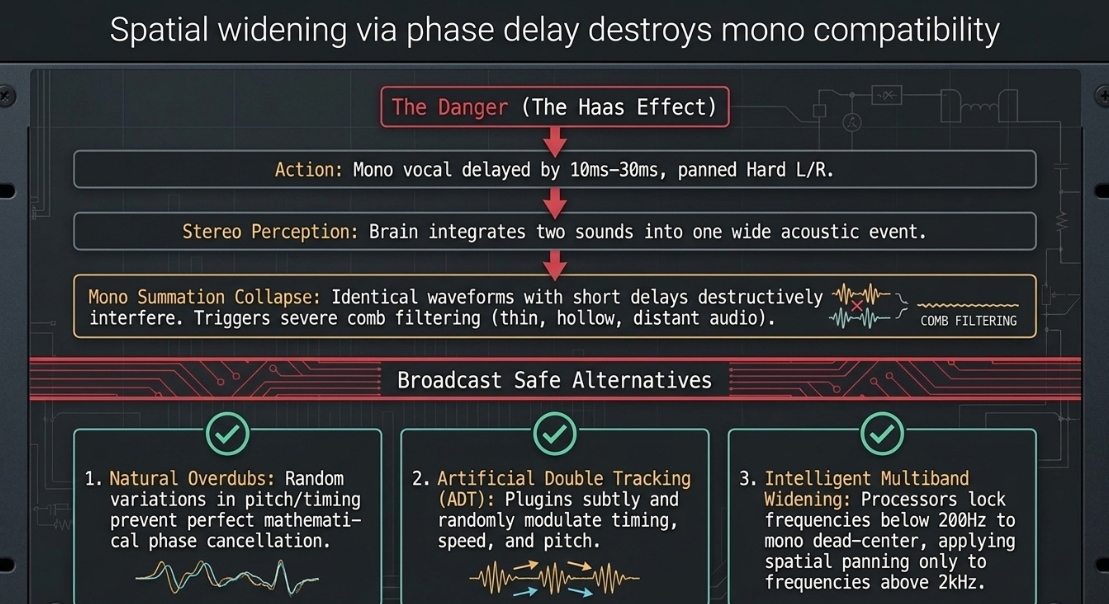
The Haas effect (or Precedence effect) dictates that when a sound is followed by a delayed duplicate separated by a time window below the listener's echo threshold ( to ), the human brain integrates the two sounds into a single acoustic event22. The perceived location of the sound is determined entirely by the first wavefront to reach the ears22.
In digital mixing, a common widening technique duplicates a mono vocal, delays one side by to , and pans the two tracks hard left and right22. While this creates a wide stereo image in headphones, it is highly unstable45.
Because the left and right channels contain identical waveforms separated by a short delay, summing the channels to mono causes the delayed signals to interfere destructively45. This triggers comb filtering, where regularly spaced frequency notches cancel out, making the vocal sound thin, hollow, or completely distant45.
To generate wide, mono-compatible dialogue tracks, engineers should avoid simple phase delays and instead use natural doubling or intelligent multiband widening49. Recording a real vocal overdub provides natural, randomized variations in timing and pitch22.
Because no two vocal takes are identical, the waveforms will never match closely enough to cause complete phase cancellation when summed49.
If a real overdub is impossible, artificial double tracking (ADT) should be used22. ADT plugins subtly modulate the timing, speed, and pitch of the duplicate track to simulate a real performance, avoiding phase cancellations while retaining stereo width22.
Another safe technique is multiband stereo widening, using processors like StageOne 2 or CenterOne50. These tools leave low frequencies (below ) and the core dialogue frequencies centered in mono, while applying spatial widening and panning only to high-frequency elements (above ), preserving center focus and mono compatibility46.
Complex Post-Production Workflows: Retro Modeling, Anonymization, and Advanced De-essing
Beyond standard vocal enhancement, podcast post-production often requires highly specialized sound design workflows, such as simulating retro communications, anonymizing interviewees, and applying dynamic phase-cancellation de-essing39.
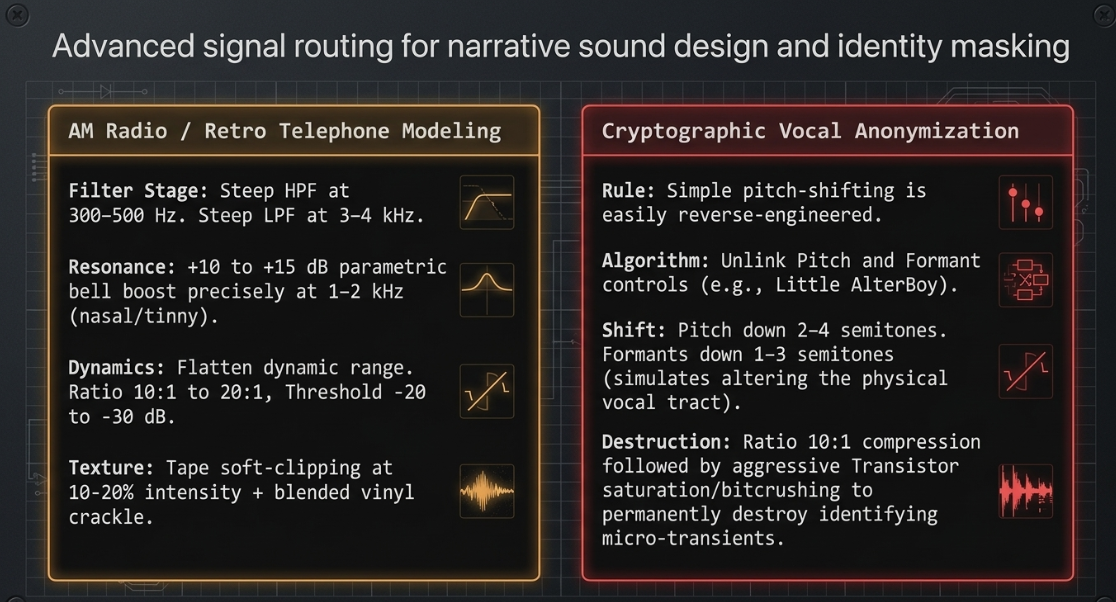
To simulate a realistic vintage telephone or AM radio broadcast, the audio's frequency response must be severely restricted56. In Audacity or professional DAWs, this is achieved through a multi-stage workflow56.
First, apply a steep high-pass filter with a cutoff frequency between and to remove all low-end body56. Follow this with a low-pass filter set between and to strip away all high-frequency clarity and sibilance56.
Next, use a parametric EQ to apply a sharp boost of to in the mid-range between and , creating a nasal, tinny response56.
To simulate analog limitations, feed this filtered signal into a compressor set with an aggressive threshold of to and a high ratio ( to ) to flatten the dynamic range56.
Finally, insert a distortion or saturation plugin configured for soft-clipping or tape saturation at to intensity, and blend in low-level vinyl crackle or tape hiss to complete the retro effect56.
For investigative journalism podcasts, protecting a whistleblower's identity requires secure vocal anonymization61. Simple pitch-shifting can be reversed61.
A secure voice-masking workflow uses a professional pitch-and-formant shifter, such as Soundtoys Little AlterBoy28. First, unlink the pitch and formant controls61. Shift the pitch down by to semitones to alter the fundamental frequency, then shift the formant down by to semitones to change the resonance characteristics of the simulated vocal tract61.
Because the pitch and formants are shifted by different ratios, this process cannot be reversed61.
Follow the shifter with a heavy compressor set to a ratio of or higher to level out vocal nuances61.
Finally, apply transistor saturation or bitcrushing to add non-linear distortion, permanently destroying the original voice's micro-transients while preserving speech intelligibility26.
Dynamic Phase-Cancellation De-essing Workflow:
[Main Vocal Track] ─────────► [Mix Bus]
│ ▲
│ (Pre-Fader Send) │
▼ │
[Parallel Aux Track] │
- Phase Inverted (180°) │
- Linear Phase EQ (Isolates │ (Subtracted sibilance)
5 kHz - 10 kHz sibilant band) │
- Dynamic Expander │
(Triggers on s's) ─────────────┘
For highly sibilant vocals where traditional de-essers fail, engineers can deploy a dynamic phase-cancellation technique39. To set up this routing, send the vocal to a parallel auxiliary track39.
Insert a utility plugin on the parallel track and invert its polarity by 39. If both tracks are played at equal volume, they will phase-cancel completely, resulting in absolute silence39.
Next, insert a linear-phase EQ on the parallel track39. Apply steep high-pass and low-pass filters to isolate only the sibilant frequency range (typically between and )17.
Within this isolated range, create a dynamic bell filter configured to expand or amplify the sibilant energy whenever the vocal hits an "S" or "T" sound16.
Finally, pull the parallel track's channel fader down significantly39.
When the vocal is clean, the parallel track remains quiet39.
However, when sibilance triggers the dynamic band, the parallel track expands, injecting polarity-inverted sibilant energy back into the mix39.
This dynamically phase-cancels the harsh sibilance on the main vocal track39.
Because this technique uses linear phase subtraction rather than dynamic compression, it tames sibilance with zero transient smearing or high-frequency distortion, providing incredibly natural results39.
In multi-track sessions, engineers can also use dynamic sidechain compression to manage space12. By routing the main vocal as a sidechain input to a dynamic EQ or compressor placed on the background music and sound effects tracks, the instruments are subtly ducked only in the key vocal frequency ranges ( to ) whenever the narrator speaks2.
This carves a clear frequency pocket for the dialogue without causing obvious, heavy volume pumping12.
Architecture and Calibration of the Dialogue Processing Chain
To construct a high-performance podcast processing chain, plugins must be sequenced in a logical order to prevent them from interfering with one another13. The industry-standard vocal chain is divided into two distinct phases: cleanup and tone shaping5.
Professional Broadcast Dialogue Signal Flow:
Restoration (Spectral Denoising, De-Reverb)
│
▼
Subtractive EQ (HPF, Resonance Attenuation)
│
▼
Dynamic Compression (Dual-Stage: FET into Opto)
│
▼
Harmonic Saturation (Even/Odd-Order Enrichment)
│
▼
Dynamic EQ / De-essing (Post-Saturation High-End Control)
│
▼
Master Bus Limiting (Loudness Normalization to -16 LUFS)
The signal must be restored before any tonal shaping occurs5. Applying compression or saturation first is a critical mistake15.
Restoration tools, such as Waves Clarity Vx or iZotope RX, are designed to isolate and remove background noise, computer fans, air conditioning rumble, and room reverb5.
If these clean-up tools are placed after compression, they will fail to track the noise profile accurately5.
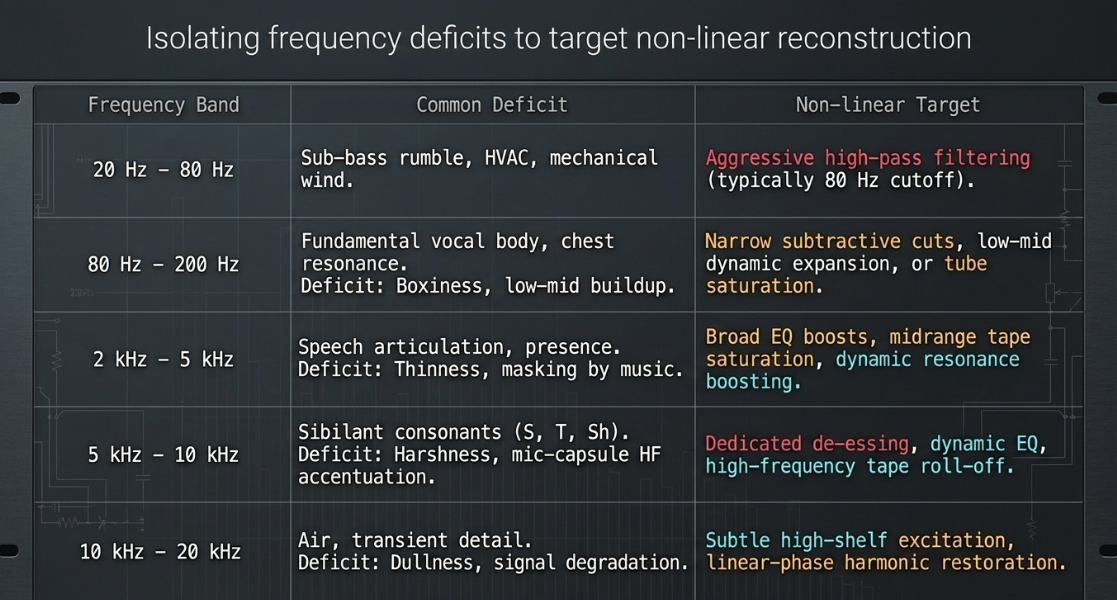
Subtractive EQ follows restoration, applying a high-pass filter set between and to remove low-end rumble and plosives before they hit the compressor5.
A narrow bell curve is used to carve out boxy resonances, typically in the to range, ensuring the compressor does not overreact to muddy frequency buildups13.
Compression is split into two stages: a fast FET-style compressor, such as the Slate FG-116 or Waves CLA-76, is placed first to catch transient peaks with a fast attack and release5.
This is followed by a slow optical compressor, such as the Waves CLA-2A, to smooth out overall level variations13.
This multi-compressor approach ensures that no single device works too hard, maintaining a natural, transparent vocal tone5.
Saturation is introduced immediately after compression15. Because the compressor has smoothed out the vocal's dynamic peaks, the signal hits the saturation processor at a highly consistent level, preventing sudden loudness spikes from causing harsh, unwanted distortion68.
Oversampling should be set to at least minimal phase during this stage to prevent digital aliasing32.
De-essing is positioned after saturation15. Because both compression and saturation generate new high-frequency harmonics and bring up low-level details, they inevitably exaggerate sibilant "S" and "T" sounds15.
Placing a dynamic de-esser, such as FabFilter Pro-DS or Waves Sibilance, late in the chain ensures that any harshness introduced by the preceding saturation or EQ is targeted and smoothed out, resulting in a clean, professional, and non-fatiguing vocal15.
Finally, the master mix bus requires a true peak brickwall limiter to ensure the podcast complies with broadcast standards5.
The ceiling should be set between to prevent clipping when the audio is converted to lossy formats like MP35.
The overall loudness must be calibrated to hit standard broadcast metrics, typically targeting for stereo podcasts and for mono dialogue12.
By maintaining this structured signal flow and applying precise numerical modeling, engineers can produce professional, clear, and highly engaging podcast audio that translates perfectly across all playback systems20.
Works cited
Sensitivity of odd-harmonic amplitudes to open quotient and skewing quotient in glottal airflow - PMC, https://pmc.ncbi.nlm.nih.gov/articles/PMC4305027/
Facts about speech intelligibility - DPA Microphones, https://www.dpamicrophones.com/mic-university/background-knowledge/facts-about-speech-intelligibility/
Balancing Odd and Even Harmonics in the Source Spectrum - Utah Center for Vocology, https://vocology.utah.edu/_resources/documents/balancing_odd_and_even_harmonics_titze.pdf
Sensitivity of Odd-Harmonic Amplitudes to Open Quotient and Skewing Quotient in Glottal Airflow - PubMed, https://pubmed.ncbi.nlm.nih.gov/25618080/
Pro Audio: Plugins and Processing Tips for Mixing Podcasts - MacSales.com, https://eshop.macsales.com/blog/66337-plugins-processing-tips-for-mixing-podcasts/
Breathy vocal quality, background noise, and hearing loss: how do these adverse conditions affect speech perception by older adults? - PMC, https://pmc.ncbi.nlm.nih.gov/articles/PMC11832343/
How to use saturation to add warmth to digital recordings - Wisseloord Studios, https://wisseloord.org/academy/how-to-use-saturation-to-add-warmth-to-digital-recordings
Using Saturation for Warmth: The Digital Trick That Feels Analog - Making A Scene!, https://www.makingascene.org/using-saturation-for-warmth-the-digital-trick-that-feels-analog/
Audio Saturation - The What, Why and How to use it in your Mix! - Making A Scene!, https://www.makingascene.org/audio-saturation-the-what-why-and-how-to-use-it-in-your-mix/
tube, tape, and transformer | KERN Audio guides, https://kernaudio.io/guides/saturation/tube-tape-transformer
From subtle to saturated: how to use tape emulation in your mix - iZotope, https://www.izotope.com/community/blog/tape-emulation
Hi! It's me again with another sound design question : r/audiodrama - Reddit, https://www.reddit.com/r/audiodrama/comments/1jefzbx/hi_its_me_again_with_another_sound_design_question/
Crafting a Basic Vocal Chain: A Step-by-Step Tutorial - Audient, https://audient.com/tutorial/crafting-a-basic-vocal-chain-a-step-by-step-tutorial/
The Perfect Vocal Chain Order - Music Guy Mixing, https://www.musicguymixing.com/vocal-chain/
What is a Vocal Chain? The Complete AutoTune Guide to Pro Vocals, https://www.antarestech.com/blog/what-is-a-vocal-chain-the-complete-auto-tune-guide-to-pro-vocals
How to Use Dynamic EQ on Vocals - 5 Useful Tips - Music Guy Mixing, https://www.musicguymixing.com/dynamic-eq-vocals/
Dynamic Equalization Techniques for Mastering and Mixing - MasteringBOX, https://www.masteringbox.com/learn/dynamic-eq-techniques
Essential Vocal Effects You Need to Know as a Music Producer - Musiversal, https://musiversal.com/blog/best-vocal-effects
Cranborne Audio Brick Lane 500 - Sound On Sound, https://www.soundonsound.com/reviews/cranborne-audio-brick-lane-500
Beyond the Music: Mastering Your Podcast Audio with the Right Plugins (My Current Go-To Guide) - Lochlainn Harte, https://lochlainnharte.com/2025/03/23/beyond-the-music-mastering-your-podcast-audio-with-the-right-plugins-my-current-go-to-guide/
Managing Sibilance - Sound On Sound, https://www.soundonsound.com/techniques/managing-sibilance
Double Tracking Vocals: Different Approaches for a Richer Mix | Blog - Waves Audio, https://www.waves.com/double-tracking-vocals-different-approaches-for-a-richer-mix
About To Give Up Music Because Of De Essing. - SOS FORUM, https://www.soundonsound.com/forum/viewtopic.php?t=95202
Tips for achieving saturation using plug-ins that doesn't sound digitally harsh? - Reddit, https://www.reddit.com/r/audioengineering/comments/1thqkyr/tips_for_achieving_saturation_using_plugins_that/
What is Oversampling in Audio and Why You Should Use It - Music Guy Mixing, https://www.musicguymixing.com/what-is-oversampling-in-audio-and-why-you-should-use-it/
Saturation in Mixing – Instant Warmth, Glue and Fullness with One Plugin - Tough Tones, https://www.toughtones.com/saturation-in-mixing/
How to Use Saturation to Add Warmth to Your Mixes - Mastering The Mix, https://www.masteringthemix.com/blogs/learn/how-to-use-saturation-to-add-warmth-to-your-mixes
30 Favorite Saturation Plugins (+ Mix Tips) - Pro Audio Files, https://theproaudiofiles.com/saturation-plugins/
Saturation Strategies - Sound On Sound, https://www.soundonsound.com/techniques/saturation-strategies
Tips for hearing saturation from tape or console emulations? Is it really supposed to be that subtle? : r/mixingmastering - Reddit, https://www.reddit.com/r/mixingmastering/comments/1t4utfl/tips_for_hearing_saturation_from_tape_or_console/
Aliasing: Everything You Need to Know - Sage Audio, https://www.sageaudio.com/articles/aliasing-everything-you-need-to-know
saturation/distortion with excellent anti-aliasing - Page 3 - Effects Forum - KVR Audio, https://www.kvraudio.com/forum/viewtopic.php?t=618193&start=30
The Silent Killer of Clarity: A Definitive Guide to Audio Aliasing in Music Production, https://blog.dubspot.com/audio-aliasing-guide-music-production
What is the effect of listening fatigue and how do you avoid it? - Accustic Arts®, https://www.accusticarts.de/blog/what-is-the-effect-of-listening-fatigue-and-how-do-you-avoid-it/
Has Experimenting With Saturation Ever Caused Major Ear Fatigue? : r/audioengineering - Reddit, https://www.reddit.com/r/audioengineering/comments/10530qn/has_experimenting_with_saturation_ever_caused/
When Should You Use Oversampling? - Sound On Sound, https://www.soundonsound.com/techniques/when-should-you-use-oversampling
11) Sophisticated Oversampling, Simplified - Schwabe Digital, https://www.schwabedigital.com/sdu/oversampling
7 Best Linear Phase EQ Plugins (2026), https://pluginerds.com/7-best-linear-phase-eq-plugins/
My Favorite Vocal Mixing Tricks - Sage Audio, https://www.sageaudio.com/articles/my-favorite-vocal-mixing-tricks
A classification of digital equalizers (draft) - vladg/sound - WordPress.com, https://vladgsound.wordpress.com/2015/01/12/a-classification-of-digital-equalizers-draft/
09) Oversampling Made Simple with ORANGE CLIP 3 - Schwabe Digital, https://www.schwabedigital.com/sdu/oc09
Modulation effects - Audition - Adobe Help Center, https://helpx.adobe.com/audition/desktop/effects-reference/modulation-effects.html
Understanding Chorus, Flangers, and Phasers in Audio Production - iZotope, https://www.izotope.com/community/blog/understanding-chorus-flangers-and-phasers-in-audio-production
Phase cancellation explained: The hidden reason your audio loses power, https://acestudio.ai/blog/phase-cancellation-in-audio/
Phase Issues Explained: Why Your Mix Sounds Thin - Making A Scene!, https://www.makingascene.org/phase-issues-explained-why-your-mix-sounds-thin/
The Science of Stereo Width: How to Widen Your Mix Without Ruining It - MixMaster Pro, https://mixmasterpro.io/articles/stereowidth
How to avoid phase cancelation (vocal double)? : r/musicproduction - Reddit, https://www.reddit.com/r/musicproduction/comments/19byfy3/how_to_avoid_phase_cancelation_vocal_double/
8 Tips for Fixing Phase Problems in your Mix | Blog - Waves Audio, https://www.waves.com/tips-for-fixing-phase-problems-in-your-mix
How to Prevent Phase Issues When Layering AI Vocal Tracks - Sonarworks Blog, https://www.sonarworks.com/blog/learn/how-to-prevent-phase-issues-when-layering-ai-vocal-tracks
How to Create a Wide Mix Without Affecting Phase - Leapwing Audio, https://www.leapwingaudio.com/blog/how-to-create-a-wide-mix-without-affecting-phase/
Tips for making vocals wider in stereo image WITHOUT phasing? : r/edmproduction - Reddit, https://www.reddit.com/r/edmproduction/comments/6648o9/tips_for_making_vocals_wider_in_stereo_image/
Q. Is phasing affecting the sound of my double-tracked vocals?, https://www.soundonsound.com/sound-advice/q-phasing-affecting-sound-my-double-tracked-vocals
Transparent Correction: How to Widen Your Mix Without Phasing Issues - Techivation, https://techivation.com/blog/transparent-correction-how-to-widen-your-mix-without-phasing-issues/
Vintage Flanging - Sound On Sound, https://www.soundonsound.com/sound-advice/vintage-flanging
How To Use Chorus, Flanger & Phaser Effects in EDM - EDMProd, https://www.edmprod.com/how-to-use-chorus-flangers-phasers/
How to Make a Radio Effect in Audacity - Swell AI, https://www.swellai.com/blog/how-to-make-a-radio-effect-in-audacity
“If your flanger is too harsh, try a chorus - if it's too subtle, try a phaser”: How modulation effects work and how to use them | MusicRadar, https://www.musicradar.com/tutorials/music-production-tutorials/plugin-week-flanger-redux
Sound Design for Audio Dramas: Complete Podcast Sound Guide - Tommy Law Private Eye, https://tommylawpi.com/sound-design-for-audio-dramas-complete-podcast-sound-guide/
Doctor Who & The BBC Radiophonic Workshop — Twenty Thousand Hertz - The stories behind the world's most recognizable and interesting sounds., https://www.20k.org/episodes/doctor-who
Audio Telephone Effect | Online Free Tool - Elysia Tools, https://elysiatools.com/en/tools/audio-telephone-effect
Easy way to disguise a voice for podcast interview? : r/audioengineering - Reddit, https://www.reddit.com/r/audioengineering/comments/r4elb3/easy_way_to_disguise_a_voice_for_podcast_interview/
Free Sound Effects for Podcasts | ZapSplat, https://www.zapsplat.com/free-sound-effects-for-podcasts/
Telephone Effect | theDAWstudio.com, https://www.thedawstudio.com/telephone-effect/
Audio Radio Effect | Online Free Tool - Elysia Tools, https://elysiatools.com/en/tools/audio-radio-effect
Transform Your Recordings with Radio Voice Effects| Sound Like a Pro - CapCut, https://www.capcut.com/resource/radio-voice-effects
Phase Cancellation: Is It Ruining Your Mix? - Mastering.com, https://mastering.com/phase-cancellation/
Where should you put the de-esser in a vocal chain? : r/FL_Studio - Reddit, https://www.reddit.com/r/FL_Studio/comments/10x456v/where_should_you_put_the_deesser_in_a_vocal_chain/
where do u put ur deesser when mixing vocals? : r/mixingmastering - Reddit, https://www.reddit.com/r/mixingmastering/comments/x3im7c/where_do_u_put_ur_deesser_when_mixing_vocals/
Plugins for Streaming & Podcasting - Waves Audio, https://www.waves.com/plugins/streaming-podcasting