The Acoustic Reality of Podcast Dialogue: From Physical Mitigation to Post-Production Objectives
In professional spoken-word post-production, dialogue is the central element around which all other sonic assets are engineered1. Unlike music production, where vocal tracks are mixed as an instrument within a dense arrangement of competitive frequencies, podcast mixing requires that speech maintains absolute clarity, consistency, and spatial realism1. Audiences listening to spoken-word content are highly sensitive to vocal fatigue, and even minor acoustic inconsistencies can lead to listener abandonment2. This sensitivity is deeply rooted in human psychoacoustics, historically defined by the equal-loudness contours of the Fletcher-Munson curves1. Because the human auditory system naturally associates increased loudness with enhanced high-frequency clarity and low-frequency richness, raw, uncompressed, or highly reflective recordings can easily fatigue a listener over extended durations1. A sparse arrangement, such as a solo voice or a two-person interview, exposes every microscopic flaw in the recording, demanding pristine noise reduction and gentle, transparent processing1.
Modern podcast workflows frequently rely on remote recording sessions where guests connect from untreated domestic spaces4. Hard surfaces like concrete, tile, glass, and wood reflect sound waves, creating echoes that sound hollow4. These physical anomalies are best mitigated at the source using dynamic microphones, such as the RØDE PodMic or Shure MV7X, which reject off-axis room noise more effectively than sensitive condenser microphones7. Simple physical adjustments can also reduce early reflections before they reach the capsule7. Introducing soft, sound-absorbing materials like thick area rugs, heavy fabric curtains over windows, upholstered furniture, and blankets draped over desks prevents a "sound trampoline" effect where vocal reflections bounce off hard surfaces and external monitors4. Portable reflection filters or collapsible clothing racks draped with thick blankets can serve as isolation systems behind the microphone7.
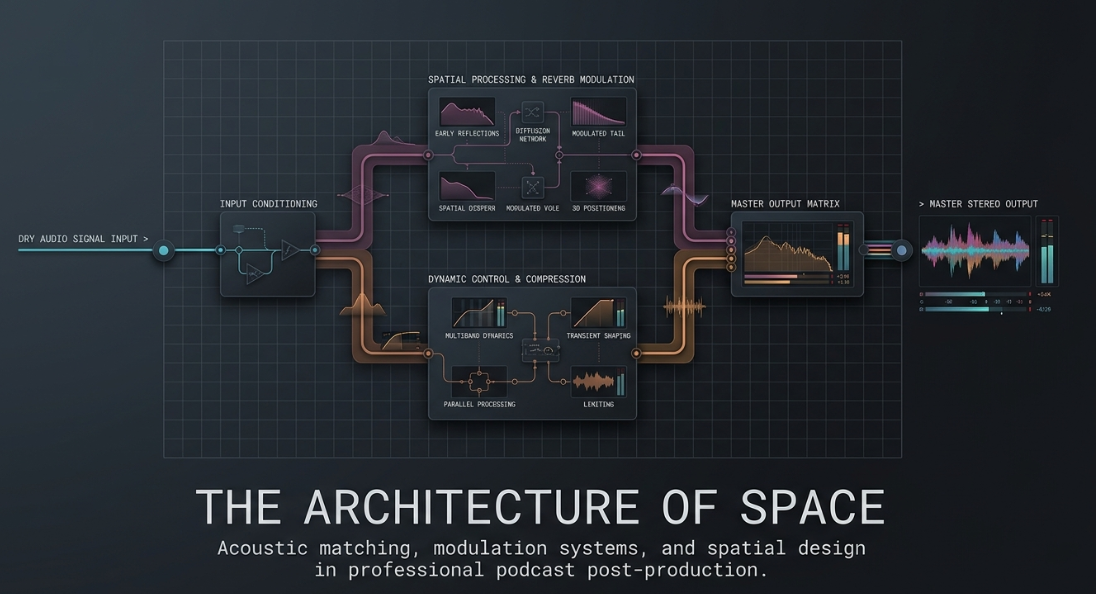
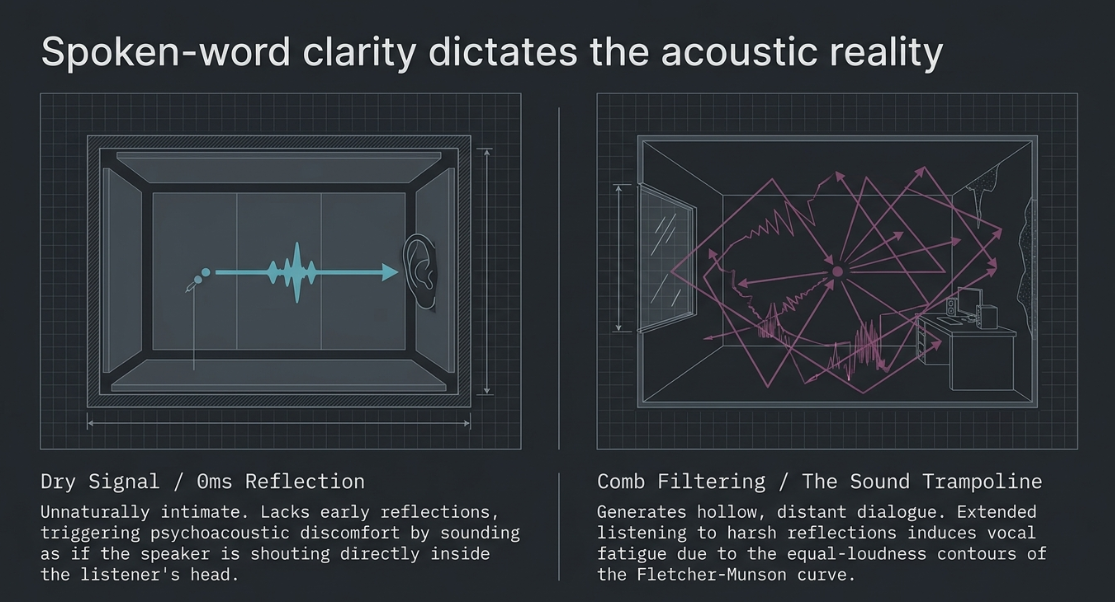
When dialogue is captured in highly sterile recording environments, such as isolated voiceover booths, and delivered via headphones, it can sound unnaturally intimate9. This dry signal lacks early reflections, creating a psychoacoustic phenomenon where the speaker sounds as if they are shouting directly into the listener’s ear canal9. Conversely, recordings captured in untreated domestic spaces contain excessive, uncontrolled room reflections7. These hard reflections bounce off glass, wood, or drywall, resulting in comb filtering and hollow, distant-sounding dialogue4. Post-production engineers resolve these issues by establishing a balance between natural acoustic environments and artificial enhancements1. While uncontrolled room reflections must be suppressed, a subtle, highly controlled degree of artificial early reflections can be introduced to simulate a natural, physically plausible space9. This technique matches the physical expectations of the listener, grounding the voices within a shared environment and maximizing intelligibility across diverse listening setups4.
Upstream Audio Restoration: De-Reverb, Dynamic Spectral Expansion, and Tone Excavation
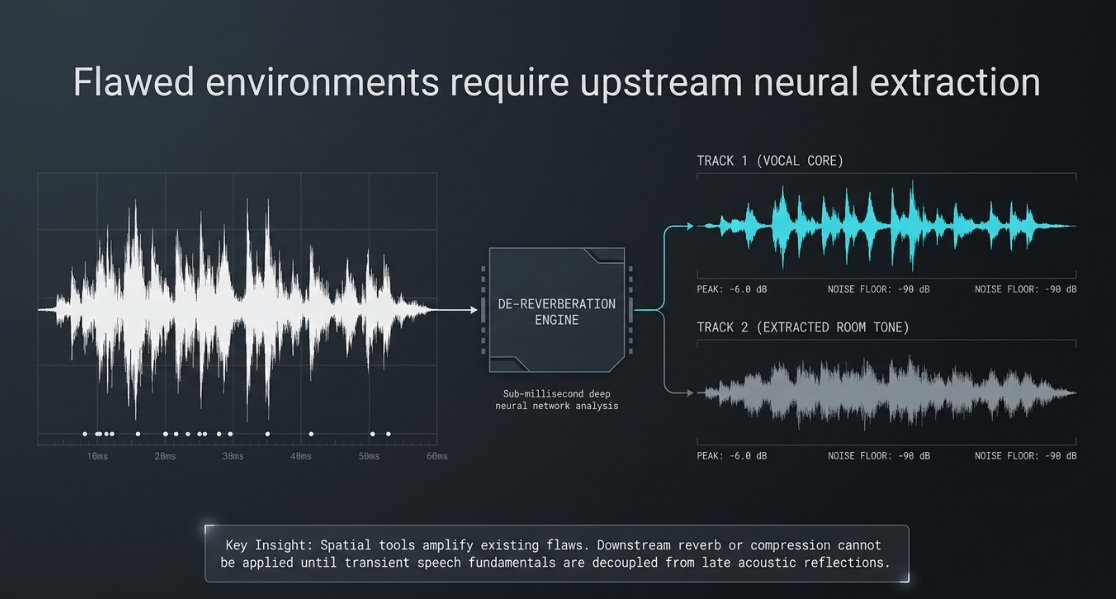
Before spatial or modulation tools can be applied to enhance dialogue, the raw recordings must undergo rigorous cleaning12. Because remote guest production is a standard workflow in modern podcasting, engineers regularly encounter audio files containing disparate and highly reflective room acoustics4. Upstream dereberation and resonance extraction are essential; attempting to apply downstream spatial effects or dynamic compression to a highly reverberant or resonant signal will only amplify those acoustic flaws12. Modern audio restoration employs advanced digital signal processing (DSP) and artificial intelligence (AI) to separate direct speech from its surrounding acoustic reflections13. These algorithms operate in both the time and spectral domains to attenuate unwanted spatial trails14.
Tools such as Waves Clarity Vx DeReverb, iZotope RX De-reverb, and Accentize DX Revive leverage deep neural networks trained on thousands of acoustic conditions13. These tools analyze the input signal at sub-millisecond resolutions to differentiate transient speech fundamentals from the diffuse, late reflections of the recording environment14. Web-based processing platforms like Isolate Audio allow engineers to target specific acoustic anomalies using natural language processing17. By generating isolated dual-track outputs of both the dry target signal and the extracted room reflections, engineers can dial back the room tone precisely, maintaining a subtle floor of natural atmosphere to avoid over-sanitizing the performance17.
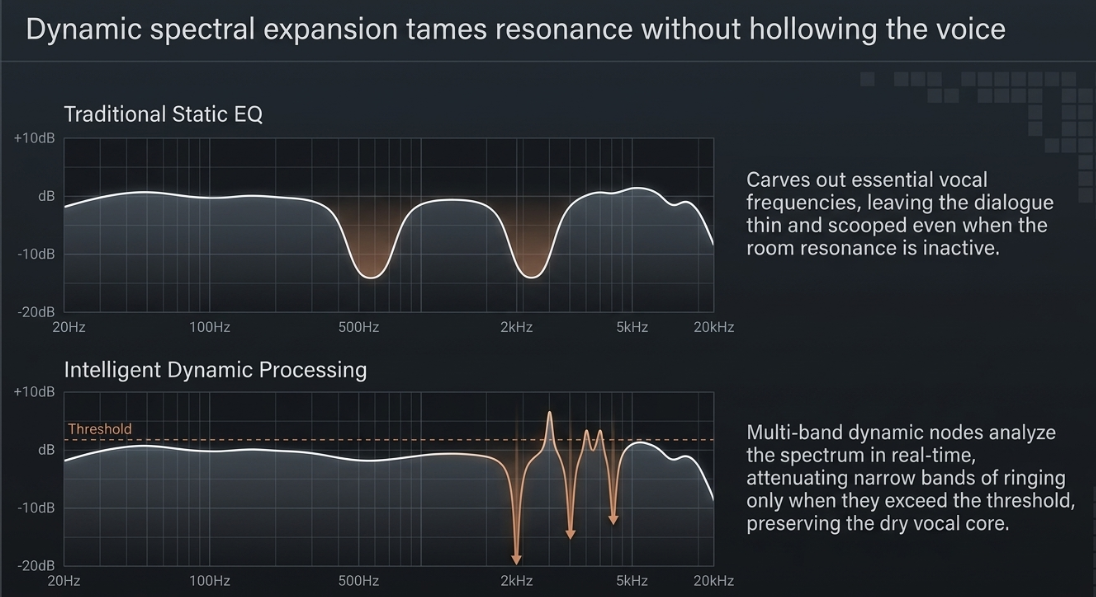
Untreated recording environments frequently generate mid-frequency room resonances, which manifest as sharp, narrow bands of ringing19. Traditional static parametric equalizers (EQs) can address these ring frequencies, but they also carve out essential vocal frequencies even when the resonance is inactive, resulting in a thin, scooped sound19. To prevent this, engineers utilize intelligent spectral dynamic processors, such as Oeksound Soothe218. These processors act as highly adaptive, multi-band dynamic EQs, analyzing the incoming frequency spectrum in real time and automatically attenuating narrow resonance bands (typically in the 

Once these resonances and early reflections are managed, the dialogue is prepared for subsequent processing, ensuring that any added artificial reverb integrates seamlessly with the dry vocal core12. In complex productions with pre-mixed music beds, tools like Acon Digital Remix allow the real-time separation of vocals, piano, drums, and other instruments22. This allows the engineer to attenuate vocals on a background music track when a host speaks, rather than executing a blunt, full-band ducking strategy22.
The Mechanics of Space: Convolution, Algorithmic, and Hybrid Re-Synthesis Engines
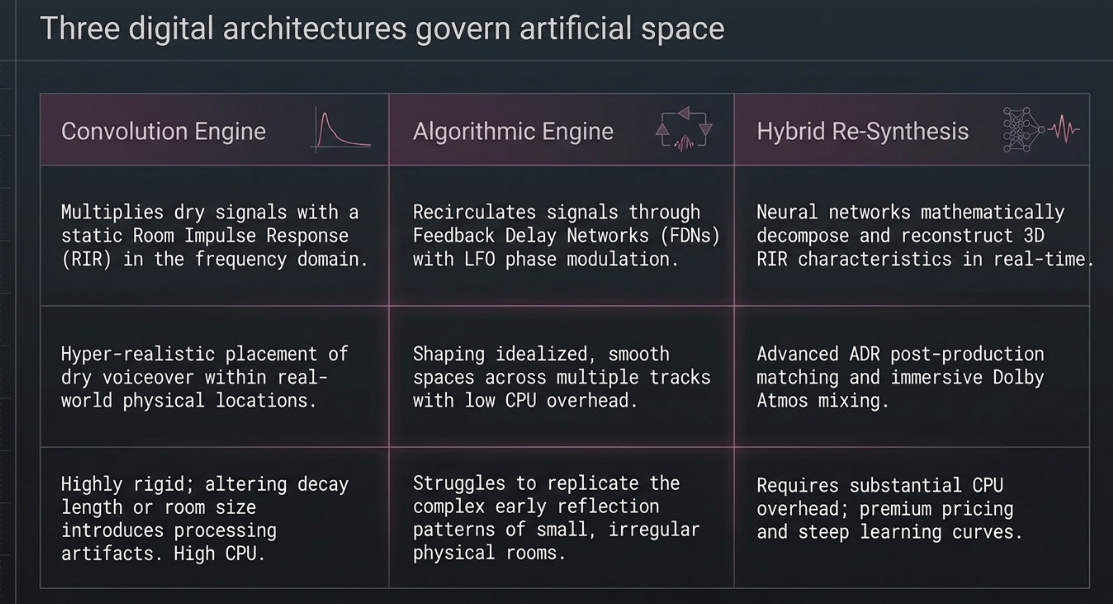
When introducing artificial space to podcast dialogue, post-production engineers rely on distinct plugin architectures: convolution reverbs, algorithmic reverbs, and hybrid re-synthesis models23. Each uses a different mathematical and computational approach to simulate physical or synthetic environments23.
Convolution Reverbs
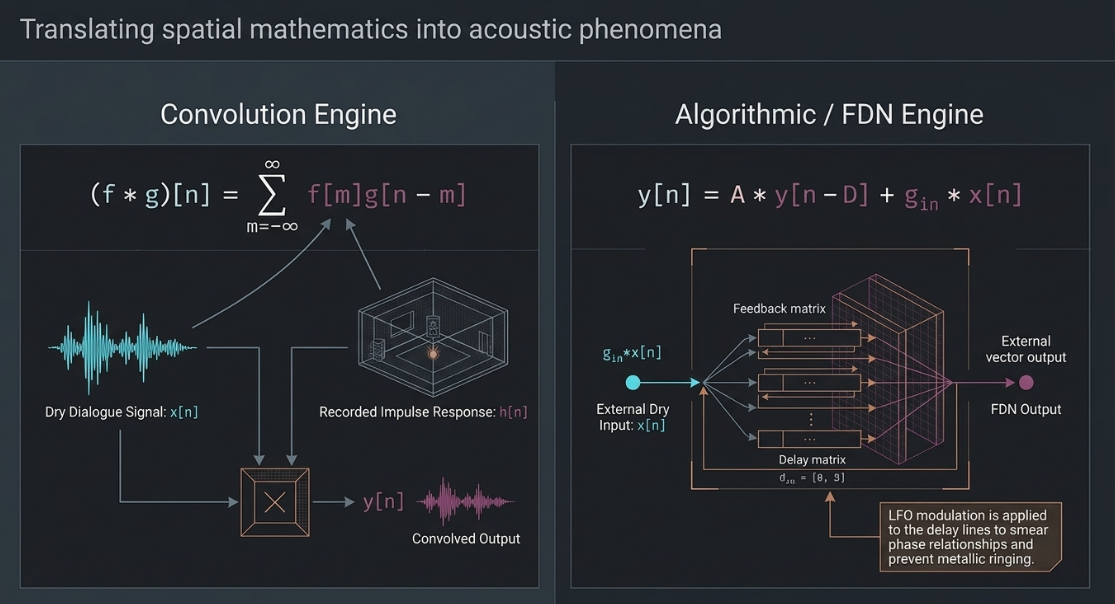
Convolution processors work by mathematically multiplying a dry input signal with a recorded Room Impulse Response (RIR)23. This process is represented mathematically by the discrete convolution sum:

where 

Algorithmic Reverbs
Algorithmic processors synthesize artificial space using digital delay lines, multi-tap networks, band-pass filters, and feedback structures23. Modern algorithmic reverbs almost universally rely on a Feedback Delay Network (FDN) architecture, where energy recirculates through multiple delay paths coupled by a mixing matrix32. The recurrence relationship of an FDN can be expressed as:

where 


Without modulation, an FDN is a linear time-invariant system that can produce metallic ringing and comb-filtering artifacts due to static phase cancellations32. To resolve this, designers introduce slow, low-frequency oscillator (LFO) modulation to vary the delay line lengths and filter coefficients over time32. This creates a linear time-varying system, smearing the phase relationships within the late decay tail to produce a smooth, diffuse sound free of robotic resonance23. Algorithmic reverbs, such as Valhalla Room or FabFilter Pro-R, are highly efficient and offer deep parameter control, but they can struggle to replicate the complex early reflection patterns of small, irregular physical rooms26.
Hybrid Re-Synthesis Engines
To combine the realism of convolution with the flexibility of algorithmic design, manufacturers have introduced hybrid re-synthesis engines24. Nugen Audio’s Paragon and Accentize Chameleon utilize artificial neural networks to analyze the temporal and spectral characteristics of 3D recorded spaces16. Rather than playing back a static RIR file, these tools decompose the acoustic data and reconstruct the space mathematically in real time24. This allows the engineer to alter room size, decay times, and brightness dynamically, without sample-stretching or introducing processing artifacts24.
Dialogue and ADR Matching: Systems for Creating Unified Shared Environments
A common challenge in podcast post-production is matching the vocal tone and spatial footprint of two or more hosts recorded in different locations4. For example, one host may record in a professionally treated studio, while a remote guest connects from an untreated home office4. To create a cohesive conversation, the engineer must minimize the acoustic contrast between these sources4.
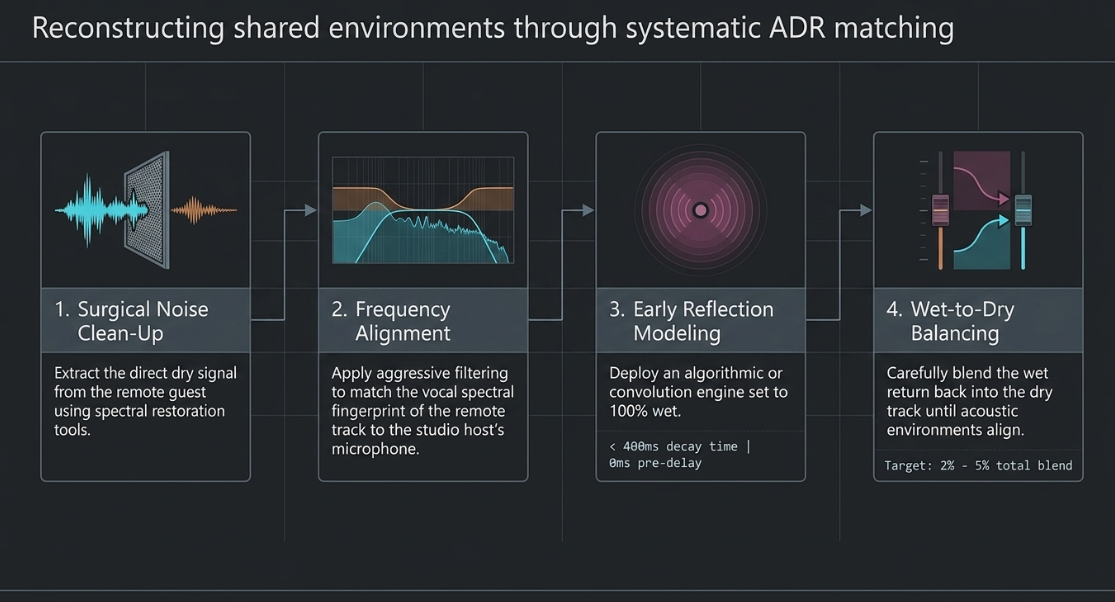
Historically, this matching process was completed manually, requiring years of listening experience10. The process involves several key manual steps:
Surgical Noise Clean-Up: The remote guest's track is cleaned of background noise using spectral restoration tools to isolate the direct dry signal12.
Frequency Alignment: High-pass and low-pass filters are applied aggressively to shape the vocal balance of the remote track to match the host microphone41.
Early Reflection Modeling: An algorithmic or convolution reverb is set to 100% wet, with a decay time of under

Wet-to-Dry Balancing: The wet reverb return is slowly blended back into the dry dialogue track (typically between 2% and 5%) until the acoustic environments align43.
Today, specialized software profiles these environments automatically10. Accentize Chameleon and iZotope Dialogue Match analyze a reference dialogue track, extract its acoustic fingerprint (spectral profile, early reflection response, and late decay time), and construct a matching convolutional space to apply directly to the dry track10.
Engineers also employ color-matching processors to bridge physical discrepancies41. Wireless lapel microphones used in production often exhibit a distinct high-frequency grit and over-compression from transmitters41. Adding subtle harmonic excitement via the Aphex Aural Exciter or low-fidelity saturation using plugins like Avid Lo-Fi to dry studio ADR helps make it sit seamlessly alongside gritty location feeds41.
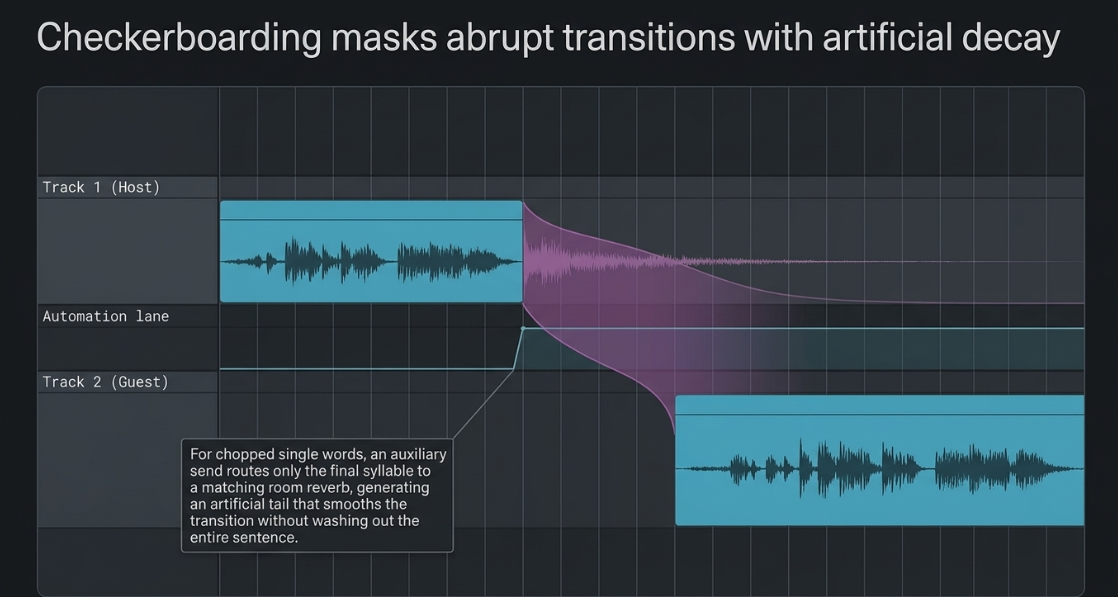
Beyond setting the space, engineers use specialized workflows to ensure editing transitions remain transparent11. When editing dynamic interviews, abrupt cuts between separate takes can slice off the natural room reflections at the end of a sentence, drawing immediate attention to the edit11. To prevent this, engineers "checkerboard" adjacent dialogue segments onto alternating audio tracks11. This allows the natural or artificial reverb tail of the first speaker to decay gracefully underneath the start of the next speaker's line, avoiding abrupt acoustic transitions11.
If checkerboarding is insufficient, or if a single word has been cut from a sentence, engineers use an auxiliary send to route only the final syllable of the edited word to a matching room reverb11. By writing dynamic fader automation to open the aux send only during that final syllable, the engineer generates an artificial tail that rings out naturally, smoothing the transition without washing the entire sentence in reverb11.
For situations where clean room tone is unavailable, engineers utilize the manufactured room tone trick11. By extracting a few frames of silence containing only background ambient noise from a recording, analyzing the impulse response profile inside a plugin like McDSP Revolver, and routing pink noise through that convolutional model, the system generates a steady, unlimited supply of phase-coherent matching room tone11.
Advanced Tail-Shaping, Filtering, and Modulation Chain Architectures
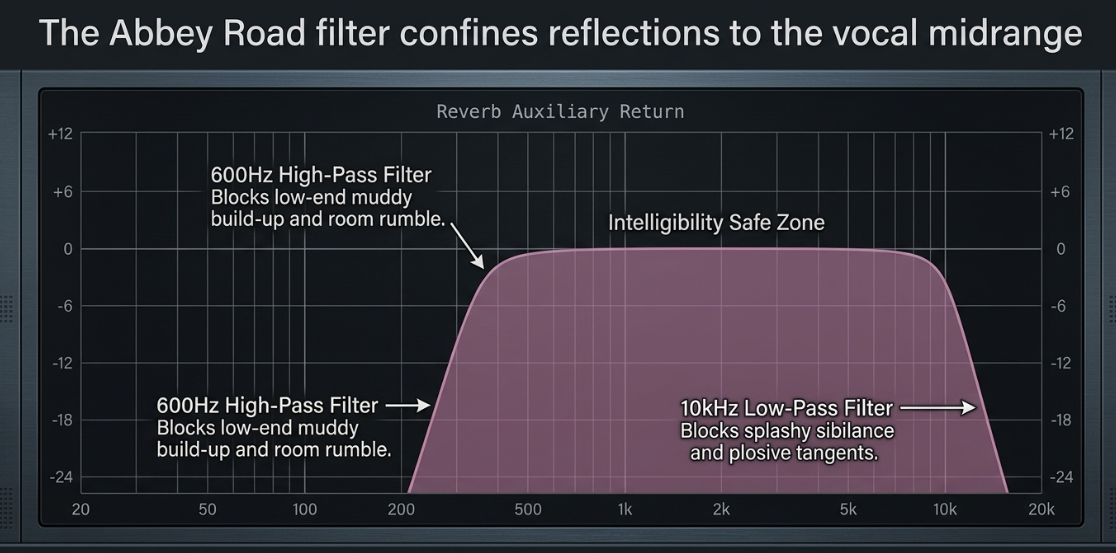
To integrate reverb into a dialogue mix without reducing intelligibility, engineers use advanced signal flow routings and dynamic modulation techniques2. Applying full-bandwidth reverb to dialogue often introduces low-frequency rumble and high-frequency sibilance, muddying the mix43. To prevent this, engineers employ a band-pass filtering technique on the auxiliary reverb send, historically known as the Abbey Road trick45. An equalizer is placed immediately before or after the reverb processor on the auxiliary return bus43. A high-pass filter (HPF) is set between 




Engineers also incorporate the Waves Abbey Road Saturator into the pre-delay signal path48. This processor uses a pre-EQ compressor, filters, saturation, and expander (a compander circuit) to add harmonic excitation without introducing brittleness, allowing the dialogue to cut through dense backgrounds48. For more complex tape-based spatial behaviors, engineers employ modeled systems like the S.T.E.E.D. (Send, Tape, Echo, Echo, Delay) signal path in Abbey Road Chambers49. This configuration routes a feedback loop through modeled tape delays, RS106 band-pass filters, and RS127 midrange boosts to generate evolving slapback echoes, which prevents the static, sterile decay common in purely digital acoustic models49.
[Dialogue Input] ───> [Saturator / Compander] ───> [S.T.E.E.D. Feedback Loop] ───> [Reverb Matrix]
To prevent the spatial tails from sounding sterile, other modulation tools are introduced into the signal chain1. Chorus, flanging, phasing, and tremolo are placed mid-chain, after dynamics and tone shaping but before the final reverb1. Placing these effects before the reverb ensures that their modulation is diffused into the spatial tail, creating subtle movement and depth50. This approach is paired with hardware emulations like the Lexicon 480L51. The Lexicon 480L’s Random algorithm adds random delay variations to its feedback paths51. This reduces long-lived resonant modes in the late decay tail, minimizing metallic coloration and improving steady-state timbre51.
Dynamic Control: Duckers, Sidechain Compression, and Spatial Integration
To manage the relationship between dialogue and surrounding elements, engineers must distinguish between true dynamic sidechaining and static level adjustments52. True ducking requires dedicated sidechain routing, where the presence or amplitude of a primary signal dynamically controls the gain of a secondary processor52.
┌─────────────────┐
▼ │
[Dialogue Track] ─── (Split to Sidechain) │ (Triggers Compression)
│ │
└─────── (Direct Output) ─────────> [Reverb Bus Compressor] <─── [Reverb Tail Input]
In reverb ducking, a compressor is inserted on the auxiliary reverb return bus, immediately following the reverb plugin and the band-pass EQ43. The sidechain input of this compressor is routed from the dry dialogue track53. The compressor threshold is adjusted so that whenever the host is actively speaking, the reverb return is compressed (ducked) by 

This maintains vocal presence and clarity during speech, while still providing a sense of space in the pauses54. Plugins like Waves H-Reverb feature built-in ducking and overdrive controls, allowing engineers to configure this dynamic interaction directly within the reverb engine48.
This dynamic routing is also used to balance dialogue against music beds2. Engineers configure duckers and upward expanders to manage background elements without crushing their natural dynamics1. When dialogue is present, the background music bed is ducked to prevent masking in the 

When the dialogue stops, the music rises back to its target level52. Upward expanders are placed in the music signal path to restore dynamic contrast during these transitions, ensuring that the background elements sound natural rather than over-compressed or pumping unnaturally1.


Spatial Routing Architectures and Templates in Modern Post-Production
To ensure efficiency and consistency across episodes, professional podcast engineers construct standardized routing templates in their DAWs2. These configurations avoid placing processors directly on individual tracks, opting instead for a streamlined bussing system2.
[Dialogue Tracks] ───> [Vocal Subgroup Bus] ─── (Aux Sends) ───> [Reverb / Pitch Returns]
│ │ │
└─> (Direct Path) ─────┴────────> [Master Output Bus (Mono)] <───┘
Engineers typically design their templates around a three-reverb setup to handle various matching and spatial requirements11:
Mono Reverb Bus
This routing hosts a short convolution or algorithmic engine set to 100% wet with a decay time under 
Stereo Room Bus
Set to a medium decay time (

Surround/Immersive Bus
For multi-channel formats like Dolby Atmos (

These plugins utilize dedicated crosstalk controls to manage how reflections bleed across channels24. By disabling the crosstalk input on the center channel and routing the reflections to the side and rear channels, the engineer keeps the primary dry dialogue focused in the center, free of muddy reflections, while the spatial environment envelopes the listener24.
[L/R Surround Channels] <─── (Crosstalk Out)
▲
│
[Mono Center Dialogue] ───> [Paragon] ─── (Crosstalk In: Disabled) ───> [Dry Center Output]
To monitor these configurations, engineers place specialized meters on the master output6. Waves WLM or WLM Plus track target loudness (-16 LUFS for podcasts)28.
For precise analysis of dialogue clarity, tools like Nugen Audio DialogCheck run Fraunhofer's IDMT Listening Effort algorithm3. The plugin’s color-coded History View highlights areas of poor intelligibility (coloring values above 60 green, 30 to 60 yellow, and below 30 red), allowing the engineer to spot-treat muddy sections or adjust the wet-to-dry balance of the spatial returns3.
Narrative Sound Design and Emotional Spot-Reverbs
While spatial tools are primarily used to correct and balance acoustic environments, they also serve as creative narrative elements in spoken-word productions1. Exaggerated reverb can be used in a natural context to reinforce a scene's mood, such as creating a sense of dread or loneliness10.
For example, applying an unnaturally large reverb to a door slam can establish a feeling of isolation or tension, while slowing down and extending the tail of a critical sound effect (like a gunshot) can reflect a character's internal point of view during a dramatic transition10.
[Dry Vocal Cut] ───> [EQ Bandpass Filter] ───> [Modulated Delay Feedback] ───> [Long Lush Reverb]
Reverbs are also used to place off-screen sound effects, such as footsteps or background events, within the proper spatial context to maintain the illusion of distance and placement within the virtual room10.
When treating narration, engineers tailor the spatial properties based on the desired tone:
Wistful Narration: Uses a longer decay tail with a modest pre-delay to place the narrator in a separate, reflective space from the main scene, signaling distance and reflection10.
Snappy Narration: Employs short, subtle early reflections to add vocal presence and warmth while keeping the narrative voice distinct from any background music8.
Flashback Dialogue: When transitioning to a flashback, engineers fade up a short "handle of atmosphere" (the natural background ambience of the flashback scene) right before the speaker starts10. This subtle transition cue signals the shift in time and space, establishing the emotional context before the dialogue begins10.
Through these techniques, the post-production engineer transforms reverb from a simple acoustic corrective tool into an active, creative element that supports the narrative arc and protects the listener's experience1.
Works cited
Audio Engineering in a Professional Podcast Post-Production - Finchley Studios, https://www.finchley.co.uk/finchley-learning/visual-podcast/audio-engineering-in-a-professional-podcast-post-production
Audio Mixing Techniques for Pro-Level Podcasts & Video - Flexwork Studios, https://flexworkstudios.com/audio-mixing-techniques/
Nugen Audio DialogCheck - Sound On Sound, https://www.soundonsound.com/reviews/nugen-audio-dialogcheck
Why Your Studio Acoustics and Remote Interview Audio Quality Matter - Podcast Engineers, https://www.podcastengineers.com/blogs/why-your-studio-acoustics-and-remote-interview-audio-quality-matter/
Virtual Presenting A Guide To Formats, Production and Authentic Delivery (Jamie Cohen, Michael Sorrentino) (Z-Library) - Scribd, https://www.scribd.com/document/801981768/Virtual-Presenting-a-Guide-to-Formats-Production-and-Authentic-Delivery-Jamie-Cohen-Michael-Sorrentino-Z-Library
What does your editing process typically involve? : r/podcasting - Reddit, https://www.reddit.com/r/podcasting/comments/1inlvvk/what_does_your_editing_process_typically_involve/
Room Reflections & Reverb: Fix Podcast Audio Problems, https://thepodcastconsultant.com/blog/reverb-room-reflections
Tech-Free, No-Cost Ways to Dramatically Improve your Podcast Audio | Blog Post, https://www.annavanvalin.com/blog/acoustics
Podcast reverb.. : r/audioengineering - Reddit, https://www.reddit.com/r/audioengineering/comments/hzo9i2/podcast_reverb/
6 Ways to Use Reverb in Post Production Sound Design - iZotope, https://www.izotope.com/community/blog/reverb-in-post-production-and-sound-design
Dialog Reverb. A place to share your experience. - The Post Place - JWSOUNDGROUP, https://jwsoundgroup.net/index.php?/topic/20868-dialog-reverb-a-place-to-share-your-experience/
Audio Post-Production: Complete Guide, Techniques, and More - Boris FX, https://borisfx.com/blog/audio-post-production-complete-guide/
Plugins for Post-Production & Sound Design - Waves Audio, https://www.waves.com/plugins/post-production
Are there any plugins designed specifically for improving the sound of dialogue? - Reddit, https://www.reddit.com/r/AudioPost/comments/1dnqgsz/are_there_any_plugins_designed_specifically_for/
Bossjock Studio My Best in Show for Voice Excellence, https://clonemyvoice.io/blog/bossjock-studio-my-best-in-show-for-voice-excellence.php
Dialogue Reverb Matching Plugin for ADR and Post Production - Accentize, https://www.accentize.com/product/chameleon/
The 12 Best Podcast Editing Software Options for 2026 (Ranked and Reviewed), https://isolate.audio/articles/best-podcast-editing-software
Dialogue Signal Processing for Film Tutorial - Pro Sound Effects Blog, https://blog.prosoundeffects.com/dialogue-signal-processing-tutorial-video
Any tips on dealing with mid frequency room resonances on dialogue? : r/AudioPost - Reddit, https://www.reddit.com/r/AudioPost/comments/cq2bvh/any_tips_on_dealing_with_mid_frequency_room/
11 Tips to Fix Cheap Sounding Audio in the Mix - iZotope, https://www.izotope.com/community/blog/11-tips-to-fix-cheap-sounding-audio-in-the-mix
Schmoooooooo - got any settings to share? - Effects - Guitarchat, https://www.guitarchat.co.uk/topic/5519-schmoooooooo-got-any-settings-to-share/
Fitting Music Around Dialogue: How Acon Digital Remix Transforms Audio Post, https://acondigital.com/blog/fitting-music-around-dialogue-how-acon-digital-remix-transforms-audio-post
What is convolution reverb vs. algorithmic reverb? - Wisseloord Studios, https://wisseloord.org/academy/what-is-convolution-reverb-vs-algorithmic-reverb
Paragon: A sense of space | NUGEN Audio, https://nugenaudio.com/sense-of-space/
How Films Recreate Reverb for Scenes | Enhanced Media - Audio Post Production Company, https://enhanced.media/blog/2020/7/28/how-to-create-realistic-reverb-for-your-films
Top Convolution Reverb & Algorithmic Reverb Plugins - MasteringBOX, https://www.masteringbox.com/learn/reverb-plugins
(PDF) METHODS OF USING ARTIFICIAL REVERBERATION IN MODERN SOUND ENGINEERING - ResearchGate, https://www.researchgate.net/publication/360728375_METHODS_OF_USING_ARTIFICIAL_REVERBERATION_IN_MODERN_SOUND_ENGINEERING
Plugins for Audio Post-Production: What the Pros Are Using, https://theproaudiofiles.com/post-production-plugins/
IR-L Convolution Reverb Plugin - Waves Audio, https://www.waves.com/plugins/ir-l-convolution-reverb
Accentize unveil Chameleon Surround, https://www.soundonsound.com/news/accentize-unveil-chameleon-surround
Convolution Reverb 101: 7 Best Plugins and How to Use Them - Output, https://output.com/blog/convolution-reverb-101-7-best-plugins-and-how-to-use-them
FDN Reverb - Ripples of Space and Time | Jian Chen, https://jian-chen.name/posts/reverb/
What is Reverb? Types, Parameters, & Uses Explained - Avid, https://www.avid.com/resource-center/what-is-reverb
Best reverb plugins: Amazing space-makers for your DAW - MusicRadar, https://www.musicradar.com/news/best-reverb-plugins
Best FX for Soundtracks: Cinematic Audio Processing Guide - Output, https://output.com/blog/best-fx-for-soundtracks
2025's Best Convolution Reverb & Algorithmic Reverb Plugins - Unison Audio, https://unison.audio/convolution-reverb/
NUGEN Audio Paragon Review: The Most Realistic Algorithmic Reverb Available?, https://www.michaelmusco.com/2026/05/nugen-audio-paragon-review.html
NUGEN Audio Paragon - Milk Audio Store, https://www.milkaudiostore.com/intl/shop/nugen-audio-paragon/
reverb | The Halls of Valhalla, https://valhalladsp.wordpress.com/tag/reverb/
Introducing Accentize Chameleon Surround, https://www.accentize.com/2024/10/10/introducing-accentize-chameleon-surround/
How the Pros Match ADR and Production Dialogue - Jeff Carpenter, https://www.tbirdsound.com/post/adrmatch
ADR dialogue, make the studio sterility more like it came from the field - Waves Forum, https://forum.waves.com/t/adr-dialogue-make-the-studio-sterility-more-like-it-came-from-the-field/212
How to get reverb to sound authentic and not forced? : r/audioengineering - Reddit, https://www.reddit.com/r/audioengineering/comments/1cpc869/how_to_get_reverb_to_sound_authentic_and_not/
Accentize - Chameleon - 344 Audio, https://www.344audio.com/post/review-accentize-chameleon
Are There Any Benefits to Using P8 in a DAW? (Page 1) - Pianoteq user forum, https://forum.modartt.com/viewtopic.php?id=10120
Drummer not happy with mixes. Wants more of an “Albini” sound. - Reddit, https://www.reddit.com/r/audioengineering/comments/17t4rzx/drummer_not_happy_with_mixes_wants_more_of_an/
Less is more: the art of removing the unnecessary from your music | MusicRadar, https://www.musicradar.com/news/less-is-more-minimalism-music
Best Waves Plugins for Vocals 2026 · Notes · Resoundsound Mastering, https://resoundsound.com/notes/best-waves-plugins-for-vocals/
Abbey Road Chambers Reverb Plugin - Waves Audio, https://www.waves.com/plugins/abbey-road-chambers
Understanding Audio Effects: A Producer's Overview for 2026 - Dubspot.com, https://blog.dubspot.com/understanding-audio-effects-an-overview
Lexicon 480L Digital Reverb and Effects Manual - Universal Audio Support, https://help.uaudio.com/hc/en-us/articles/33194625601044-Lexicon-480L-Digital-Reverb-and-Effects-Manual
Ducking - Grokipedia, https://grokipedia.com/page/Ducking
What Is Sidechain Compression & How to Use It - Boris FX, https://borisfx.com/blog/what-is-sidechain-compression-and-how-to-use-it/
What is Audio Ducking and How to Do It in Music Production - iZotope, https://www.izotope.com/community/blog/what-is-audio-ducking
Soundcraft Audio Mixer: A Podcaster's Guide for 2026 - SparkPod.ai, https://sparkpod.ai/blog/soundcraft-audio-mixer
Hotone NeonGlow Series Freqlux Tri-Pitch Engine (Stereo) - Pedal of the Day, https://www.pedal-of-the-day.com/2026/05/07/hotone-neonglow-series-freqlux-tri-pitch-engine-stereo/
How to mix a song with iZotope Music Production Suite 8, https://www.izotope.com/community/blog/mix-with-music-production-suite
NUGEN Audio - Wikipedia, https://en.wikipedia.org/wiki/NUGEN_Audio