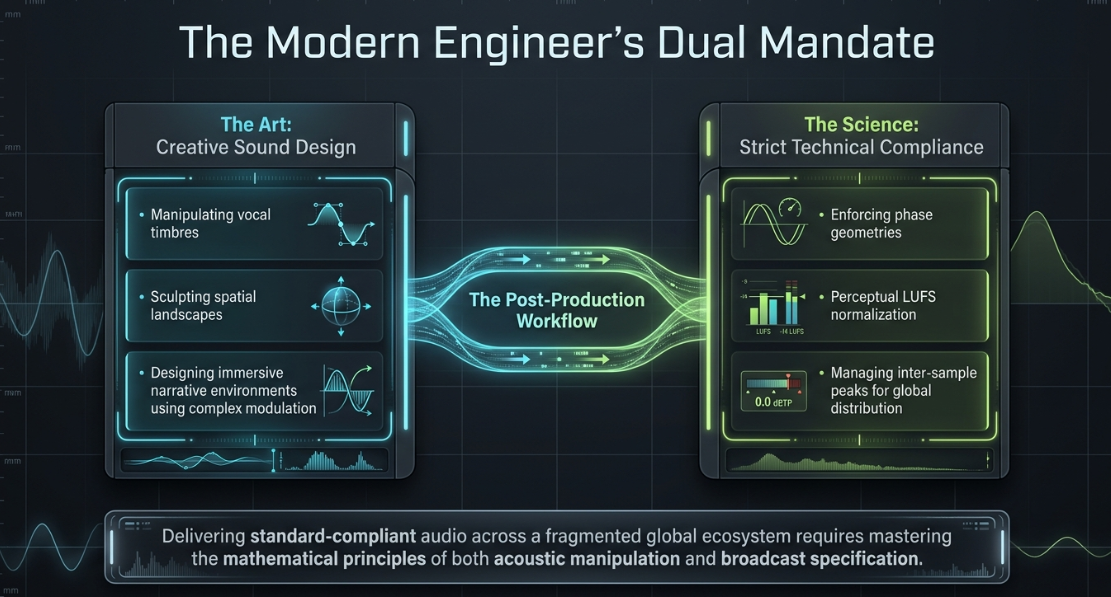
The post-production landscape of professional spoken-word and narrative podcasting demands a precise synthesis of creative sound design and strict technical compliance1. To deliver standard-compliant audio across a fragmented ecosystem of global distribution channels, audio engineers must possess an exhaustive understanding of two distinct domains2. First, the mathematical and digital signal processing principles that govern modulation tools must be mastered to manipulate vocal timbres, create spatial landscapes, and design narrative environments6. Second, the complex physics of perceived loudness normalization, inter-sample peak geometries, and international broadcast delivery specifications must be rigorously implemented9. This technical report examines the tools, algorithms, and post-production workflows required to achieve broadcast-level acoustic quality3.
Comparative Analysis of Modulation Tools in Voice Styling and Sound Design
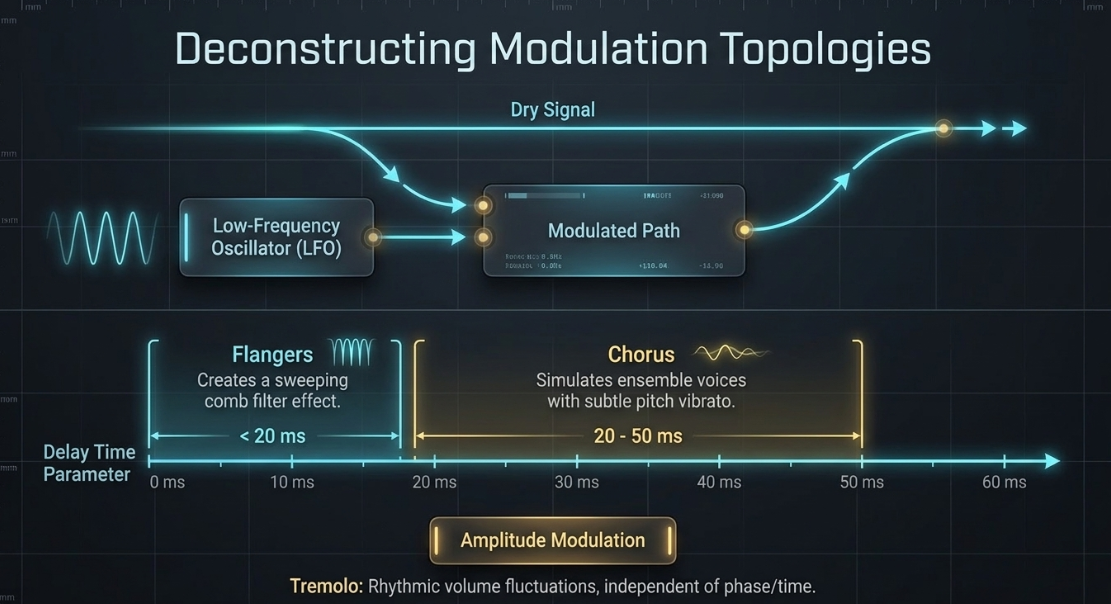
Modulation processors operate by splitting an incoming audio signal, altering specific parameters of the duplicated path over time using a Low-Frequency Oscillator (LFO), and recombining the modulated path with the dry signal8. While traditionally associated with musical instrumentation, these tools are highly effective in podcast post-production for voiceover styling, sound design, and audio drama narrative transitions6.
The primary physical variable that distinguishes chorus, flanging, and phasing is delay time8. Phasers do not utilize a digital delay line; instead, they split the signal and route one path through a series of all-pass filters that shift the phase of specific frequency bands relative to the input, creating frequency notches upon recombination8. Flangers employ short, LFO-modulated delays of to to generate a sweeping comb filter8. Chorus processors extend these delays to to and introduce subtle pitch modulation (vibrato) across multiple voices to simulate an ensemble8. Tremolo modulates signal amplitude rather than phase or time, creating rhythmic volume fluctuations6.
Modern post-production utilizes specialized digital and hardware tools to achieve these modulation profiles, each presenting unique engineering mechanisms and workflows:
Cableguys Shaperbox 2: This suite provides dynamic control over modulation parameters by incorporating dedicated Time and Filter Shapers21. The time-shaping algorithms allow engineers to draw custom LFO wave shapes with sample-accurate precision, enabling tempo-synced tape-stop effects, rhythmic stuttering, and dynamic filtering21. In podcast sound design, this provides an efficient platform for generating stylized transitions or processing background soundscapes to separate them from the primary voice frequencies6.
Waves Vocal Bender: Operating with zero latency, this monophonic voice manipulation plugin is optimized for real-time vocal pitch and formant shifting22. Rather than simply altering the pitch of the voice, which can introduce unnatural "chipmunk" artifacts, the plugin permits independent adjustment of the vocal formant22. Lowering the formant maintains the pitch while artificially expanding the vocal tract, creating a deeper, more resonant character, whereas raising the formant tightens the vocal tract to simulate a younger or synthesized voice22. Integrated step sequencers, LFOs, and pitch envelopes allow sound designers to generate robotic "flattened" vocal double effects, robotic voiceovers, and dynamic vocal transitions22.
Kernom ELIPSE: Powered by patented Analog Morphing Core technology, this processor bridges digital flexibility and analog warmth19. Its MOOD control allows the engineer to morph between classic modulation effects, including tremolo, chorus, flanging, phasing, and rotary speaker emulation19. The SWIRL control blends a slow, phase-shifted texture with an internal analog drive circuit, generating rich even and odd harmonics that enrich thin vocal recordings19. This tool handles instrument and line-level inputs, making it useful in hybrid analog-digital mastering loops19.
Southampton Pedals Utility Knife: This multi-modulation digital tool consolidates chorus, flanging, tremolo, and phasing into a streamlined interface20. A critical engineering feature of this design is its integrated output volume control, which provides up to of clean makeup gain to combat the perceived volume drop that historically plagues classic passive modulators20. The tremolo mode utilizes a clean sine-wave modulation curve for vintage-style volume sweeps, while the flanger features a warm, complex "whoosh" by modulating a tight LFO rate with high feedback settings20.
Waldorf Iridium Desktop MK2: For sound design within complex audio dramas, this hardware synthesizer and signal processor utilizes six distinct synthesis engines, including granular particle sampling and resonator modeling, alongside dual stereo filters24. Its modulation matrix features six LFOs and a morphable "Komplex" modulator24. The integration of a "Flavour" control introduces subtle micro-variations in timing, pitch, and timbre24. This control replicates the natural, non-linear instabilities of vintage analog circuitry, preventing digital stagnation and adding organic movement to synthesized ambiences and transitional sound effects24.
Phase Geometries, Mono Compatibility, and Mid-Side Matrixing
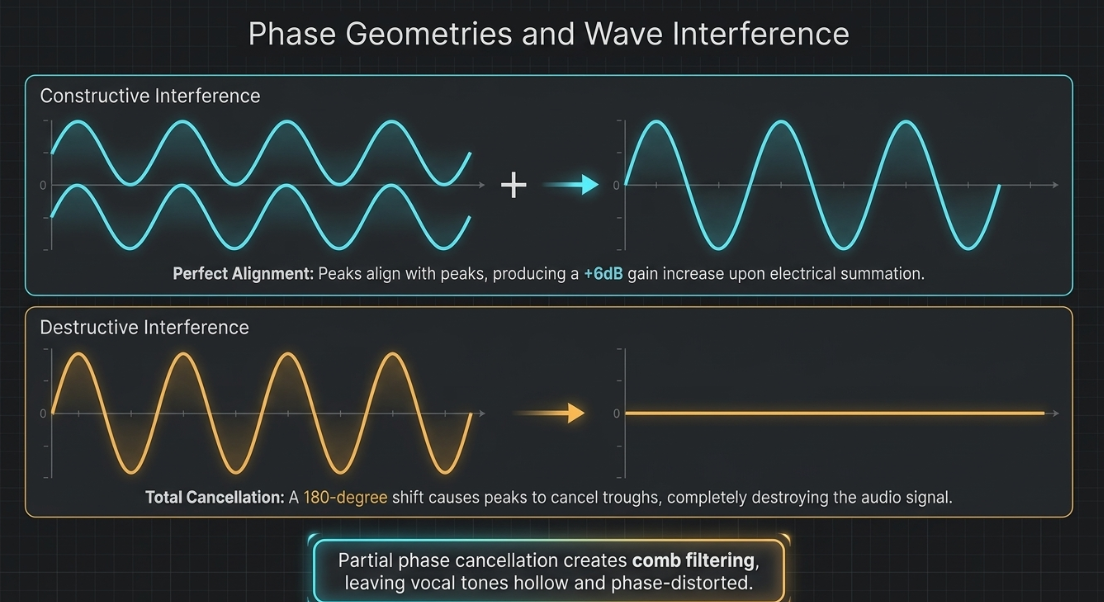
Phase alignment is a fundamental physical property of sound waves that determines whether combining related signals results in acoustic reinforcement or degradation25. A sound wave is a repeating cycle of air pressure variations; when captured digitally, this cycle is mapped as a waveform that rises (peaks) and falls (troughs) relative to a zero axis25. The relative position of a waveform within this cycle is its phase, measured in degrees26.
When two related waveforms combine, they exhibit wave interference8. Constructive interference occurs when two identical waves are in phase ( phase shift), aligning peaks with peaks to produce a gain increase upon summation25. Destructive interference occurs when a delay, reflection, or polarity inversion shifts one wave relative to the other25. At a perfect phase shift (opposite polarity), the peaks of one signal align with the troughs of the other, canceling the audio signal completely when summed electrically25. In real-world environments, partial phase cancellation generates comb filtering, where specific frequencies are attenuated at regular intervals, resulting in a thin, hollow, and phase-distorted vocal tone8.
The Threat of Stereo Widening to Mono Compatibility
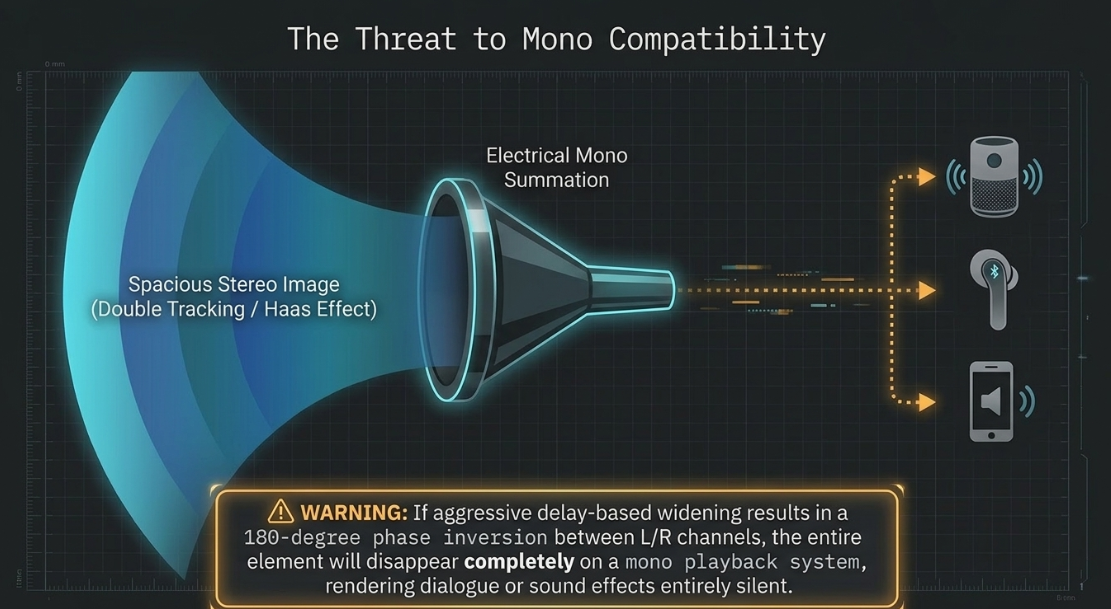
In professional podcasting, mono compatibility is a vital quality control metric25. While post-production engineers often mix in stereo, a substantial portion of the audience consumes podcasts on monaural systems, including smart speakers, mobile devices, single headphones, or public address networks26.
If an engineer applies wide-stereo modulation effects, aggressive delay-based widening (such as the Haas effect), or out-of-phase double-tracking to voiceovers or music beds, these elements may sound spacious in stereo but will suffer from severe phase cancellation when summed to mono15. In extreme scenarios, such as when a signal is completely phase-inverted between the Left and Right channels ( offset), the entire element will disappear from a mono playback system, rendering the dialogue or sound effect completely silent26.
Mid-Side Matrix Processing and Signal Protection
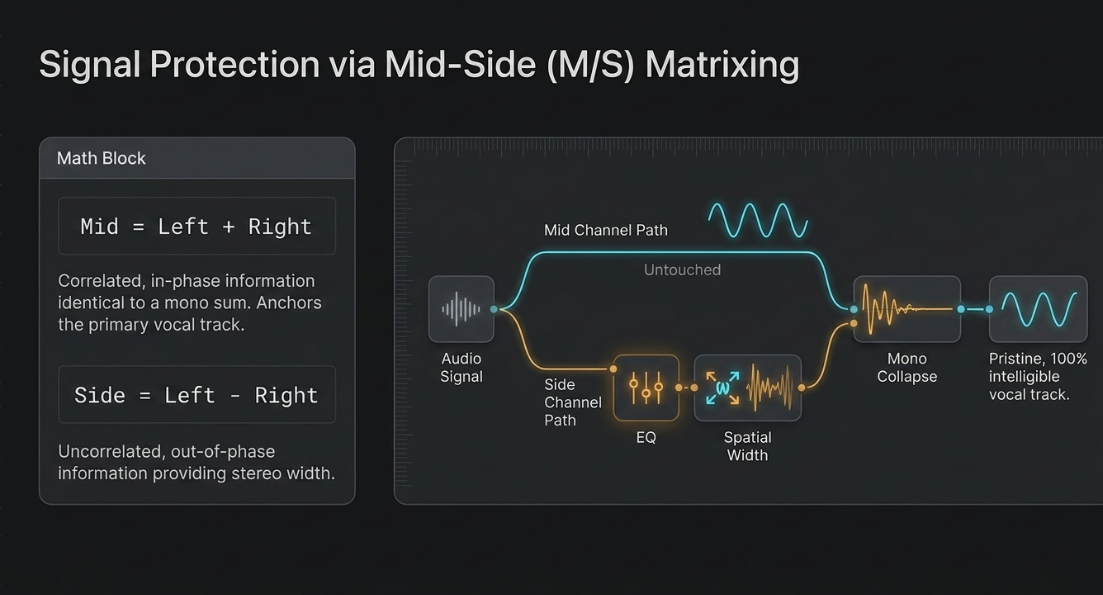
To expand the stereo field while guaranteeing perfect mono compatibility, post-production engineers utilize Mid-Side (M/S) matrix processing27. The M/S matrix converts a standard Left/Right () stereo signal into Mid () and Side () channels through mathematical summation and subtraction28:
[cite: 28]
[cite: 28]
The Mid channel captures all correlated, in-phase information that is centered in the stereo image, which is identical to a standard mono sum27. The Side channel isolates all non-correlated, out-of-phase information that provides the perception of stereo width27.
By processing these channels independently, an engineer can apply equalization, compression, or subtle modulation solely to the Side channel to create spatial width and depth, while leaving the Mid channel untreated15. When the stereo mix is eventually summed to mono, the Side channel cancels itself out completely, leaving the clean, focused Mid channel completely untouched27. This ensures that the primary voice track remains centered, intelligible, and free from comb filtering, regardless of the listener's playback environment25.
Perceptual Loudness and Broadcast Metering Architectures
The evolution of audio leveling has transitioned from legacy peak-amplitude measurements to perceived loudness normalization standards2. This shift was accelerated by the limitations of peak-based metering and the resulting public complaints regarding extreme volume discrepancies13.
The Legacy of Peak Programme Meters
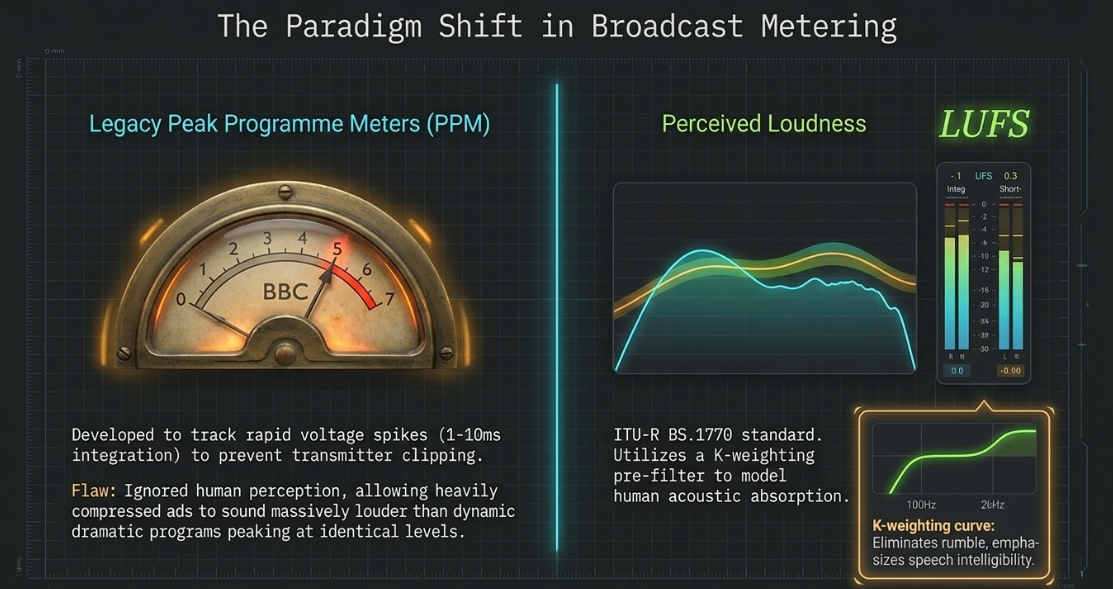
Developed by the BBC in the late 1930s and eventually standardized under IEC 60268-10, Peak Programme Meters (PPM) were the standard tool for monitoring broadcast levels for decades32. PPMs are electronic instruments designed with a fast integration time (typically to ) and a slow, controlled decay profile (usually dropping in approximately to )35. This quasi-peak response was engineered to track rapid voltage spikes (transients) to prevent overmodulation and transmitter clipping, while ignoring sustained average levels35.
However, because human hearing does not perceive loudness based on instantaneous voltage peaks, the PPM failed to provide an accurate representation of how loud a broadcast actually felt over time9. This measurement gap allowed highly compressed, dynamically flat advertisements and music blocks to sound significantly louder than adjacent, highly dynamic dramatic programs, even though both peaked at identical levels on the meter13.
The Modern Perceived Loudness Framework
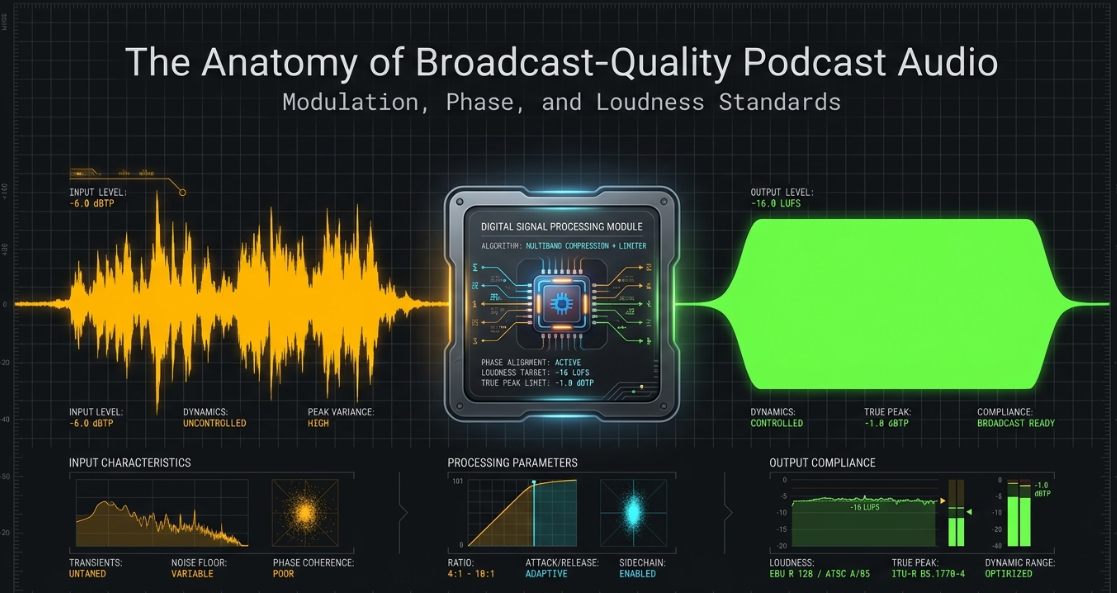
To address these inconsistencies, the International Telecommunication Union established the ITU-R BS.1770 standard, introducing the Loudness Unit () and Loudness Unit relative to Full Scale (), which is identical to Loudness K-weighted relative to Full Scale ()9. Perceived loudness calculations use a K-weighting pre-filter to model the acoustic absorption of the human head and the frequency response of the ear canal2. This pre-filtering consists of a high-pass filter at to eliminate inaudible low-frequency rumble, combined with a high-shelf pre-emphasis boost starting at to emphasize the speech-intelligibility range2.
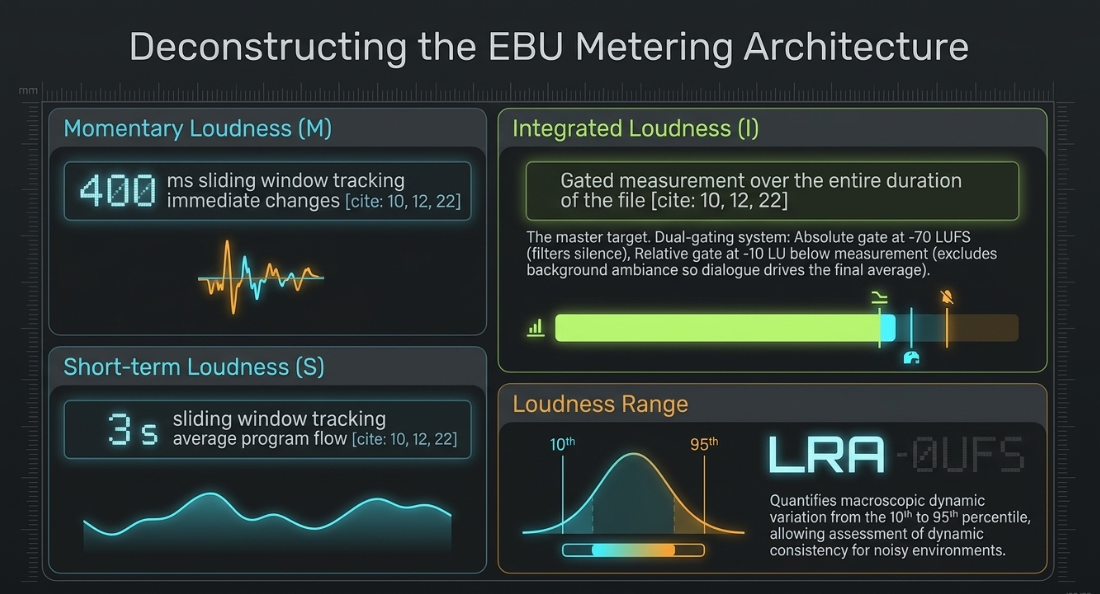
Modern metering software complies with EBU Tech 3341 ("EBU Mode") and tracks three primary integration time frames:
Integrated loudness () utilizes a dual-gating process11. First, an absolute gate at filters out background silence11. Second, a relative gate set at below the initial measurement excludes low-level atmospheres and ambient noise from the final average, ensuring the reading is dominated by active foreground program material11.
Loudness Range and Dialogue Intelligence
Loudness Range (), specified in EBU Tech 3342, quantifies the macroscopic variation of loudness over the course of a program in units of 10. The algorithm estimates the statistical spread of the short-term loudness distribution between the 10th and 95th percentiles12. To make the measurement robust against long periods of silence, fade-outs, or ambient noise, a cascaded gating system is applied: an absolute gate at is followed by a relative gate set to 40. This measurement allows post-production engineers to assess whether a podcast exhibits appropriate dynamic consistency or requires further compression to suit noisy listening environments10.
For highly dynamic film soundtracks, audiobooks, or podcasts, advanced metering suites implement Dolby Dialogue Intelligence14. This speech-gated analysis algorithm isolates active voice channels and measures loudness strictly during dialogue passages, disregarding loud music cues or explosions14. This is critical for matching vocal consistency across different speakers, hosts, and interstitial advertisements14.
Specialized Metering and Loudness Management Tools
Youlean Loudness Meter 2: A widely adopted metering utility featuring real-time graphical displays of integrated, short-term, and momentary values12. The PRO version includes targeted presets for streaming networks and automated drag-and-drop normalization capabilities42.
HoRNet ELM 128 MK2: A broadcast-compliant meter that tracks all five standard EBU R128 metrics over continuous timelines up to 12 hours23. It features a Continuous Normalization Mode that dynamically adjusts output gain up to in response to real-time incoming levels23.
APU Software Loudness Suite: Incorporates a Loudness Compressor, Loudness Limiter, and Dynamics Optimizer45. The Compressor utilizes a "Learn" function based on the LRA algorithm to detect the source material's dynamic range and compress the signal toward a specific target45. The Limiter provides real-time lookahead peak limiting combined with soft ceilings on momentary levels45. The Dynamics Optimizer conducts offline file analysis to compute precise non-destructive gain offsets to meet targets45.
NUGEN Audio Loudness Toolkit: Features VisLM (for real-time tracking of integrated, short-term, and momentary levels), ISL (an intelligent, transparent True Peak limiter that prevents inter-sample clipping during transcoding), and LM-Correct (which analyzes and corrects files offline in a single pass to meet global specifications)14.
Database of Global Delivery Standards and Platform Rules
Podcast distribution requires compliance with target integrated loudness levels to prevent platforms from applying destructive automatic level adjustments1. The tables below outline the specifications for consumer streaming platforms and global broadcast networks10:
Consumer Streaming Platform Specifications
Global Broadcast and High-End Video Standards
Automated vs. Manual Engineering Post-Production Workflows
Modern audio post-production utilizes both artificial intelligence automation and precise manual processing chains3. Understanding when to deploy these systems determines the acoustic quality and consistency of the final master3.
Automated Leveling and Mastering Suites
Automated post-production tools have democratized the mastering stage for independent creators by packaging complex DSP tasks into single-click interfaces3.
Auphonic: This web and desktop application uses machine learning algorithms to automate voice leveling, background noise reduction, and loudness targeting3. Its Adaptive Leveler isolates speech from background elements, balancing multiple speakers to a uniform conversational level62. However, automated platforms lack creative nuance3. For example, the algorithm cannot distinguish between an intentional narrative pause designed for dramatic tension and a technical mistake or silence3. Consequently, Auphonic may inappropriately boost the makeup gain during a quiet, dramatic moment, amplifying background noise, analog amp hiss, or mouth sounds3.
Hindenburg Pro: Optimized for journalists and radio producers, this multitrack editor features automatic level matching on ingest62. It analyzes incoming clips and adjusts them to broadcast targets, utilizing speaker-specific "Voice Profiles" to apply customized equalization and dynamics compression62.
Descript, Riverside.fm, and Alitu: These platforms offer browser-based recording and text-based editing alongside AI voice enhancement models (such as Magic Dust) to eliminate background noise, plosives, and filler words in a single pass62.
Manual Dynamic and Spatial Alignment in the DAW
For high-end, chart-topping productions, manual signal processing chains remain standard to retain creative authority over the dynamic structure of the podcast3.
A critical step in manual DAW normalization occurs when handling mono voice files within a stereo master project64. In standard editing systems like Reaper, a mono vocal track is automatically routed in dual-mono configuration, duplicating the signal across both the Left and Right playback channels64. If an engineer processes a mono item using standard peak or loudness normalization to a target of , the digital summation will render the voice up to to louder than panned stereo elements or music tracks normalized to the same value27.
To prevent this level shift, engineers utilize specialized SWS extensions in Reaper, activating the "Use dual mono mode for mono takes/channel modes" function64. This aligns the computed loudness values across mono and stereo tracks, ensuring precise acoustic level matching64.
Standard Parameters and File Optimization
To maintain professional fidelity, recording setups must adhere to strict sample rate and bit-depth parameters3. The industry-standard minimum is at resolution3. This sample rate is vital for podcasts containing visual elements (visualized podcasts on YouTube and Spotify Video) because standard video frame rates align mathematically with digital audio3.
Recording at and syncing to video can introduce sampling drift, causing the audio to gradually fall out of sync with the video frames, or necessitate sample-rate conversions that generate high-frequency aliasing artifacts3.
For speech-only narratives, saving and delivering files in mono reduces file sizes by exactly 50% relative to stereo files, lowering distribution hosting costs and data bandwidth requirements for mobile listeners63.
Standard speech-centric mono MP3 files should target a fixed bitrate of 63. When a podcast incorporates extensive stereo music beds or complex surround-sound design, engineers should retain the stereo field and increase the target MP3 bitrate to or higher to prevent compression artifacts in the high-frequency spectrum63.
Standard Professional Post-Production Signal Processing Sequence
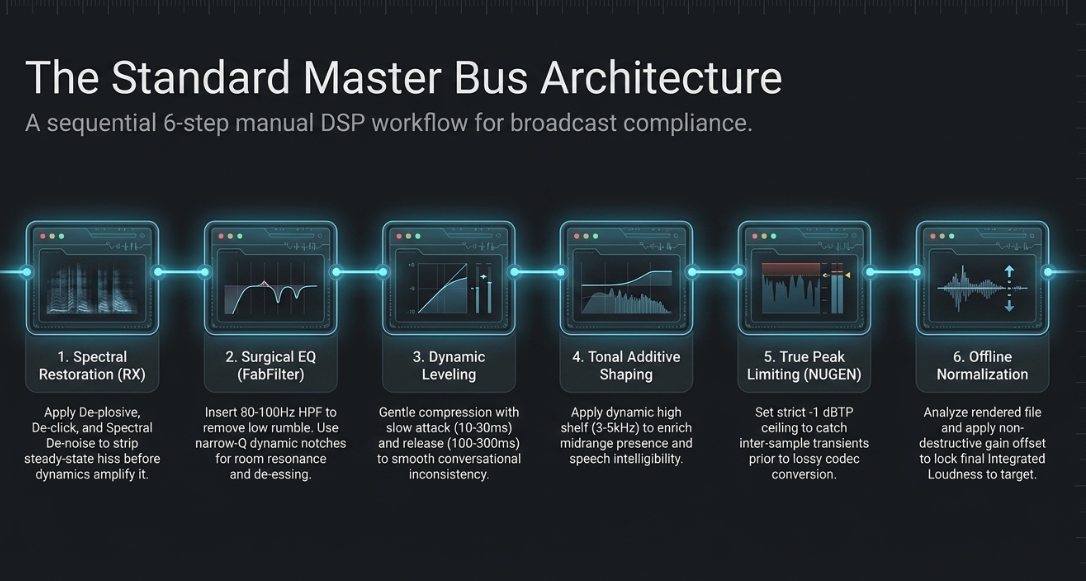
To achieve broadcast compliance, a precise series of dynamic and spectral processors must be arranged sequentially3. Applying limiting before surgical equalization, for example, forces the limiter to react to low-end rumble and plosives, resulting in unnatural volume pumping3.
The step-by-step master processing sequence is structured as follows:
┌───────────────────────────────┐
│ 1. Spectral Restoration (RX) │
└───────────────┬───────────────┘
│
▼
┌───────────────────────────────┐
│ 2. Surgical EQ (FabFilter) │
└───────────────┬───────────────┘
│
▼
┌───────────────────────────────┐
│ 3. Dynamic Control (Level) │
└───────────────┬───────────────┘
│
▼
┌───────────────────────────────┐
│ 4. Tonal Additive Shaping │
└───────────────┬───────────────┘
│
▼
┌───────────────────────────────┐
│ 5. True Peak Limiter (NUGEN) │
└───────────────┬───────────────┘
│
▼
┌───────────────────────────────┐
│ 6. Offline Normalization │
└───────────────────────────────┘
Spectral Restoration (iZotope RX): Clean the incoming raw audio prior to applying any gain or dynamic processing3. Apply De-plosive to remove low-frequency explosive bursts caused by air hitting the microphone diaphragm, De-click to eliminate mouth noise, and Spectral De-noise to strip out steady-state background room rumble or preamp hiss3.
Surgical Equalization (FabFilter Pro-Q 3): Clean the tone by inserting a high-pass filter (HPF) around to to remove low-frequency noise3. Use narrow-Q dynamic notches to sweep and attenuate resonant room frequencies (often found between and ) and to soften harsh vocal sibilance in the to region3.
Dynamic Leveling and Compression: Apply a gentle compressor with a slow attack ( to ) and release ( to ) to smooth out conversational inconsistencies, ensuring that the dialogue stays within a stable range3.
Tonal Additive Shaping: Use a dynamic high shelf or a warm, vintage-modeled equalizer to add a gentle presence boost (around to ) and enrich the midrange to enhance speech intelligibility and add polish3.
Brick-Wall True Peak Limiting (NUGEN ISL): Place a professional True Peak limiter at the end of the master bus14. Set the ceiling strictly to (or if delivering for Amazon Music or high-end broadcast)4. This catches fast inter-sample transients and protects the file from clipping during conversion to lossy MP3 or AAC codecs4.
Offline Compliance Verification (LM-Correct): Analyze the fully rendered master file offline using an EBU-mode loudness analyzer11. Apply non-destructive gain offset to lock the final integrated loudness to the specific platform target (e.g., for Apple Podcasts)1.
Technical Recommendations for Post-Production Compliance
To ensure complete acoustic compliance and prevent platform-enforced audio degradation, professional engineers must establish standard operating procedures based on empirical broadcast guidelines3:
Establish a Dual-Mastering Delivery Workflow: When producing a show destined for both consumer podcast platforms (Apple/Spotify) and broadcast networks (such as the BBC), the engineer must render two separate files3. The consumer master must target with a maximum peak limit of 3. The broadcast version must comply with EBU R128, targeting with a maximum peak limit10. Submitting a file to a broadcast network will result in immediate rejection3.
Enforce True Peak Safety Margins: For standard streaming uploads, always limit with a to ceiling9. This safety margin absorbs the transient expansion that naturally occurs during lossy transcoding processes, shielding the listener from distortion on mobile decoders4.
Implement Dialogue-Weighted Verification: During the metering stage, verify that the integrated loudness measurement is aligned with the active speech level14. For complex files with extensive sound effects and music beds, utilize dialogue-gated metering software to ensure the vocal tracks remain clean and steady without being masked by background elements14.
Enforce Mono Compatibility Checks: Insert a mono sum utility on the master bus of the DAW and audit the entire program in mono during critical mixing stages25. If any vocal element thin out or lose level upon summing, reduce the depth of the stereo modulation effects and tighten the Side channel panning to guarantee a clear voice track for all mono playback environments25.
Works cited
Podcast Master | Joel Löf — Audio Software Developer, https://joellof.com/podcast-master/
Understanding LUFS: Broadcasting Standards for BBC and Apple Podcasts, https://www.finchley.co.uk/finchley-learning/visual-podcast/understanding-lufs-broadcasting-standards-for-bbc-and-apple-podcasts
Acoustic Standards and Infrastructure in the UK Podcast Ecosystem: A Technical Analysis of Chart-Topping Productions and London Studio Facilities, https://www.finchley.co.uk/finchley-learning/visual-podcast/acoustic-standards-and-infrastructure-in-the-uk-podcast-ecosystem-a-technical-analysis-of-chart-topping-productions-and-london-studio-facilities
Podcast Loudness Standards 2026: Spotify, Apple, YouTube Requirements, https://sone.app/blog/podcast-loudness-standards-2026-spotify-apple-youtube
Loudness - AES - Audio Engineering Society, https://aes.org/audio-topics/loudness/
Audio Reverb, Modulation, and Sound Design Effects Tools, https://elysiatools.com/en/hubs/audio-sound-design-effects
Whose Job is It? When Plug-in Effects are Sound Design vs. Mix Choices. - SoundGirls, https://soundgirls.org/whose-job-is-it-when-plug-in-effects-are-sound-design-vs-mix-choices/
Understanding Chorus, Flangers, and Phasers in Audio Production - iZotope, https://www.izotope.com/community/blog/understanding-chorus-flangers-and-phasers-in-audio-production
Podcasting Levels: Tips and Standards for Publishing | B&H eXplora, https://www.bhphotovideo.com/explora/pro-audio/tips-and-solutions/podcasting-levels-tips-and-standards-for-publishing
EBU R 128 - Wikipedia, https://en.wikipedia.org/wiki/EBU_R_128
EBU R 128 - Grokipedia, https://grokipedia.com/page/EBU_R_128
LUFS Meter — Broadcast Loudness Measurement - Studio Six Digital, https://studiosixdigital.com/lufs-meter/
sound mixing for bbc programmes - Aiwan Obinyan, http://aiwanobinyan.com/wp-content/uploads/2022/04/BBC-Broadcast-Standards.pdf
Broadcast Loudness Made Simple - NUGEN Audio, https://nugenaudio.com/broadcast-loudness-made-simple/
How to create stereo width using modulation - Mixdown Magazine, https://mixdownmag.com.au/features/how-to-create-stereo-width-using-modulation/
Hearing Effects: Modulation (rotary speaker, chorus, flanger, phaser) - Musical U, https://www.musical-u.com/learn/hearing-effects-modulation-rotary-speaker-chorus-flanger-phaser/
The ultimate guide to modulation effects: phasers, chorus and flangers | MusicRadar, https://www.musicradar.com/news/ultimate-guide-modulation-effects
Modulation effects - Audition - Adobe Help Center, https://helpx.adobe.com/uk/audition/using/modulation-effects.html
Kernom Unveils the Elipse - Premier Guitar, https://www.premierguitar.com/news/kernom-elipse
Southampton Pedals Utility Knife Review - Premier Guitar, https://www.premierguitar.com/gear/southampton-pedals-utility-knife-review
Cableguys ShaperBox 2 - What To Know & Where To Buy | Equipboard, https://equipboard.com/items/cableguys-shaperbox-2
Vocal Bender – Realtime Vocal Manipulation Plugin - Waves Audio, https://www.waves.com/plugins/vocal-bender
HoRNet ELM 128 MK2 2.1.0 update, https://www.hornetplugins.com/hornet-elm128mk2-2-1-0-update/
Waldorf Iridium Desktop MK2 Digital Synthesizer - Musician's Friend, https://www.musiciansfriend.com/keyboards-midi/waldorf-iridium-desktop-mk2-digital-synthesizer/m28306000000000
Phase cancellation explained: The hidden reason your audio loses power, https://acestudio.ai/blog/phase-cancellation-in-audio/
What is phase in audio? 5 ways to address phase issues - iZotope, https://www.izotope.com/community/blog/5-ways-to-adjust-phase-after-recording
How to use phase cancelation to your advantage - SOS FORUM, https://www.soundonsound.com/forum/viewtopic.php?t=75216
ELI5 what "stereo difference"/phase-canceled tracks actually output? : r/audioengineering, https://www.reddit.com/r/audioengineering/comments/erx53y/eli5_what_stereo_differencephasecanceled_tracks/
LUFS Loudness Standards for 50+ Platforms - Free Lookup - Dan Murtagh, https://danmurtagh.com/lufs-loudness-standards
Logic Pro Effects - Apple, https://cdsassets.apple.com/live/6GJYWVAV/user/ma1925_logic-pro-10-6-effects-user-guide.pdf
Mastering Loudness Targets for Streaming: Spotify, Tidal, Apple Music and More - Mat Leffler-Schulman, https://matlefflerschulman.com/mastering-articles/loudness-targets-and-mastering-for-streaming-platforms
LUFS: How to Mix Audio to Broadcast Specification EBU R128, https://soundguy.london/lufs-loudness-and-levels/
EBU R 128: Loudness Normalisation Guide | PDF | Science & Mathematics - Scribd, https://www.scribd.com/doc/220758589/Ebu-R-128-Loudness
EBU R128 Loudness Normalisation Guide | PDF | Telecommunications | Acoustics - Scribd, https://www.scribd.com/document/517404082/EBU-r128-2020
Peak programme meter - Grokipedia, https://grokipedia.com/page/Peak_programme_meter
Fix Common Problems in Audio Streaming - Radio World, https://www.radioworld.com/tech-and-gear/tech-tips/fix-common-problems-in-audio-streaming
Mastering for Spotify, Apple Music & More – the Loudness of the Pros | HOFA-College, https://hofa-college.de/en/blog/mastering-for-spotify-apple-music-more-the-loudness-of-the-pros/
Loudness metering – MiRA, https://doc.flux.audio/mira/Metering_Loudness.html
How to master for streaming platforms: normalization, LUFS, and loudness - iZotope, https://www.izotope.com/community/blog/mastering-for-streaming-platforms
EBU Tech 3342: Loudness Range Explained | PDF | Sound - Scribd, https://www.scribd.com/document/929989495/Tech-3342
(PDF) Loudness Range (LRA) - Design and Evaluation - ResearchGate, https://www.researchgate.net/publication/321627735_Loudness_Range_LRA_-_Design_and_Evaluation
Youlean Loudness Meter 2 Overview | PDF | Mac Os | Command Line Interface - Scribd, https://www.scribd.com/document/975155791/Youlean-Loudness-Meter-2-MANUAL
Youlean Loudness Meter - Changelog, https://youlean.co/youlean-loudness-meter-changelog/
【無料】Youlean「Youlean Loudness Meter2」映画・テレビや各種配信プラットフォームのラウドネス基準への対応・管理に活躍するラウドネス測定プラグイン - ダウハック, https://dtm-sale.com/29197/
Amazon Music Loudness Target - APU Software, https://apu.software/amazon-music-loudness/
Loudness Toolkit - Complete Loudness Compliance Suite - NUGEN Audio, https://nugenaudio.com/loudnesstoolkit/
Comparing Loudness Standards and Guidelines | Rig::Sonics, https://rigsonics.com/en/comparing-loudness-standards-and-guidelines/
Loudness normalization on Spotify, https://support.spotify.com/us/artists/article/loudness-normalization/
Spotify loudness and dynamic range - ongoing research - Sonic Academy Forums, https://forums.sonicacademy.com/t/spotify-loudness-and-dynamic-range-ongoing-research/35300
YouTube Music normalizes loudness - Peak-Studios, https://www.peak-studios.de/en/youtube-music-normalisiert-lautheit/
Get ready to drink : r/audioengineering - Reddit, https://www.reddit.com/r/audioengineering/comments/1liqxx1/get_ready_to_drink/
EBU R 128 Loudness Guidelines Update | PDF | Communication | Computing - Scribd, https://www.scribd.com/document/253419660/Especificaciones-Tecnicas-EBU-Loudness
Global Audio Loudness Standards Guide | PDF | Apple Inc. | I Tunes - Scribd, https://www.scribd.com/document/950157988/Worldwide-Loudness-Delivery-Standards
EBU addresses OTT loudness and Next Generation Audio progress in current projects, https://www.svgeurope.org/blog/headlines/ebu-addresses-ott-loudness-and-next-generation-audio-progress-in-current-projects/
Streaming is not as good as CDs played from transport or WAV or AIFF files from drive? - Page 8 - Roon Labs Community, https://community.roonlabs.com/t/streaming-is-not-as-good-as-cds-played-from-transport-or-wav-or-aiff-files-from-drive/174346?page=8
EBU R 128 s4: What It Means, And How To Implement It Today - Telos Alliance, https://blogs.telosalliance.com/ebu-r-128-s4-what-it-means-how-to-implement-today
Radio 1 Creative Production: Radio Commercial Creation - Media.co.uk, https://www.media.co.uk/blogs/blog/radio-1-creative-production-radio-commercial-creation
Worldwide Loudness Delivery Standards - RTW Audio, https://www.rtw.com/blog/rtw-knowledge-base-1/worldwide-loudness-delivery-standards-4
Guidelines for Streaming Loudness | TV Tech - TVTechnology, https://www.tvtechnology.com/opinions/guidelines-for-streaming-loudnesss
Artificial Intelligence in Internet Radio and Podcasting: Evolution, Integration, and Future Directions | by Jung-Hua Liu | Medium, https://medium.com/@gwrx2005/artificial-intelligence-in-internet-radio-and-podcasting-evolution-integration-and-future-5a44ab472aa2
Best AI Podcast Editing Software in 2026, https://origin.elitecontentmarketer.com/best-podcast-editing-software/
Auphonic Media Mastering Settings - Blubrry Podcasting, https://blubrry.com/support/media-hosting-documentation/auphonic-settings/
How to normalize audio items in Reaper using the new SWS extension (v2.14.0.3), https://melodiefabriek.com/sound-tech/normalize-audio-items-reaper-using-the-new-sws-extension/
Why Your Podcast Sounds Amateur (5 Audio Specs Explained), https://www.podcaststudioglasgow.com/podcast-studio-glasgow-blog/the-5-audio-specs-that-separate-professional-from-amateur-podcasts
Broadcast audio mastering help! : r/broadcastengineering - Reddit, https://www.reddit.com/r/broadcastengineering/comments/1jlxtzf/broadcast_audio_mastering_help/
Recording a Podcast from Home on a Budget: Complete Guide 2026 - Automateed, https://www.automateed.com/recording-a-podcast-from-home-on-a-budget
Creating podcasts using Audition - Adobe Help Center, https://helpx.adobe.com/uk/audition/using/creating-podcasts.html
Podcast Voice Over | Voices & Media Solutions, https://www.voicesmediasolutions.com/en/voice-over-services/podcast-voice-over
Voice Training for Podcasters: Modulation, Diction, and Intonation - Journalism University, https://journalism.university/audio-podcast/voice-training-podcasters-modulation-diction/
Podcast & Audiobook Production - Wounded Buffalo Sound Studios, https://woundedbuffalo.co.uk/facilities/podcast-audiobook-recording/
Speech Loudness in Broadcasting and Streaming - arXiv, https://arxiv.org/html/2405.17364v1